
36 Daily Catalyst Pg 30 HardyWeinberg Equilibrium 1
3/6 Daily Catalyst Pg. 30 Hardy-Weinberg Equilibrium 1. Why can’t an individual evolve? 2. What causes gene pools to change? 3. What is effected more by changes in gene frequencies, large or small populations?
3/6 Birthday fun!
3/6 Class Business Pg. 30 Hardy. Weinberg Equilibrium Quiz #7 Evolution Evidence TODAY! I will be gone Monday You will have a sub packet due Tuesday Ecology paper due Friday, March 6 th Library work time on Tuesday Works cited page Visual aid Emailed to stacie. ireland@gmail. com
3/6 Agenda Pg. 30 Hardy-Weinberg Equilibrium Daily Catalyst Class Business Objective Hardy Weinberg notes Quiz #7 Evolution Evidence Timed 10 passage Trade and grade
3/6 Objective Pg. 30 Hardy-Weinberg Equilibrium We will be able to use data from Hardy. Weinberg equilibrium to analyze the effects of natural selection on a population.
Darwin’s Theory of Evolution With a partner, review: Darwin’s Theory of Evolution Natural Selection DNA similarities as evidence Gene pools
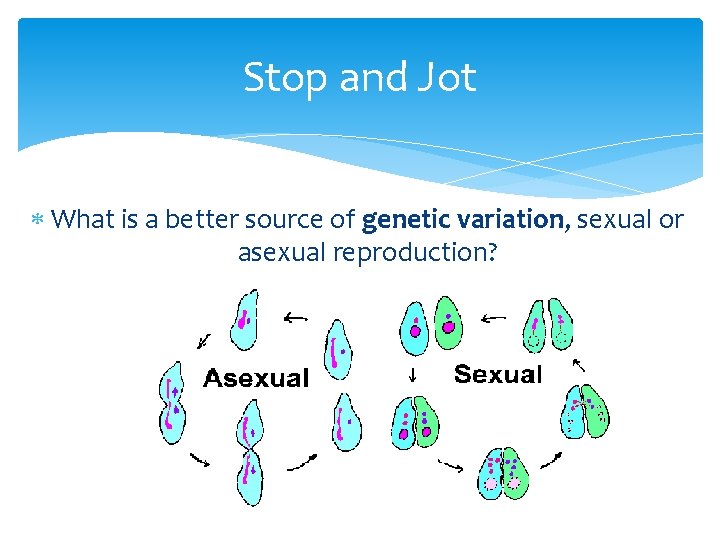
Stop and Jot What is a better source of genetic variation, sexual or asexual reproduction?
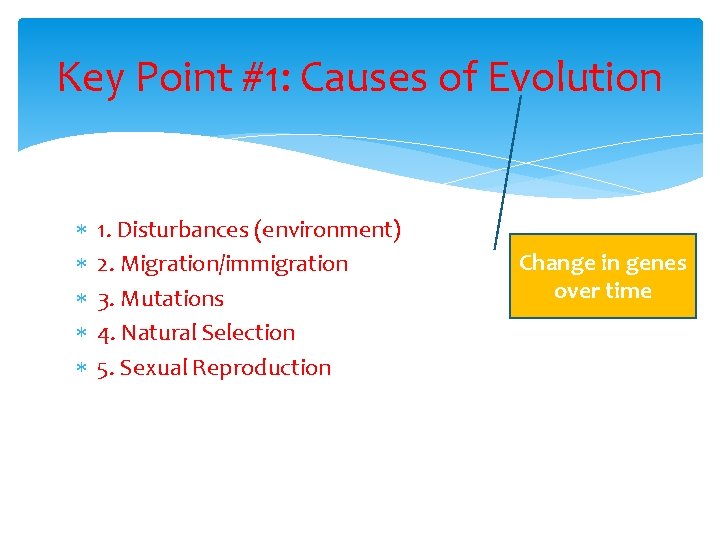
Key Point #1: Causes of Evolution 1. Disturbances (environment) 2. Migration/immigration 3. Mutations 4. Natural Selection 5. Sexual Reproduction Change in genes over time
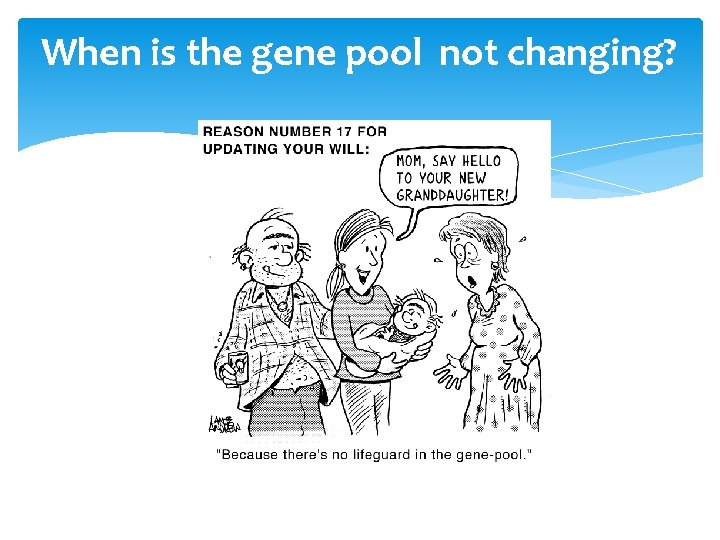
When is the gene pool not changing?
Key Point #2: When there is no change in gene frequency, the population is said to be stable and non -evolving. This is called HARDY-WEINBERG EQUILIBRIUM. (Named after two scientists describing a stable population)
Turn and Talk In your opinion thus far, is Hardy-Weinberg Equilibrium highly likely? Why or why not?
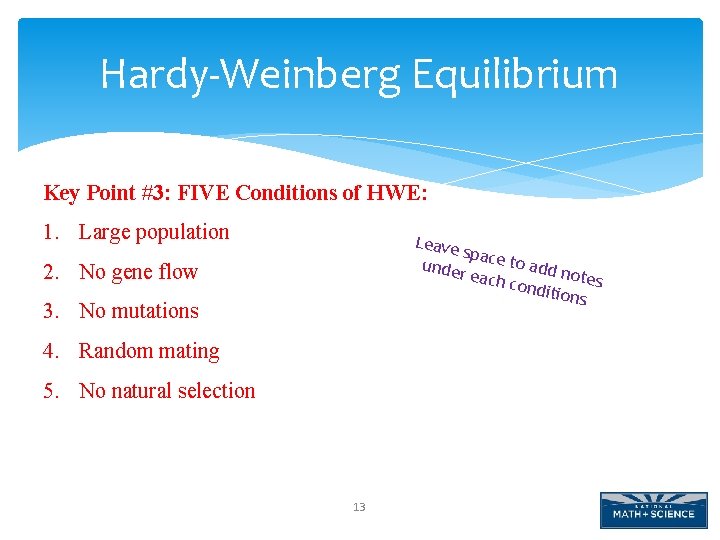
Hardy-Weinberg Equilibrium Key Point #3: FIVE Conditions of HWE: 1. Large population Leave spa under ce to add n o each c onditi tes ons 2. No gene flow 3. No mutations 4. Random mating 5. No natural selection 13
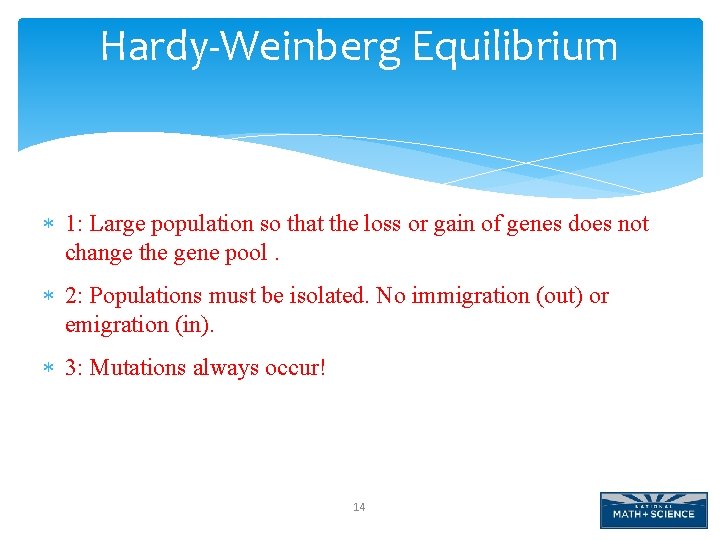
Hardy-Weinberg Equilibrium 1: Large population so that the loss or gain of genes does not change the gene pool. 2: Populations must be isolated. No immigration (out) or emigration (in). 3: Mutations always occur! 14
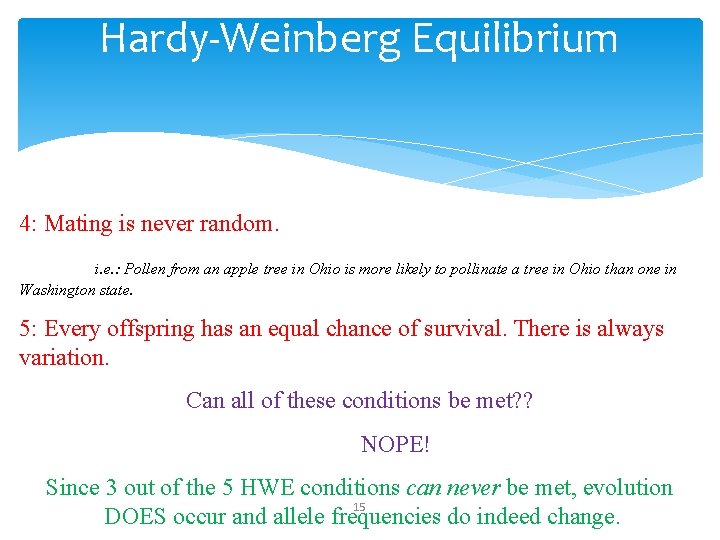
Hardy-Weinberg Equilibrium 4: Mating is never random. i. e. : Pollen from an apple tree in Ohio is more likely to pollinate a tree in Ohio than one in Washington state. 5: Every offspring has an equal chance of survival. There is always variation. Can all of these conditions be met? ? NOPE! Since 3 out of the 5 HWE conditions can never be met, evolution 15 DOES occur and allele frequencies do indeed change.

Hardy-Weinberg Equilibrium 1. Large population 2. No gene flow 3. No mutations* 4. Random mating* 5. No natural selection* 16
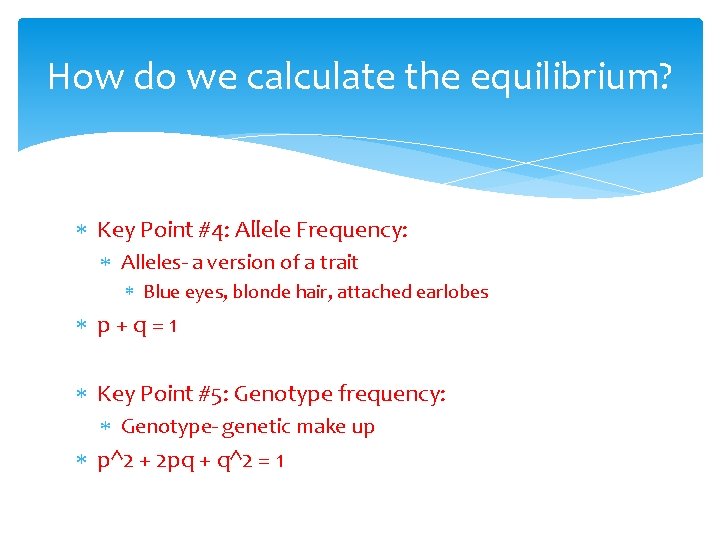
How do we calculate the equilibrium? Key Point #4: Allele Frequency: Alleles- a version of a trait Blue eyes, blonde hair, attached earlobes p+q=1 Key Point #5: Genotype frequency: Genotype- genetic make up p^2 + 2 pq + q^2 = 1
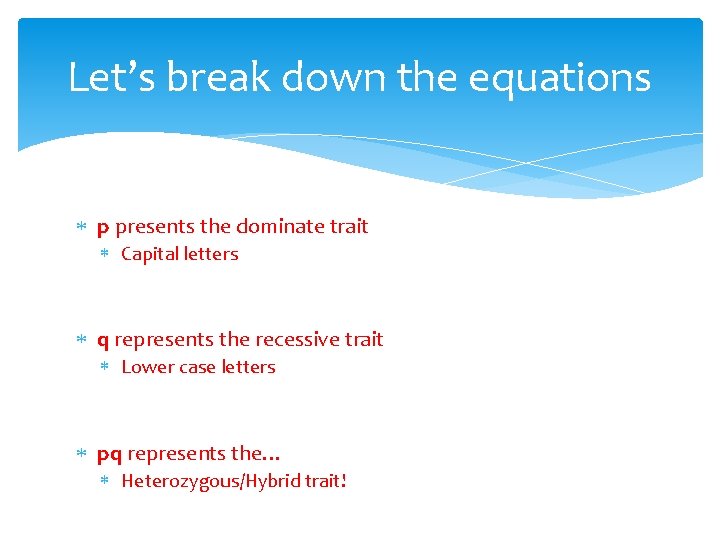
Let’s break down the equations p presents the dominate trait Capital letters q represents the recessive trait Lower case letters pq represents the… Heterozygous/Hybrid trait!
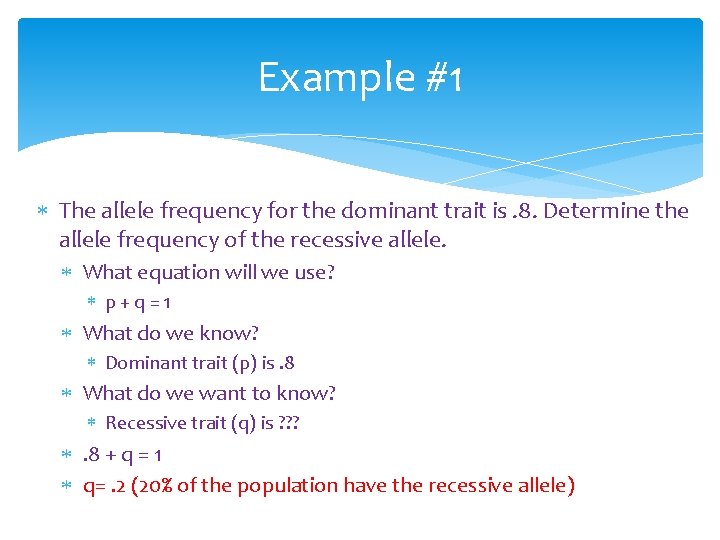
Example #1 The allele frequency for the dominant trait is. 8. Determine the allele frequency of the recessive allele. What equation will we use? p+q=1 What do we know? Dominant trait (p) is. 8 What do we want to know? Recessive trait (q) is ? ? ? . 8 + q = 1 q=. 2 (20% of the population have the recessive allele)
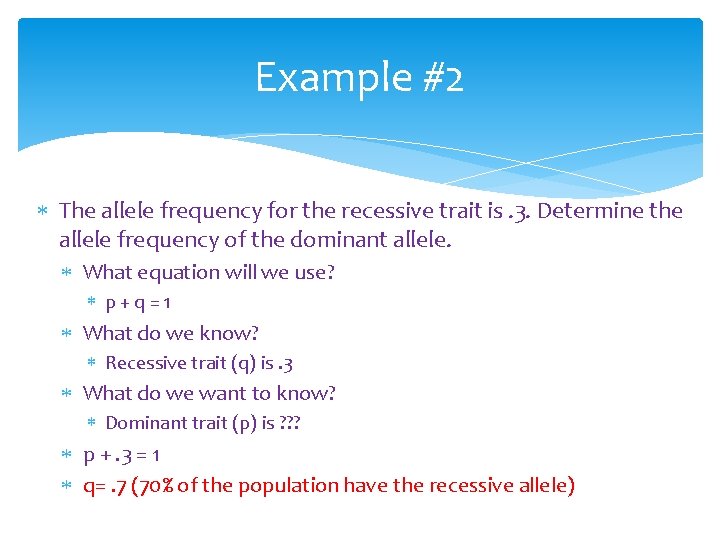
Example #2 The allele frequency for the recessive trait is. 3. Determine the allele frequency of the dominant allele. What equation will we use? p+q=1 What do we know? Recessive trait (q) is. 3 What do we want to know? Dominant trait (p) is ? ? ? p +. 3 = 1 q=. 7 (70% of the population have the recessive allele)
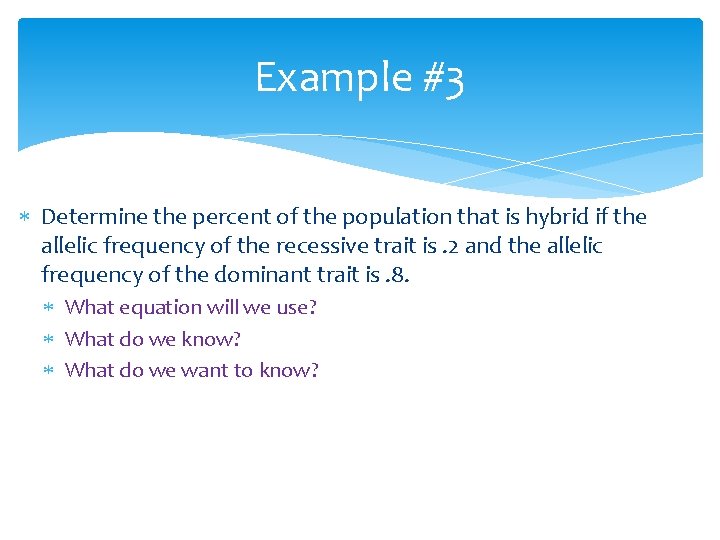
Example #3 Determine the percent of the population that is hybrid if the allelic frequency of the recessive trait is. 2 and the allelic frequency of the dominant trait is. 8. What equation will we use? What do we know? What do we want to know?
Timed 10 Directions: Silently and independently complete the timed 10 passage. When you finish your timed 10, give Mrs. Ireland your passage and pick up quiz #7 and being your quiz. Time: 10 minutes Noise: 0 (SILENT)
Quiz #7 Directions: Silently and independently complete the quiz. Turn your quiz into the basket when you are finished. Time: 12 minutes Noise: 0 (SILENT)
- Slides: 23