
3500 BC 2000 BC Cuneiformwedge shaped Numeral first

바빌로니아 수메리안 3500 BC 바빌로니아 2000 BC Cuneiform(wedge shaped) Numeral (first position system) base 60 = 1*2*3*4*5 24시간 60분 60초 테이블: 제곱, 역수(몇 천억까지), 세제 곱등 82 = 1, 4 = 1 60 + 4 = 64
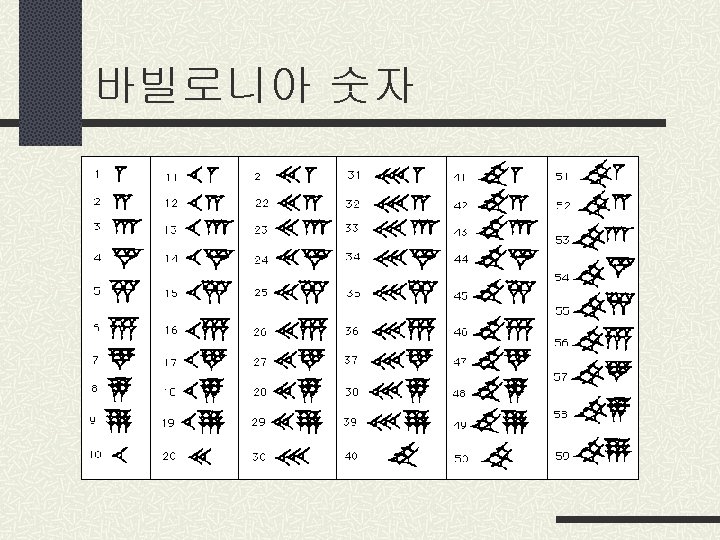
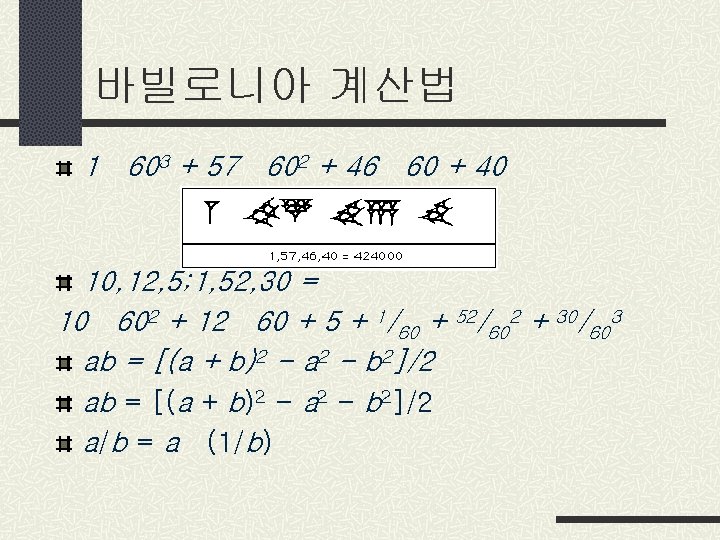
바빌로니아 계산법 1 603 + 57 602 + 46 60 + 40 10, 12, 5; 1, 52, 30 = 10 602 + 12 60 + 5 + 1/60 + ab = [(a + b)2 - a 2 - b 2]/2 a/b = a (1/b) 52/ 60 2 + 30/ 60 3
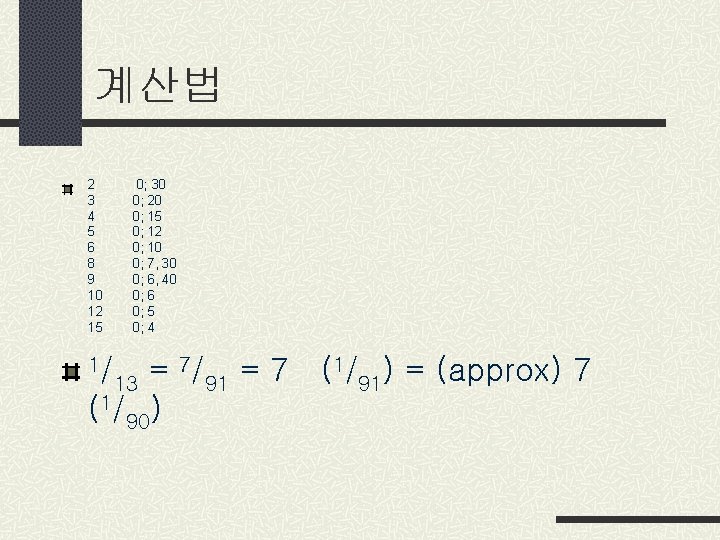
계산법 2 3 4 5 6 8 9 10 12 15 1/ 0; 30 0; 20 0; 15 0; 12 0; 10 0; 7, 30 0; 6, 40 0; 6 0; 5 0; 4 7/ 1/ ) = (approx) 7 = = 7 ( 13 91 91 (1/90)
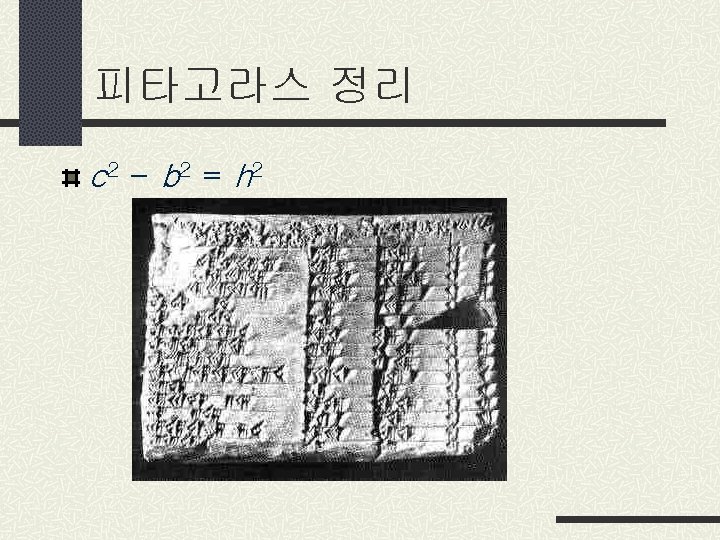
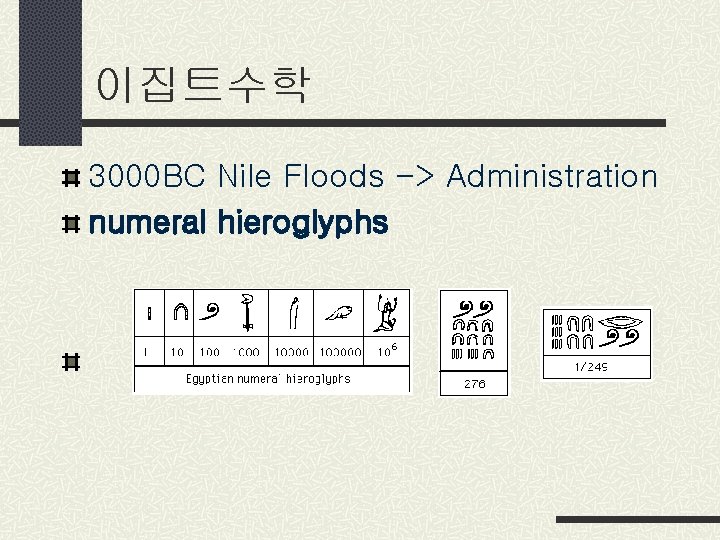
이집트수학 3000 BC Nile Floods -> Administration numeral hieroglyphs
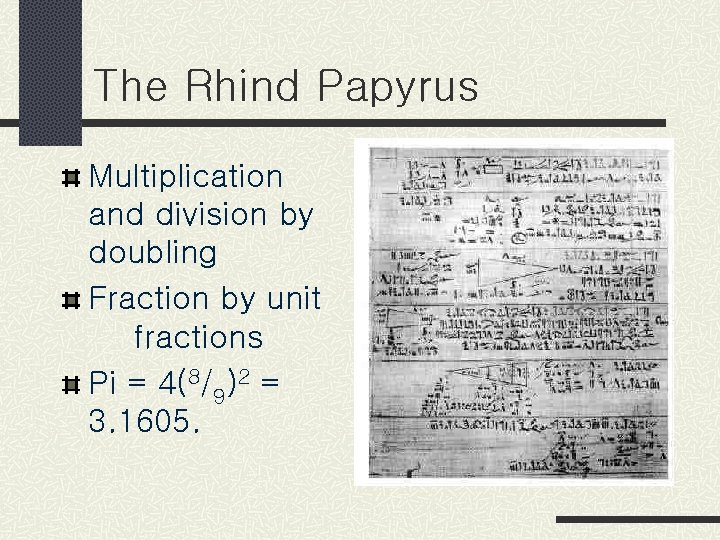
The Rhind Papyrus Multiplication and division by doubling Fraction by unit fractions Pi = 4(8/9)2 = 3. 1605.
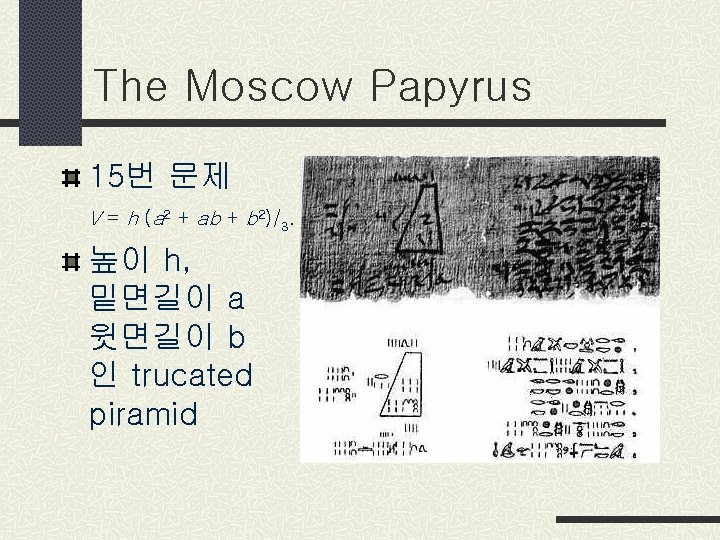
The Moscow Papyrus 15번 문제 V = h (a 2 + ab + b 2)/3. 높이 h, 밑면길이 a 윗면길이 b 인 trucated piramid
유클리드 325 BC- about 265 BC in Alexandria, Egypt 알렉산드리아 Elements 13권 (플라톤 방식의 기하학) 정의와 5개의 가정으로 시작하여 기하 학의 모든정리를 증명 Greek mathematics can boast no finer discovery than this theory, which put on a sound footing so much of geometry as depended on the use of proportion.
인도수학 3000 BC 인더스강 Shatapatha Brahmana, Sulbasutra Harappan civilization, Indo-Aryan Invasion Sulbasutras were composed by Baudhayana (800 BC), Manava (750 BC), Apastamba (600 BC), and Katyayana (200 BC): pythagoras 정리, 2의 제곱근의 근사등
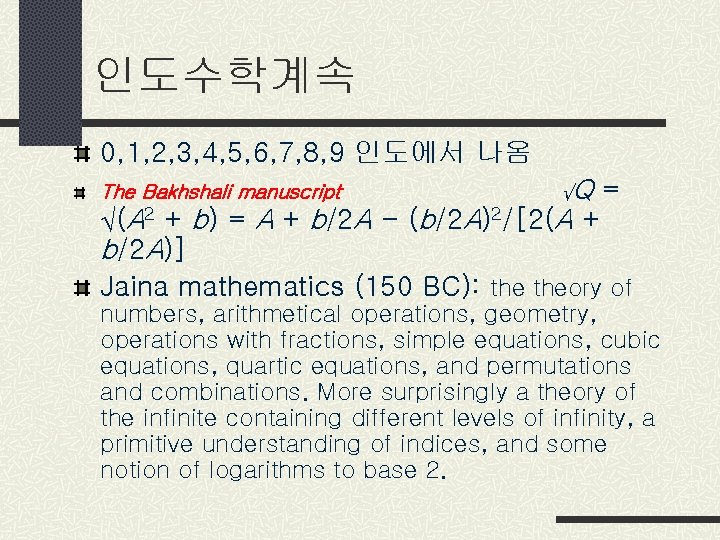
인도수학계속 0, 1, 2, 3, 4, 5, 6, 7, 8, 9 인도에서 나옴 The Bakhshali manuscript √Q = √(A 2 + b) = A + b/2 A - (b/2 A)2/[2(A + b/2 A)] Jaina mathematics (150 BC): theory of numbers, arithmetical operations, geometry, operations with fractions, simple equations, cubic equations, quartic equations, and permutations and combinations. More surprisingly a theory of the infinite containing different levels of infinity, a primitive understanding of indices, and some notion of logarithms to base 2.
인도수학 계속 For a long time Western scholars thought that Indians had not done any original work till the time of Bhaskara II (12세기). This is far from the truth. Nor has the growth of Indian mathematics stopped with Bhaskara II. Quite a few results of Indian mathematicians have been rediscovered by Europeans. For instance, the development of number theory, theory of indeterminates infinite series expressions for sine, cosine and tangent, computational mathematics, etc.
아랍 수학 그리스 로마의 지식 전수 al-Khwarizmi (algorithm) Successors undertook a systematic application of arithmetic to algebra, algebra to arithmetic, both to trigonometry, algebra to the Euclidean theory of numbers, algebra to geometry, and geometry to algebra. This was how the creation of polynomial algebra, combinatorial analysis, numerical analysis, the numerical solution of equations, the new elementary theory of numbers, and the geometric construction of equations arose.
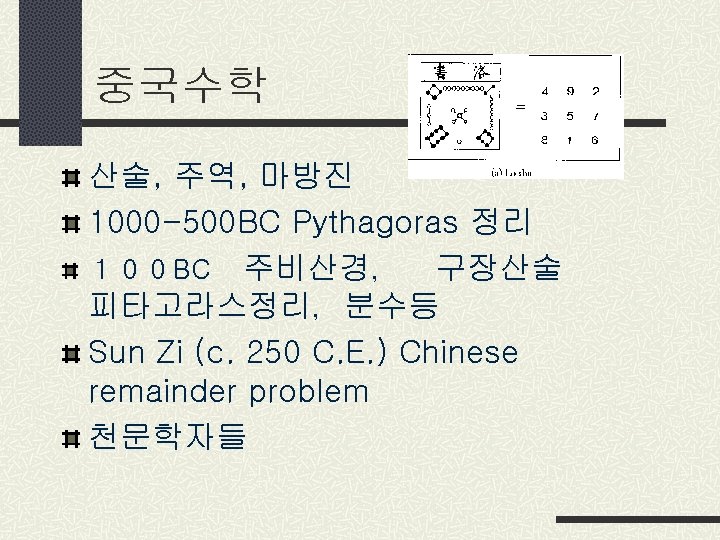
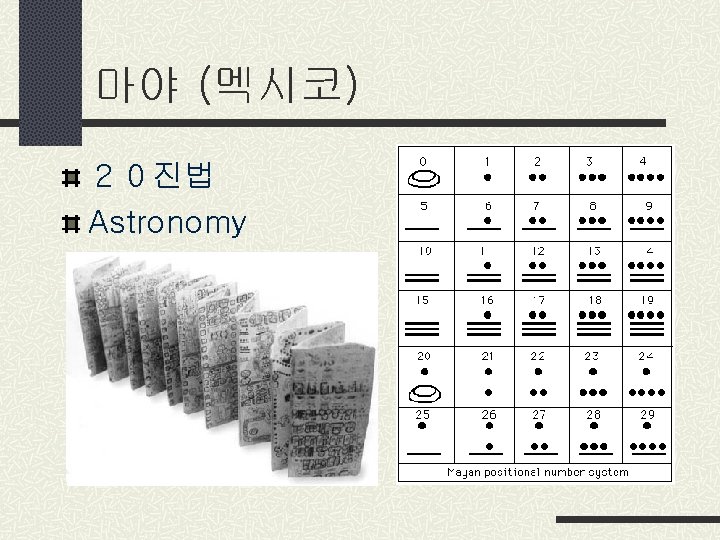
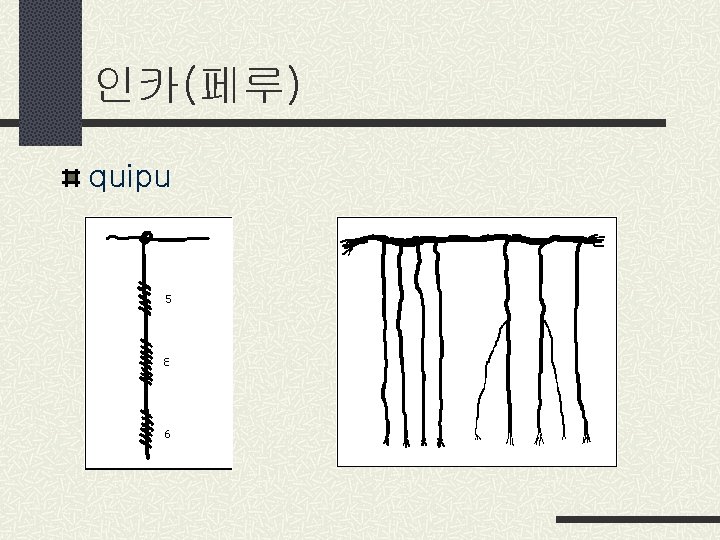

참고자료 turnbull. mcs. st-and. ac. uk/~history/ Indexes/History. Topics. html aleph 0. clarku. edu/~djoyce/mathhist/ china. html

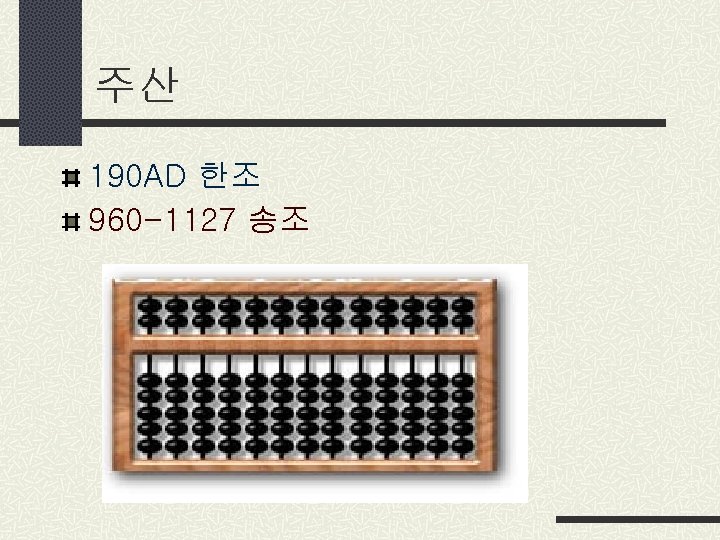
주산 190 AD 한조 960 -1127 송조
- Slides: 26