
350 ft History of the Earth Sears Tower
- Slides: 64
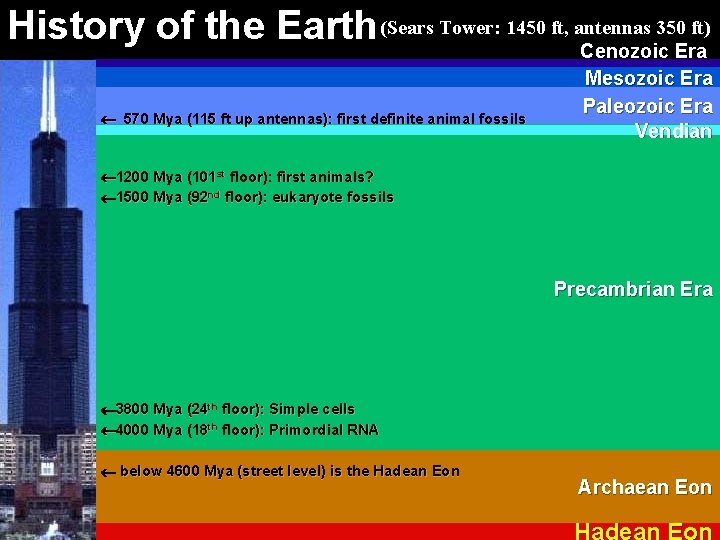
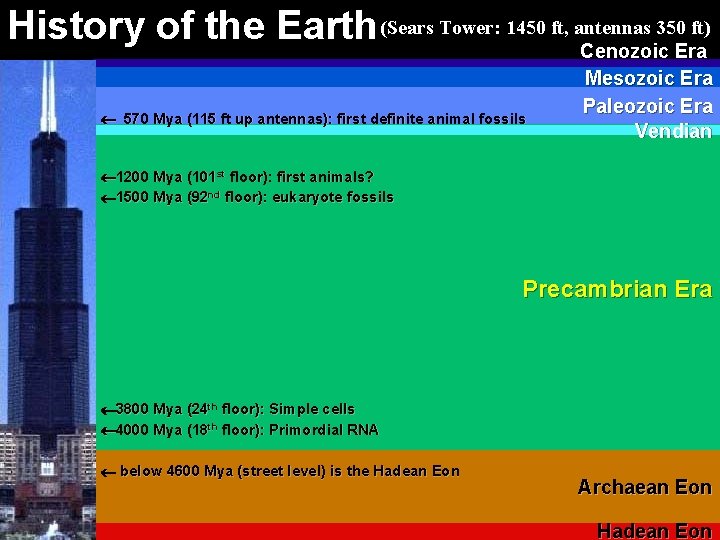
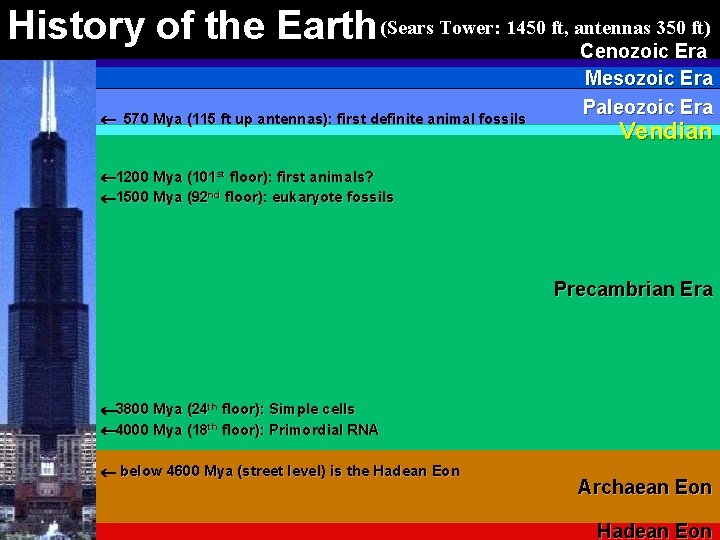
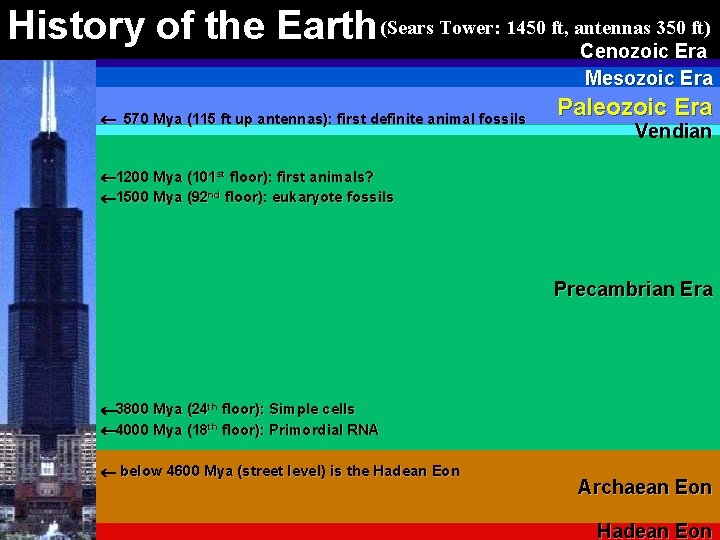
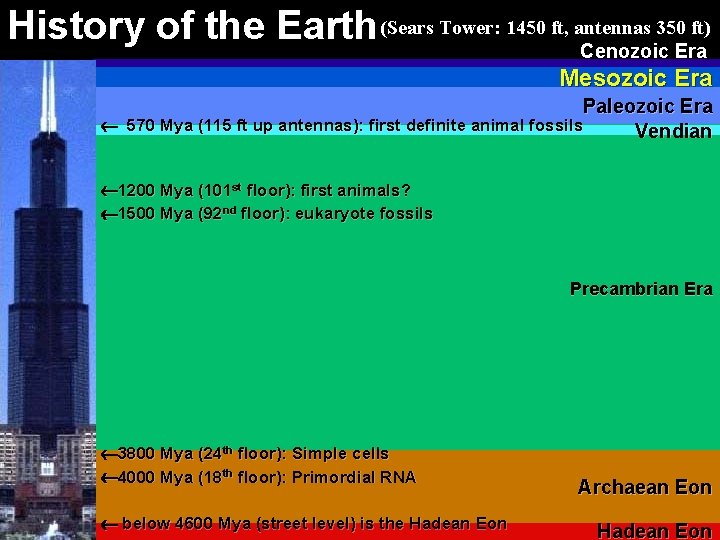
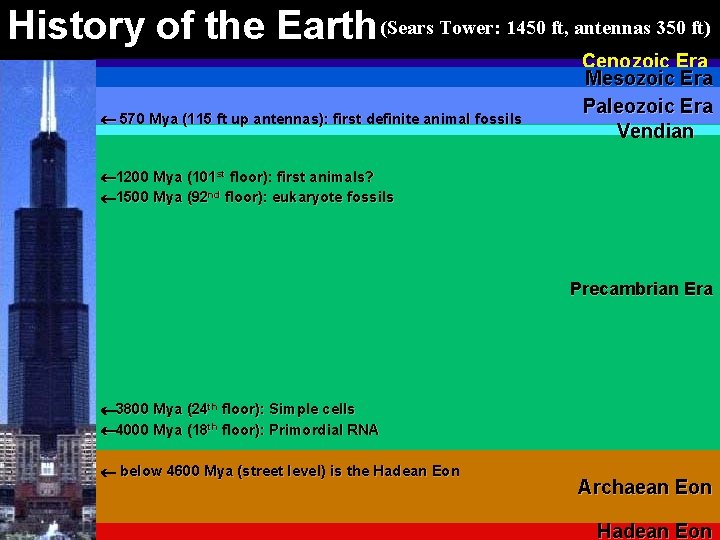
350 ft) History of the Earth (Sears Tower: 1450 ft, antennas Cenozoic Era 570 Mya (115 ft up antennas): first definite animal fossils Mesozoic Era Paleozoic Era Vendian 1200 Mya (101 st floor): first animals? 1500 Mya (92 nd floor): eukaryote fossils Precambrian Era 3800 Mya (24 th floor): Simple cells 4000 Mya (18 th floor): Primordial RNA below 4600 Mya (street level) is the Hadean Eon Archaean Eon Hadean Eon
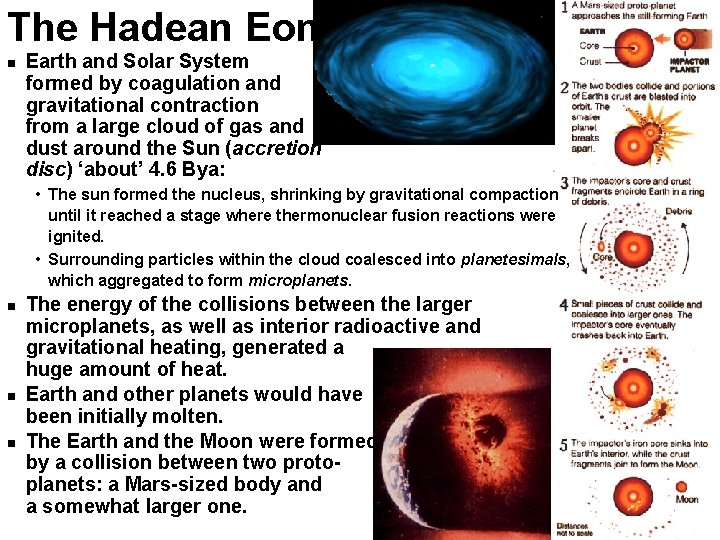
The Hadean Eon Earth and Solar System formed by coagulation and gravitational contraction from a large cloud of gas and dust around the Sun (accretion disc) ‘about’ 4. 6 Bya: • The sun formed the nucleus, shrinking by gravitational compaction until it reached a stage where thermonuclear fusion reactions were ignited. • Surrounding particles within the cloud coalesced into planetesimals, which aggregated to form microplanets. The energy of the collisions between the larger microplanets, as well as interior radioactive and gravitational heating, generated a huge amount of heat. Earth and other planets would have been initially molten. The Earth and the Moon were formed by a collision between two protoplanets: a Mars-sized body and a somewhat larger one.
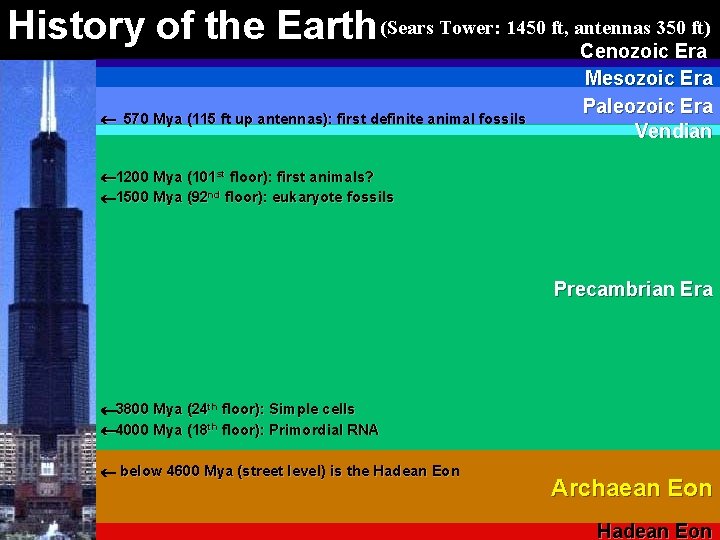
350 ft) History of the Earth (Sears Tower: 1450 ft, antennas Cenozoic Era 570 Mya (115 ft up antennas): first definite animal fossils Mesozoic Era Paleozoic Era Vendian 1200 Mya (101 st floor): first animals? 1500 Mya (92 nd floor): eukaryote fossils Precambrian Era 3800 Mya (24 th floor): Simple cells 4000 Mya (18 th floor): Primordial RNA below 4600 Mya (street level) is the Hadean Eon Archaean Eon Hadean Eon
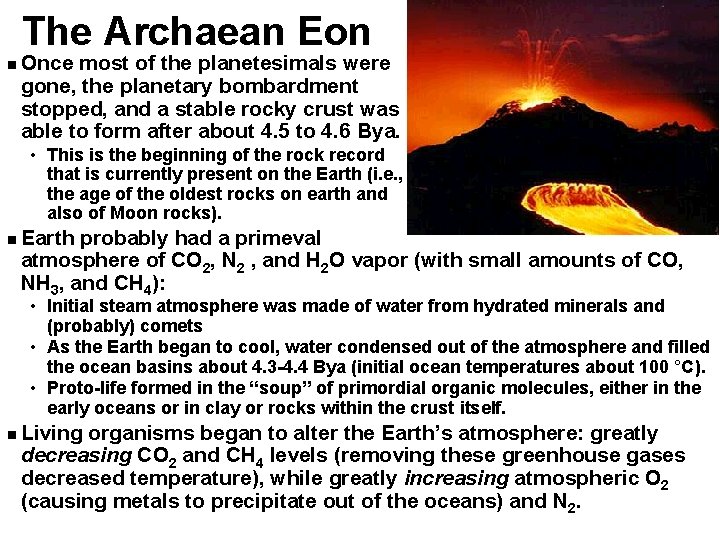
The Archaean Eon Once most of the planetesimals were gone, the planetary bombardment stopped, and a stable rocky crust was able to form after about 4. 5 to 4. 6 Bya. • This is the beginning of the rock record that is currently present on the Earth (i. e. , the age of the oldest rocks on earth and also of Moon rocks). Earth probably had a primeval atmosphere of CO 2, N 2 , and H 2 O vapor (with small amounts of CO, NH 3, and CH 4): • Initial steam atmosphere was made of water from hydrated minerals and (probably) comets • As the Earth began to cool, water condensed out of the atmosphere and filled the ocean basins about 4. 3 -4. 4 Bya (initial ocean temperatures about 100 °C). • Proto-life formed in the “soup” of primordial organic molecules, either in the early oceans or in clay or rocks within the crust itself. Living organisms began to alter the Earth’s atmosphere: greatly decreasing CO 2 and CH 4 levels (removing these greenhouse gases decreased temperature), while greatly increasing atmospheric O 2 (causing metals to precipitate out of the oceans) and N 2.
350 ft) History of the Earth (Sears Tower: 1450 ft, antennas Cenozoic Era 570 Mya (115 ft up antennas): first definite animal fossils Mesozoic Era Paleozoic Era Vendian 1200 Mya (101 st floor): first animals? 1500 Mya (92 nd floor): eukaryote fossils Precambrian Era 3800 Mya (24 th floor): Simple cells 4000 Mya (18 th floor): Primordial RNA below 4600 Mya (street level) is the Hadean Eon Archaean Eon Hadean Eon
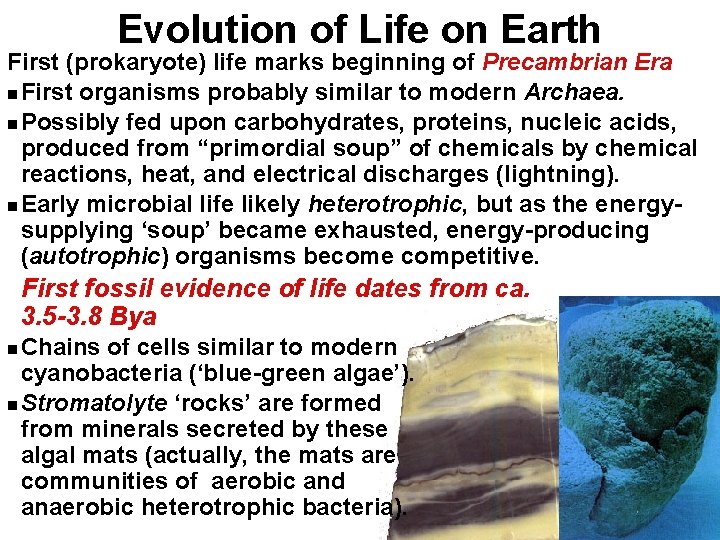
Evolution of Life on Earth First (prokaryote) life marks beginning of Precambrian Era First organisms probably similar to modern Archaea. Possibly fed upon carbohydrates, proteins, nucleic acids, produced from “primordial soup” of chemicals by chemical reactions, heat, and electrical discharges (lightning). Early microbial life likely heterotrophic, but as the energysupplying ‘soup’ became exhausted, energy-producing (autotrophic) organisms become competitive. First fossil evidence of life dates from ca. 3. 5 -3. 8 Bya Chains of cells similar to modern cyanobacteria (‘blue-green algae’). Stromatolyte ‘rocks’ are formed from minerals secreted by these algal mats (actually, the mats are communities of aerobic and anaerobic heterotrophic bacteria).
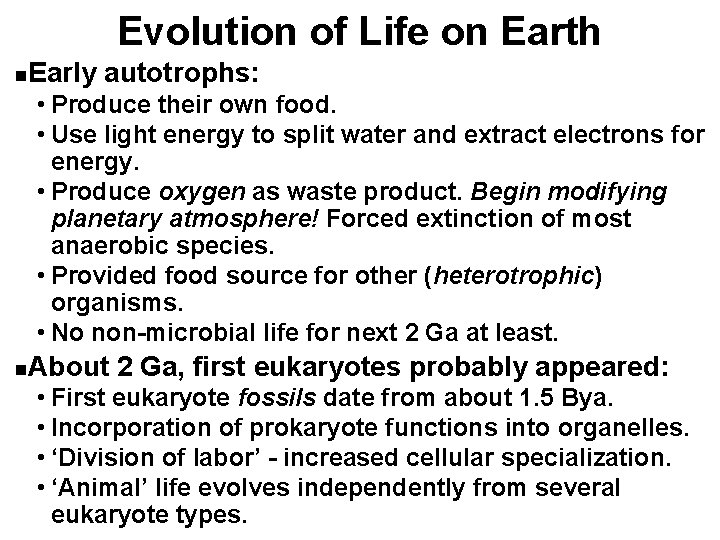
Evolution of Life on Earth Early autotrophs: • Produce their own food. • Use light energy to split water and extract electrons for energy. • Produce oxygen as waste product. Begin modifying planetary atmosphere! Forced extinction of most anaerobic species. • Provided food source for other (heterotrophic) organisms. • No non-microbial life for next 2 Ga at least. About 2 Ga, first eukaryotes probably appeared: • First eukaryote fossils date from about 1. 5 Bya. • Incorporation of prokaryote functions into organelles. • ‘Division of labor’ - increased cellular specialization. • ‘Animal’ life evolves independently from several eukaryote types.
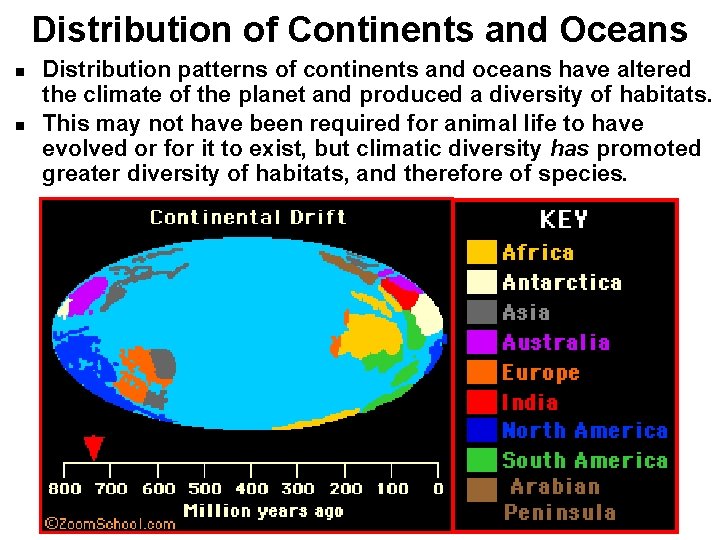
Distribution of Continents and Oceans Distribution patterns of continents and oceans have altered the climate of the planet and produced a diversity of habitats. This may not have been required for animal life to have evolved or for it to exist, but climatic diversity has promoted greater diversity of habitats, and therefore of species.
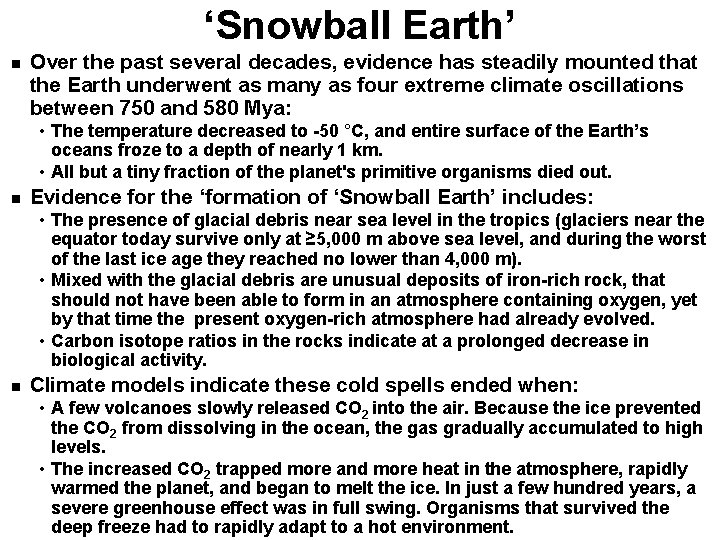
‘Snowball Earth’ Over the past several decades, evidence has steadily mounted that the Earth underwent as many as four extreme climate oscillations between 750 and 580 Mya: • The temperature decreased to -50 °C, and entire surface of the Earth’s oceans froze to a depth of nearly 1 km. • All but a tiny fraction of the planet's primitive organisms died out. Evidence for the ‘formation of ‘Snowball Earth’ includes: • The presence of glacial debris near sea level in the tropics (glaciers near the equator today survive only at ≥ 5, 000 m above sea level, and during the worst of the last ice age they reached no lower than 4, 000 m). • Mixed with the glacial debris are unusual deposits of iron-rich rock, that should not have been able to form in an atmosphere containing oxygen, yet by that time the present oxygen-rich atmosphere had already evolved. • Carbon isotope ratios in the rocks indicate at a prolonged decrease in biological activity. Climate models indicate these cold spells ended when: • A few volcanoes slowly released CO 2 into the air. Because the ice prevented the CO 2 from dissolving in the ocean, the gas gradually accumulated to high levels. • The increased CO 2 trapped more and more heat in the atmosphere, rapidly warmed the planet, and began to melt the ice. In just a few hundred years, a severe greenhouse effect was in full swing. Organisms that survived the deep freeze had to rapidly adapt to a hot environment.
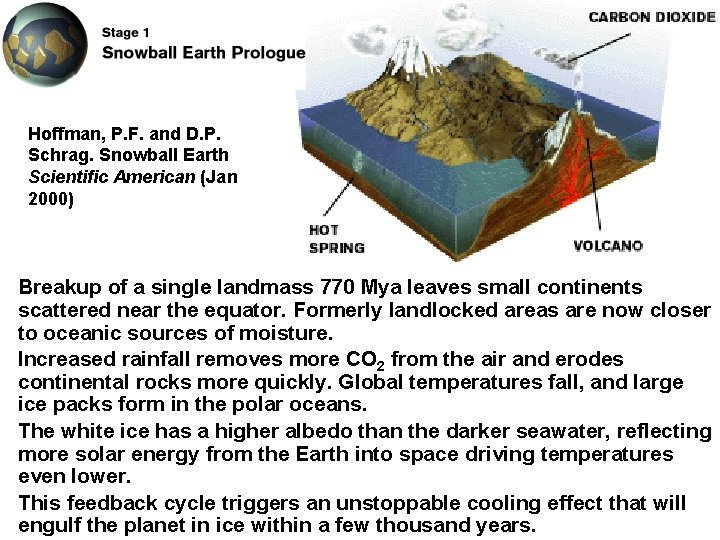
Hoffman, P. F. and D. P. Schrag. Snowball Earth Scientific American (Jan 2000) Breakup of a single landmass 770 Mya leaves small continents scattered near the equator. Formerly landlocked areas are now closer to oceanic sources of moisture. Increased rainfall removes more CO 2 from the air and erodes continental rocks more quickly. Global temperatures fall, and large ice packs form in the polar oceans. The white ice has a higher albedo than the darker seawater, reflecting more solar energy from the Earth into space driving temperatures even lower. This feedback cycle triggers an unstoppable cooling effect that will engulf the planet in ice within a few thousand years.
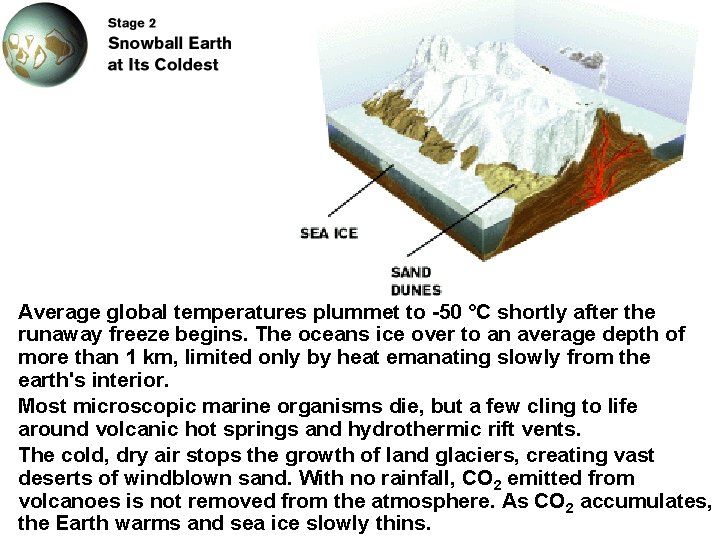
Average global temperatures plummet to -50 °C shortly after the runaway freeze begins. The oceans ice over to an average depth of more than 1 km, limited only by heat emanating slowly from the earth's interior. Most microscopic marine organisms die, but a few cling to life around volcanic hot springs and hydrothermic rift vents. The cold, dry air stops the growth of land glaciers, creating vast deserts of windblown sand. With no rainfall, CO 2 emitted from volcanoes is not removed from the atmosphere. As CO 2 accumulates, the Earth warms and sea ice slowly thins.
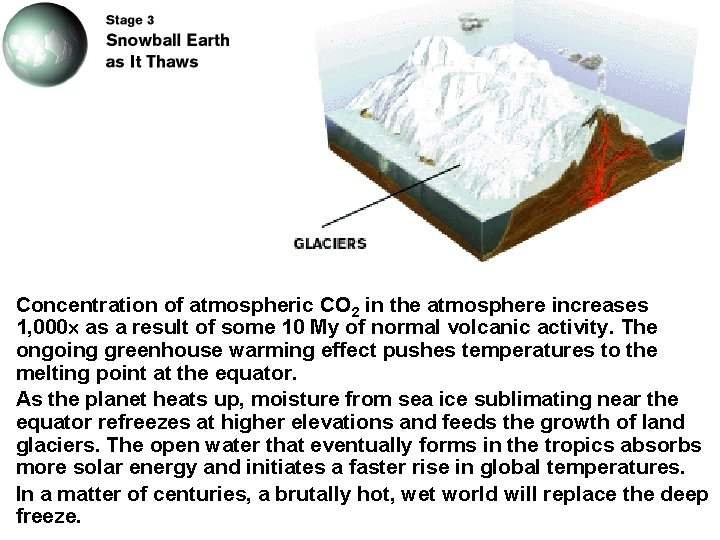
Concentration of atmospheric CO 2 in the atmosphere increases 1, 000 as a result of some 10 My of normal volcanic activity. The ongoing greenhouse warming effect pushes temperatures to the melting point at the equator. As the planet heats up, moisture from sea ice sublimating near the equator refreezes at higher elevations and feeds the growth of land glaciers. The open water that eventually forms in the tropics absorbs more solar energy and initiates a faster rise in global temperatures. In a matter of centuries, a brutally hot, wet world will replace the deep freeze.
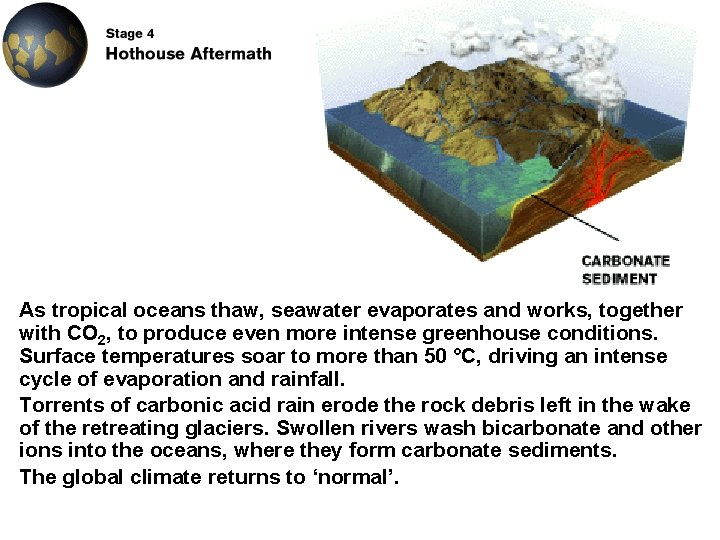
As tropical oceans thaw, seawater evaporates and works, together with CO 2, to produce even more intense greenhouse conditions. Surface temperatures soar to more than 50 °C, driving an intense cycle of evaporation and rainfall. Torrents of carbonic acid rain erode the rock debris left in the wake of the retreating glaciers. Swollen rivers wash bicarbonate and other ions into the oceans, where they form carbonate sediments. The global climate returns to ‘normal’.
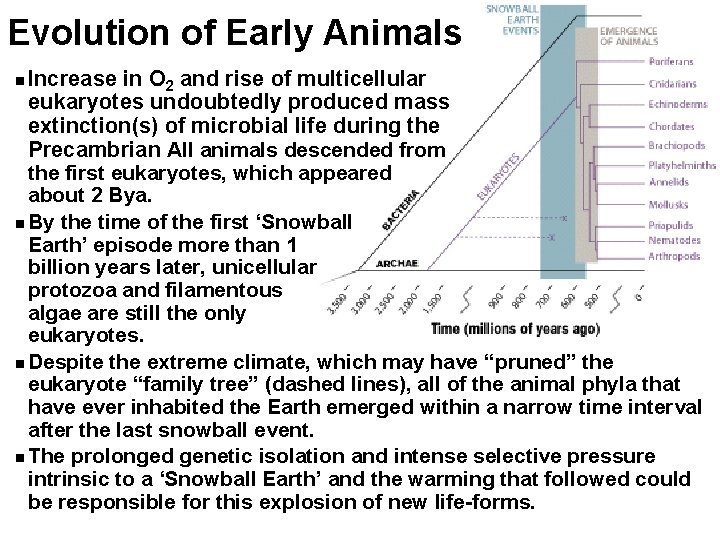
Evolution of Early Animals Increase in O 2 and rise of multicellular eukaryotes undoubtedly produced mass extinction(s) of microbial life during the Precambrian All animals descended from the first eukaryotes, which appeared about 2 Bya. By the time of the first ‘Snowball Earth’ episode more than 1 billion years later, unicellular protozoa and filamentous algae are still the only eukaryotes. Despite the extreme climate, which may have “pruned” the eukaryote “family tree” (dashed lines), all of the animal phyla that have ever inhabited the Earth emerged within a narrow time interval after the last snowball event. The prolonged genetic isolation and intense selective pressure intrinsic to a ‘Snowball Earth’ and the warming that followed could be responsible for this explosion of new life-forms.
350 ft) History of the Earth (Sears Tower: 1450 ft, antennas Cenozoic Era 570 Mya (115 ft up antennas): first definite animal fossils Mesozoic Era Paleozoic Era Vendian 1200 Mya (101 st floor): first animals? 1500 Mya (92 nd floor): eukaryote fossils Precambrian Era 3800 Mya (24 th floor): Simple cells 4000 Mya (18 th floor): Primordial RNA below 4600 Mya (street level) is the Hadean Eon Archaean Eon Hadean Eon
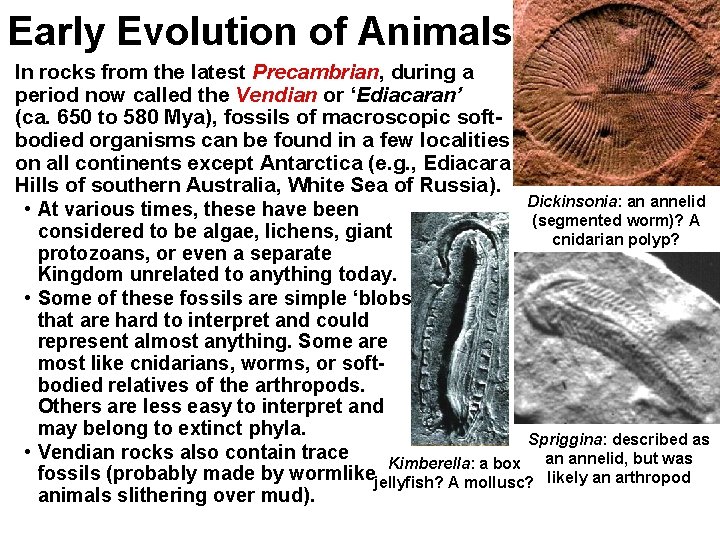
Early Evolution of Animals In rocks from the latest Precambrian, during a period now called the Vendian or ‘Ediacaran’ (ca. 650 to 580 Mya), fossils of macroscopic softbodied organisms can be found in a few localities on all continents except Antarctica (e. g. , Ediacara Hills of southern Australia, White Sea of Russia). Dickinsonia: an annelid • At various times, these have been (segmented worm)? A considered to be algae, lichens, giant cnidarian polyp? protozoans, or even a separate Kingdom unrelated to anything today. • Some of these fossils are simple ‘blobs’ that are hard to interpret and could represent almost anything. Some are most like cnidarians, worms, or softbodied relatives of the arthropods. Others are less easy to interpret and may belong to extinct phyla. Spriggina: described as • Vendian rocks also contain trace an annelid, but was Kimberella: a box fossils (probably made by wormlikejellyfish? A mollusc? likely an arthropod animals slithering over mud).
350 ft) History of the Earth (Sears Tower: 1450 ft, antennas Cenozoic Era Mesozoic Era 570 Mya (115 ft up antennas): first definite animal fossils Paleozoic Era Vendian 1200 Mya (101 st floor): first animals? 1500 Mya (92 nd floor): eukaryote fossils Precambrian Era 3800 Mya (24 th floor): Simple cells 4000 Mya (18 th floor): Primordial RNA below 4600 Mya (street level) is the Hadean Eon Archaean Eon Hadean Eon
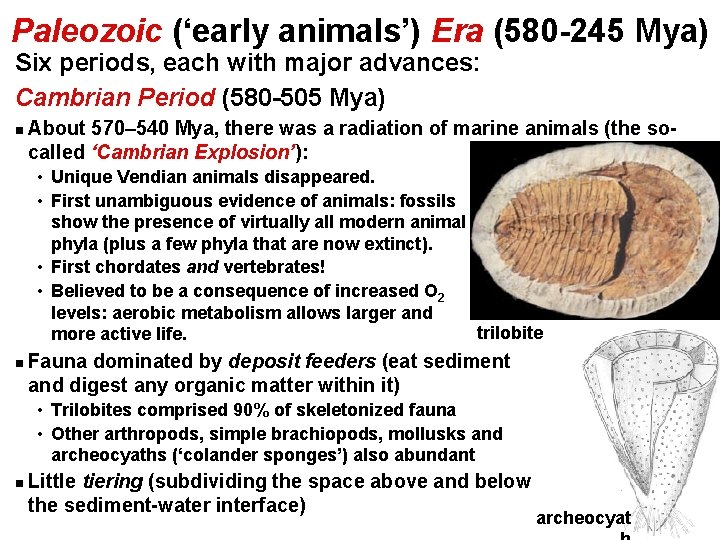
Paleozoic (‘early animals’) Era (580 -245 Mya) Six periods, each with major advances: Cambrian Period (580 -505 Mya) About 570– 540 Mya, there was a radiation of marine animals (the socalled ‘Cambrian Explosion’): • Unique Vendian animals disappeared. • First unambiguous evidence of animals: fossils show the presence of virtually all modern animal phyla (plus a few phyla that are now extinct). • First chordates and vertebrates! • Believed to be a consequence of increased O 2 levels: aerobic metabolism allows larger and trilobite more active life. Fauna dominated by deposit feeders (eat sediment and digest any organic matter within it) • Trilobites comprised 90% of skeletonized fauna • Other arthropods, simple brachiopods, mollusks and archeocyaths (‘colander sponges’) also abundant Little tiering (subdividing the space above and below the sediment-water interface) archeocyat
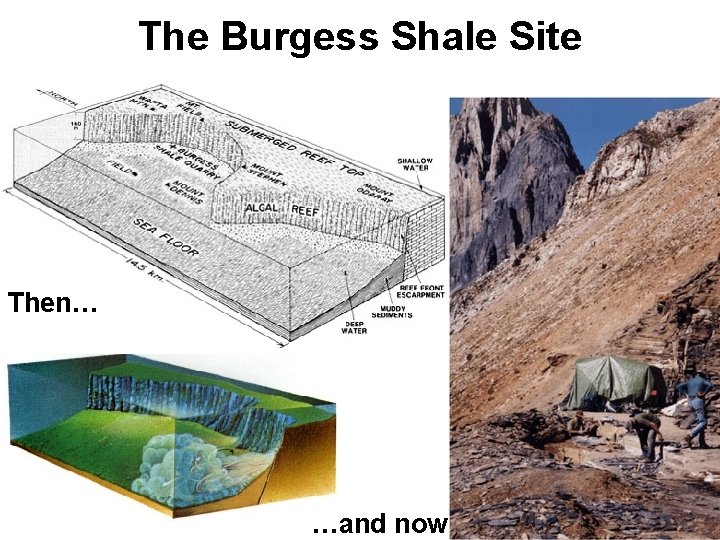
The Burgess Shale Site Then… …and now
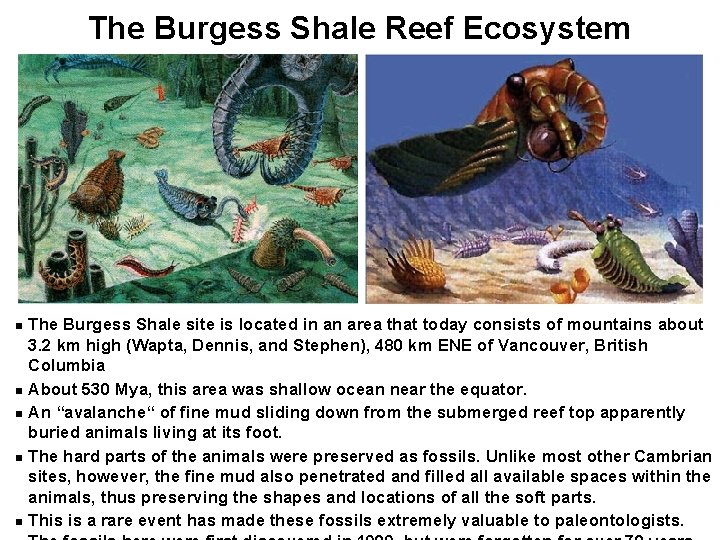
The Burgess Shale Reef Ecosystem The Burgess Shale site is located in an area that today consists of mountains about 3. 2 km high (Wapta, Dennis, and Stephen), 480 km ENE of Vancouver, British Columbia About 530 Mya, this area was shallow ocean near the equator. An “avalanche“ of fine mud sliding down from the submerged reef top apparently buried animals living at its foot. The hard parts of the animals were preserved as fossils. Unlike most other Cambrian sites, however, the fine mud also penetrated and filled all available spaces within the animals, thus preserving the shapes and locations of all the soft parts. This is a rare event has made these fossils extremely valuable to paleontologists.
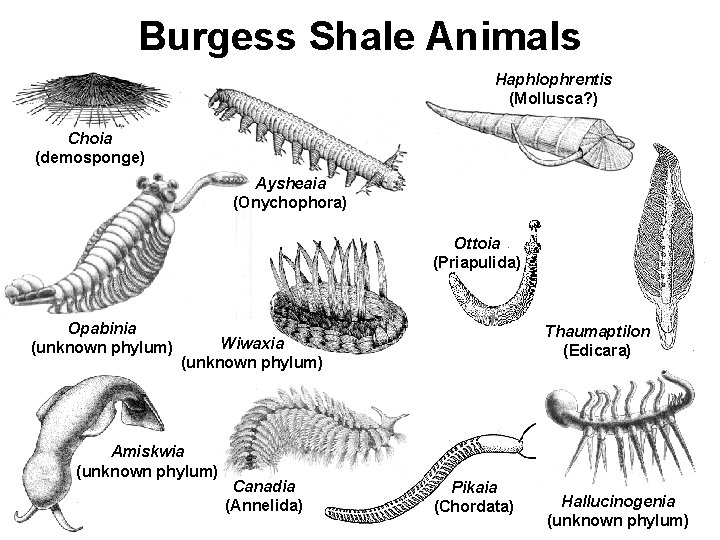
Burgess Shale Animals Haphlophrentis (Mollusca? ) Choia (demosponge) Aysheaia (Onychophora) Ottoia (Priapulida) Opabinia (unknown phylum) Thaumaptilon (Edicara) Wiwaxia (unknown phylum) Amiskwia (unknown phylum) Canadia (Annelida) Pikaia (Chordata) Hallucinogenia (unknown phylum)
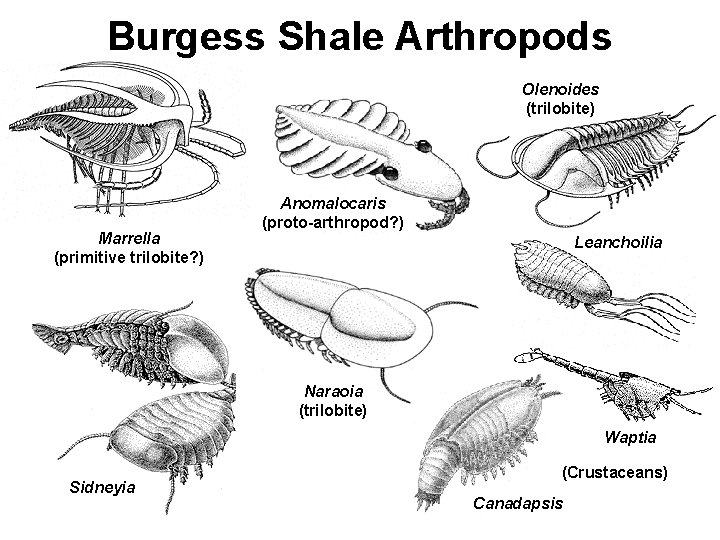
Burgess Shale Arthropods Olenoides (trilobite) Marrella (primitive trilobite? ) Anomalocaris (proto-arthropod? ) Leanchoilia Naraoia (trilobite) Waptia Sidneyia (Crustaceans) Canadapsis
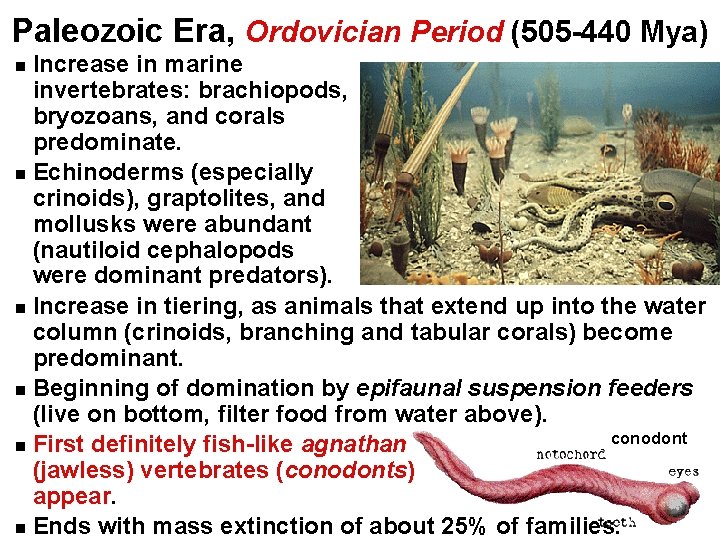
Paleozoic Era, Ordovician Period (505 -440 Mya) Increase in marine invertebrates: brachiopods, bryozoans, and corals predominate. Echinoderms (especially crinoids), graptolites, and mollusks were abundant (nautiloid cephalopods were dominant predators). Increase in tiering, as animals that extend up into the water column (crinoids, branching and tabular corals) become predominant. Beginning of domination by epifaunal suspension feeders (live on bottom, filter food from water above). conodont First definitely fish-like agnathan (jawless) vertebrates (conodonts) appear. Ends with mass extinction of about 25% of families.
Ordovician Period (450 Mya)
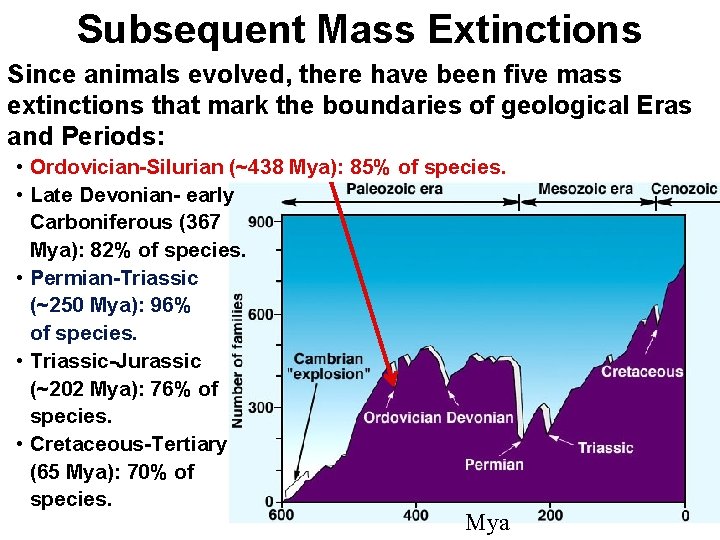
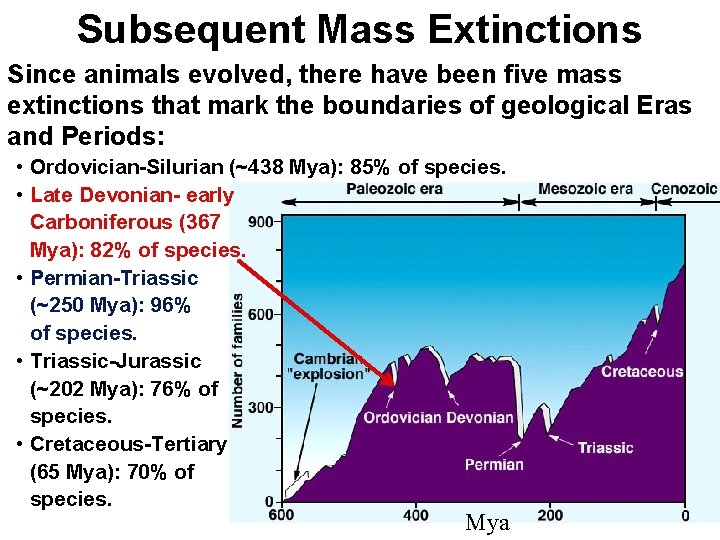
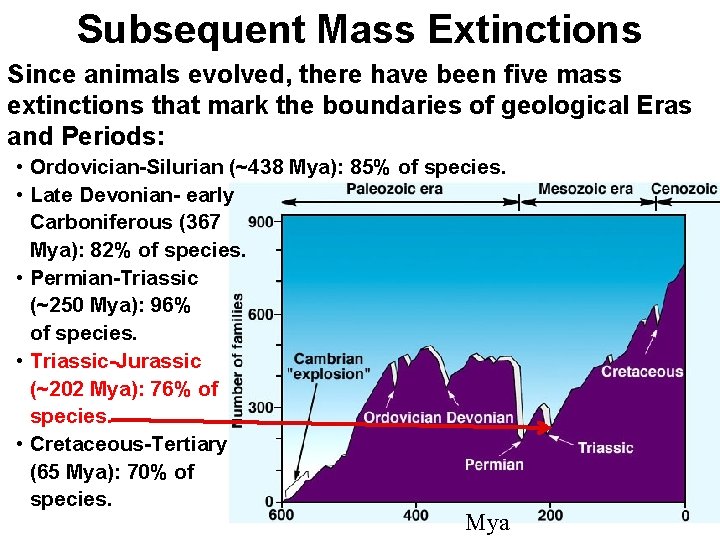
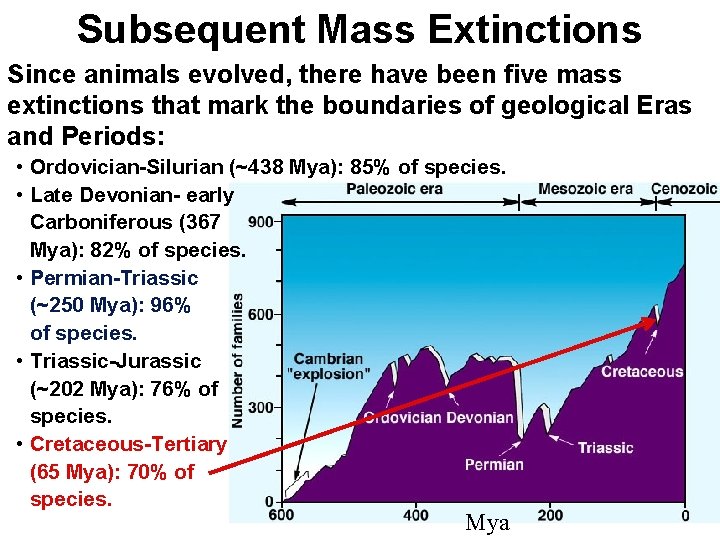
Subsequent Mass Extinctions Since animals evolved, there have been five mass extinctions that mark the boundaries of geological Eras and Periods: • Ordovician-Silurian (~438 Mya): 85% of species. • Late Devonian- early Carboniferous (367 Mya): 82% of species. • Permian-Triassic (~250 Mya): 96% of species. • Triassic-Jurassic (~202 Mya): 76% of species. • Cretaceous-Tertiary (65 Mya): 70% of species. Mya
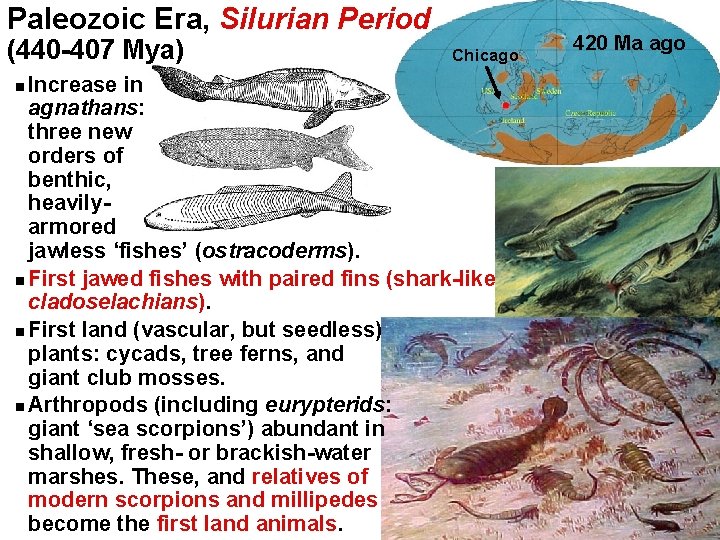
Paleozoic Era, Silurian Period (440 -407 Mya) Chicago Increase in agnathans: three new orders of benthic, heavilyarmored jawless ‘fishes’ (ostracoderms). First jawed fishes with paired fins (shark-like cladoselachians). First land (vascular, but seedless) plants: cycads, tree ferns, and giant club mosses. Arthropods (including eurypterids: giant ‘sea scorpions’) abundant in shallow, fresh- or brackish-water marshes. These, and relatives of modern scorpions and millipedes become the first land animals. 420 Ma ago
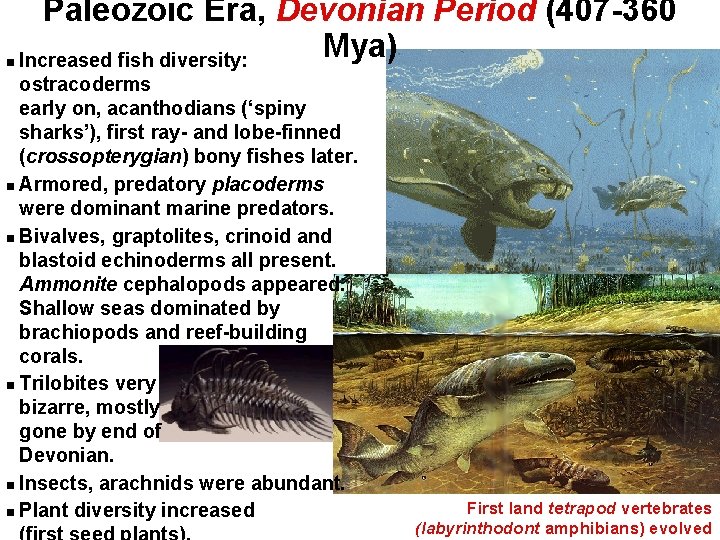
Paleozoic Era, Devonian Period (407 -360 Mya) Increased fish diversity: ostracoderms early on, acanthodians (‘spiny sharks’), first ray- and lobe-finned (crossopterygian) bony fishes later. Armored, predatory placoderms were dominant marine predators. Bivalves, graptolites, crinoid and blastoid echinoderms all present. Ammonite cephalopods appeared. Shallow seas dominated by brachiopods and reef-building corals. Trilobites very bizarre, mostly gone by end of Devonian. Insects, arachnids were abundant. Plant diversity increased First land tetrapod vertebrates (labyrinthodont amphibians) evolved
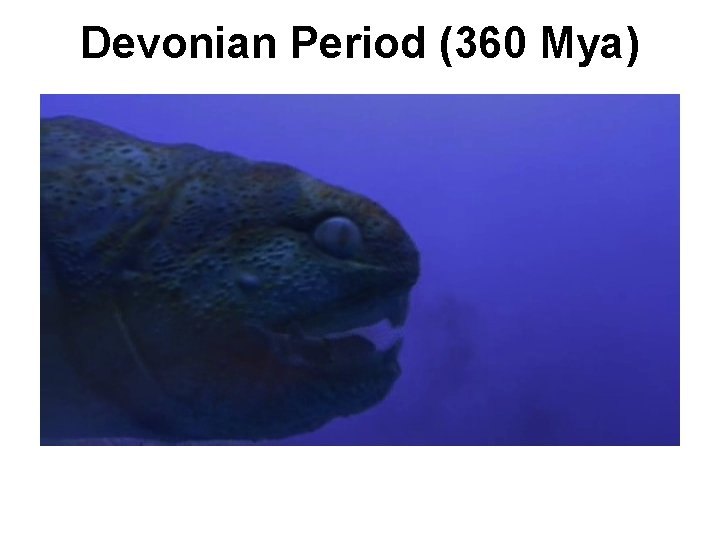
Devonian Period (360 Mya)
Subsequent Mass Extinctions Since animals evolved, there have been five mass extinctions that mark the boundaries of geological Eras and Periods: • Ordovician-Silurian (~438 Mya): 85% of species. • Late Devonian- early Carboniferous (367 Mya): 82% of species. • Permian-Triassic (~250 Mya): 96% of species. • Triassic-Jurassic (~202 Mya): 76% of species. • Cretaceous-Tertiary (65 Mya): 70% of species. Mya
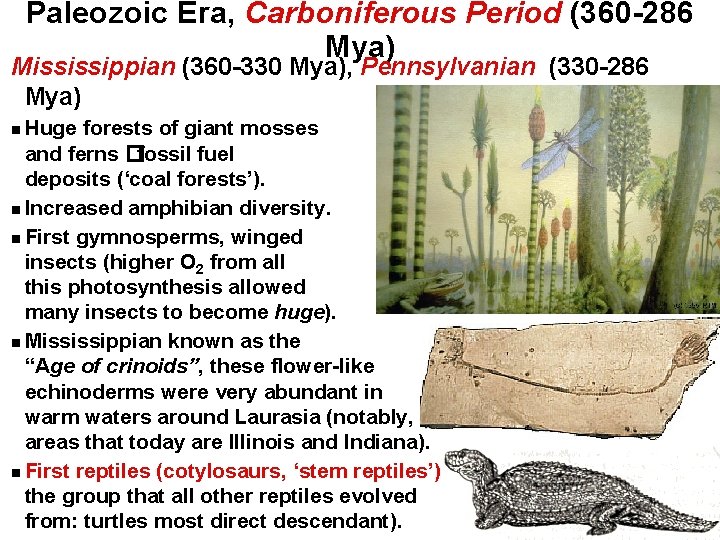
Paleozoic Era, Carboniferous Period (360 -286 Mya) Mississippian (360 -330 Mya), Pennsylvanian (330 -286 Mya) Huge forests of giant mosses and ferns �fossil fuel deposits (‘coal forests’). Increased amphibian diversity. First gymnosperms, winged insects (higher O 2 from all this photosynthesis allowed many insects to become huge). Mississippian known as the “Age of crinoids”, these flower-like echinoderms were very abundant in warm waters around Laurasia (notably, areas that today are Illinois and Indiana). First reptiles (cotylosaurs, ‘stem reptiles’) the group that all other reptiles evolved from: turtles most direct descendant).
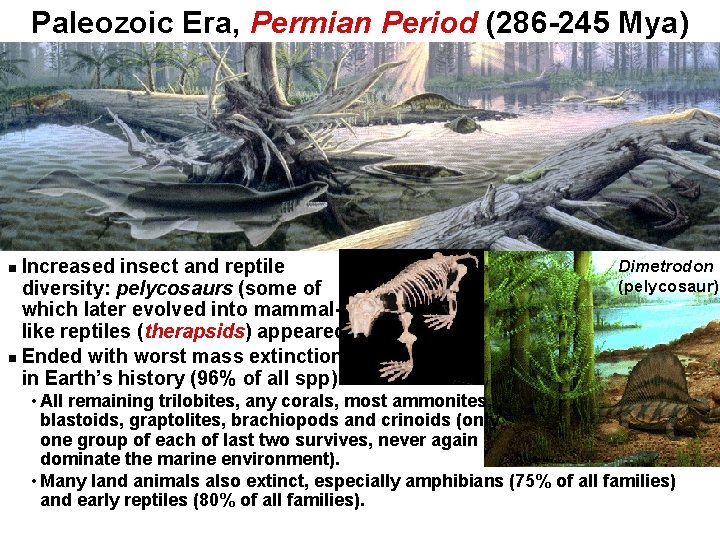
Paleozoic Era, Permian Period (286 -245 Mya) Increased insect and reptile diversity: pelycosaurs (some of which later evolved into mammallike reptiles (therapsids) appeared. Ended with worst mass extinction in Earth’s history (96% of all spp): Dimetrodon (pelycosaur) therapsid • All remaining trilobites, any corals, most ammonites, blastoids, graptolites, brachiopods and crinoids (only one group of each of last two survives, never again dominate the marine environment). • Many land animals also extinct, especially amphibians (75% of all families) and early reptiles (80% of all families).
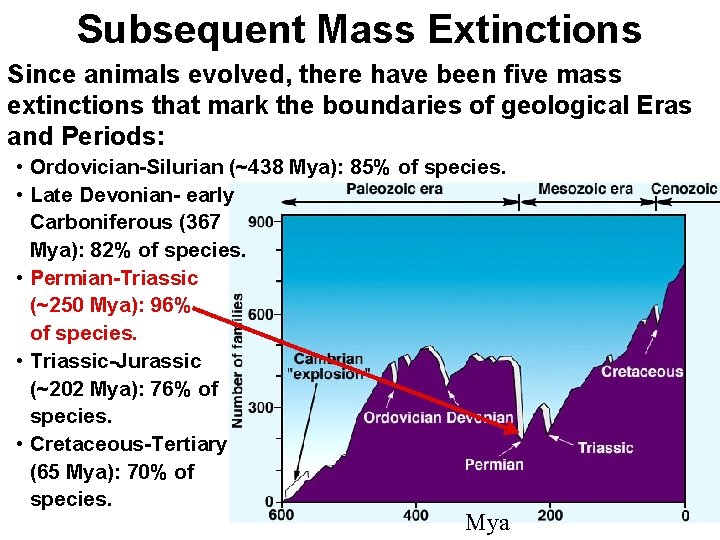
Subsequent Mass Extinctions Since animals evolved, there have been five mass extinctions that mark the boundaries of geological Eras and Periods: • Ordovician-Silurian (~438 Mya): 85% of species. • Late Devonian- early Carboniferous (367 Mya): 82% of species. • Permian-Triassic (~250 Mya): 96% of species. • Triassic-Jurassic (~202 Mya): 76% of species. • Cretaceous-Tertiary (65 Mya): 70% of species. Mya
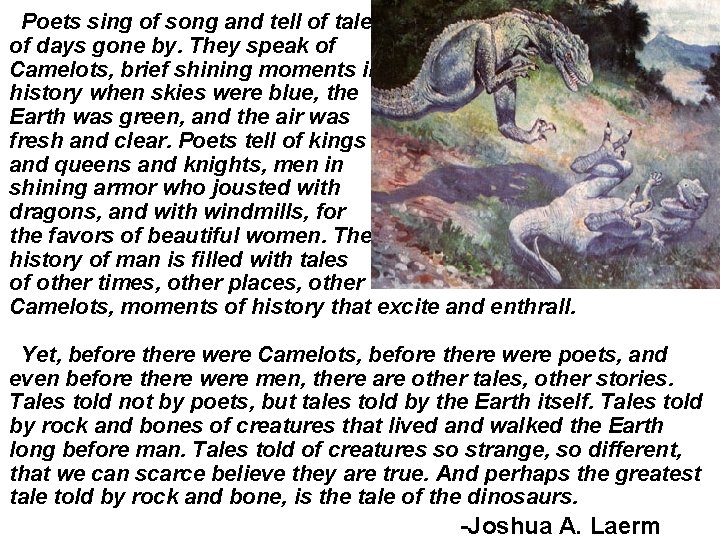
Poets sing of song and tell of tales of days gone by. They speak of Camelots, brief shining moments in history when skies were blue, the Earth was green, and the air was fresh and clear. Poets tell of kings and queens and knights, men in shining armor who jousted with dragons, and with windmills, for the favors of beautiful women. The history of man is filled with tales of other times, other places, other Camelots, moments of history that excite and enthrall. Yet, before there were Camelots, before there were poets, and even before there were men, there are other tales, other stories. Tales told not by poets, but tales told by the Earth itself. Tales told by rock and bones of creatures that lived and walked the Earth long before man. Tales told of creatures so strange, so different, that we can scarce believe they are true. And perhaps the greatest tale told by rock and bone, is the tale of the dinosaurs. -Joshua A. Laerm
350 ft) History of the Earth (Sears Tower: 1450 ft, antennas Cenozoic Era Mesozoic Era Paleozoic Era 570 Mya (115 ft up antennas): first definite animal fossils Vendian 1200 Mya (101 st floor): first animals? 1500 Mya (92 nd floor): eukaryote fossils Precambrian Era 3800 Mya (24 th floor): Simple cells 4000 Mya (18 th floor): Primordial RNA below 4600 Mya (street level) is the Hadean Eon Archaean Eon Hadean Eon
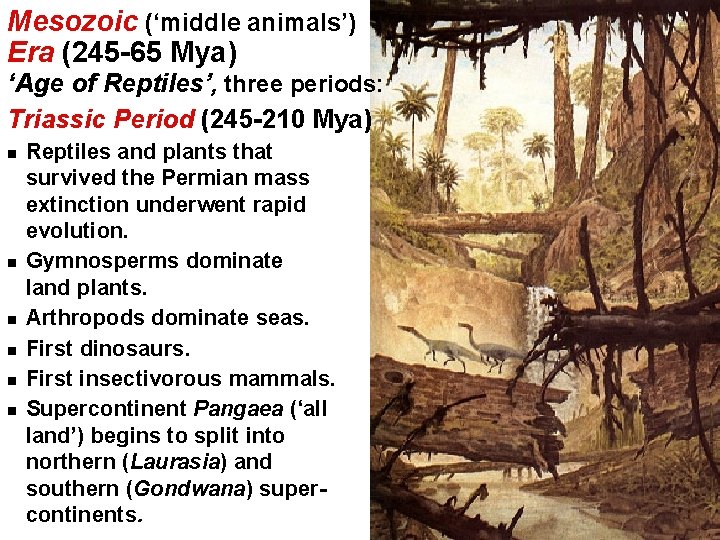
Mesozoic (‘middle animals’) Era (245 -65 Mya) ‘Age of Reptiles’, three periods: Triassic Period (245 -210 Mya) Reptiles and plants that survived the Permian mass extinction underwent rapid evolution. Gymnosperms dominate land plants. Arthropods dominate seas. First dinosaurs. First insectivorous mammals. Supercontinent Pangaea (‘all land’) begins to split into northern (Laurasia) and southern (Gondwana) supercontinents.
Triassic Period (230 Mya)
Subsequent Mass Extinctions Since animals evolved, there have been five mass extinctions that mark the boundaries of geological Eras and Periods: • Ordovician-Silurian (~438 Mya): 85% of species. • Late Devonian- early Carboniferous (367 Mya): 82% of species. • Permian-Triassic (~250 Mya): 96% of species. • Triassic-Jurassic (~202 Mya): 76% of species. • Cretaceous-Tertiary (65 Mya): 70% of species. Mya
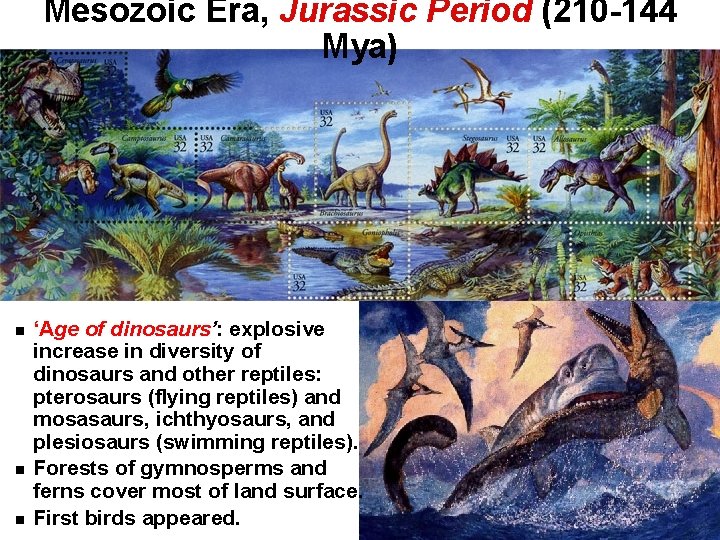
Mesozoic Era, Jurassic Period (210 -144 Mya) ‘Age of dinosaurs’: explosive increase in diversity of dinosaurs and other reptiles: pterosaurs (flying reptiles) and mosasaurs, ichthyosaurs, and plesiosaurs (swimming reptiles). Forests of gymnosperms and ferns cover most of land surface. First birds appeared.
Jurassic Period (155 Mya)
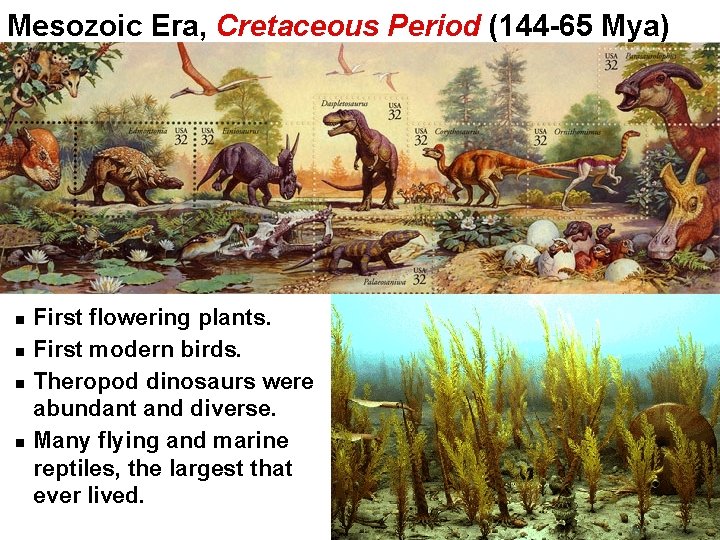
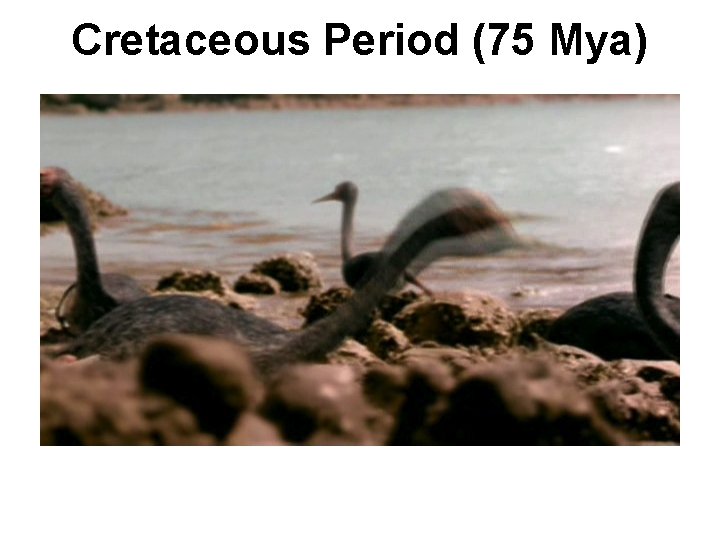
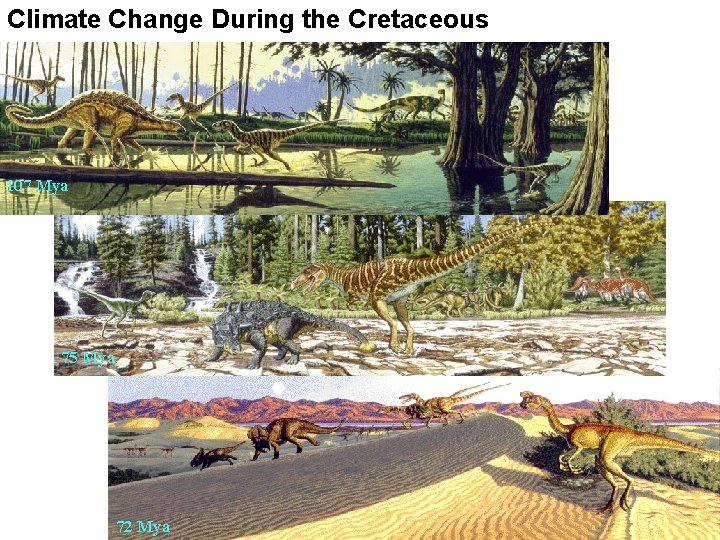
Mesozoic Era, Cretaceous Period (144 -65 Mya) First flowering plants. First modern birds. Theropod dinosaurs were abundant and diverse. Many flying and marine reptiles, the largest that ever lived.
Cretaceous Period (75 Mya)
Subsequent Mass Extinctions Since animals evolved, there have been five mass extinctions that mark the boundaries of geological Eras and Periods: • Ordovician-Silurian (~438 Mya): 85% of species. • Late Devonian- early Carboniferous (367 Mya): 82% of species. • Permian-Triassic (~250 Mya): 96% of species. • Triassic-Jurassic (~202 Mya): 76% of species. • Cretaceous-Tertiary (65 Mya): 70% of species. Mya
Climate Change During the Cretaceous 107 Mya 75 Mya 72 Mya
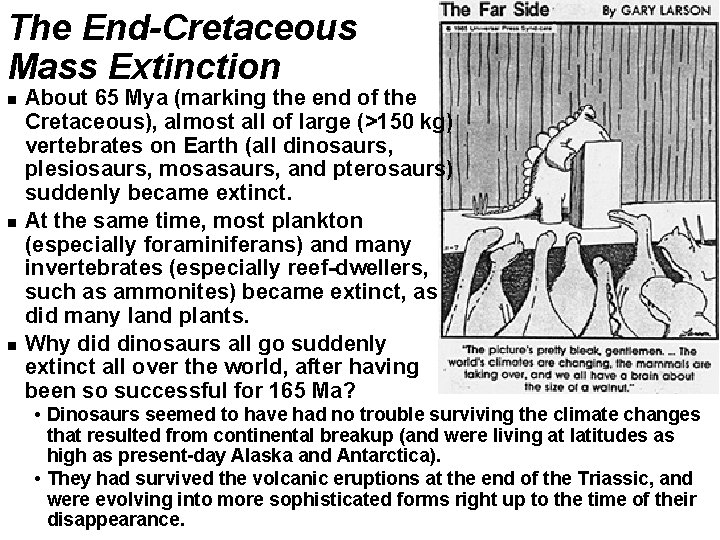
The End-Cretaceous Mass Extinction About 65 Mya (marking the end of the Cretaceous), almost all of large (>150 kg) vertebrates on Earth (all dinosaurs, plesiosaurs, mosasaurs, and pterosaurs) suddenly became extinct. At the same time, most plankton (especially foraminiferans) and many invertebrates (especially reef-dwellers, such as ammonites) became extinct, as did many land plants. Why did dinosaurs all go suddenly extinct all over the world, after having been so successful for 165 Ma? • Dinosaurs seemed to have had no trouble surviving the climate changes that resulted from continental breakup (and were living at latitudes as high as present-day Alaska and Antarctica). • They had survived the volcanic eruptions at the end of the Triassic, and were evolving into more sophisticated forms right up to the time of their disappearance.
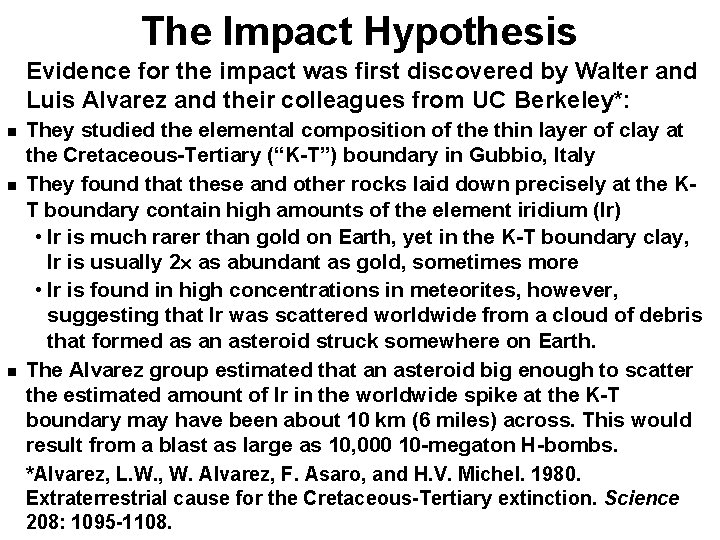
The Impact Hypothesis Evidence for the impact was first discovered by Walter and Luis Alvarez and their colleagues from UC Berkeley*: They studied the elemental composition of the thin layer of clay at the Cretaceous-Tertiary (“K-T”) boundary in Gubbio, Italy They found that these and other rocks laid down precisely at the KT boundary contain high amounts of the element iridium (Ir) • Ir is much rarer than gold on Earth, yet in the K-T boundary clay, Ir is usually 2 as abundant as gold, sometimes more • Ir is found in high concentrations in meteorites, however, suggesting that Ir was scattered worldwide from a cloud of debris that formed as an asteroid struck somewhere on Earth. The Alvarez group estimated that an asteroid big enough to scatter the estimated amount of Ir in the worldwide spike at the K-T boundary may have been about 10 km (6 miles) across. This would result from a blast as large as 10, 000 10 -megaton H-bombs. *Alvarez, L. W. , W. Alvarez, F. Asaro, and H. V. Michel. 1980. Extraterrestrial cause for the Cretaceous-Tertiary extinction. Science 208: 1095 -1108.
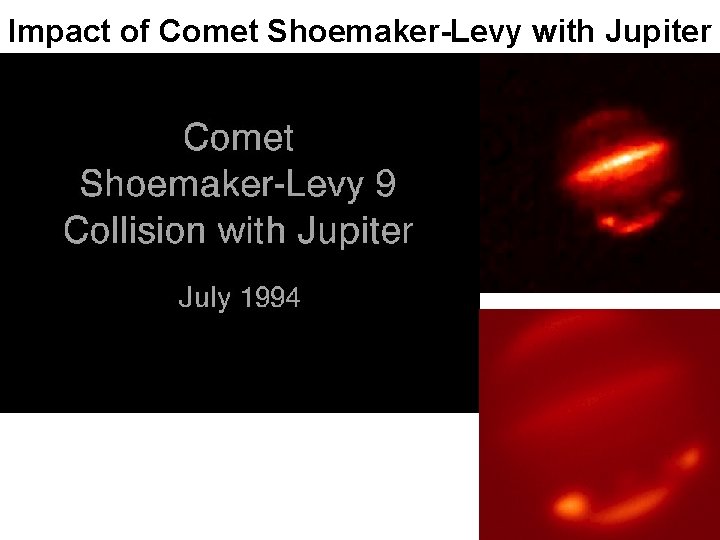
Impact of Comet Shoemaker-Levy with Jupiter
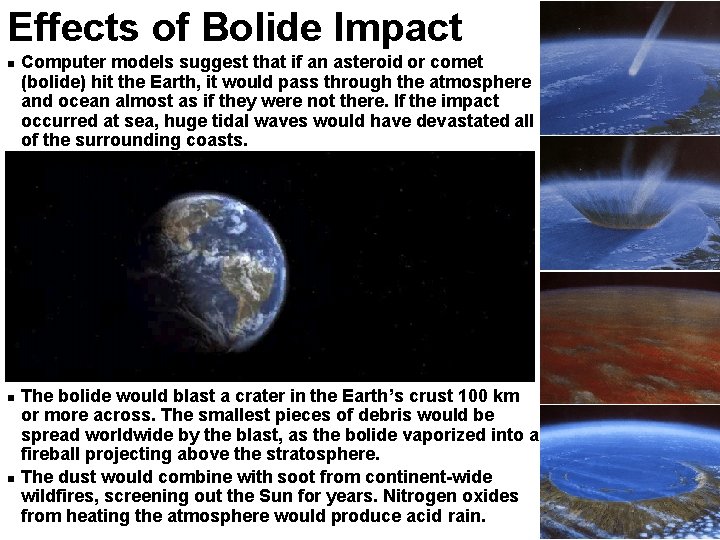
Effects of Bolide Impact Computer models suggest that if an asteroid or comet (bolide) hit the Earth, it would pass through the atmosphere and ocean almost as if they were not there. If the impact occurred at sea, huge tidal waves would have devastated all of the surrounding coasts. The bolide would blast a crater in the Earth’s crust 100 km or more across. The smallest pieces of debris would be spread worldwide by the blast, as the bolide vaporized into a fireball projecting above the stratosphere. The dust would combine with soot from continent-wide wildfires, screening out the Sun for years. Nitrogen oxides from heating the atmosphere would produce acid rain.
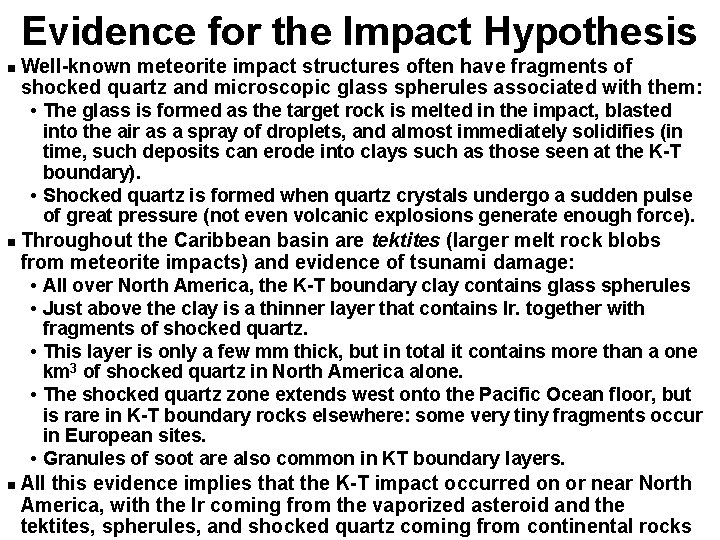
Evidence for the Impact Hypothesis Well-known meteorite impact structures often have fragments of shocked quartz and microscopic glass spherules associated with them: • The glass is formed as the target rock is melted in the impact, blasted into the air as a spray of droplets, and almost immediately solidifies (in time, such deposits can erode into clays such as those seen at the K-T boundary). • Shocked quartz is formed when quartz crystals undergo a sudden pulse of great pressure (not even volcanic explosions generate enough force). Throughout the Caribbean basin are tektites (larger melt rock blobs from meteorite impacts) and evidence of tsunami damage: • All over North America, the K-T boundary clay contains glass spherules • Just above the clay is a thinner layer that contains Ir. together with fragments of shocked quartz. • This layer is only a few mm thick, but in total it contains more than a one km 3 of shocked quartz in North America alone. • The shocked quartz zone extends west onto the Pacific Ocean floor, but is rare in K-T boundary rocks elsewhere: some very tiny fragments occur in European sites. • Granules of soot are also common in KT boundary layers. All this evidence implies that the K-T impact occurred on or near North America, with the Ir coming from the vaporized asteroid and the tektites, spherules, and shocked quartz coming from continental rocks
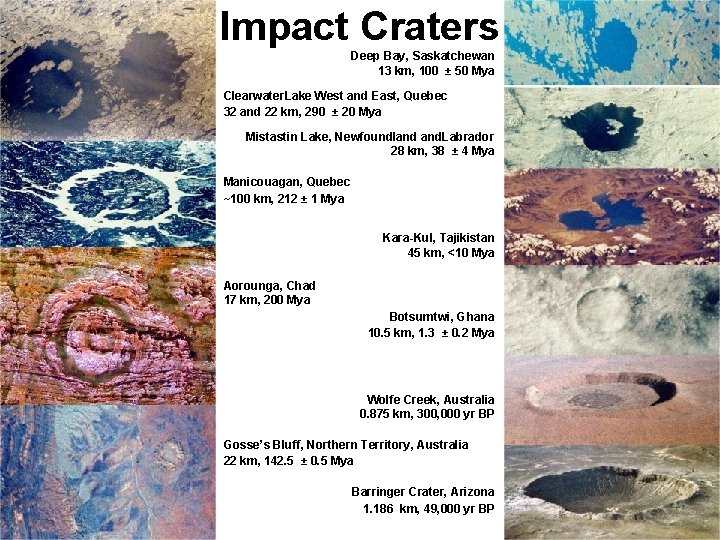
Impact Craters Deep Bay, Saskatchewan 13 km, 100 ± 50 Mya Clearwater. Lake West and East, Quebec 32 and 22 km, 290 ± 20 Mya Mistastin Lake, Newfoundland and. Labrador 28 km, 38 ± 4 Mya Manicouagan, Quebec ~100 km, 212 ± 1 Mya Kara-Kul, Tajikistan 45 km, <10 Mya Aorounga, Chad 17 km, 200 Mya Botsumtwi, Ghana 10. 5 km, 1. 3 ± 0. 2 Mya Wolfe Creek, Australia 0. 875 km, 300, 000 yr BP Gosse’s Bluff, Northern Territory, Australia 22 km, 142. 5 ± 0. 5 Mya Barringer Crater, Arizona 1. 186 km, 49, 000 yr BP
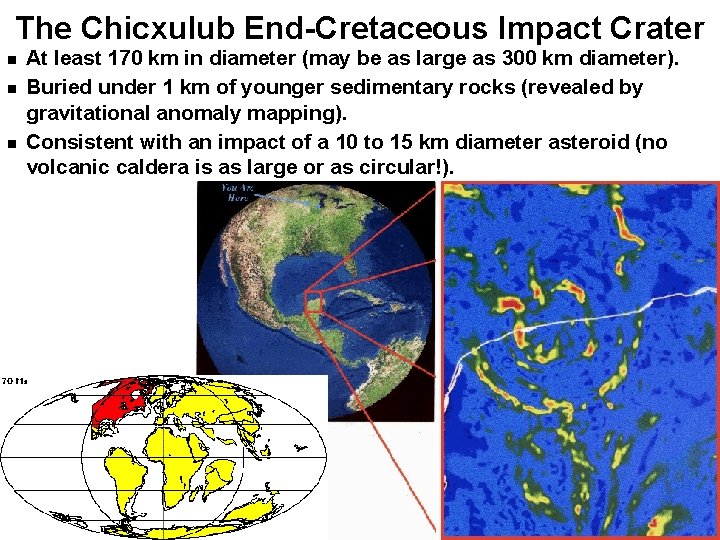
The Chicxulub End-Cretaceous Impact Crater At least 170 km in diameter (may be as large as 300 km diameter). Buried under 1 km of younger sedimentary rocks (revealed by gravitational anomaly mapping). Consistent with an impact of a 10 to 15 km diameter asteroid (no volcanic caldera is as large or as circular!).
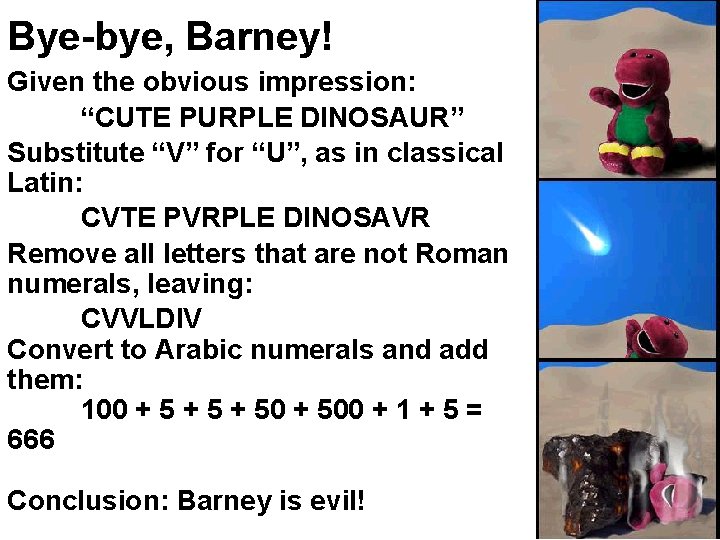
Bye-bye, Barney! Given the obvious impression: “CUTE PURPLE DINOSAUR” Substitute “V” for “U”, as in classical Latin: CVTE PVRPLE DINOSAVR Remove all letters that are not Roman numerals, leaving: CVVLDIV Convert to Arabic numerals and add them: 100 + 5 + 500 + 1 + 5 = 666 Conclusion: Barney is evil!
History of the Earth (Sears Tower: 1450 ft, antennas 350 ft) 570 Mya (115 ft up antennas): first definite animal fossils Cenozoic Era Mesozoic Era Paleozoic Era Vendian 1200 Mya (101 st floor): first animals? 1500 Mya (92 nd floor): eukaryote fossils Precambrian Era 3800 Mya (24 th floor): Simple cells 4000 Mya (18 th floor): Primordial RNA below 4600 Mya (street level) is the Hadean Eon Archaean Eon Hadean Eon
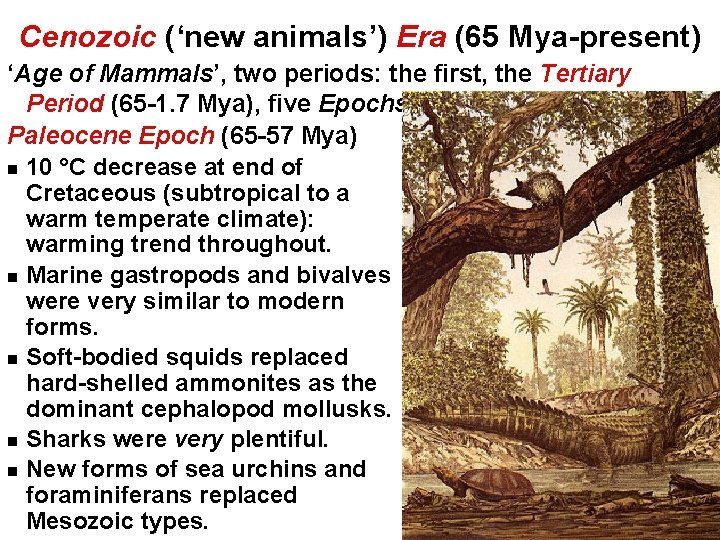
Cenozoic (‘new animals’) Era (65 Mya-present) ‘Age of Mammals’, two periods: the first, the Tertiary Period (65 -1. 7 Mya), five Epochs: Paleocene Epoch (65 -57 Mya) 10 °C decrease at end of Cretaceous (subtropical to a warm temperate climate): warming trend throughout. Marine gastropods and bivalves were very similar to modern forms. Soft-bodied squids replaced hard-shelled ammonites as the dominant cephalopod mollusks. Sharks were very plentiful. New forms of sea urchins and foraminiferans replaced Mesozoic types.
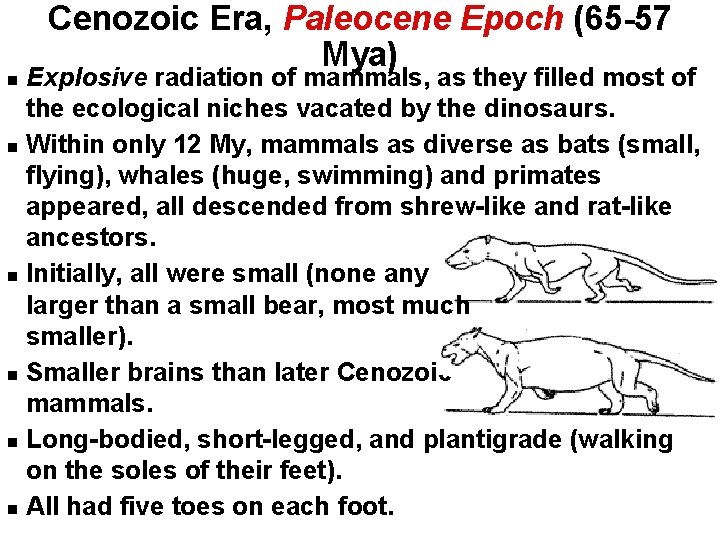
Cenozoic Era, Paleocene Epoch (65 -57 Mya) Explosive radiation of mammals, as they filled most of the ecological niches vacated by the dinosaurs. Within only 12 My, mammals as diverse as bats (small, flying), whales (huge, swimming) and primates appeared, all descended from shrew-like and rat-like ancestors. Initially, all were small (none any larger than a small bear, most much smaller). Smaller brains than later Cenozoic mammals. Long-bodied, short-legged, and plantigrade (walking on the soles of their feet). All had five toes on each foot.
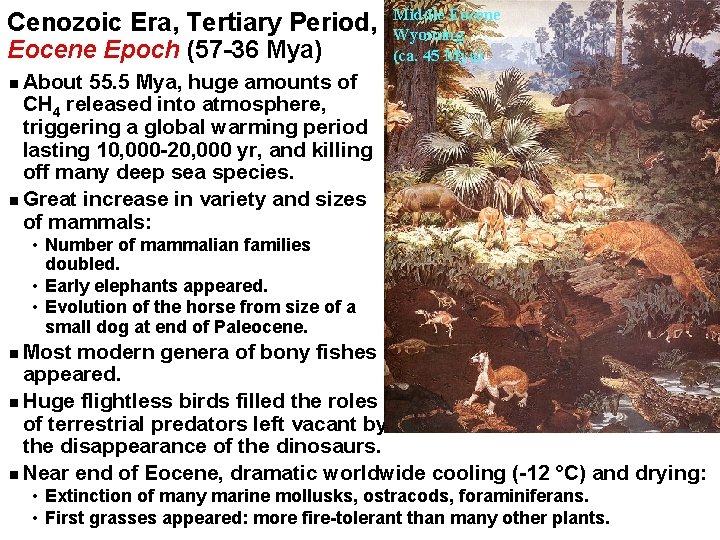
Cenozoic Era, Tertiary Period, Eocene Epoch (57 -36 Mya) Middle Eocene Wyoming (ca. 45 Mya) About 55. 5 Mya, huge amounts of CH 4 released into atmosphere, triggering a global warming period lasting 10, 000 -20, 000 yr, and killing off many deep sea species. Great increase in variety and sizes of mammals: • Number of mammalian families doubled. • Early elephants appeared. • Evolution of the horse from size of a small dog at end of Paleocene. Most modern genera of bony fishes appeared. Huge flightless birds filled the roles of terrestrial predators left vacant by the disappearance of the dinosaurs. Near end of Eocene, dramatic worldwide cooling (-12 °C) and drying: • Extinction of many marine mollusks, ostracods, foraminiferans. • First grasses appeared: more fire-tolerant than many other plants.
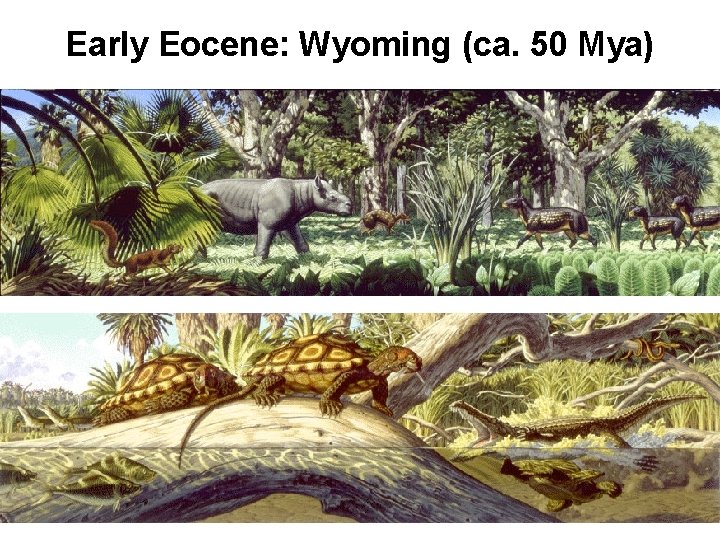
Early Eocene: Wyoming (ca. 50 Mya)
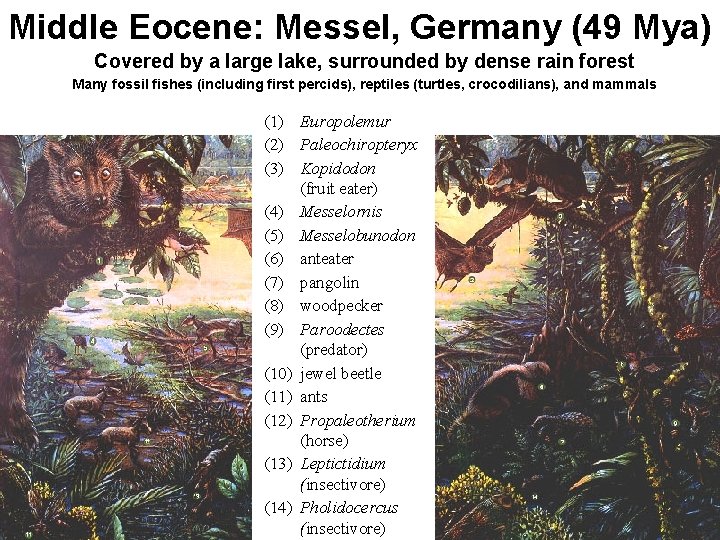
Middle Eocene: Messel, Germany (49 Mya) Covered by a large lake, surrounded by dense rain forest Many fossil fishes (including first percids), reptiles (turtles, crocodilians), and mammals (1) Europolemur (2) Paleochiropteryx (3) Kopidodon (fruit eater) (4) Messelornis (5) Messelobunodon (6) anteater (7) pangolin (8) woodpecker (9) Paroodectes (predator) (10) jewel beetle (11) ants (12) Propaleotherium (horse) (13) Leptictidium (insectivore) (14) Pholidocercus (insectivore)
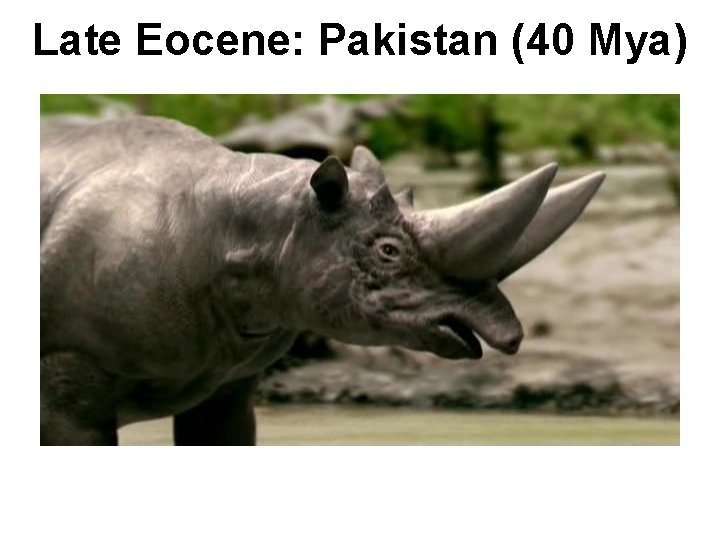
Late Eocene: Pakistan (40 Mya)
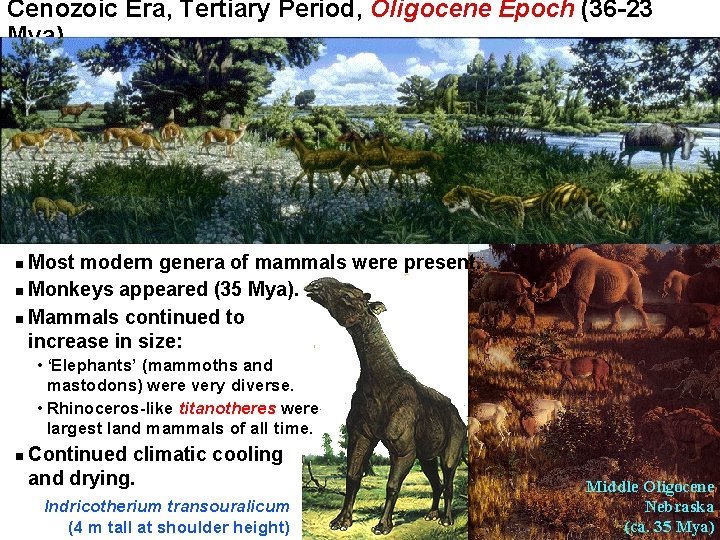
Cenozoic Era, Tertiary Period, Oligocene Epoch (36 -23 Mya) Most modern genera of mammals were present. Monkeys appeared (35 Mya). Mammals continued to increase in size: • ‘Elephants’ (mammoths and mastodons) were very diverse. • Rhinoceros-like titanotheres were largest land mammals of all time. Continued climatic cooling and drying. Indricotherium transouralicum (4 m tall at shoulder height) Middle Oligocene Nebraska (ca. 35 Mya)
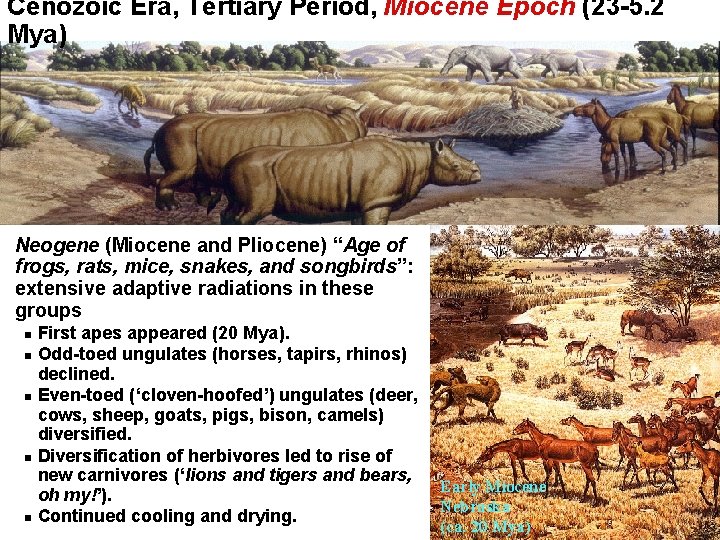
Cenozoic Era, Tertiary Period, Miocene Epoch (23 -5. 2 Mya) Neogene (Miocene and Pliocene) “Age of frogs, rats, mice, snakes, and songbirds”: extensive adaptive radiations in these groups First apes appeared (20 Mya). Odd-toed ungulates (horses, tapirs, rhinos) declined. Even-toed (‘cloven-hoofed’) ungulates (deer, cows, sheep, goats, pigs, bison, camels) diversified. Diversification of herbivores led to rise of new carnivores (‘lions and tigers and bears, oh my!’). Continued cooling and drying. Early Miocene Nebraska (ca. 20 Mya)
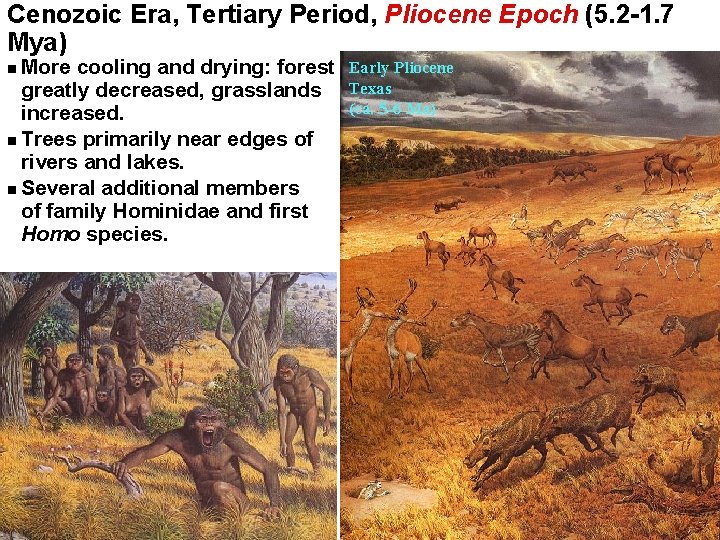
Cenozoic Era, Tertiary Period, Pliocene Epoch (5. 2 -1. 7 Mya) More cooling and drying: forest Early Pliocene greatly decreased, grasslands Texas (ca. 5 -6 Ma) increased. Trees primarily near edges of rivers and lakes. Several additional members of family Hominidae and first Homo species.
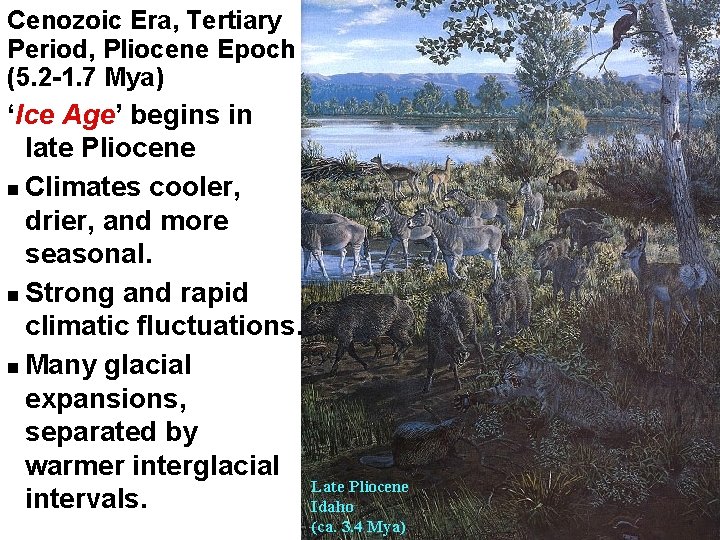
Cenozoic Era, Tertiary Period, Pliocene Epoch (5. 2 -1. 7 Mya) ‘Ice Age’ begins in late Pliocene Climates cooler, drier, and more seasonal. Strong and rapid climatic fluctuations. Many glacial expansions, separated by warmer interglacial Late Pliocene intervals. Idaho (ca. 3. 4 Mya)
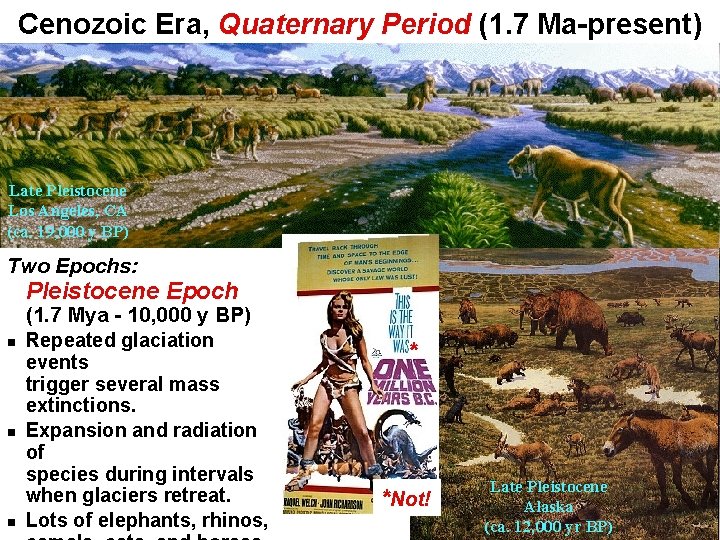
Cenozoic Era, Quaternary Period (1. 7 Ma-present) Late Pleistocene Los Angeles, CA (ca. 19, 000 y BP) Two Epochs: Pleistocene Epoch (1. 7 Mya - 10, 000 y BP) Repeated glaciation events trigger several mass extinctions. Expansion and radiation of species during intervals when glaciers retreat. Lots of elephants, rhinos, * *Not! Late Pleistocene Alaska (ca. 12, 000 yr BP)
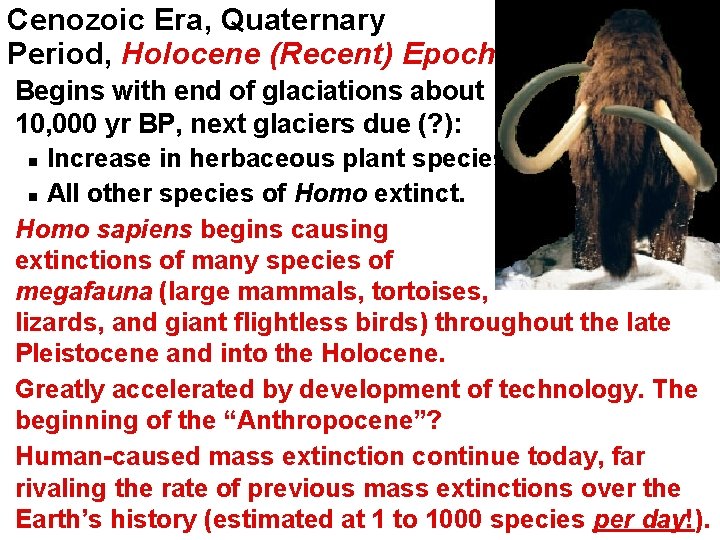
Cenozoic Era, Quaternary Period, Holocene (Recent) Epoch Begins with end of glaciations about 10, 000 yr BP, next glaciers due (? ): Increase in herbaceous plant species. All other species of Homo extinct. Homo sapiens begins causing extinctions of many species of megafauna (large mammals, tortoises, lizards, and giant flightless birds) throughout the late Pleistocene and into the Holocene. Greatly accelerated by development of technology. The beginning of the “Anthropocene”? Human-caused mass extinction continue today, far rivaling the rate of previous mass extinctions over the Earth’s history (estimated at 1 to 1000 species per day!).