
35 years of Cognitive Linguistics Session 8 Cognitive



- Slides: 51
35 years of Cognitive Linguistics Session 8: Cognitive Grammar Martin Hilpert
your questions • • • constituency relational expressions salience schema semantic pole / phonological pole open-ended knowledge systems
Langacker 1987 Langacker 1991
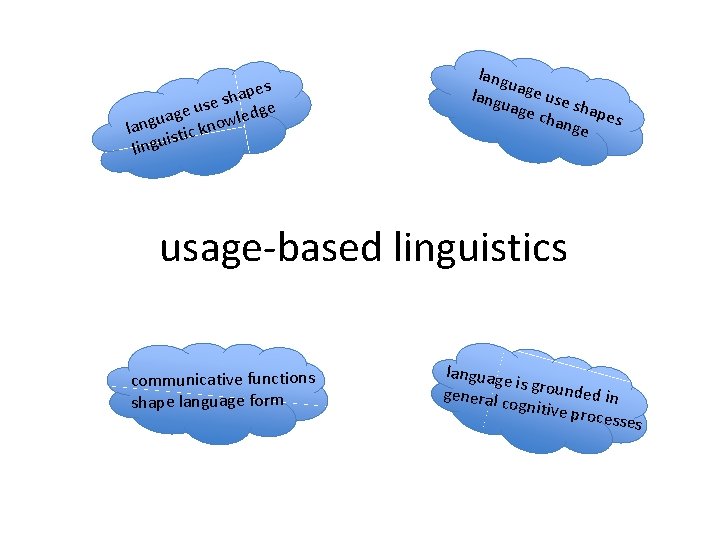
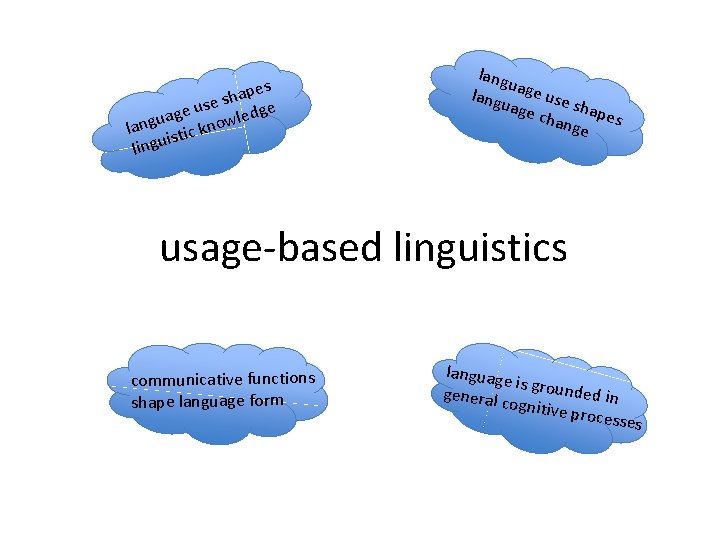
pes a h s use edge e g a l langu tic know is lingu lang age use uage sh chan apes ge usage-based linguistics communicative functions shape language form language is groun de general cognitive d in processe s
ideas from Cognitive Grammar, now widely held in Cognitive Linguistics
• Knowledge of language is knowledge of a network of symbolic units that pair sounds with meanings.
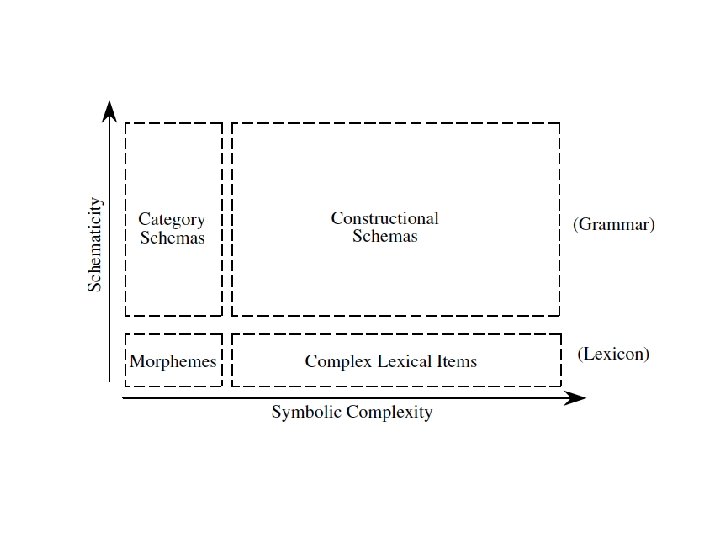
• Lexicon and grammar are not distinct modules: there is a continuum from very concrete symbols (chair, dog) to very schematic symbols (subject, relative clause).
• Knowledge of language is usage-based: speakers know symbolic units because they make abstractions over usage events.
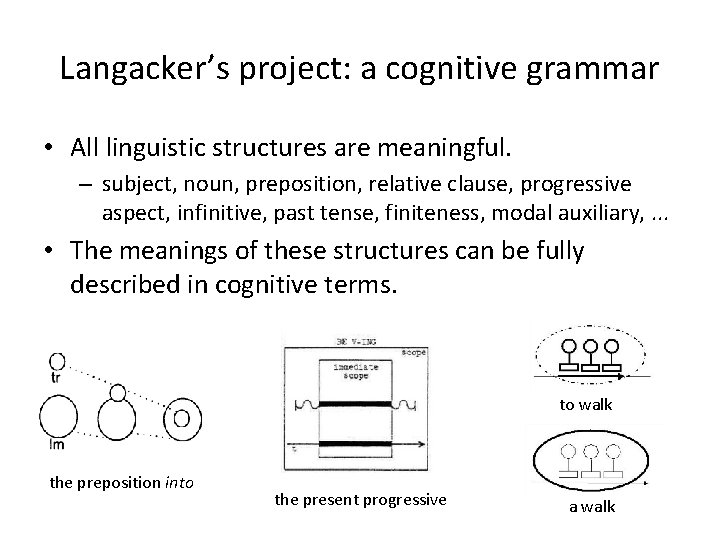
Langacker’s project: a cognitive grammar • All linguistic structures are meaningful. – subject, noun, preposition, relative clause, progressive aspect, infinitive, past tense, finiteness, modal auxiliary, . . . • The meanings of these structures can be fully described in cognitive terms. to walk the preposition into the present progressive a walk
job of the cognitive grammarian • Describe all grammatical structures in terms of their meanings. • Analyze those meanings in terms of general cognitive processes.
the content requirement • The stuff grammars are made of: 1. sounds and structures you’ve heard before • tree, I don’t know, Could you pass the salt? 2. schemas on the basis of the sounds and structures that you’ve heard before • NOUN, SUB VP, AUX, SUB, VP 3. categorizing relationships between 1 and 2 • ‘tree’ is a NOUN
the content requirement • “The only units permitted in the grammar of a language are (i) semantic, phonological, and symbolic structures that occur overtly in linguistic expressions; (ii) structures that are schematic for the those in (i); and (iii) categorizing relationships involving the structures in (i) and (ii). ”
technical terms
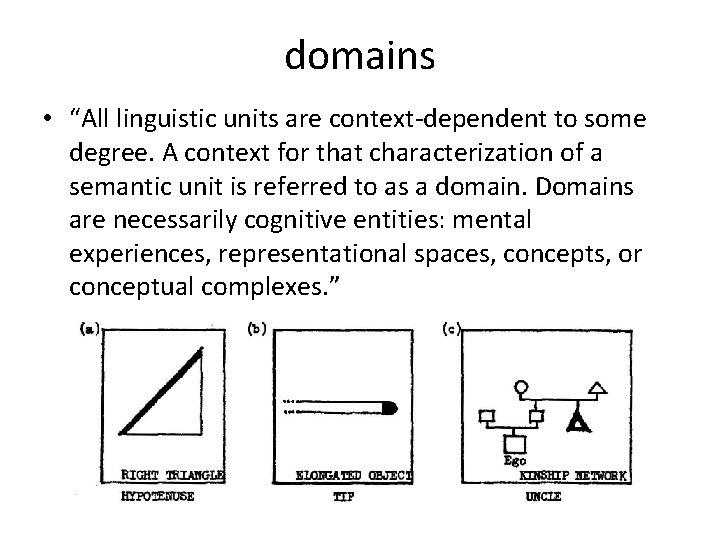
domains • “All linguistic units are context-dependent to some degree. A context for that characterization of a semantic unit is referred to as a domain. Domains are necessarily cognitive entities: mental experiences, representational spaces, concepts, or conceptual complexes. ”
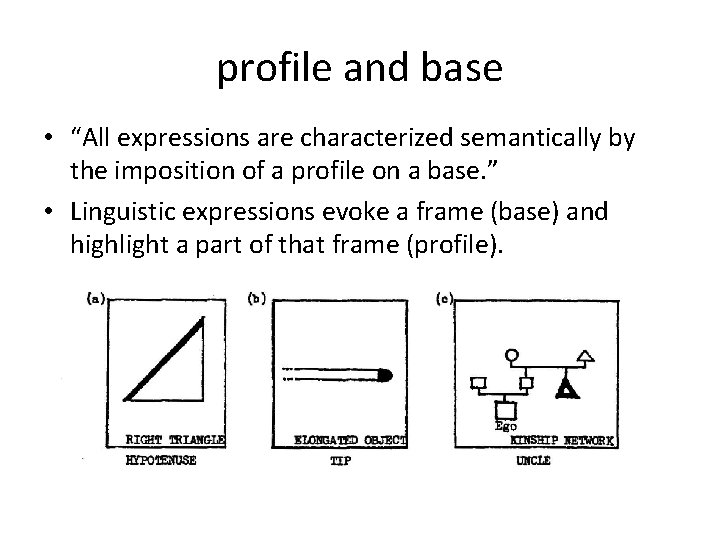
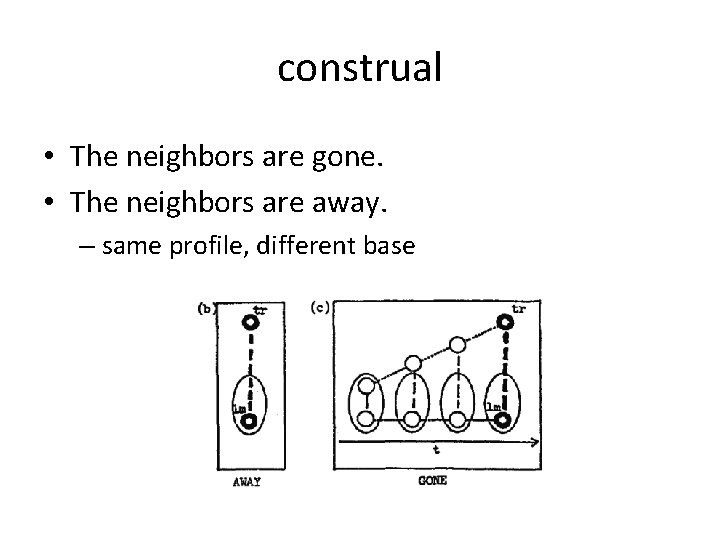
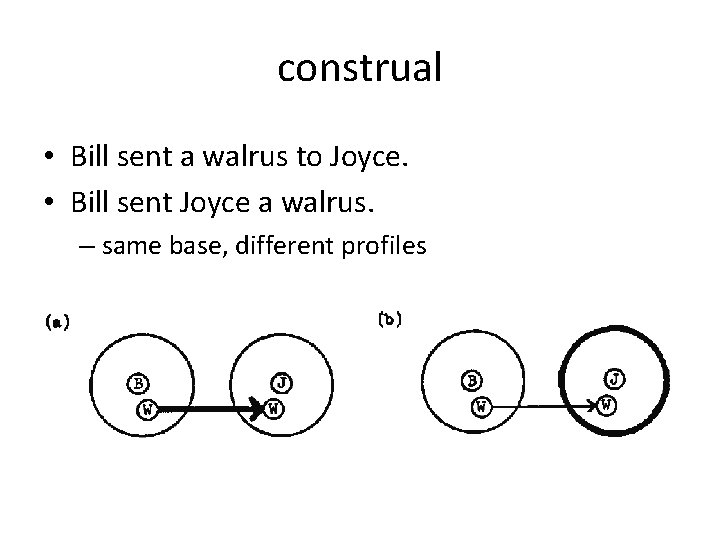
profile and base • “All expressions are characterized semantically by the imposition of a profile on a base. ” • Linguistic expressions evoke a frame (base) and highlight a part of that frame (profile).
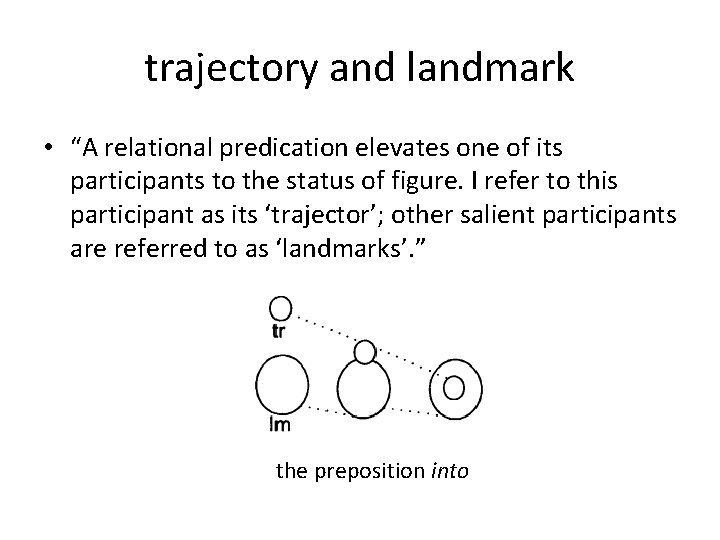
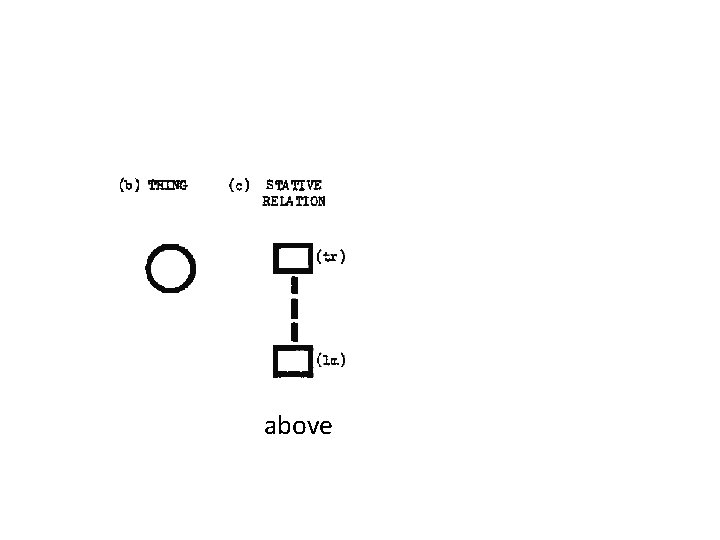
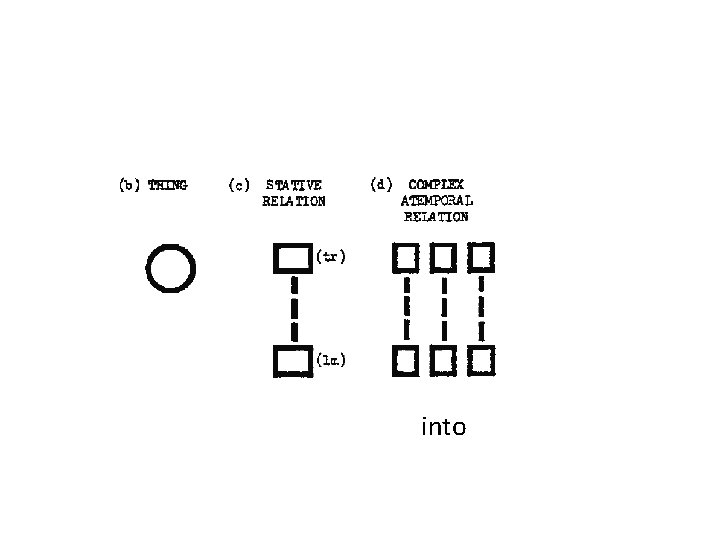
trajectory and landmark • “A relational predication elevates one of its participants to the status of figure. I refer to this participant as its ‘trajector’; other salient participants are referred to as ‘landmarks’. ” the preposition into
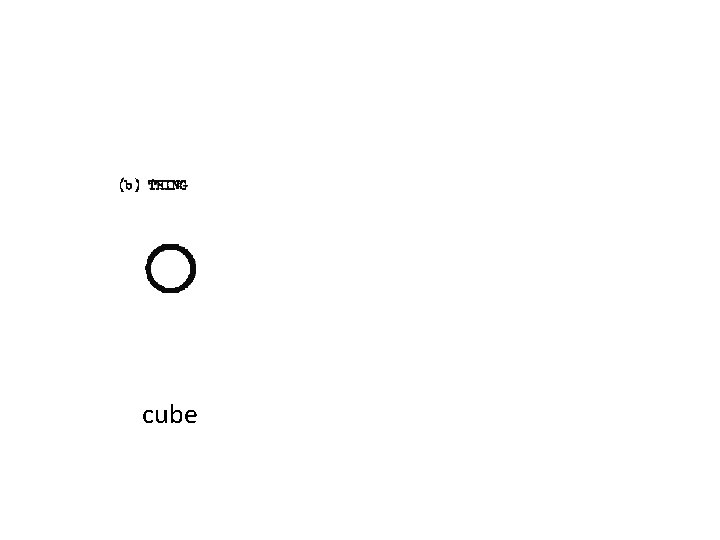
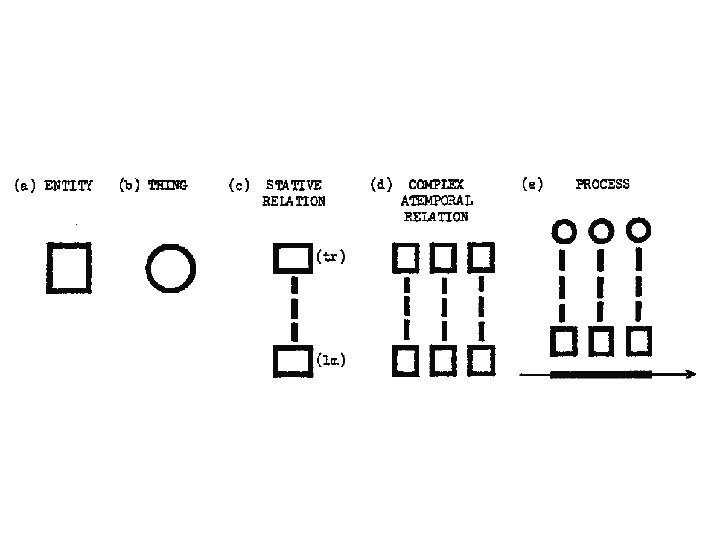
thing • “a region in some domain of conceptual space” • “a noun is a symbolic structure that designates a thing” – – – cube (a bounded region in 3 D space) moment (a bounded region in time) paragraph (a portion of a written work) B-flat (a point-like region on the musical scale) electricity (a bounded region in the ‘space’ of physical characteristics)
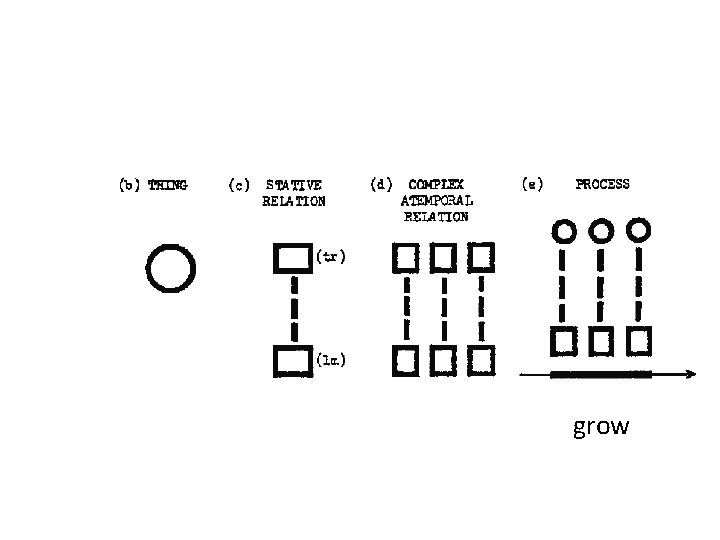
relation • “relational expressions profile the interconnections among conceived entities” – prepositions (above) – adjectives (red) – adverbs (quickly) – verbs (run)
cube
above
into
grow
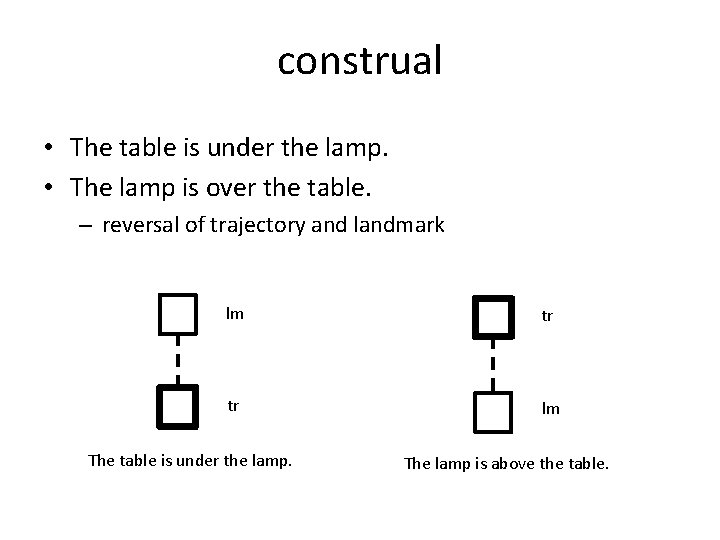
construal • “Construal is our ability to conceive and portray the same situation in alternate ways. Every lexical and grammatical element incorporates, as an inherent aspect of its meaning, a certain way of construing the conceptual content evoked. ”
construal • The table is under the lamp. • The lamp is over the table. – reversal of trajectory and landmark lm tr tr lm The table is under the lamp. The lamp is above the table.
construal • The neighbors are gone. • The neighbors are away. – same profile, different base
construal • Bill sent a walrus to Joyce. • Bill sent Joyce a walrus. – same base, different profiles
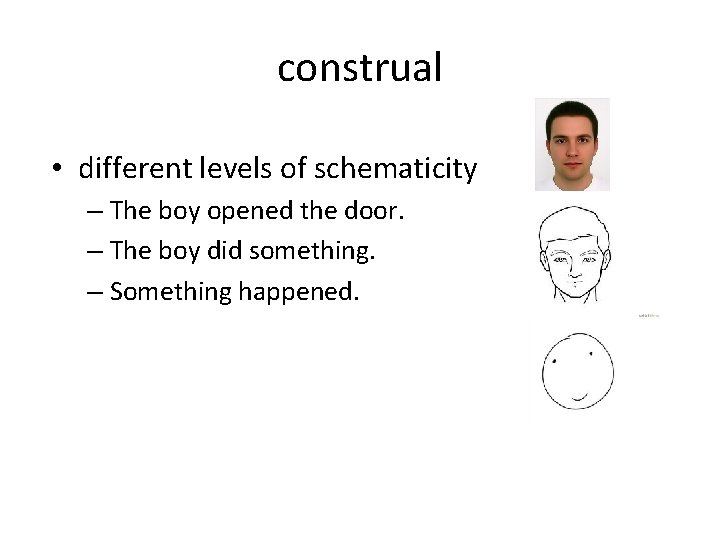
construal • different levels of schematicity – The boy opened the door. – The boy did something. – Something happened.
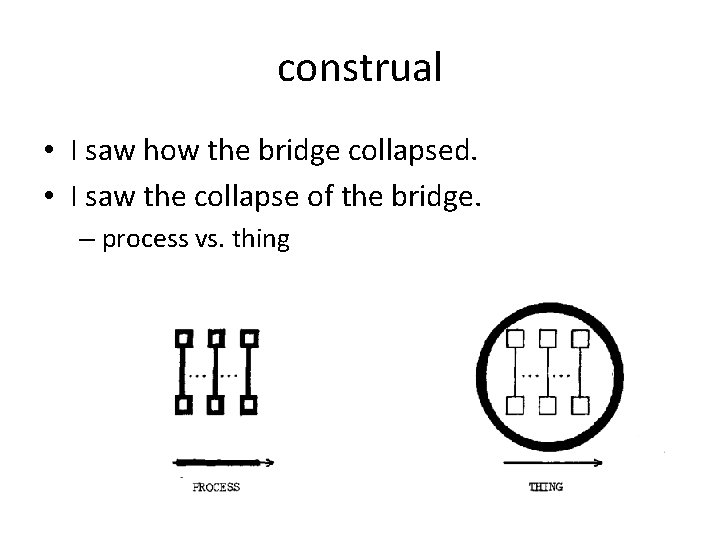
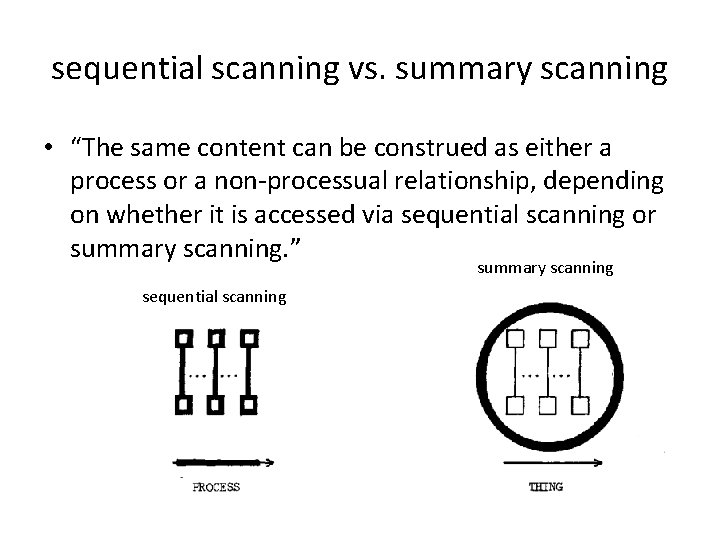
construal • I saw how the bridge collapsed. • I saw the collapse of the bridge. – process vs. thing
sequential scanning vs. summary scanning • “The same content can be construed as either a process or a non-processual relationship, depending on whether it is accessed via sequential scanning or summary scanning. ” summary scanning sequential scanning
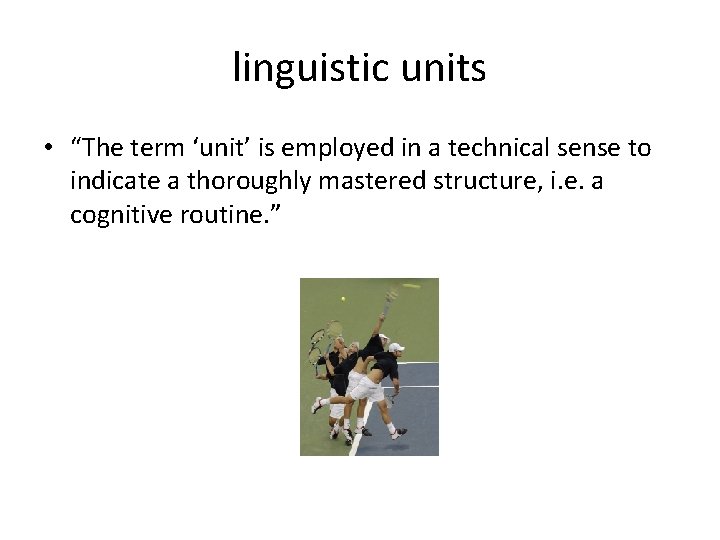
linguistic units • “The term ‘unit’ is employed in a technical sense to indicate a thoroughly mastered structure, i. e. a cognitive routine. ”
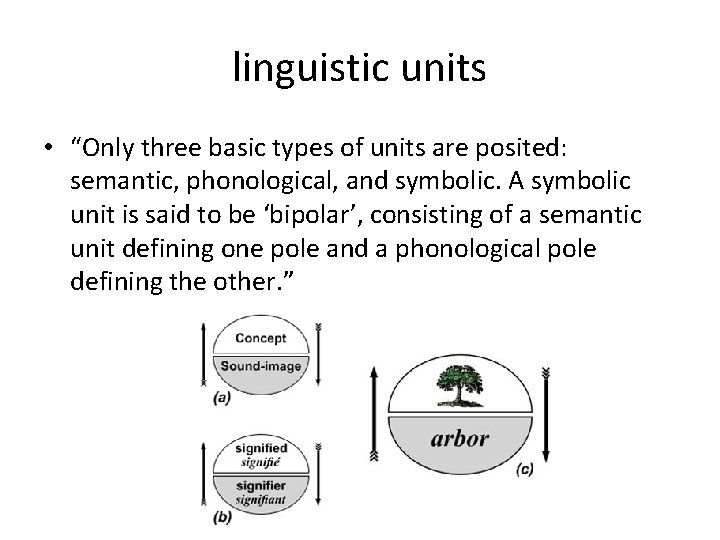
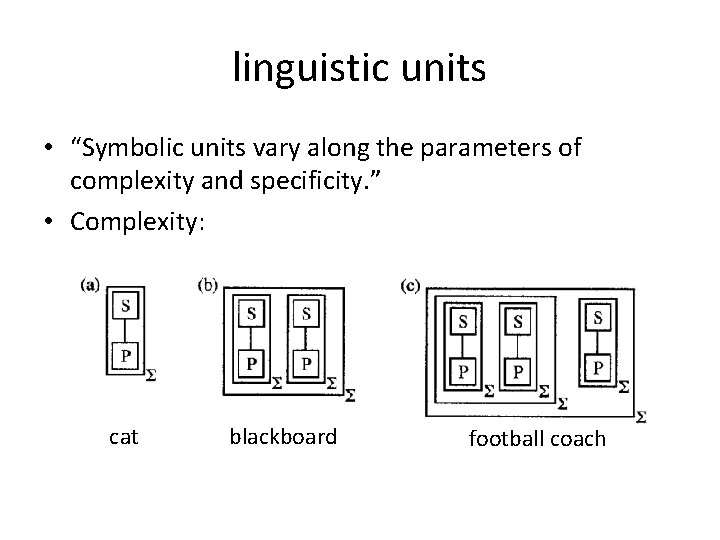
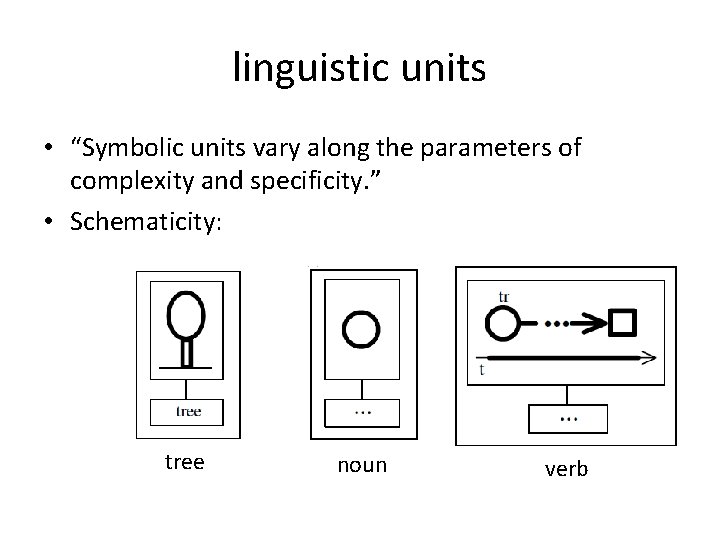
linguistic units • “Only three basic types of units are posited: semantic, phonological, and symbolic. A symbolic unit is said to be ‘bipolar’, consisting of a semantic unit defining one pole and a phonological pole defining the other. ”
linguistic units • “Symbolic units vary along the parameters of complexity and specificity. ” • Complexity: cat blackboard football coach
linguistic units • “Symbolic units vary along the parameters of complexity and specificity. ” • Schematicity: tree noun verb
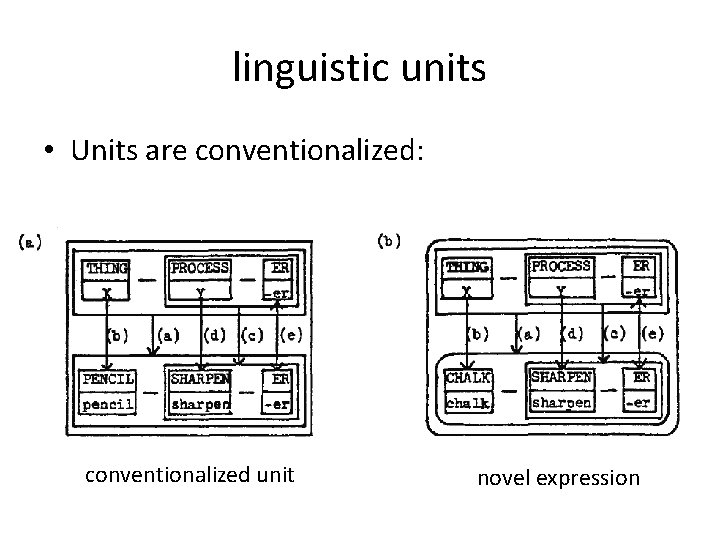
linguistic units • Units are conventionalized: conventionalized unit novel expression
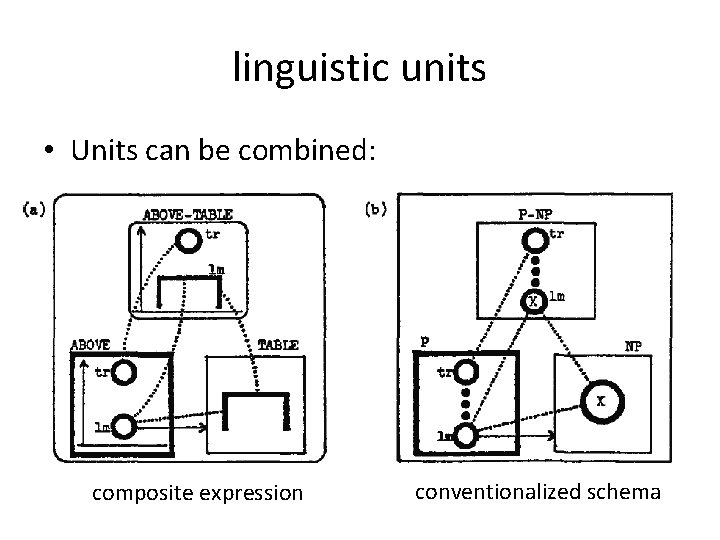
linguistic units • Units can be combined: composite expression conventionalized schema
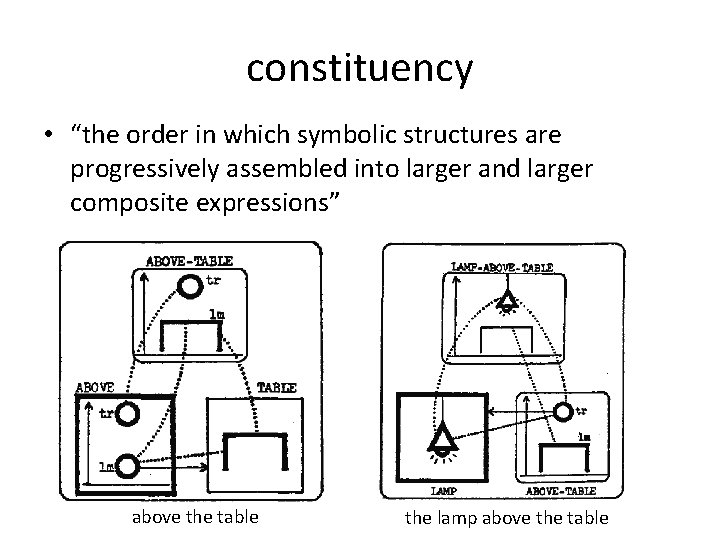
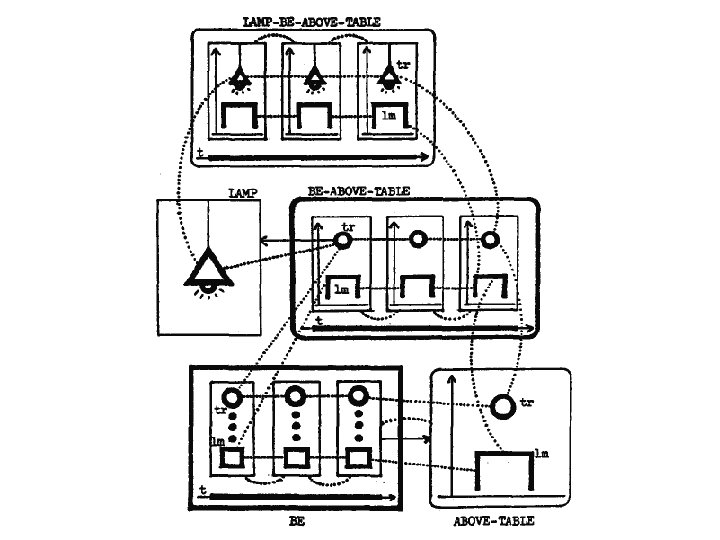
constituency • “the order in which symbolic structures are progressively assembled into larger and larger composite expressions” above the table the lamp above the table
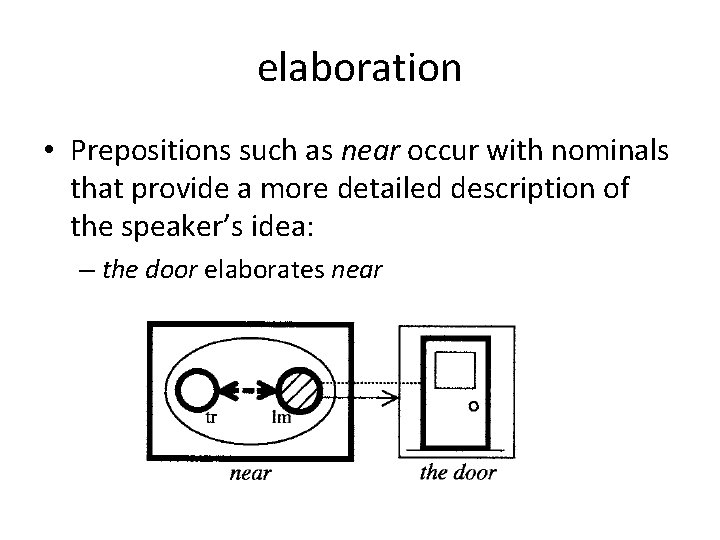
elaboration • “It is typical in a construction for one component structure to contain a schematic substructure which the other component serves to elaborate , i. e. characterize in finergrained detail. ” • “A schematic element elaborated by another component is called an elaboration site, or esite for short. ”
elaboration • Prepositions such as near occur with nominals that provide a more detailed description of the speaker’s idea: – the door elaborates near
elaboration • Elaboration sites: ‘open slots’ in complex constructions – the nominal in a prepositional phrase • near the door – the noun in a noun phrase with a determiner • the door – the object nominal in a transitive verb phrase • open the door
grounding • “Grounding is proposed as a technical term in Cognitive Grammar to characterize grammatical predications that indicate the relationship of a designated entity to the ground or situation of speech, including the speech event itself, its participants, and their respective spheres of knowledge. ” • “Grounding predications are obligatory grammatical elements needed to turn nouns into full nominals, and verbs into finite clauses. ”
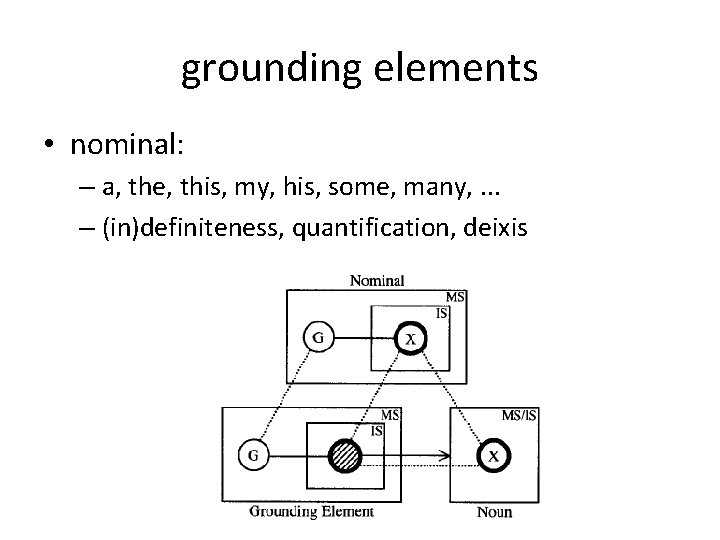
grounding elements • nominal: – a, the, this, my, his, some, many, . . . – (in)definiteness, quantification, deixis
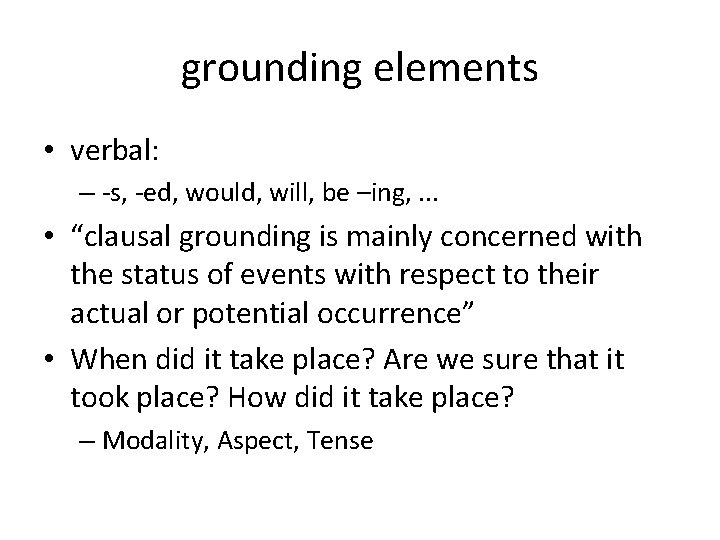
grounding elements • verbal: – -s, -ed, would, will, be –ing, . . . • “clausal grounding is mainly concerned with the status of events with respect to their actual or potential occurrence” • When did it take place? Are we sure that it took place? How did it take place? – Modality, Aspect, Tense
Summing up
pes a h s use edge e g a l langu tic know is lingu lang age use uage sh chan apes ge usage-based linguistics communicative functions shape language form language is groun de general cognitive d in processe s
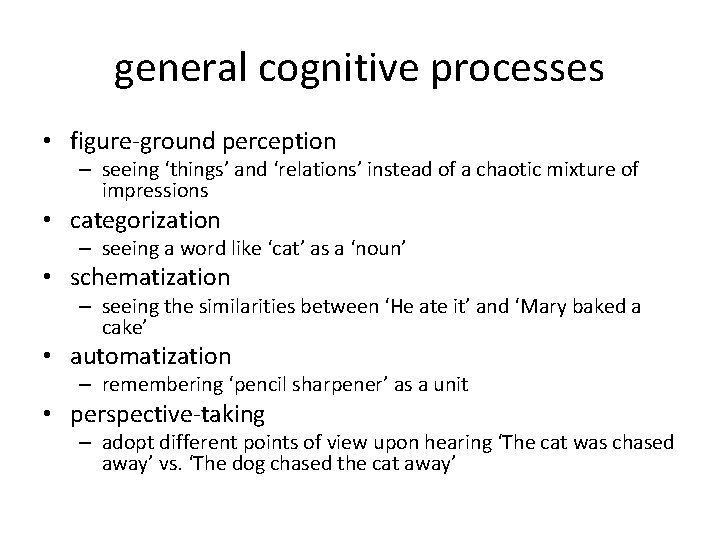
general cognitive processes • figure-ground perception – seeing ‘things’ and ‘relations’ instead of a chaotic mixture of impressions • categorization – seeing a word like ‘cat’ as a ‘noun’ • schematization – seeing the similarities between ‘He ate it’ and ‘Mary baked a cake’ • automatization – remembering ‘pencil sharpener’ as a unit • perspective-taking – adopt different points of view upon hearing ‘The cat was chased away’ vs. ‘The dog chased the cat away’
• Can we come up with a description of grammar that is based exclusively on sounds and meanings? • nouns, verbs, the present tense, the progressive aspect, relative clauses, demonstratives, accusative case, . . .
See you next time! martin. hilpert@unine. ch