
313 PHL Lab 1 Introduction Dose Response Curve
313 PHL Lab #1 Introduction & Dose Response Curve of Different Doses of Acetylcholine
Purpose of Pharmacological Experiments : The pharmacological experiments largely divided in to : Qualitative : - To determine ( analyze) the activity of drug (i. e. analgesic, hypotensive and hypoglycemic). -To determine mechanism of drugs action. Quantitative: To assay (measure) the potency of drugs (e. g. toxic level, therapeutic level, LD 50).
Types of pharmacological experiments : A- In vitro experiments - Study the action of drugs on isolated preparation: 1) Tissue e. g. (intestine, ileum). 2) Organ e. g. (heart). • Advantages: - Easier to study MOA (qualitative). - Easier to study its potency (quantitative) e. g. DRC on rectus abdominis. • Disadvantages : - There is no interference by compensatory mechanisms of body that may affect the direct action of drug not easy to study the chemical and biological effect of the drug.
B- In vivo experiments - Study the action of drugs on the whole body (intact). • Advantages: - Observe the direct drug action(actual effect). - Easier to study the chemical and biological effect. • Disadvantages : - Difficulty to determine the exact mechanism of action.
In vitro experiments 1) Experimental conditions: An isolated organ or muscle should be bathed in a suitable media that is resemble to the normal condition in the body regarding (p. H, osmolarity, temperature). Therefore, tissue is bathed in solution containing: 1 - Electrolytes. 2 - Nutrients. 3 - Adjusted Physiological p. H. 4 - Constant temperature. 5 - Aeration.
2) Physiological Salt Solution : • According to different tissue to be used, there is a different physiological solution prepared. • But all or most of them contain the following ingredients at different concentrations: 1 - Nacl → to adjust the isotonicity. 2 - Glucose → nutrient. 3 - Ca+2, K+, sometimes Mg+2 as CL salt → to maintain normal muscle contraction.
3 - Sodium bicarbonate → to adjust p. H similar to that of blood. 4 - Na. H 2 PO 4 (sodium di hydrogen phosphate) buffer→ to compensate for any change in p. H. The two most commonly used physiological solutions are Tyrode’s and Krebs.
3) Aeration: Physiological salt solutions should be aerated by a suitable gas : 1 - Pure oxygen → for heart tissues. 2 - Normal air → for intestine. 3 - Carbogen (95% O 2, 5% CO 2) → used for uterus.
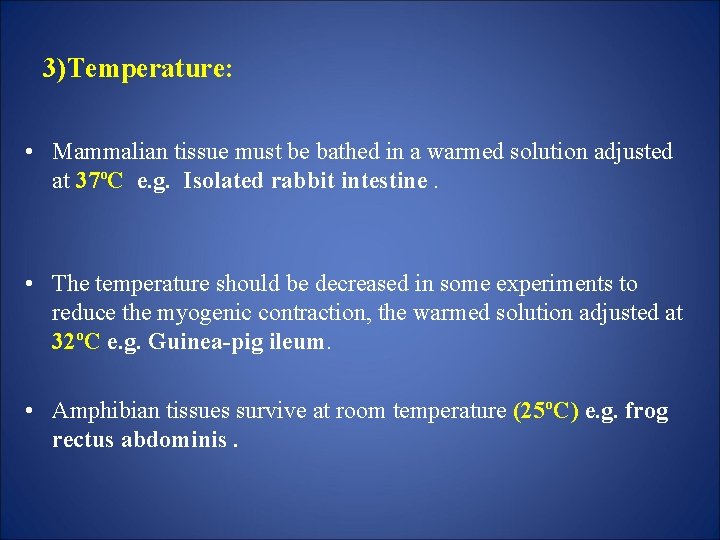
3)Temperature: • Mammalian tissue must be bathed in a warmed solution adjusted at 37ºC e. g. Isolated rabbit intestine. • The temperature should be decreased in some experiments to reduce the myogenic contraction, the warmed solution adjusted at 32ºC e. g. Guinea-pig ileum. • Amphibian tissues survive at room temperature (25ºC) e. g. frog rectus abdominis.
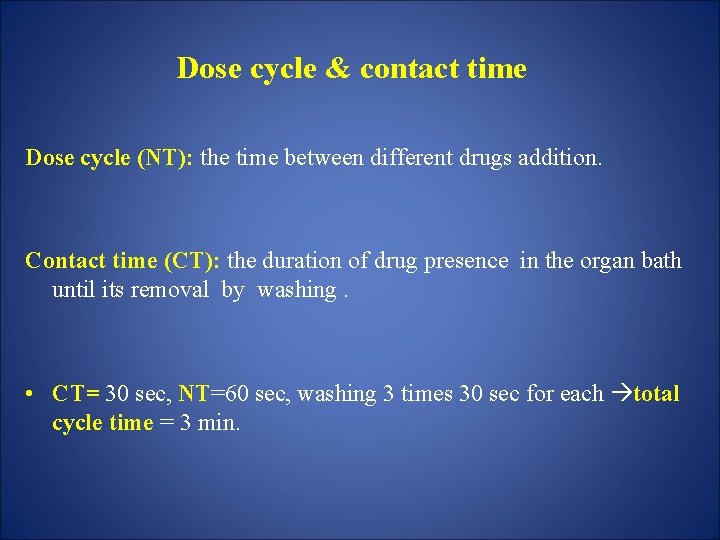
Dose cycle & contact time Dose cycle (NT): the time between different drugs addition. Contact time (CT): the duration of drug presence in the organ bath until its removal by washing. • CT= 30 sec, NT=60 sec, washing 3 times 30 sec for each total cycle time = 3 min.
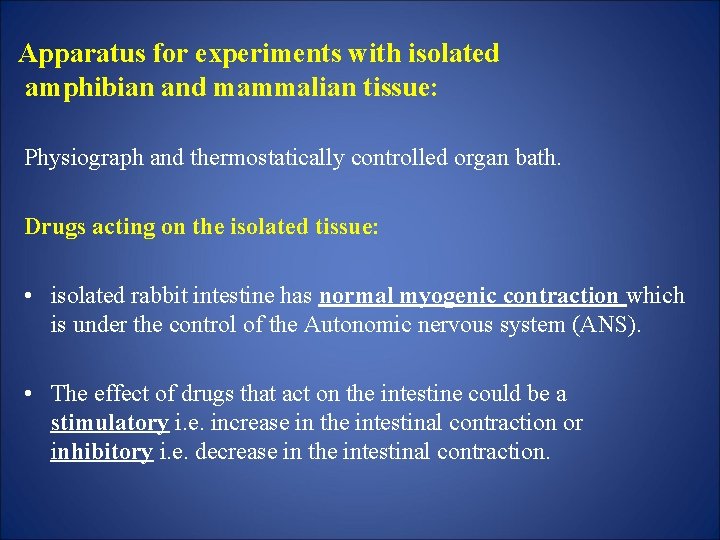
Apparatus for experiments with isolated amphibian and mammalian tissue: Physiograph and thermostatically controlled organ bath. Drugs acting on the isolated tissue: • isolated rabbit intestine has normal myogenic contraction which is under the control of the Autonomic nervous system (ANS). • The effect of drugs that act on the intestine could be a stimulatory i. e. increase in the intestinal contraction or inhibitory i. e. decrease in the intestinal contraction.
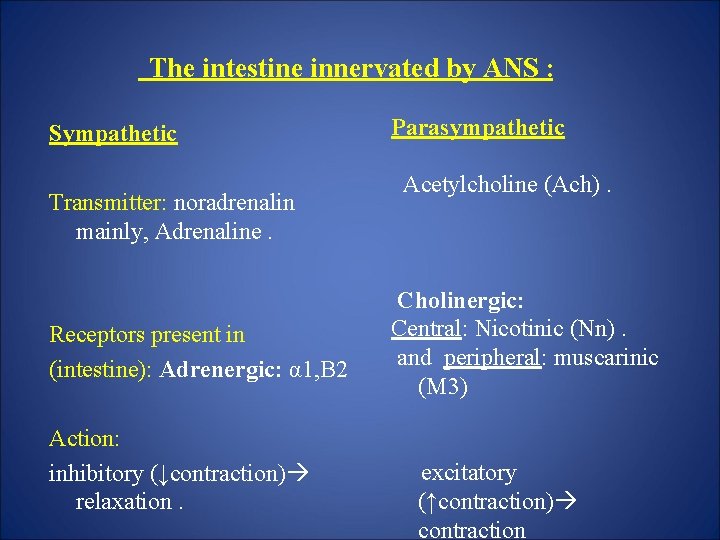
The intestine innervated by ANS : Sympathetic Transmitter: noradrenalin mainly, Adrenaline. Receptors present in (intestine): Adrenergic: α 1, B 2 Action: inhibitory (↓contraction) relaxation. Parasympathetic Acetylcholine (Ach). Cholinergic: Central: Nicotinic (Nn). and peripheral: muscarinic (M 3) excitatory (↑contraction) contraction
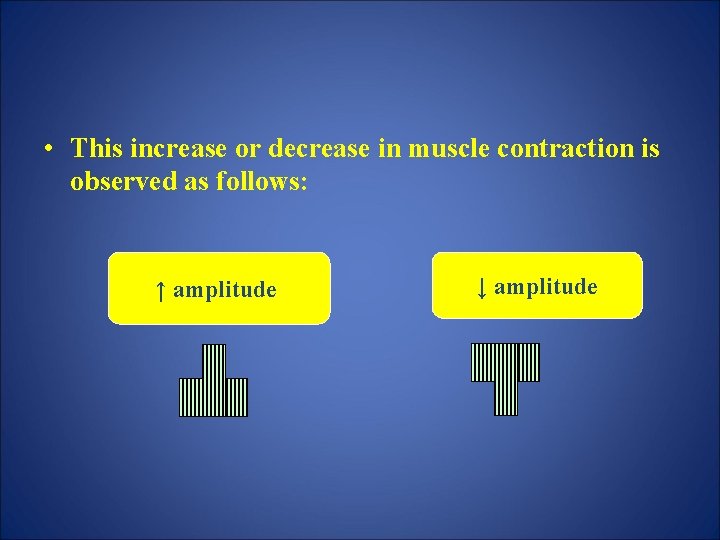
• This increase or decrease in muscle contraction is observed as follows: ↑ amplitude ↓ amplitude
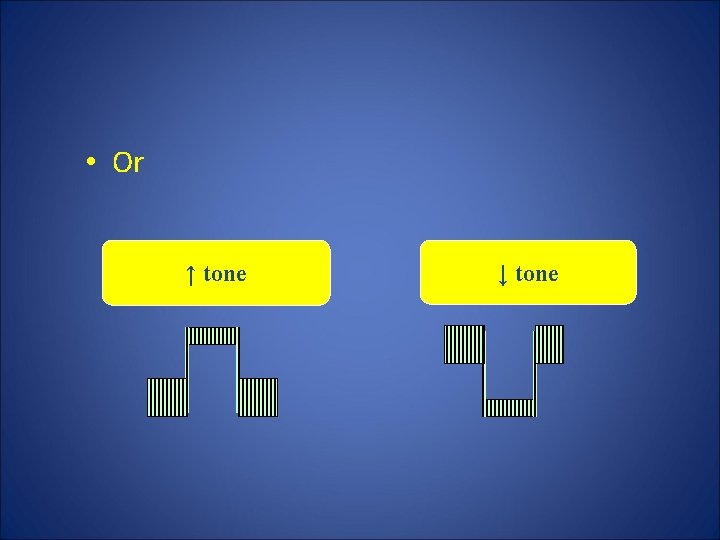
• Or ↑ tone ↓ tone
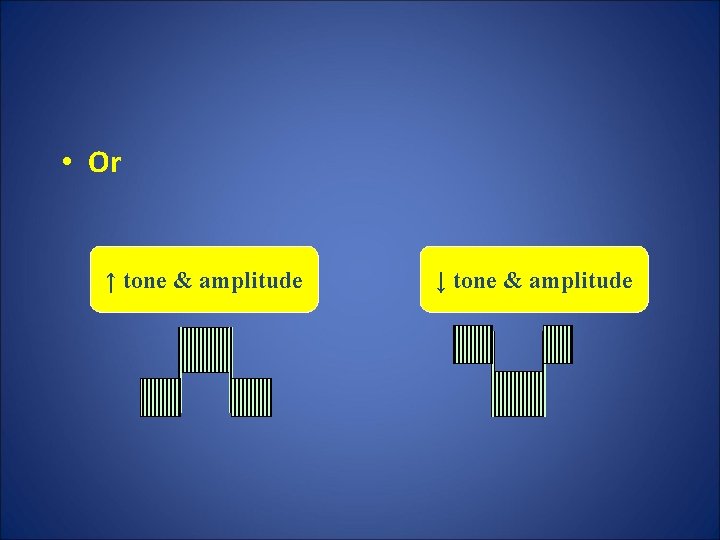
• Or ↑ tone & amplitude ↓ tone & amplitude
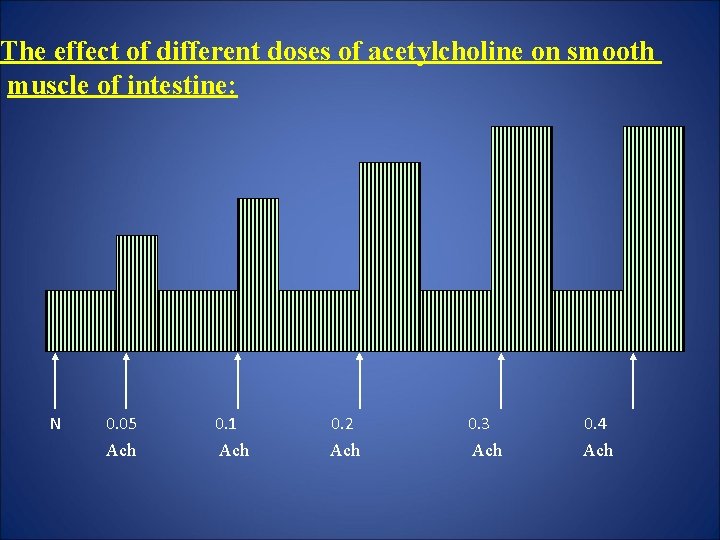
The effect of different doses of acetylcholine on smooth muscle of intestine: N 0. 05 0. 1 0. 2 0. 3 0. 4 Ach Ach Ach
- Slides: 16