
31 Gene regulation in bacteria Lecture Outline 111805
31 Gene regulation in bacteria
Lecture Outline 11/18/05 • Finish up from last time: • Transposable elements (“jumping genes”) • Gene Regulation in Bacteria – Transcriptional control – Cells adjust to their environment by turning genes on and off • The operon concept – Repressors, Inducers, Operators, Promoters • Repressible operons (e. g. trp) • Inducible operons (e. g. lac)
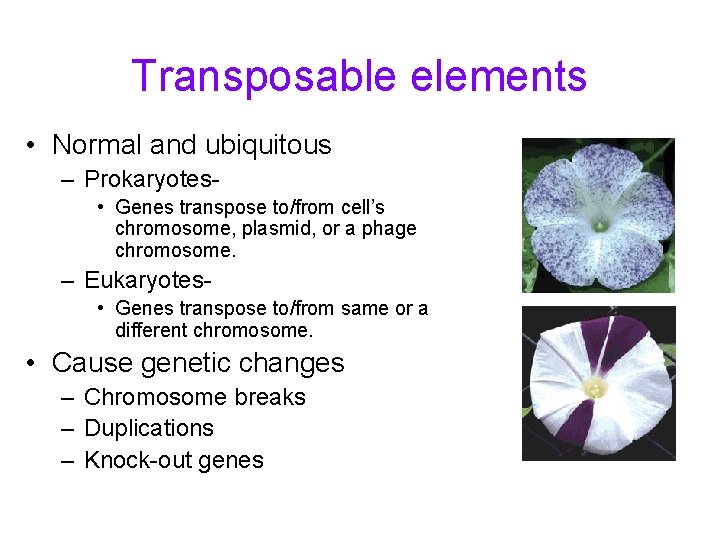
Transposable elements • Normal and ubiquitous – Prokaryotes • Genes transpose to/from cell’s chromosome, plasmid, or a phage chromosome. – Eukaryotes • Genes transpose to/from same or a different chromosome. • Cause genetic changes – Chromosome breaks – Duplications – Knock-out genes
I’ll talk about 2 kinds: • Insertion sequences • Ac/Ds elements in corn • A third major class: Retrotransposons – Uses RNA intermediate and reverse transcriptase – Most Important class in mammalian genomes
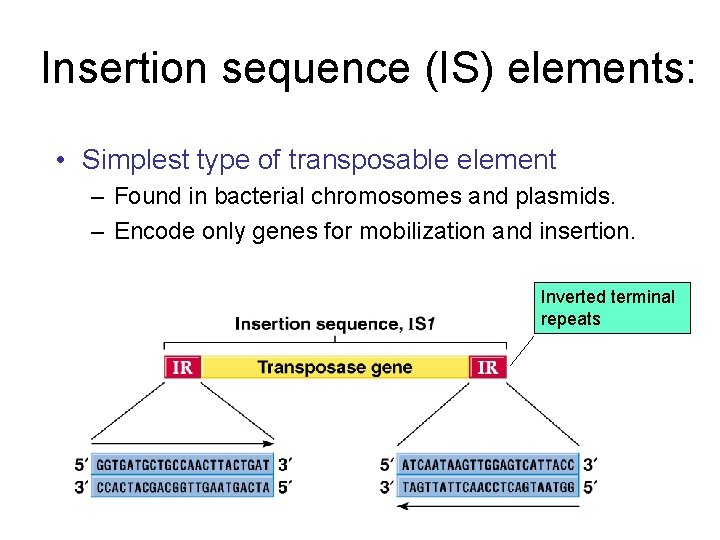
Insertion sequence (IS) elements: • Simplest type of transposable element – Found in bacterial chromosomes and plasmids. – Encode only genes for mobilization and insertion. Inverted terminal repeats
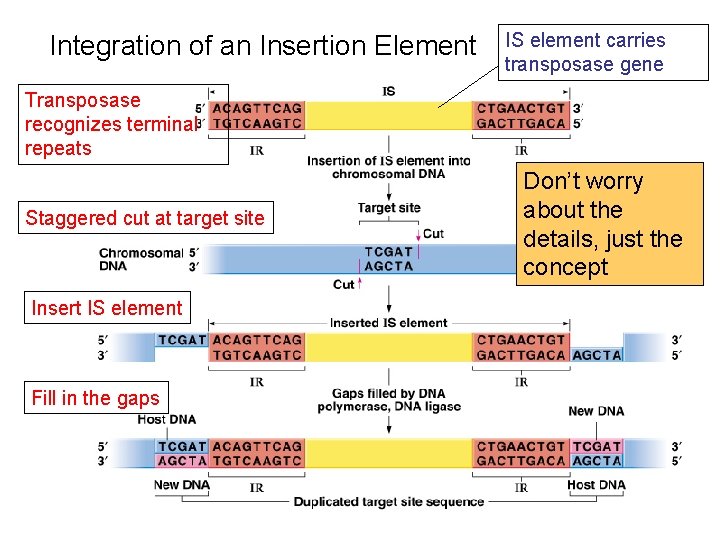
Integration of an Insertion Element IS element carries transposase gene Transposase recognizes terminal repeats Staggered cut at target site Insert IS element Fill in the gaps Don’t worry about the details, just the concept
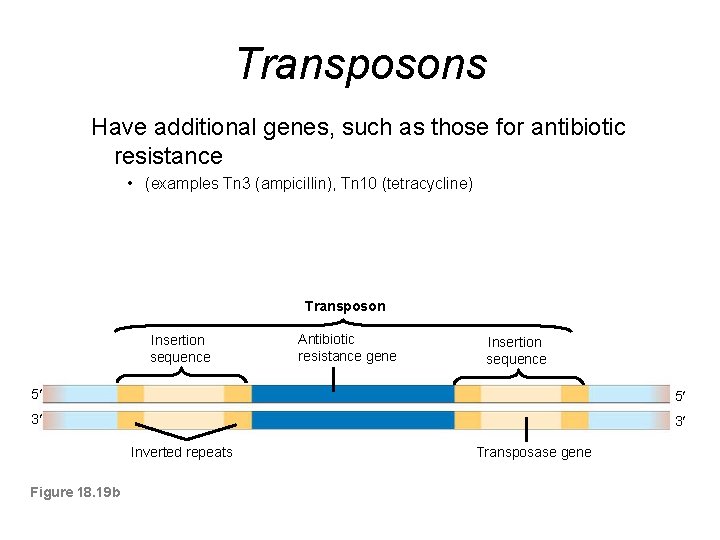
Transposons Have additional genes, such as those for antibiotic resistance • (examples Tn 3 (ampicillin), Tn 10 (tetracycline) Transposon Insertion sequence Antibiotic resistance gene Insertion sequence 5 5 3 3 Inverted repeats Figure 18. 19 b Transposase gene
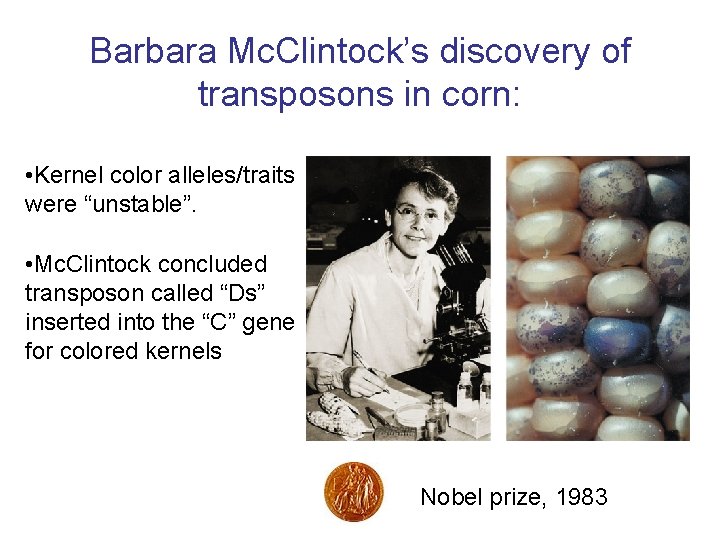
Barbara Mc. Clintock’s discovery of transposons in corn: • Kernel color alleles/traits were “unstable”. • Mc. Clintock concluded transposon called “Ds” inserted into the “C” gene for colored kernels Nobel prize, 1983
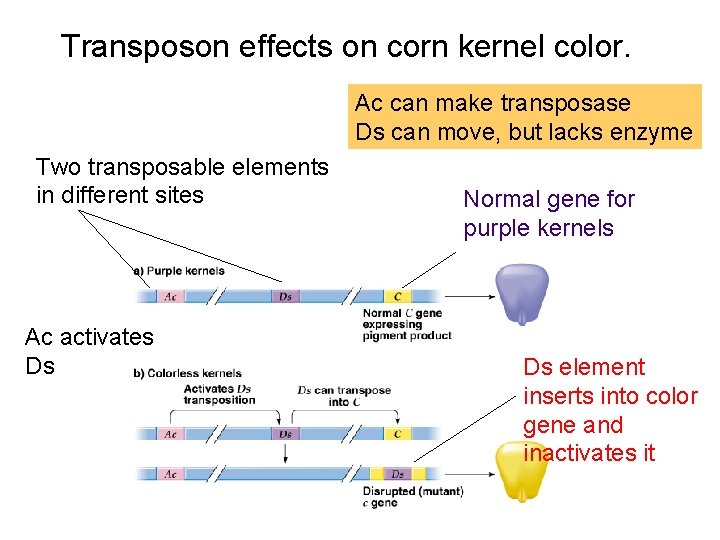
Transposon effects on corn kernel color. Ac can make transposase Ds can move, but lacks enzyme Two transposable elements in different sites Ac activates Ds Normal gene for purple kernels Ds element inserts into color gene and inactivates it
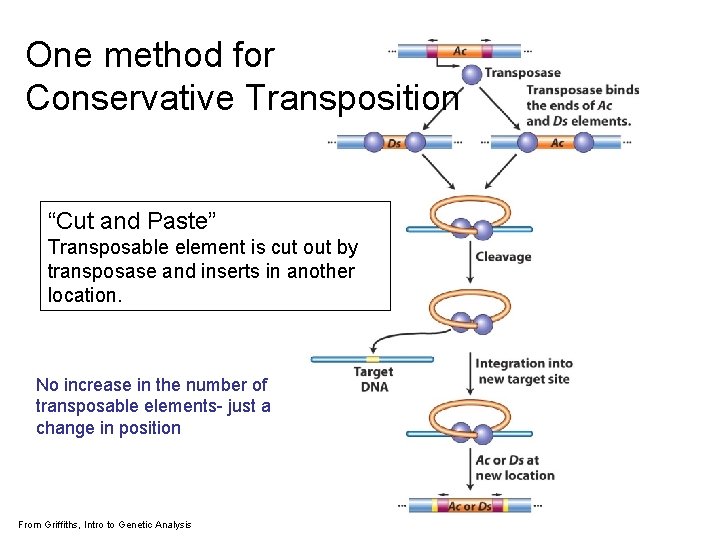
One method for Conservative Transposition “Cut and Paste” Transposable element is cut out by transposase and inserts in another location. No increase in the number of transposable elements- just a change in position From Griffiths, Intro to Genetic Analysis
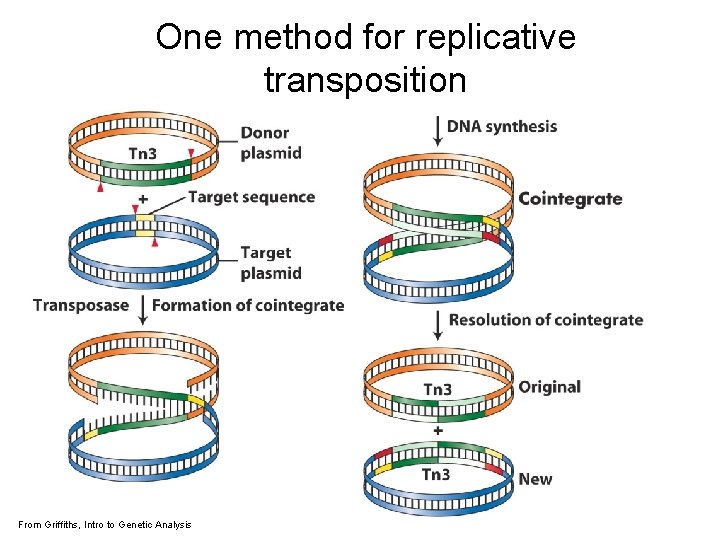
One method for replicative transposition From Griffiths, Intro to Genetic Analysis
Gene regulation in bacteria E. coli bacteria eat whatever we eat! But ALL organisms must adjust to changes in their environment and all have evolved numerous control mechanisms.
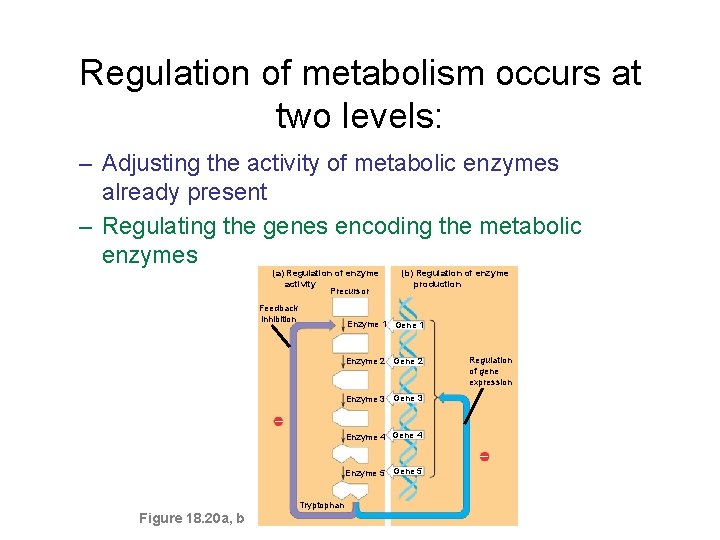
Regulation of metabolism occurs at two levels: – Adjusting the activity of metabolic enzymes already present – Regulating the genes encoding the metabolic enzymes (a) Regulation of enzyme activity Precursor Feedback inhibition (b) Regulation of enzyme production Enzyme 1 Gene 1 Enzyme 2 Gene 2 Regulation of gene expression Enzyme 3 Gene 3 – Enzyme 4 Gene 4 – Enzyme 5 Gene 5 Tryptophan Figure 18. 20 a, b
Types of Regulated Genes • Constitutive genes are always expressed – Tend to be vital for basic cell functions (often called “housekeeping genes”) • Inducible genes are normally off, but can be turned on when substrate is present • Common for catabolic enzymes (i. e. for the utilization of particular resources) • Repressible genes are normally on, but can be turned off when the end product is abundant • Common for anabolic enzymes

In bacteria, genes are often clustered into operons Operons have: 1. Several genes for metabolic enzymes 2. One promoter 3. An operator, or control site (“on-off” switch) 4. A separate gene that makes a repressor or activator protein that binds to the operator P R P O 1 2 3
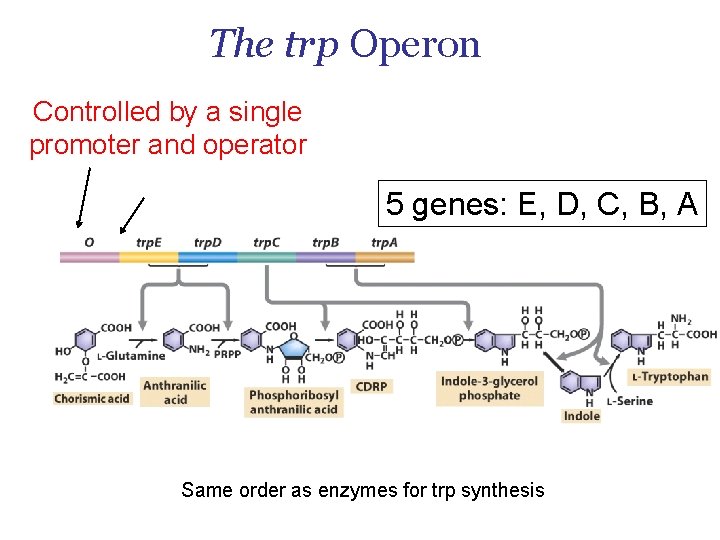
The trp Operon Controlled by a single promoter and operator 5 genes: E, D, C, B, A Same order as enzymes for trp synthesis
More Terminology • Repressors and Activators are proteins that bind to DNA and control transcription. • Co-repressors and Inducers: small “effector” molecules that bind to repressors or activators
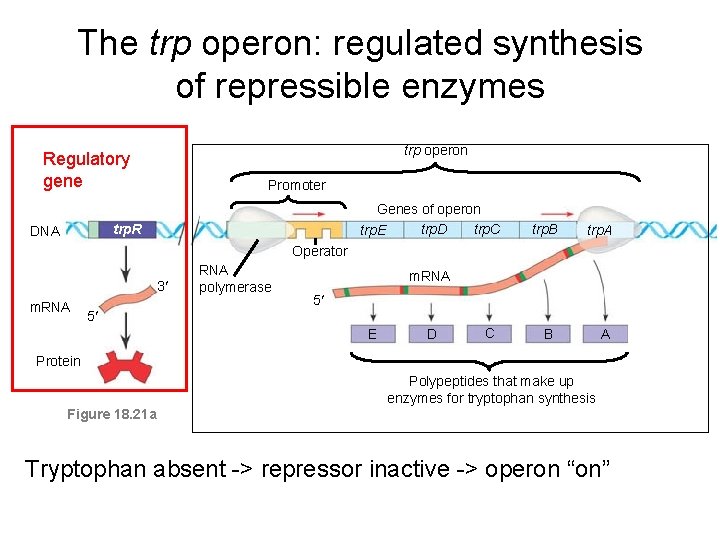
The trp operon: regulated synthesis of repressible enzymes trp operon Regulatory gene Promoter Genes of operon trp. D trp. C trp. E trp. R DNA trp. B trp. A Operator 3 m. RNA polymerase m. RNA 5 5 E D C B A Protein Polypeptides that make up enzymes for tryptophan synthesis Figure 18. 21 a Tryptophan absent -> repressor inactive -> operon “on”
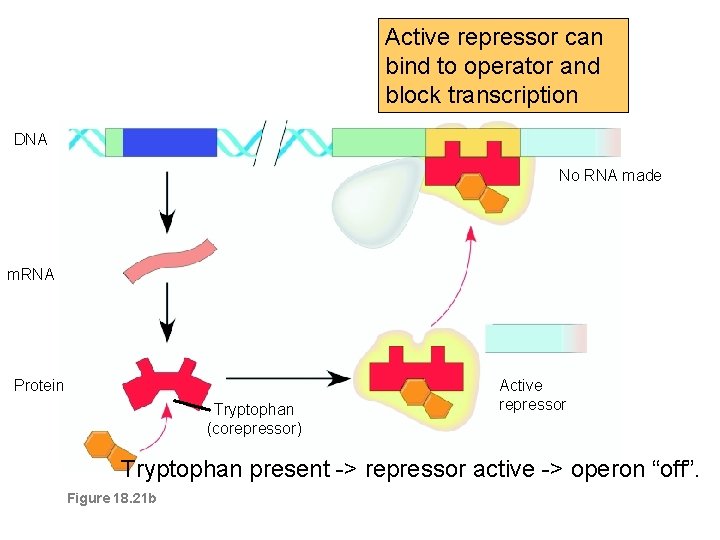
Active repressor can bind to operator and block transcription DNA No RNA made m. RNA Protein Tryptophan (corepressor) Active repressor Tryptophan present -> repressor active -> operon “off”. Figure 18. 21 b
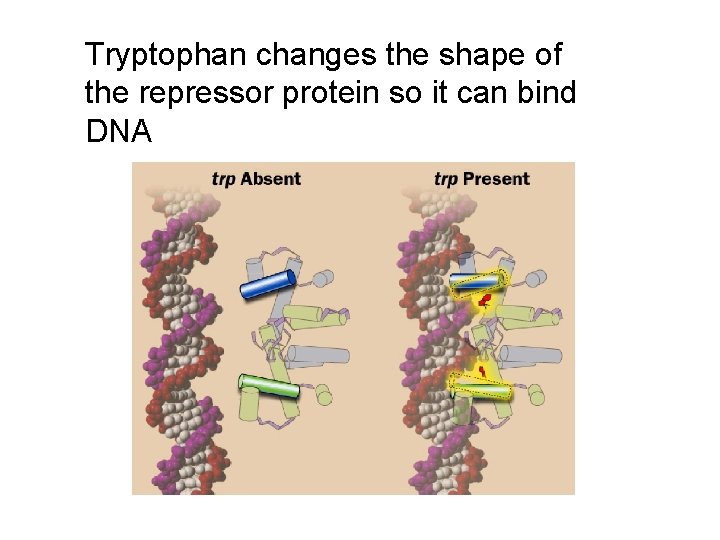
Tryptophan changes the shape of the repressor protein so it can bind DNA
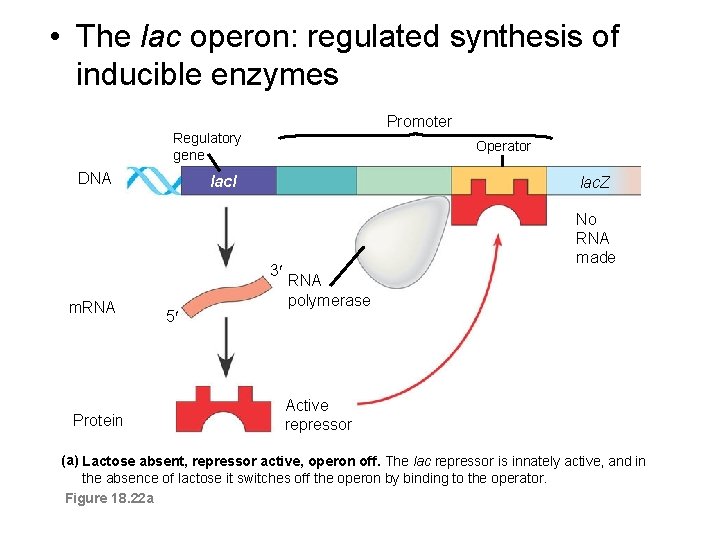
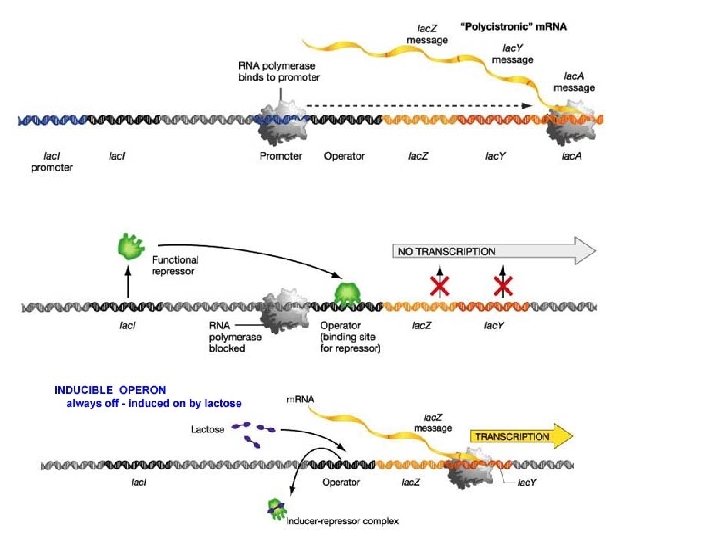
• The lac operon: regulated synthesis of inducible enzymes Promoter Regulatory gene DNA Operator lacl lac. Z 3 m. RNA Protein 5 No RNA made RNA polymerase Active repressor (a) Lactose absent, repressor active, operon off. The lac repressor is innately active, and in the absence of lactose it switches off the operon by binding to the operator. Figure 18. 22 a
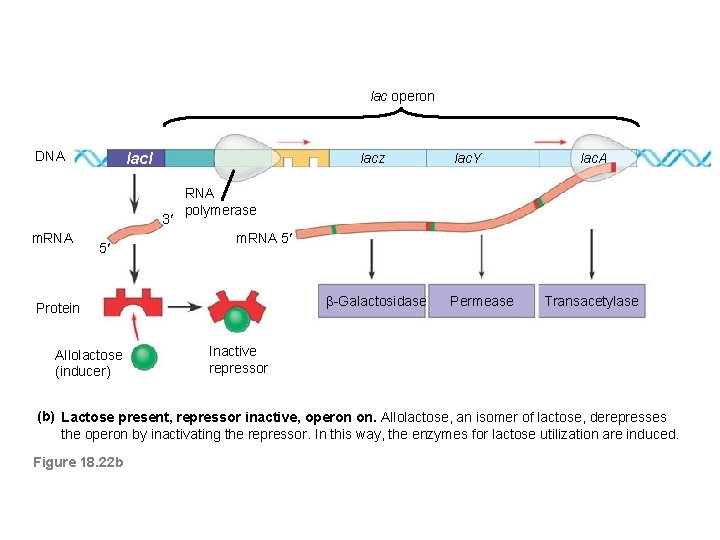
lac operon DNA lacl lacz 3 m. RNA 5 lac. A RNA polymerase m. RNA 5' 5 m. RNA -Galactosidase Protein Allolactose (inducer) lac. Y Permease Transacetylase Inactive repressor (b) Lactose present, repressor inactive, operon on. Allolactose, an isomer of lactose, derepresses the operon by inactivating the repressor. In this way, the enzymes for lactose utilization are induced. Figure 18. 22 b
Positive Gene Regulation • Both the trp and lac operons involve negative control of genes – because the operons are switched off by the active form of the repressor protein • Some operons are also subject to positive control – Via a stimulatory activator protein, such as catabolite activator protein (CAP)
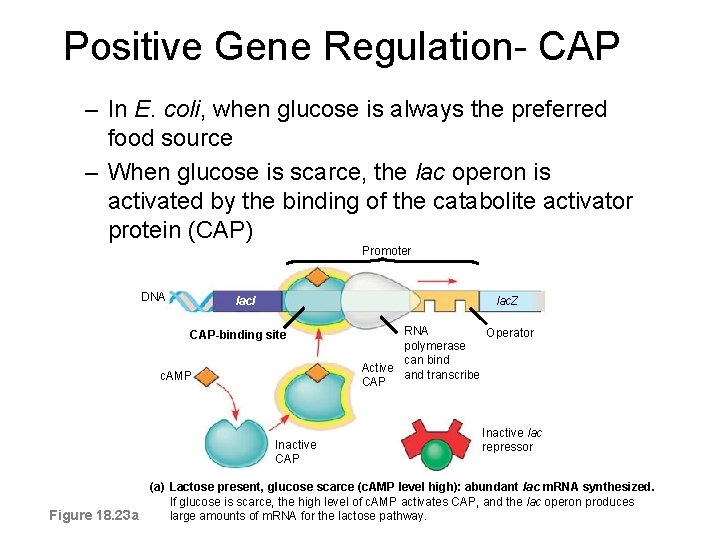
Positive Gene Regulation- CAP – In E. coli, when glucose is always the preferred food source – When glucose is scarce, the lac operon is activated by the binding of the catabolite activator protein (CAP) Promoter DNA lacl lac. Z CAP-binding site c. AMP Inactive CAP RNA Operator polymerase can bind Active and transcribe CAP Inactive lac repressor (a) Lactose present, glucose scarce (c. AMP level high): abundant lac m. RNA synthesized. If glucose is scarce, the high level of c. AMP activates CAP, and the lac operon produces Figure 18. 23 a large amounts of m. RNA for the lactose pathway.
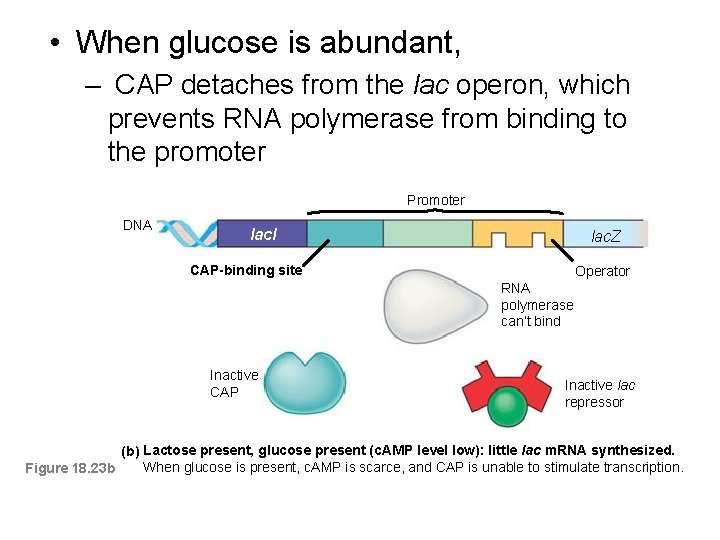
• When glucose is abundant, – CAP detaches from the lac operon, which prevents RNA polymerase from binding to the promoter Promoter DNA lacl lac. Z CAP-binding site Operator RNA polymerase can’t bind Inactive CAP Inactive lac repressor (b) Lactose present, glucose present (c. AMP level low): little lac m. RNA synthesized. When glucose is present, c. AMP is scarce, and CAP is unable to stimulate transcription. Figure 18. 23 b
- Slides: 26