
304 649 Course Project Intro IMMJPDAF MultipleTarget Tracking
- Slides: 8
304 -649 Course Project Intro IMM-JPDAF Multiple-Target Tracking Algorithm: Description and Performance Testing By Melita Tasic 3/5/2001
Overview • Multiple-targets in clutter; tracking principles and techniques • Data Association • Filtering and Prediction • IMM-JPDAF • Measures of Performance
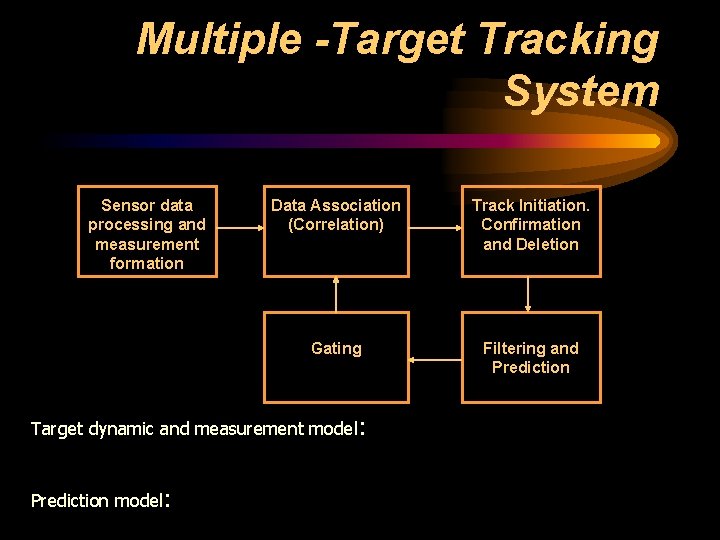
Multiple -Target Tracking System Sensor data processing and measurement formation Data Association (Correlation) Track Initiation. Confirmation and Deletion Gating Filtering and Prediction Target dynamic and measurement model: Prediction model:
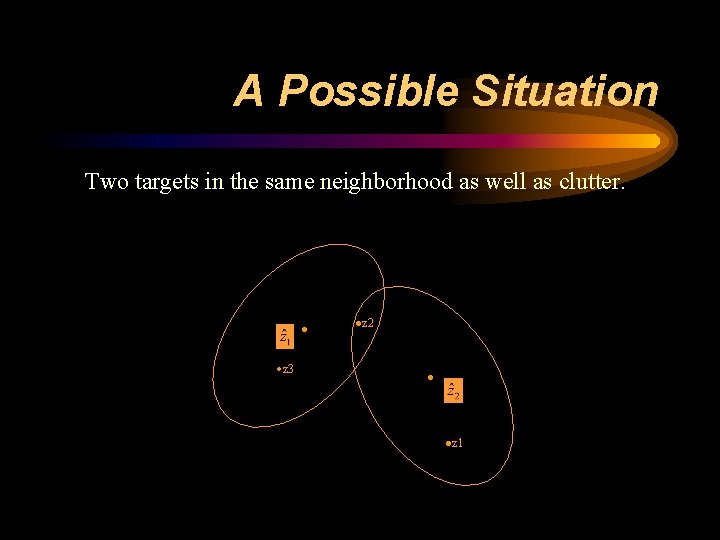
A Possible Situation Two targets in the same neighborhood as well as clutter. ● z 3 ●z 2 ● ●z 1
Data Association • Measurement–to-Track correlation-the key element of MTT – Deterministic (non-Bayesian) approaches – Probabilistic (Bayesian) approaches • Includes Gating – To decide if a measurement belongs to a established track or to a new target • Miscorrelation – Large prediction errors - tracks become ”starved” for observations, thus deleted – Unstable tracking decreased by increasing PD or by improved data association methods
Filtering and Prediction • Incorporates correlating observations into the update track estimates • Typical choice - Kalman filter – Advantages • associated covariance matrix can be used for gating • Provides convenient way to determine filter gains as a function of assumed measurement model, target maneuver model and measurement sequence – Cost • Additional computations and storage requirements
IMM-JPDAF • IMM - Interactive multiple model approach – Obeys one of finite number of motion models (modes) – The filter switches between modes according to a Markov chain • JPDAF - Joint Probability Data Association Filter – Multi-hypotheses are formed after each scan, but combined before the next scan of data is processed – Used for calculations of association probabilities, using all measurements and all tracks – Association probabilities used for the track update
Measures of Performance (MOPs) • Reaction Time • Track Quality – Track Estimation • State Estimation Error • Radial Miss Distance – Track Purity (Misassociation) – the percentage of correctly associated measurements