
30 Years of BGP Design Expectations vs Deployment
30 Years of BGP Design Expectations vs. Deployment Reality in Protocol Development Geoff Huston APNIC June 2019
In the Beginning… • BGP was an evolution of the earlier EGP protocol (developed in 1982 by Eric Rosen and Dave Mills) • BGP-1 – RFC 1105, June 1989, Kirk Lougheed, Yakov Rekhter • TCP-based message exchange protocol, based on distance vector routing algorithm with explicit path attributes • BGP-3 – RFC 1267, October 1991, Kirk Lougheed, Yakov Rekhter • Essentially a clarification and minor tweaks to the basic concepts used in BGP • BGP-4 – RFC 1654, July 1994, Yakov Rekhter, Tony Li • Added CIDR (explicit prefix lengths) and proxy aggregation
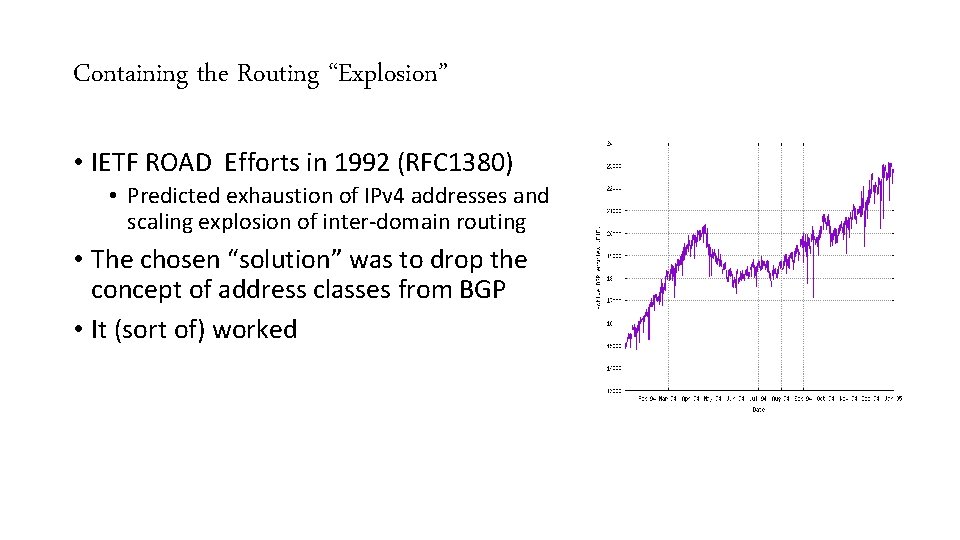
Containing the Routing “Explosion” • IETF ROAD Efforts in 1992 (RFC 1380) • Predicted exhaustion of IPv 4 addresses and scaling explosion of inter-domain routing • The chosen “solution” was to drop the concept of address classes from BGP • It (sort of) worked
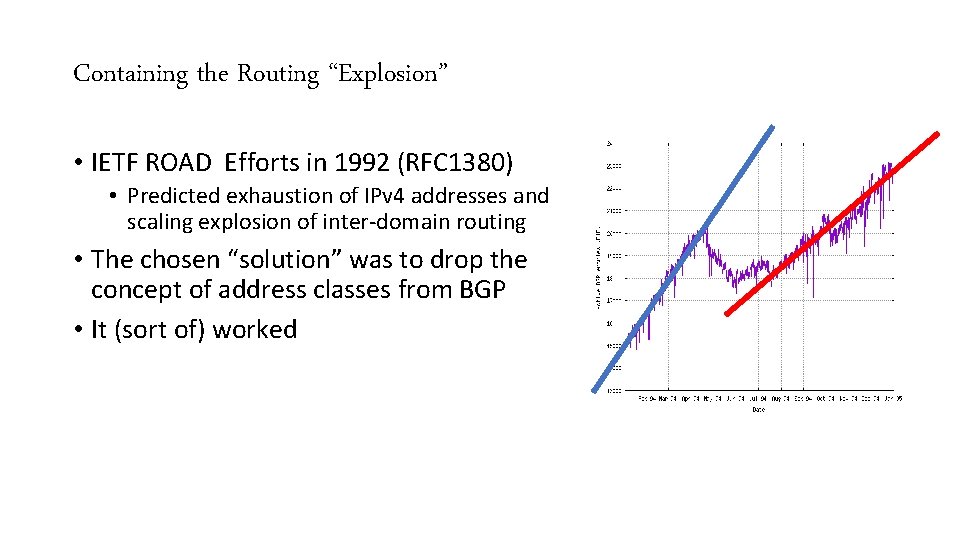
Containing the Routing “Explosion” • IETF ROAD Efforts in 1992 (RFC 1380) • Predicted exhaustion of IPv 4 addresses and scaling explosion of inter-domain routing • The chosen “solution” was to drop the concept of address classes from BGP • It (sort of) worked
IPv 6 and BGP • While the IETF adopted the IPv 6 address architecture for the address exhaustion issue, it was unable to find an IPv 6 routing architecture that had similar scaling properties • IETF efforts to impose a routing hierarchy (TLAs and sub-TLAs – RFC 2928) got nowhere! • So we just used BGP for IPv 6 in the same way as we used BGP for IPv 4 • Address allocation policies that allocated ‘independent’ address blocks of /35 or larger • ISP traffic engineering and hijack “defence” by advertising /48 s
BGP isn’t perfect • Session insecurity • Payload insecurity • Protocol instability • Sparseness of signalling • No ability to distinguish between topology maintenance and policy negotiation

Scale generates inertia • BGP-4 was introduces when the routing table contains ~ 20 K entries – it is now ~800 K entries • The network carries some 75 K ASNs • Changing the internet to use a new common IDR protocol would be incredibly challenging – something would need to break to force change
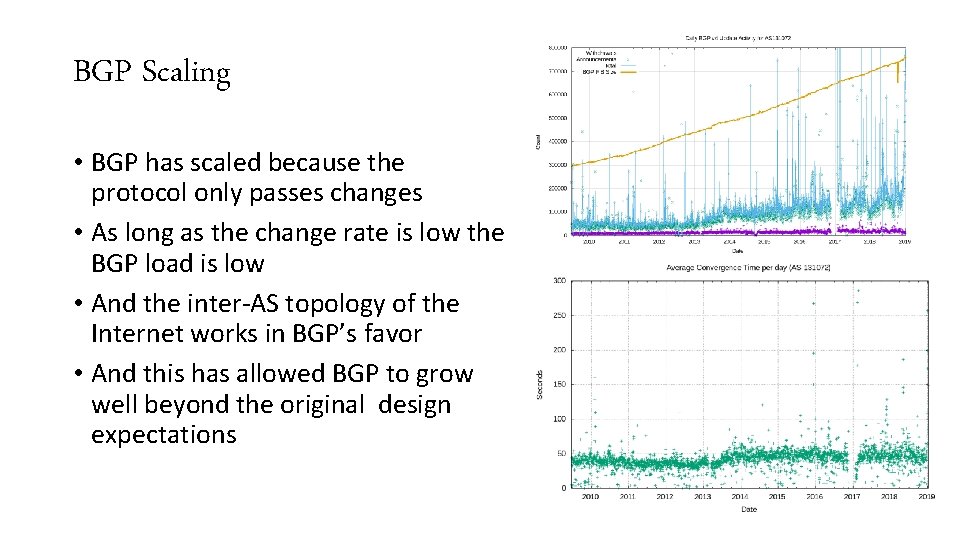
BGP Scaling • BGP has scaled because the protocol only passes changes • As long as the change rate is low the BGP load is low • And the inter-AS topology of the Internet works in BGP’s favor • And this has allowed BGP to grow well beyond the original design expectations
Expectations vs Deployment • Session lifetime • Expectations of short session lifetimes – experience of longevity • Session Security • Expectation of routing being a public function - experience of session attack • Payload Integrity • Expectations of mutual trust – experience of malicious and negligent attack • Protocol Performance • Expectations of slow performance – experience of more demanding environments • Error Handling • Expectations of “clear session” as the universal solution – experience required better recovery without session teardown • Use • Expectations of topology maintenance – experience of traffic engineering
Why does BGP still work? • It’s a Hop-by-Hop protocol • This allows new behaviours to be deployed on an incremental basis, as long as there is a “tunnelling” capability to pass through legacy speakers • A classic example is the 2 -byte to 4 -byte AS number transition in BGP • It’s layered above a generic reliable stream transport • Arbitrary message sizes are supportable • No need to refresh sent information
- Slides: 10