
30 Sorting 1 dimensional Arrays Bubble Sort Insertion
30. Sorting 1 -dimensional Arrays Bubble Sort Insertion Sort Insight Through Computing 1
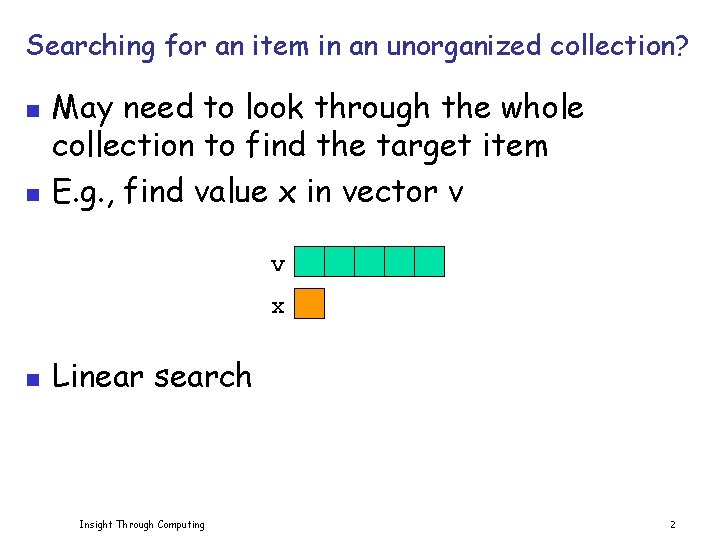
Searching for an item in an unorganized collection? n n May need to look through the whole collection to find the target item E. g. , find value x in vector v v x n Linear search Insight Through Computing 2
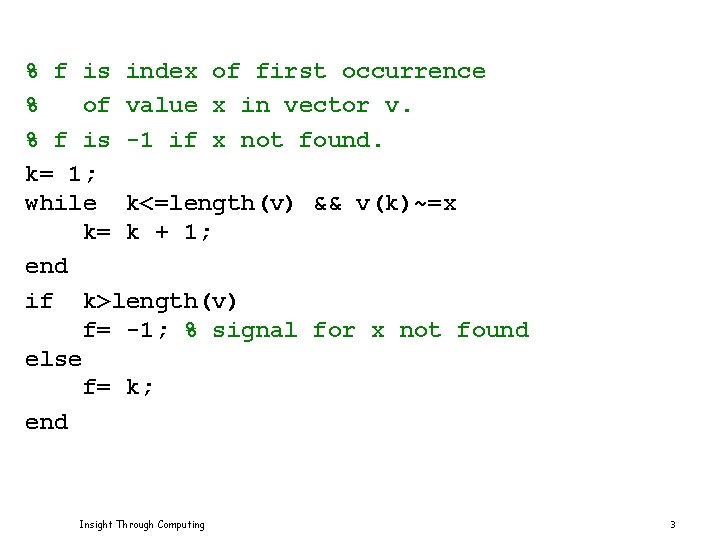
% f is index of first occurrence % of value x in vector v. % f is -1 if x not found. k= 1; while k<=length(v) && v(k)~=x k= k + 1; end if k>length(v) f= -1; % signal for x not found else f= k; end Insight Through Computing 3
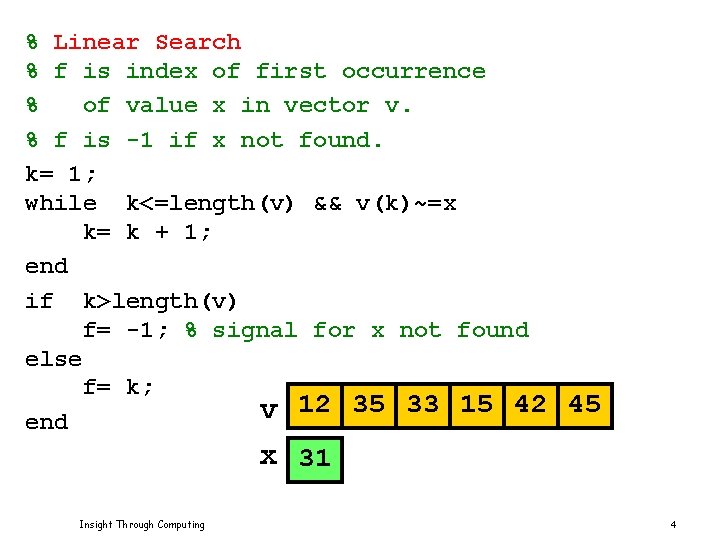
% Linear Search % f is index of first occurrence % of value x in vector v. % f is -1 if x not found. k= 1; while k<=length(v) && v(k)~=x k= k + 1; end if k>length(v) f= -1; % signal for x not found else f= k; 12 35 33 15 42 45 v end x 31 Insight Through Computing 4
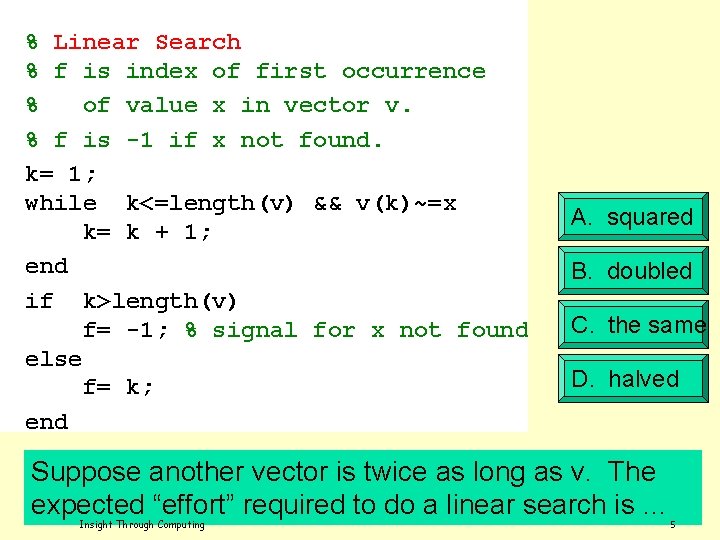
% Linear Search % f is index of first occurrence % of value x in vector v. % f is -1 if x not found. k= 1; while k<=length(v) && v(k)~=x k= k + 1; end if k>length(v) f= -1; % signal for x not found else f= k; end A. squared B. doubled C. the same D. halved Suppose another vector is twice as long as v. The expected “effort” required to do a linear search is … Insight Through Computing 5
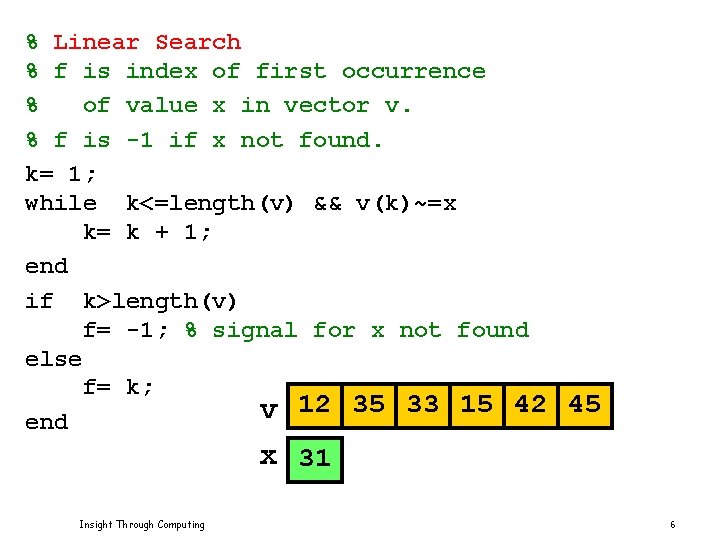
% Linear Search % f is index of first occurrence % of value x in vector v. % f is -1 if x not found. k= 1; while k<=length(v) && v(k)~=x k= k + 1; end if k>length(v) f= -1; % signal for x not found else f= k; 12 35 33 15 42 45 v end x 31 Insight Through Computing 6
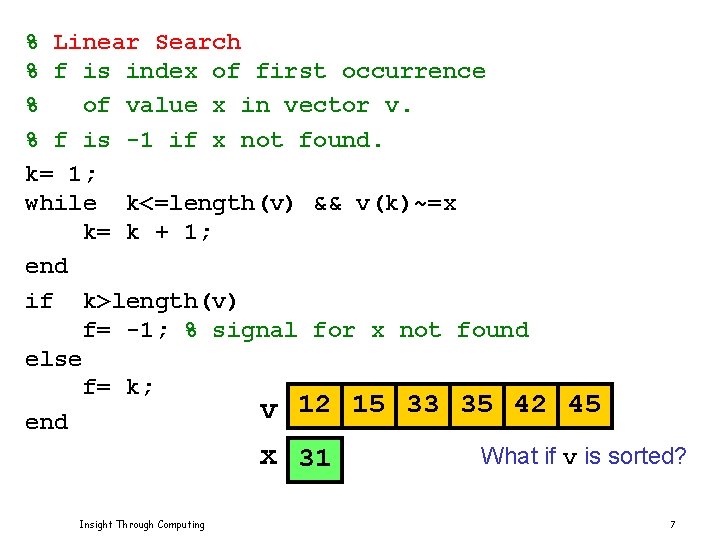
% Linear Search % f is index of first occurrence % of value x in vector v. % f is -1 if x not found. k= 1; while k<=length(v) && v(k)~=x k= k + 1; end if k>length(v) f= -1; % signal for x not found else f= k; 12 15 33 35 42 45 v end x 31 What if v is sorted? Insight Through Computing 7
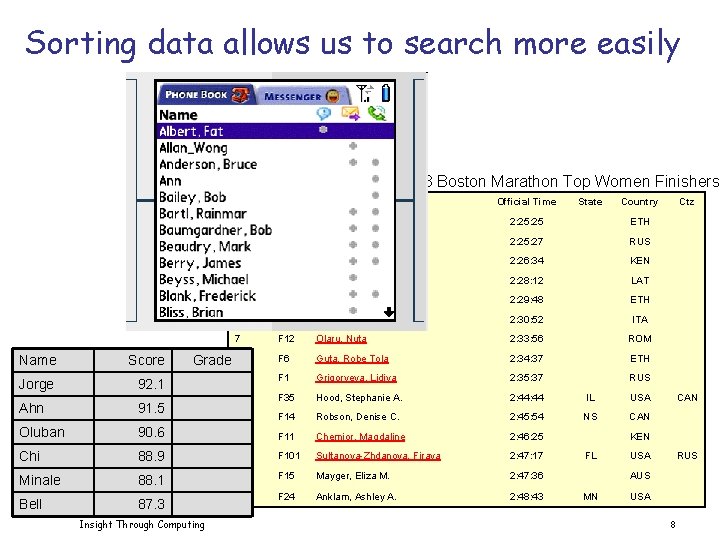
Sorting data allows us to search more easily 2008 Boston Marathon Top Women Finishers Place Bib Name Official Time State Country 1 F 7 Tune, Dire 2: 25 ETH 2 F 8 Biktimirova, Alevtina 2: 25: 27 RUS 3 F 4 Jeptoo, Rita 2: 26: 34 KEN 4 F 2 Prokopcuka, Jelena 2: 28: 12 LAT 5 F 5 Magarsa, Askale Tafa 2: 29: 48 ETH 6 F 9 Genovese, Bruna 2: 30: 52 ITA 7 F 12 Olaru, Nuta 2: 33: 56 ROM Name Score Grade 8 F 6 Guta, Robe Tola 2: 34: 37 ETH Jorge 92. 1 9 F 1 Grigoryeva, Lidiya 2: 35: 37 RUS Ahn 91. 5 10 F 35 Hood, Stephanie A. 2: 44 IL USA 11 F 14 Robson, Denise C. 2: 45: 54 NS CAN Oluban 90. 6 12 F 11 Chemjor, Magdaline 2: 46: 25 Chi 88. 9 13 F 101 Sultanova-Zhdanova, Firaya 2: 47: 17 Minale 88. 1 14 F 15 Mayger, Eliza M. 2: 47: 36 Bell 87. 3 15 F 24 Anklam, Ashley A. 2: 48: 43 Insight Through Computing Ctz CAN KEN FL USA RUS AUS MN USA 8
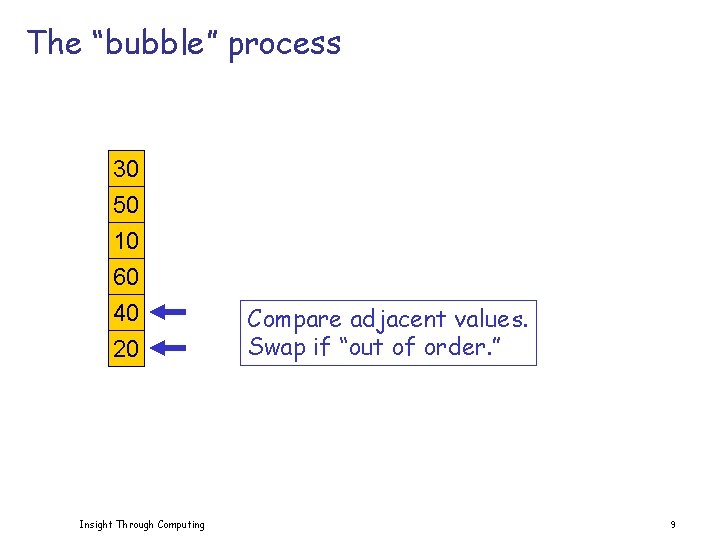
The “bubble” process 30 50 10 60 40 20 Insight Through Computing Compare adjacent values. Swap if “out of order. ” 9
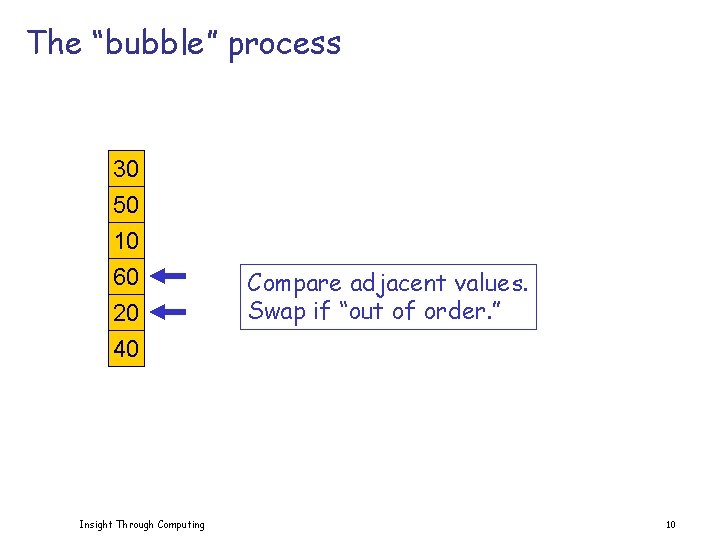
The “bubble” process 30 50 10 60 20 40 Insight Through Computing Compare adjacent values. Swap if “out of order. ” 10
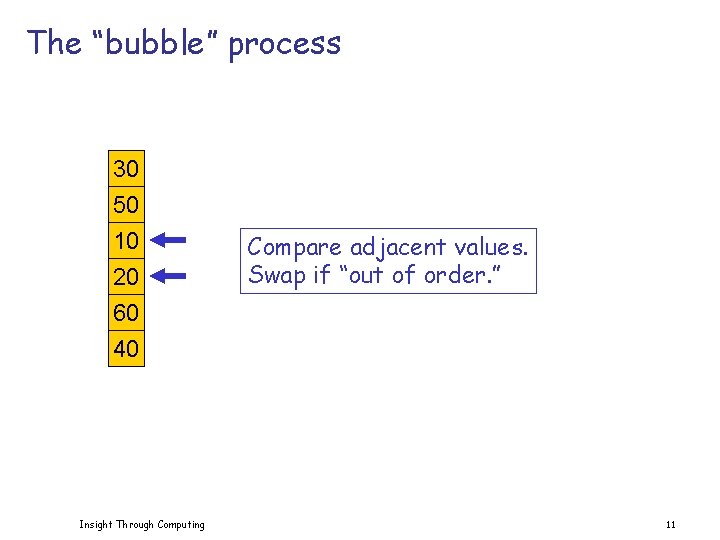
The “bubble” process 30 50 10 20 60 40 Insight Through Computing Compare adjacent values. Swap if “out of order. ” 11
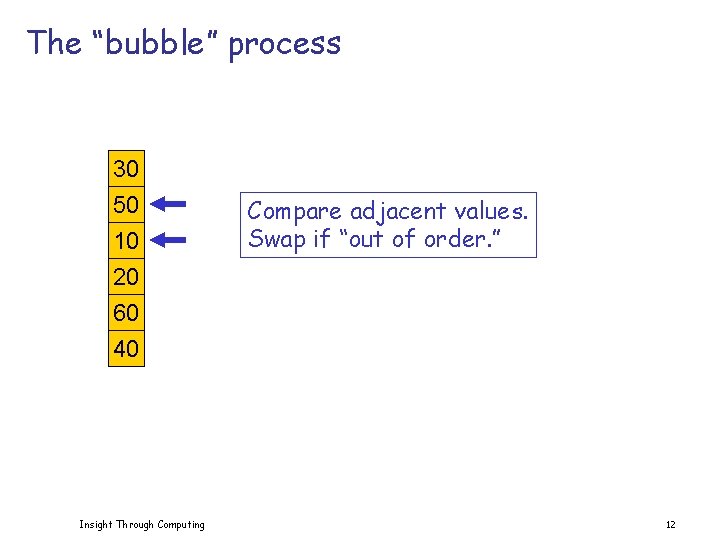
The “bubble” process 30 50 10 20 60 40 Insight Through Computing Compare adjacent values. Swap if “out of order. ” 12

The “bubble” process 30 10 50 20 60 40 Insight Through Computing Compare adjacent values. Swap if “out of order. ” 13
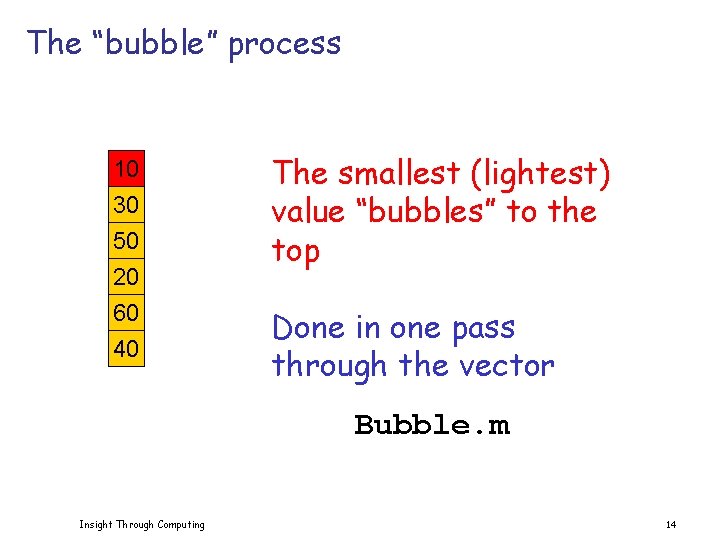
The “bubble” process 10 30 50 20 60 40 The smallest (lightest) value “bubbles” to the top Done in one pass through the vector Bubble. m Insight Through Computing 14
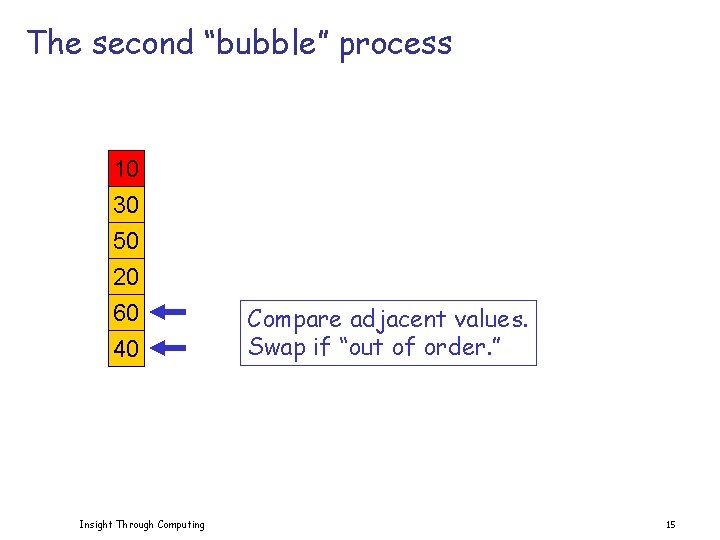
The second “bubble” process 10 30 50 20 60 40 Insight Through Computing Compare adjacent values. Swap if “out of order. ” 15
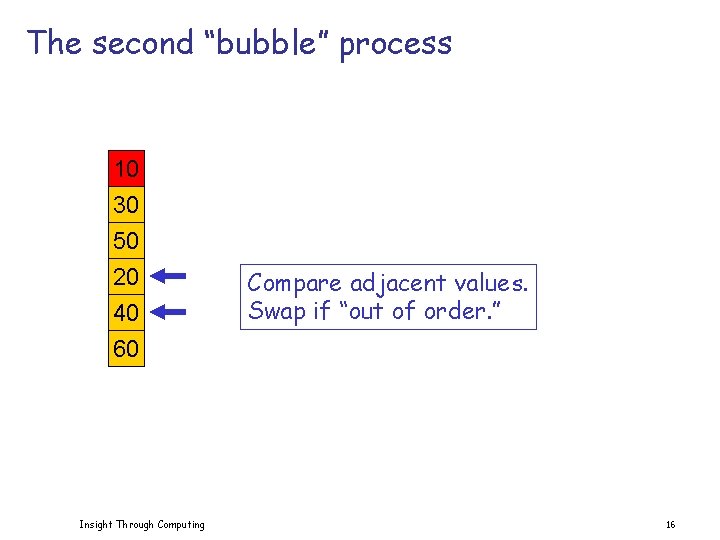
The second “bubble” process 10 30 50 20 40 60 Insight Through Computing Compare adjacent values. Swap if “out of order. ” 16
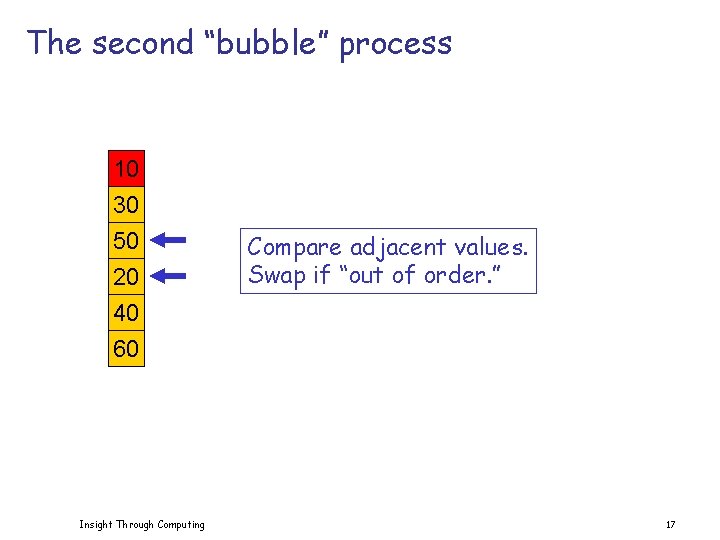
The second “bubble” process 10 30 50 20 40 60 Insight Through Computing Compare adjacent values. Swap if “out of order. ” 17
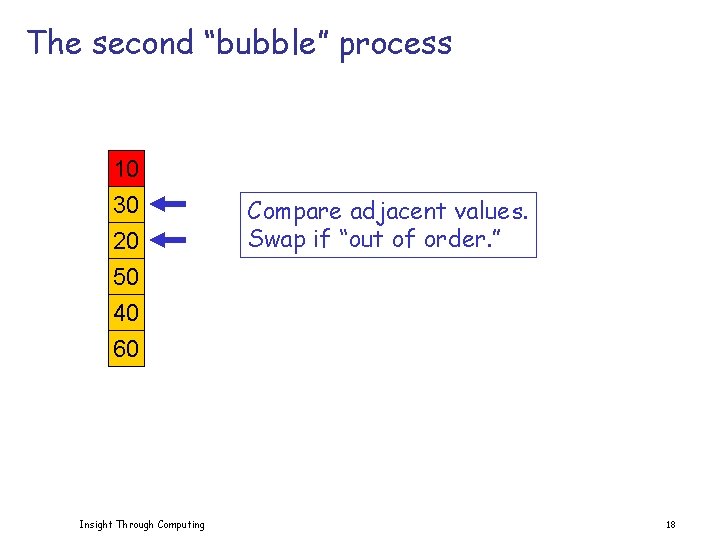
The second “bubble” process 10 30 20 50 40 60 Insight Through Computing Compare adjacent values. Swap if “out of order. ” 18
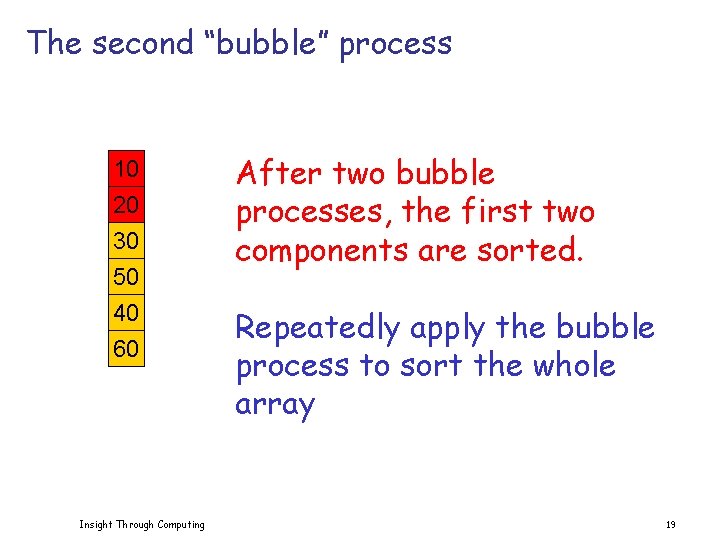
The second “bubble” process 10 20 30 50 40 60 Insight Through Computing After two bubble processes, the first two components are sorted. Repeatedly apply the bubble process to sort the whole array 19
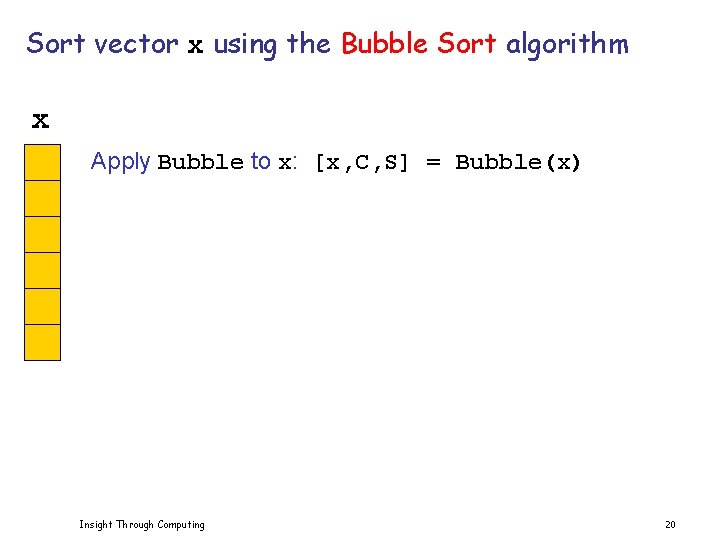
Sort vector x using the Bubble Sort algorithm x Apply Bubble to x: [x, C, S] = Bubble(x) Insight Through Computing 20
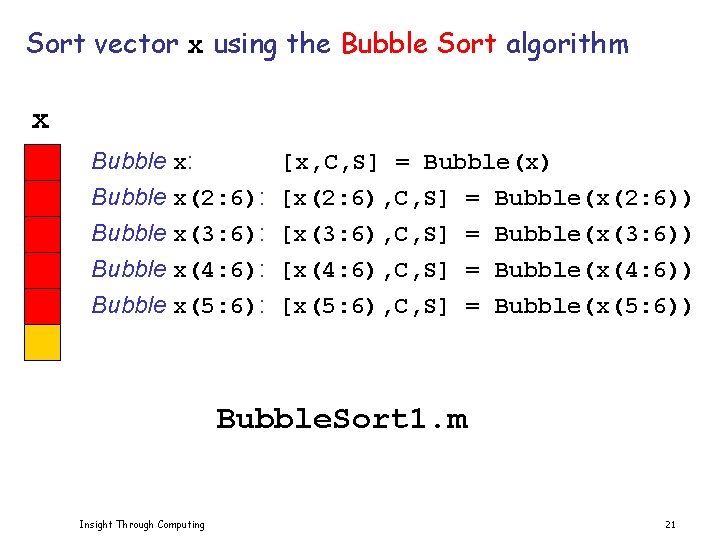
Sort vector x using the Bubble Sort algorithm x Bubble x: Bubble x(2: 6): Bubble x(3: 6): Bubble x(4: 6): Bubble x(5: 6): [x, C, S] = Bubble(x) [x(2: 6), C, S] = Bubble(x(2: 6)) [x(3: 6), C, S] = Bubble(x(3: 6)) [x(4: 6), C, S] = Bubble(x(4: 6)) [x(5: 6), C, S] = Bubble(x(5: 6)) Bubble. Sort 1. m Insight Through Computing 21
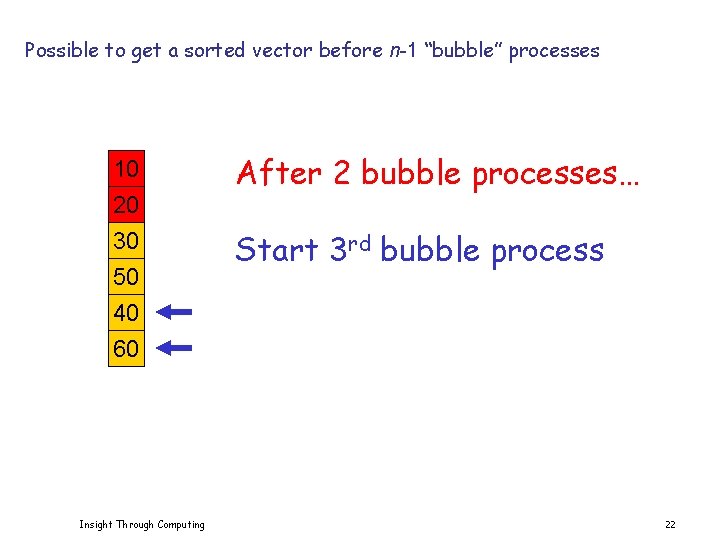
Possible to get a sorted vector before n-1 “bubble” processes 10 20 30 50 40 60 Insight Through Computing After 2 bubble processes… Start 3 rd bubble process 22
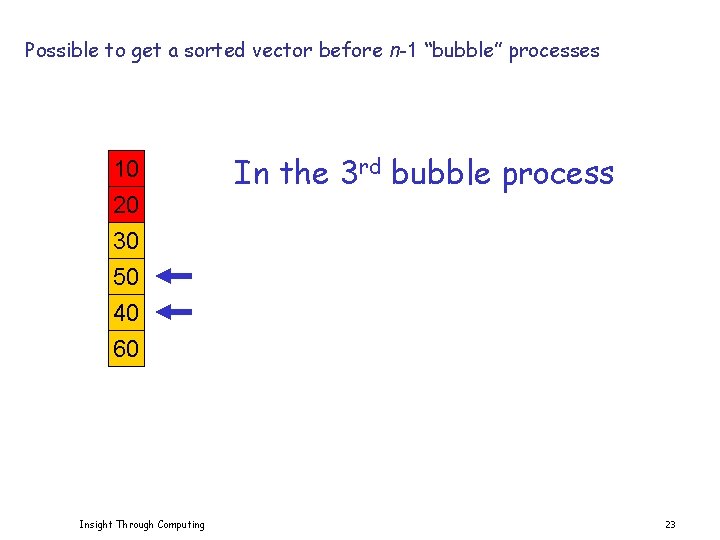
Possible to get a sorted vector before n-1 “bubble” processes 10 20 30 50 40 60 Insight Through Computing In the 3 rd bubble process 23
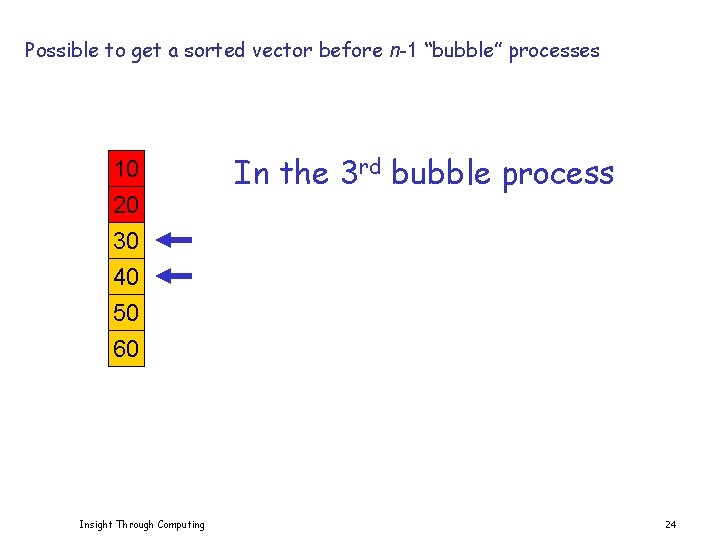
Possible to get a sorted vector before n-1 “bubble” processes 10 20 30 40 50 60 Insight Through Computing In the 3 rd bubble process 24
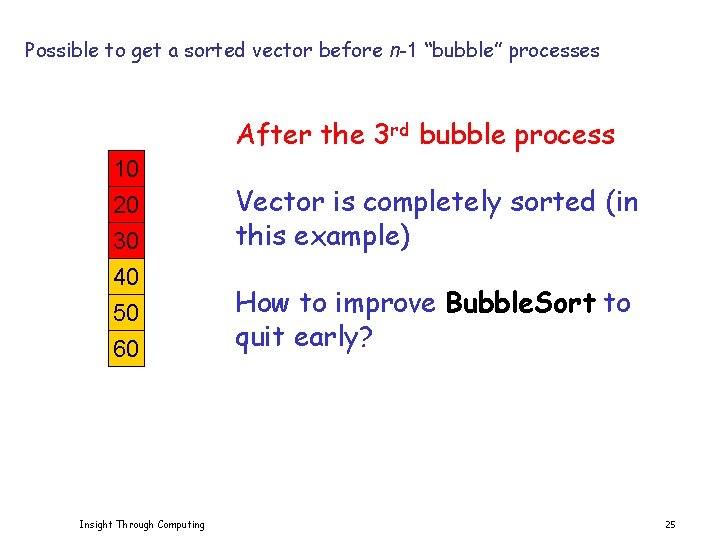
Possible to get a sorted vector before n-1 “bubble” processes After the 3 rd bubble process 10 20 30 40 50 60 Insight Through Computing Vector is completely sorted (in this example) How to improve Bubble. Sort to quit early? 25
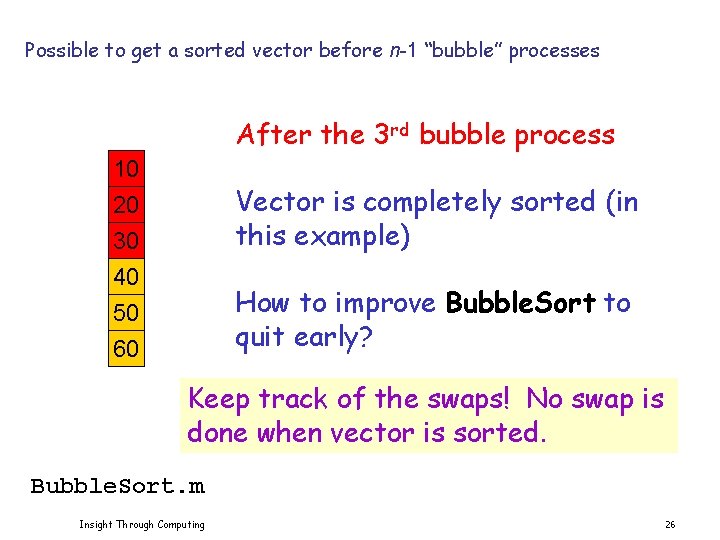
Possible to get a sorted vector before n-1 “bubble” processes After the 3 rd bubble process 10 20 30 40 50 60 Vector is completely sorted (in this example) How to improve Bubble. Sort to quit early? Keep track of the swaps! No swap is done when vector is sorted. Bubble. Sort. m Insight Through Computing 26
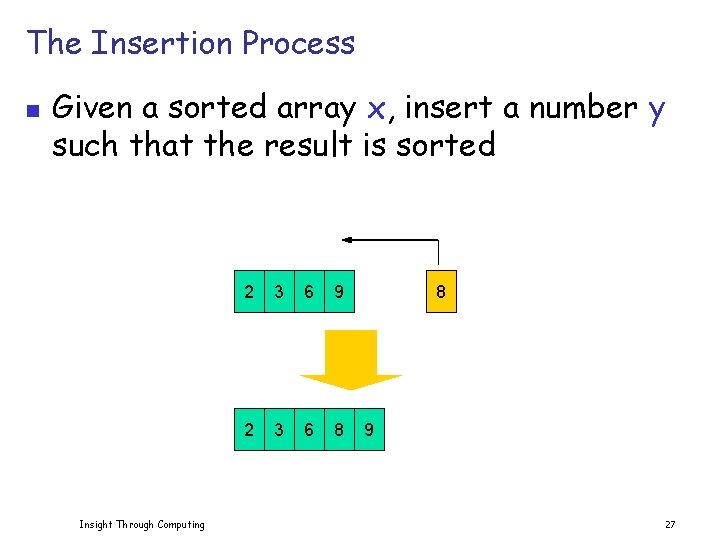
The Insertion Process n Given a sorted array x, insert a number y such that the result is sorted Insight Through Computing 2 3 6 9 2 3 6 8 8 9 27
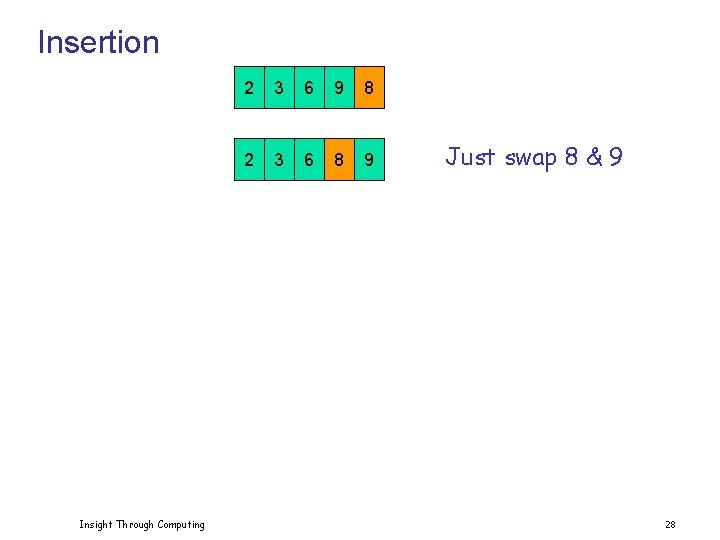
Insertion Insight Through Computing 2 3 6 9 8 2 3 6 8 9 Just swap 8 & 9 28
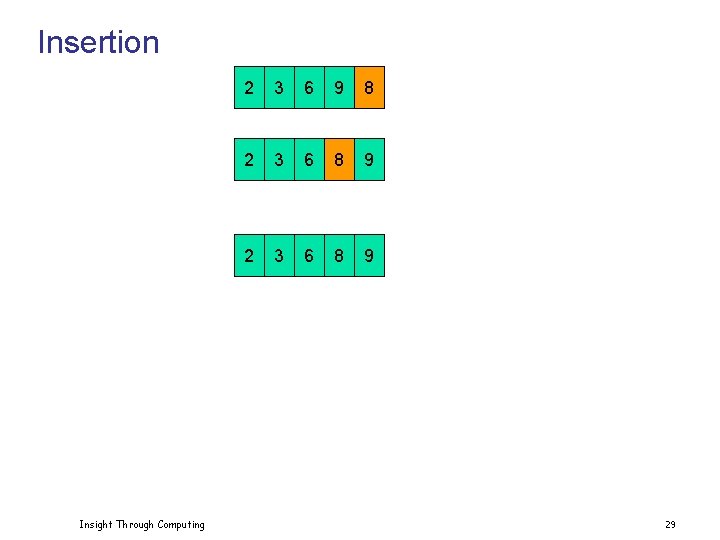
Insertion Insight Through Computing 2 3 6 9 8 2 3 6 8 9 29
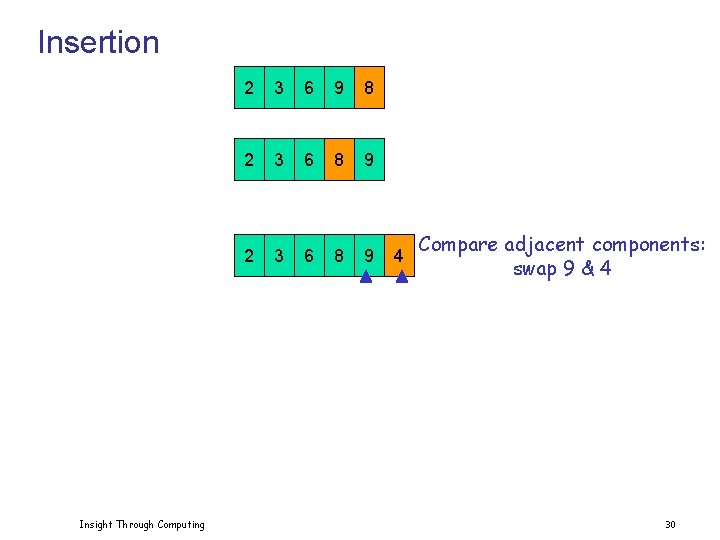
Insertion Insight Through Computing 2 3 6 9 8 2 3 6 8 9 4 Compare adjacent components: swap 9 & 4 30
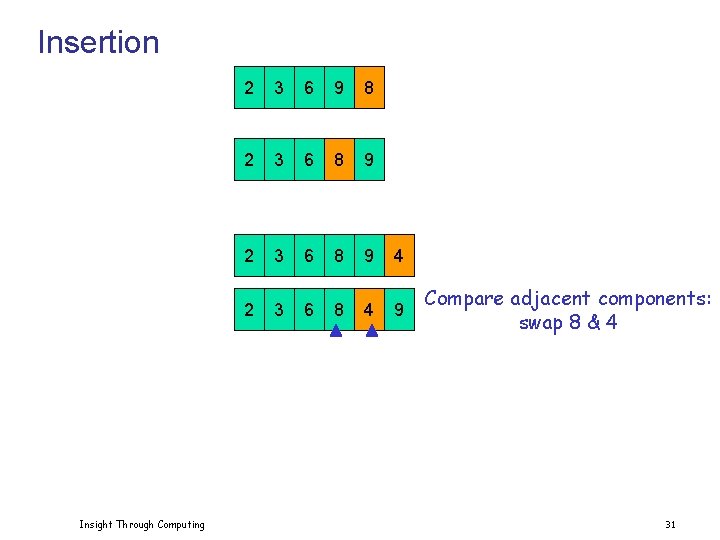
Insertion Insight Through Computing 2 3 6 9 8 2 3 6 8 9 4 2 3 6 8 4 9 Compare adjacent components: swap 8 & 4 31
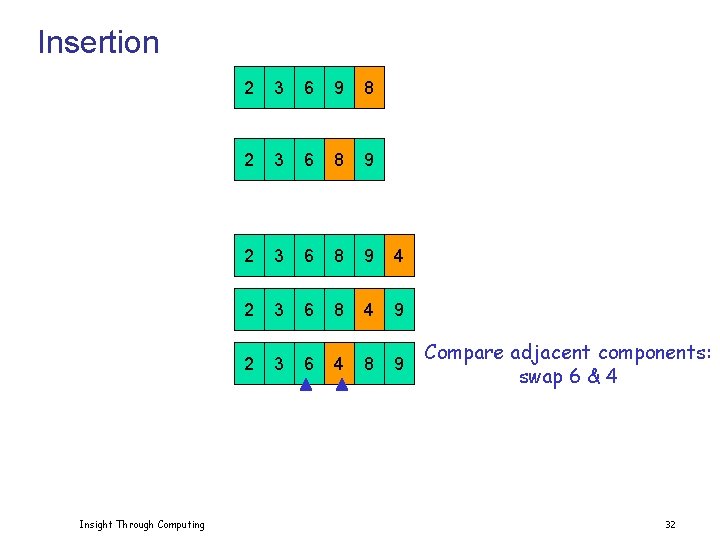
Insertion Insight Through Computing 2 3 6 9 8 2 3 6 8 9 4 2 3 6 8 4 9 2 3 6 4 8 9 Compare adjacent components: swap 6 & 4 32
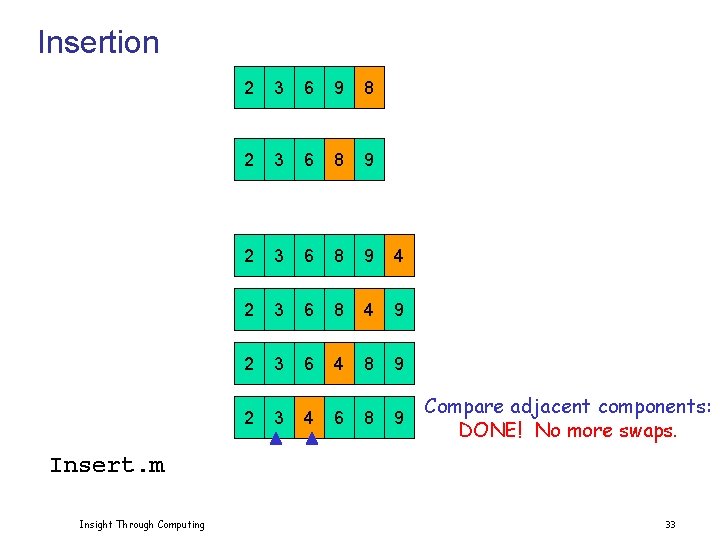
Insertion 2 3 6 9 8 2 3 6 8 9 4 2 3 6 8 4 9 2 3 6 4 8 9 2 3 4 6 8 9 Compare adjacent components: DONE! No more swaps. Insert. m Insight Through Computing 33
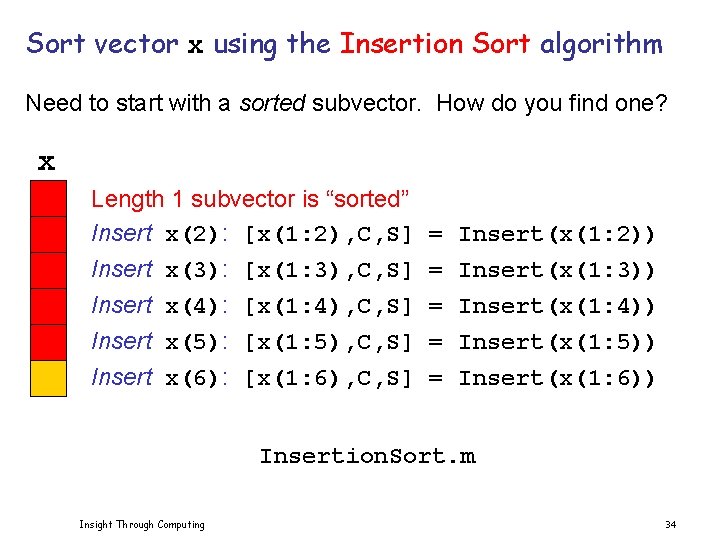
Sort vector x using the Insertion Sort algorithm Need to start with a sorted subvector. How do you find one? x Length 1 subvector is “sorted” Insert x(2): [x(1: 2), C, S] Insert x(3): [x(1: 3), C, S] Insert x(4): [x(1: 4), C, S] Insert x(5): [x(1: 5), C, S] Insert x(6): [x(1: 6), C, S] = = = Insert(x(1: 2)) Insert(x(1: 3)) Insert(x(1: 4)) Insert(x(1: 5)) Insert(x(1: 6)) Insertion. Sort. m Insight Through Computing 34
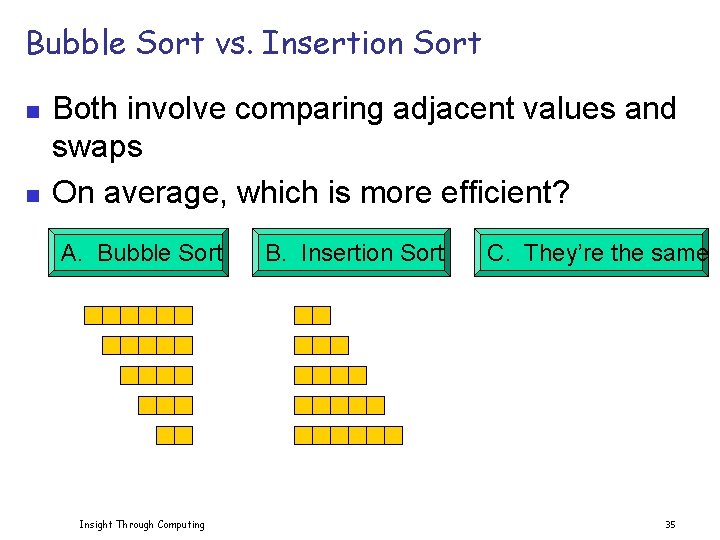
Bubble Sort vs. Insertion Sort n n Both involve comparing adjacent values and swaps On average, which is more efficient? A. Bubble Sort Insight Through Computing B. Insertion Sort C. They’re the same 35
Other efficiency considerations n n n Worst case, best case, average case Use of subfunction incurs an “overhead” Memory use and access Example: Rather than directing the insert process to a subfunction, have it done “in-line. ” Also, Insertion sort can be done “in-place, ” i. e. , using “only” the memory space of the original vector. Insight Through Computing 36
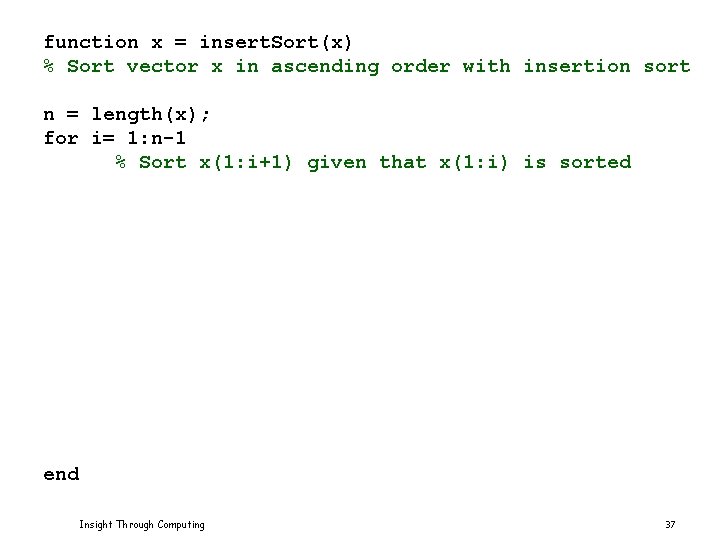
function x = insert. Sort(x) % Sort vector x in ascending order with insertion sort n = length(x); for i= 1: n-1 % Sort x(1: i+1) given that x(1: i) is sorted end Insight Through Computing 37
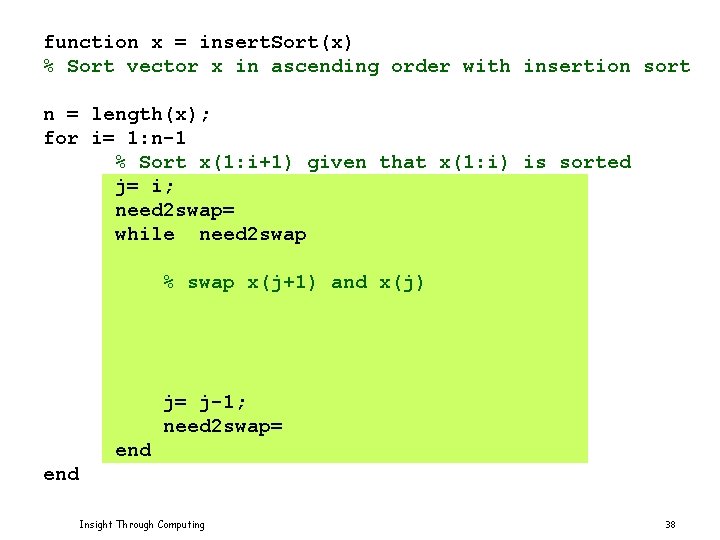
function x = insert. Sort(x) % Sort vector x in ascending order with insertion sort n = length(x); for i= 1: n-1 % Sort x(1: i+1) given that x(1: i) is sorted j= i; need 2 swap= while need 2 swap % swap x(j+1) and x(j) j= j-1; need 2 swap= end Insight Through Computing 38
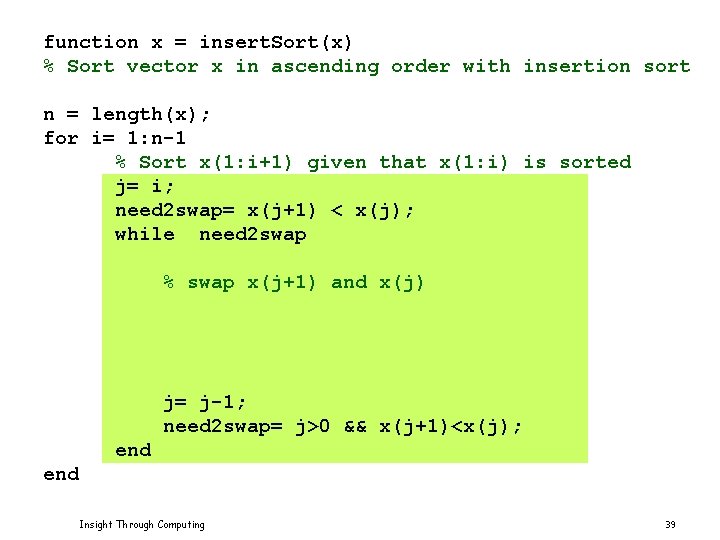
function x = insert. Sort(x) % Sort vector x in ascending order with insertion sort n = length(x); for i= 1: n-1 % Sort x(1: i+1) given that x(1: i) is sorted j= i; need 2 swap= x(j+1) < x(j); while need 2 swap % swap x(j+1) and x(j) j= j-1; need 2 swap= j>0 && x(j+1)<x(j); end Insight Through Computing 39
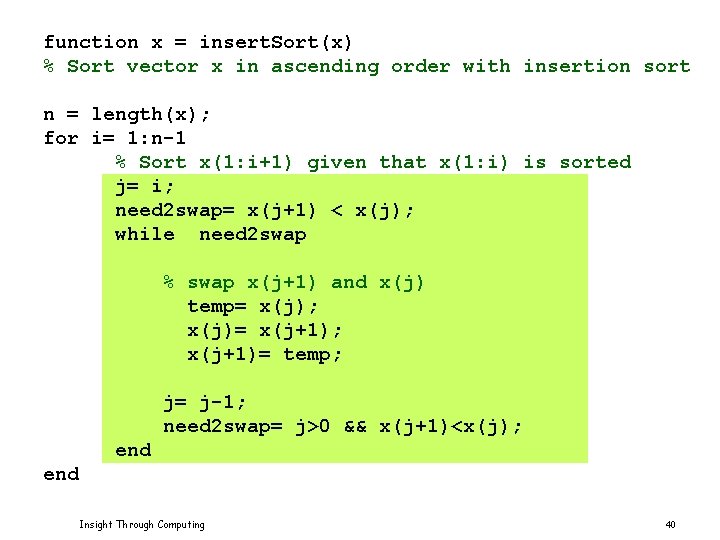
function x = insert. Sort(x) % Sort vector x in ascending order with insertion sort n = length(x); for i= 1: n-1 % Sort x(1: i+1) given that x(1: i) is sorted j= i; need 2 swap= x(j+1) < x(j); while need 2 swap % swap x(j+1) and x(j) temp= x(j); x(j)= x(j+1); x(j+1)= temp; j= j-1; need 2 swap= j>0 && x(j+1)<x(j); end Insight Through Computing 40
- Slides: 40