
3 The table below shows total utility in


3. The table below shows total utility in utils that a utilitymaximizing consumer receives from consuming two goods: apples and oranges. Apples Quantity Total utility 0 0 1 20 2 35 3 45 4 50 5 52 Oranges Quantity Total utility 0 0 1 30 2 50 3 65 4 75 5 80
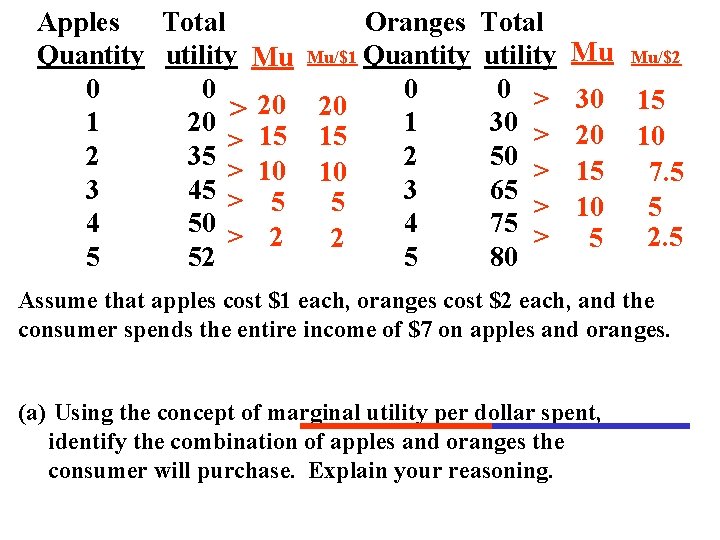
Apples Total Oranges Quantity utility Mu Mu/$1 Quantity 0 0 0 20 20 > 1 20 1 > 15 15 2 35 2 > 10 10 3 45 > 5 3 5 4 50 > 2 4 2 5 52 5 Total utility 0 > 30 > 50 > 65 > 75 > 80 Mu Mu/$2 30 20 15 10 5 15 10 7. 5 5 2. 5 Assume that apples cost $1 each, oranges cost $2 each, and the consumer spends the entire income of $7 on apples and oranges. (a) Using the concept of marginal utility per dollar spent, identify the combination of apples and oranges the consumer will purchase. Explain your reasoning.

Apples Total Oranges Quantity utility Mu Mu/$1 Quantity 0 0 0 20 20 > 1 20 1 > 15 15 2 35 2 > 10 10 3 45 > 5 3 5 4 50 > 2 4 2 5 52 5 Total utility 0 > 30 > 50 > 65 > 75 > 80 Mu Mu/$2 30 20 15 10 5 15 10 7. 5 5 2. 5 (a) Using the concept of marginal utility per dollar spent, identify the combination of apples and oranges the consumer will purchase. Explain your reasoning. The consumer will purchase 3 apples and 2 oranges because this is where the Mu/per dollar is equal and where the consumer maximizes satisfaction for a total utility of 95. (Maximum utility answer is not good enough. )

Finished • The question continues if you want more!
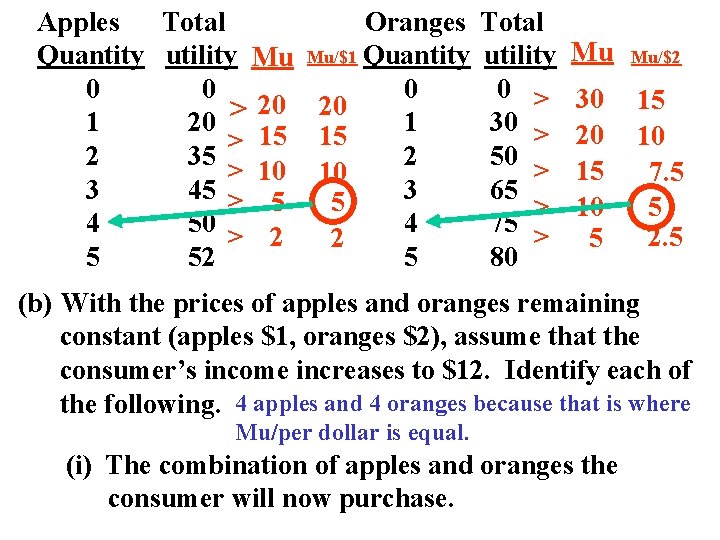
Apples Total Oranges Quantity utility Mu Mu/$1 Quantity 0 0 0 20 20 > 1 20 1 > 15 15 2 35 2 > 10 10 3 45 > 5 3 5 4 50 > 2 4 2 5 52 5 Total utility 0 > 30 > 50 > 65 > 75 > 80 Mu Mu/$2 30 20 15 10 5 15 10 7. 5 5 2. 5 (b) With the prices of apples and oranges remaining constant (apples $1, oranges $2), assume that the consumer’s income increases to $12. Identify each of the following. 4 apples and 4 oranges because that is where Mu/per dollar is equal. (i) The combination of apples and oranges the consumer will now purchase.
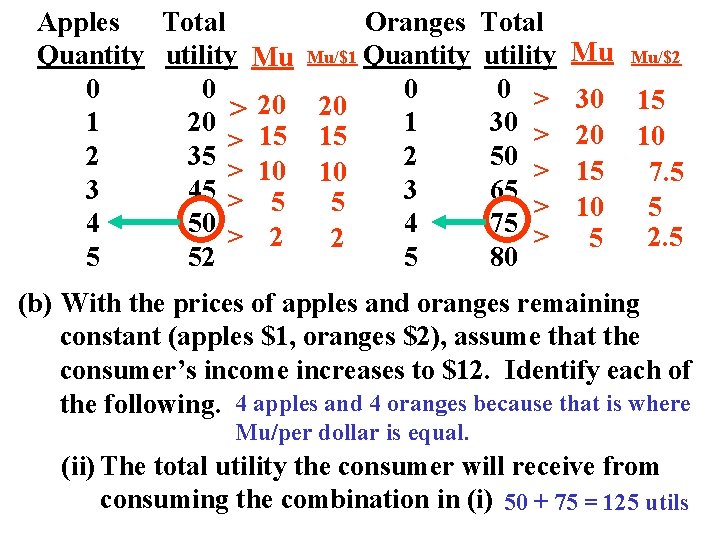
Apples Total Oranges Quantity utility Mu Mu/$1 Quantity 0 0 0 20 20 > 1 20 1 > 15 15 2 35 2 > 10 10 3 45 > 5 3 5 4 50 > 2 4 2 5 52 5 Total utility 0 > 30 > 50 > 65 > 75 > 80 Mu Mu/$2 30 20 15 10 5 15 10 7. 5 5 2. 5 (b) With the prices of apples and oranges remaining constant (apples $1, oranges $2), assume that the consumer’s income increases to $12. Identify each of the following. 4 apples and 4 oranges because that is where Mu/per dollar is equal. (ii) The total utility the consumer will receive from consuming the combination in (i) 50 + 75 = 125 utils
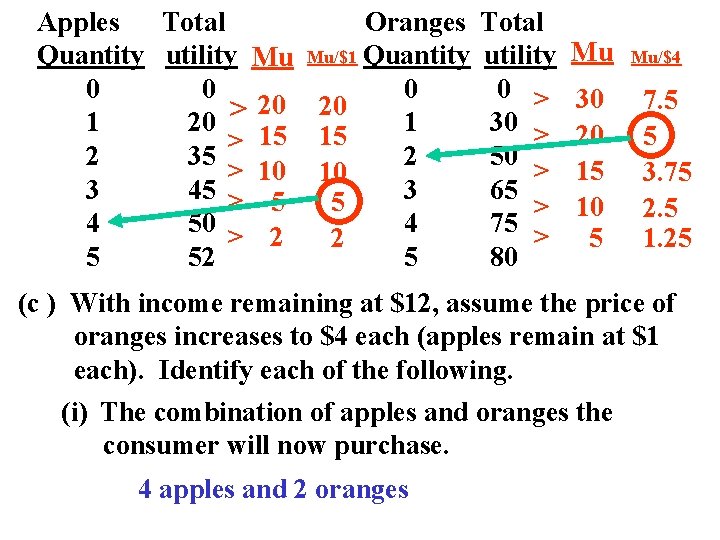
Apples Total Oranges Quantity utility Mu Mu/$1 Quantity 0 0 0 20 20 > 1 20 1 > 15 15 2 35 2 > 10 10 3 45 > 5 3 5 4 50 > 2 4 2 5 52 5 Total utility 0 > 30 > 50 > 65 > 75 > 80 Mu 30 20 15 10 5 Mu/$4 7. 5 5 3. 75 2. 5 1. 25 (c ) With income remaining at $12, assume the price of oranges increases to $4 each (apples remain at $1 each). Identify each of the following. (i) The combination of apples and oranges the consumer will now purchase. 4 apples and 2 oranges
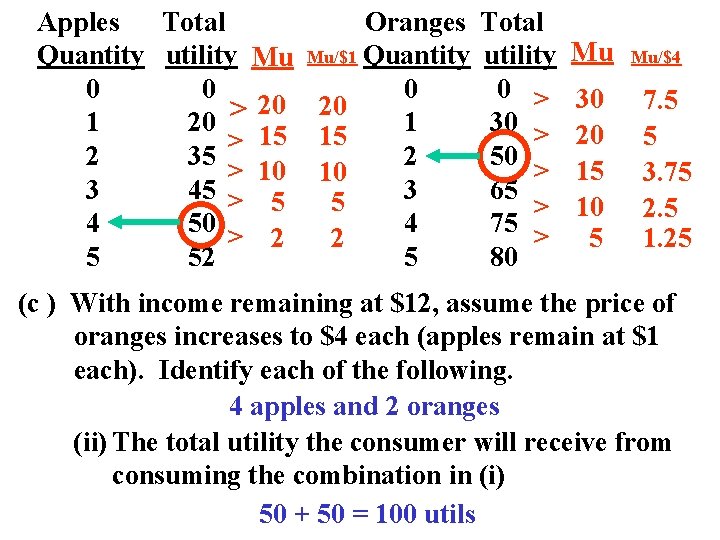
Apples Total Oranges Quantity utility Mu Mu/$1 Quantity 0 0 0 20 20 > 1 20 1 > 15 15 2 35 2 > 10 10 3 45 > 5 3 5 4 50 > 4 2 2 5 52 5 Total utility 0 > 30 > 50 > 65 > 75 > 80 Mu 30 20 15 10 5 Mu/$4 7. 5 5 3. 75 2. 5 1. 25 (c ) With income remaining at $12, assume the price of oranges increases to $4 each (apples remain at $1 each). Identify each of the following. 4 apples and 2 oranges (ii) The total utility the consumer will receive from consuming the combination in (i) 50 + 50 = 100 utils
- Slides: 9