
3 Technical and administrative metadata standards Metadata Standards
- Slides: 23
3. Technical and administrative metadata standards Metadata Standards and Applications
Goals of session u To understand the different types of administrative metadata standards u To learn what types of metadata are needed for digital preservation u To learn the importance of technical, structural and rights metadata in digital libraries Metadata Standards & Applications 2
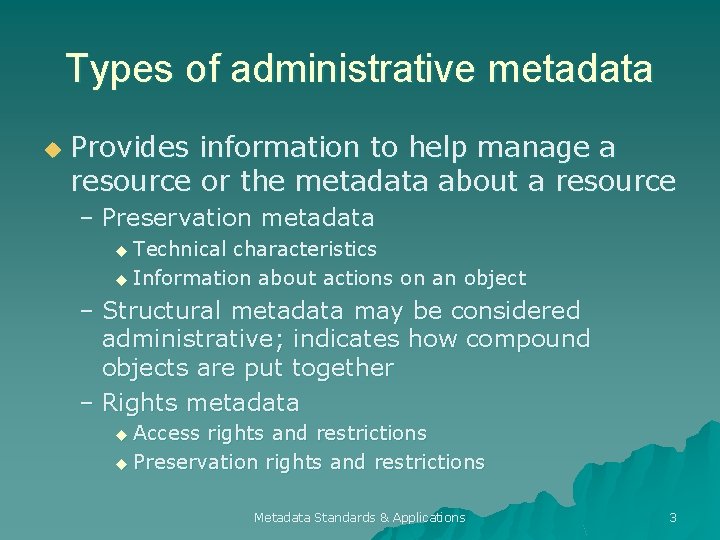
Types of administrative metadata u Provides information to help manage a resource or the metadata about a resource – Preservation metadata u Technical characteristics u Information about actions on an object – Structural metadata may be considered administrative; indicates how compound objects are put together – Rights metadata u Access rights and restrictions u Preservation rights and restrictions Metadata Standards & Applications 3
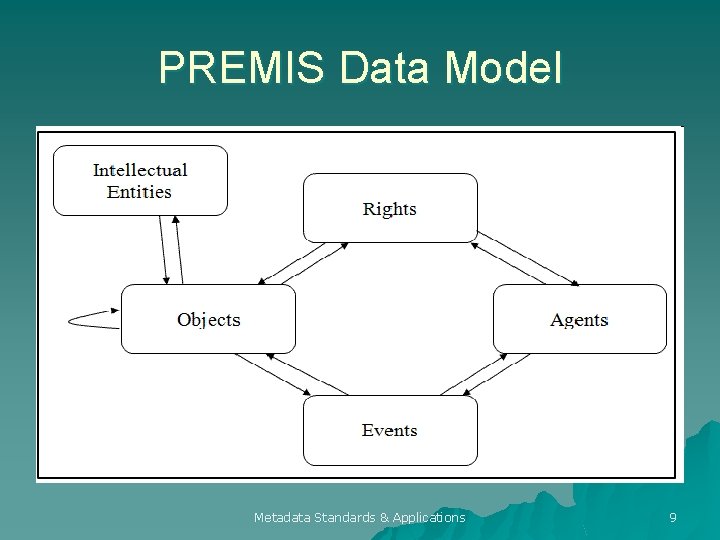
Preservation Metadata: PREMIS u PREMIS is: – Common data model for organizing/thinking about preservation metadata – Guidance for local implementations – Standard for exchanging information packages between repositories u http: //www. loc. gov/standards/premis/ Metadata Standards & Applications 4
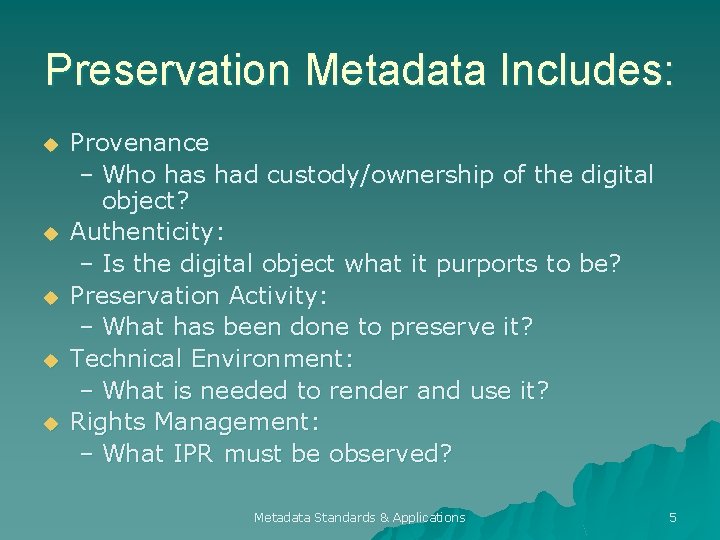
Preservation Metadata Includes: u u u Provenance – Who has had custody/ownership of the digital object? Authenticity: – Is the digital object what it purports to be? Preservation Activity: – What has been done to preserve it? Technical Environment: – What is needed to render and use it? Rights Management: – What IPR must be observed? Metadata Standards & Applications 5
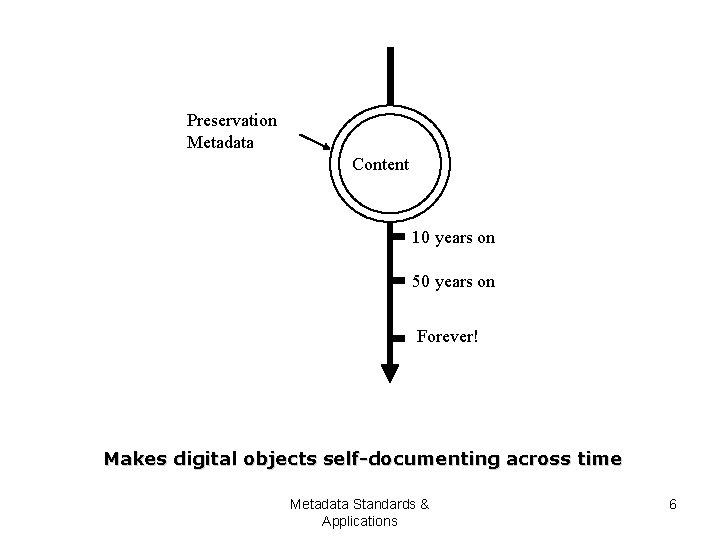
Preservation Metadata Content 10 years on 50 years on Forever! Makes digital objects self-documenting across time Metadata Standards & Applications 6
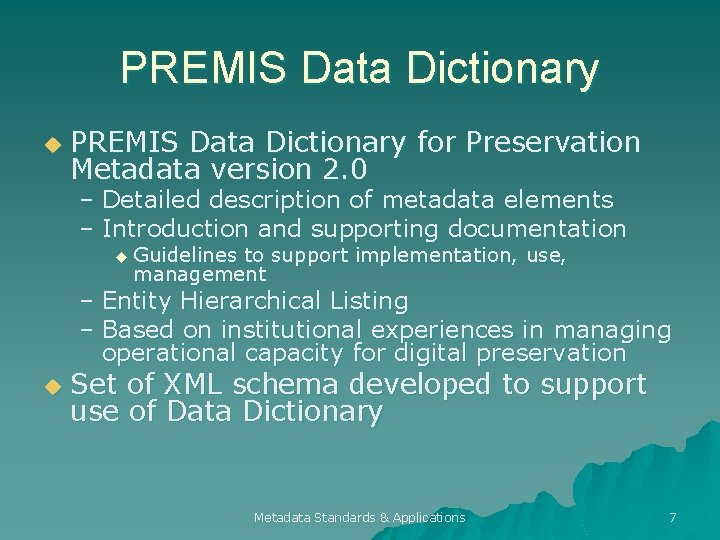
PREMIS Data Dictionary u PREMIS Data Dictionary for Preservation Metadata version 2. 0 – Detailed description of metadata elements – Introduction and supporting documentation u Guidelines to support implementation, use, management – Entity Hierarchical Listing – Based on institutional experiences in managing operational capacity for digital preservation u Set of XML schema developed to support use of Data Dictionary Metadata Standards & Applications 7
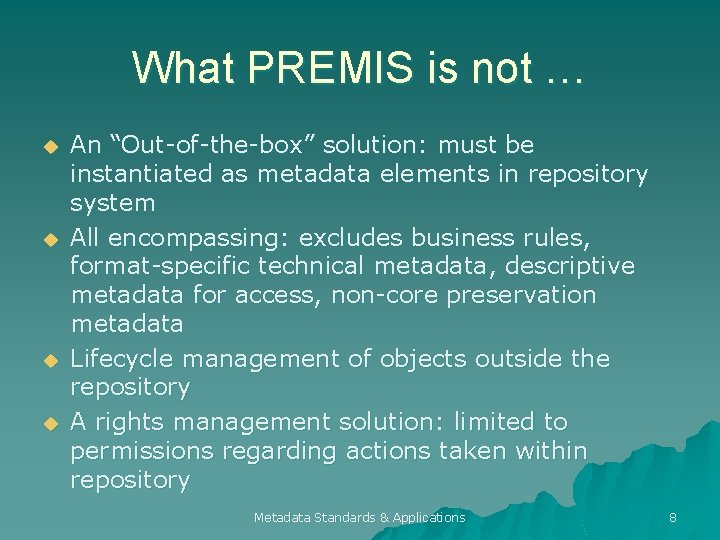
What PREMIS is not … u u An “Out-of-the-box” solution: must be instantiated as metadata elements in repository system All encompassing: excludes business rules, format-specific technical metadata, descriptive metadata for access, non-core preservation metadata Lifecycle management of objects outside the repository A rights management solution: limited to permissions regarding actions taken within repository Metadata Standards & Applications 8
PREMIS Data Model Metadata Standards & Applications 9
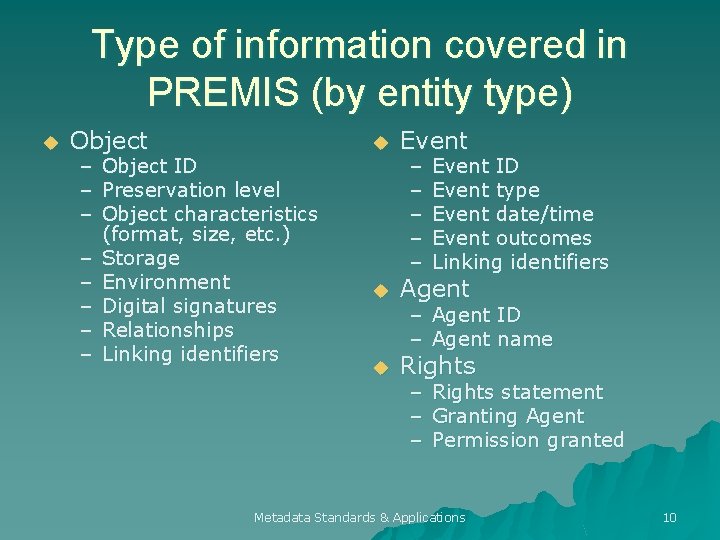
Type of information covered in PREMIS (by entity type) u Object – Object ID – Preservation level – Object characteristics (format, size, etc. ) – Storage – Environment – Digital signatures – Relationships – Linking identifiers u Event – – – Event ID Event type Event date/time Event outcomes Linking identifiers u Agent u Rights – Agent ID – Agent name – Rights statement – Granting Agent – Permission granted Metadata Standards & Applications 10
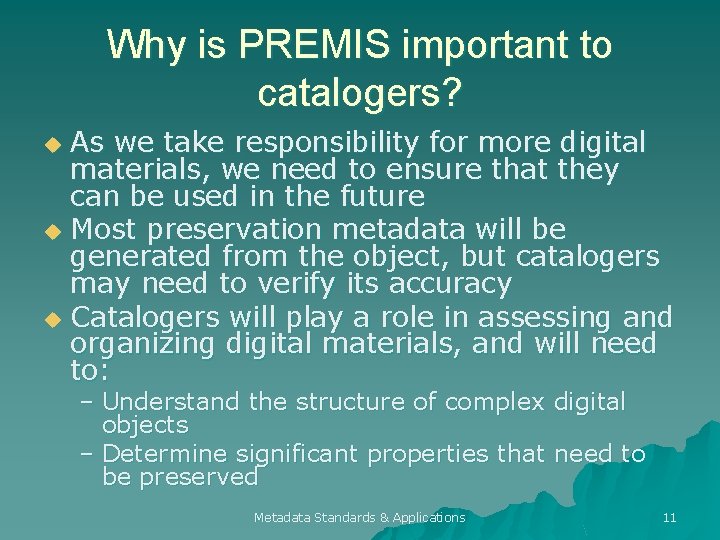
Why is PREMIS important to catalogers? As we take responsibility for more digital materials, we need to ensure that they can be used in the future u Most preservation metadata will be generated from the object, but catalogers may need to verify its accuracy u Catalogers will play a role in assessing and organizing digital materials, and will need to: u – Understand the structure of complex digital objects – Determine significant properties that need to be preserved Metadata Standards & Applications 11
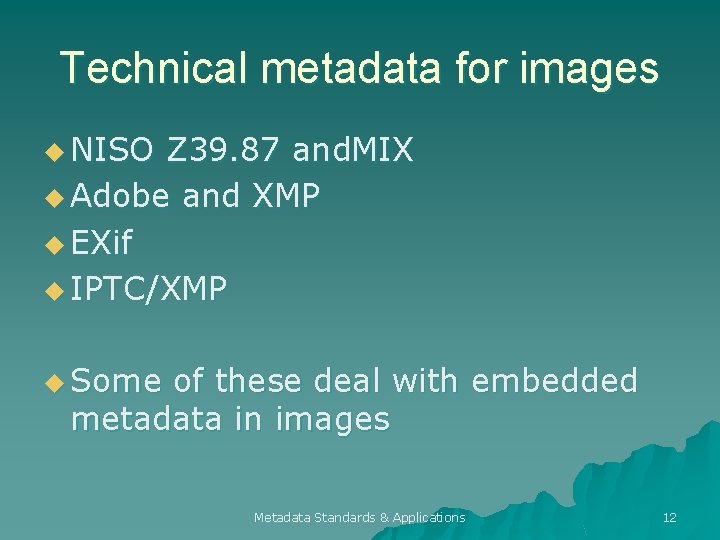
Technical metadata for images u NISO Z 39. 87 and. MIX u Adobe and XMP u EXif u IPTC/XMP u Some of these deal with embedded metadata in images Metadata Standards & Applications 12
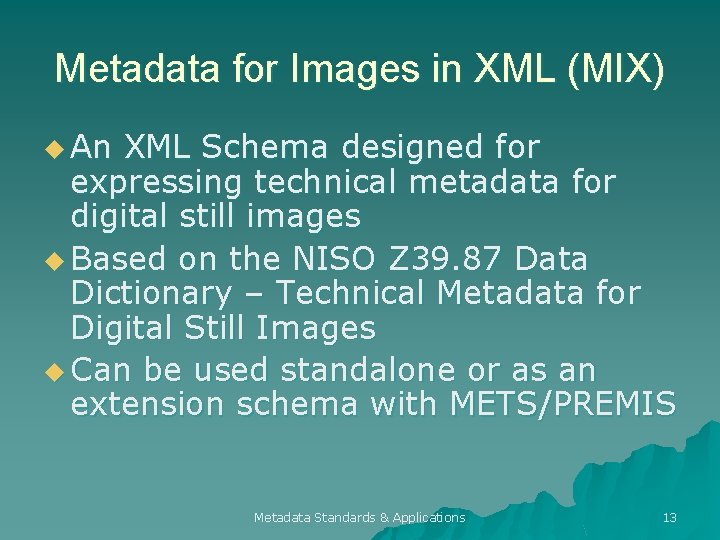
Metadata for Images in XML (MIX) u An XML Schema designed for expressing technical metadata for digital still images u Based on the NISO Z 39. 87 Data Dictionary – Technical Metadata for Digital Still Images u Can be used standalone or as an extension schema with METS/PREMIS Metadata Standards & Applications 13
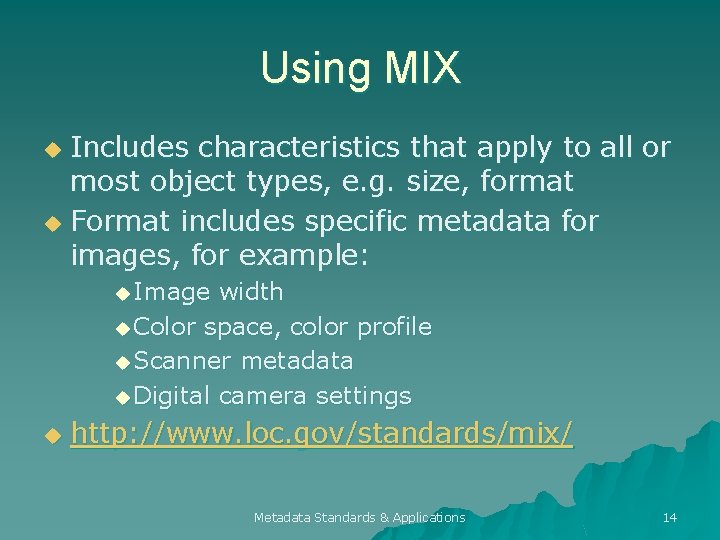
Using MIX Includes characteristics that apply to all or most object types, e. g. size, format u Format includes specific metadata for images, for example: u u Image width u Color space, color profile u Scanner metadata u Digital camera settings u http: //www. loc. gov/standards/mix/ Metadata Standards & Applications 14
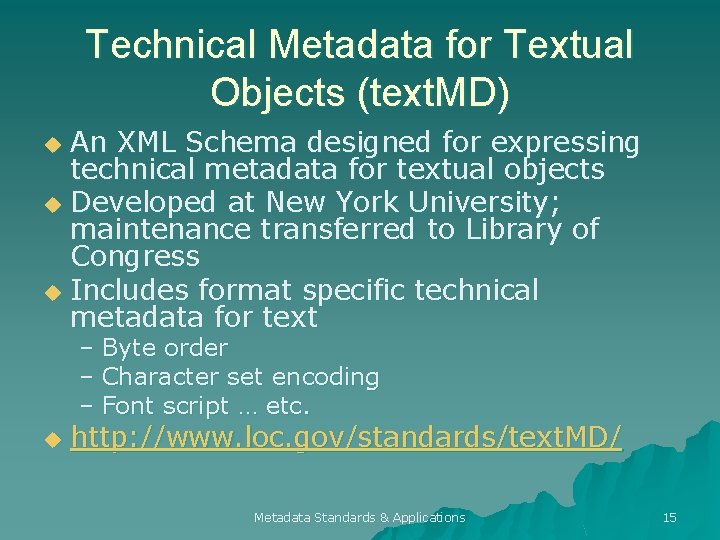
Technical Metadata for Textual Objects (text. MD) An XML Schema designed for expressing technical metadata for textual objects u Developed at New York University; maintenance transferred to Library of Congress u Includes format specific technical metadata for text u – Byte order – Character set encoding – Font script … etc. u http: //www. loc. gov/standards/text. MD/ Metadata Standards & Applications 15
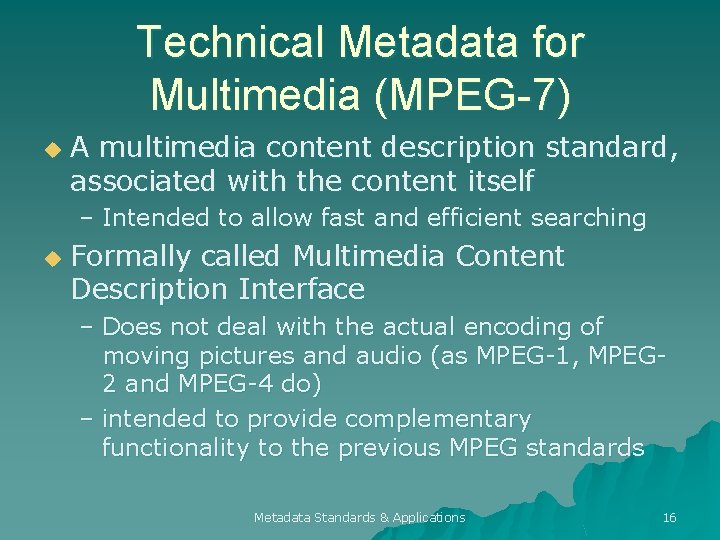
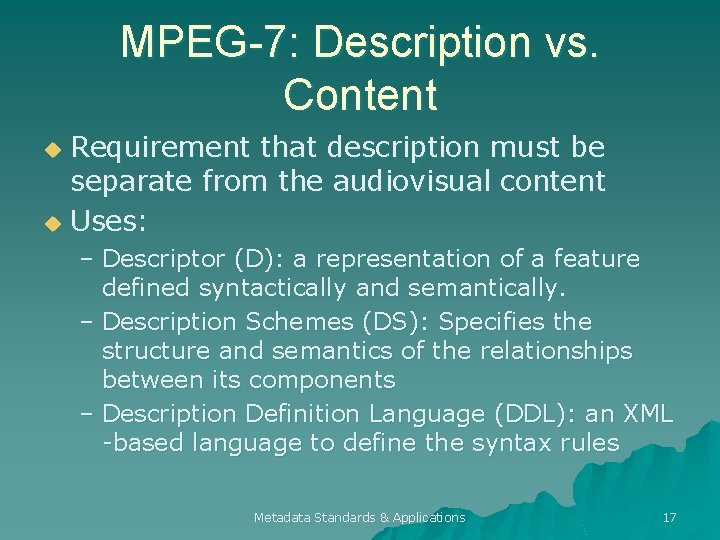
Technical Metadata for Multimedia (MPEG-7) u A multimedia content description standard, associated with the content itself – Intended to allow fast and efficient searching u Formally called Multimedia Content Description Interface – Does not deal with the actual encoding of moving pictures and audio (as MPEG-1, MPEG 2 and MPEG-4 do) – intended to provide complementary functionality to the previous MPEG standards Metadata Standards & Applications 16
MPEG-7: Description vs. Content Requirement that description must be separate from the audiovisual content u Uses: u – Descriptor (D): a representation of a feature defined syntactically and semantically. – Description Schemes (DS): Specifies the structure and semantics of the relationships between its components – Description Definition Language (DDL): an XML -based language to define the syntax rules Metadata Standards & Applications 17
Other Technical Metadata for Audio and Video LC developed XML technical metadata schemas for LC Audiovisual Prototype Project; these were widely implemented because of the lack of other schemas u Audio and video technical metadata schemas under development by expert organizations u Moving Image Collections (MIC) project is also experimenting with these: u – http: //mic. loc. gov/ u For more information on LC schemas: – http: //www. loc. gov/rr/mopic/avprot/metsmenu 2. html Metadata Standards & Applications 18
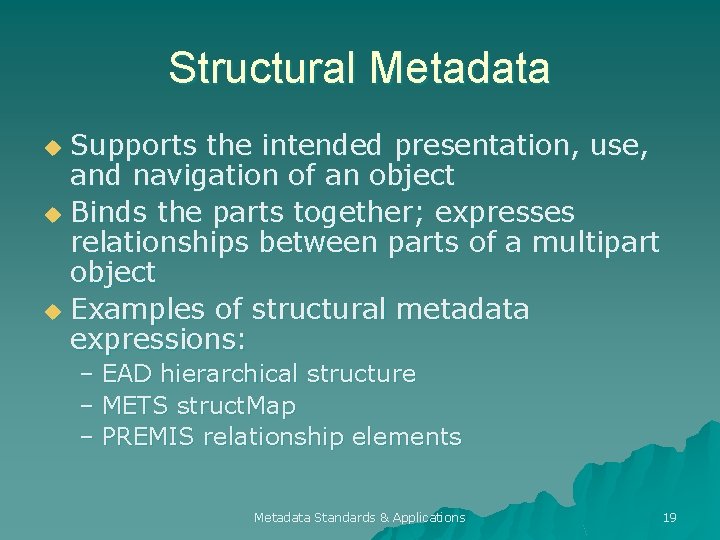
Structural Metadata Supports the intended presentation, use, and navigation of an object u Binds the parts together; expresses relationships between parts of a multipart object u Examples of structural metadata expressions: u – EAD hierarchical structure – METS struct. Map – PREMIS relationship elements Metadata Standards & Applications 19
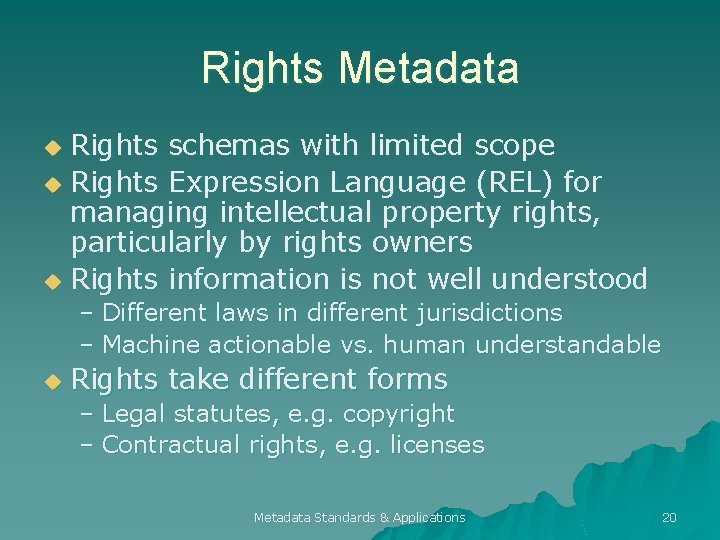
Rights Metadata Rights schemas with limited scope u Rights Expression Language (REL) for managing intellectual property rights, particularly by rights owners u Rights information is not well understood u – Different laws in different jurisdictions – Machine actionable vs. human understandable u Rights take different forms – Legal statutes, e. g. copyright – Contractual rights, e. g. licenses Metadata Standards & Applications 20
Rights Schema Examples u Creative Commons – Allows creators to choose a license for their work – Simple rights statements that fit a lot of situations – http: //creativecommons. org/ u METS Rights – Access rights for use with METS objects – Rights declarations – Rights holder – Context Metadata Standards & Applications 21
More Rights Schema Examples PLUS for images u MPEG-21 REL for multimedia u ONIX for licensing terms u XRML/MPEG-21 u ODRL (Open Digital Rights Language) u u For a fuller discussion of rights languages, see the report written by Karen Coyle for the Library of Congress: – http: //www. loc. gov/standards/relreport. pdf Metadata Standards & Applications 22
Exercise u Provide administrative or technical metadata for the object used in the descriptive metadata exercise. Metadata Standards & Applications 23