
3 Technical and administrative metadata standards Metadata Standards
- Slides: 26
3. Technical and administrative metadata standards Metadata Standards and Applications Workshop
Goals of session To understand the different types of administrative metadata standards n To learn what types of metadata are needed for digital preservation n To learn the importance of technical, structural and rights metadata in digital libraries n
Types of administrative metadata n Provides information to help manage a resource n Preservation metadata • Technical characteristics • Information about actions on an object n Structural metadata may be considered administrative; indicates how compound objects are put together n Rights metadata • Access rights and restrictions • Preservation rights and restrictions
PREMIS: introduction n Preservation metadata that includes subcategories: Technical metadata n Relationships (structural and derivative) n Digital provenance (what actions performed on objects n Rights n
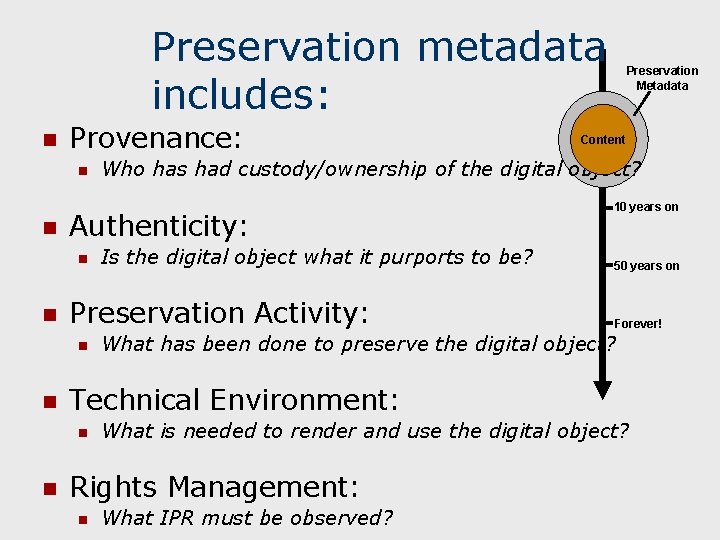
Preservation metadata includes: n Provenance: n n 10 years on 50 years on Forever! What has been done to preserve the digital object? Technical Environment: n n Is the digital object what it purports to be? Preservation Activity: n Content Who has had custody/ownership of the digital object? Authenticity: n Preservation Metadata What is needed to render and use the digital object? Rights Management: n What IPR must be observed?
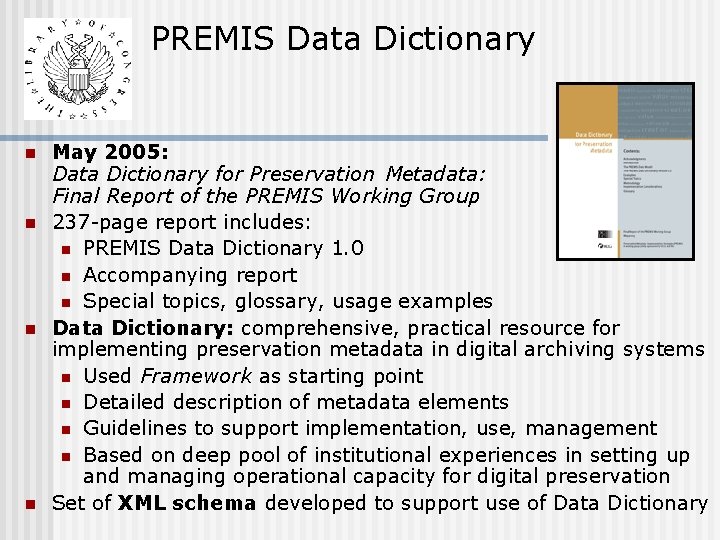
PREMIS Data Dictionary n n May 2005: Data Dictionary for Preservation Metadata: Final Report of the PREMIS Working Group 237 -page report includes: n PREMIS Data Dictionary 1. 0 n Accompanying report n Special topics, glossary, usage examples Data Dictionary: comprehensive, practical resource for implementing preservation metadata in digital archiving systems n Used Framework as starting point n Detailed description of metadata elements n Guidelines to support implementation, use, management n Based on deep pool of institutional experiences in setting up and managing operational capacity for digital preservation Set of XML schema developed to support use of Data Dictionary
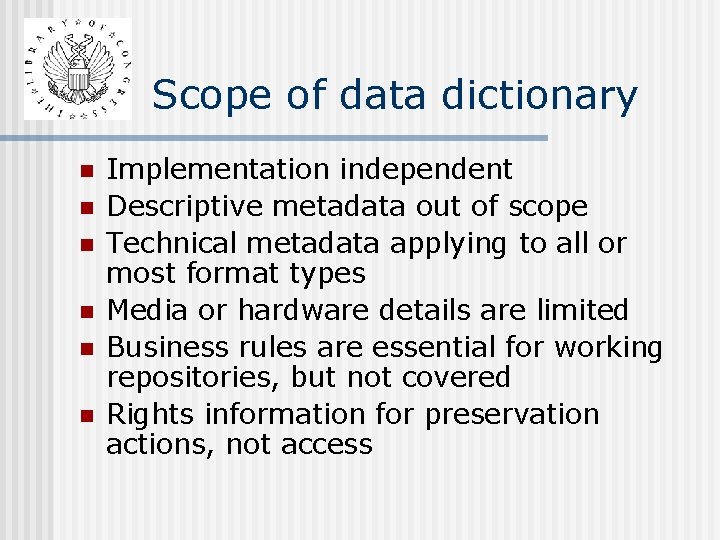
Scope of data dictionary n n n Implementation independent Descriptive metadata out of scope Technical metadata applying to all or most format types Media or hardware details are limited Business rules are essential for working repositories, but not covered Rights information for preservation actions, not access
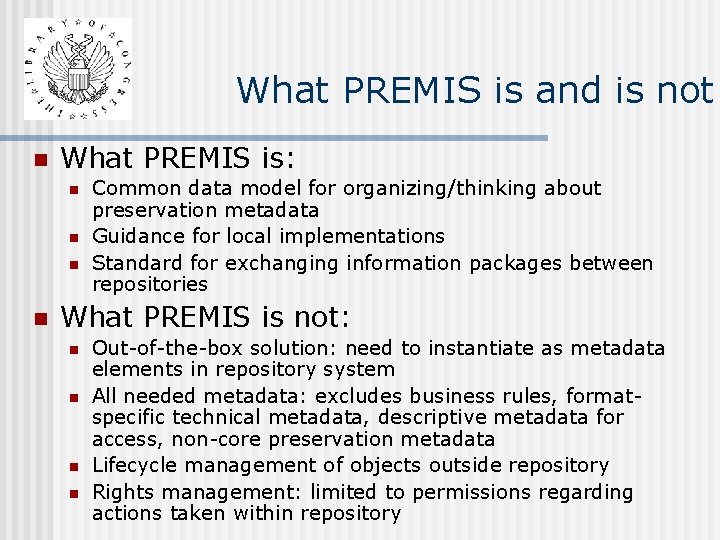
What PREMIS is and is not n What PREMIS is: n n Common data model for organizing/thinking about preservation metadata Guidance for local implementations Standard for exchanging information packages between repositories What PREMIS is not: n n Out-of-the-box solution: need to instantiate as metadata elements in repository system All needed metadata: excludes business rules, formatspecific technical metadata, descriptive metadata for access, non-core preservation metadata Lifecycle management of objects outside repository Rights management: limited to permissions regarding actions taken within repository
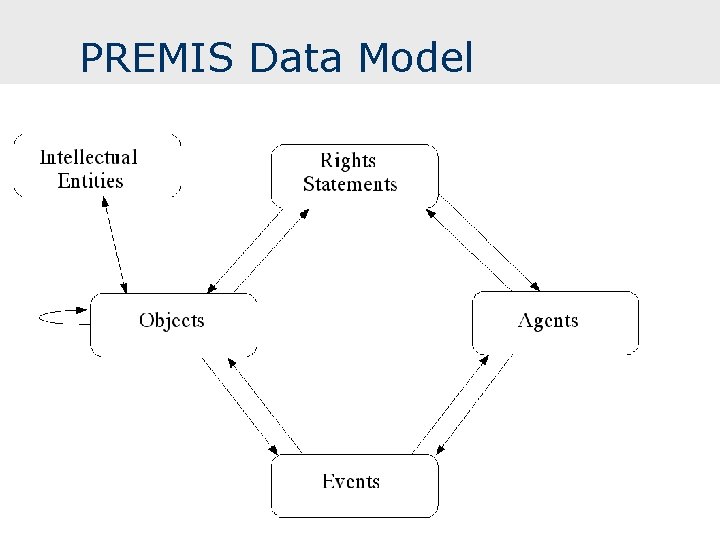
PREMIS Data Model
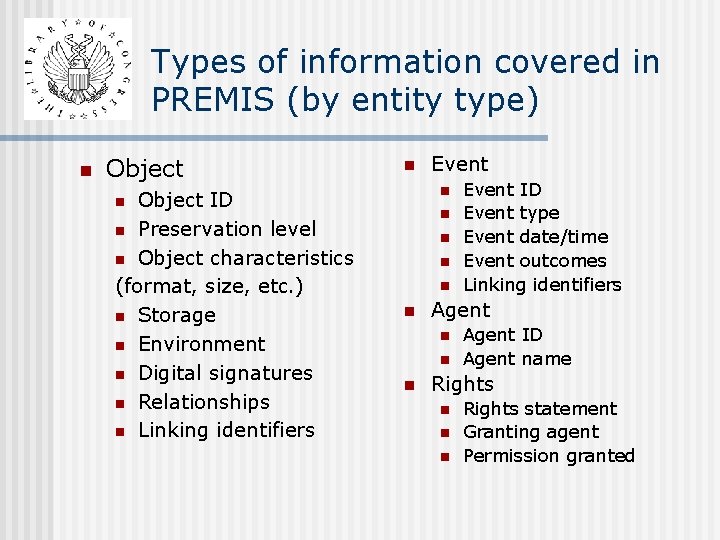
Types of information covered in PREMIS (by entity type) n Object ID n Preservation level n Object characteristics (format, size, etc. ) n Storage n Environment n Digital signatures n Relationships n Linking identifiers n Event n n n n Agent n n n Event ID Event type Event date/time Event outcomes Linking identifiers Agent ID Agent name Rights n n n Rights statement Granting agent Permission granted
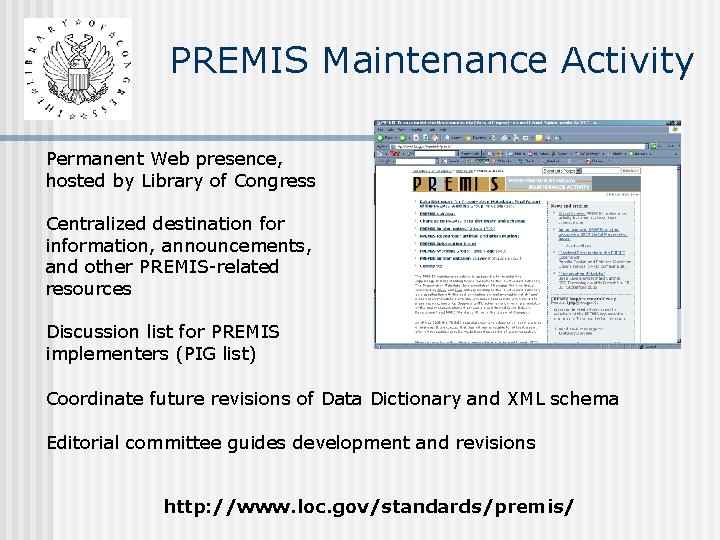
PREMIS Maintenance Activity Permanent Web presence, hosted by Library of Congress Centralized destination for information, announcements, and other PREMIS-related resources Discussion list for PREMIS implementers (PIG list) Coordinate future revisions of Data Dictionary and XML schema Editorial committee guides development and revisions http: //www. loc. gov/standards/premis/
Current activities n PREMIS Implementers’ Registry n n http: //www. loc. gov/standards/premisregistry. html Revision of data dictionary and schemas (March 2008) Guidelines for use of PREMIS within METS PREMIS tutorials n One or one and a half day tutorials have been given in several locations: Glasgow, Boston, Stockholm, Albuquerque, Washington, San Diego n Training materials available from LC
Why is PREMIS important to catalogers? n n n As we take responsibility for more digital materials, we need to ensure that they can be used in the future Most preservation metadata will be generated from the object, but catalogers may need to verify its accuracy Catalogers may need to play a role in assessing and organizing digital materials n n Understanding the structure of complex digital objects Determining significant properties that need to be preserved
Technical metadata for images NISO Z 39. 87 and MIX n Adobe and XMP n Exif n IPTC (International Press Telecommunications Council)/XMP n Some of these deal with embedded metadata in images n
Metadata For Images in XML (MIX) n n n An XML Schema designed for expressing technical metadata for digital still images Based on the NISO Z 39. 87 Data Dictionary – Technical Metadata for Digital Still Images Can be used standalone or as an extension schema with METS/PREMIS
Using MIX n Technical metadata for digital images n n n Characteristics that apply to all or most object types, e. g. size, format (elements also in PREMIS) Format specific metadata for images, e. g. bit depth, color space, etc. Originally designed for TIFF files Recent revision (version 1. 0) includes support for GIS images and JPEG 2000; data element names harmonized with those in PREMIS Most well developed of format specific technical metadata standards Example of MIX metadata
Technical metadata for textual objects text. MD is an XML Schema designed for expressing technical metadata for textual objects n Developed at New York University; maintenance transferred to LC n Includes format specific technical metadata for text, e. g. byte order, character set encoding, font script n
Technical metadata for audio and video n n Not as well developed as other technical metadata Complexities of file formats requires expertise to develop these LC developed XML technical metadata schemas in 2003/2004 for LC Audiovisual Prototype Project used with METS; these were widely implemented because of the lack of other schemas Audio and video technical metadata schemas under development by expert organizations
Technical metadata for audio Audio Engineering Society n Audio Objects (AES-098 B) schema n Accommodates analog and digital as well as segmenting n Schema for process history metadata n Integrates audio and video to some extent n
Technical metadata for moving image n n Society of Motion Picture and Television Engineers (SMPTE) standards: technical standards for television, motion picture and digital cinema MPEG family of standards: MPEG-7 These are highly technical and may be difficult to understand use Moving Image Catalog (MIC) project is also experimenting with these
Structural metadata n n n Supports the intended presentation and use and navigation of an object Binds the parts together; expresses relationships between parts of a multipart object Examples of structural metadata expressions: n n n METS struct. Map PREMIS relationship elements EAD hierarchical structure
Rights metadata n n n Rights schemas with limited scope Full blown Rights Expression Languages (REL) for managing intellectual property rights, particularly by rights owners Rights information is not well understood n n n Different laws in different jurisdictions Machine actionable vs. human understandable Rights take different forms n n legal statutes, e. g. copyright contractual rights, e. g. licenses
Rights schemas with limited scope n METS Rights n n n Access rights for use with METS objects Rights declarations Rights holder Context CDL copyright schema n n Specifically copyrights, not other intellectual property rights Information you need to know to assess copyright status (e. g. creators, rights holders, dates, jurisdiction)
Rights schemas with limited scope cont. n PREMIS Rights n n Focused on rights for preservation rather than access Revision of PREMIS data dictionary expanded this area Allows for extensibility, i. e. inserting another rights schema Creative commons n n Allows creators to choose a license for their work Simple rights statements that fit a lot of situations
Rights metadata for specific object types PLUS for images n MPEG-21 REL for moving images, etc. n ONIX for licensing terms n Full Rights Expression Languages n XRML/MPEG 21 n ODRL n
Exercise n Provide administrative/technical metadata for the object used in the descriptive metadata exercise