
3 SLEEPERS 3 1 Functions of sleepers various



- Slides: 33
3 SLEEPERS 3. 1 Functions of sleepers, various types of Sleepers including composite sleepers PERIODS 2
SLEEPER • Sleepers are members generally laid transverse to the rails on which the rails are supported and fixed, to transfer the loads from rails to the ballast and sub grade below.
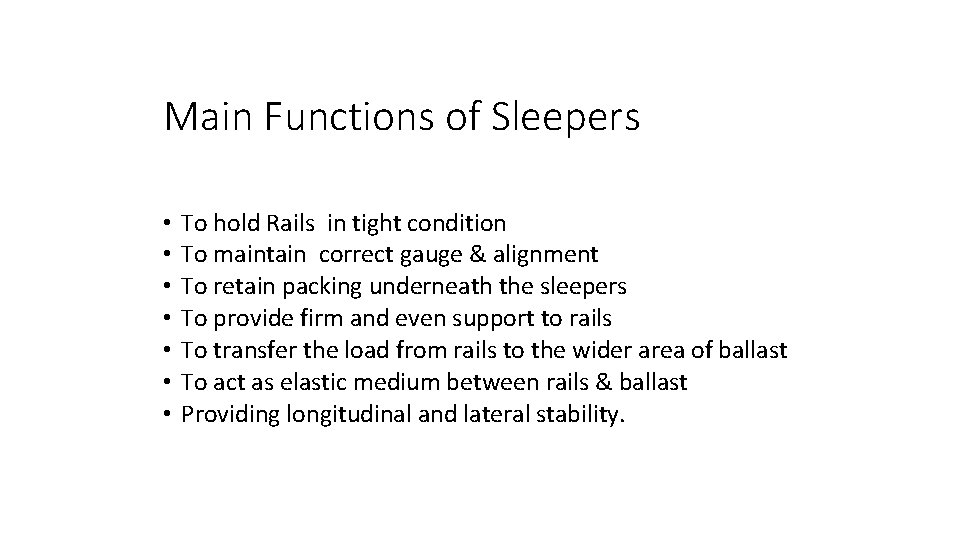
Main Functions of Sleepers • • To hold Rails in tight condition To maintain correct gauge & alignment To retain packing underneath the sleepers To provide firm and even support to rails To transfer the load from rails to the wider area of ballast To act as elastic medium between rails & ballast Providing longitudinal and lateral stability.
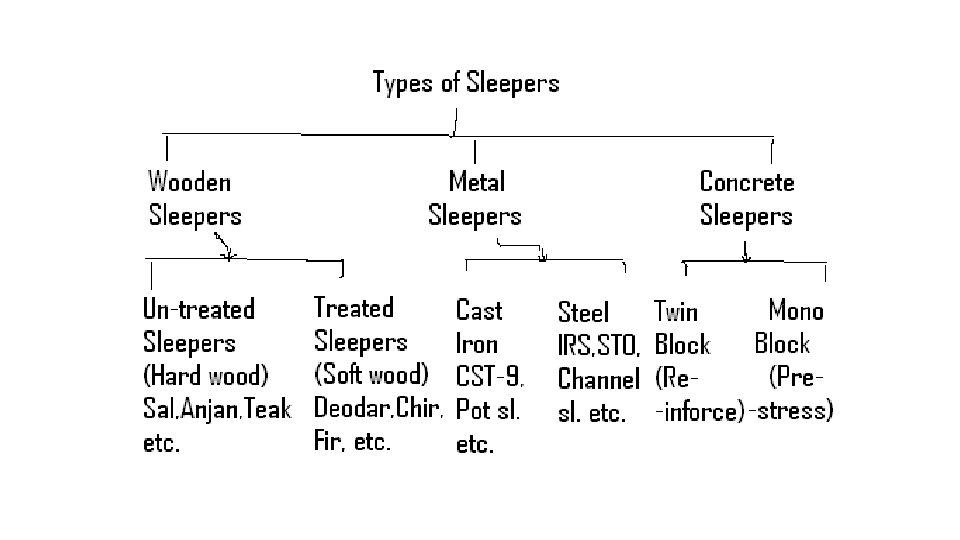
CLASSIFICATION OF SLEEPERs Sleepers can be classified according to the materials used in their construction 1. Wooden sleepers 2. Metal sleepers • C S T – 9 sleepers • Steel trough sleepers 3. Concrete sleepers • Reinforced concrete sleepers • Pre-stressed concrete sleepers
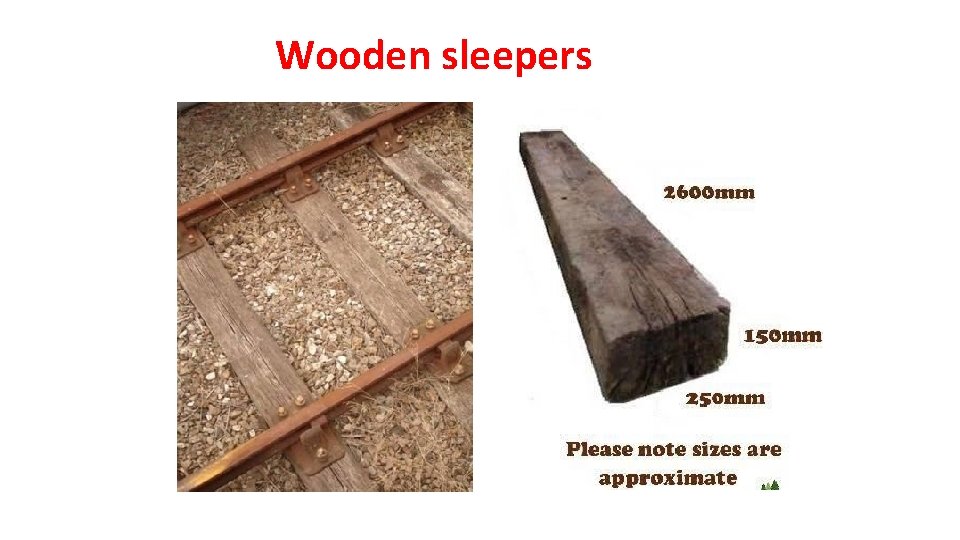
Wooden sleepers
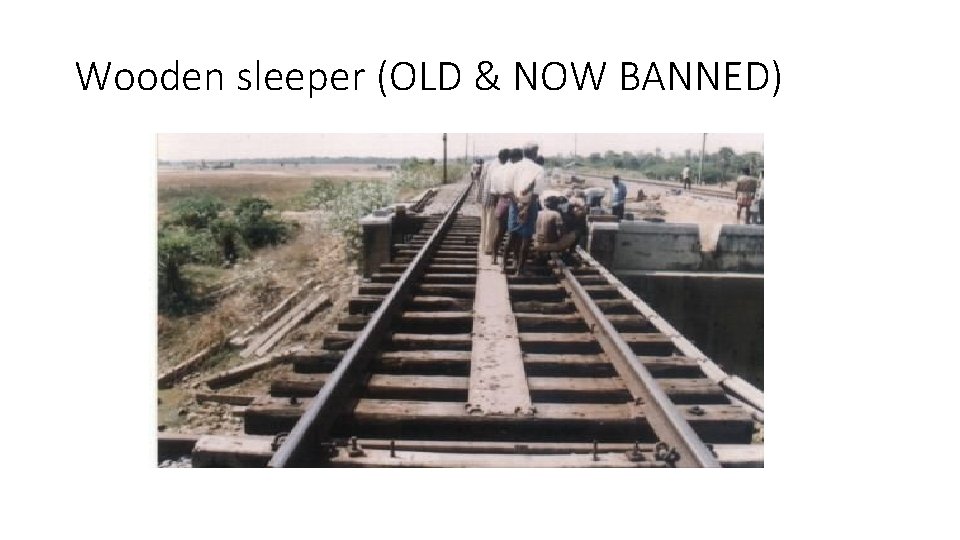
Wooden sleeper (OLD & NOW BANNED)
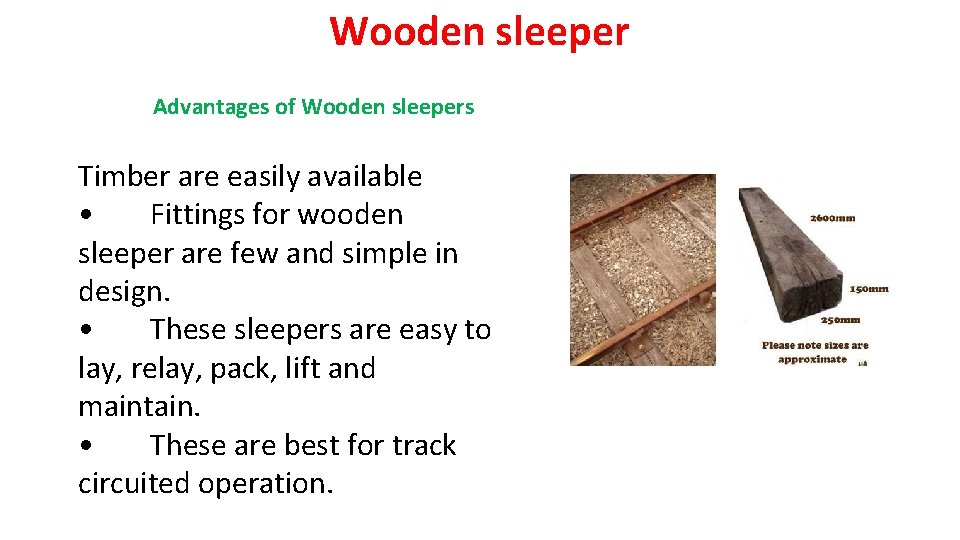
Wooden sleeper Advantages of Wooden sleepers Timber are easily available • Fittings for wooden sleeper are few and simple in design. • These sleepers are easy to lay, relay, pack, lift and maintain. • These are best for track circuited operation.
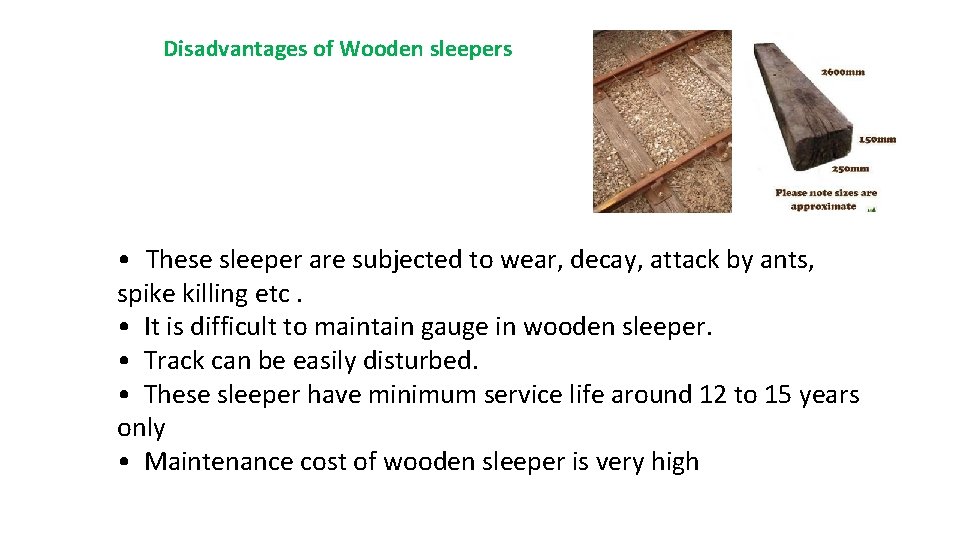
Disadvantages of Wooden sleepers • These sleeper are subjected to wear, decay, attack by ants, spike killing etc. • It is difficult to maintain gauge in wooden sleeper. • Track can be easily disturbed. • These sleeper have minimum service life around 12 to 15 years only • Maintenance cost of wooden sleeper is very high
C S T – 9 sleepers
C S T – 9 sleepers
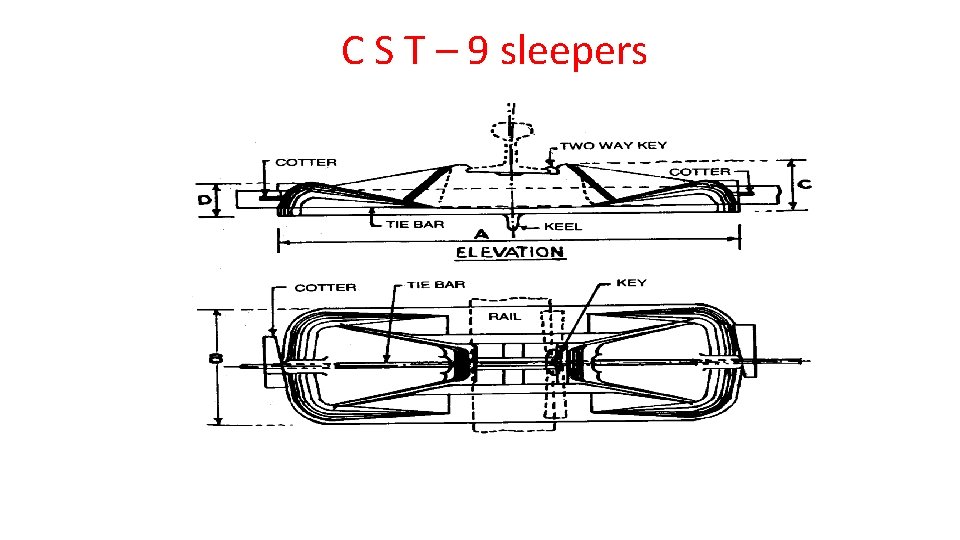
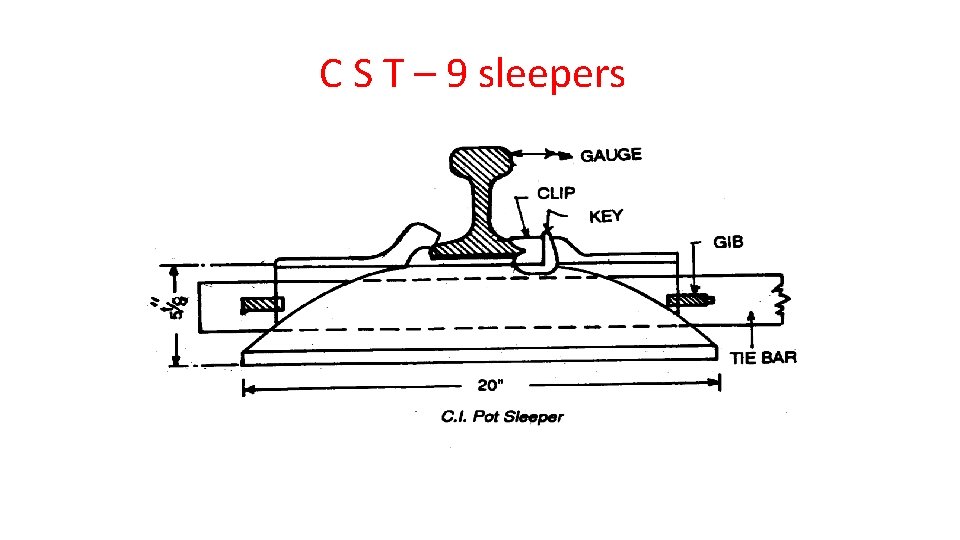
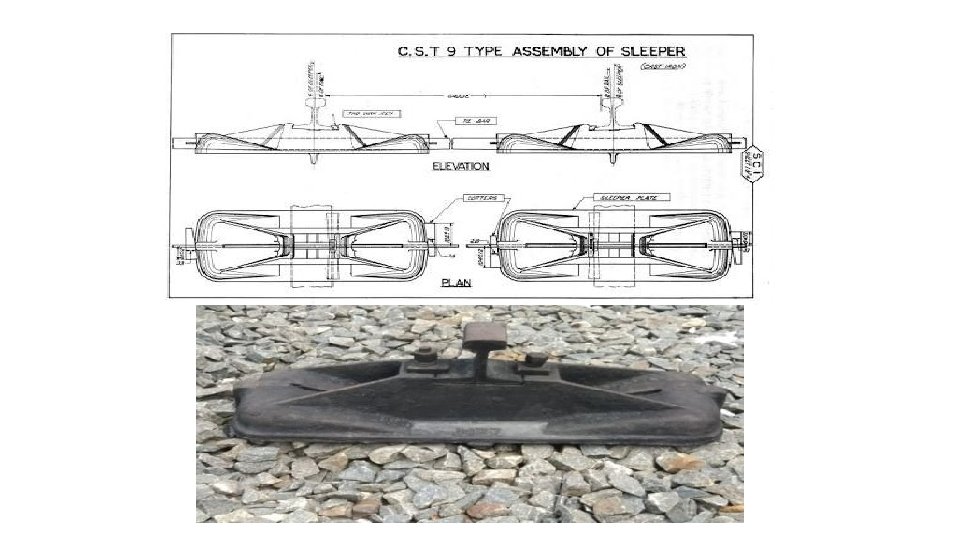
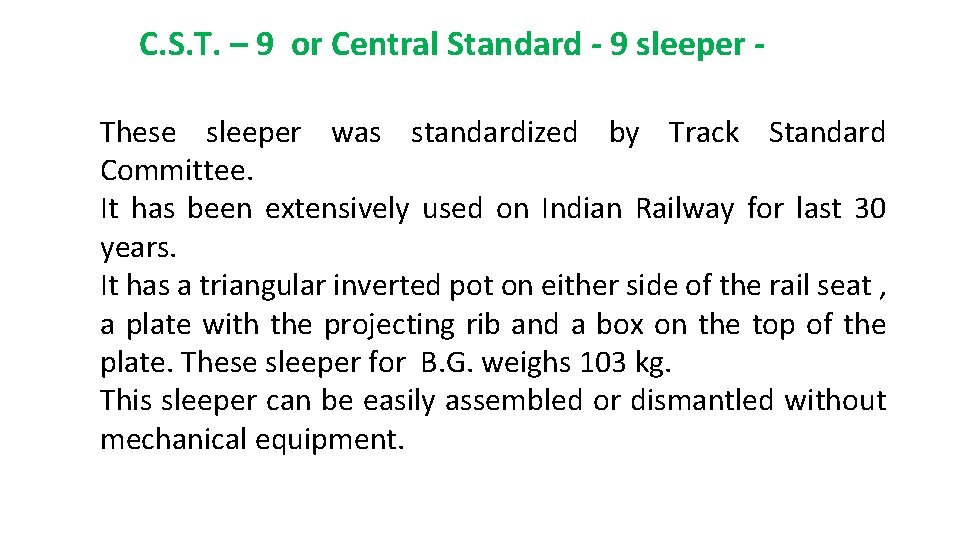
C. S. T. – 9 or Central Standard - 9 sleeper These sleeper was standardized by Track Standard Committee. It has been extensively used on Indian Railway for last 30 years. It has a triangular inverted pot on either side of the rail seat , a plate with the projecting rib and a box on the top of the plate. These sleeper for B. G. weighs 103 kg. This sleeper can be easily assembled or dismantled without mechanical equipment.
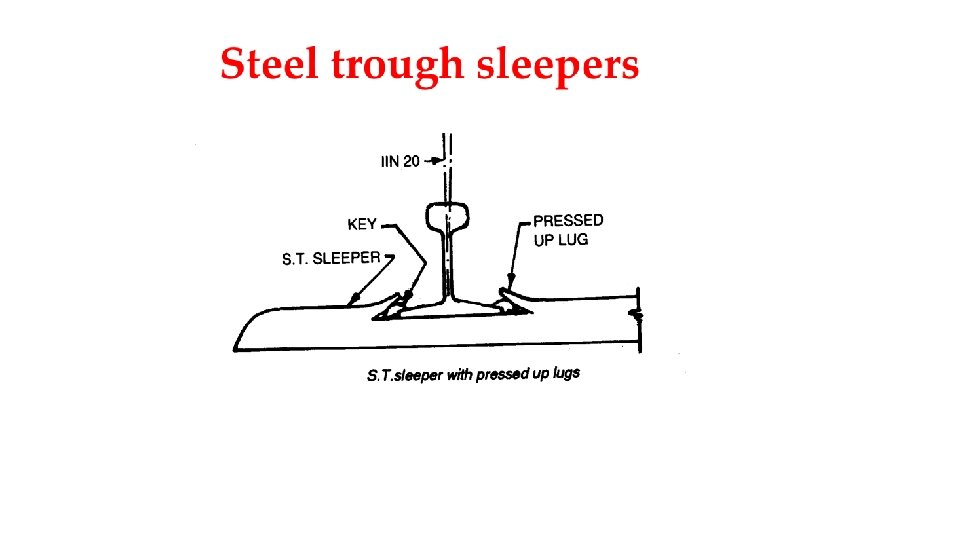
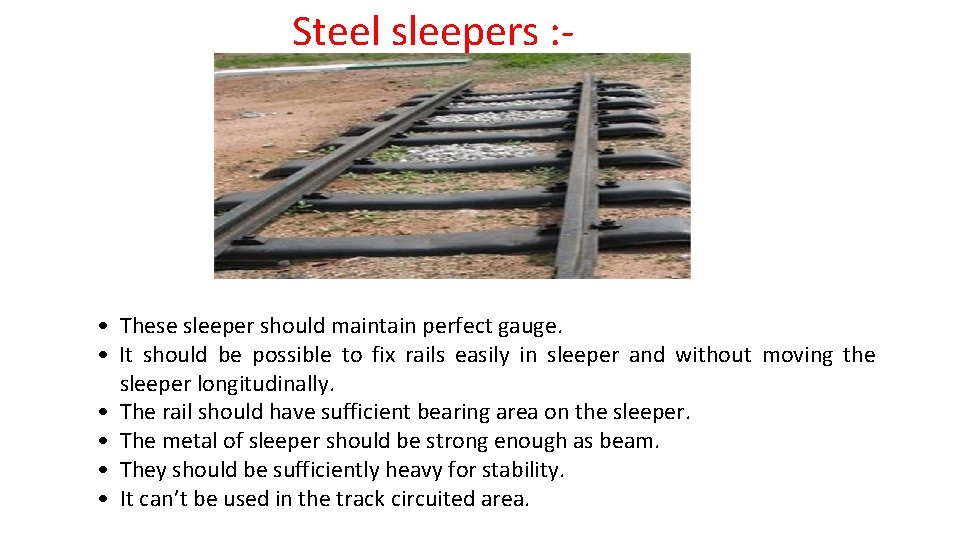
Steel sleepers : - • These sleeper should maintain perfect gauge. • It should be possible to fix rails easily in sleeper and without moving the sleeper longitudinally. • The rail should have sufficient bearing area on the sleeper. • The metal of sleeper should be strong enough as beam. • They should be sufficiently heavy for stability. • It can’t be used in the track circuited area.
Advantages of metal sleepers : • Metal sleepers are uniform in strength and durability. • Metal sleepers are economical as life is longer and maintenance is easier. • Gauge can be easily adjusted. • Metal sleepers have good scrape value, easy in manufacturing and not susceptible to fire hazards.
Disadvantages of metal sleepers : More ballast require than other type of sleepers. • Fittings required are greater in number, and difficult to maintain and inspection. • Metal, C. I. , or steel are liable to rusting or corrosion. • These sleepers cannot be used in track circuited areas.
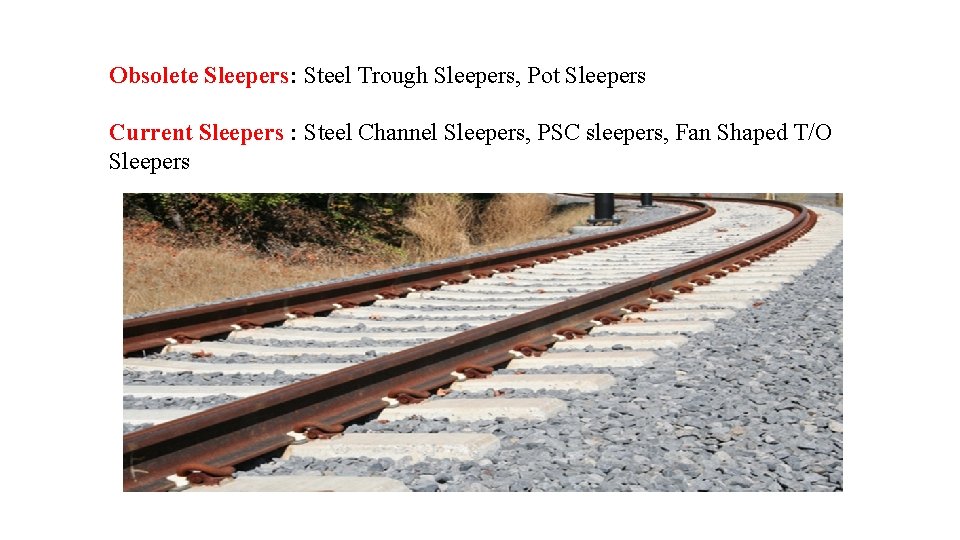
Obsolete Sleepers: Steel Trough Sleepers, Pot Sleepers Current Sleepers : Steel Channel Sleepers, PSC sleepers, Fan Shaped T/O Sleepers
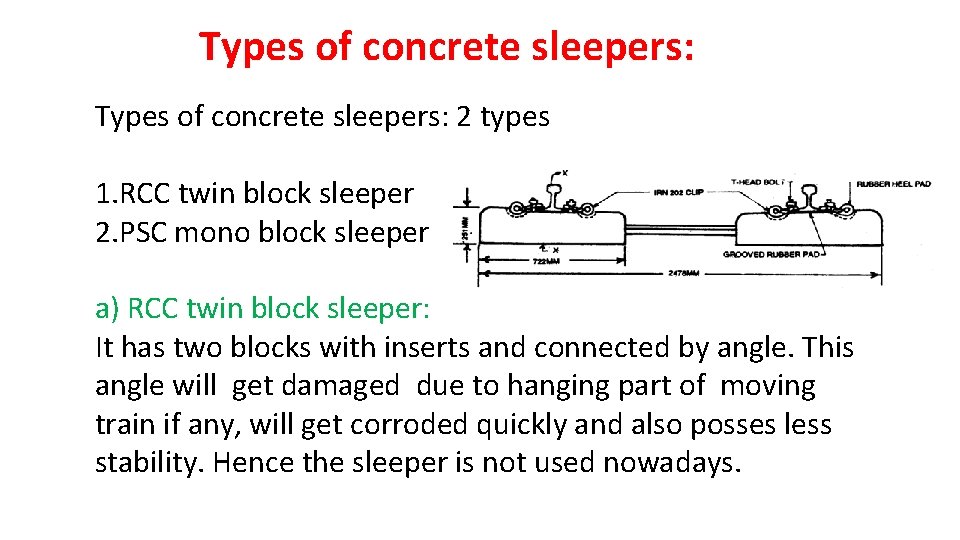
Types of concrete sleepers: 2 types 1. RCC twin block sleeper 2. PSC mono block sleeper a) RCC twin block sleeper: It has two blocks with inserts and connected by angle. This angle will get damaged due to hanging part of moving train if any, will get corroded quickly and also posses less stability. Hence the sleeper is not used nowadays.
Types of concrete sleepers: b) PSC mono block sleeper Design considerations: In case of RCC the dimension of sleeper will be large. And hence prestressed con-crete is used. It is designed for a load of 15 tonnes at each rail seat based on statical load 15 tonnes for BG and 11 tonnes for MG. The cross section of sleeper as minimum as compared to cross section at rail seat and end face of sleeper. The sleeper is designed for M 55 grade of concrete. High tensile steel wires (H. T. S) 3 x 3 mm ply of 18 no’s for B. G sleeper and 12 no’s for MG sleeper are used as reinforcement The prestressing force of 2730 kg is applied to each strand.
Concrete Sleepers Advantages • Freedom of design and construction • Long service life & durability • With elastic fastening system • Maintains good track geometry for better Safety • Higher weight for • Good longitudinal & lateral resistance • Better longitudinal & lateral stability for LWR • Anti theft & Anti-sabotage • Flat bottom – Best suited for mechanized maintenance • Well-suited for track circuiting • Simple to manufacture, Cost effective etc.
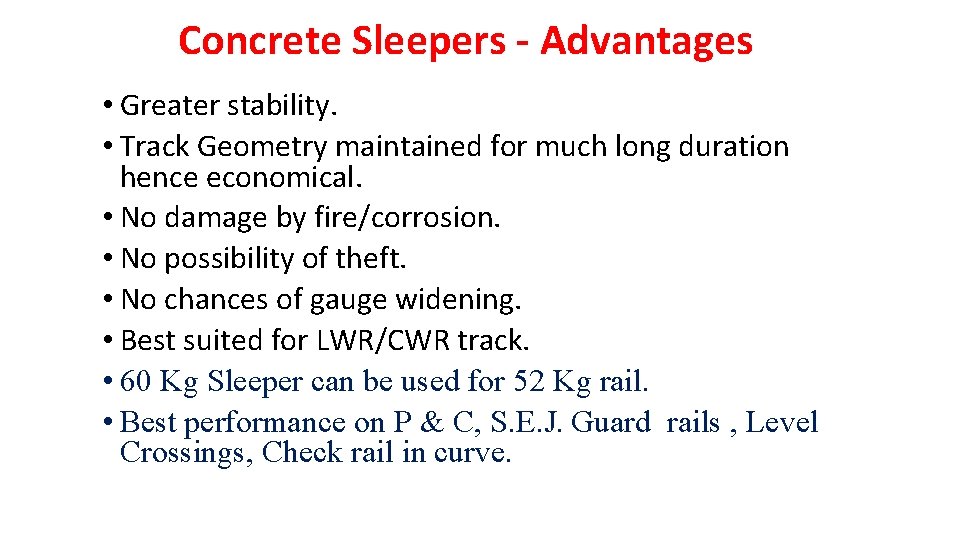
Concrete Sleepers - Advantages • Greater stability. • Track Geometry maintained for much long duration hence economical. • No damage by fire/corrosion. • No possibility of theft. • No chances of gauge widening. • Best suited for LWR/CWR track. • 60 Kg Sleeper can be used for 52 Kg rail. • Best performance on P & C, S. E. J. Guard rails , Level Crossings, Check rail in curve.
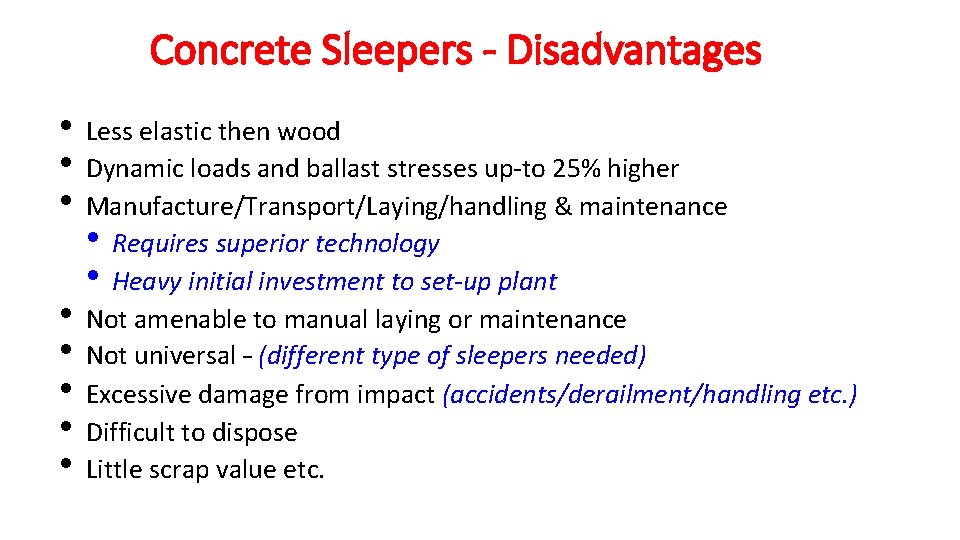
Concrete Sleepers - Disadvantages • Less elastic then wood • Dynamic loads and ballast stresses up-to 25% higher • Manufacture/Transport/Laying/handling & maintenance • Requires superior technology • Heavy initial investment to set-up plant • Not amenable to manual laying or maintenance • Not universal – (different type of sleepers needed) • Excessive damage from impact (accidents/derailment/handling etc. ) • Difficult to dispose • Little scrap value etc.
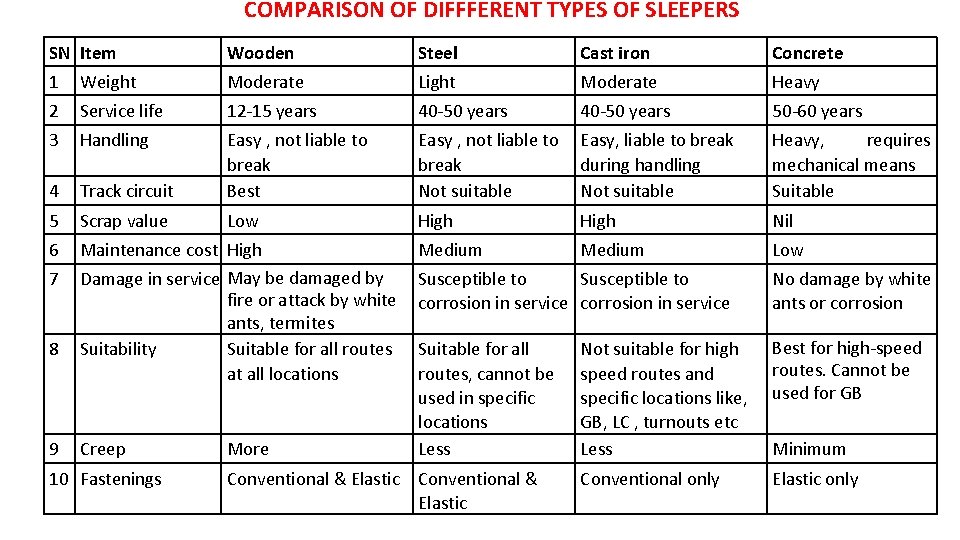
COMPARISON OF DIFFFERENT TYPES OF SLEEPERS SN Item Wooden Steel Cast iron Concrete 1 Weight Moderate Light Moderate Heavy 2 Service life 12 -15 years 40 -50 years 50 -60 years 3 Handling 4 Track circuit Easy , not liable to break Best Easy , not liable to break Not suitable Easy, liable to break during handling Not suitable Heavy, requires mechanical means Suitable 5 Scrap value Low High Nil 6 Maintenance cost High Damage in service May be damaged by fire or attack by white ants, termites Suitability Suitable for all routes at all locations Medium Low 7 8 9 Creep 10 Fastenings More Susceptible to corrosion in service No damage by white ants or corrosion Suitable for all routes, cannot be used in specific locations Less Not suitable for high speed routes and specific locations like, GB, LC , turnouts etc Less Best for high-speed routes. Cannot be used for GB Conventional only Elastic only Conventional & Elastic Minimum
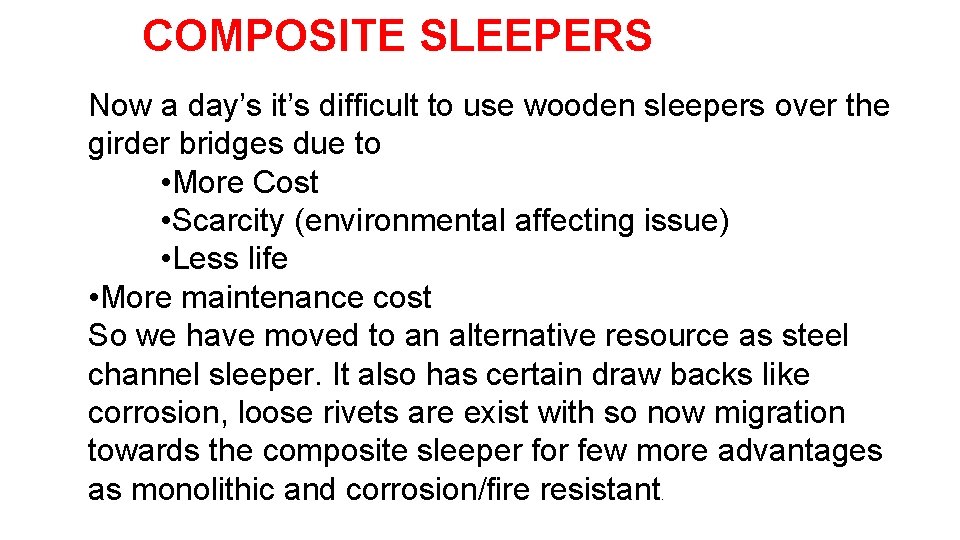
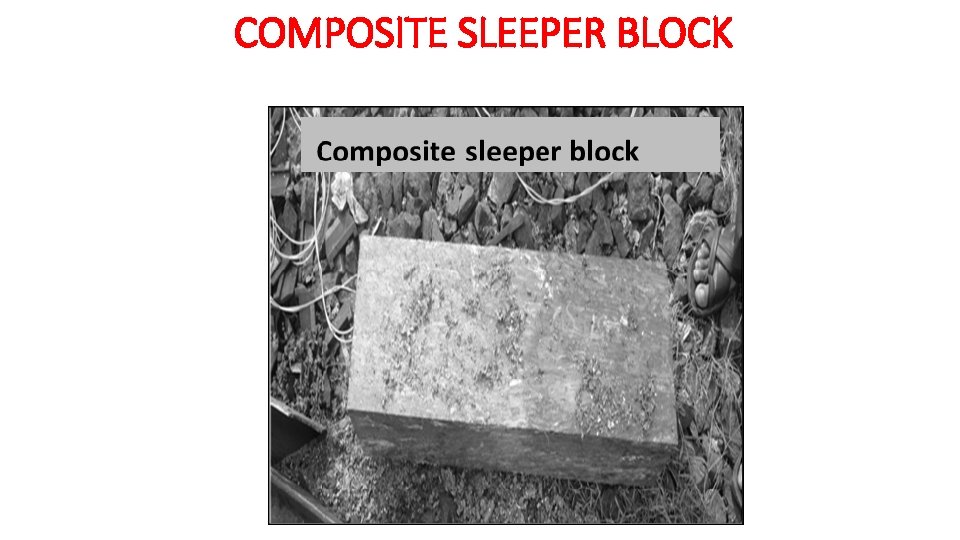
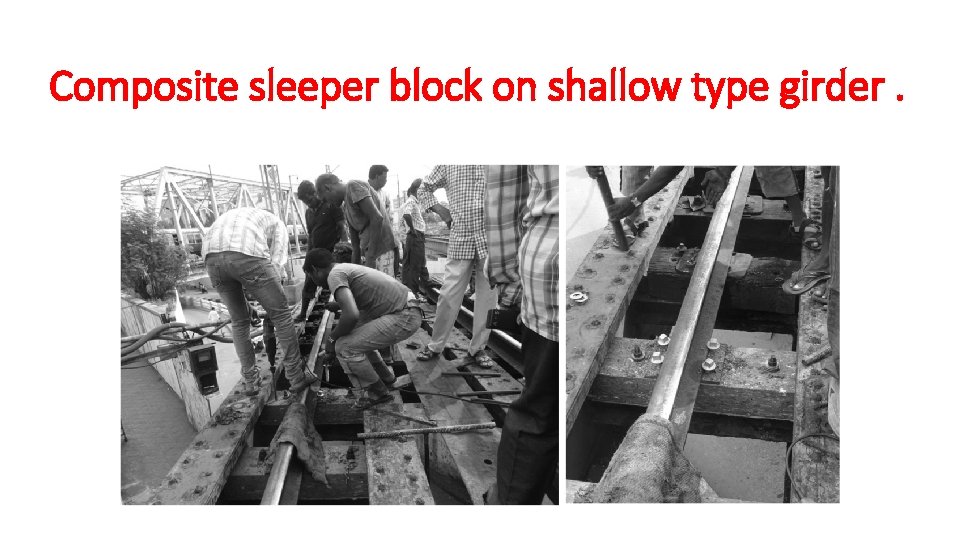
COMPOSITE SLEEPERS Now a day’s it’s difficult to use wooden sleepers over the girder bridges due to • More Cost • Scarcity (environmental affecting issue) • Less life • More maintenance cost So we have moved to an alternative resource as steel channel sleeper. It also has certain draw backs like corrosion, loose rivets are exist with so now migration towards the composite sleeper for few more advantages as monolithic and corrosion/fire resistant.
COMPOSITE SLEEPER BLOCK
Composite material A composite material is a material formed using two or more discretely identified materials (e. g. a polymer binder with reinforcement in polymer composites) to obtain specific properties that are superior to the individual material. In general, composite sleeper is a material system that incorporates reinforcement (e. g. glass fibres) and / or other property modifiers in a polymer matrix. Based on reinforcement and property modifiers, the Polymer composite sleepers may be classified in any one of the following
Composite sleeper block on shallow type girder.
Types of composite sleeper • a) Fibre reinforced polymer composite- polymer reinforced with fibrous glass or other fibres, including polymeric fibres. Fillers and other modifiers may also be added to enhance particular physical or mechanical properties. • b)Particle reinforced polymer composite- polymer modified with dispersed small particles to enhance particulars physical and / or mechanical properties. • c)Hybrid composite – a composite that incorporates two different reinforcement fibres or other structural components (e. g. a concrete steel and polymer combination).
Requirement for a composite sleeper • It should hold the rail with bearing plates by means of rail screw without any additional procedure to do so • It should withstand a maximum dynamic load of 25 T and also to observe the vibration during dynamic load over the sleeper (passing of vehicle). • It should not fail due to weather conditions such as heat/cold over the four temperature zones • Material surface degradation due to solar ultraviolet (UV) radiation exposure shall not exceed 0. 076 mm per year
Requirement for a composite sleeper • It would be preferable if the sleeper is grey or black in colour but shall not be red in colour. • No visible voids on the surface of the sleeper • Sleeper shall be fire resistant in prevailing Indian condition and shall be suitable for use in track circuited area. • The sleeper shall be durable, so as to retain necessary strength and other structural properties during service in track. • The sleeper shall be resistant to rot, bacteria and insects such as termites, borers etc which may reduce strength and/or integrity of sleeper.
THANKS