
3 REGIONS OF THE CELL Surface Extensions Plasma




- Slides: 27
3 REGIONS OF THE CELL Surface Extensions Plasma Membrane Cytoplasm
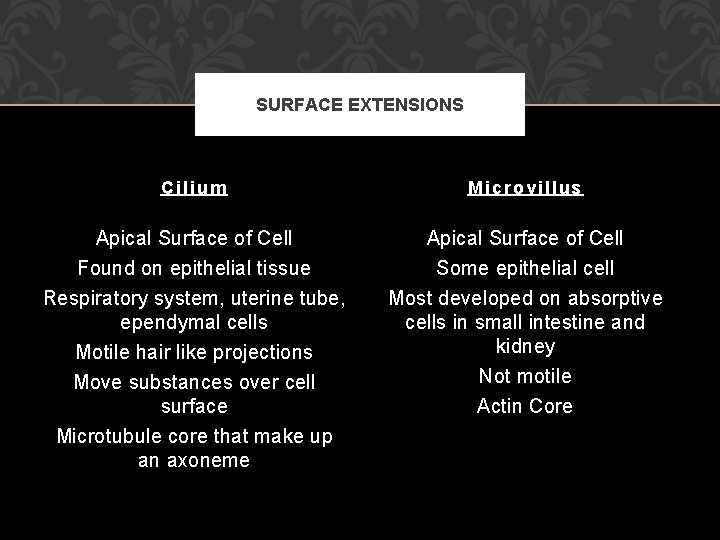
SURFACE EXTENSIONS Cilium Microvillus Apical Surface of Cell Found on epithelial tissue Apical Surface of Cell Some epithelial cell Respiratory system, uterine tube, ependymal cells Motile hair like projections Move substances over cell surface Microtubule core that make up an axoneme Most developed on absorptive cells in small intestine and kidney Not motile Actin Core
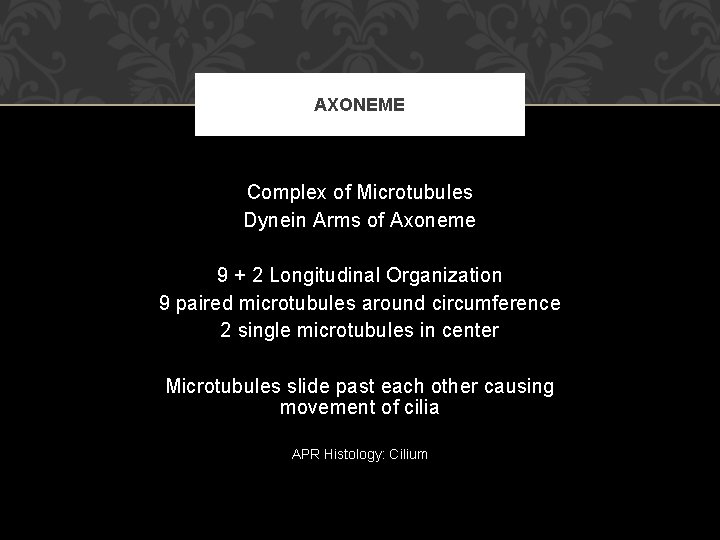
AXONEME Complex of Microtubules Dynein Arms of Axoneme 9 + 2 Longitudinal Organization 9 paired microtubules around circumference 2 single microtubules in center Microtubules slide past each other causing movement of cilia APR Histology: Cilium
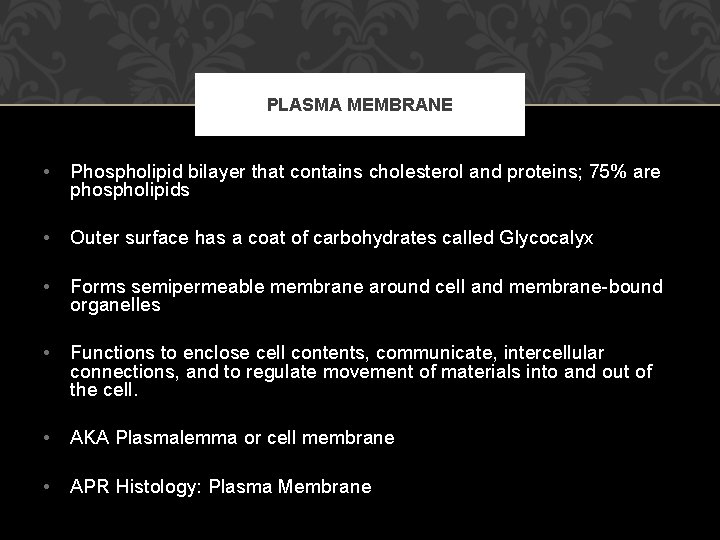
PLASMA MEMBRANE • Phospholipid bilayer that contains cholesterol and proteins; 75% are phospholipids • Outer surface has a coat of carbohydrates called Glycocalyx • Forms semipermeable membrane around cell and membrane-bound organelles • Functions to enclose cell contents, communicate, intercellular connections, and to regulate movement of materials into and out of the cell. • AKA Plasmalemma or cell membrane • APR Histology: Plasma Membrane
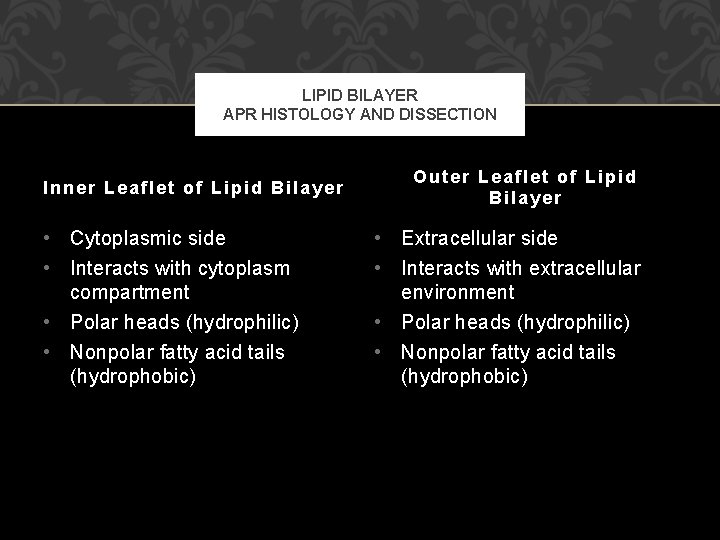
LIPID BILAYER APR HISTOLOGY AND DISSECTION Inner Leaflet of Lipid Bilayer • Cytoplasmic side • Interacts with cytoplasm compartment • Polar heads (hydrophilic) • Nonpolar fatty acid tails (hydrophobic) Outer Leaflet of Lipid Bilayer • Extracellular side • Interacts with extracellular environment • Polar heads (hydrophilic) • Nonpolar fatty acid tails (hydrophobic)
CHOLESTEROL • Hydrophobic region of lipid bilayer • 20% of plasma membrane lipids • Strengthens membrane and stabilizes at extreme temperature • Prevents over-dense packing of fatty acid tails by filling gaps between fatty acid tails
GLYCOLIPIDS • Sugar containing lipid molecules • Outer surface of plasma membrane • 5% of lipid molecules in outer membrane • Protect membrane from harsh extracellular conditions • Cell-Cell Recognition • Binding of cell to extracellular matrix
GLYCOCALYX • Outer surface of plasma membrane • “fuzzy coat” • Made of carbohydrates attached to membrane glycolipids and glycoproteins • Protects against mechanical and chemical damage • Provides immunity to infection, cancer defense, transplant compatability, cell adhesion, and embryonic development
PROTEINS 1. • • • Glycoprotein >90% of membrane molecules that are conjugated with carbs Sugar containing membrane protein Membrane protein covalently bonded to carbs 2. • • Integral Membrane Proteins Partially/completely embedded in membrane Receptors Membrane channel Proteins Cell Identity Marker 3. • • • Peripheral Membrane Proteins On plasma membrane Does not extend into lipid bilayer Cell signaling and enzyme activity
MEMBRANE BOUND ORGANELLES • • • NUCLEUS NUCLEOLUS MEMBRANE BOUND RIBOSOME FREE RIBOSOME ROUGH ENDOPLASMIC RETICULUM SMOOTH ENDOPLASMIC RETICULUM GOLGI COMPLEX LYSOSOME PEROXISOME ENDOCYTIC VESICLES MITOCHONDRIA
NUCLEUS • Generally centrally located • Occasionally eccentrically located • Spherical or Ovid Shaped • Largest Organelle • Nuclear envelope has a double membrane • Contains cellular DNA • Contains nucleolus • • • DNA replication DNA transcritpion to m. RNA Ribosomal RNA synthesis Ribosome unit assembly Anucleate = cells without a nucleus • Multinucleate = cells with multiple nuclei
NUCLEAR PORE • Opening in nuclear envelope • Formed by proteins • Allows/regulates passage of materials between cytoplasm and nucleus
NUCLEOLUS • Usually spherical in shape • Ribosomal RNA synthesis • Ribosome assembly • 1 -3 Nucleoli present depending on cell activity
MEMBRANE BOUND RIBOSOMES • • Outer aspect of endoplasmic reticulum Outer aspect of nuclear envelope Ribosomes attached to membrane bound organelles Involved with translating protein
FREE RIBOSOMES • Located in cytpolasm • Polyribosomes: when multiple ribosomes are attached to m. RNA and site for protein synthesis
ROUGH ENDOPLASMIC RETICULUM • Located in cytoplasm between nucleus and Golgi apparatus • Ribosomes attached • Continuous with SER • RER + SER comprises more than ½ of the total membrane of the cell • Protein synthesis for secretion, insertion into membrane, and for lysosome
SMOOTH ENDOPLASMIC RETICULUM • Subdivision of ER which is a series of tubules and flattened sacs • Lacks ribosomes • In skeletal muscle is called sarcoplasmic reticulum • Synthesizes lipids • Detoxifies drugs and alcohol • Metabolizes carbohydrates • Stores calcium
GOLGI COMPLEX • • • Cytoplasm adjacent to RER Cis-face – closest to RER; receiving region Intermediate face Trans-face – farthest from RER; transport or shipping region Modifies, sorts and packages newly synthesized proteins
LYSOSOMES • Contains acidid hydrolilic enzymes • Digest macromolecules, microorganisms, old or damaged organelles • Structurally similar to perixisomes but contain different enzymes, acidic hydrolasses
PEROXISOME • Cytoplasm • Contain oxidative enzymes • Formation and breakdown of intracellular hydrogen peroxide • Breakdown of fatty acids • Involved in bile acid synthesis in liver
ENDOCYTIC VESICLES • Plasma membrane and cytoplasm • Larger type = Phagosome-engulfs larger particles • Smaller type = Pinocytic vesicle- engulfs extracellular fluid and recycles plasma membrane • Endocytosis: plasma membrane surrounds particle to bring into cell
MITOCHONDRION • Rod shaped • Double layer membrane (2 lipid layers) • Matrix space enclosed by inner membrane • “Powerhouse” of cell • Synthesizes ATP
CRISTAE • Complex folds • Increase surface area
NON-MEMBRANE BOUND ORGANELLES • Centrosome • Cytoskeleton
CENTROSOME • Perinuclear (near nucleus) • Pair of centrioles at right angles to each other • Centrosome matrix • Assists in formation and organization of microtubules • Spindle formation during mitosis • AKA Microtubule Organizing Center (MTOC) • Pair of Centrosomes = Diplosome
MICROTUBULES • Located in cytoplasm, cilia, and flagella, and in the centromere • Composed of polymerized tubulin protein monomers • Provide mechanical strength • Allow for organelle and chromosome movement
APR WORKBOOK EXERCISES • Exercise 2. 1 p. 75 -76 (up to but not including histology: flagellum of sperm) • p. 80 -83 (up to but not including histology: cytoskeleton(neurofilament and microtubule) • p. 84 - 97 • Exercise 2. 2 p. 98 - 102