
3 rd Food Structure and Functionality Forum 3
- Slides: 1
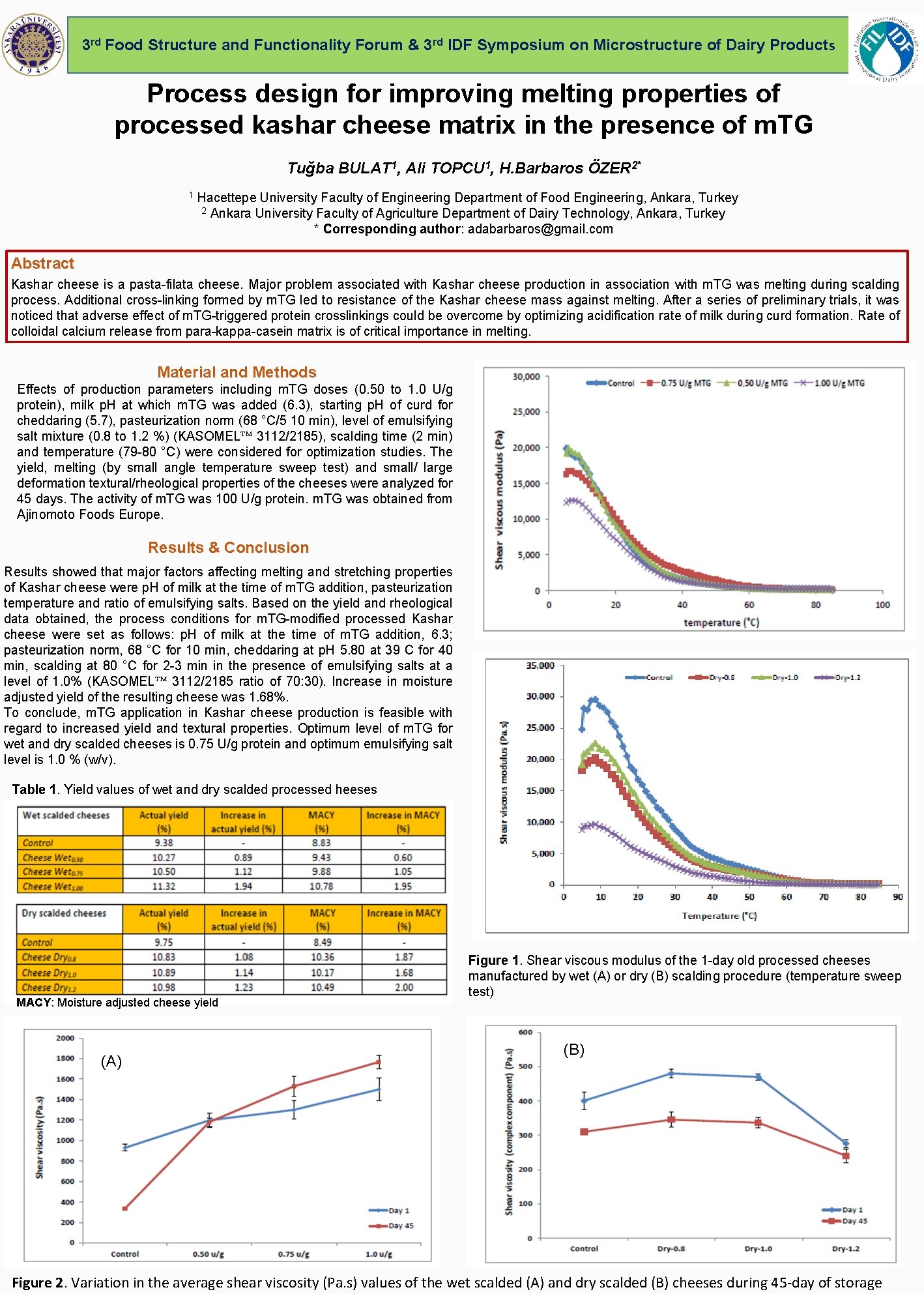
3 rd Food Structure and Functionality Forum & 3 rd IDF Symposium on Microstructure of Dairy Products Process design for improving melting properties of processed kashar cheese matrix in the presence of m. TG Tuğba BULAT 1, Ali TOPCU 1, H. Barbaros ÖZER 2* 1 Hacettepe University Faculty of Engineering Department of Food Engineering, Ankara, Turkey 2 Ankara University Faculty of Agriculture Department of Dairy Technology, Ankara, Turkey * Corresponding author: adabarbaros@gmail. com Abstract Kashar cheese is a pasta-filata cheese. Major problem associated with Kashar cheese production in association with m. TG was melting during scalding process. Additional cross-linking formed by m. TG led to resistance of the Kashar cheese mass against melting. After a series of preliminary trials, it was noticed that adverse effect of m. TG-triggered protein crosslinkings could be overcome by optimizing acidification rate of milk during curd formation. Rate of colloidal calcium release from para-kappa-casein matrix is of critical importance in melting. Material and Methods Effects of production parameters including m. TG doses (0. 50 to 1. 0 U/g protein), milk p. H at which m. TG was added (6. 3), starting p. H of curd for cheddaring (5. 7), pasteurization norm (68 °C/5 10 min), level of emulsifying salt mixture (0. 8 to 1. 2 %) (KASOMEL 3112/2185), scalding time (2 min) and temperature (79 -80 °C) were considered for optimization studies. The yield, melting (by small angle temperature sweep test) and small/ large deformation textural/rheological properties of the cheeses were analyzed for 45 days. The activity of m. TG was 100 U/g protein. m. TG was obtained from Ajinomoto Foods Europe. Results & Conclusion Results showed that major factors affecting melting and stretching properties of Kashar cheese were p. H of milk at the time of m. TG addition, pasteurization temperature and ratio of emulsifying salts. Based on the yield and rheological data obtained, the process conditions for m. TG-modified processed Kashar cheese were set as follows: p. H of milk at the time of m. TG addition, 6. 3; pasteurization norm, 68 °C for 10 min, cheddaring at p. H 5. 80 at 39 C for 40 min, scalding at 80 °C for 2 -3 min in the presence of emulsifying salts at a level of 1. 0% (KASOMEL 3112/2185 ratio of 70: 30). Increase in moisture adjusted yield of the resulting cheese was 1. 68%. To conclude, m. TG application in Kashar cheese production is feasible with regard to increased yield and textural properties. Optimum level of m. TG for wet and dry scalded cheeses is 0. 75 U/g protein and optimum emulsifying salt level is 1. 0 % (w/v). Table 1. Yield values of wet and dry scalded processed heeses MACY: Moisture adjusted cheese yield (A) Figure 1. Shear viscous modulus of the 1 -day old processed cheeses manufactured by wet (A) or dry (B) scalding procedure (temperature sweep test) (B) Figure 2. Variation in the average shear viscosity (Pa. s) values of the wet scalded (A) and dry scalded (B) cheeses during 45 -day of storage