
3 Process Strategy Power Point Slides by Jeff
3 Process Strategy Power. Point Slides by Jeff Heyl Copyright © 2010 Pearson Education, Inc. Publishing as Prentice Hall. For Operations Management, 9 e by Krajewski/Ritzman/Malhotra © 2010 Pearson 3 Education – 1
Process Strategy l Principles of process strategy 1. Make choices that fit the situation and that make sense together, that have a close strategic fit 2. Individual processes are the building blocks that eventually create the firm’s whole supply chain 3. Management must pay particular attention to the interfaces between processes 3– 2 Copyright © 2010 Pearson Education, Inc. Publishing as Prentice Hall.
Process Strategy l There are four basic process decisions 1. Process structure including layout 2. Customer involvement 3. Resource flexibility 4. Capital intensity 3– 3 Copyright © 2010 Pearson Education, Inc. Publishing as Prentice Hall.
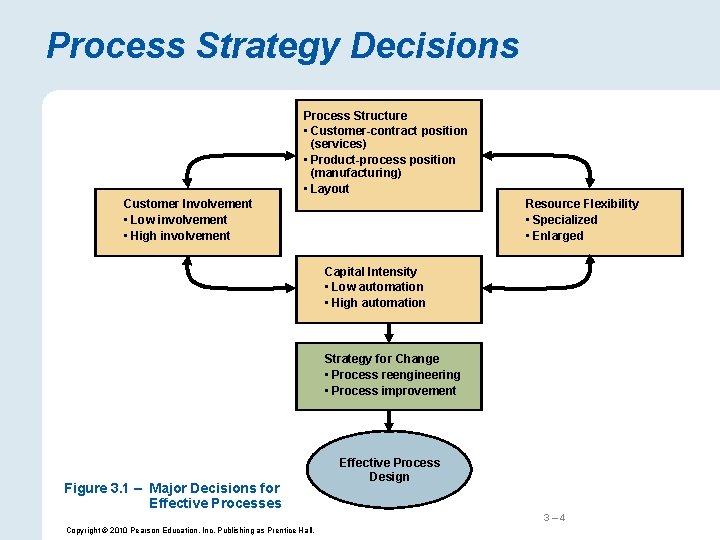
Process Strategy Decisions Process Structure • Customer-contract position (services) • Product-process position (manufacturing) • Layout Customer Involvement • Low involvement • High involvement Resource Flexibility • Specialized • Enlarged Capital Intensity • Low automation • High automation Strategy for Change • Process reengineering • Process improvement Figure 3. 1 – Major Decisions for Effective Processes Effective Process Design 3– 4 Copyright © 2010 Pearson Education, Inc. Publishing as Prentice Hall.
Process Structure in Services l Customer contact is the extent to which the customer is present, actively involved, and receives personal attention during the service process l Face-to-face interaction is sometimes called a moment of truth or a service encounter 3– 5 Copyright © 2010 Pearson Education, Inc. Publishing as Prentice Hall.
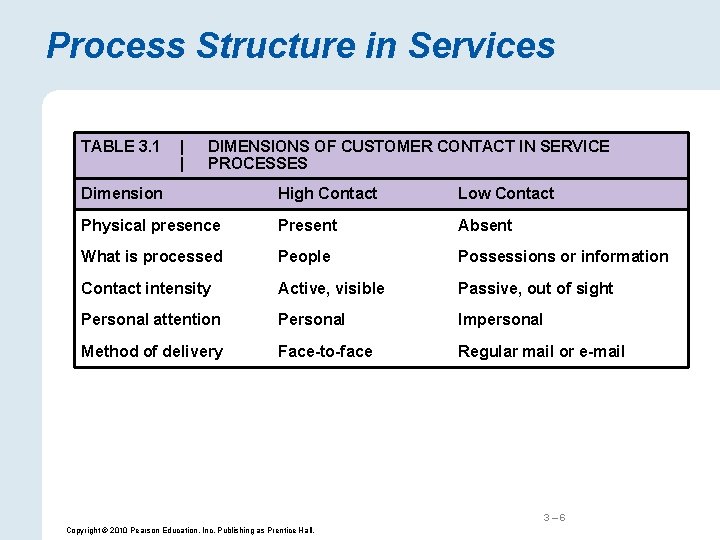
Process Structure in Services TABLE 3. 1 | | DIMENSIONS OF CUSTOMER CONTACT IN SERVICE PROCESSES Dimension High Contact Low Contact Physical presence Present Absent What is processed People Possessions or information Contact intensity Active, visible Passive, out of sight Personal attention Personal Impersonal Method of delivery Face-to-face Regular mail or e-mail 3– 6 Copyright © 2010 Pearson Education, Inc. Publishing as Prentice Hall.
Process Structure in Services l The three elements of the customer-contact matrix are 1. The degree of customer contact 2. Customization 3. Process characteristics l Process characteristics include 1. Process divergence deals with customization and the latitude as to how tasks are performed 2. Flow is how customers, objects, or information are process and can be either line of flexible 3– 7 Copyright © 2010 Pearson Education, Inc. Publishing as Prentice Hall.
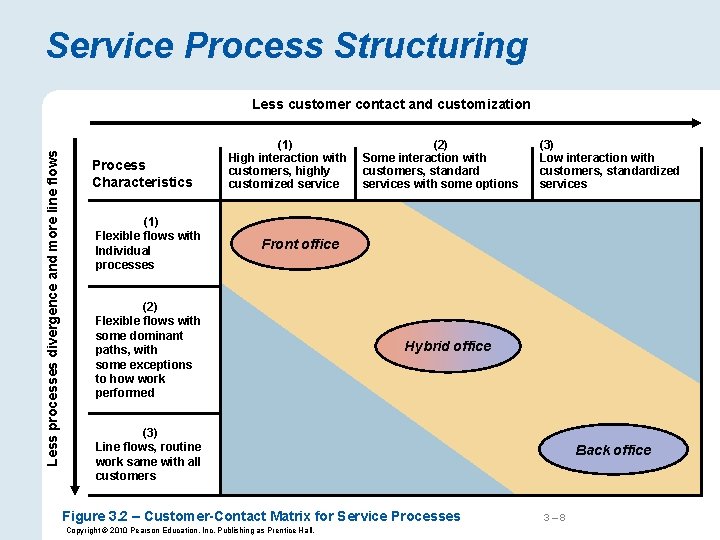
Service Process Structuring Less processes divergence and more line flows Less customer contact and customization Process Characteristics (1) Flexible flows with Individual processes (1) High interaction with customers, highly customized service (2) Some interaction with customers, standard services with some options (3) Low interaction with customers, standardized services Front office (2) Flexible flows with some dominant paths, with some exceptions to how work performed Hybrid office (3) Line flows, routine work same with all customers Figure 3. 2 – Customer-Contact Matrix for Service Processes Copyright © 2010 Pearson Education, Inc. Publishing as Prentice Hall. Back office 3– 8
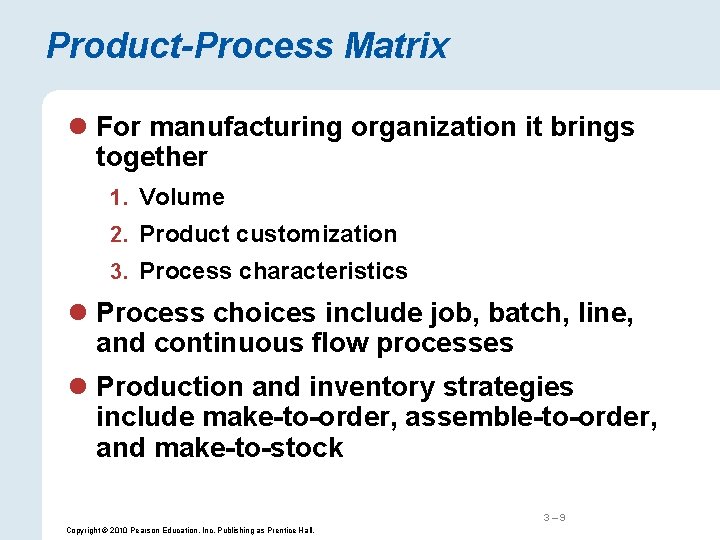
Product-Process Matrix l For manufacturing organization it brings together 1. Volume 2. Product customization 3. Process characteristics l Process choices include job, batch, line, and continuous flow processes l Production and inventory strategies include make-to-order, assemble-to-order, and make-to-stock 3– 9 Copyright © 2010 Pearson Education, Inc. Publishing as Prentice Hall.

Product-Process Matrix Less customization and higher volume Less complexity, less divergence, and more line flows Process Characteristics (1) Customized process, with flexible and unique sequence of tasks (1) (2) Low-volume Multiple products with low products, made to moderate volume to customer order (3) Few major products, higher volume (4) High volume, high standardization, commodity products Job process (2) Disconnected line flows, moderately complex work Small batch process Batch processes (3) Connected line, highly repetitive work Large batch process Line process (4) Continuous flows Figure 3. 3 – Product-Process Matrix for Processes Copyright © 2010 Pearson Education, Inc. Publishing as Prentice Hall. Continuous process 3 – 10
Layout l The physical arrangement of human and capital resources l An operation is a group of resources performing all or part of one or more processes l Layout involves three basic steps 1. Gather information 2. Develop a block plan 3. Design a detailed layout 3 – 11 Copyright © 2010 Pearson Education, Inc. Publishing as Prentice Hall.
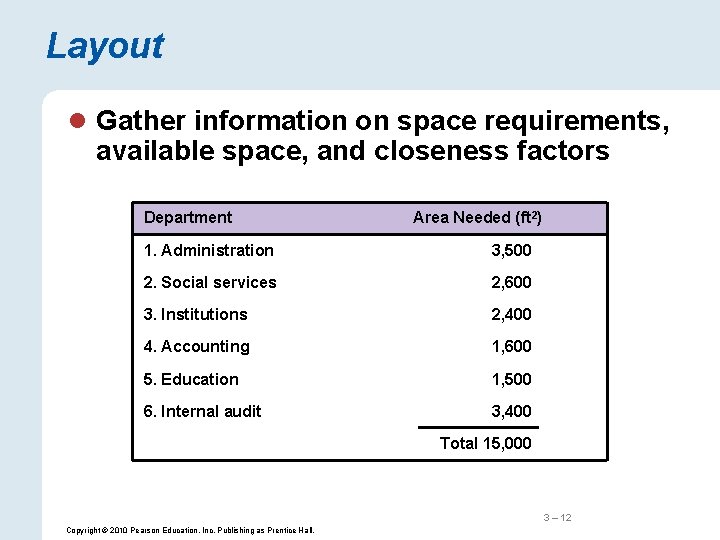
Layout l Gather information on space requirements, available space, and closeness factors Department Area Needed (ft 2) 1. Administration 3, 500 2. Social services 2, 600 3. Institutions 2, 400 4. Accounting 1, 600 5. Education 1, 500 6. Internal audit 3, 400 Total 15, 000 3 – 12 Copyright © 2010 Pearson Education, Inc. Publishing as Prentice Hall.
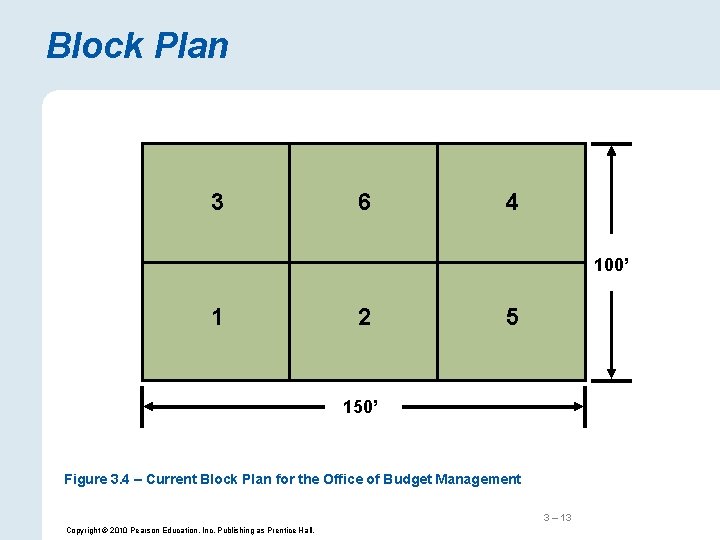
Block Plan 3 6 4 100’ 1 2 5 150’ Figure 3. 4 – Current Block Plan for the Office of Budget Management 3 – 13 Copyright © 2010 Pearson Education, Inc. Publishing as Prentice Hall.
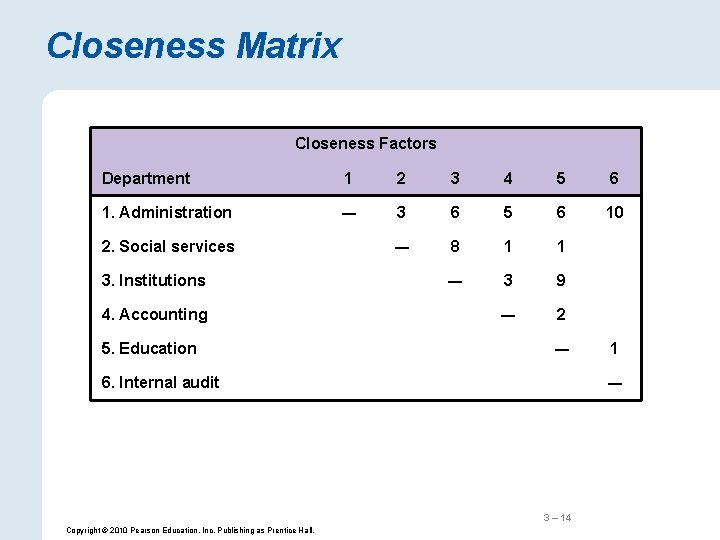
Closeness Matrix Closeness Factors Department 1 2 3 4 5 6 1. Administration ― 3 6 5 6 10 ― 8 1 1 ― 3 9 ― 2 2. Social services 3. Institutions 4. Accounting 5. Education ― 6. Internal audit ― 3 – 14 Copyright © 2010 Pearson Education, Inc. Publishing as Prentice Hall. 1
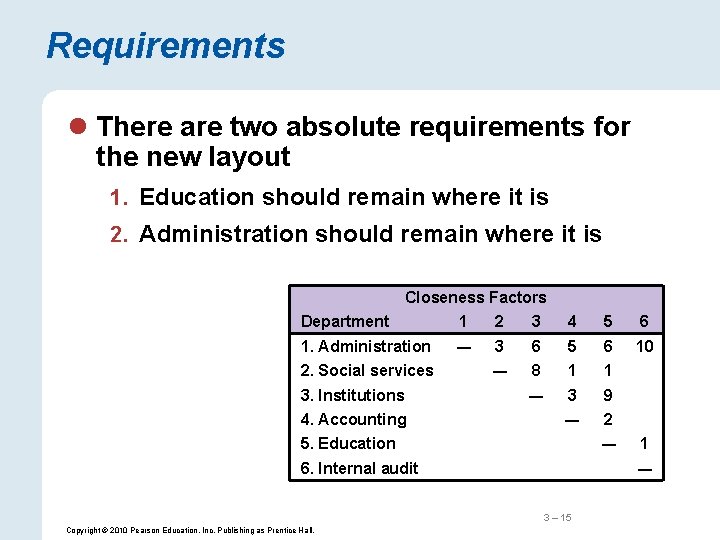
Requirements l There are two absolute requirements for the new layout 1. Education should remain where it is 2. Administration should remain where it is Closeness Factors Department 1 2 3 4 5 6 1. Administration ― 3 6 5 6 10 ― 8 1 1 ― 3 9 ― 2 2. Social services 3. Institutions 4. Accounting 5. Education ― 6. Internal audit ― 3 – 15 Copyright © 2010 Pearson Education, Inc. Publishing as Prentice Hall. 1
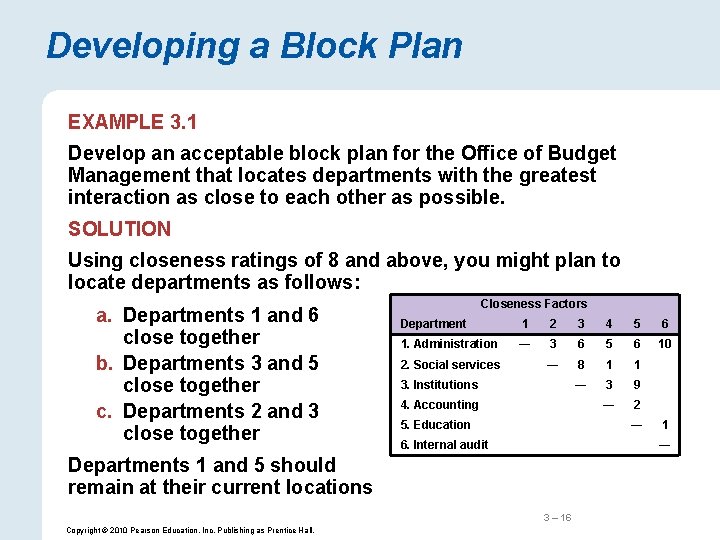
Developing a Block Plan EXAMPLE 3. 1 Develop an acceptable block plan for the Office of Budget Management that locates departments with the greatest interaction as close to each other as possible. SOLUTION Using closeness ratings of 8 and above, you might plan to locate departments as follows: a. Departments 1 and 6 close together b. Departments 3 and 5 close together c. Departments 2 and 3 close together Closeness Factors Department 1 2 3 4 5 6 1. Administration ― 3 6 5 6 10 ― 8 1 1 ― 3 9 ― 2 2. Social services 3. Institutions 4. Accounting 5. Education ― 6. Internal audit ― Departments 1 and 5 should remain at their current locations 3 – 16 Copyright © 2010 Pearson Education, Inc. Publishing as Prentice Hall. 1
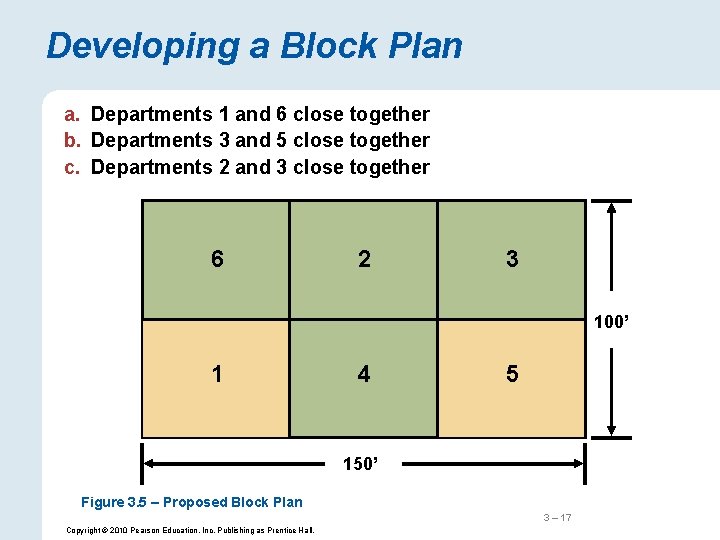
Developing a Block Plan a. Departments 1 and 6 close together b. Departments 3 and 5 close together c. Departments 2 and 3 close together 6 2 3 100’ 1 4 5 150’ Figure 3. 5 – Proposed Block Plan 3 – 17 Copyright © 2010 Pearson Education, Inc. Publishing as Prentice Hall.
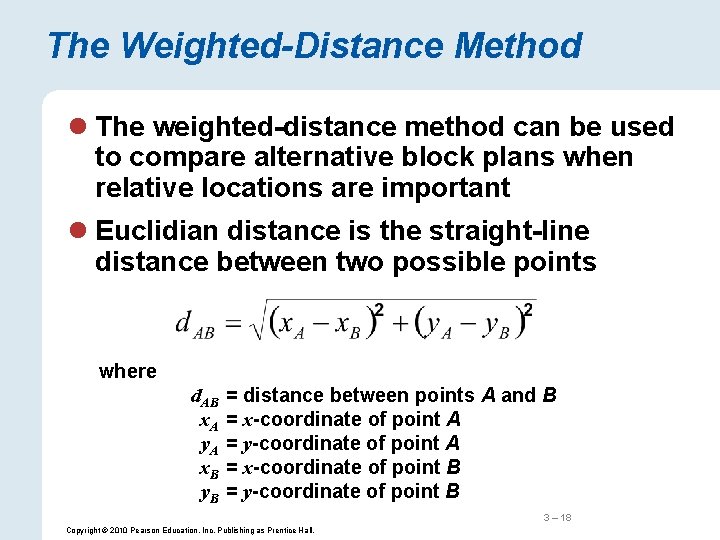
The Weighted-Distance Method l The weighted-distance method can be used to compare alternative block plans when relative locations are important l Euclidian distance is the straight-line distance between two possible points where d. AB x. A y. A x. B y. B = distance between points A and B = x-coordinate of point A = y-coordinate of point A = x-coordinate of point B = y-coordinate of point B 3 – 18 Copyright © 2010 Pearson Education, Inc. Publishing as Prentice Hall.
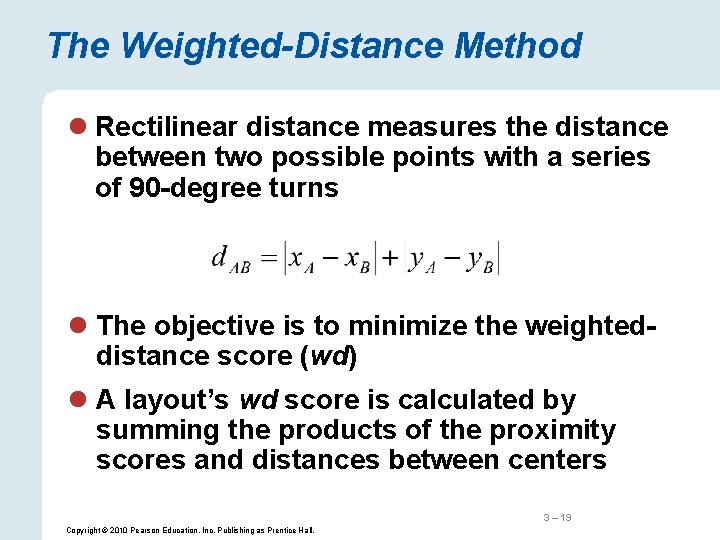
The Weighted-Distance Method l Rectilinear distance measures the distance between two possible points with a series of 90 -degree turns l The objective is to minimize the weighteddistance score (wd) l A layout’s wd score is calculated by summing the products of the proximity scores and distances between centers 3 – 19 Copyright © 2010 Pearson Education, Inc. Publishing as Prentice Hall.
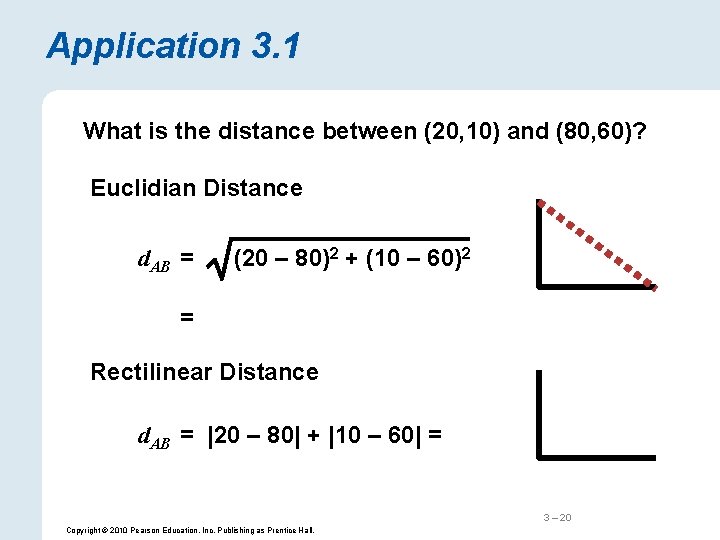
Application 3. 1 What is the distance between (20, 10) and (80, 60)? Euclidian Distance d. AB = (20 – 80)2 + (10 – 60)2 = Rectilinear Distance d. AB = |20 – 80| + |10 – 60| = 3 – 20 Copyright © 2010 Pearson Education, Inc. Publishing as Prentice Hall.
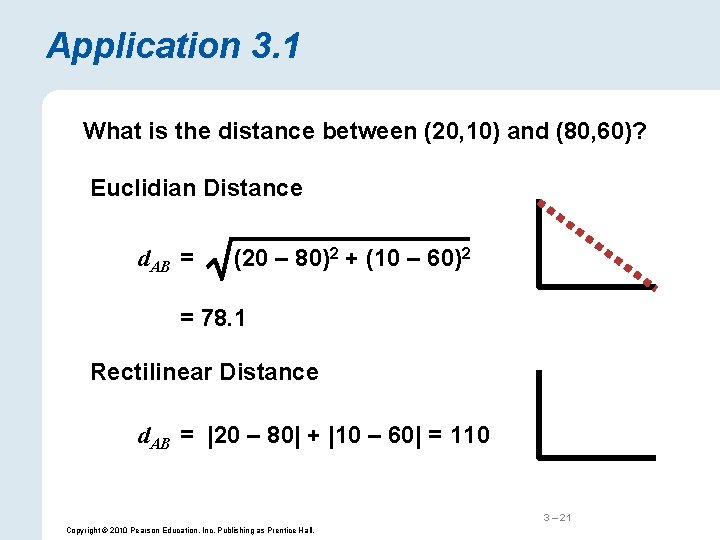
Application 3. 1 What is the distance between (20, 10) and (80, 60)? Euclidian Distance d. AB = (20 – 80)2 + (10 – 60)2 = 78. 1 Rectilinear Distance d. AB = |20 – 80| + |10 – 60| = 110 3 – 21 Copyright © 2010 Pearson Education, Inc. Publishing as Prentice Hall.
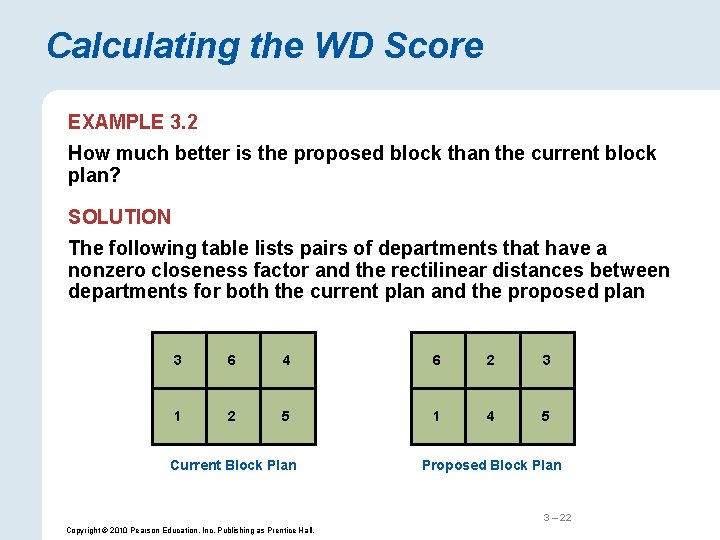
Calculating the WD Score EXAMPLE 3. 2 How much better is the proposed block than the current block plan? SOLUTION The following table lists pairs of departments that have a nonzero closeness factor and the rectilinear distances between departments for both the current plan and the proposed plan 3 6 4 6 2 3 1 2 5 1 4 5 Current Block Plan Proposed Block Plan 3 – 22 Copyright © 2010 Pearson Education, Inc. Publishing as Prentice Hall.
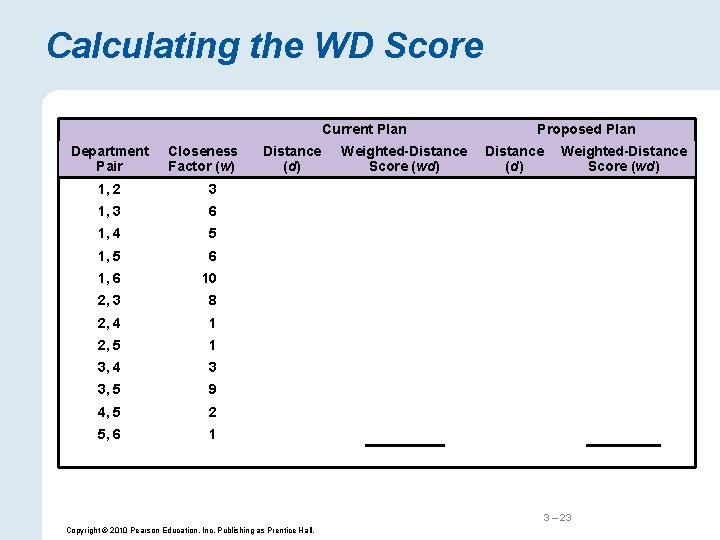
Calculating the WD Score Current Plan Department Pair Closeness Factor (w) 1, 2 3 1, 3 6 1, 4 5 1, 5 6 1, 6 10 2, 3 8 2, 4 1 2, 5 1 3, 4 3 3, 5 9 4, 5 2 5, 6 1 Distance (d) Weighted-Distance Score (wd) Proposed Plan Distance (d) Weighted-Distance Score (wd) 3 – 23 Copyright © 2010 Pearson Education, Inc. Publishing as Prentice Hall.
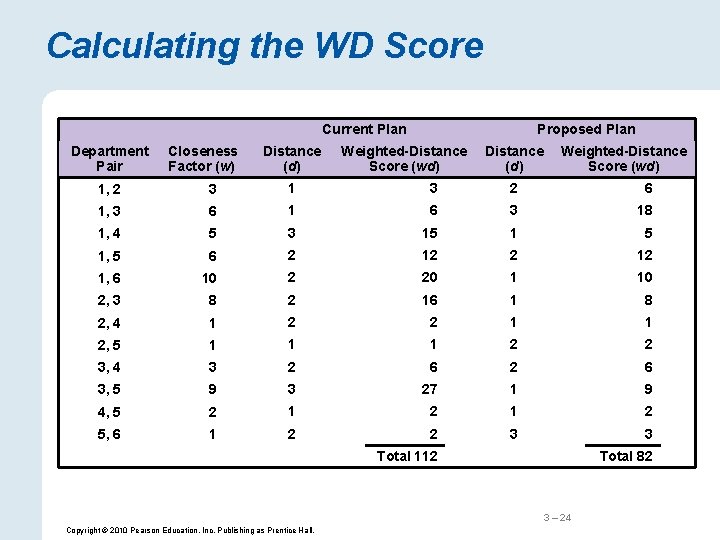
Calculating the WD Score Current Plan Department Pair Closeness Factor (w) Distance (d) Proposed Plan Weighted-Distance Score (wd) Distance (d) Weighted-Distance Score (wd) 1, 2 3 1 3 2 6 1, 3 6 1 6 3 18 1, 4 5 3 15 1 5 1, 5 6 2 12 1, 6 10 2 20 1 10 2, 3 8 2 16 1 8 2, 4 1 2 2 1 1 2, 5 1 1 1 2 2 3, 4 3 2 6 3, 5 9 3 27 1 9 4, 5 2 1 2 5, 6 1 2 2 3 3 Total 112 Total 82 3 – 24 Copyright © 2010 Pearson Education, Inc. Publishing as Prentice Hall.
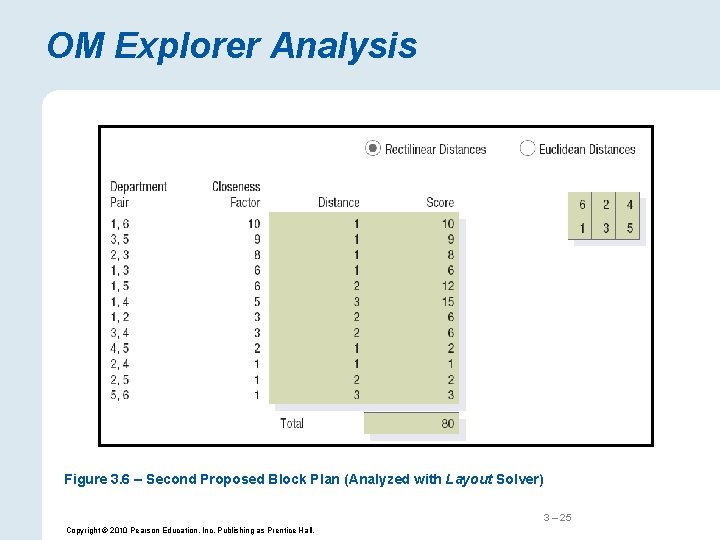
OM Explorer Analysis Figure 3. 6 – Second Proposed Block Plan (Analyzed with Layout Solver) 3 – 25 Copyright © 2010 Pearson Education, Inc. Publishing as Prentice Hall.
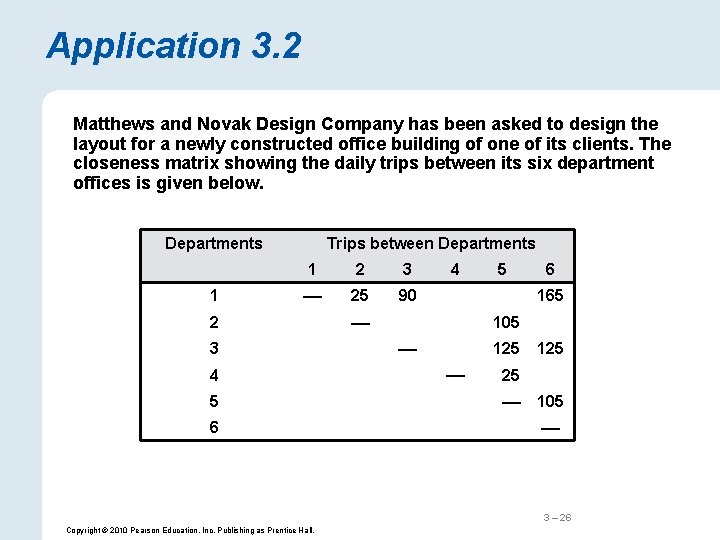
Application 3. 2 Matthews and Novak Design Company has been asked to design the layout for a newly constructed office building of one of its clients. The closeness matrix showing the daily trips between its six department offices is given below. Departments 1 Trips between Departments 1 2 3 25 90 2 3 4 5 6 165 105 125 25 105 3 – 26 Copyright © 2010 Pearson Education, Inc. Publishing as Prentice Hall.
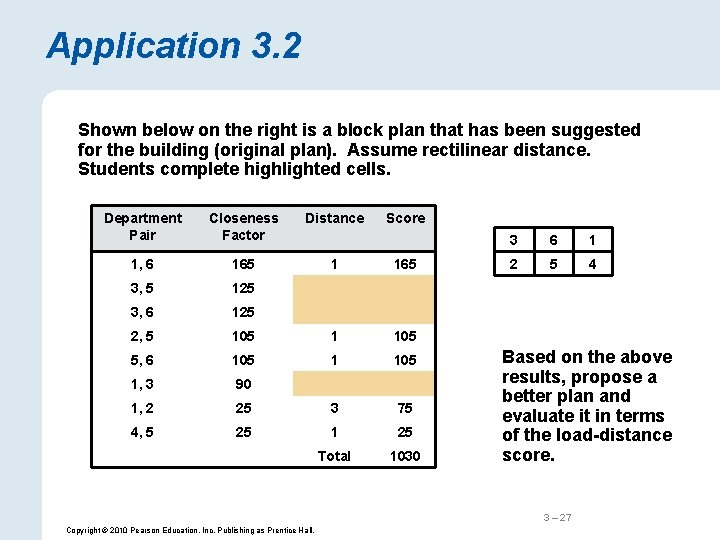
Application 3. 2 Shown below on the right is a block plan that has been suggested for the building (original plan). Assume rectilinear distance. Students complete highlighted cells. Department Pair Closeness Factor Distance Score 1, 6 165 1 165 3, 5 125 3, 6 125 2, 5 105 1 105 5, 6 105 1, 3 90 1, 2 25 3 75 4, 5 25 1 25 Total 1030 3 6 1 2 5 4 Based on the above results, propose a better plan and evaluate it in terms of the load-distance score. 3 – 27 Copyright © 2010 Pearson Education, Inc. Publishing as Prentice Hall.
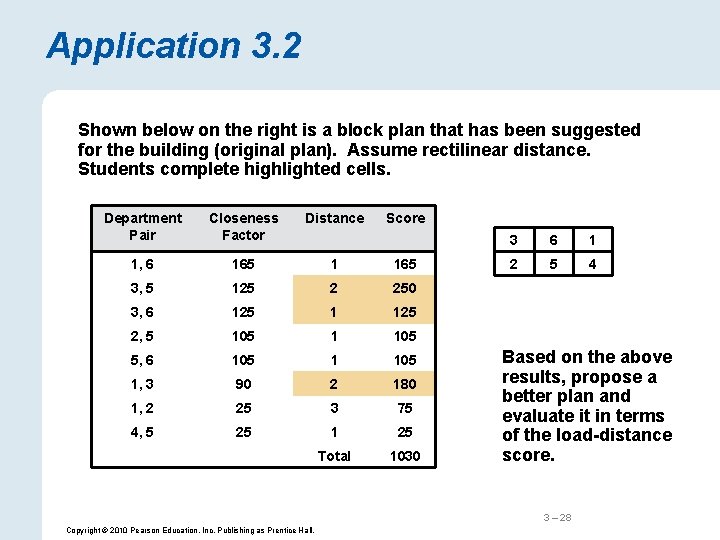
Application 3. 2 Shown below on the right is a block plan that has been suggested for the building (original plan). Assume rectilinear distance. Students complete highlighted cells. Department Pair Closeness Factor Distance Score 1, 6 165 1 165 3, 5 125 2 250 3, 6 125 1 125 2, 5 105 1 105 5, 6 105 1, 3 90 2 180 1, 2 25 3 75 4, 5 25 1 25 Total 1030 3 6 1 2 5 4 Based on the above results, propose a better plan and evaluate it in terms of the load-distance score. 3 – 28 Copyright © 2010 Pearson Education, Inc. Publishing as Prentice Hall.
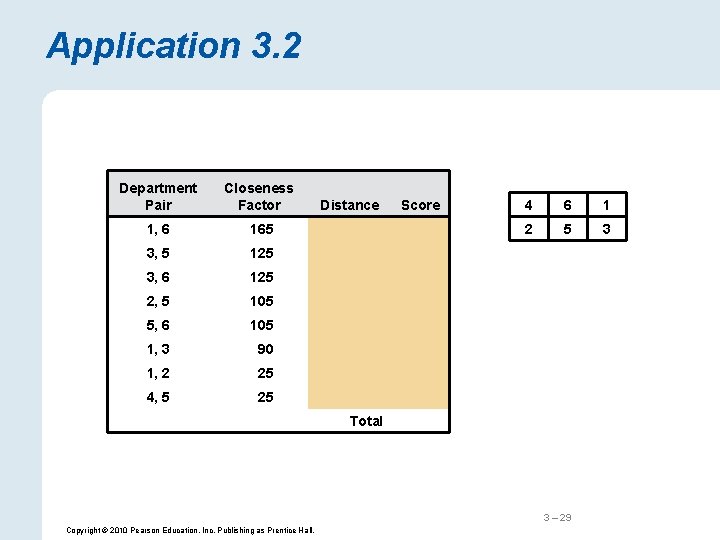
Application 3. 2 Department Pair Closeness Factor 1, 6 165 3, 5 125 3, 6 125 2, 5 105 5, 6 105 1, 3 90 1, 2 25 4, 5 25 Distance Score 4 6 1 2 5 3 Total 3 – 29 Copyright © 2010 Pearson Education, Inc. Publishing as Prentice Hall.
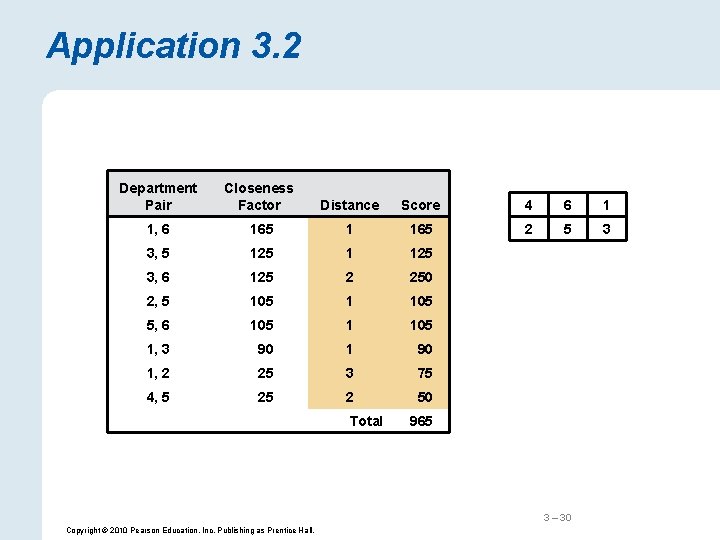
Application 3. 2 Department Pair Closeness Factor Distance Score 4 6 1 1, 6 165 1 165 2 5 3 3, 5 125 1 125 3, 6 125 2 250 2, 5 105 1 105 5, 6 105 1, 3 90 1, 2 25 3 75 4, 5 25 2 50 Total 965 3 – 30 Copyright © 2010 Pearson Education, Inc. Publishing as Prentice Hall.
A Detailed Layout l Once a block plan has been selected, a detailed representation is created showing the exact size and shape of each center l Elements such as desks, machines, and storage areas can be shown l Drawings or models can be utilized l Options can be discussed and problems resolved 3 – 31 Copyright © 2010 Pearson Education, Inc. Publishing as Prentice Hall.
Customer Involvement l Possible disadvantages u Can be disruptive u Managing timing and volume can be challenging u Quality measurement can be difficult u Requires interpersonal skills u Layouts may have to be revised u Multiple locations may be necessary 3 – 32 Copyright © 2010 Pearson Education, Inc. Publishing as Prentice Hall.
Customer Involvement l Possible advantages u Increased net value to the customer u Can mean better quality, faster delivery, greater flexibility, and lower cost u May reduce product, shipping, and inventory costs u May help coordinate across the supply chain u Processes may be revised to accommodate the customers’ role 3 – 33 Copyright © 2010 Pearson Education, Inc. Publishing as Prentice Hall.
Resource Flexibility l A flexible workforce can often require higher skills and more training and education l Worker flexibility can help achieve reliable customer service and alleviate bottlenecks l Resource flexibility helps absorb changes in workloads l The type of workforce may be adjusted using full-time or part-time workers 3 – 34 Copyright © 2010 Pearson Education, Inc. Publishing as Prentice Hall.
Resource Flexibility l The volume of business may affect the type of equipment used l Break-even analysis can be used to determine at what volumes changes in equipment should be made 3 – 35 Copyright © 2010 Pearson Education, Inc. Publishing as Prentice Hall.
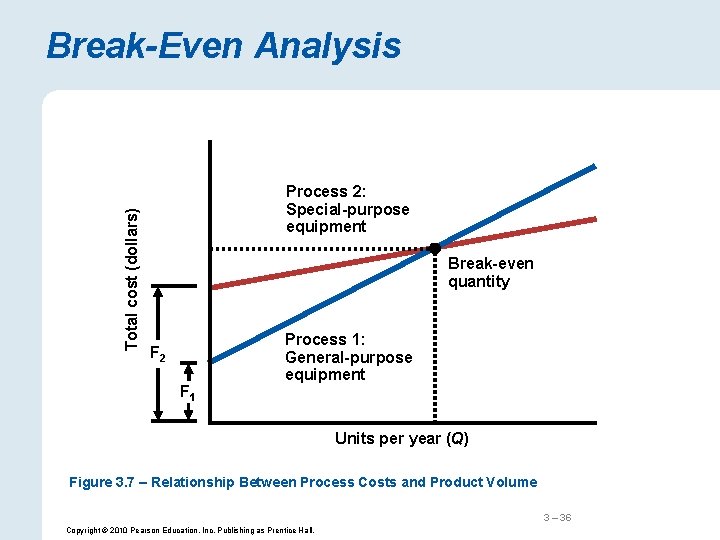
Total cost (dollars) Break-Even Analysis Process 2: Special-purpose equipment Break-even quantity F 2 F 1 Process 1: General-purpose equipment Units per year (Q) Figure 3. 7 – Relationship Between Process Costs and Product Volume 3 – 36 Copyright © 2010 Pearson Education, Inc. Publishing as Prentice Hall.
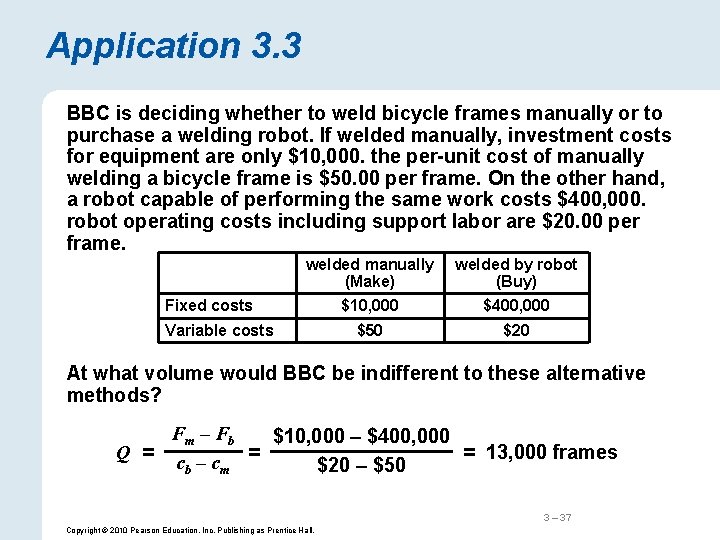
Application 3. 3 BBC is deciding whether to weld bicycle frames manually or to purchase a welding robot. If welded manually, investment costs for equipment are only $10, 000. the per-unit cost of manually welding a bicycle frame is $50. 00 per frame. On the other hand, a robot capable of performing the same work costs $400, 000. robot operating costs including support labor are $20. 00 per frame. welded manually (Make) welded by robot (Buy) $10, 000 $400, 000 $50 $20 Fixed costs Variable costs At what volume would BBC be indifferent to these alternative methods? Fm – Fb $10, 000 – $400, 000 Q = c –c = = 13, 000 frames $20 – $50 b m 3 – 37 Copyright © 2010 Pearson Education, Inc. Publishing as Prentice Hall.
Capital Intensity l Automation is one way to address the mix of capital and labor l Automated manufacturing processes substitute capital equipment for labor l Typically require high volumes and costs are high l Automation might not align with a company’s competitive priorities 3 – 38 Copyright © 2010 Pearson Education, Inc. Publishing as Prentice Hall.
Capital Intensity l Fixed automation produces one type of part or product in a fixed sequence l Typically requires large investments and is relatively inflexible l Flexible automation can be changed to handle various products l Industrial robots are classic examples of flexible automation 3 – 39 Copyright © 2010 Pearson Education, Inc. Publishing as Prentice Hall.
Capital Intensity l Capital equipment may be used to automate service processes l Investment can be justified by cost reduction and increased task divergence through expanded customer choice l May impact customer contact l May be used in both front and back-office operations 3 – 40 Copyright © 2010 Pearson Education, Inc. Publishing as Prentice Hall.
Capital Intensity l Economies of scope reflect the ability to produce multiple products more inexpensively in combination than separately l Applies to manufacturing and services l Requires sufficient collective volume 3 – 41 Copyright © 2010 Pearson Education, Inc. Publishing as Prentice Hall.
Strategic Fit l The process chosen should reflect the desired competitive priorities l The process structure has a major impact on customer involvement, resource flexibility, and capital intensity 3 – 42 Copyright © 2010 Pearson Education, Inc. Publishing as Prentice Hall.
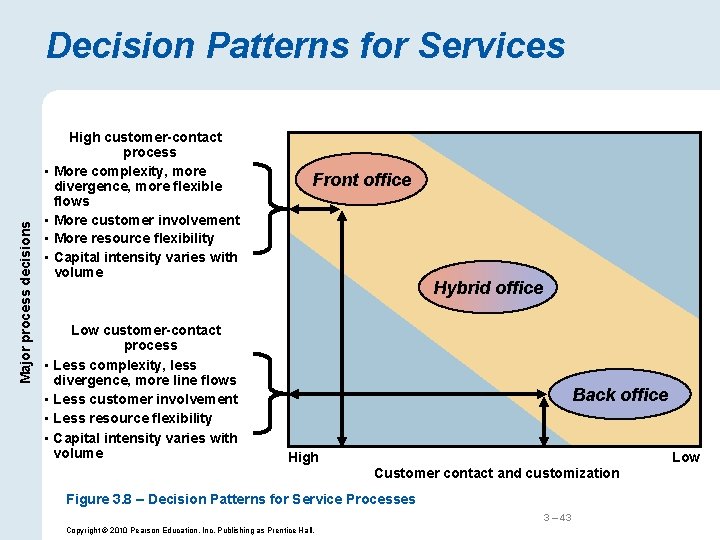
Decision Patterns for Services Major process decisions • • High customer-contact process More complexity, more divergence, more flexible flows More customer involvement More resource flexibility Capital intensity varies with volume Low customer-contact process Less complexity, less divergence, more line flows Less customer involvement Less resource flexibility Capital intensity varies with volume Front office Hybrid office Back office High Low Customer contact and customization Figure 3. 8 – Decision Patterns for Service Processes 3 – 43 Copyright © 2010 Pearson Education, Inc. Publishing as Prentice Hall.
Decision Patterns for Manufacturing l Processes can be adjusted for the degree of customization and volume l Process flows can be made more of less linear l Competitive priorities must be considered when choosing processes 3 – 44 Copyright © 2010 Pearson Education, Inc. Publishing as Prentice Hall.
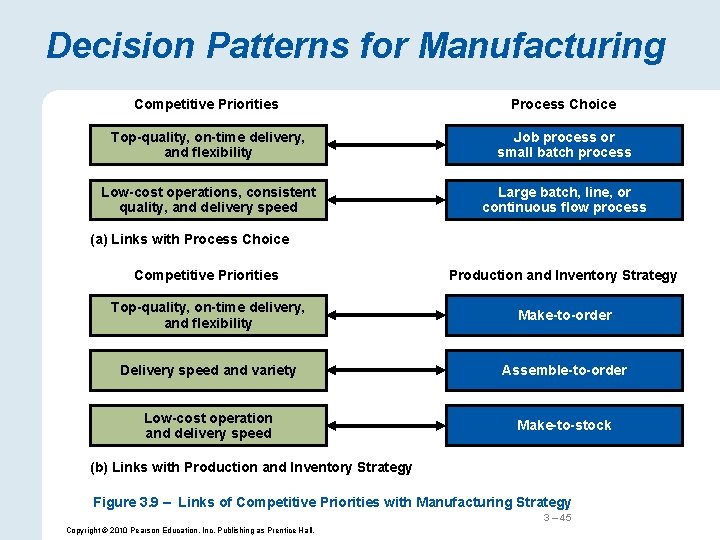
Decision Patterns for Manufacturing Competitive Priorities Process Choice Top-quality, on-time delivery, and flexibility Job process or small batch process Low-cost operations, consistent quality, and delivery speed Large batch, line, or continuous flow process (a) Links with Process Choice Competitive Priorities Production and Inventory Strategy Top-quality, on-time delivery, and flexibility Make-to-order Delivery speed and variety Assemble-to-order Low-cost operation and delivery speed Make-to-stock (b) Links with Production and Inventory Strategy Figure 3. 9 – Links of Competitive Priorities with Manufacturing Strategy 3 – 45 Copyright © 2010 Pearson Education, Inc. Publishing as Prentice Hall.
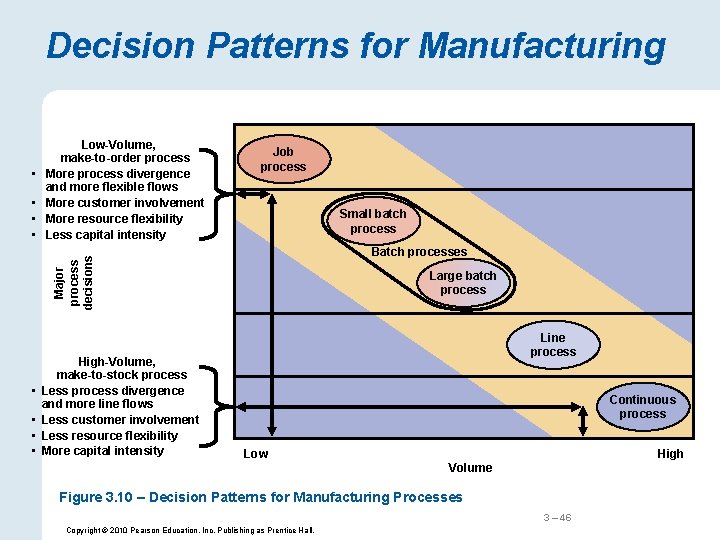
Decision Patterns for Manufacturing • Job process Small batch process Batch processes Major process decisions • • • Low-Volume, make-to-order process More process divergence and more flexible flows More customer involvement More resource flexibility Less capital intensity • • High-Volume, make-to-stock process Less process divergence and more line flows Less customer involvement Less resource flexibility More capital intensity Large batch process Line process Continuous process Low High Volume Figure 3. 10 – Decision Patterns for Manufacturing Processes 3 – 46 Copyright © 2010 Pearson Education, Inc. Publishing as Prentice Hall.
Gaining Focus l Operations can be focused by process segments when competitive priorities differ l Plants within plants (PWPs) are different operations under the same roof l Service can be focused in much the same way l Focused factories can be created by splitting a large plant into several smaller plants dedicated to narrower product lines 3 – 47 Copyright © 2010 Pearson Education, Inc. Publishing as Prentice Hall.
Strategies for Change l Process reengineering is the fundamental rethinking and radical redesign of a process to improve performance l Can be successful but it is not simple or easy l The people who are involved with the process each day are the best source of ideas on how to improve it l Process improvement is the systematic study of activities and flows of a process to find ways to improve it 3 – 48 Copyright © 2010 Pearson Education, Inc. Publishing as Prentice Hall.
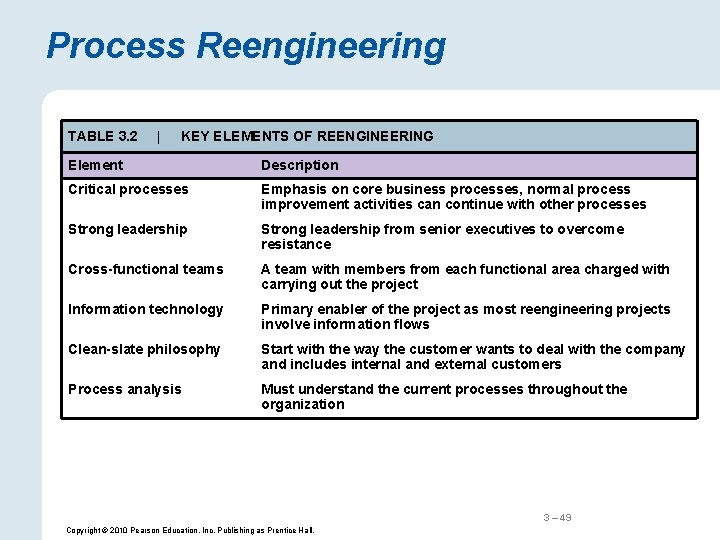
Process Reengineering TABLE 3. 2 | KEY ELEMENTS OF REENGINEERING Element Description Critical processes Emphasis on core business processes, normal process improvement activities can continue with other processes Strong leadership from senior executives to overcome resistance Cross-functional teams A team with members from each functional area charged with carrying out the project Information technology Primary enabler of the project as most reengineering projects involve information flows Clean-slate philosophy Start with the way the customer wants to deal with the company and includes internal and external customers Process analysis Must understand the current processes throughout the organization 3 – 49 Copyright © 2010 Pearson Education, Inc. Publishing as Prentice Hall.
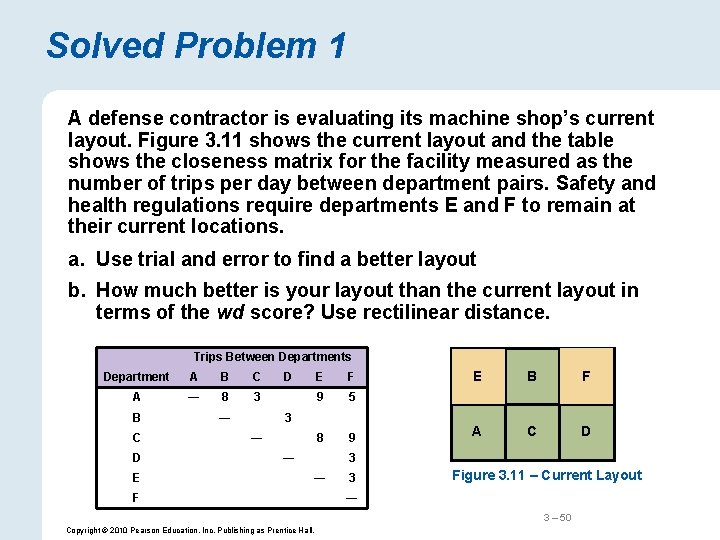
Solved Problem 1 A defense contractor is evaluating its machine shop’s current layout. Figure 3. 11 shows the current layout and the table shows the closeness matrix for the facility measured as the number of trips per day between department pairs. Safety and health regulations require departments E and F to remain at their current locations. a. Use trial and error to find a better layout b. How much better is your layout than the current layout in terms of the wd score? Use rectilinear distance. Trips Between Departments Department A B C A ― 8 3 B C D E ― D E F 9 5 8 9 3 ― ― E B F A C D 3 ― F 3 Figure 3. 11 – Current Layout ― 3 – 50 Copyright © 2010 Pearson Education, Inc. Publishing as Prentice Hall.
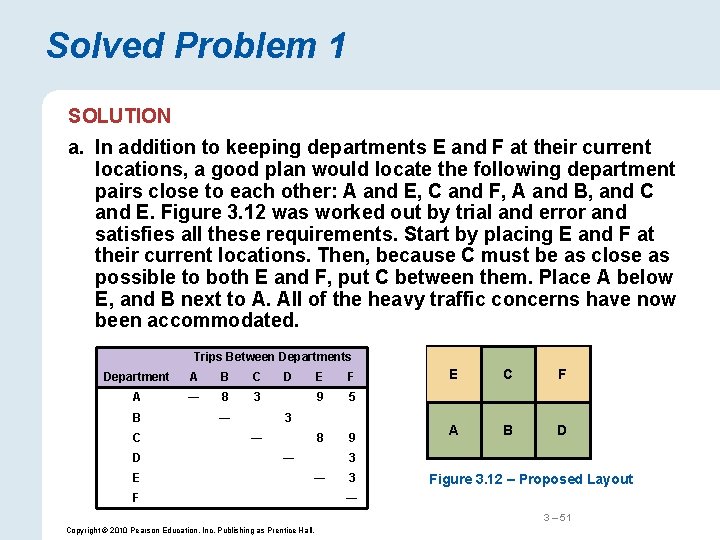
Solved Problem 1 SOLUTION a. In addition to keeping departments E and F at their current locations, a good plan would locate the following department pairs close to each other: A and E, C and F, A and B, and C and E. Figure 3. 12 was worked out by trial and error and satisfies all these requirements. Start by placing E and F at their current locations. Then, because C must be as close as possible to both E and F, put C between them. Place A below E, and B next to A. All of the heavy traffic concerns have now been accommodated. Trips Between Departments Department A B C A ― 8 3 B C D E ― D E F 9 5 8 9 3 ― ― E C F A B D 3 ― F 3 Figure 3. 12 – Proposed Layout ― 3 – 51 Copyright © 2010 Pearson Education, Inc. Publishing as Prentice Hall.
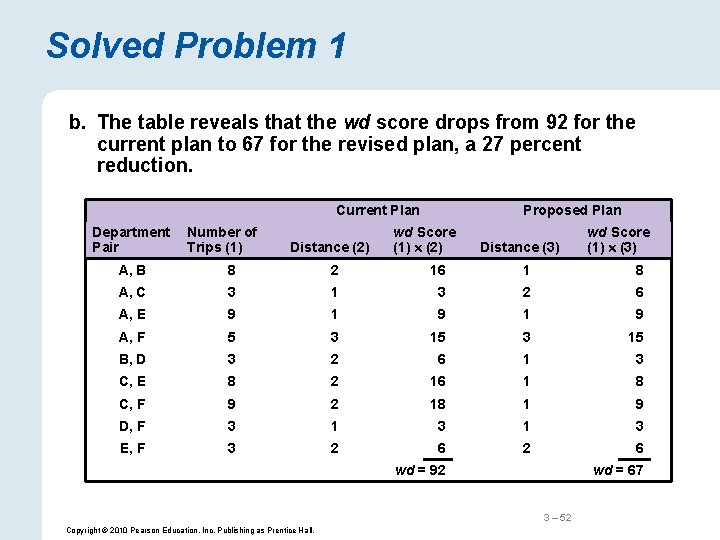
Solved Problem 1 b. The table reveals that the wd score drops from 92 for the current plan to 67 for the revised plan, a 27 percent reduction. Current Plan Department Pair Number of Trips (1) Distance (2) Proposed Plan wd Score (1) (2) Distance (3) wd Score (1) (3) A, B 8 2 16 1 8 A, C 3 1 3 2 6 A, E 9 1 9 A, F 5 3 15 B, D 3 2 6 1 3 C, E 8 2 16 1 8 C, F 9 2 18 1 9 D, F 3 1 3 E, F 3 2 6 wd = 92 wd = 67 3 – 52 Copyright © 2010 Pearson Education, Inc. Publishing as Prentice Hall.

3 – 53 Copyright © 2010 Pearson Education, Inc. Publishing as Prentice Hall.
- Slides: 53