
3 LINCOLNDOUGLAS CASE CONSTRUCTION 3 1 3 2






- Slides: 52
3 LINCOLN-DOUGLAS CASE CONSTRUCTION 3. 1 3. 2 3. 3 Slide 1 Overview of the Speeches Affirmative Case Construction Negative Case Construction Debate © Cengage/South-Western
3. 1 OVERVIEW OF THE SPEECHES GOALS Know the order and time limit of each speech in a round. Learn how to take and organize notes using a flow sheet. Slide 2 Debate © Cengage/South-Western
TERMS l l l l 3 burden of proof grace period rebuttal refute dropped point flow sheet flowing preflow Debate © Cengage Learning/South-Western
4 Debate © Cengage Learning/South-Western
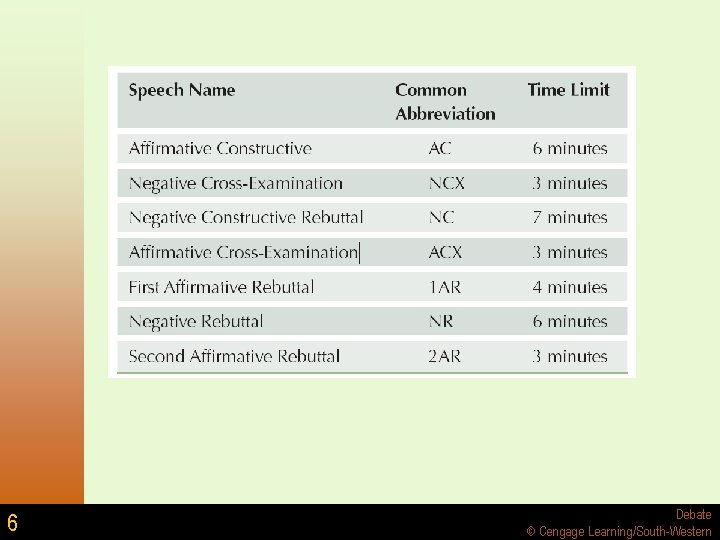
Speeches and Time Limits l As a debate participant, you must be prepared to present l The affirmative side l The negative side l Clear and concise presentation are important. l Speeches in a Lincoln-Douglas debate are l Presented in a specific order l Have pre-determined time limits 5 Debate © Cengage Learning/South-Western
6 Debate © Cengage Learning/South-Western
l When you represent the affirmative side, you must show the judge l Why the resolution should be adopted or l Why you offer the best solution 7 Debate © Cengage Learning/South-Western
l Burden of proof l The obligation to approve what is stated or disputed l The affirmative side delivers both the first and last speeches. l Grace period l Additional time added to the original time allowance l Usually no more than 30 seconds l Not all judges grant a grace period. 8 Debate © Cengage Learning/South-Western
Affirmative Constructive Speech l The first speech of the Lincoln-Douglas debate l The only speech that can be completely prepared before the debate. l Present all major arguments in your case l Statistics l Quotations l Examples l Studies l Reports 9 Debate © Cengage Learning/South-Western
l For the affirmative constructive speech l Use all six minutes l Face the judge l. Not your opponent 10 Debate © Cengage Learning/South-Western
Negative Cross-Examination l Ask questions of your opponent during crossexamination periods. l Challenge the affirmative’s arguments l Clarify meanings l Obtain information that they missed l Set up your next arguments l Three minute time limit l Rebuttal l The speech which allows you to counter the attacks and positions of your opponent. 11 Debate © Cengage Learning/South-Western
Negative Constructive Rebuttal l Seven minute time limit. l First two or three minutes l Present your stand regarding the resolution. l During the remaining time l Present a rebuttal to show fault with the affirmative’s arguments and/or value. l Attack each of the key issues of your opponent’s case. 12 Debate © Cengage Learning/South-Western
Affirmative Cross-Examination l Three minute time limit l The affirmative debater asks the negative side questions about its case. 13 Debate © Cengage Learning/South-Western
First Affirmative Rebuttal l Four minute time limit l Rebuild your case l Attack the negative’s case l Refute l Prove false the attacks against your case l Do not introduce new evidence 14 Debate © Cengage Learning/South-Western
Negative Rebuttal l Six minute time limit l The negative’s final chance to make an impression on the judge. l Only respond to arguments that you responded to in the negative constructive rebuttal. 15 Debate © Cengage Learning/South-Western
Second Affirmative Rebuttal l Three minute time limit l The affirmative’s final chance l Tell the judge l How your case best supports your value l Why your value is better than your opponent’s value l How your value best upholds the resolution 16 Debate © Cengage Learning/South-Western
l Dropped point l Any argument not addressed in the first rebuttal for the affirmative and the first constructive for the negative 17 Debate © Cengage Learning/South-Western
Prep Time l Three to four minutes l Can be used at any time during the debate l It is recommended that you save much of the time for the final speeches. 18 Debate © Cengage Learning/South-Western
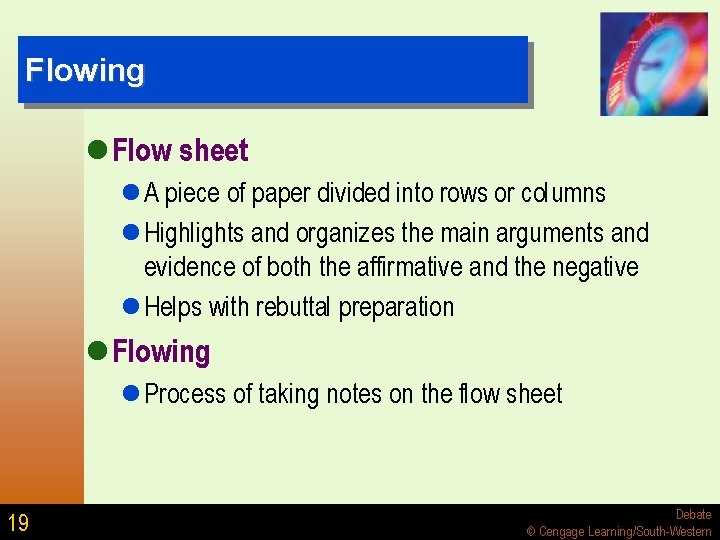
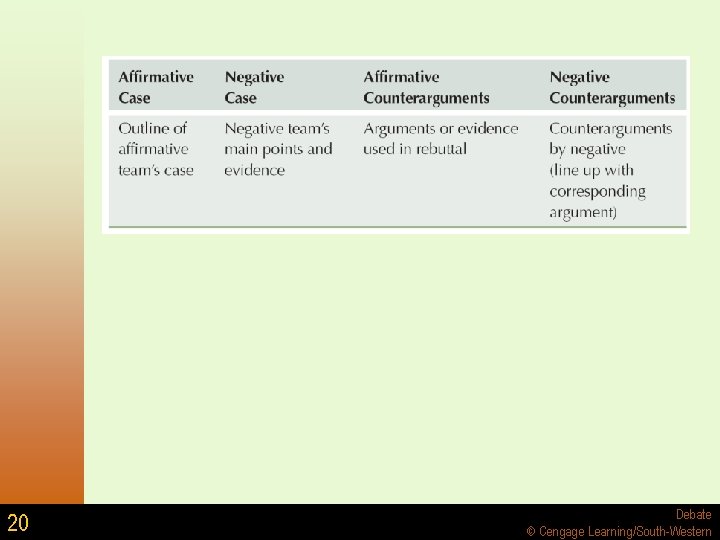
Flowing l Flow sheet l A piece of paper divided into rows or columns l Highlights and organizes the main arguments and evidence of both the affirmative and the negative l Helps with rebuttal preparation l Flowing l Process of taking notes on the flow sheet 19 Debate © Cengage Learning/South-Western
20 Debate © Cengage Learning/South-Western
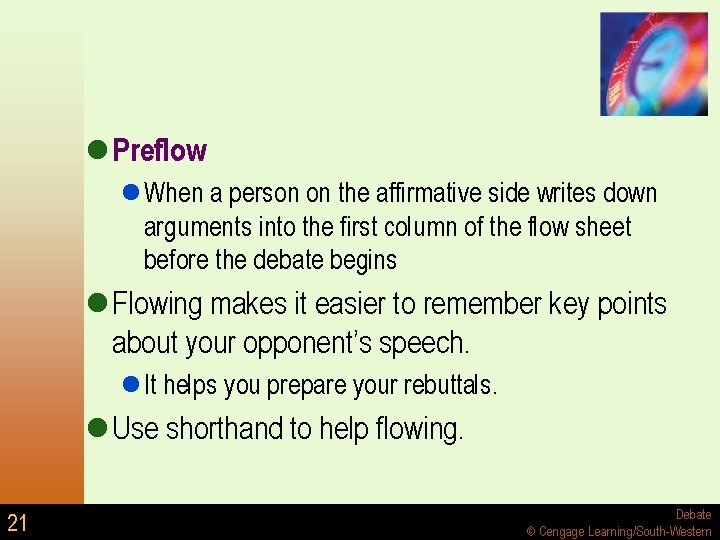
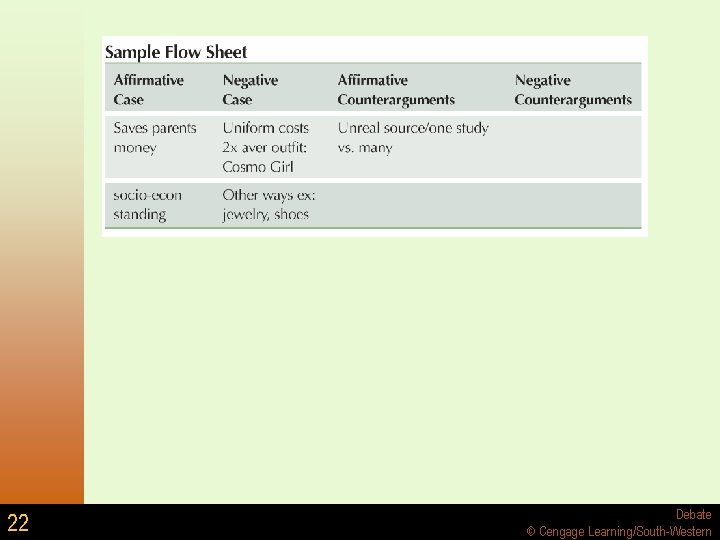
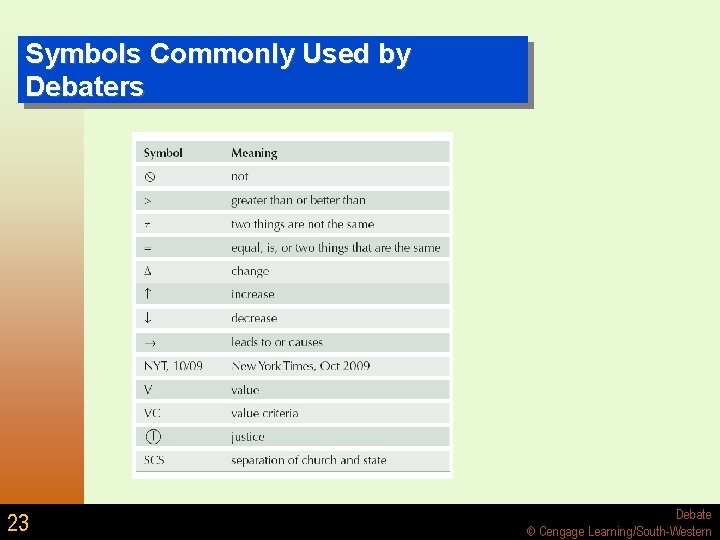
l Preflow l When a person on the affirmative side writes down arguments into the first column of the flow sheet before the debate begins l Flowing makes it easier to remember key points about your opponent’s speech. l It helps you prepare your rebuttals. l Use shorthand to help flowing. 21 Debate © Cengage Learning/South-Western
22 Debate © Cengage Learning/South-Western
Symbols Commonly Used by Debaters 23 Debate © Cengage Learning/South-Western
3. 2 AFFIRMATIVE CASE CONSTRUCTION GOALS Know how to prepare an effective affirmative constructive speech. List tips to help you in a cross-examination period. Understand what should be presented in an affirmative rebuttal. Slide 24 Debate © Cengage/South-Western
TERMS l contention l voting issue l crystallization 25 Debate © Cengage Learning/South-Western
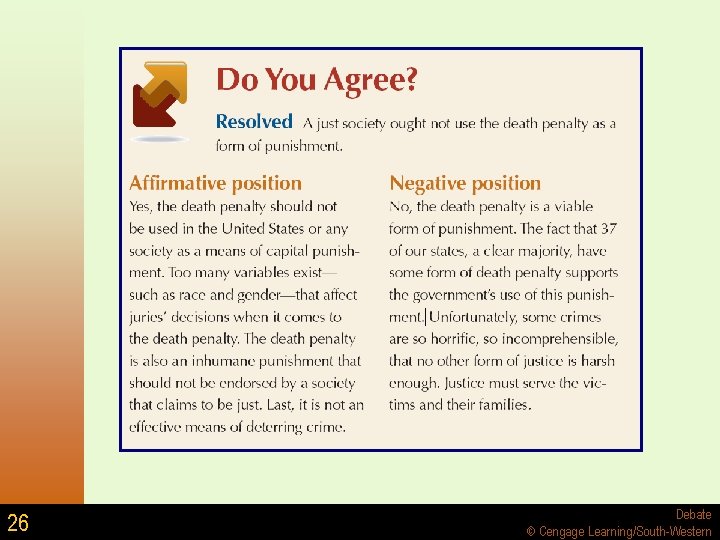
26 Debate © Cengage Learning/South-Western
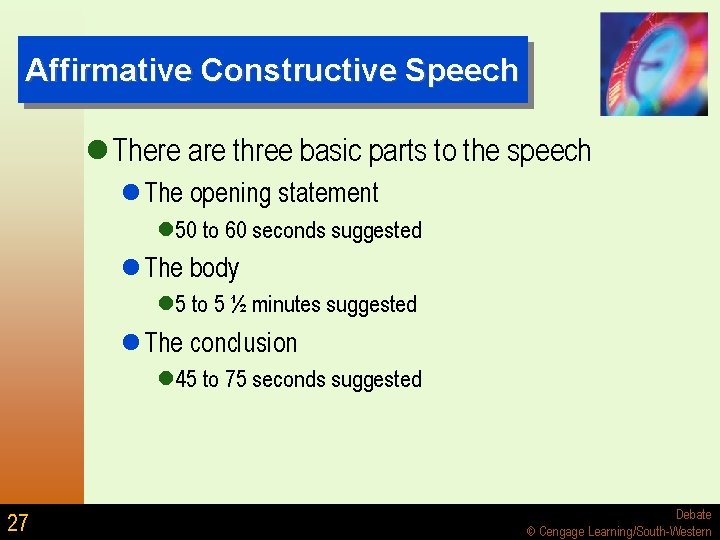
Affirmative Constructive Speech l There are three basic parts to the speech l The opening statement l 50 to 60 seconds suggested l The body l 5 to 5 ½ minutes suggested l The conclusion l 45 to 75 seconds suggested 27 Debate © Cengage Learning/South-Western
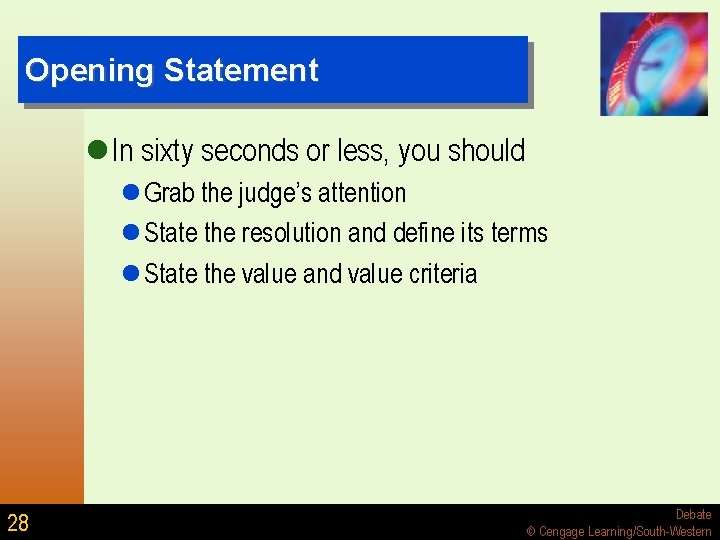
Opening Statement l In sixty seconds or less, you should l Grab the judge’s attention l State the resolution and define its terms l State the value and value criteria 28 Debate © Cengage Learning/South-Western
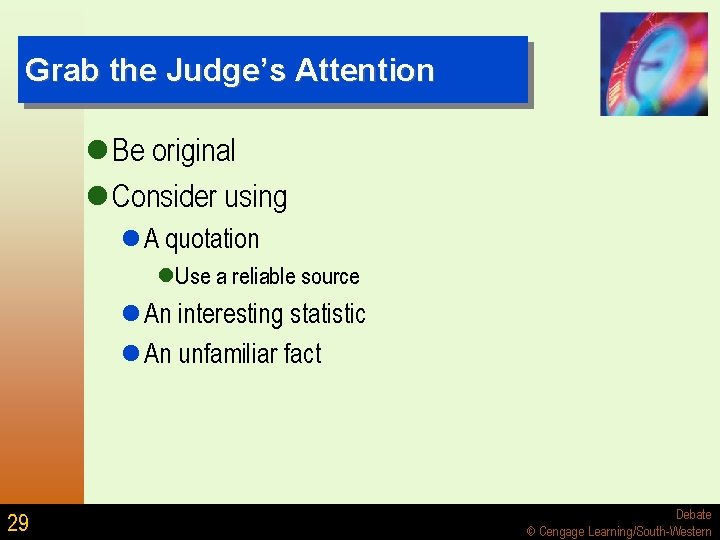
Grab the Judge’s Attention l Be original l Consider using l A quotation l. Use a reliable source l An interesting statistic l An unfamiliar fact 29 Debate © Cengage Learning/South-Western
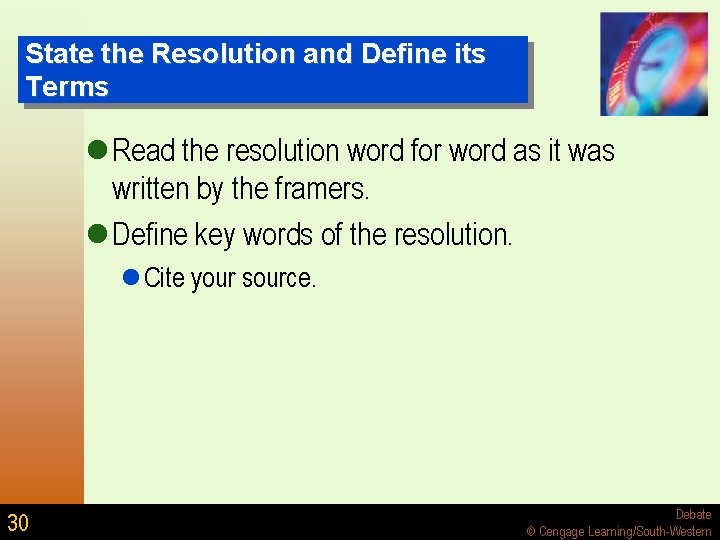
State the Resolution and Define its Terms l Read the resolution word for word as it was written by the framers. l Define key words of the resolution. l Cite your source. 30 Debate © Cengage Learning/South-Western
State the Value and Value Criteria l State the value and the value criteria at the end of the introduction. l Explain how they relate to the topic. 31 Debate © Cengage Learning/South-Western
Body l Build a case that upholds your value. l Contention l A self-contained major argument l Every affirmative constructive speech should have two or three contentions. l Present the contentions in order of importance. 32 Debate © Cengage Learning/South-Western
33 Debate © Cengage Learning/South-Western
Conclusion l Summarize your case by reminding the judge of your contentions. l Restate the value and value criteria and how it supports the resolution. l Ask the judge to vote for you. l Let your opponent know you are ready for crossexamination. 34 Debate © Cengage Learning/South-Western
Affirmative Cross-Examination l Prepare some questions in advance of the debate. l Write new questions on your flow sheet. l Face the judge even when addressing your opponent. l Stay calm. l Do not ask open-ended questions. l Answer questions directly and honestly. 35 Debate © Cengage Learning/South-Western
Affirmative Rebuttal l Four minute limit l Address each attack made against your case. l There are two ways to challenge your opponent’s arguments: l Attack the argument or evidence used l Attack the soundness of the opponent’s logic 36 Debate © Cengage Learning/South-Western
l Accomplish the following during the final rebuttal: l Emphasize your opponent’s greatest weaknesses. l Rebuild your position. 37 Debate © Cengage Learning/South-Western
l Present convincing arguments. l. Voting issues l Arguments which prove why you should win the round l. Crystallization l Gives the judge information to put all of the arguments together so the debate winner can be decided l Ask the judge to vote for you. 38 Debate © Cengage Learning/South-Western
3. 3 NEGATIVE CASE CONSTRUCTION GOALS Identify the purpose of cross-examination questions. Understand the two parts of a negative constructive rebuttal. Describe the purpose of a negative rebuttal. Slide 39 Debate © Cengage/South-Western
TERMS l l 40 road map line-by-line presentation signpost preempting Debate © Cengage Learning/South-Western
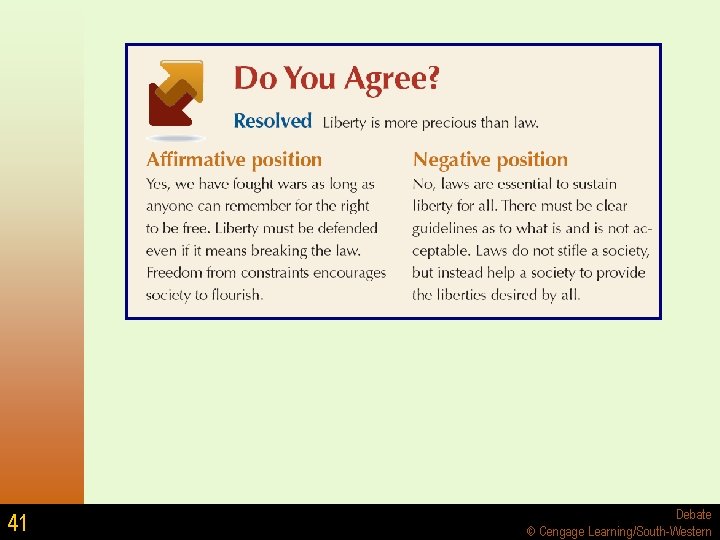
41 Debate © Cengage Learning/South-Western
Negative Cross-Examination l Use the negative cross-examination period to ask questions of your opponent. l The questions can serve any of the following purposes: l Challenging the affirmative’s arguments l Clarifying meanings of key terms or arguments l Obtaining information that you missed l Setting up your next arguments 42 Debate © Cengage Learning/South-Western
l Control the cross-examination period. l Avoid questions that require an in-depth answer. l Use the information received during the crossexamination period in your rebuttal. 43 Debate © Cengage Learning/South-Western
Negative Constructive Rebuttal l This speech has two parts. l The negative constructive speech l A rebuttal speech l The constructive portion is pre-written. 44 Debate © Cengage Learning/South-Western
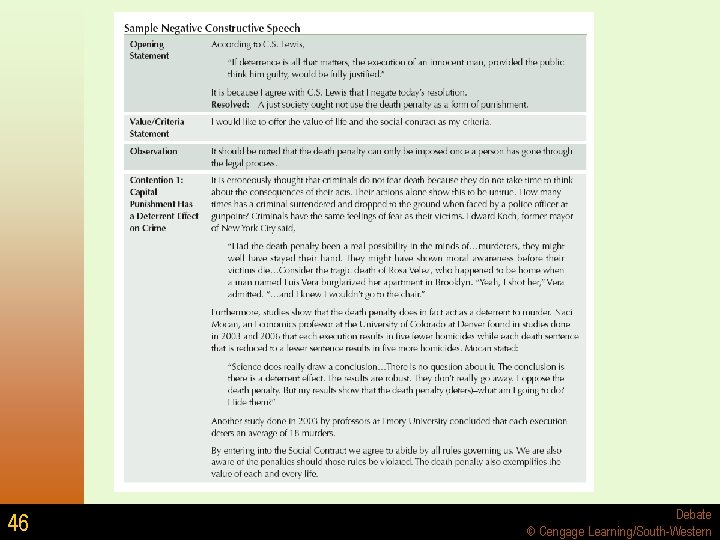
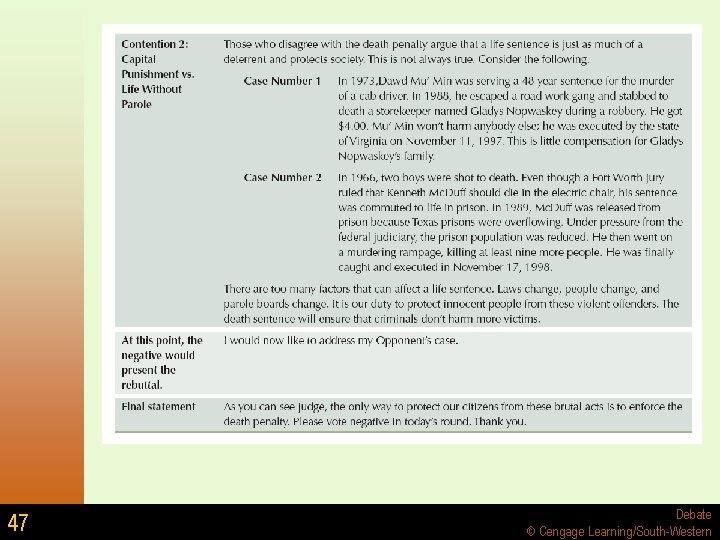
Negative Constructive Speech l Use an opening statement that catches the judge’s attention. l Repeat the resolution. l State the value on which you believe the resolution should be argued as well as its criteria. l The body contains your contentions. l Back each contention with supporting evidence. 45 Debate © Cengage Learning/South-Western
46 Debate © Cengage Learning/South-Western
47 Debate © Cengage Learning/South-Western
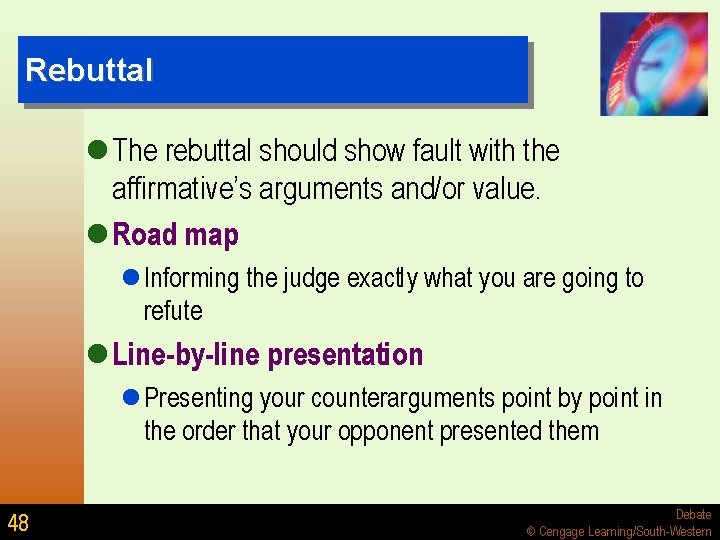
Rebuttal l The rebuttal should show fault with the affirmative’s arguments and/or value. l Road map l Informing the judge exactly what you are going to refute l Line-by-line presentation l Presenting your counterarguments point by point in the order that your opponent presented them 48 Debate © Cengage Learning/South-Western
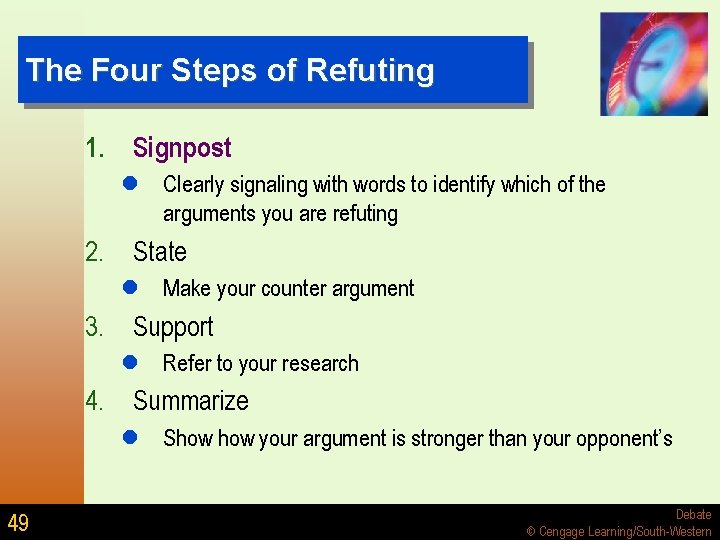
The Four Steps of Refuting 1. Signpost l Clearly signaling with words to identify which of the arguments you are refuting 2. State l Make your counter argument 3. Support l Refer to your research 4. Summarize l Show your argument is stronger than your opponent’s 49 Debate © Cengage Learning/South-Western
The “No Neg” Case l There is a new trend in some Lincoln-Douglas debates where the negative case is not presented. l This can cause two problems: l The judge has only one area to consider. l You are allowing your opponent to suggest to the judge that you have been abusive in the round. 50 Debate © Cengage Learning/South-Western
Negative Rebuttal l You should do five things in the negative rebuttal. 1. Revisit the affirmative case and show its weaknesses are still flawed. 2. Respond to the attacks made against your arguments. 51 Debate © Cengage Learning/South-Western
3. Present the arguments that will convince the judge that you have won the round. 4. Put yourself in the affirmative’s place and anticipate the arguments they will use in their final speech. l Preempting l Predicting and responding to an argument before the opponent brings it up. 5. Ask the judge to vote for you. 52 Debate © Cengage Learning/South-Western