
3 Is God a Scientific Hypothesis Scientific hypotheses
- Slides: 91
3. Is God a Scientific Hypothesis?
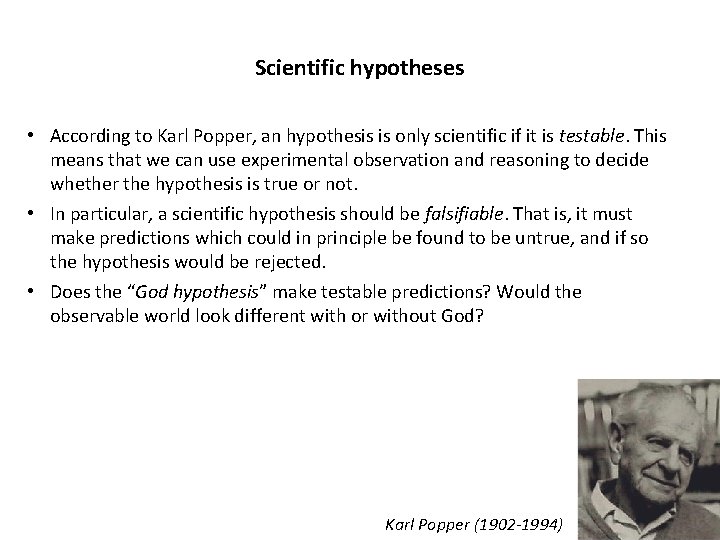
Scientific hypotheses • According to Karl Popper, an hypothesis is only scientific if it is testable. This means that we can use experimental observation and reasoning to decide whether the hypothesis is true or not. • In particular, a scientific hypothesis should be falsifiable. That is, it must make predictions which could in principle be found to be untrue, and if so the hypothesis would be rejected. • Does the “God hypothesis” make testable predictions? Would the observable world look different with or without God? Karl Popper (1902 -1994)
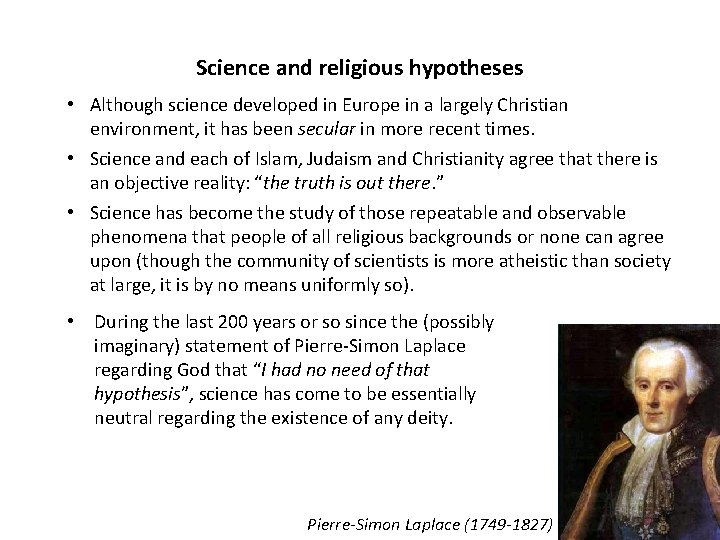
Science and religious hypotheses • Although science developed in Europe in a largely Christian environment, it has been secular in more recent times. • Science and each of Islam, Judaism and Christianity agree that there is an objective reality: “the truth is out there. ” • Science has become the study of those repeatable and observable phenomena that people of all religious backgrounds or none can agree upon (though the community of scientists is more atheistic than society at large, it is by no means uniformly so). • During the last 200 years or so since the (possibly imaginary) statement of Pierre-Simon Laplace regarding God that “I had no need of that hypothesis”, science has come to be essentially neutral regarding the existence of any deity. Pierre-Simon Laplace (1749 -1827)
Science and the “God hypothesis” • Is it plausible that the “God hypothesis” could have observable consequences – with a consensus of reasonable educated people agreeing that God’s existence would imply observation A and nonexistence would imply observation A’? • Either a believer in “intelligent design” or an extreme atheist would need to make this claim in order to “prove” their position, though they would of course disagree on which possibility we observe. • Most scientists and philosophers of science think that God is not a scientifically testable hypothesis.
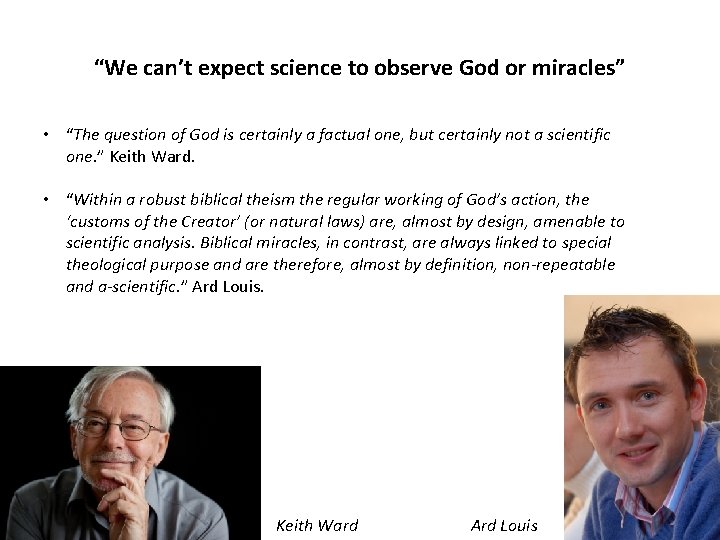
“We can’t expect science to observe God or miracles” • “The question of God is certainly a factual one, but certainly not a scientific one. ” Keith Ward. • “Within a robust biblical theism the regular working of God’s action, the ‘customs of the Creator’ (or natural laws) are, almost by design, amenable to scientific analysis. Biblical miracles, in contrast, are always linked to special theological purpose and are therefore, almost by definition, non-repeatable and a-scientific. ” Ard Louis. Keith Ward Ard Louis
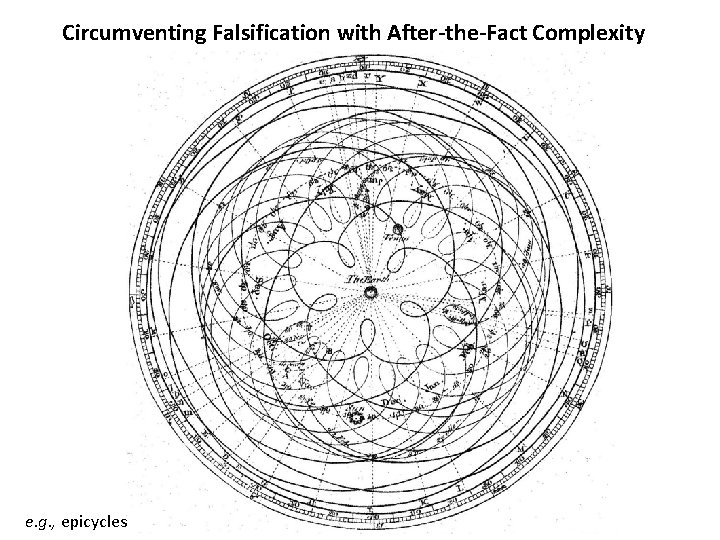
Circumventing Falsification with After-the-Fact Complexity e. g. , epicycles
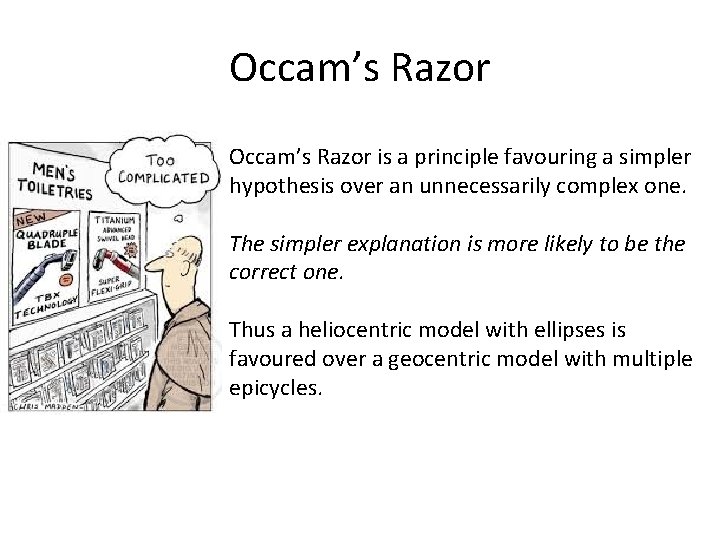
Occam’s Razor is a principle favouring a simpler hypothesis over an unnecessarily complex one. The simpler explanation is more likely to be the correct one. Thus a heliocentric model with ellipses is favoured over a geocentric model with multiple epicycles.
4. The God of the Gaps, Fine Tuning, Intelligent Design, Simulism and the Multiverse
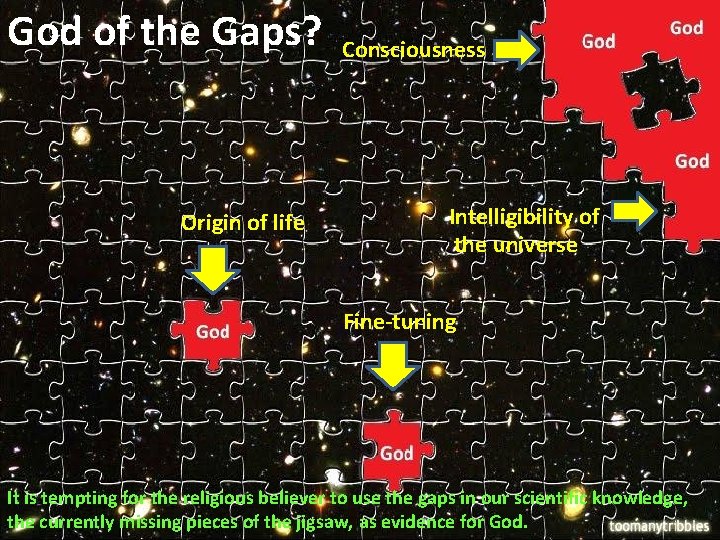
4. The God of the Gaps, Fine Tuning, Intelligent Design, Simulism and the Multiverse It is tempting for the religious believer to use the gaps in our scientific knowledge, the currently missing pieces of the jigsaw, as evidence for God.
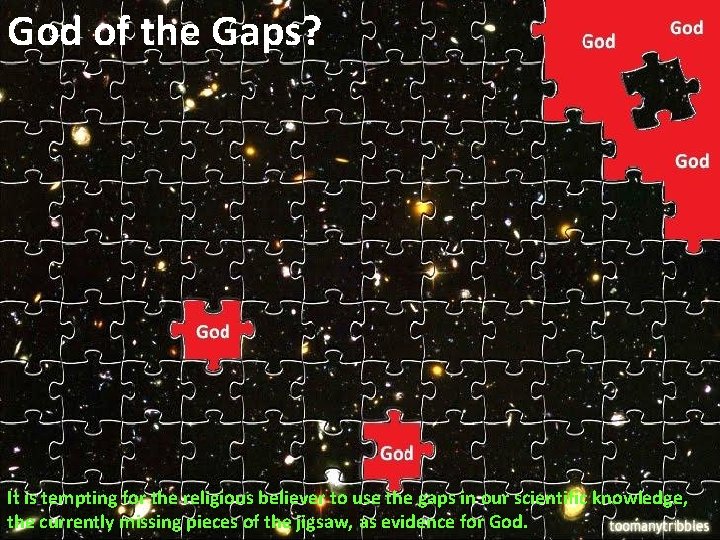
God of the Gaps? It is tempting for the religious believer to use the gaps in our scientific knowledge, the currently missing pieces of the jigsaw, as evidence for God.
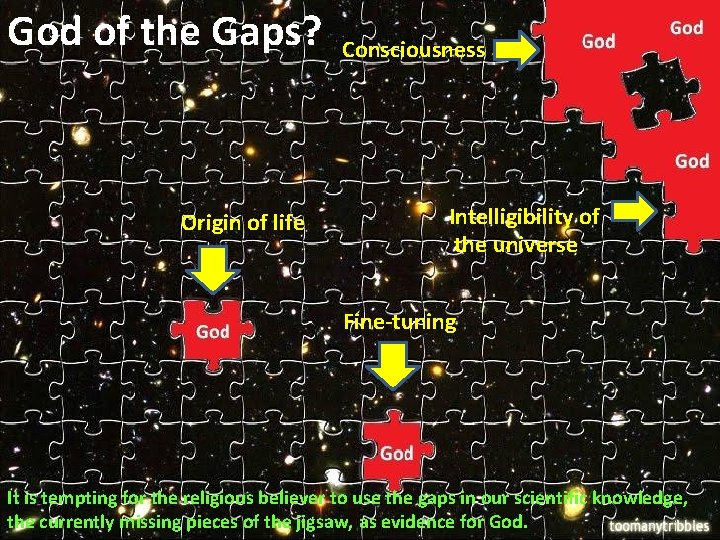
God of the Gaps? Origin of life Consciousness Intelligibility of the universe Fine-tuning It is tempting for the religious believer to use the gaps in our scientific knowledge, the currently missing pieces of the jigsaw, as evidence for God.
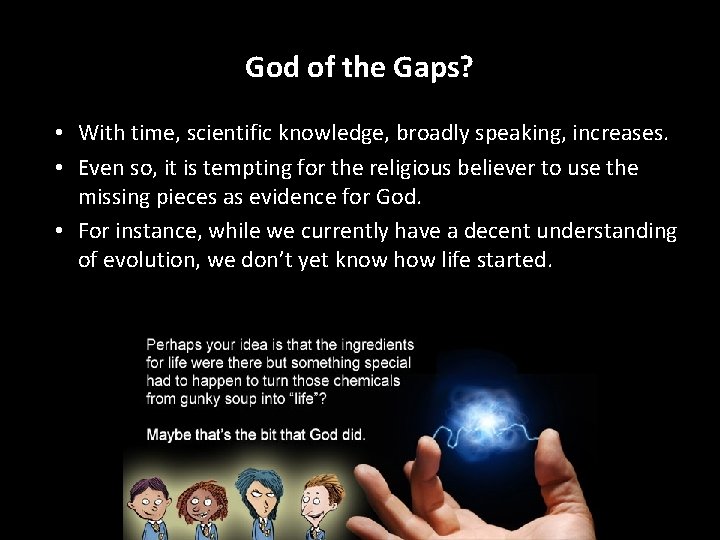
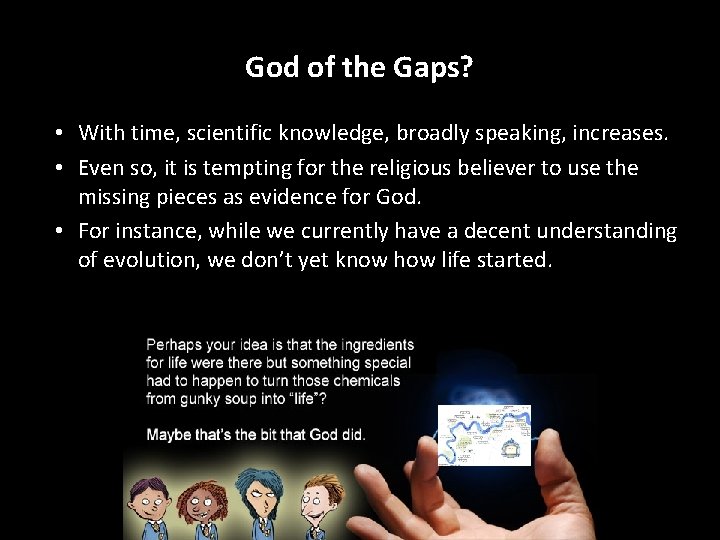
God of the Gaps? • With time, scientific knowledge, broadly speaking, increases. • Even so, it is tempting for the religious believer to use the missing pieces as evidence for God. • For instance, while we currently have a decent understanding of evolution, we don’t yet know how life started.
God of the Gaps? • With time, scientific knowledge, broadly speaking, increases. • Even so, it is tempting for the religious believer to use the missing pieces as evidence for God. • For instance, while we currently have a decent understanding of evolution, we don’t yet know how life started.
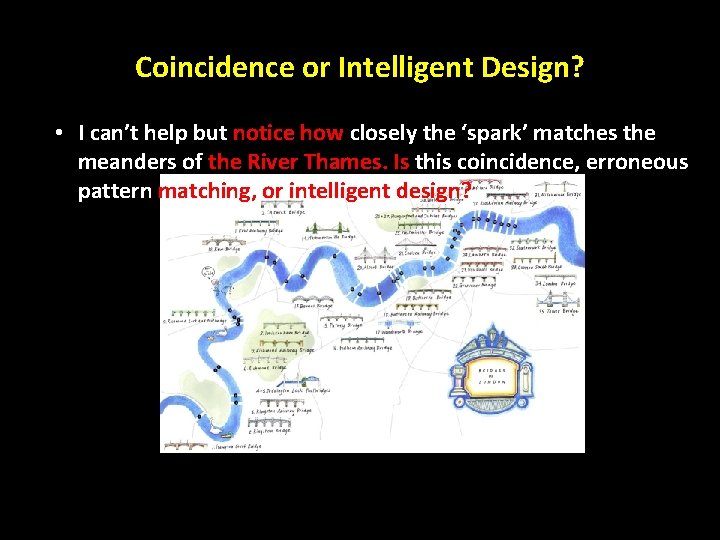
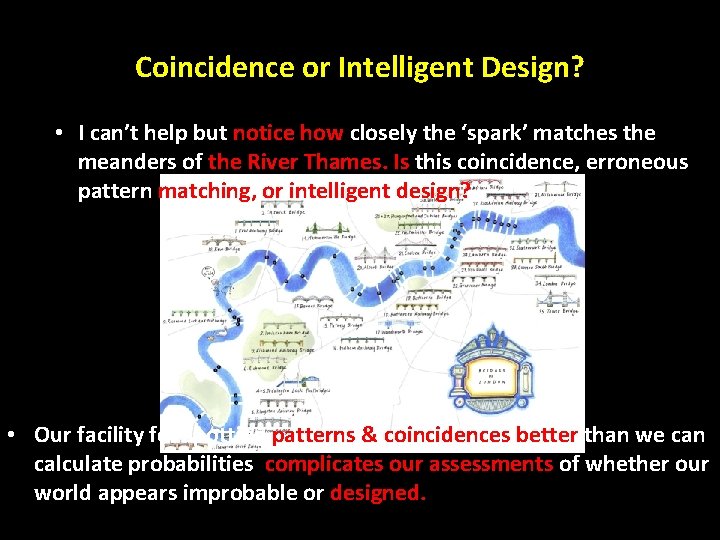
Coincidence or Intelligent Design? • I can’t help but notice how closely the ‘spark’ matches the meanders of the River Thames. Is this coincidence, erroneous pattern matching, or intelligent design?
Coincidence or Intelligent Design? • I can’t help but notice how closely the ‘spark’ matches the meanders of the River Thames. Is this coincidence, erroneous pattern matching, or intelligent design? • Our facility for spotting patterns & coincidences better than we can calculate probabilities complicates our assessments of whether our world appears improbable or designed.
Fine-tuning? • One interesting ‘gap’ is the apparent ‘fine-tuning’ of the fundamental constants describing the universe, such that is suitable for life to evolve in. • A tiny variation in the relative strengths of the strong nuclear force and electromagnetism would make it almost impossible for carbon to be formed from helium by nuclear fusion. • A very small change in the strength of gravity would make it impossible for stars and planets to form. • Thus, one could argue that our existence is highly improbable a priori.
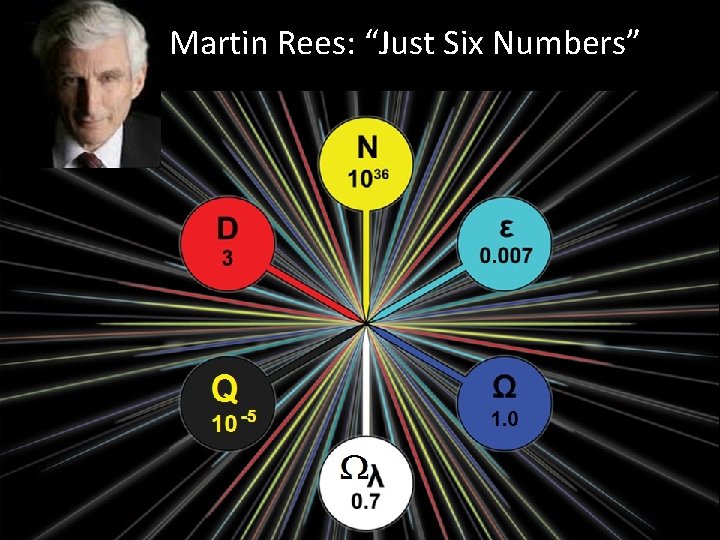
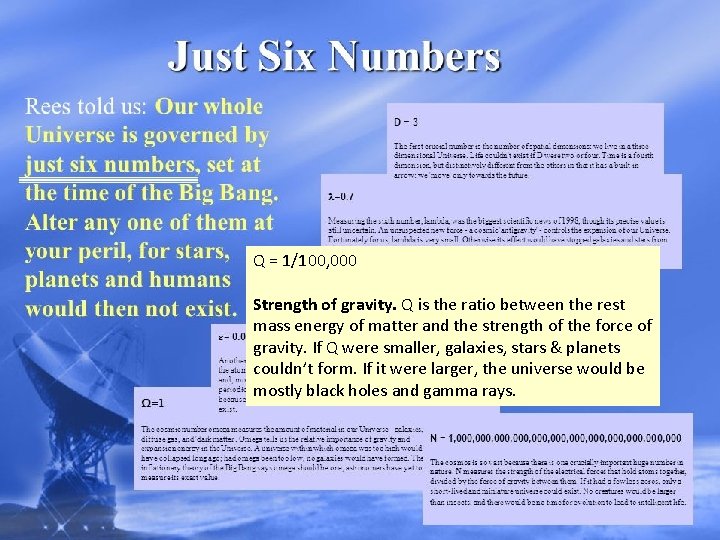
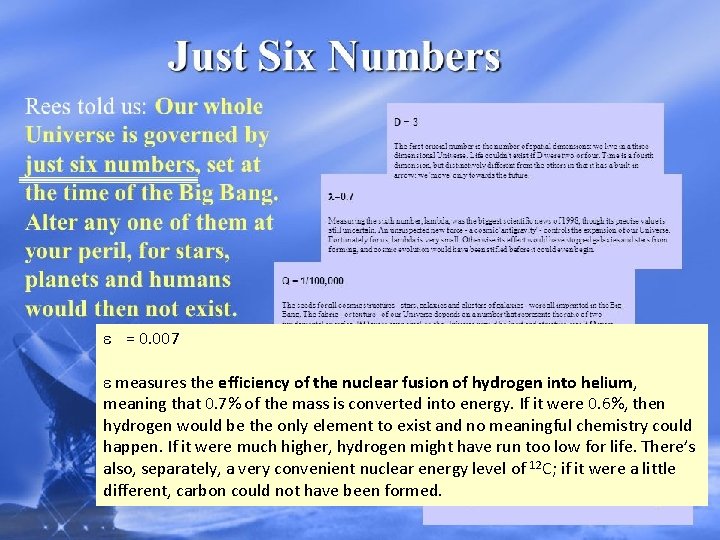
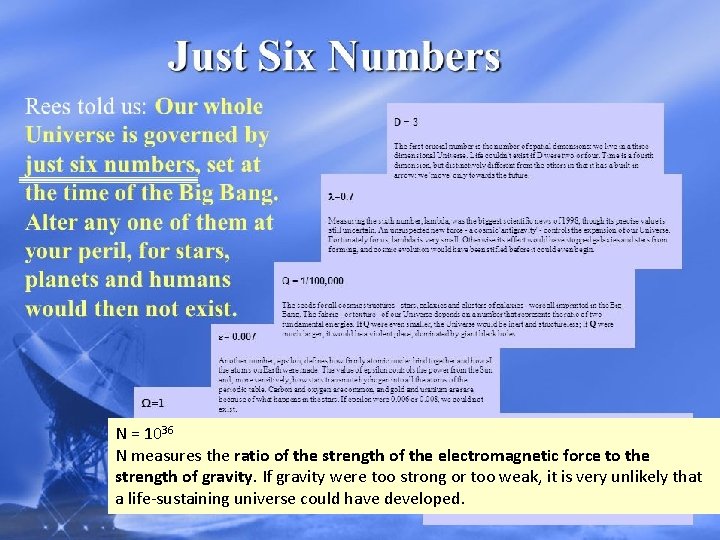
Martin Rees: “Just Six Numbers”
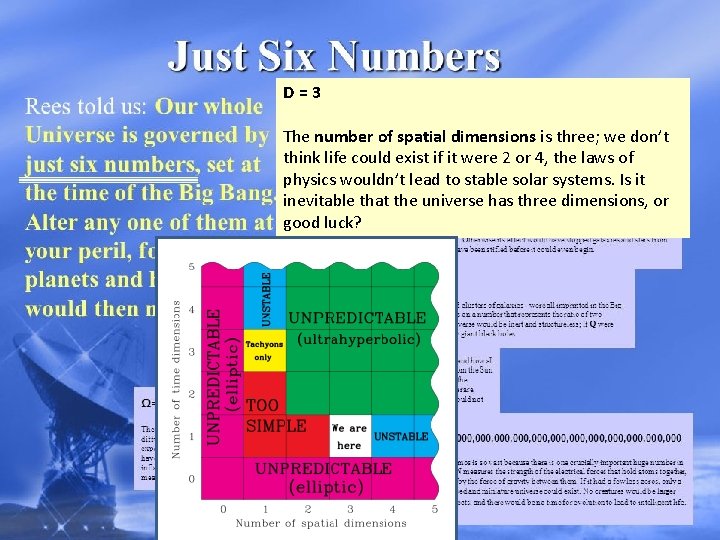
D=3 The number of spatial dimensions is three; we don’t think life could exist if it were 2 or 4, the laws of physics wouldn’t lead to stable solar systems. Is it inevitable that the universe has three dimensions, or good luck?
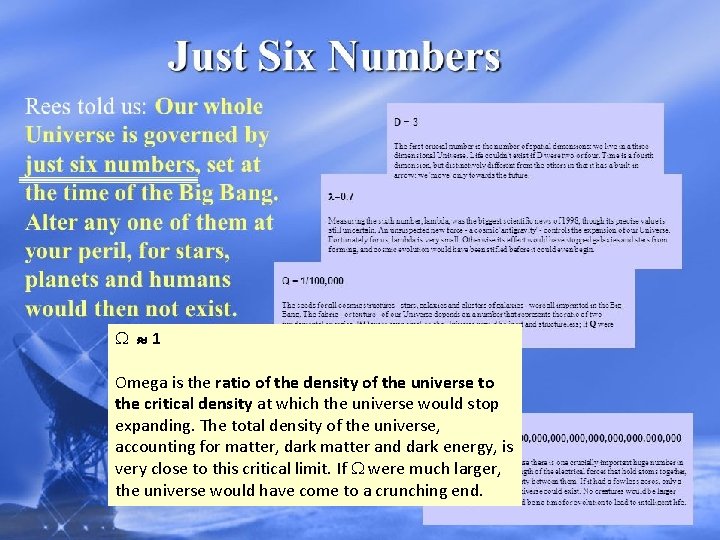
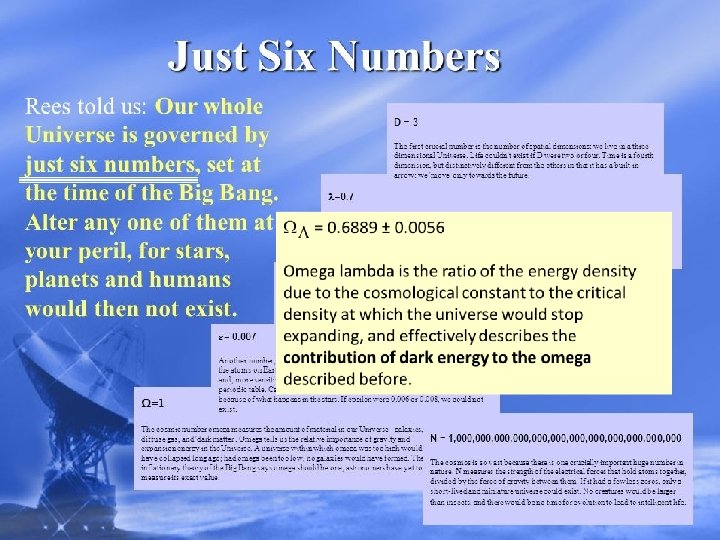
1 Omega is the ratio of the density of the universe to the critical density at which the universe would stop expanding. The total density of the universe, accounting for matter, dark matter and dark energy, is very close to this critical limit. If were much larger, the universe would have come to a crunching end.
Q = 1/100, 000 Strength of gravity. Q is the ratio between the rest mass energy of matter and the strength of the force of gravity. If Q were smaller, galaxies, stars & planets couldn’t form. If it were larger, the universe would be mostly black holes and gamma rays.
= 0. 007 measures the efficiency of the nuclear fusion of hydrogen into helium, meaning that 0. 7% of the mass is converted into energy. If it were 0. 6%, then hydrogen would be the only element to exist and no meaningful chemistry could happen. If it were much higher, hydrogen might have run too low for life. There’s also, separately, a very convenient nuclear energy level of 12 C; if it were a little different, carbon could not have been formed.
N = 1036 N measures the ratio of the strength of the electromagnetic force to the strength of gravity. If gravity were too strong or too weak, it is very unlikely that a life-sustaining universe could have developed.
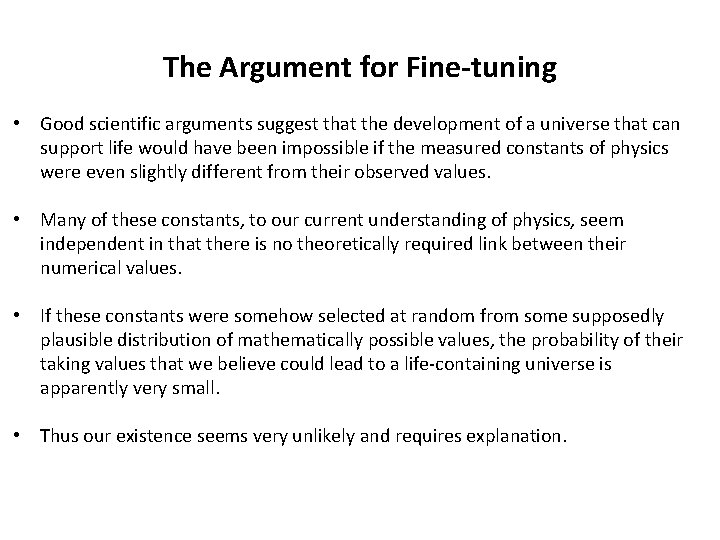
The Argument for Fine-tuning • Good scientific arguments suggest that the development of a universe that can support life would have been impossible if the measured constants of physics were even slightly different from their observed values. • Many of these constants, to our current understanding of physics, seem independent in that there is no theoretically required link between their numerical values. • If these constants were somehow selected at random from some supposedly plausible distribution of mathematically possible values, the probability of their taking values that we believe could lead to a life-containing universe is apparently very small. • Thus our existence seems very unlikely and requires explanation.
How Real is Fine-tuning? • It’s very hard to put a single number on how unlikely our universe is. • Is it realistic to imagine fundamental constants being determined randomly from some distribution? • Nonetheless, many (but certainly not all) thinkers agree that the universe appears remarkably well fitted for life. • If there is something here to explain, what might be our responses?
Possible Responses to Fine-tuning • “It is evidence for the action of God in the universe”. • “Eventually we will find a scientific explanation”. • “If the universe weren’t suitable for life, we wouldn’t be here to ask the question”.
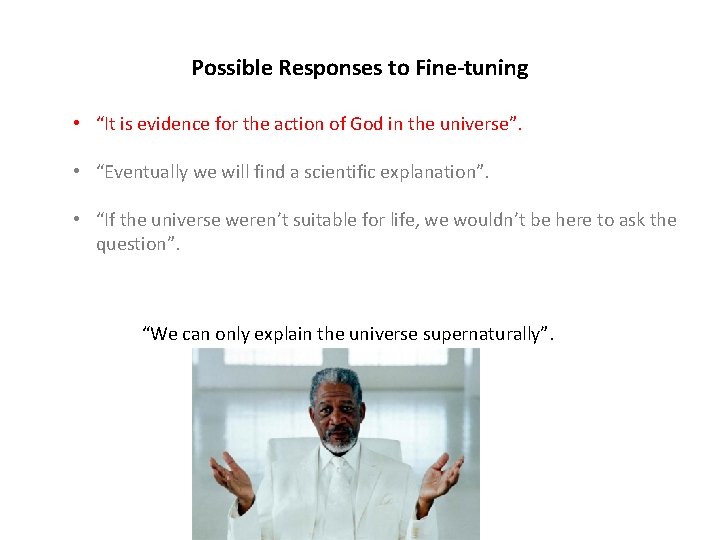
Possible Responses to Fine-tuning • “It is evidence for the action of God in the universe”. • “Eventually we will find a scientific explanation”. • “If the universe weren’t suitable for life, we wouldn’t be here to ask the question”. “We can only explain the universe supernaturally”.
Possible Responses to Fine-tuning • “Our universe was deliberately created with properties that could support life by an intelligent Creator or creators. ” This is, broadly speaking, an “intelligent design” type of argument. • “Eventually we will find a scientific explanation”. • “If the universe weren’t suitable for life, we wouldn’t be here to ask the question”.
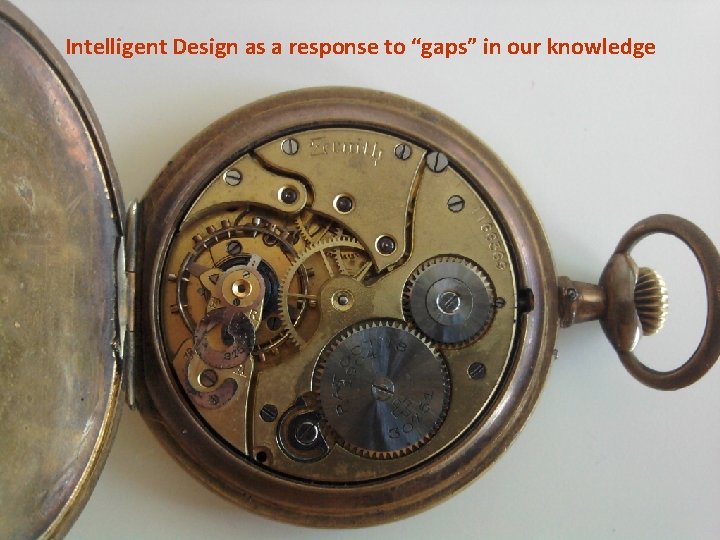
Intelligent Design as a response to “gaps” in our knowledge
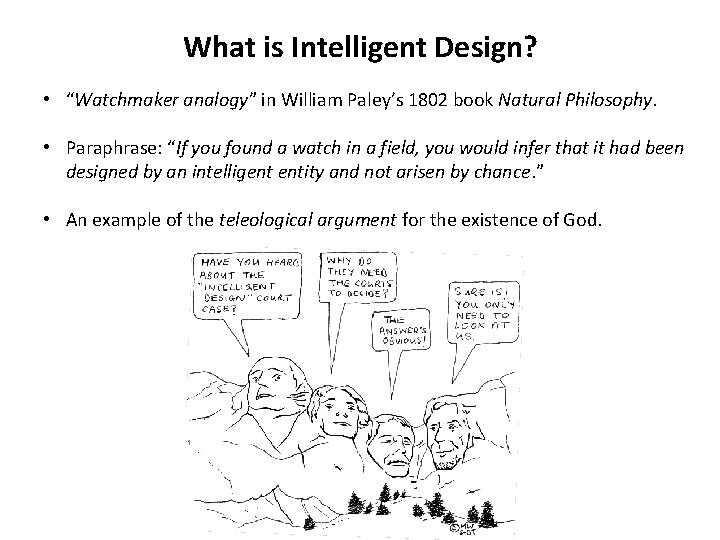
What is Intelligent Design? • “Watchmaker analogy” in William Paley’s 1802 book Natural Philosophy. • Paraphrase: “If you found a watch in a field, you would infer that it had been designed by an intelligent entity and not arisen by chance. ” • An example of the teleological argument for the existence of God.
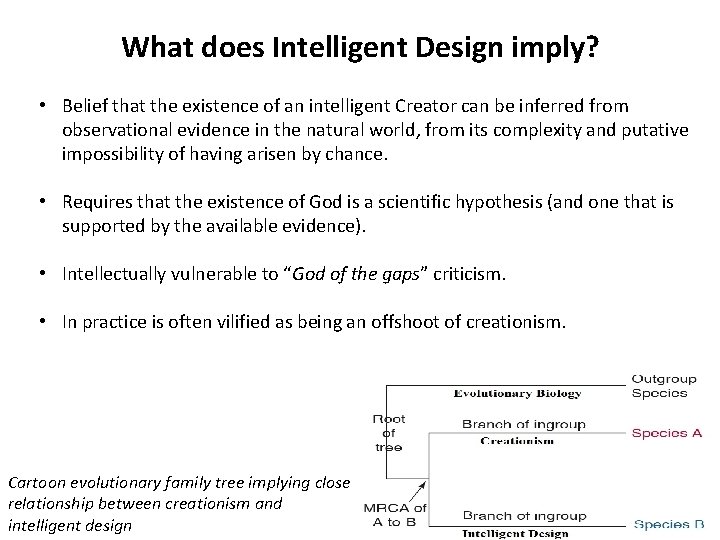
What does Intelligent Design imply? • Belief that the existence of an intelligent Creator can be inferred from observational evidence in the natural world, from its complexity and putative impossibility of having arisen by chance. • Requires that the existence of God is a scientific hypothesis (and one that is supported by the available evidence). • Intellectually vulnerable to “God of the gaps” criticism. • In practice is often vilified as being an offshoot of creationism. Cartoon evolutionary family tree implying close relationship between creationism and intelligent design
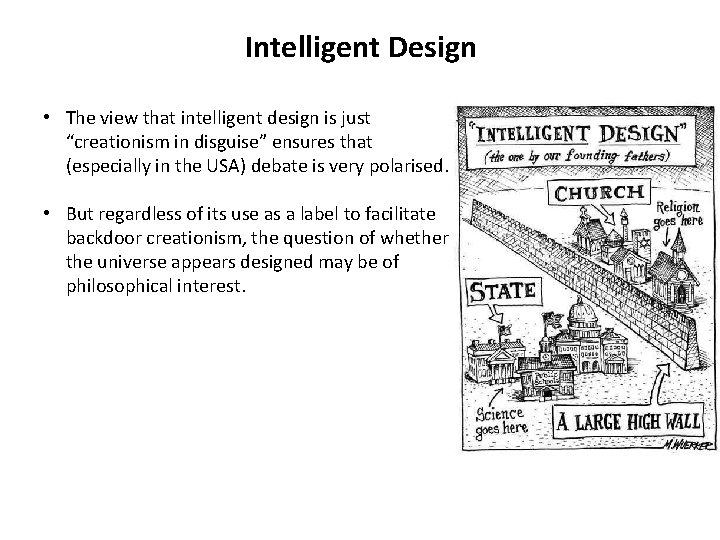
Intelligent Design • The view that intelligent design is just “creationism in disguise” ensures that (especially in the USA) debate is very polarised. • But regardless of its use as a label to facilitate backdoor creationism, the question of whether the universe appears designed may be of philosophical interest.
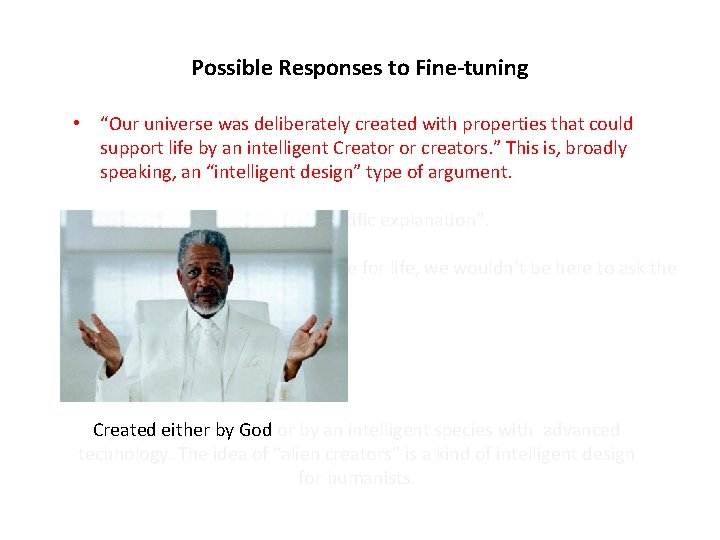
Possible Responses to Fine-tuning • “Our universe was deliberately created with properties that could support life by an intelligent Creator or creators. ” This is, broadly speaking, an “intelligent design” type of argument. • “Eventually we will find a scientific explanation”. • “If the universe weren’t suitable for life, we wouldn’t be here to ask the question”. Created either by God or by an intelligent species with advanced technology. The idea of “alien creators” is a kind of intelligent design for humanists.
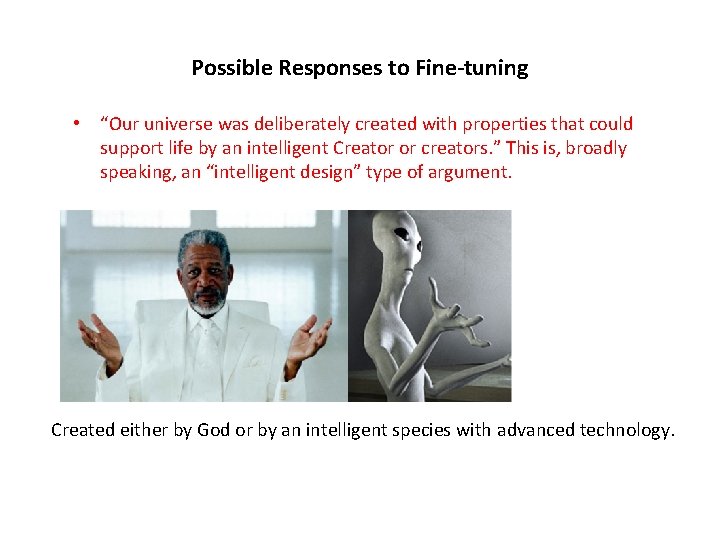
Possible Responses to Fine-tuning • “Our universe was deliberately created with properties that could support life by an intelligent Creator or creators. ” This is, broadly speaking, an “intelligent design” type of argument. • “Eventually we will find a scientific explanation”. • “If the universe weren’t suitable for life, we wouldn’t be here to ask the question”. Created either by God or by an intelligent species with advanced technology.
Possible Responses to Fine-tuning • “Our universe was deliberately created with properties that could support life by an intelligent Creator or creators. ” What if the creators were aliens or machines? • “Eventually we will find a scientific explanation”. • “If the universe weren’t suitable for life, we wouldn’t be here to ask the question”. Is the idea of “alien creators” a kind of intelligent design for humanists?
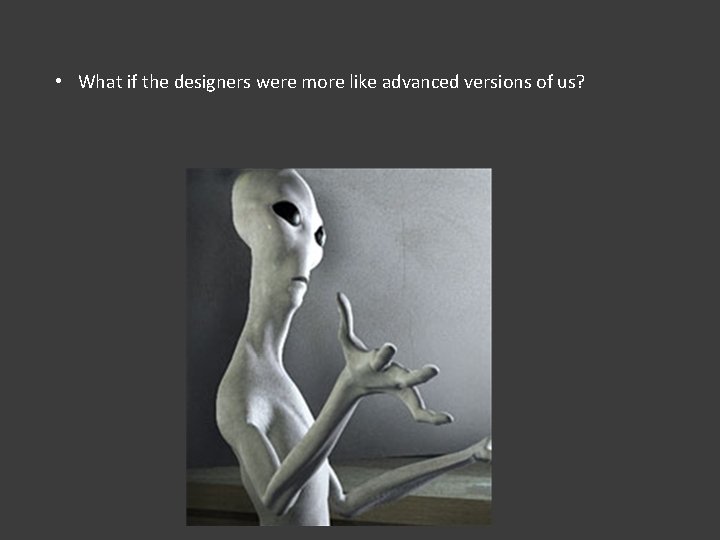
• What if the designers were more like advanced versions of us?
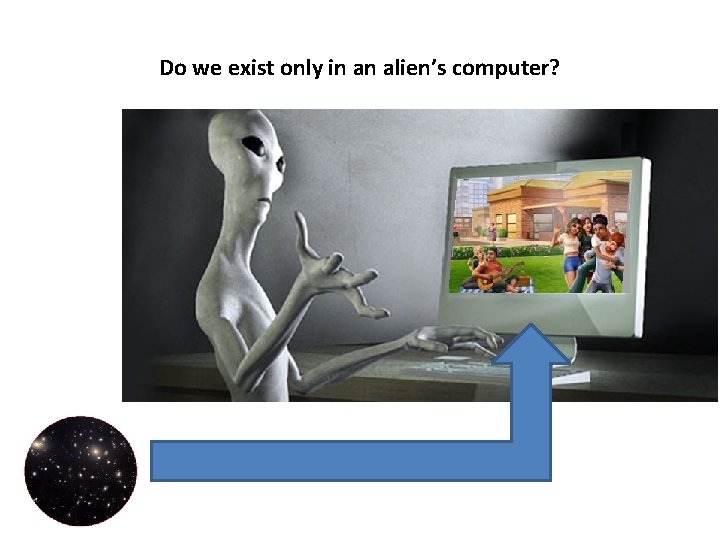
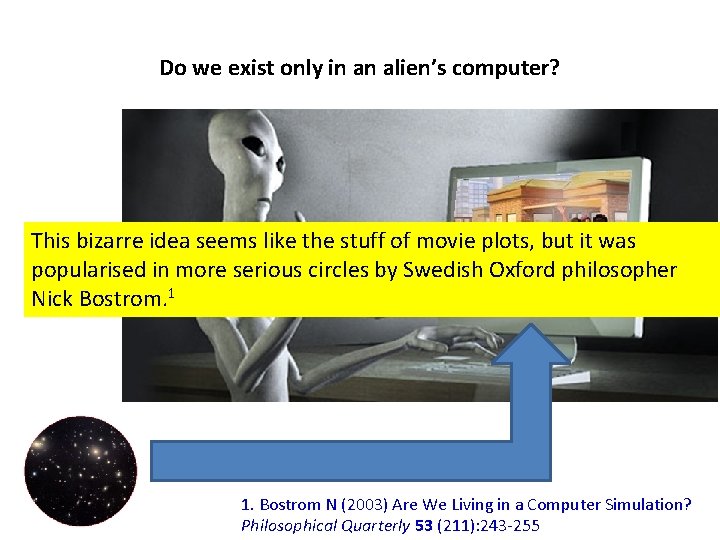
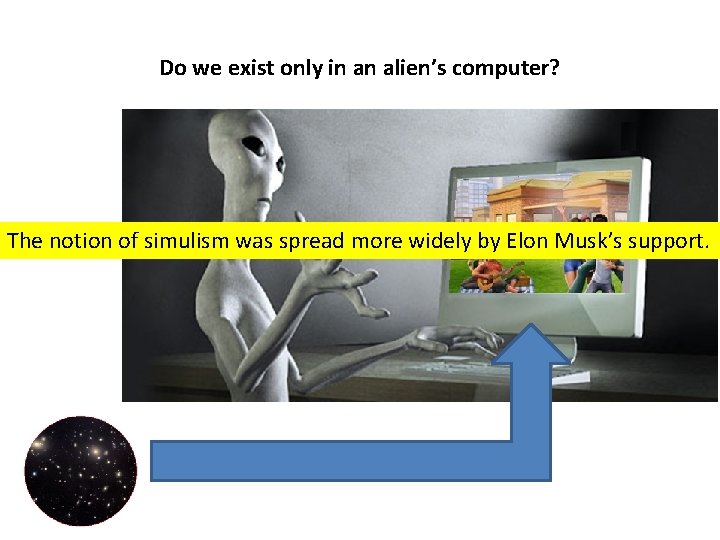
Do we exist only in an alien’s computer?
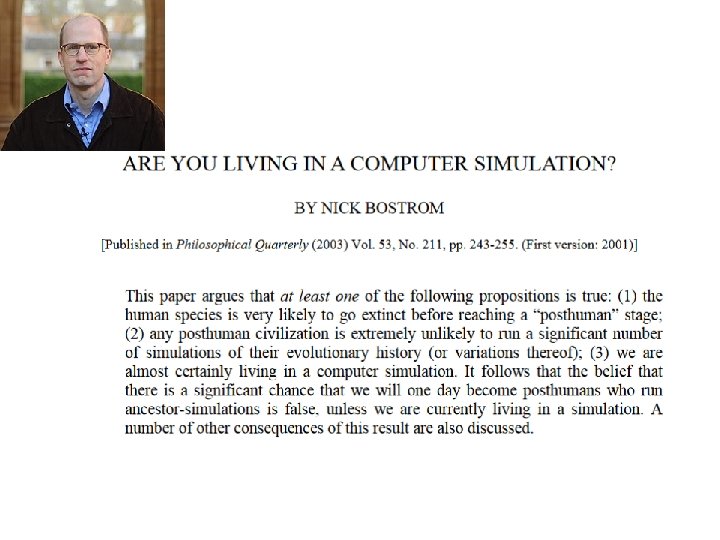
Do we exist only in an alien’s computer? This bizarre idea seems like the stuff of movie plots, but it was popularised in more serious circles by Swedish Oxford philosopher Nick Bostrom. 1 1. Bostrom N (2003) Are We Living in a Computer Simulation? Philosophical Quarterly 53 (211): 243 -255
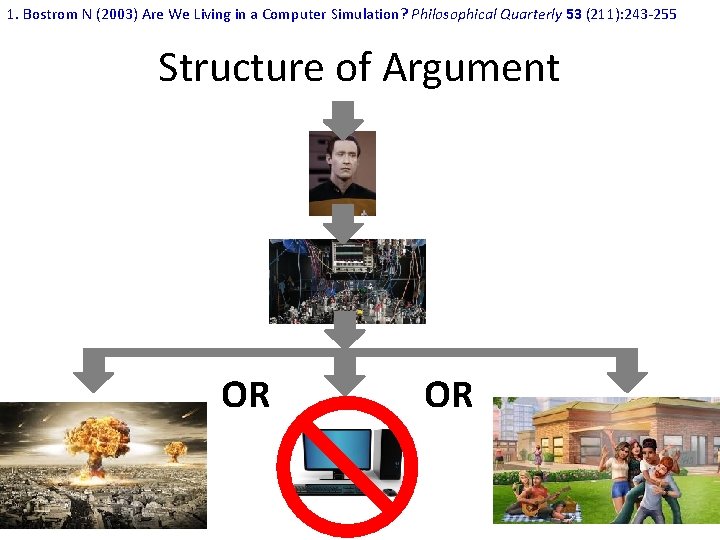
1. Bostrom N (2003) Are We Living in a Computer Simulation? Philosophical Quarterly 53 (211): 243 -255 Structure of Argument OR OR
Do we exist only in an alien’s computer? The notion of simulism was spread more widely by Elon Musk’s support.
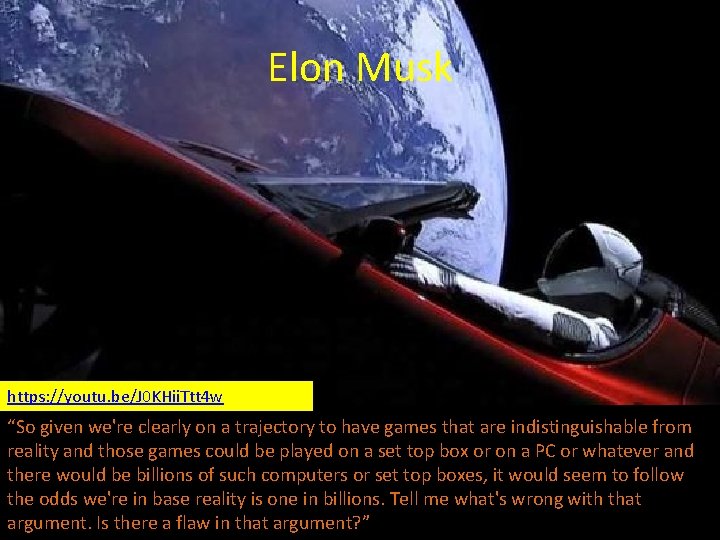
Elon Musk https: //youtu. be/J 0 KHii. Ttt 4 w “So given we're clearly on a trajectory to have games that are indistinguishable from reality and those games could be played on a set top box or on a PC or whatever and there would be billions of such computers or set top boxes, it would seem to follow the odds we're in base reality is one in billions. Tell me what's wrong with that argument. Is there a flaw in that argument? ”
Hidden Assumption The physics in their world is like the physics in ours. Bostrom 1 says: “The physics in the universe where the computer is situated that is running the simulation may or may not resemble the physics of the world that we observe. ” However, he and Musk actually address the question of whether a future version of humankind could simulate a universe containing conscious beings within a computing device based in our own universe. In principle, one could imagine the simulators’ world having whatever magical properties one chose, but this places the simulation hypothesis beyond rational discussion (would this make it a religion? ).
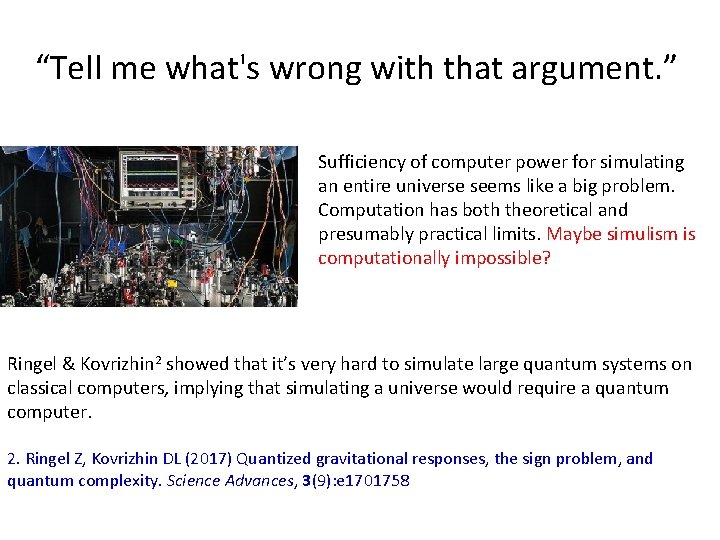
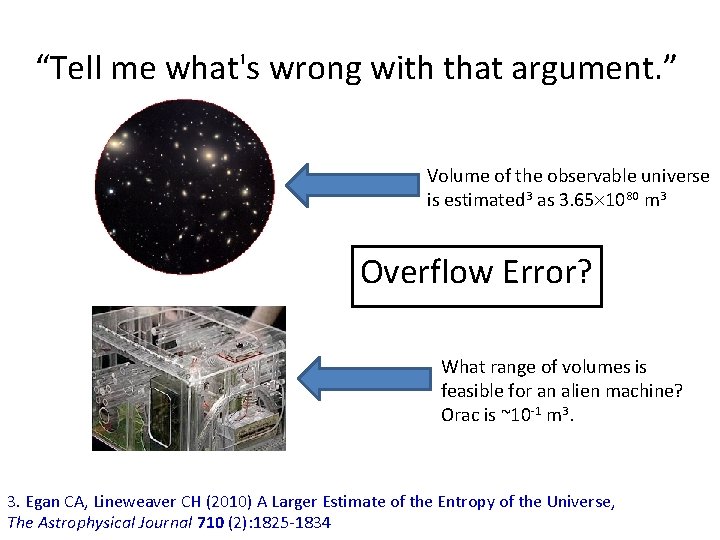
“Tell me what's wrong with that argument. ” Sufficiency of computer power for simulating an entire universe seems like a big problem. Computation has both theoretical and presumably practical limits. Maybe simulism is computationally impossible? Ringel & Kovrizhin 2 showed that it’s very hard to simulate large quantum systems on classical computers, implying that simulating a universe would require a quantum computer. 2. Ringel Z, Kovrizhin DL (2017) Quantized gravitational responses, the sign problem, and quantum complexity. Science Advances, 3(9): e 1701758
“Tell me what's wrong with that argument. ” Volume of the observable universe is estimated 3 as 3. 65 1080 m 3 Overflow Error? What range of volumes is feasible for an alien machine? Orac is ~10 -1 m 3. Egan CA, Lineweaver CH (2010) A Larger Estimate of the Entropy of the Universe, The Astrophysical Journal 710 (2): 1825 -1834
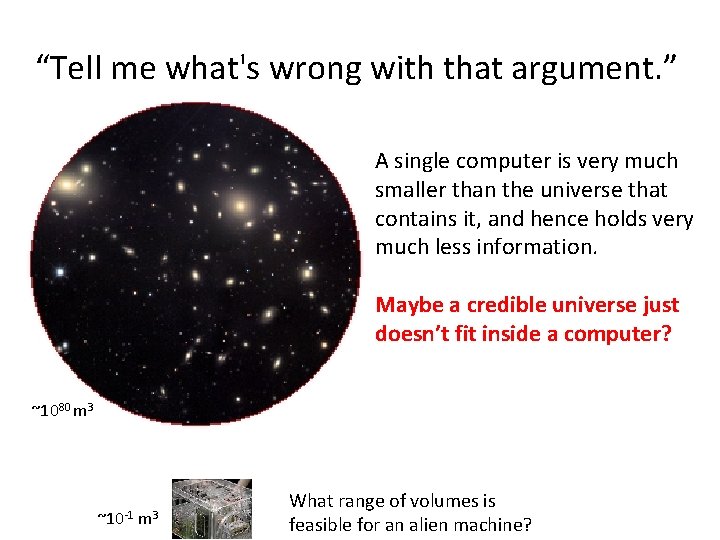
“Tell me what's wrong with that argument. ” A single computer is very much smaller than the universe that contains it, and hence holds very much less information. Maybe a credible universe just doesn’t fit inside a computer? ~1080 m 3 ~10 -1 m 3 What range of volumes is feasible for an alien machine?
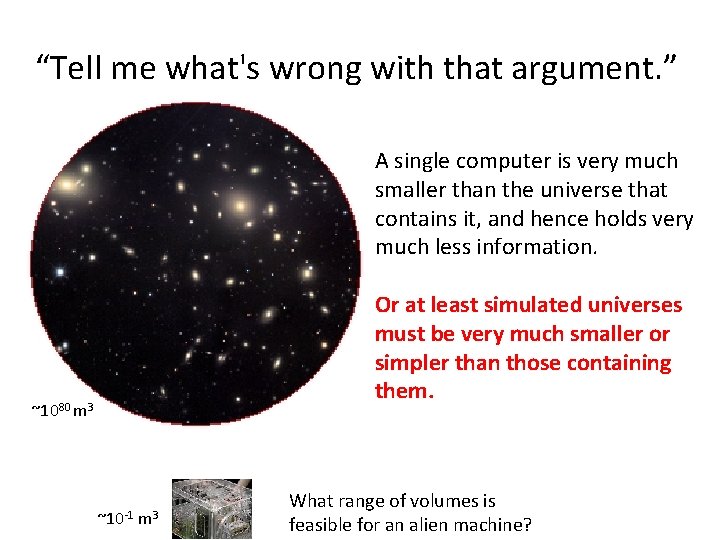
“Tell me what's wrong with that argument. ” A single computer is very much smaller than the universe that contains it, and hence holds very much less information. Or at least simulated universes must be very much smaller or simpler than those containing them. ~1080 m 3 ~10 -1 m 3 What range of volumes is feasible for an alien machine?
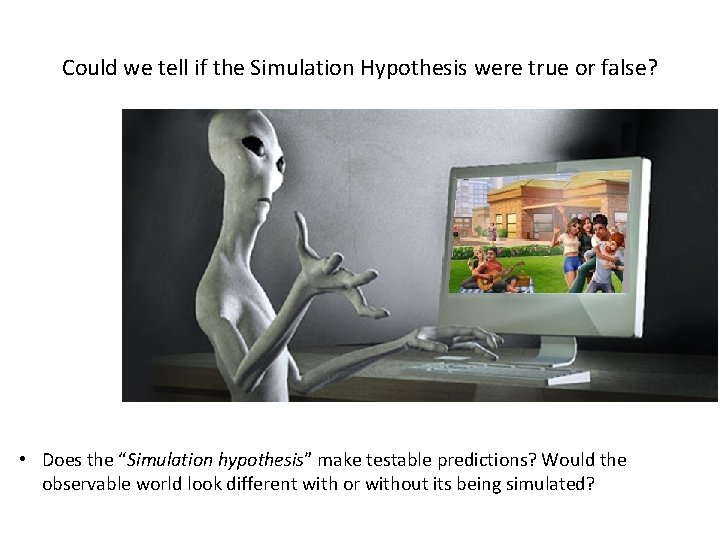
Could we tell if the Simulation Hypothesis were true or false? • Does the “Simulation hypothesis” make testable predictions? Would the observable world look different with or without its being simulated?
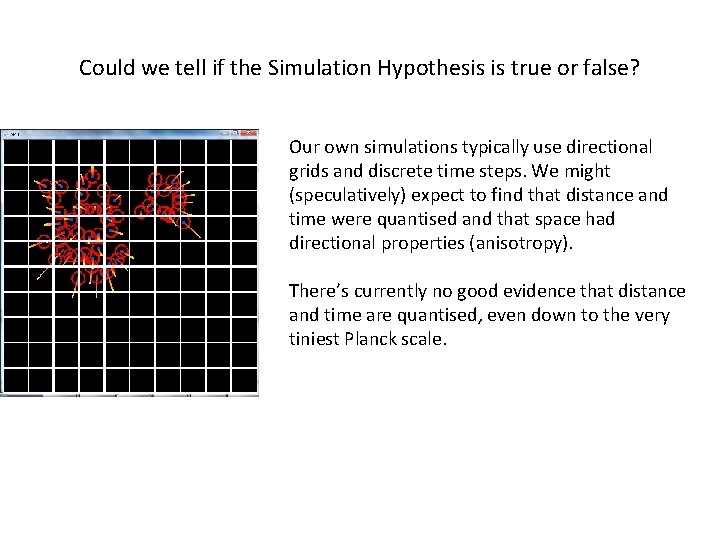
Could we tell if the Simulation Hypothesis is true or false? Our own simulations typically use directional grids and discrete time steps. We might (speculatively) expect to find that distance and time were quantised and that space had directional properties (anisotropy). There’s currently no good evidence that distance and time are quantised, even down to the very tiniest Planck scale.
Could we tell if the Simulation Hypothesis is true or false? Simulators could run a simulation with insufficient physics to describe its universe’s origin, if they started running from t > 0. If we lived in such a simulation, our cosmologists might be endlessly puzzled.
“Tell me what's wrong with that argument. ” Occam’s razor doesn’t favour simulism. Is the simulation hypothesis unnecessarily complex? Many people consider simulation to be a contrived and a priori implausible explanation for our world. This is not adequately addressed in Bostrom’s or Musk’s arguments for simulation. Maybe simulism is a somewhat implausible, highly convoluted idea?
So it’s unlikely that we exist only in an alien’s computer. I don’t think many people really believe in simulism.
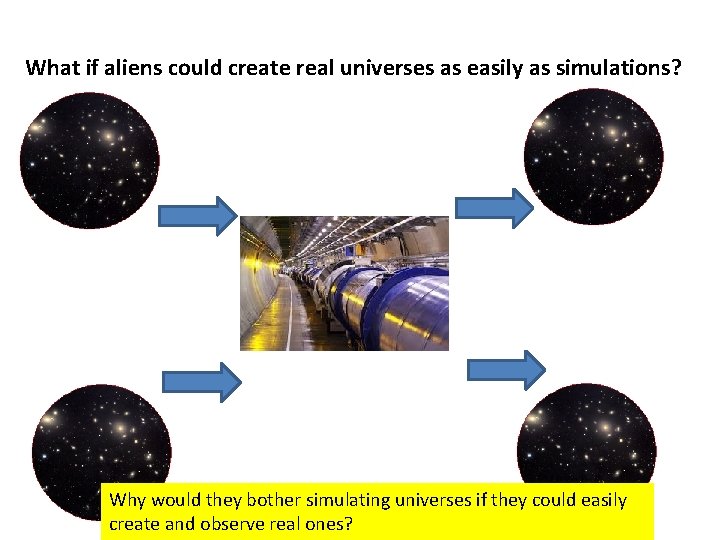
What if aliens could create real universes as easily as simulations? Why would they bother simulating universes if they could easily create and observe real ones?
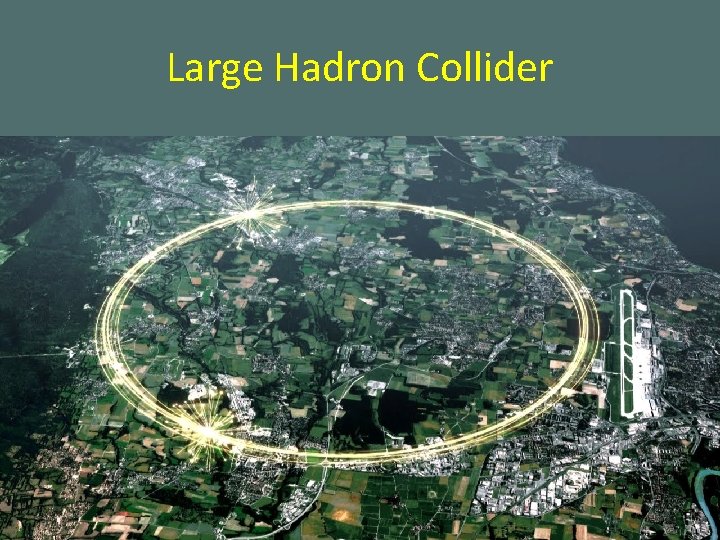
Large Hadron Collider
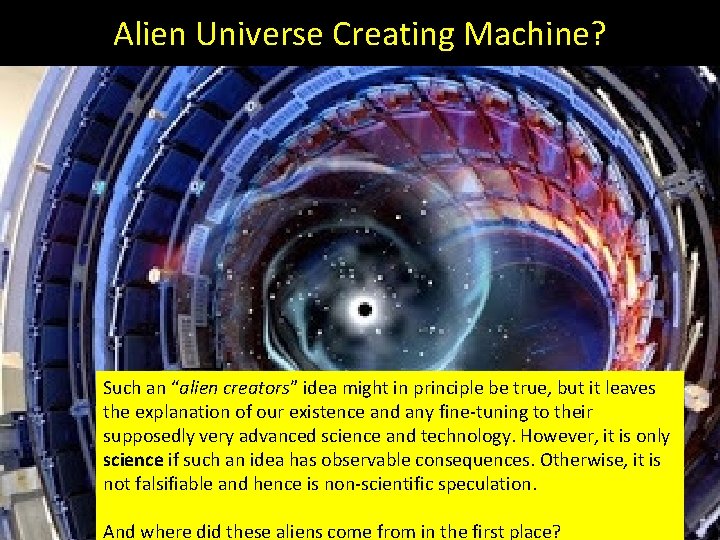
Alien Universe Creating Machine?
Alien Universe Creating Machine? Whether technology could advance to the stage of being able to create universes is, of course, highly uncertain. We just don’t know how possible this is.
Alien Universe Creating Machine? Such an “alien creators” idea might in principle be true, but it leaves the explanation of our existence and any fine-tuning to their supposedly very advanced science and technology. However, it is only science if such an idea has observable consequences. Otherwise, it is not falsifiable and hence is non-scientific speculation. And where did these aliens come from in the first place?
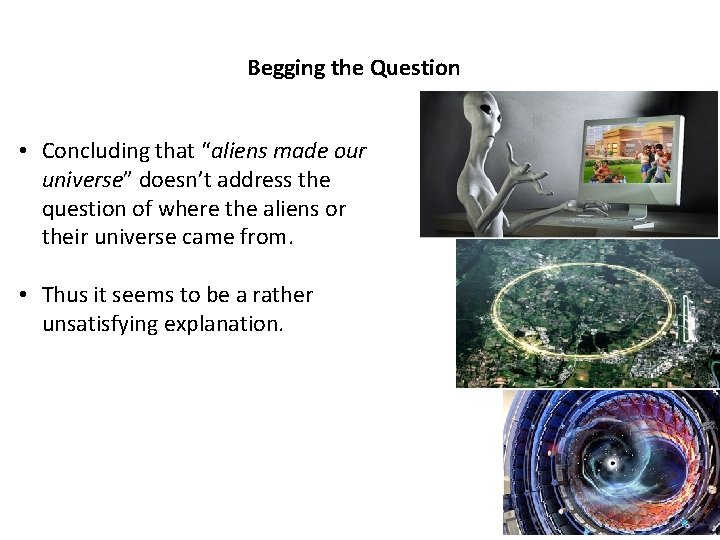
Begging the Question • Concluding that “aliens made our universe” doesn’t address the question of where the aliens or their universe came from. • Thus it seems to be a rather unsatisfying explanation.
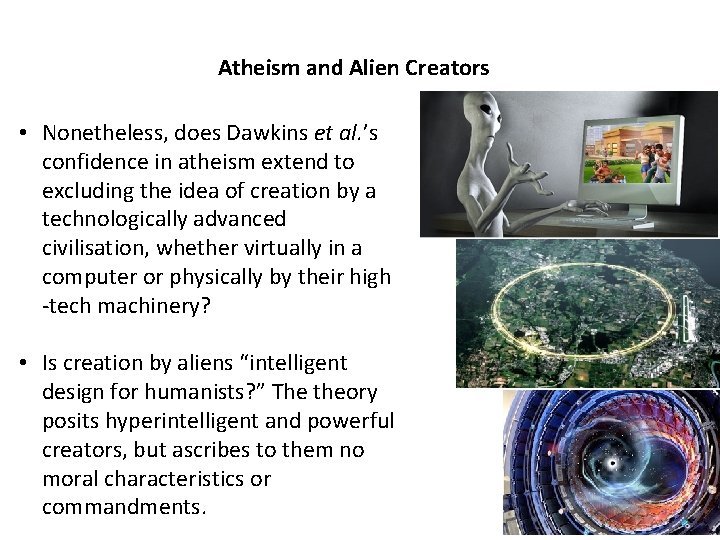
Atheism and Alien Creators • Nonetheless, does Dawkins et al. ’s confidence in atheism extend to excluding the idea of creation by a technologically advanced civilisation, whether virtually in a computer or physically by their high -tech machinery? • Is creation by aliens “intelligent design for humanists? ” The theory posits hyperintelligent and powerful creators, but ascribes to them no moral characteristics or commandments.
• So we’ve discussed intelligent design and creative aliens as explanations for the existence of a complex and fine-tuned universe. But could our science or philosophy in future provide a suitable explanation?
Possible Responses to fine-tuning • “It is evidence for the action of God (or alien creators) in the universe”. • “Eventually we will find a scientific explanation”. • “If the universe weren’t suitable for life, we wouldn’t be here to ask the question”. • There is nothing to explain. “Science will eventually explain it all away”.
Possible Responses to fine-tuning • “It is evidence for the action of God (or alien creators) in the universe”. • “There as-yet-unrecognised theoretical physics-based reasons why the values of the physical constants are either what they are, or alternatively are linked to one another. Thus their values are much less randomly chosen than we now think. ” • “If the universe weren’t suitable for life, we wouldn’t be here to ask the question”. “Science will eventually explain it all away”.
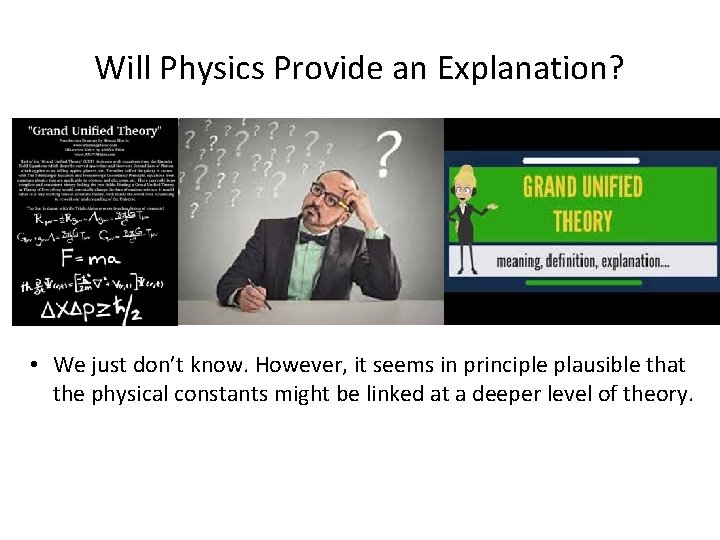
Will Physics Provide an Explanation? • We just don’t know. However, it seems in principle plausible that the physical constants might be linked at a deeper level of theory.
Possible Responses to fine-tuning • “It is evidence for the action of God (or alien creators) in the universe”. • “A multiverse. An ensemble of vastly many universes exists, and within such a massively large set it’s likely that at least one life-supporting universe exists. ” • “If the universe weren’t suitable for life, we wouldn’t be here to ask the question”. • There is nothing to explain. “Science will eventually explain it all away”.
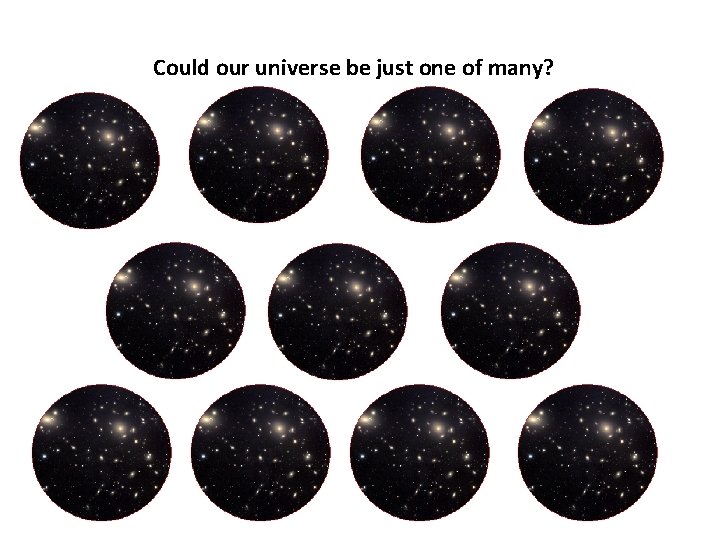
Could our universe be just one of many?
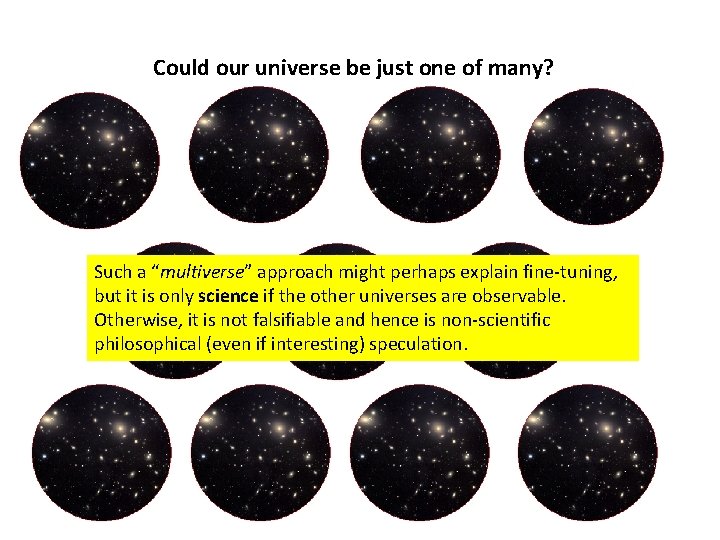
Could our universe be just one of many? Such a “multiverse” approach might perhaps explain fine-tuning, but it is only science if the other universes are observable. Otherwise, it is not falsifiable and hence is non-scientific philosophical (even if interesting) speculation.
Possible Responses to fine-tuning • “It is evidence for the action of God (or alien creators) in the universe”. • “Our universe cycled through many different initial states or was a superposition of many different initial states, of which only one survived to give rise to what we now observed. ” • “If the universe weren’t suitable for life, we wouldn’t be here to ask the question”. “Science will eventually explain it all away”.
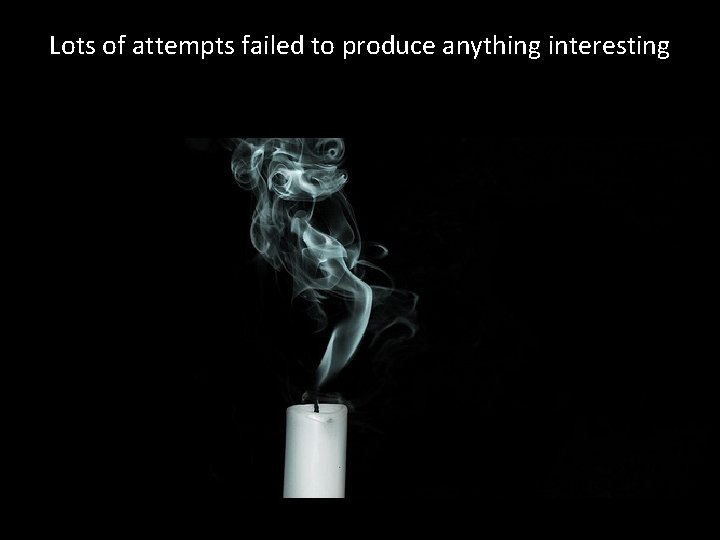
Lots of attempts failed to produce anything interesting
Lots of attempts failed to produce anything interesting
But eventually one Big Bang actually “worked”
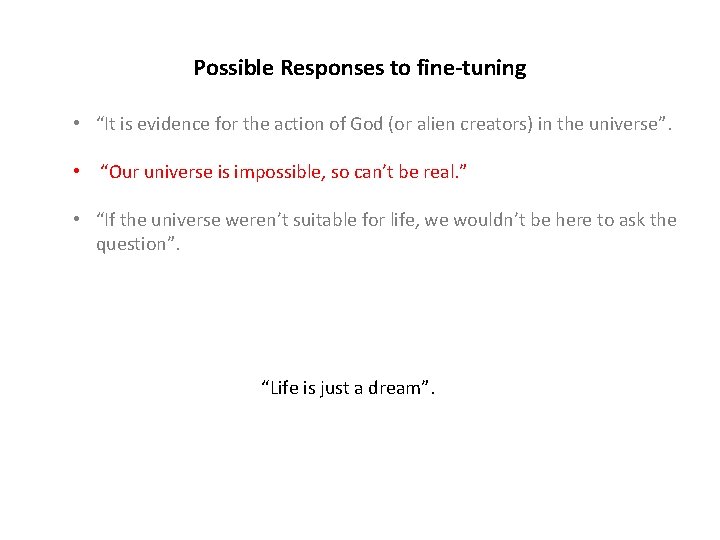
Possible Responses to fine-tuning • “It is evidence for the action of God (or alien creators) in the universe”. • “Our universe is impossible, so can’t be real. ” • “If the universe weren’t suitable for life, we wouldn’t be here to ask the question”. “Life is just a dream”.
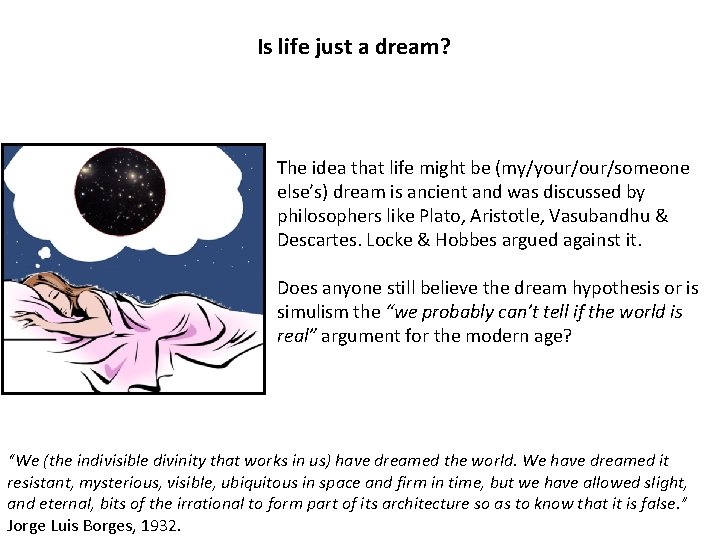
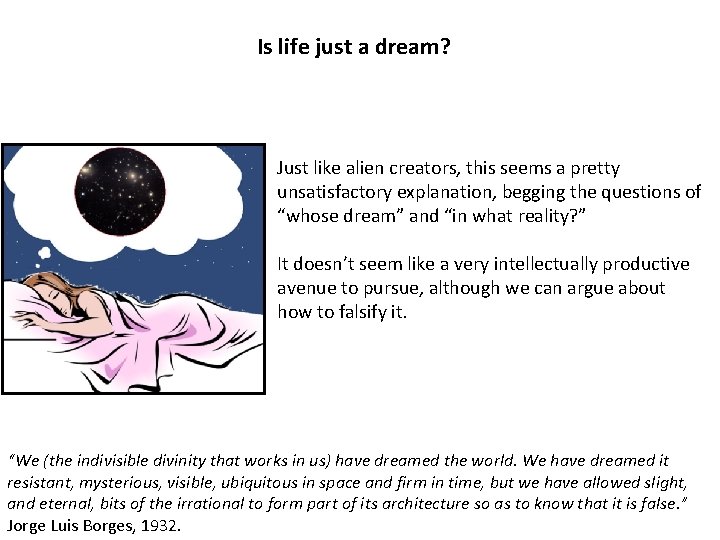
Is life just a dream? The idea that life might be (my/your/someone else’s) dream is ancient and was discussed by philosophers like Plato, Aristotle, Vasubandhu & Descartes. Locke & Hobbes argued against it. Does anyone still believe the dream hypothesis or is simulism the “we probably can’t tell if the world is real” argument for the modern age? “We (the indivisible divinity that works in us) have dreamed the world. We have dreamed it resistant, mysterious, visible, ubiquitous in space and firm in time, but we have allowed slight, and eternal, bits of the irrational to form part of its architecture so as to know that it is false. ” Jorge Luis Borges, 1932.
Is life just a dream? Just like alien creators, this seems a pretty unsatisfactory explanation, begging the questions of “whose dream” and “in what reality? ” It doesn’t seem like a very intellectually productive avenue to pursue, although we can argue about how to falsify it. “We (the indivisible divinity that works in us) have dreamed the world. We have dreamed it resistant, mysterious, visible, ubiquitous in space and firm in time, but we have allowed slight, and eternal, bits of the irrational to form part of its architecture so as to know that it is false. ” Jorge Luis Borges, 1932.
Possible Responses to Fine-tuning • “It is evidence for the action of God in the universe”. • “Eventually we will find a scientific explanation”. • “If the universe weren’t suitable for life, we wouldn’t be here to ask the question” (Anthropic Principle). “There is no meaningful question to answer”.
Possible Responses to Fine-tuning • “It is evidence for the action of God in the universe”. • “Eventually we will find a scientific explanation”. • “If the universe weren’t suitable for life, we wouldn’t be here to ask the question” (Anthropic Principle). Philosophers may debate the power or otherwise of this third approach.
@aquinas_rs (slideshare. com)
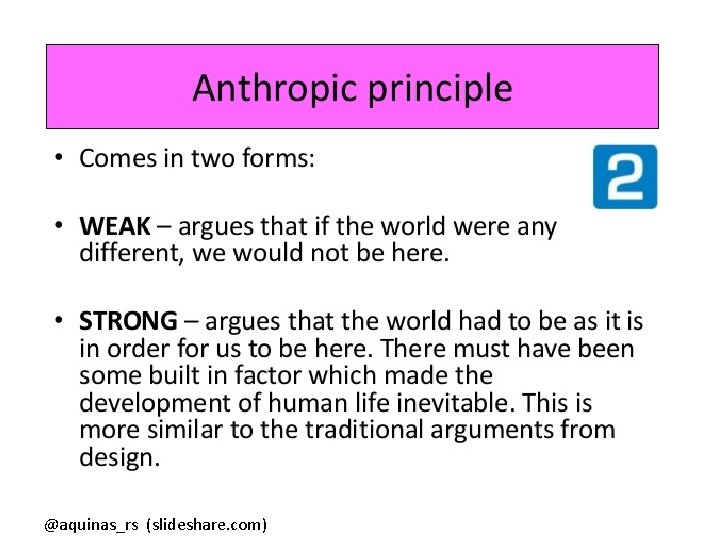
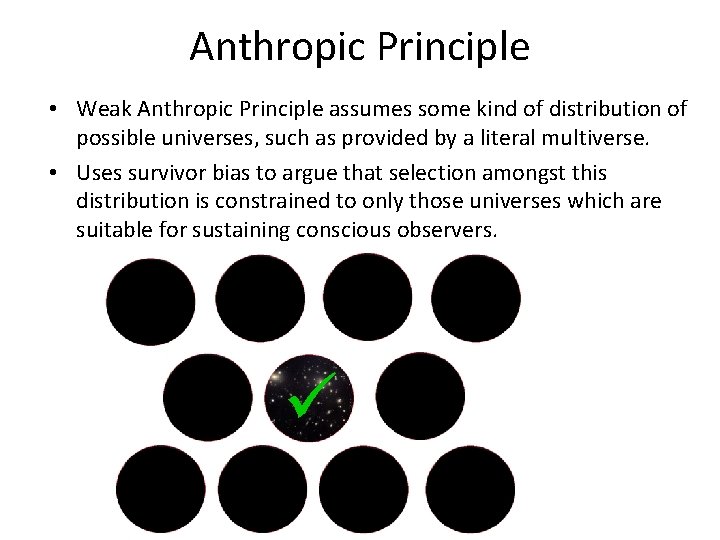
Anthropic Principle • Weak Anthropic Principle assumes some kind of distribution of possible universes, such as provided by a literal multiverse. • Uses survivor bias to argue that selection amongst this distribution is constrained to only those universes which are suitable for sustaining conscious observers.
One person’s opinion about possible ^ @aquinas_rs (slideshare. com)
God of the Gaps? Origin of life Consciousness Intelligibility of the universe Fine-tuning It is tempting for the religious believer to use the gaps in our scientific knowledge, the currently missing pieces of the jigsaw, as evidence for God.
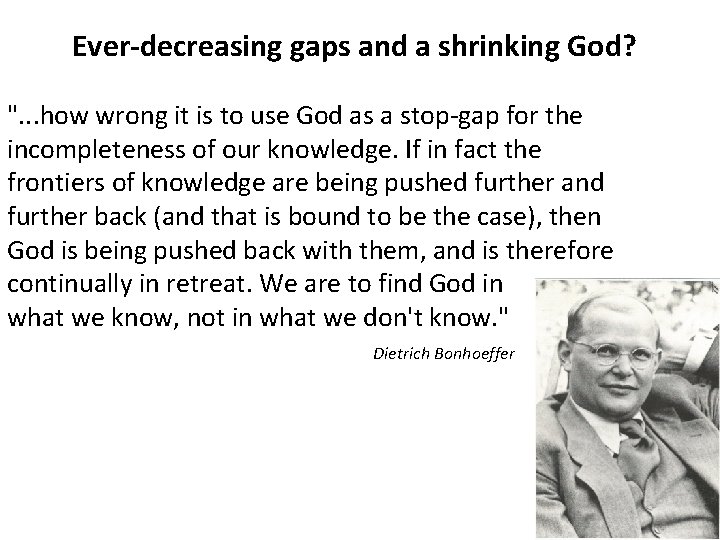
Ever-decreasing gaps and a shrinking God? ". . . how wrong it is to use God as a stop-gap for the incompleteness of our knowledge. If in fact the frontiers of knowledge are being pushed further and further back (and that is bound to be the case), then God is being pushed back with them, and is therefore continually in retreat. We are to find God in what we know, not in what we don't know. " Dietrich Bonhoeffer
Natural Theology • The interaction between religious and scientific ideas is still considered a sufficiently interesting and fruitful area that it generates numerous academic lectures and books. • The emphasis is usually on religion and science being compatible, rather than science proving (Intelligent Design) or disproving (New Atheism) the existence of God. “Either half my colleagues are enormously stupid, or else the science of Darwinism is fully compatible with conventional religious beliefs – and equally compatible with atheism. ” Stephen Jay Gould. “The Bible …. is not a science textbook, for which we should all be deeply grateful since science textbooks are generally hard work to read and quite dull! (Prof. Chris Done, Durham)”
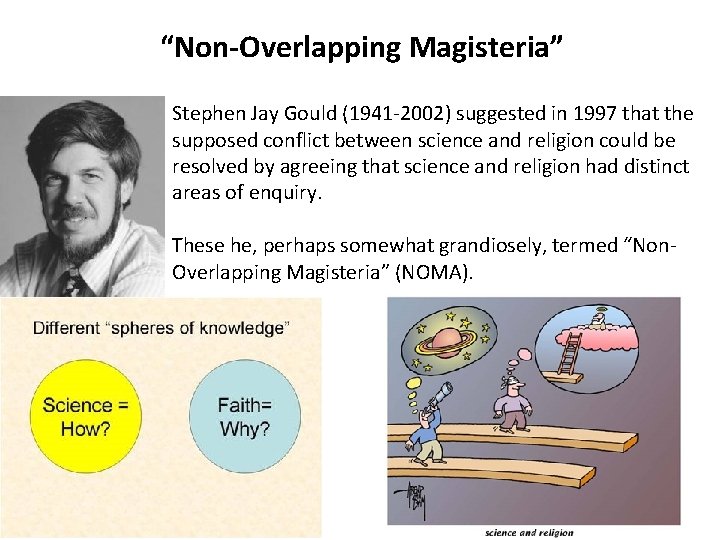
“Non-Overlapping Magisteria” Stephen Jay Gould (1941 -2002) suggested in 1997 that the supposed conflict between science and religion could be resolved by agreeing that science and religion had distinct areas of enquiry. These he, perhaps somewhat grandiosely, termed “Non. Overlapping Magisteria” (NOMA).
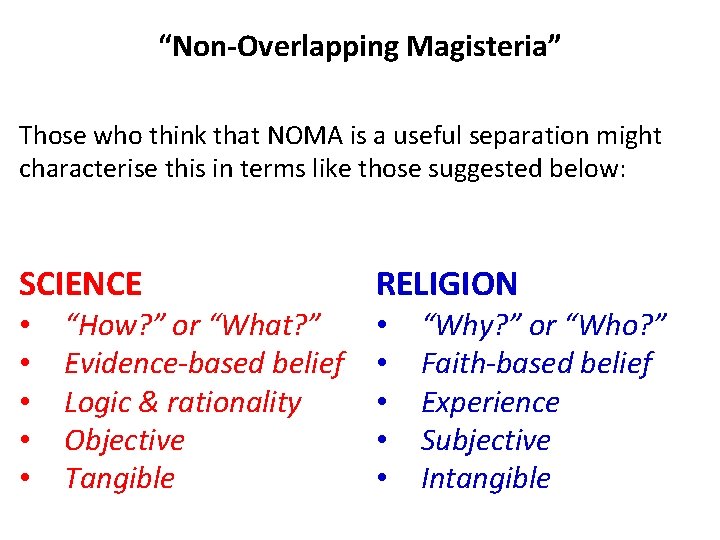
“Non-Overlapping Magisteria” Those who think that NOMA is a useful separation might characterise this in terms like those suggested below: SCIENCE RELIGION • • • “How? ” or “What? ” Evidence-based belief Logic & rationality Objective Tangible “Why? ” or “Who? ” Faith-based belief Experience Subjective Intangible
“Non-Overlapping Magisteria” However, are there some questions which seem to concern both science and religion, for example: Do we have free will? What is consciousness? What is morality and where does it come from? Are animals morally different from humans? Do humans have an intrinsic moral value? Could a computer be conscious and what moral status would self-aware AI have? • Is there a “me” distinct from my body? • Is there anything that exists outside this universe? • Origins (perhaps? ) … • • • If “magisteria” overlap in these areas, does NOMA need modification?
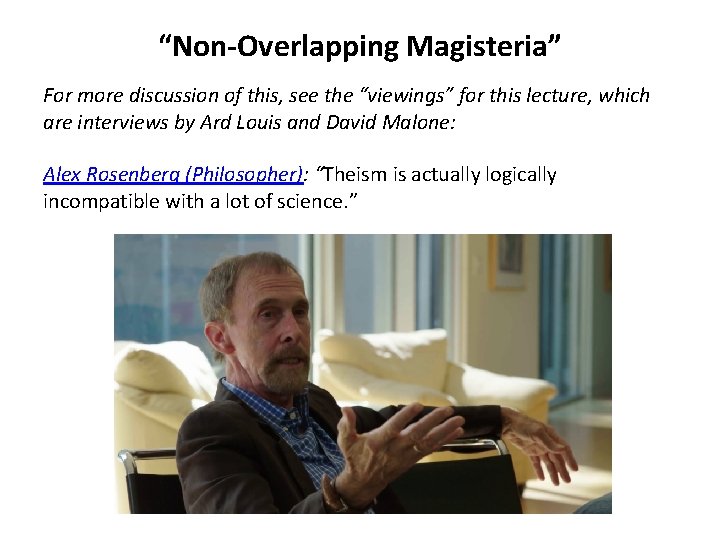
“Non-Overlapping Magisteria” For more discussion of this, see the “viewings” for this lecture, which are interviews by Ard Louis and David Malone: Alex Rosenberg (Philosopher): “Theism is actually logically incompatible with a lot of science. ”
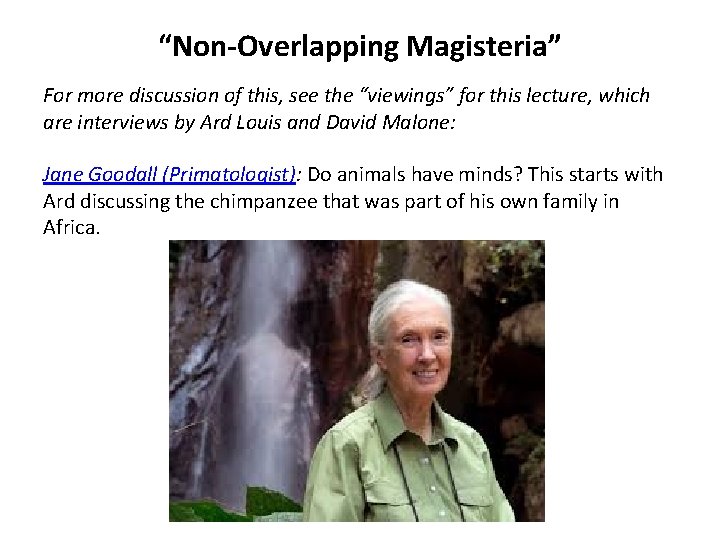
“Non-Overlapping Magisteria” For more discussion of this, see the “viewings” for this lecture, which are interviews by Ard Louis and David Malone: Jane Goodall (Primatologist): Do animals have minds? This starts with Ard discussing the chimpanzee that was part of his own family in Africa.
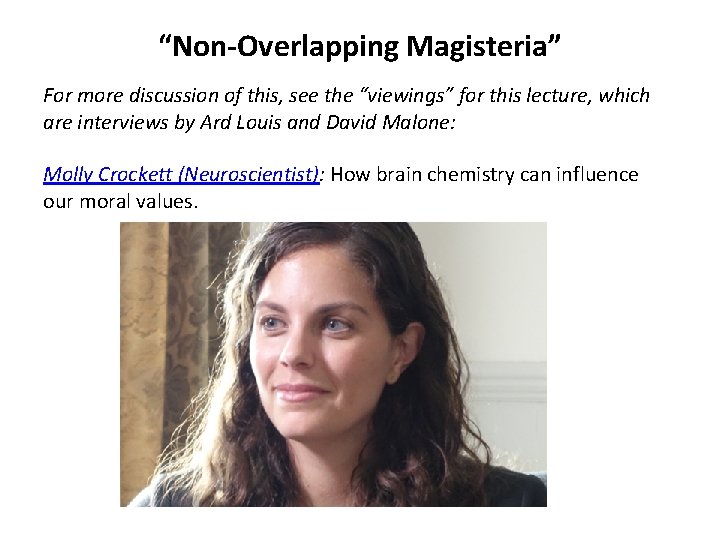
“Non-Overlapping Magisteria” For more discussion of this, see the “viewings” for this lecture, which are interviews by Ard Louis and David Malone: Molly Crockett (Neuroscientist): How brain chemistry can influence our moral values.
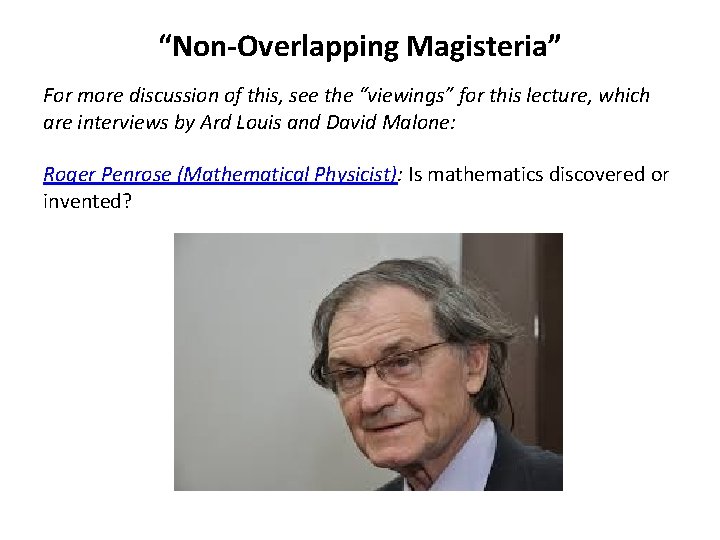
“Non-Overlapping Magisteria” For more discussion of this, see the “viewings” for this lecture, which are interviews by Ard Louis and David Malone: Roger Penrose (Mathematical Physicist): Is mathematics discovered or invented?
Scientific and Religious Belief: Summary 1 a. Fundamentalist beliefs are of course anti-scientific and, if we take science at all seriously, counterfactual. But they do not represent the views of reasonable, educated believers. 1 b. The “new atheism” is a less tolerant version of the old atheism, and could only have more explanatory power if the God hypothesis were scientifically testable. 2. Science has developed an impressive and predictive understanding of our world, an understanding that is independent of any particular religious or atheistic viewpoint. 3. Most thinkers doubt that the “God hypothesis” is a truly scientific hypothesis. 4. Intelligent Design and similar lines of thought are vulnerable to criticism as “God of the gaps” arguments. ID 1003 Dr John Mitchell jbom@st-andrews. ac. uk
Image Credits • http: //static. myfbcover. com/covers/Abstract_Bars. png • http: //kirche-in-menden. de/pics/Bonhoeffer 5. jpg • http: //1. bp. blogspot. com/-Rj. NNTFtuy 0 o/Ui. Xzj. QP 0 EWI/AAAACF 8/Mvrh 53 Aqy-g/s 1600/god_of_the_gaps_c_copy. jpg • http: //faradayschools. com/wp-content/uploads/god-of-the-gaps. jpg • https: //londonist. com/london/maps/an-illustrated-map-of-bridges-on-the-thames • http: //www. iscast. org/node/207 • http: //wp. patheos. com. s 3. amazonaws. com/blogs/nakedpastor/files/2012/04/iceburg. jpg • http: //www. iamwatch. net/files/upload/images/800 px-Zenith_pocket_watch_inside. S. jpg • http: //www. biblicalcreation. org/images/Mt. Rushmore. Cartoon. gif • http: //pandasthumb. org/outgroup. jpg • http: //www. ritholtz. com/blog/2012/02/founding-fathers-intelligent-design/ • http: //hanzgeier. files. wordpress. com/2013/05/morganfreemanspillergudibrucealmightyfra 2003. jpeg • http: //www. giffordlectures. org/archway. gif • http: //www. jamesgregory. org. uk/ • http: //ec. l. thumbs. canstockphoto. com/canstock 3395500. jpg • http: //mikefarmer. edublogs. org/files/2012/11/popper-2 i 5 ghrh. jpg • http: //2. bp. blogspot. com/-379 Ji 0 Us. YMw/Uu. FC 62 C 4_UI/AAAAAYI/ncwr. HC 5 Y 2 q. Q/s 1600/Textura+(20). jpg • https: //simple. wikipedia. org/wiki/File: Circle_-_black_simple. svg • http: //pixhost. me/avaxhome/06/5 b/00095 b 06_medium. jpeg • http: //www. skeptic. com/eskeptic/09 -06 -24 images/alien-at-computer-banner. jpg • https: //commons. wikimedia. org/wiki/File: Pierre-Simon_Laplace. jpg • http: //g-ecx. images-amazon. com/images/G/01/ciu/d 2/55/06 aea 15 f 66930 a 7 f 023574. L. _V 146190888_SY 470_. jpg • http: //www. veritas. org/Uploads/Presenter. Pictures/344. jpg
• https: //en. wikipedia. org/wiki/File: Stephen_Jay_Gould_2015, _portrait_(unknown_date). jpg • http: //www. wychwoodcircle. org/2013/04/ • http: //www. networknorwich. co. uk/Images/content/213/424988. jpg • https: //i. ytimg. com/vi/b. THz. B 4 h 0 po 4/maxresdefault. jpg • https: //www. youtube. com/watch? v=ai. CUn. Vt. CHk 4 • https: //www. littlebrown. co. uk/assets/Little. Brown. Book. Group/img/book/738/isbn 9780465036738. jpg • https: //img 00. deviantart. net/6 af 8/i/2013/072/0/a/martin_rees_six_numbers_by_yathish-d 5 xw 7 ya. jpg • https: //en. wikipedia. org/wiki/Deferent_and_epicycle#/media/File: Cassini_apparent. jpg • https: //www. safalniveshak. com/wp-content/uploads/2015/04/occam_razor. png • https: //usatftw. files. wordpress. com/2018/02/ap_spacex_new_rocket_97189852. jpg • http: //siennaartstudios. com/shop/grand-unified-theory • https: //radiofreethinker. files. wordpress. com/2013/07/blownout_candle. jpg • http: //www. clipartguide. com/_named_clipart_images/0511 -1003 -1504 -0041_Pretty_Woman_Sleeping_in_Pink_Sheets_clipart_image. jpg • https: //www. express. co. uk/news/science/818018/what-came-before-the-Big-Bang-multiverse-inflation • https: //en. wikipedia. org/wiki/File: Spacetime_dimensionality. svg • https: //image. slidesharecdn. com/lesson 8 -teleologicalargumentanthropicprinciple-130416085735 -phpapp 01/ • https: //www. whyarewehere. tv/media/1393/molly-crockett-portrait-phtograph. png • https: //encrypted-tbn 0. gstatic. com/images? q=tbn: ANd 9 Gc. T 6 j. Az 0 Jnr. HYmv. BPJgze. MIyi. UOjc. Zn. KAppcx. R_z 0 J-l. NPl 0 a. Ie 6 • https: //i. ytimg. com/vi/09 -H 2 u. PEac. I/maxresdefault. jpg