
3 Interlanguage Rod Ellis page 31 Novita Arum




- Slides: 17
3. Interlanguage Rod Ellis (page 31) Novita Arum Sari 2201410104
Interlanguage 1. Behaviorist learning theory 2. A mentalist theory of language learning 3. What is interlanguage 4. A computational model of L 2 acquisition
Behaviorist Learning Theory According to this theory, language learning is like any other kind of learning in that involves habit information. Habits are formed when learners respond to stimuli in the environment and subsequently have their responses reinforced so that they are remembered.
A habit stimulus response connection Learning>> practice making response to a given stimulus correct Learners imitated models of correct language and receive positive reinforcement if they were correct and negative reinforcement if they incorrect.
Learners frequently do not produce output that simply reproduces the input. ERRORS>> actively involved in constructing their own ‘rule’ (little resemblance to the patterns of language modeled in the input. In short, learning is not just a response to external stimuli.
A mentalist theory of language learning In the 1960 s and 1970 s a mentalist theory of first language acquisition emerged. According to this theory; 1. only human being are capable of learning language. 2. the human mind is equipped with a faculty for learning language, referred to as a Language Acquisition Devise.
3. this faculty is the primary determinant of language acquisition. 4. input is needed, but only to ‘trigger’ the operation of the language acquisition device. The concept of interlanguage drew directly on these mentalist views of L 1 acquisition.
What is interlanguage? ‘interlanguage’>> Selinker) ; American linguist (Larry “ L 2 learners construct a linguistic system that draws, in part, on the learner’s L 1 but is also different from it and also from the target language. ” A learners interlanguage is, therefore, a unique linguistic system.
The concept of interlanguage involves the following premises about L 2 acquisition; 1. The learner constructs a system of abstract linguistic rules which underlies comprehension and production of the L 2. this system of rules is viewed as a ‘mental grammar’ and is referred to as an ‘interlanguage’.
2. The learners’ grammar is permeable. Grammar is open to influence from the outside, it is also influenced from the inside. 3. The learners’ grammar is transitional. learners change their grammar from one time to another by adding rules, deleting rules, and restructuring the whole system. This results in an interlanguage continuum.
4. Some researchers have claimed that the systems learners construct contain variable rules. 5. Learners employ various learning strategies to develop their interlanguage. 6. The learner’s grammar is likely to fossilized. Fossilization does not occur in L 1 acquisition and thus is unique to L 2 grammars.
The concept of interlanguage offers a general account of how L 2 acquisition take place. It incorporates elements from mentalist theories of linguistics and elements of cognitive psychology.
A computational model of L 2 acquisition q Interlanguage =metaphor of how L 2 acquisition takes place. q. Human mind = Computer
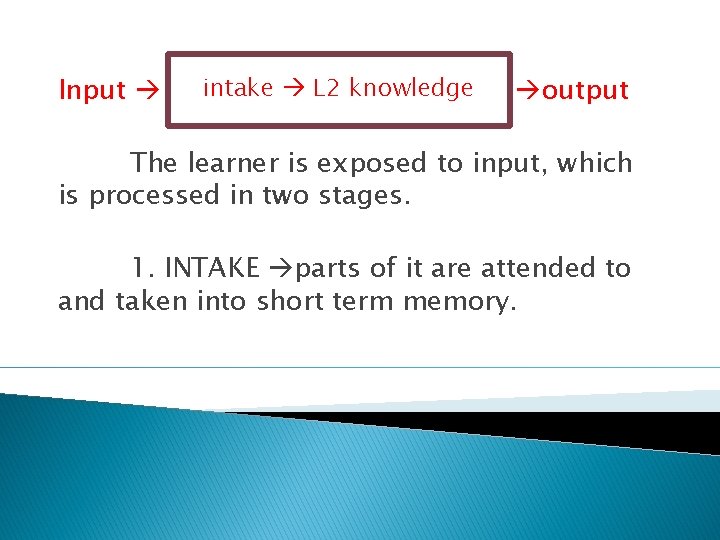
Input intake L 2 knowledge output The learner is exposed to input, which is processed in two stages. 1. INTAKE parts of it are attended to and taken into short term memory.
2. KNOWLEDGE intake is stored in longterm memory. PROCESS responsible for creating intake and knowledge occur within the ‘black box’ of the learner’s mind where the learner’s interlanguage is constructed.
The ‘L 2 knowledge’ component can be broken up into two or more components to reflect the different kind of knowledge learner construct (example; explicit and implicit knowledge about language). An arrow can be drawn from ‘output’ to input to show that what a learner says or writes can also serve as samples of language from which intake can be derived.
THANKS