
3 Hemorrhage Is extravasations of blood from vessels
3. Hemorrhage Is extravasations of blood from vessels into the extravascular space - Rupture of a large artery or vein results in severe hemorrhage, and is almost always due to vascular injury, including -

a. Trauma, b. Atherosclerosis, or C. Inflammatory or neoplastic erosion of the vessel wall
§ Hemorrhage can be external or Can be confined within a tissue; referred to as hematoma - Hematoma can be relatively insignificant called bruise or may lead to death such as retroperitoneal hematoma
§ Petechiae are (1 - to 2 -mm) hemorrhages into skin or, mucous membranes, and are typically associated with a. locally increased intravascular pressure, b. low platelet counts (thrombocytopenia), c. Defective platelet function c. clotting factor deficiencies
§ Purpura: - (3 - to 5 -mm) hemorrhages - And can be associated with many of the same disorders that cause petechiae; - In addition, purpura can occur with trauma, vascular inflammation (vasculitis),
§ Ecchymoses: - Are (1 - to 2 -cm) subcutaneous hemorrhages - Erythrocytes in these local hemorrhages are phagocytosed and degraded by macrophages - The hemoglobin (red-blue )color is enzymatically converted into bilirubin (blue-green )color and eventually into
§ Large accumulations of blood in one or another of the body cavities are called hemothorax, hemopericardium, hemoperitoneum, or hemarthrosis (in joints). § Patients with extensive hemorrhages occasionally develop jaundice from the massive breakdown of red blood cells and systemic increases in bilirubin
§ The clinical significance of haemorrhage depends on the volume , rate of blood loss and site of hemorrhage. 1. Rapid removal of as much as 20% of the blood volume or slow losses of even larger amounts may have little impact in healthy adults; - Greater losses, however, can cause hemorrhagic (hypovolemic) shock.

2. The site of hemorrhage is also important; bleeding that would be not significant in the subcutaneous tissues may cause death if located in the brain 3. Chronic or recurrent external blood loss (e. g. , a peptic ulcer or menstrual bleeding) causes a net loss of iron, frequently culminating in an iron deficiency anemia

4. THROMBOSIS • Pathogenesis Virchow Triad 1. Endothelial Injury 2. Stasis 3. Blood Hypercoagulability
1. Endothelial injury - This is the dominant influence since endothelial loss by itself can lead to thrombosis - It is particularly important for thrombus formation in the heart or in the arterial circulation

Causes 1. Valvulitis 2. Myocardial infarction 3. Ulcerated plaques of atherosclerosis 4. Traumatic or inflammatory conditions
5. Endotoxins 6. Hypercholesterolemia 7. Radiation 8. Smoking 9. High blood pressure
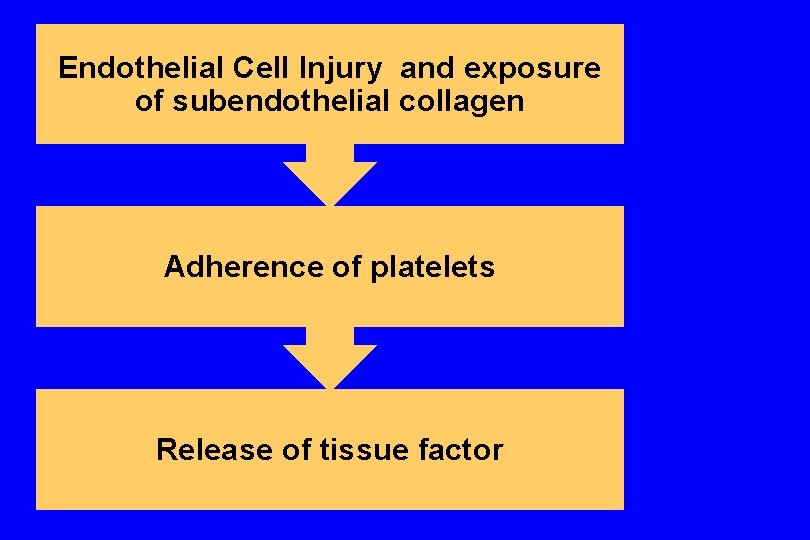
Endothelial Cell Injury and exposure of subendothelial collagen Adherence of platelets Release of tissue factor
It is important to note that endothelium need not to be denuded or physically disrupted to contribute to the development of thrombosis - Any disturbance in the dynamic balance of prothrombotic and antithrombotic properties of endothelium can influence local clotting events -
Thus dysfunctional endothelium a. May elaborate greater amounts of procoagulant factors such as platelet adhesion molecules, or tissue factor b, . Or synthesize fewer anti-coagulant effectors such as thrombomodulin or PGI 2 -
- Endothelial dysfunction without endothelial loss occurs due to 1. Hypertension 2. Bacterial endotoxins 3. Hypercholesterolemia 4. Products absorbed from cigarette smoke
2. Alteration in normal blood flow (turbulence) - Turbulence contributes to arterial and cardiac thrombosis by a. Causing endothelial dysfunction b. Local pockets of stasis
- Stasis is a major factor in venous thrombi • Disrupt laminas flow - Normal Blood flow is laminas Stasis • Prevent dilution of activated clotting factors by fresh flowing blood. • Retard the inflow of clotting factor inhibitors • Promote endothelial cell.
• Causes of Stasis 1. Aneurysms 2. Acute Myocardial infarction (MI ) ( Noncontractile fibers) 3. Remote myocardial infarction may cause cardiac aneurysms resulting in stasis 3. Mitral valve stenosis (atrial dilation) 5. Hyperviscosity syndrome
3. Hypercoagulability: - Alteration of the coagulation pathway - Generally contributes less frequently to thrombotic states A. Primary (Genetic) 1. Factor V mutation ( Leiden mutation) - The mutation results in a factor Va that cannot be cleaved and inactivated by protein C
2. Prothrombin mutation: - A type of mutation in prothrombin results in increased transcription of prothrombin and causes threefold increased risk of venous thrombi 3. Antithrombin 3 Deficiency 4. Protein C deficiency 5. Protein S deficiency
• Secondary ( Acquired) - Pathogenesis is multifactorial and more complicated A. High Risk for thrombosis 1 - Prolonged bed rest or Immobilization 2 - Myocardial infarction complicated by cardiac failure 3 - Tissue damage (surgery, fracture, burns) 4 - Cancer: Release of procagulant
5. Lupus anticoagulant: Antiphospholipid antibody syndrome - Characterized by 1. Recurrent thrombosis 2. Recurrent abortions 3. Cardiac valve vegetations 4. Thrombocytopenia
- Associated with autoantibodies directed against anionic phospholipids (cardiolipin ) - In vivo these antibodies induce hypercagulability by inducing direct platelet activation or interference with production of PGI 2 from endothelium
• Primary antiphospholipid antibody syndrome----no associated autoimmune disease • Secondary antiphospholipid antibody syndrome---patients have autoimmune diseases such as systemic lupus erythematosis
B. Low Risk for thrombosis 1. Hyperestrogenic states such as pregnancy and Oral contraceptive pills that cause Increase Synthesis of coagulation factors) and decreases synthesis of Decrease synthesis of antithrombin 3 2. Aging: Increase platelets aggregation and Decrease PGI 2 release by endothelium.
- Slides: 27