
3 Giant Magnetoresistance Experimentally Driven 1986 1989 Theoretically
![#3] Giant Magnetoresistance: Experimentally Driven 1986 -1989; Theoretically Modeled 1989; IT Applications into 1990’s](https://slidetodoc.com/presentation_image_h/906bea232785721bf04efc0acec087ea/image-2.jpg "#3] Giant Magnetoresistance: Experimentally Driven 1986 -1989; Theoretically Modeled 1989; IT Applications into 1990’s")


![Application of GMR: Magnetic field sensor Example of a real layer structure [1]: NAF](https://slidetodoc.com/presentation_image_h/906bea232785721bf04efc0acec087ea/image-27.jpg "Application of GMR: Magnetic field sensor Example of a real layer structure [1]: NAF")
- Slides: 55
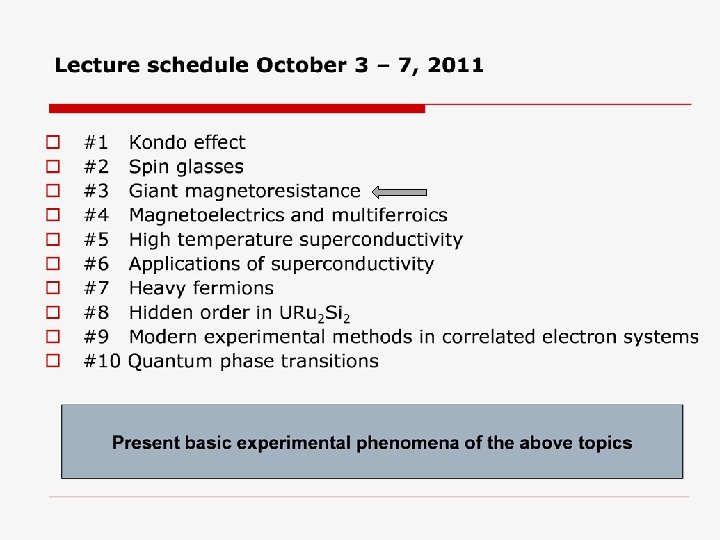
#3] Giant Magnetoresistance: Experimentally Driven 1986 -1989; Theoretically Modeled 1989; IT Applications into 1990’s First Commerical Hard-Disks with GMR Sensors (IBM) 1998 Effect parallel / antiparallel thin magnetic films separated by nonmagnetic spacer Nobel Prize in Physics 2007: ‘‘Discovery of GMR’’ Basic physics involved Divice applications – computers hard disks Beyond the GMR Film from Juelich
1988: … simultaneously, but independent … “Does the electrical resistance depend on the magnetization alignment? ” Albert Fert Peter Grünberg
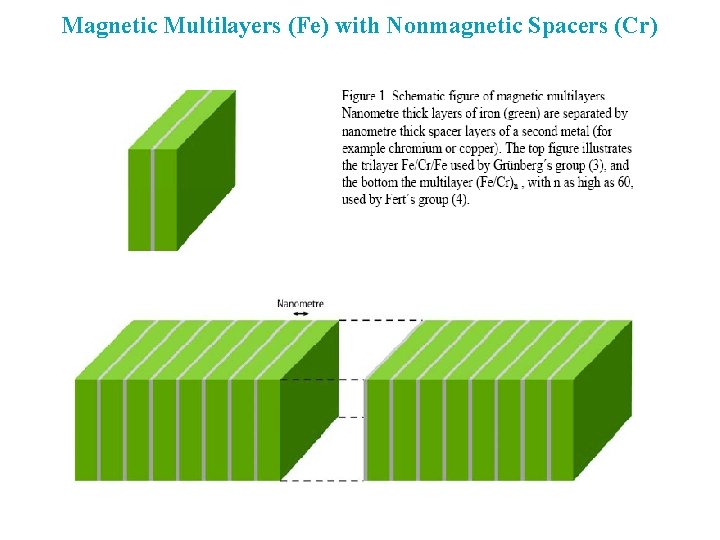
Magnetic Multilayers (Fe) with Nonmagnetic Spacers (Cr)
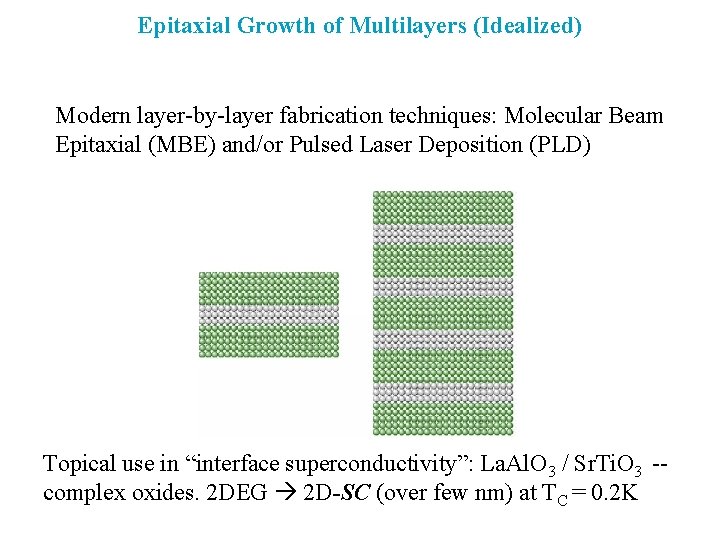
Epitaxial Growth of Multilayers (Idealized) Modern layer-by-layer fabrication techniques: Molecular Beam Epitaxial (MBE) and/or Pulsed Laser Deposition (PLD) Topical use in “interface superconductivity”: La. Al. O 3 / Sr. Ti. O 3 -complex oxides. 2 DEG 2 D-SC (over few nm) at TC = 0. 2 K
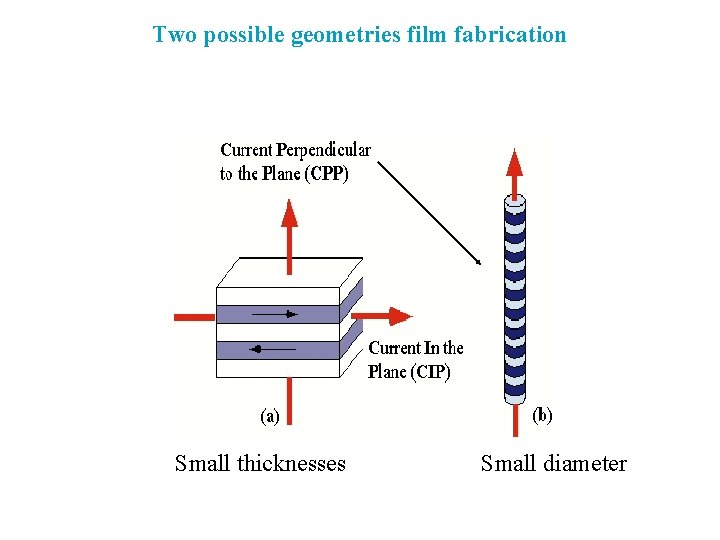
Two possible geometries film fabrication Small thicknesses Small diameter
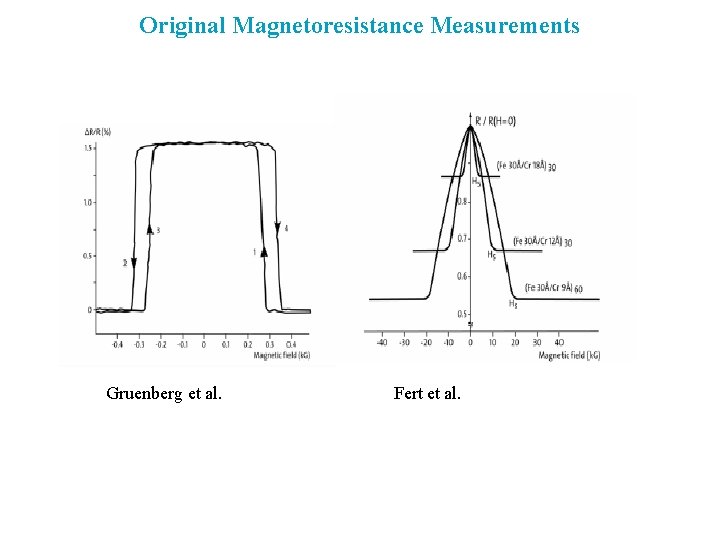
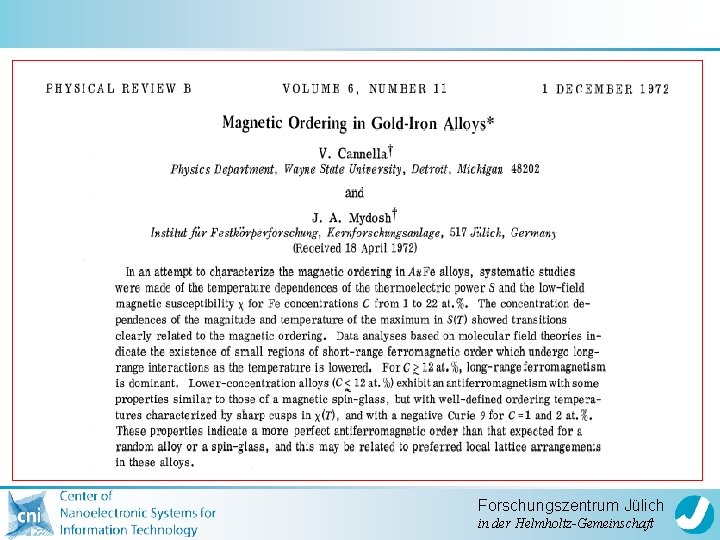
Original Magnetoresistance Measurements Gruenberg et al. Fert et al.
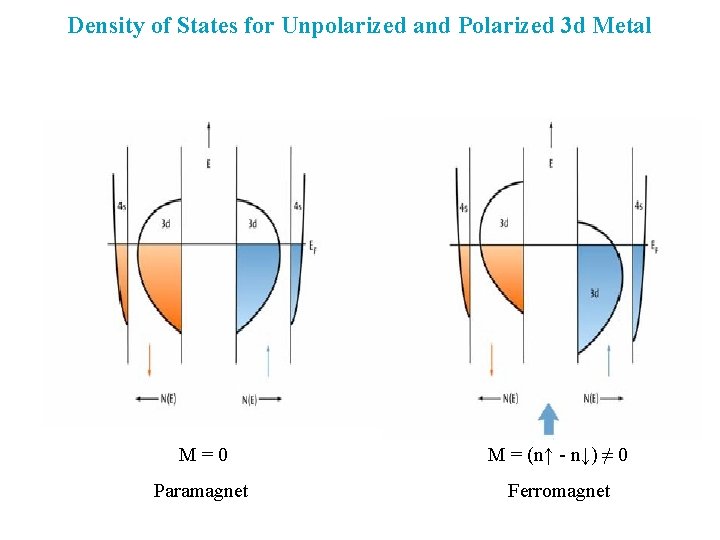
Density of States for Unpolarized and Polarized 3 d Metal M=0 M = (n↑ - n↓) ≠ 0 Paramagnet Ferromagnet
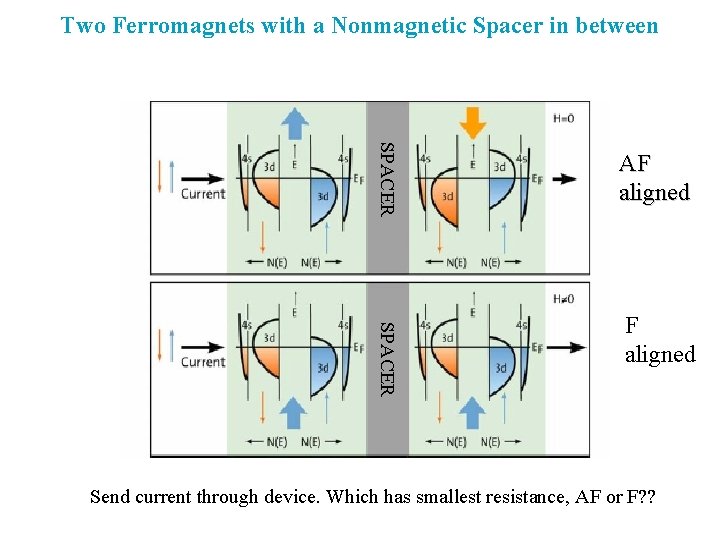
Two Ferromagnets with a Nonmagnetic Spacer in between SPACER AF aligned SPACER F aligned Send current through device. Which has smallest resistance, AF or F? ?
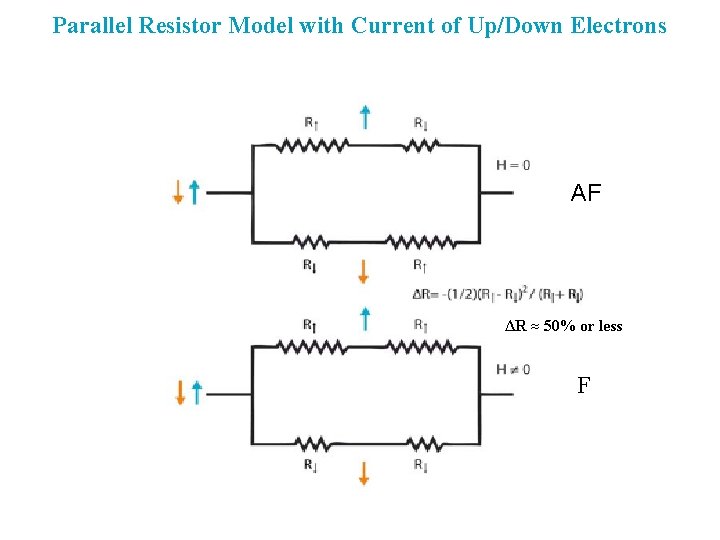
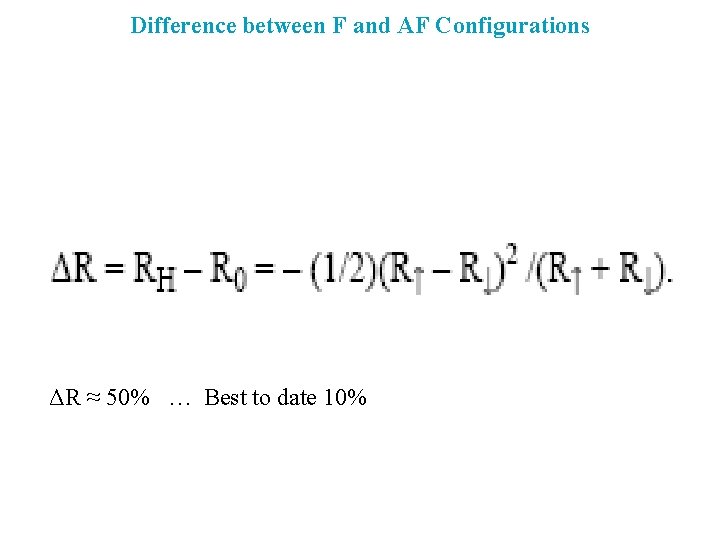
Parallel Resistor Model with Current of Up/Down Electrons AF ΔR ≈ 50% or less F
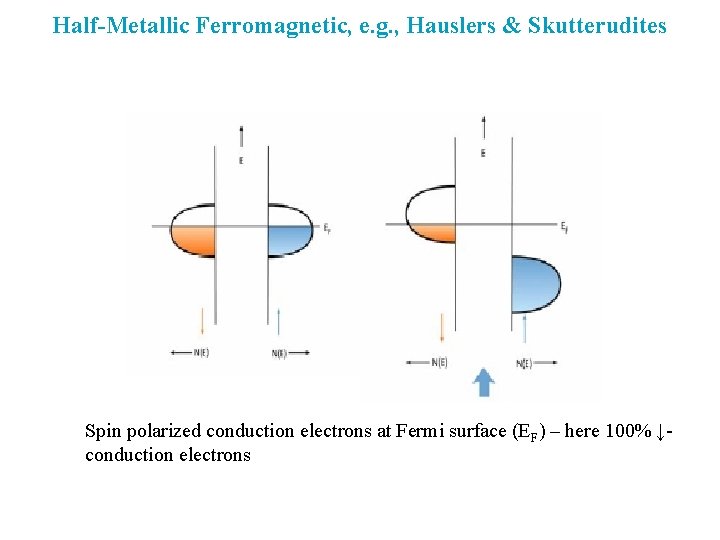
Half-Metallic Ferromagnetic, e. g. , Hauslers & Skutterudites Spin polarized conduction electrons at Fermi surface (EF) – here 100% ↓conduction electrons
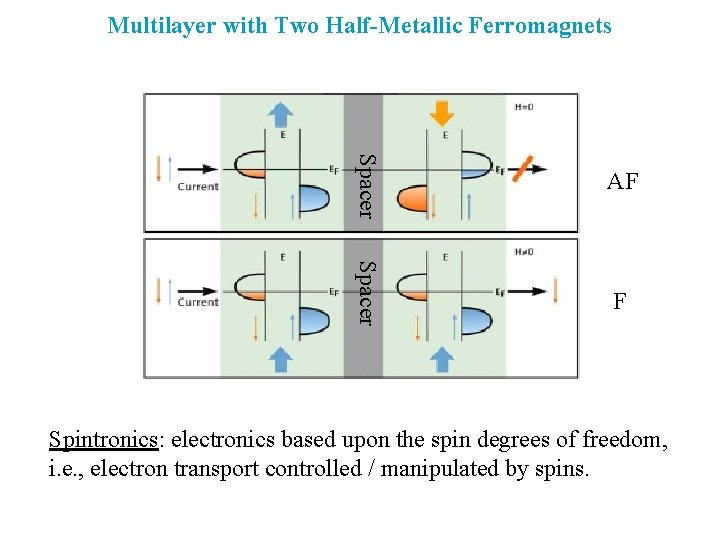
Multilayer with Two Half-Metallic Ferromagnets Spacer AF Spacer F Spintronics: electronics based upon the spin degrees of freedom, i. e. , electron transport controlled / manipulated by spins.
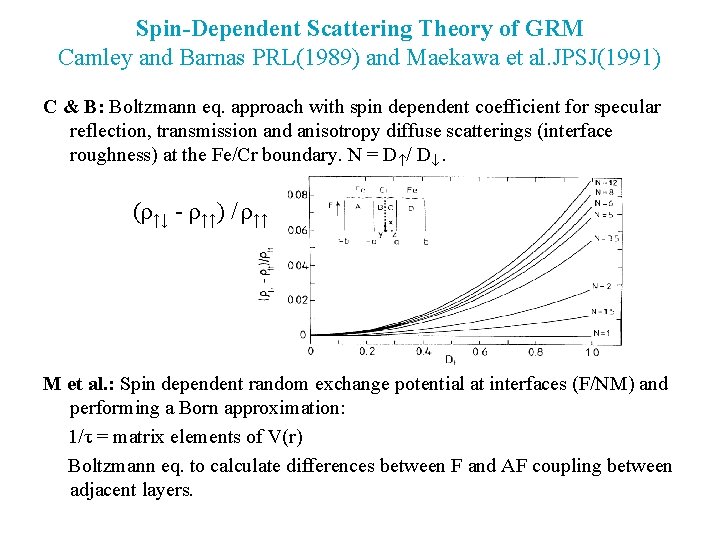
Spin-Dependent Scattering Theory of GRM Camley and Barnas PRL(1989) and Maekawa et al. JPSJ(1991) C & B: Boltzmann eq. approach with spin dependent coefficient for specular reflection, transmission and anisotropy diffuse scatterings (interface roughness) at the Fe/Cr boundary. N = D / D . (ρ↑↓ - ρ↑↑) / ρ↑↑ M et al. : Spin dependent random exchange potential at interfaces (F/NM) and performing a Born approximation: 1/τ = matrix elements of V(r) Boltzmann eq. to calculate differences between F and AF coupling between adjacent layers.
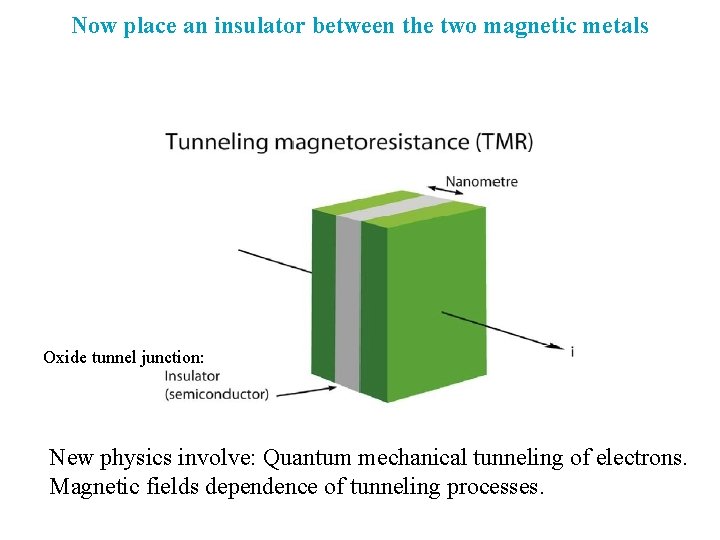
Now place an insulator between the two magnetic metals Oxide tunnel junction: New physics involve: Quantum mechanical tunneling of electrons. Magnetic fields dependence of tunneling processes.
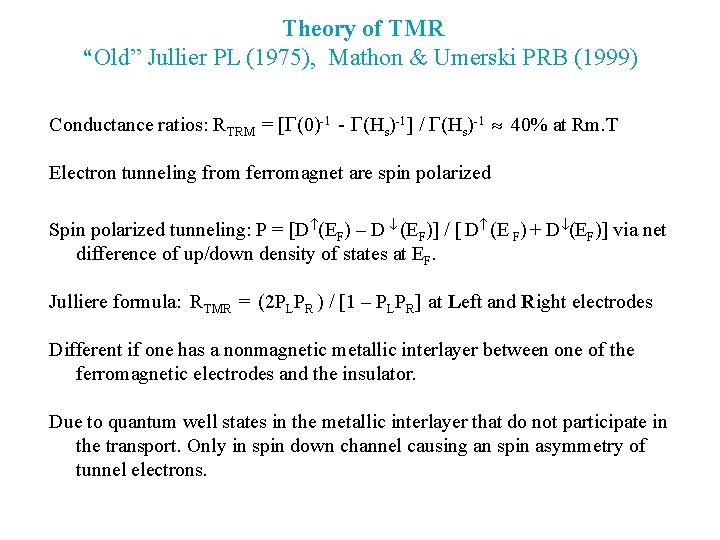
Theory of TMR “Old” Jullier PL (1975), Mathon & Umerski PRB (1999) Conductance ratios: RTRM = [ (0)-1 - (Hs)-1] / (Hs)-1 40% at Rm. T Electron tunneling from ferromagnet are spin polarized Spin polarized tunneling: P = [D (EF) – D (EF)] / [ D (E F) + D (EF)] via net difference of up/down density of states at EF. Julliere formula: RTMR = (2 PLPR ) / [1 – PLPR] at Left and Right electrodes Different if one has a nonmagnetic metallic interlayer between one of the ferromagnetic electrodes and the insulator. Due to quantum well states in the metallic interlayer that do not participate in the transport. Only in spin down channel causing an spin asymmetry of tunnel electrons.
IN RESERVE to Juelich CARTOONS Film from Jülich at time of Noble Prize ?
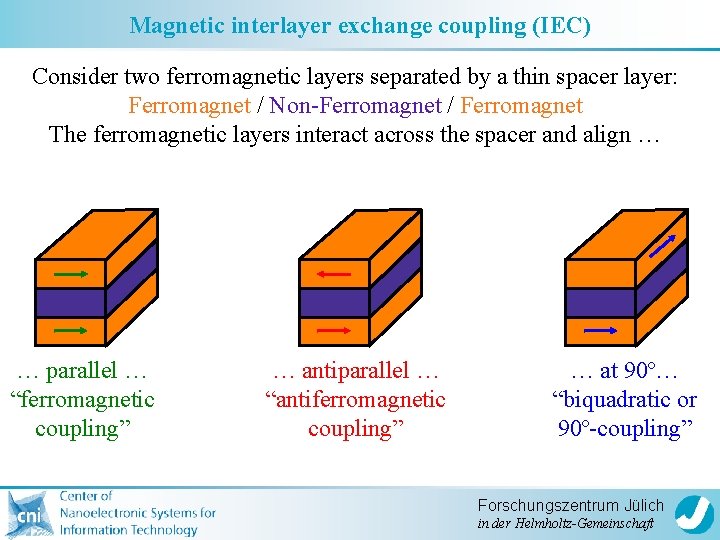
Magnetic interlayer exchange coupling (IEC) Consider two ferromagnetic layers separated by a thin spacer layer: Ferromagnet / Non-Ferromagnet / Ferromagnet The ferromagnetic layers interact across the spacer and align … … parallel … “ferromagnetic coupling” … antiparallel … “antiferromagnetic coupling” … at 90º… “biquadratic or 90º-coupling” Forschungszentrum Jülich in der Helmholtz-Gemeinschaft
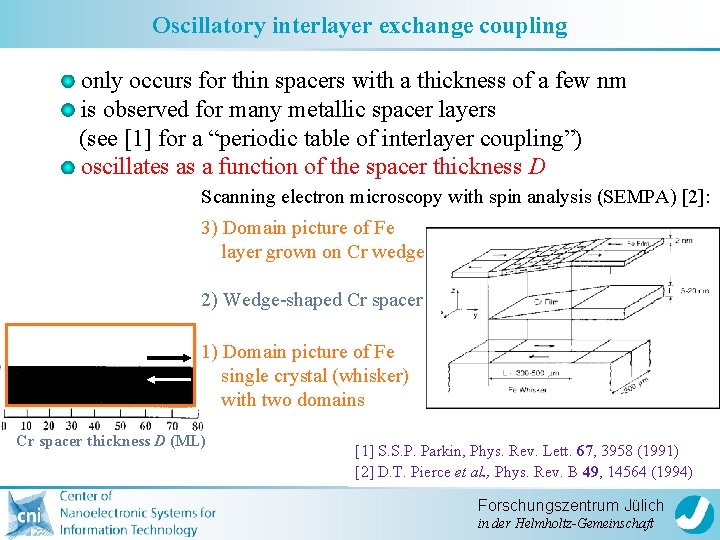
Oscillatory interlayer exchange coupling only occurs for thin spacers with a thickness of a few nm is observed for many metallic spacer layers (see [1] for a “periodic table of interlayer coupling”) oscillates as a function of the spacer thickness D Scanning electron microscopy with spin analysis (SEMPA) [2]: 3) Domain picture of Fe layer grown on Cr wedge 2) Wedge-shaped Cr spacer 1) Domain picture of Fe single crystal (whisker) with two domains Cr spacer thickness D (ML) [1] S. S. P. Parkin, Phys. Rev. Lett. 67, 3958 (1991) [2] D. T. Pierce et al. , Phys. Rev. B 49, 14564 (1994) Forschungszentrum Jülich in der Helmholtz-Gemeinschaft
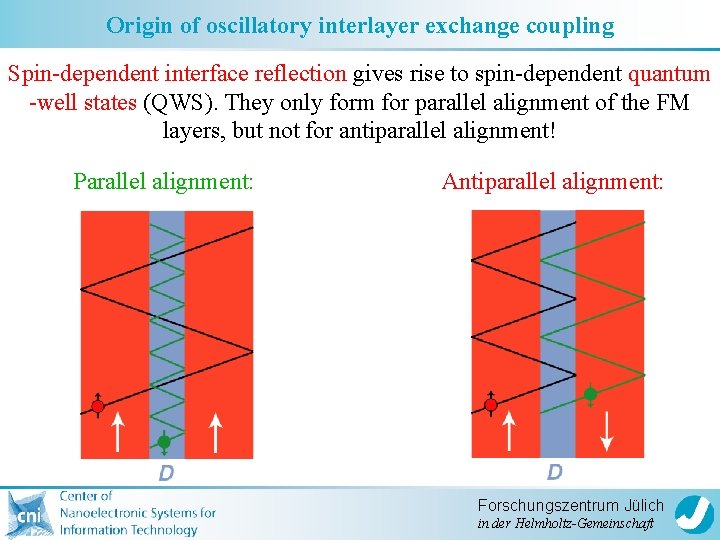
Origin of oscillatory interlayer exchange coupling Spin-dependent interface reflection gives rise to spin-dependent quantum -well states (QWS). They only form for parallel alignment of the FM layers, but not for antiparallel alignment! Parallel alignment: Antiparallel alignment: Forschungszentrum Jülich in der Helmholtz-Gemeinschaft
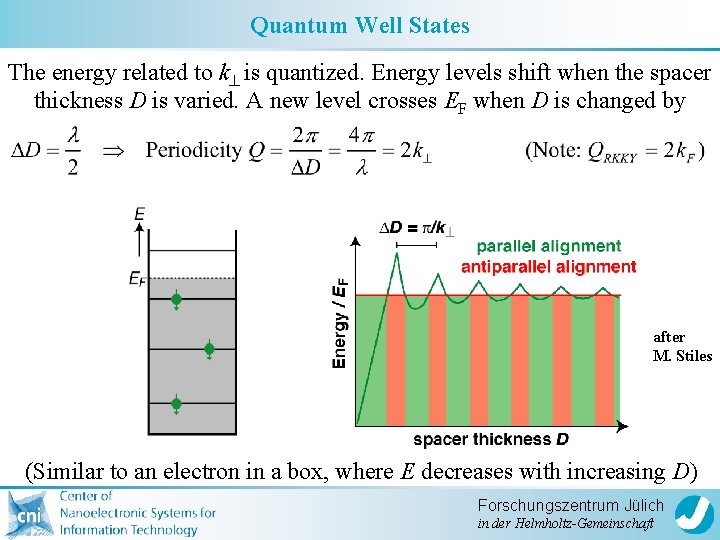
Quantum Well States The energy related to k is quantized. Energy levels shift when the spacer thickness D is varied. A new level crosses EF when D is changed by after M. Stiles (Similar to an electron in a box, where E decreases with increasing D) Forschungszentrum Jülich in der Helmholtz-Gemeinschaft
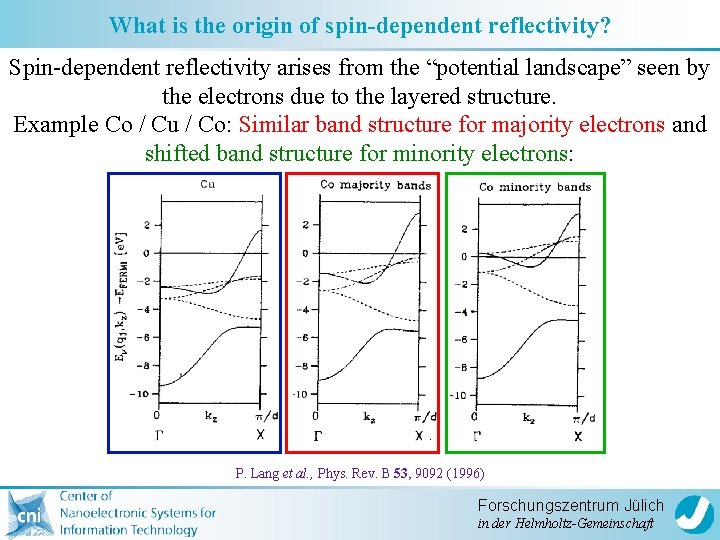
What is the origin of spin-dependent reflectivity? Spin-dependent reflectivity arises from the “potential landscape” seen by the electrons due to the layered structure. Example Co / Cu / Co: Similar band structure for majority electrons and shifted band structure for minority electrons: P. Lang et al. , Phys. Rev. B 53, 9092 (1996) Forschungszentrum Jülich in der Helmholtz-Gemeinschaft
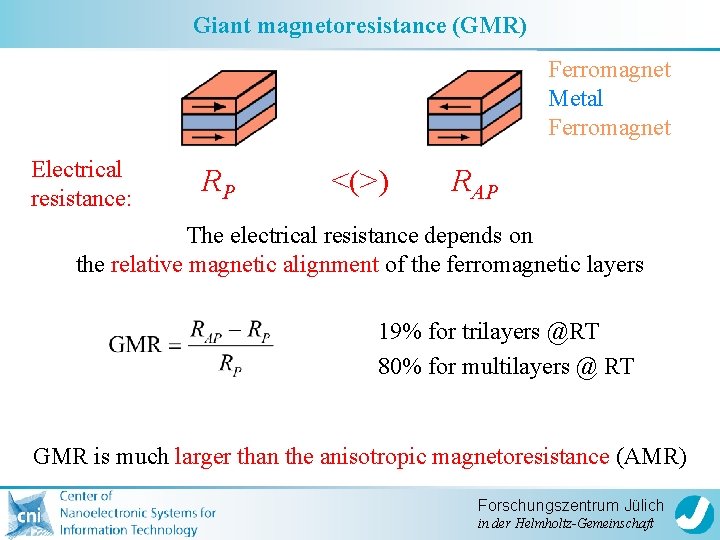
Giant magnetoresistance (GMR) Ferromagnet Metal Ferromagnet Electrical resistance: RP <(>) RAP The electrical resistance depends on the relative magnetic alignment of the ferromagnetic layers 19% for trilayers @RT 80% for multilayers @ RT GMR is much larger than the anisotropic magnetoresistance (AMR) Forschungszentrum Jülich in der Helmholtz-Gemeinschaft
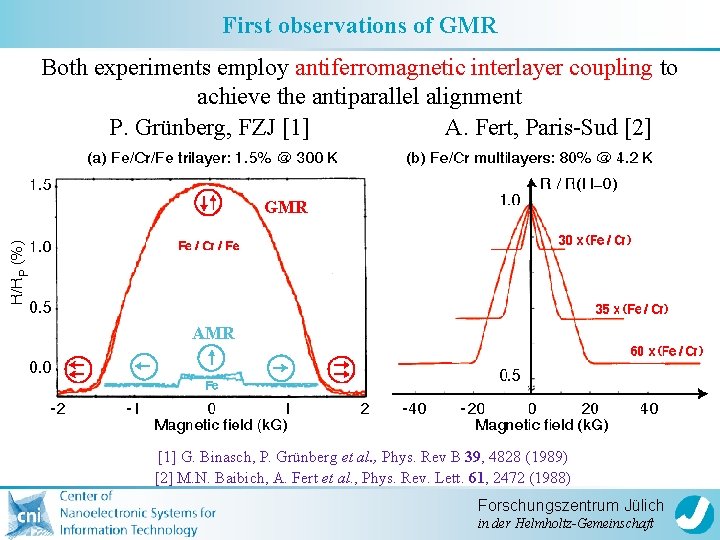
First observations of GMR Both experiments employ antiferromagnetic interlayer coupling to achieve the antiparallel alignment P. Grünberg, FZJ [1] A. Fert, Paris-Sud [2] GMR AMR [1] G. Binasch, P. Grünberg et al. , Phys. Rev B 39, 4828 (1989) [2] M. N. Baibich, A. Fert et al. , Phys. Rev. Lett. 61, 2472 (1988) Forschungszentrum Jülich in der Helmholtz-Gemeinschaft
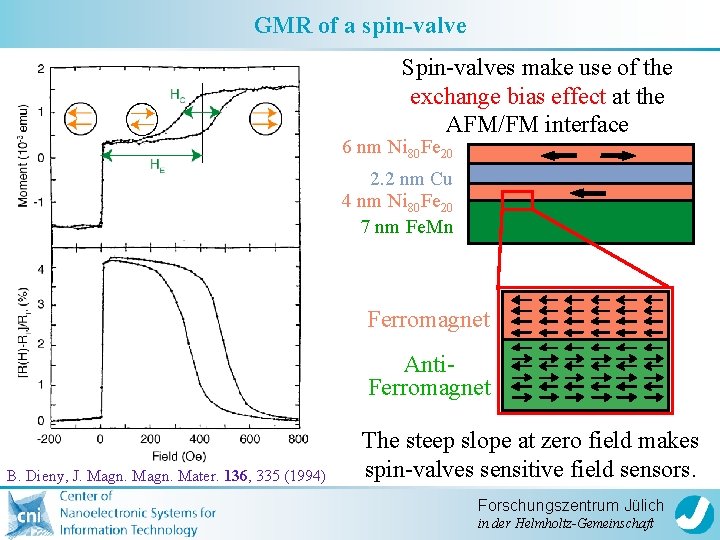
GMR of a spin-valve Spin-valves make use of the exchange bias effect at the AFM/FM interface 6 nm Ni 80 Fe 20 2. 2 nm Cu 4 nm Ni 80 Fe 20 7 nm Fe. Mn CIP-geometry Ferromagnet Anti. Ferromagnet B. Dieny, J. Magn. Mater. 136, 335 (1994) The steep slope at zero field makes spin-valves sensitive field sensors. Forschungszentrum Jülich in der Helmholtz-Gemeinschaft
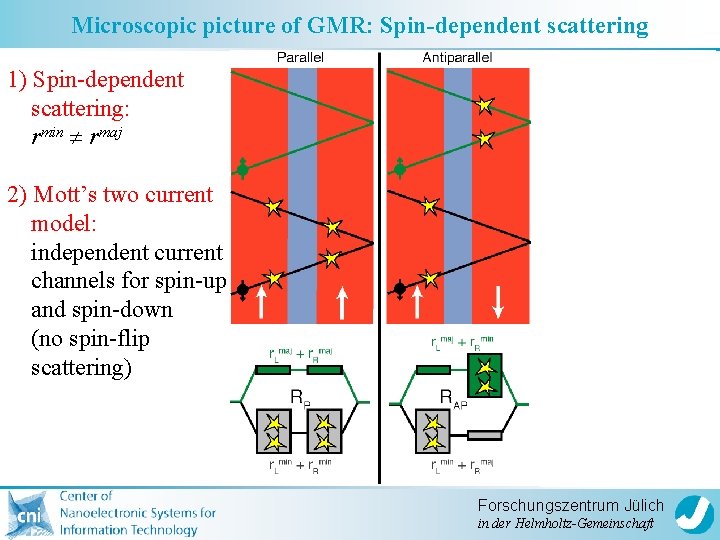
Microscopic picture of GMR: Spin-dependent scattering 1) Spin-dependent scattering: rmin rmaj 2) Mott’s two current model: independent current channels for spin-up and spin-down (no spin-flip scattering) Forschungszentrum Jülich in der Helmholtz-Gemeinschaft
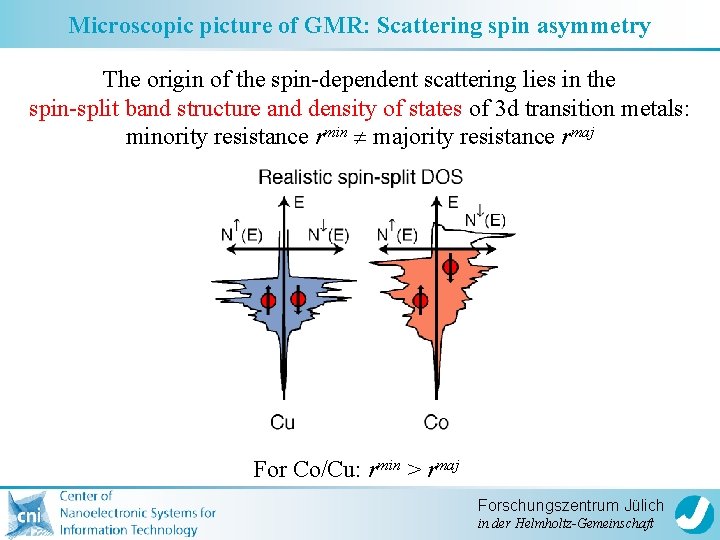
Microscopic picture of GMR: Scattering spin asymmetry The origin of the spin-dependent scattering lies in the spin-split band structure and density of states of 3 d transition metals: minority resistance rmin majority resistance rmaj For Co/Cu: rmin > rmaj Forschungszentrum Jülich in der Helmholtz-Gemeinschaft
Application of GMR: Magnetic field sensor Example of a real layer structure [1]: NAF = natural antiferromagnet, SAF = synthetic antiferromagnet [1] K. M. H. Lenssen et al. , J. Appl. Phys. 85, 5531 (1999) Forschungszentrum Jülich in der Helmholtz-Gemeinschaft
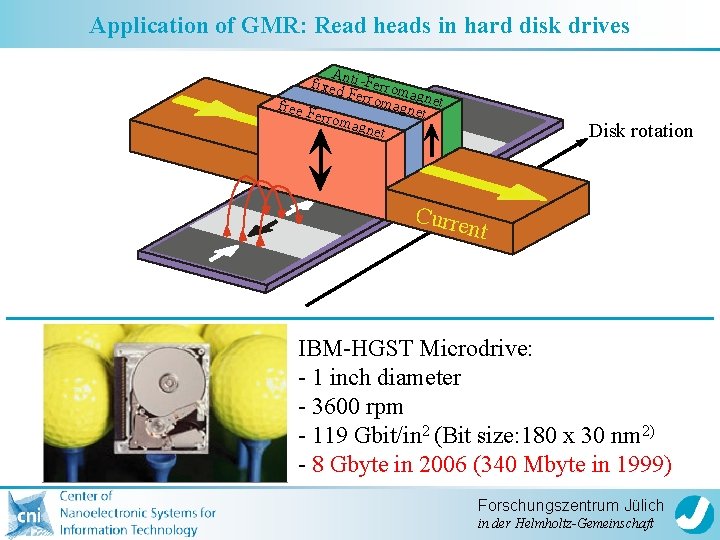
Application of GMR: Read heads in hard disk drives A fixednti-Ferrom Ferro a magn gnet free F et errom agnet Disk rotation Curre nt IBM-HGST Microdrive: - 1 inch diameter - 3600 rpm - 119 Gbit/in 2 (Bit size: 180 x 30 nm 2) - 8 Gbyte in 2006 (340 Mbyte in 1999) Forschungszentrum Jülich in der Helmholtz-Gemeinschaft
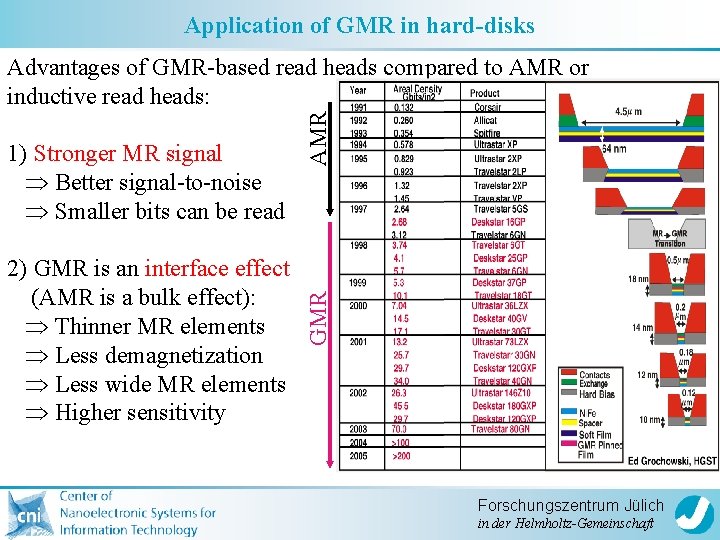
Application of GMR in hard-disks 2) GMR is an interface effect (AMR is a bulk effect): Thinner MR elements Less demagnetization Less wide MR elements Higher sensitivity GMR 1) Stronger MR signal Better signal-to-noise Smaller bits can be read AMR Advantages of GMR-based read heads compared to AMR or inductive read heads: Forschungszentrum Jülich in der Helmholtz-Gemeinschaft
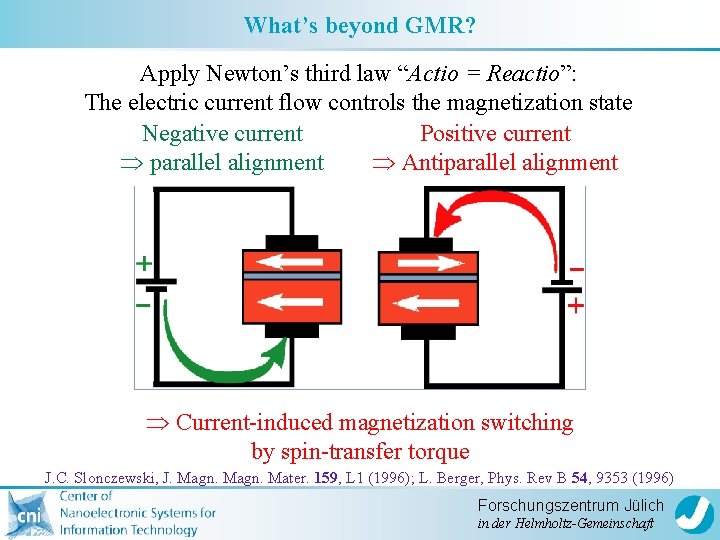
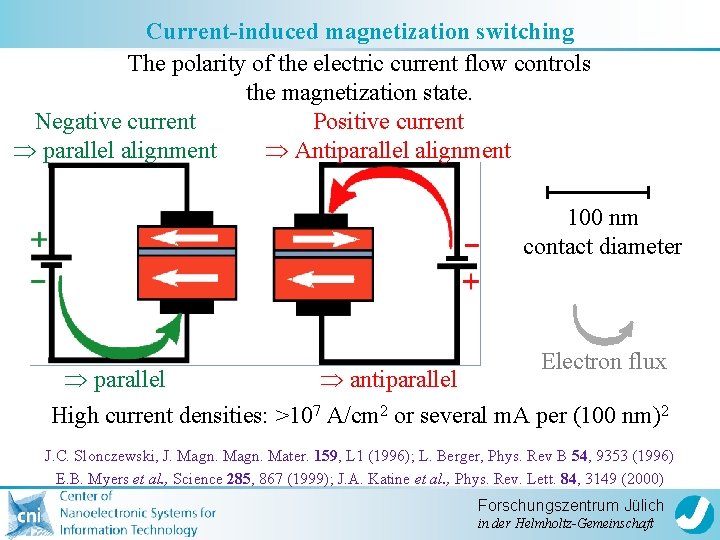
What’s beyond GMR? Apply Newton’s third law “Actio = Reactio”: The electric current flow controls the magnetization state Negative current Positive current parallel alignment Antiparallel alignment Current-induced magnetization switching by spin-transfer torque J. C. Slonczewski, J. Magn. Mater. 159, L 1 (1996); L. Berger, Phys. Rev B 54, 9353 (1996) Forschungszentrum Jülich in der Helmholtz-Gemeinschaft
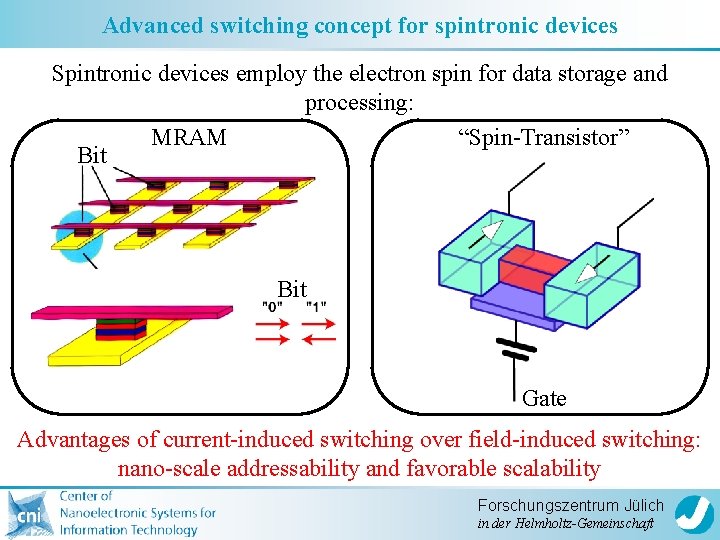
Advanced switching concept for spintronic devices Spintronic devices employ the electron spin for data storage and processing: MRAM “Spin-Transistor” Bit Gate Advantages of current-induced switching over field-induced switching: nano-scale addressability and favorable scalability Forschungszentrum Jülich in der Helmholtz-Gemeinschaft
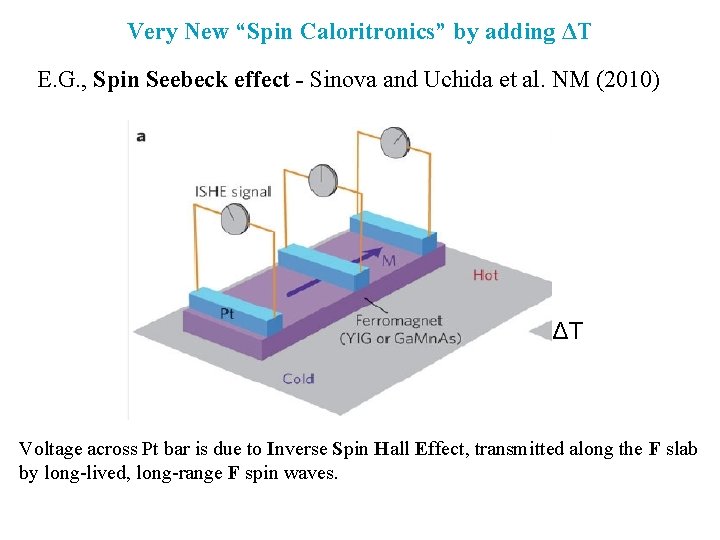
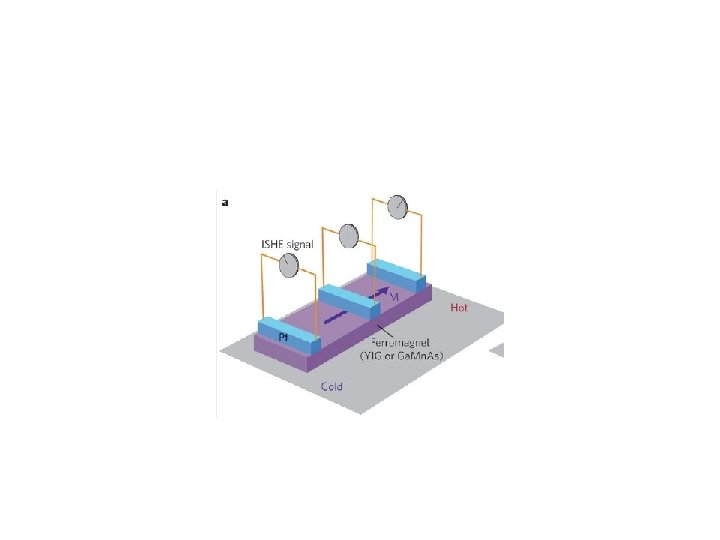
Very New “Spin Caloritronics” by adding ΔT E. G. , Spin Seebeck effect - Sinova and Uchida et al. NM (2010) ΔT Voltage across Pt bar is due to Inverse Spin Hall Effect, transmitted along the F slab by long-lived, long-range F spin waves.
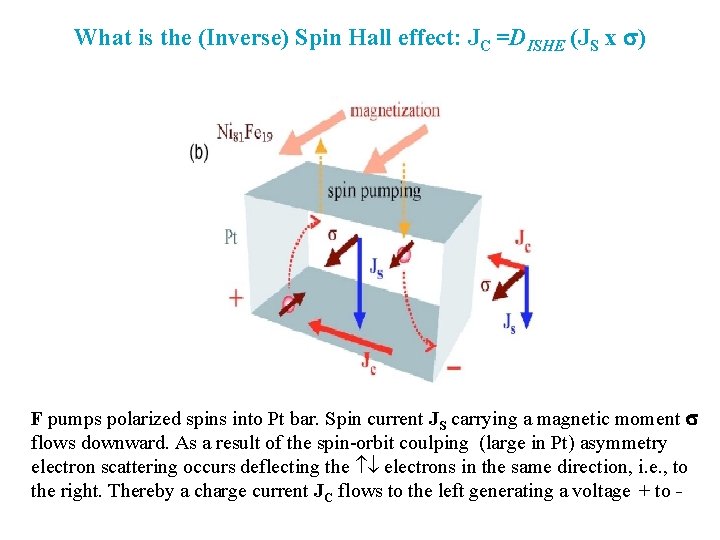
What is the (Inverse) Spin Hall effect: JC =DISHE (JS x ) F pumps polarized spins into Pt bar. Spin current JS carrying a magnetic moment flows downward. As a result of the spin-orbit coulping (large in Pt) asymmetry electron scattering occurs deflecting the electrons in the same direction, i. e. , to the right. Thereby a charge current JC flows to the left generating a voltage + to -
FILM and THE END STOP Forschungszentrum Jülich in der Helmholtz-Gemeinschaft
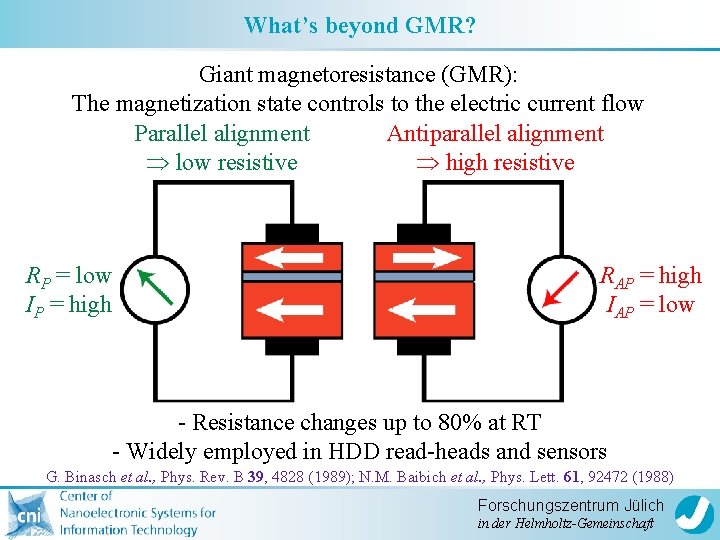
What’s beyond GMR? Giant magnetoresistance (GMR): The magnetization state controls to the electric current flow Parallel alignment Antiparallel alignment low resistive high resistive RP = low IP = high RAP = high IAP = low - Resistance changes up to 80% at RT - Widely employed in HDD read-heads and sensors G. Binasch et al. , Phys. Rev. B 39, 4828 (1989); N. M. Baibich et al. , Phys. Lett. 61, 92472 (1988) Forschungszentrum Jülich in der Helmholtz-Gemeinschaft
Current-induced magnetization switching The polarity of the electric current flow controls the magnetization state. Negative current Positive current parallel alignment Antiparallel alignment 100 nm contact diameter Electron flux parallel antiparallel High current densities: >107 A/cm 2 or several m. A per (100 nm)2 J. C. Slonczewski, J. Magn. Mater. 159, L 1 (1996); L. Berger, Phys. Rev B 54, 9353 (1996) E. B. Myers et al. , Science 285, 867 (1999); J. A. Katine et al. , Phys. Rev. Lett. 84, 3149 (2000) Forschungszentrum Jülich in der Helmholtz-Gemeinschaft
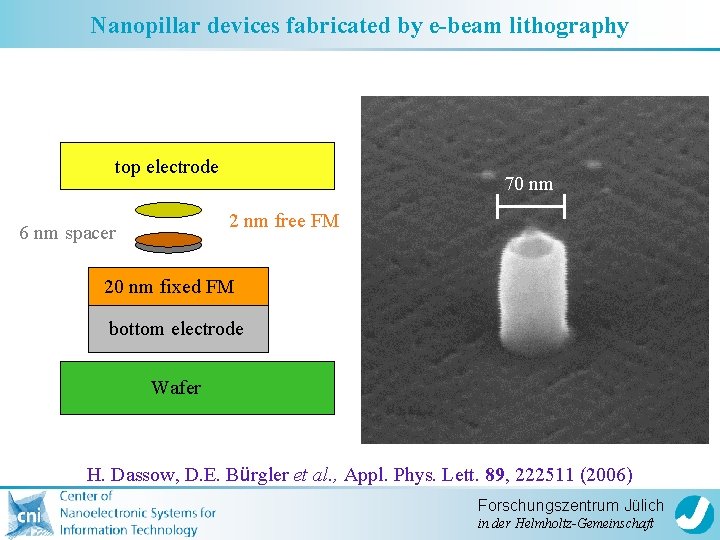
Nanopillar devices fabricated by e-beam lithography top electrode 70 nm 2 nm free FM 6 nm spacer 20 nm fixed FM bottom electrode Wafer H. Dassow, D. E. Bürgler et al. , Appl. Phys. Lett. 89, 222511 (2006) Forschungszentrum Jülich in der Helmholtz-Gemeinschaft
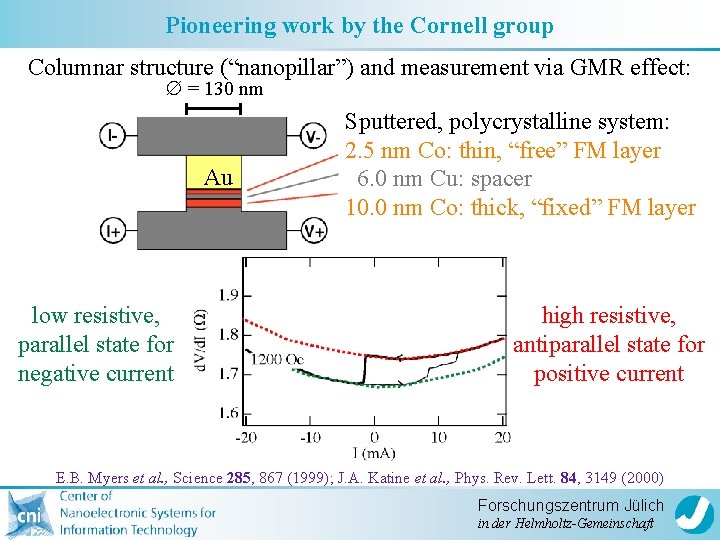
Pioneering work by the Cornell group Columnar structure (“nanopillar”) and measurement via GMR effect: = 130 nm Au low resistive, parallel state for negative current Sputtered, polycrystalline system: 2. 5 nm Co: thin, “free” FM layer 6. 0 nm Cu: spacer 10. 0 nm Co: thick, “fixed” FM layer high resistive, antiparallel state for positive current E. B. Myers et al. , Science 285, 867 (1999); J. A. Katine et al. , Phys. Rev. Lett. 84, 3149 (2000) Forschungszentrum Jülich in der Helmholtz-Gemeinschaft
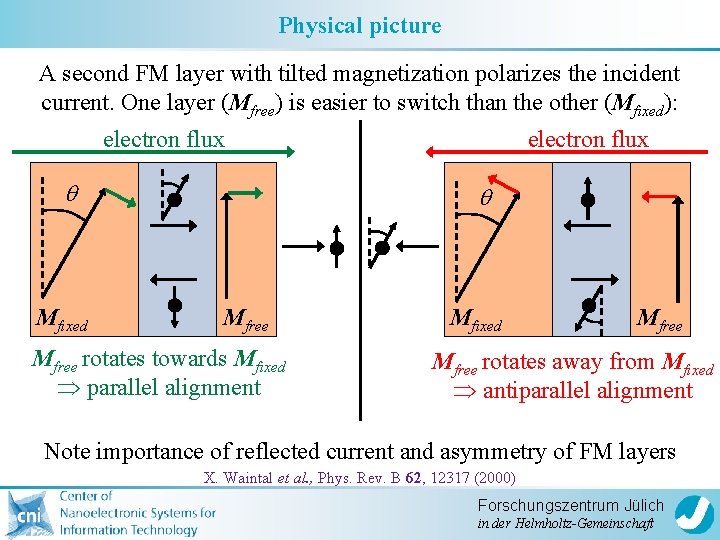
Physical picture A second FM layer with tilted magnetization polarizes the incident current. One layer (Mfree) is easier to switch than the other (Mfixed): electron flux Mfixed electron flux Mfree rotates towards Mfixed parallel alignment Mfixed Mfree rotates away from Mfixed antiparallel alignment Note importance of reflected current and asymmetry of FM layers X. Waintal et al. , Phys. Rev. B 62, 12317 (2000) Forschungszentrum Jülich in der Helmholtz-Gemeinschaft
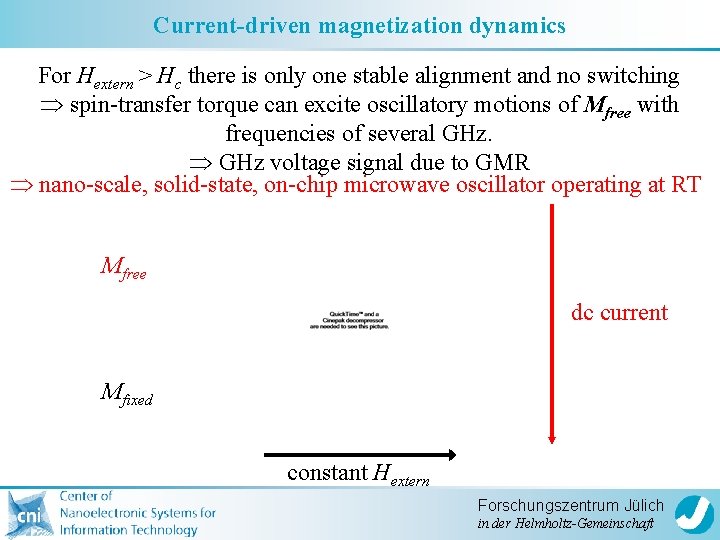
Current-driven magnetization dynamics For Hextern > Hc there is only one stable alignment and no switching spin-transfer torque can excite oscillatory motions of Mfree with frequencies of several GHz voltage signal due to GMR nano-scale, solid-state, on-chip microwave oscillator operating at RT Mfree dc current Mfixed constant Hextern Forschungszentrum Jülich in der Helmholtz-Gemeinschaft
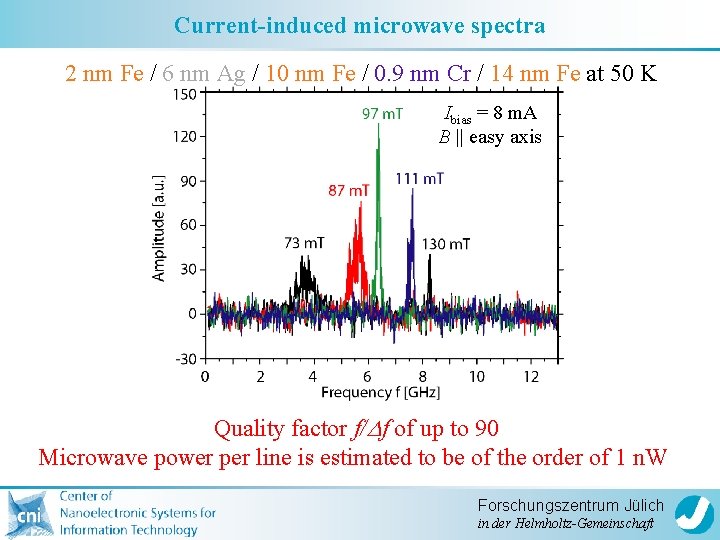
Current-induced microwave spectra 2 nm Fe / 6 nm Ag / 10 nm Fe / 0. 9 nm Cr / 14 nm Fe at 50 K Ibias = 8 m. A B || easy axis Quality factor f/ f of up to 90 Microwave power per line is estimated to be of the order of 1 n. W Forschungszentrum Jülich in der Helmholtz-Gemeinschaft
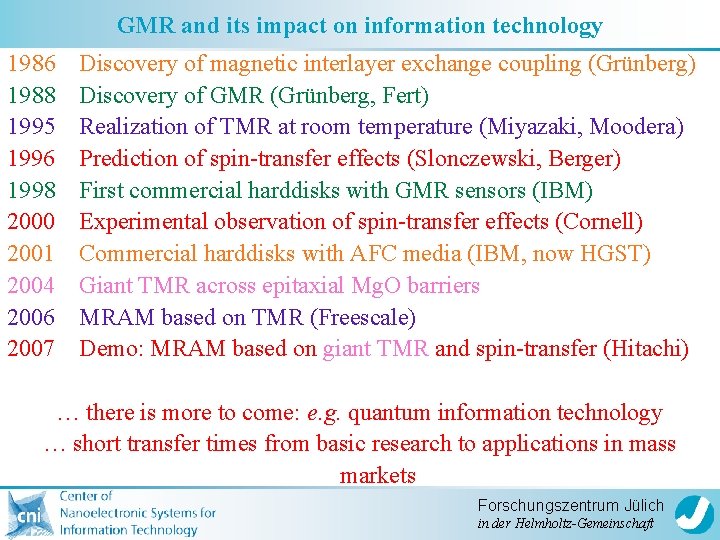
GMR and its impact on information technology 1986 1988 1995 1996 1998 2000 2001 2004 2006 2007 Discovery of magnetic interlayer exchange coupling (Grünberg) Discovery of GMR (Grünberg, Fert) Realization of TMR at room temperature (Miyazaki, Moodera) Prediction of spin-transfer effects (Slonczewski, Berger) First commercial harddisks with GMR sensors (IBM) Experimental observation of spin-transfer effects (Cornell) Commercial harddisks with AFC media (IBM, now HGST) Giant TMR across epitaxial Mg. O barriers MRAM based on TMR (Freescale) Demo: MRAM based on giant TMR and spin-transfer (Hitachi) … there is more to come: e. g. quantum information technology … short transfer times from basic research to applications in mass markets Forschungszentrum Jülich in der Helmholtz-Gemeinschaft
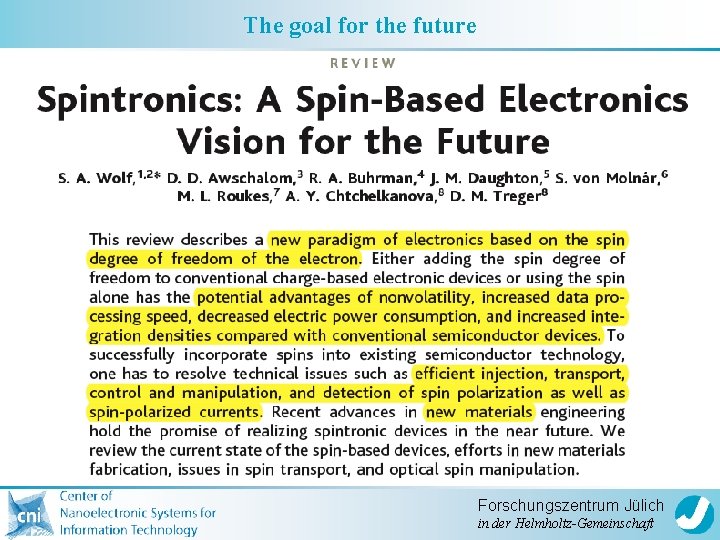
The goal for the future Forschungszentrum Jülich in der Helmholtz-Gemeinschaft
STOP Forschungszentrum Jülich in der Helmholtz-Gemeinschaft
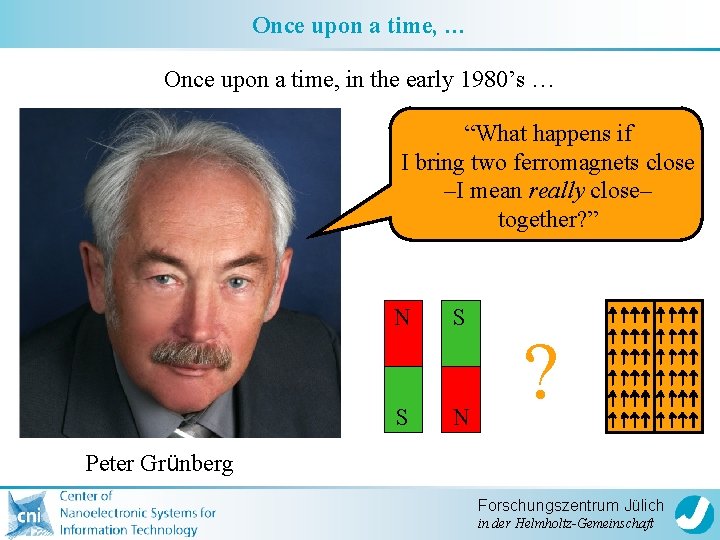
Once upon a time, … Once upon a time, in the early 1980’s … “What happens if I bring two ferromagnets close –I mean really close– together? ” N S S N ? Peter Grünberg Forschungszentrum Jülich in der Helmholtz-Gemeinschaft
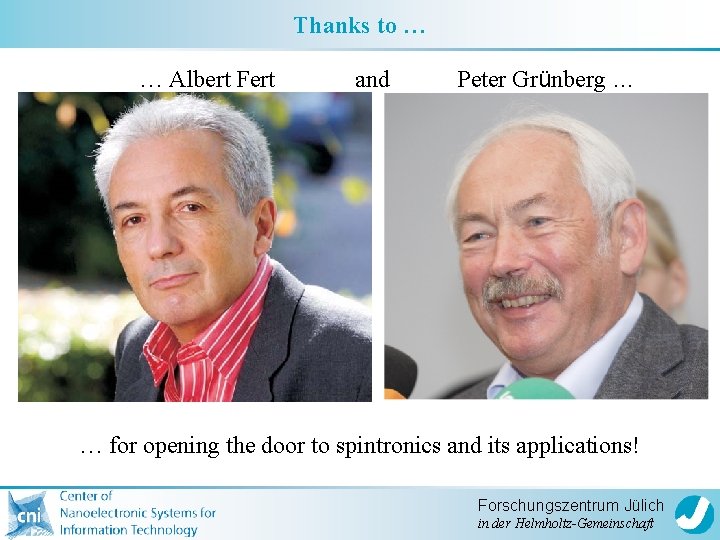
Thanks to … … Albert Fert and Peter Grünberg … … for opening the door to spintronics and its applications! Forschungszentrum Jülich in der Helmholtz-Gemeinschaft
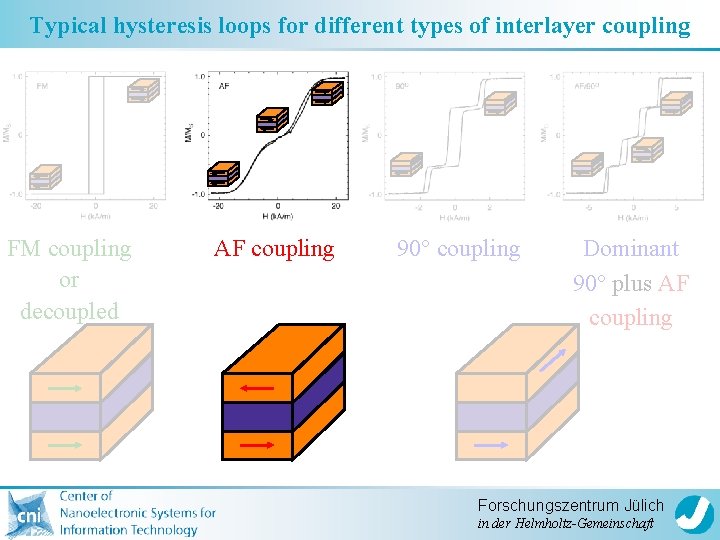
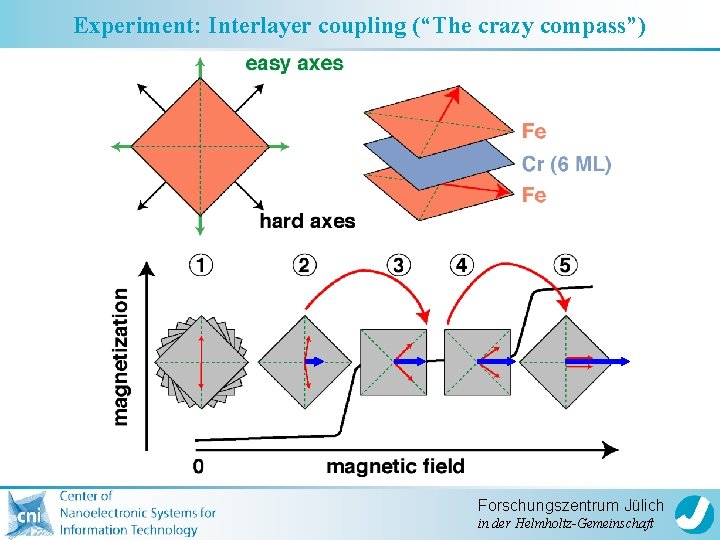
Typical hysteresis loops for different types of interlayer coupling FM coupling or decoupled AF coupling 90° coupling Dominant 90° plus AF coupling Forschungszentrum Jülich in der Helmholtz-Gemeinschaft
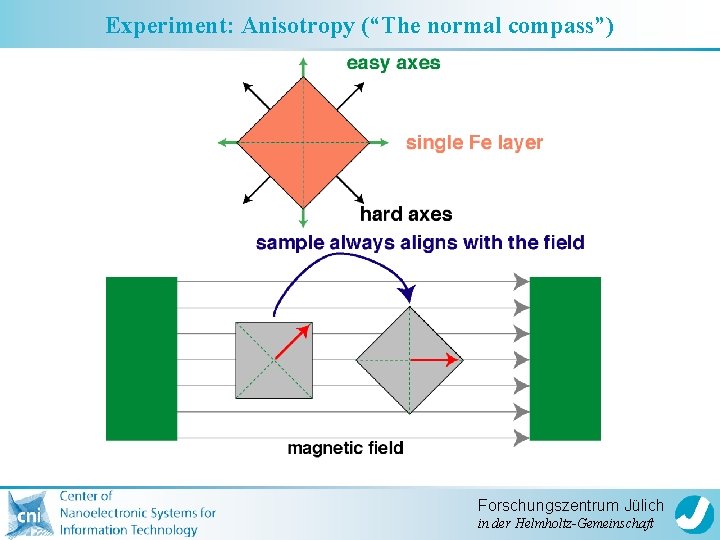
Experiment: Anisotropy (“The normal compass”) Forschungszentrum Jülich in der Helmholtz-Gemeinschaft
Experiment: Interlayer coupling (“The crazy compass”) Forschungszentrum Jülich in der Helmholtz-Gemeinschaft
Application of GMR: Read heads in hard disk drives An animation explaining the application of GMR in readheads of hard disk drives can be found at: http: //www. fz-juelich. de/ Forschungszentrum Jülich in der Helmholtz-Gemeinschaft
Giant Magnetoresistance Effect Physical Picture, Applications, and Future Daniel E. Bürgler Institut für Festkörperforschung, Elektronische Eigenschaften (IFF– 9) CNI – Center of Nanoelectronic Systems for Information Technology Forschungszentrum Jülich Gmb. H, Germany University of Leoben, November 14, 2007 Forschungszentrum Jülich in der Helmholtz-Gemeinschaft
Forschungszentrum Jülich in der Helmholtz-Gemeinschaft
Fundamental Physics of Nano. & Info. Technology – Dec. 2008
Difference between F and AF Configurations ΔR ≈ 50% … Best to date 10%