
3 GHz medical linac technology highgradient proton accelerating
![Regular cell design E Sc H Fixed geometry parameters Iris thickness [mm] 2. 0](https://slidetodoc.com/presentation_image_h/04bc8cdb8f8612379b1936e379307ed8/image-11.jpg "Regular cell design E Sc H Fixed geometry parameters Iris thickness [mm] 2. 0")


- Slides: 40
3 GHz medical linac technology: high-gradient proton accelerating structure and rotary joint Alberto DEGIOVANNI (CERN BE-RF) High Gradient Workshop 2015 Tsinghua University Beijing, 16 -19 June 2015
Outline Motivation q High Gradient Proton TW structure q – RF design – Machining – Low power measurements q Waveguide high power rotating joint – RF design – Test setup – Low power measurements – High power test results New developments q Conclusion q 19/06/15 A. Degiovanni - HG 2015 workshop - Tsinghua University, China 2
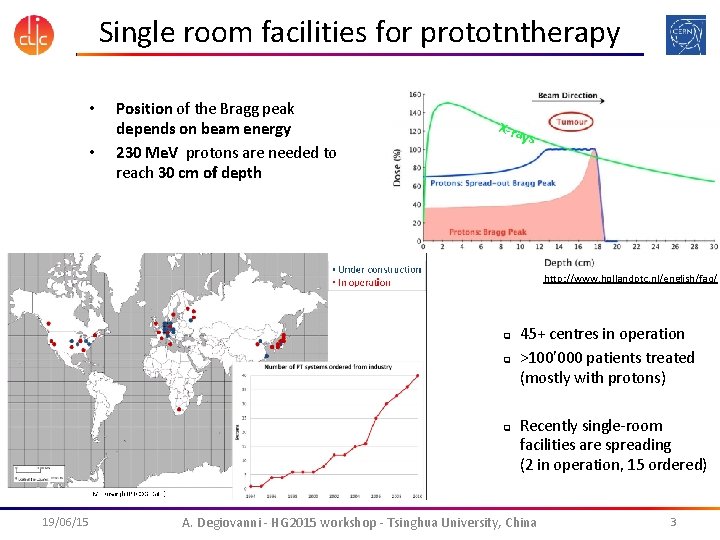
Single room facilities for prototntherapy • • Position of the Bragg peak depends on beam energy 230 Me. V protons are needed to reach 30 cm of depth X-ra y s http: //www. hollandptc. nl/english/faq/ q q q 19/06/15 45+ centres in operation >100’ 000 patients treated (mostly with protons) Recently single-room facilities are spreading (2 in operation, 15 ordered) A. Degiovanni - HG 2015 workshop - Tsinghua University, China 3
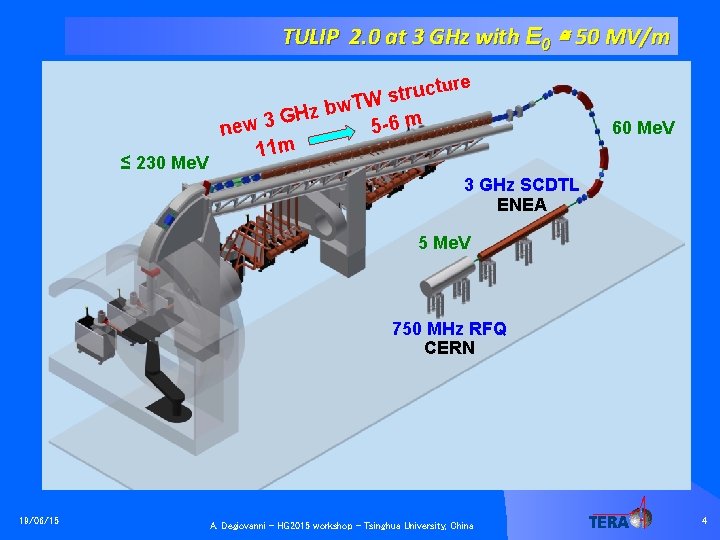
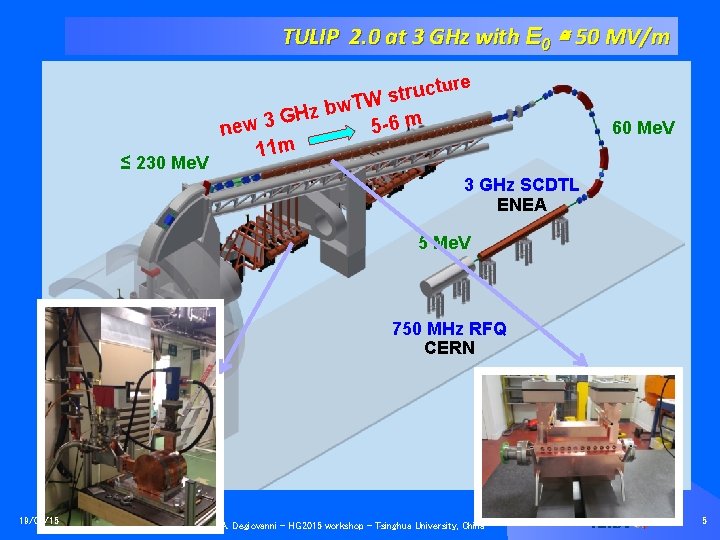
TULIP 2. 0 at 3 GHz with E 0 ≅ 50 MV/m re ≤ 230 Me. V ructu t s W w. T b z H G 5 -6 m new 3 11 m 60 Me. V 3 GHz SCDTL ENEA 5 Me. V 750 MHz RFQ CERN 19/06/15 A. Degiovanni - HG 2015 workshop - Tsinghua University, China 4
TULIP 2. 0 at 3 GHz with E 0 ≅ 50 MV/m re ≤ 230 Me. V ructu t s W w. T b z H G 5 -6 m new 3 11 m 60 Me. V 3 GHz SCDTL ENEA 5 Me. V 750 MHz RFQ CERN 19/06/15 A. Degiovanni - HG 2015 workshop - Tsinghua University, China 5
HIGH GRADIENT PROTON TW STRUCTURE 19/06/15 A. Degiovanni - HG 2015 workshop - Tsinghua University, China 6
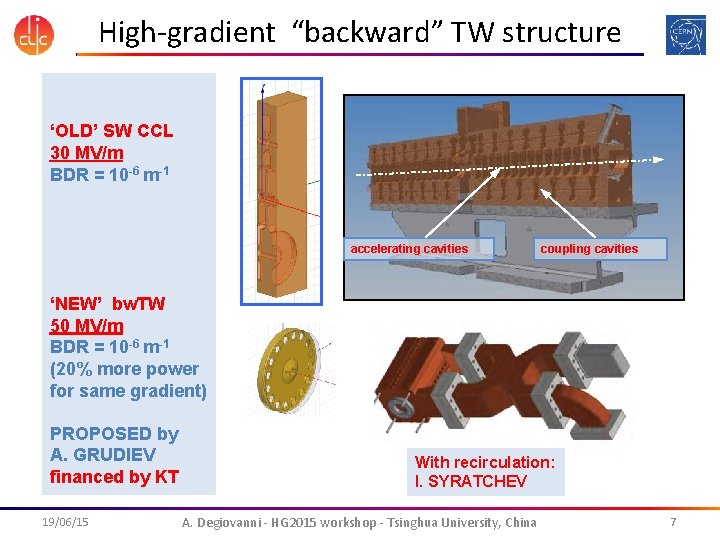
High-gradient “backward” TW structure ‘OLD’ SW CCL 30 MV/m BDR = 10 -6 m-1 accelerating cavities coupling cavities ‘NEW’ bw. TW 50 MV/m BDR = 10 -6 m-1 (20% more power for same gradient) PROPOSED by A. GRUDIEV financed by KT 19/06/15 With recirculation: I. SYRATCHEV A. Degiovanni - HG 2015 workshop - Tsinghua University, China 7
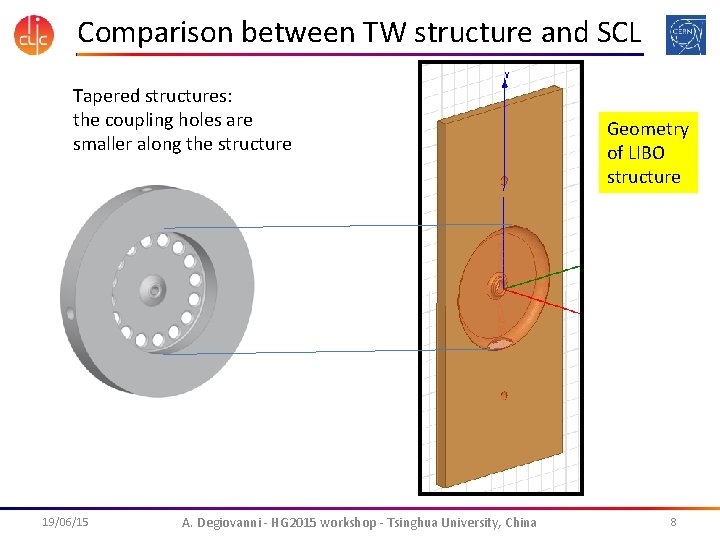
Comparison between TW structure and SCL Tapered structures: the coupling holes are smaller along the structure 19/06/15 A. Degiovanni - HG 2015 workshop - Tsinghua University, China Geometry of LIBO structure 8
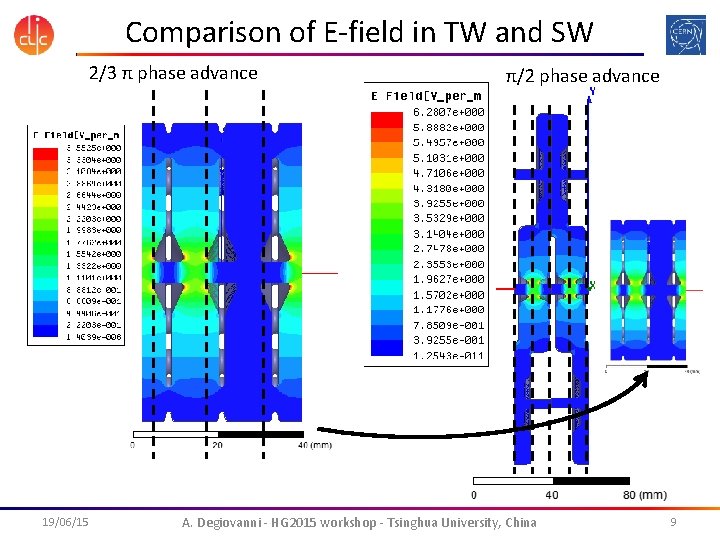
Comparison of E-field in TW and SW 2/3 π phase advance 19/06/15 π/2 phase advance A. Degiovanni - HG 2015 workshop - Tsinghua University, China 9
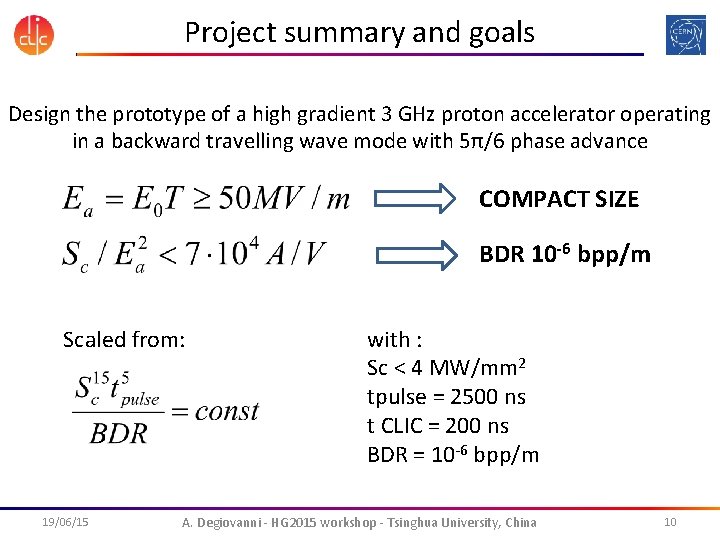
Project summary and goals Design the prototype of a high gradient 3 GHz proton accelerator operating in a backward travelling wave mode with 5π/6 phase advance COMPACT SIZE BDR 10 -6 bpp/m Scaled from: 19/06/15 with : Sc < 4 MW/mm 2 tpulse = 2500 ns t CLIC = 200 ns BDR = 10 -6 bpp/m A. Degiovanni - HG 2015 workshop - Tsinghua University, China 10
Regular cell design E Sc H Fixed geometry parameters Iris thickness [mm] 2. 0 Averaged accelerating parameters Gap [mm] 7. 0 Frequency [GHz] 2. 9985 Nose cone angle [°] 65 Q 7194 Bore radius [mm] 2. 5 Rshunt/Q [MΩ/m] 7394 Nose inner radius [mm] 1. 0 ZTT [MΩ/m] 53. 2 Nose outer radius [mm] 2. 0 vg [‰c] 2. 93 Corner inner radius [mm] 1. 0 Es/Ea 3. 86 Corner outer radius [mm] 1. 0 Hs/Ea [1/kΩ] 4. 64 Number of cell 12 Sc/Ea 2 nose[ 1/kΩ] 0. 26 Cell length [mm] 15. 82 Sc/Ea 2 slot [1/kΩ] 0. 25 19/06/15 A. Degiovanni - HG 2015 workshop - Tsinghua University, China 11
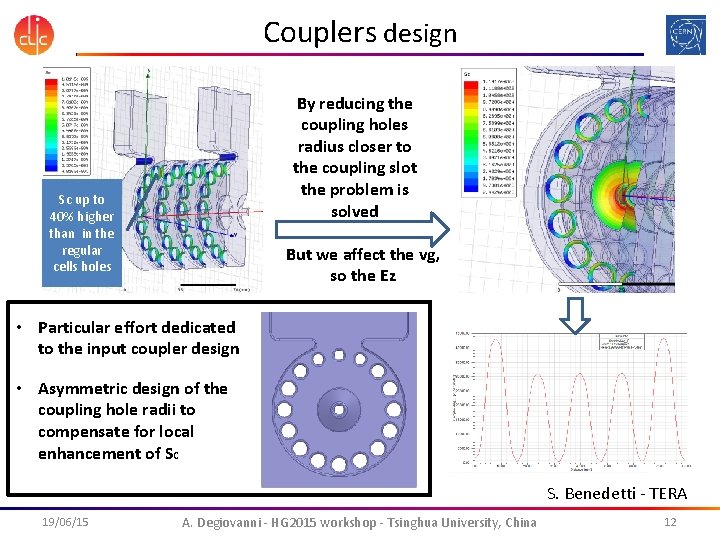
Couplers design By reducing the coupling holes radius closer to the coupling slot the problem is solved Sc up to 40% higher than in the regular cells holes But we affect the vg, so the Ez • Particular effort dedicated to the input coupler design • Asymmetric design of the coupling hole radii to compensate for local enhancement of Sc S. Benedetti - TERA 19/06/15 A. Degiovanni - HG 2015 workshop - Tsinghua University, China 12
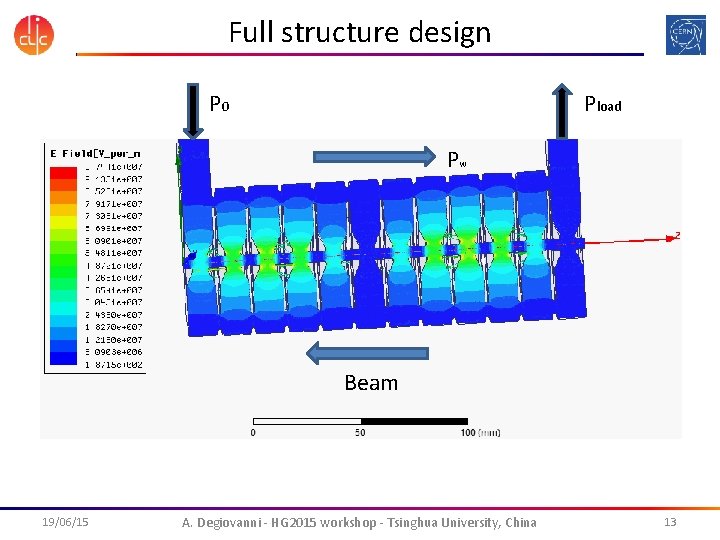
Full structure design P 0 Pload Pw Beam 19/06/15 A. Degiovanni - HG 2015 workshop - Tsinghua University, China 13
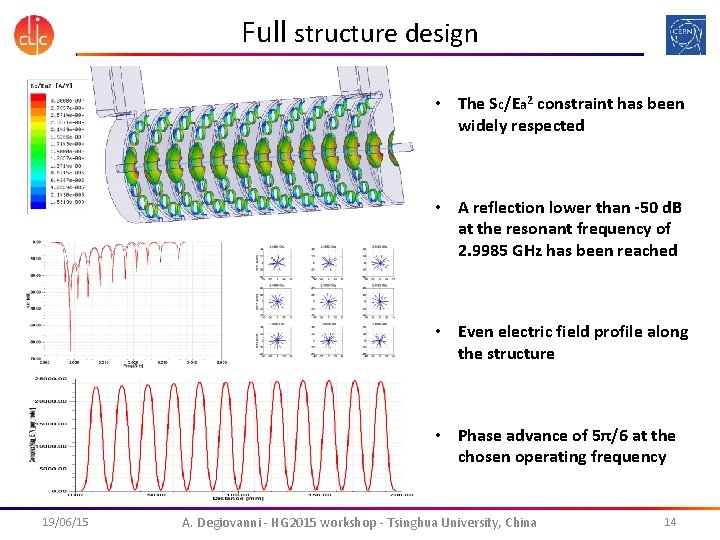
Full structure design • The Sc/Ea 2 constraint has been widely respected • A reflection lower than -50 d. B at the resonant frequency of 2. 9985 GHz has been reached • Even electric field profile along the structure • Phase advance of 5π/6 at the chosen operating frequency 19/06/15 A. Degiovanni - HG 2015 workshop - Tsinghua University, China 14
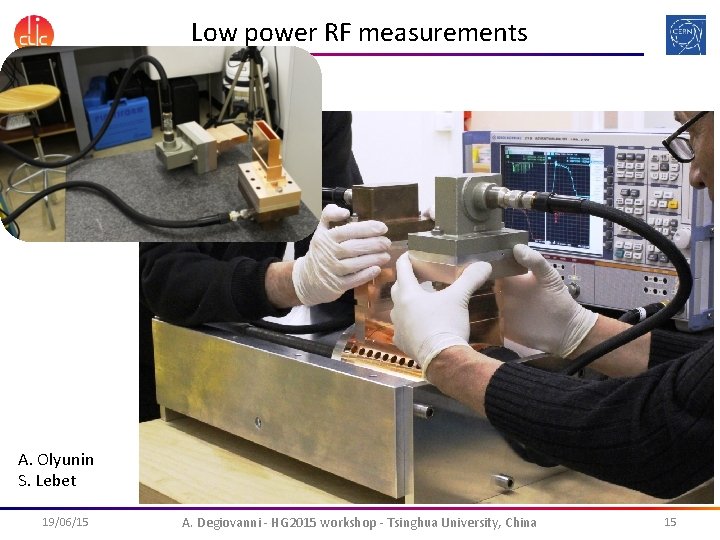
Low power RF measurements A. Olyunin S. Lebet 19/06/15 A. Degiovanni - HG 2015 workshop - Tsinghua University, China 15
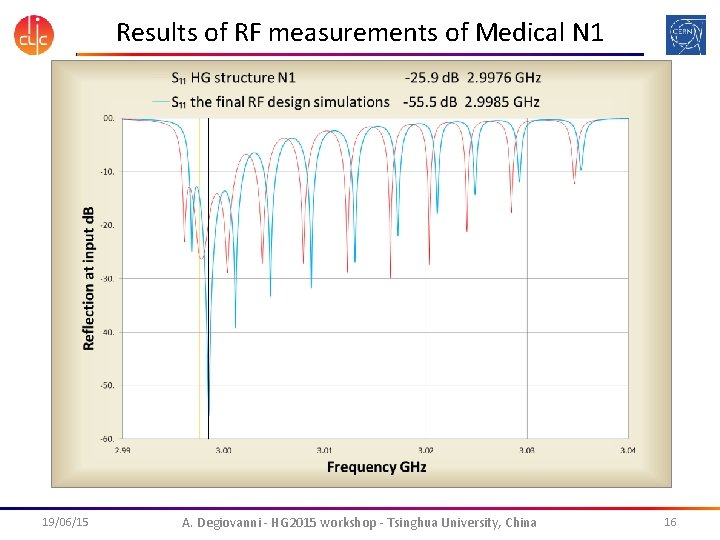
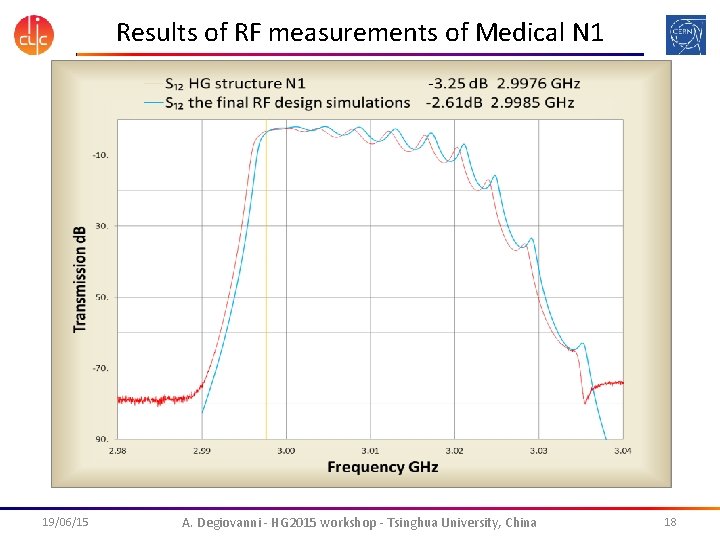
Results of RF measurements of Medical N 1 19/06/15 A. Degiovanni - HG 2015 workshop - Tsinghua University, China 16
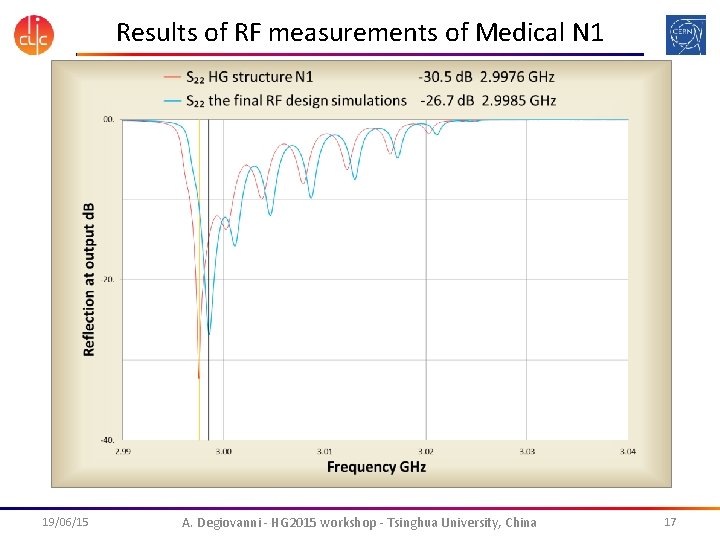
Results of RF measurements of Medical N 1 19/06/15 A. Degiovanni - HG 2015 workshop - Tsinghua University, China 17
Results of RF measurements of Medical N 1 19/06/15 A. Degiovanni - HG 2015 workshop - Tsinghua University, China 18
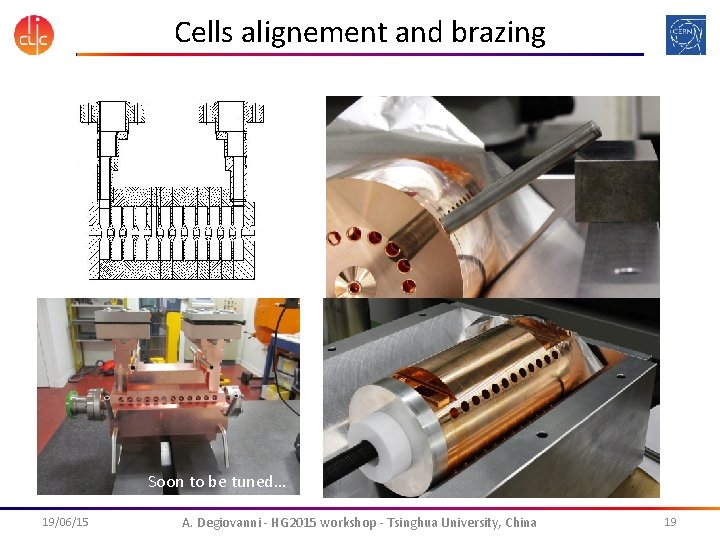
Cells alignement and brazing Soon to be tuned… 19/06/15 A. Degiovanni - HG 2015 workshop - Tsinghua University, China 19
WAVEGUIDE HIGH POWER ROTATING JOINT 19/06/15 A. Degiovanni - HG 2015 workshop - Tsinghua University, China 20
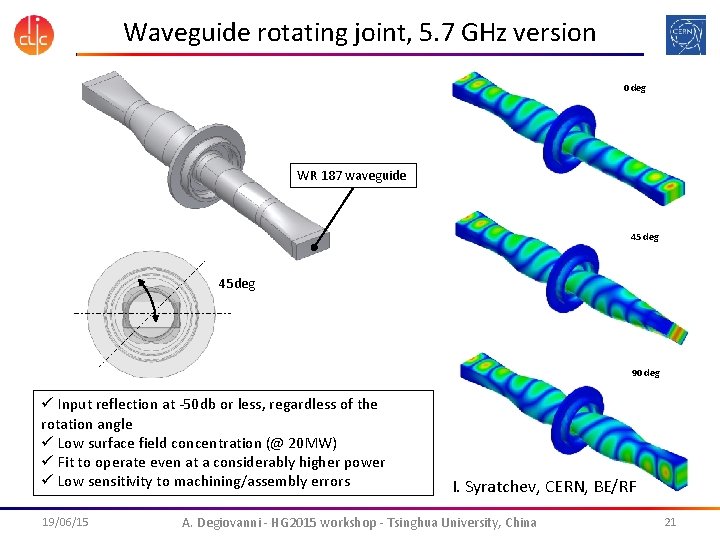
Waveguide rotating joint, 5. 7 GHz version 0 deg WR 187 waveguide 45 deg 45 deg 90 deg ü Input reflection at -50 db or less, regardless of the rotation angle ü Low surface field concentration (@ 20 MW) ü Fit to operate even at a considerably higher power ü Low sensitivity to machining/assembly errors 19/06/15 I. Syratchev, CERN, BE/RF A. Degiovanni - HG 2015 workshop - Tsinghua University, China 21
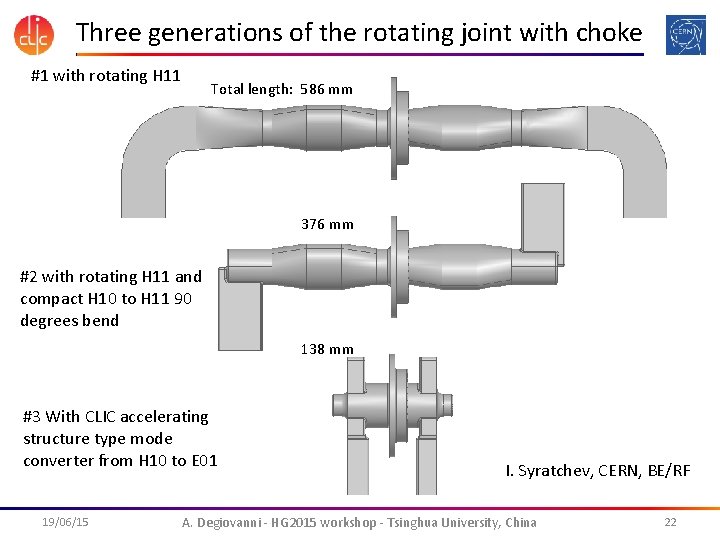
Three generations of the rotating joint with choke #1 with rotating H 11 Total length: 586 mm 376 mm #2 with rotating H 11 and compact H 10 to H 11 90 degrees bend 138 mm #3 With CLIC accelerating structure type mode converter from H 10 to E 01 19/06/15 I. Syratchev, CERN, BE/RF A. Degiovanni - HG 2015 workshop - Tsinghua University, China 22
S 11, S 12 d. B S-band rotating joint – Simulation and design 19/06/15 00 450 900 A. Degiovanni - HG 2015 workshop - Tsinghua University, China Ø ~ 40 cm ~ 50 Kg 23
Low power measurements - Amplitude REFLECTION 19/06/15 TRANSMISSION A. Degiovanni - HG 2015 workshop - Tsinghua University, China 24
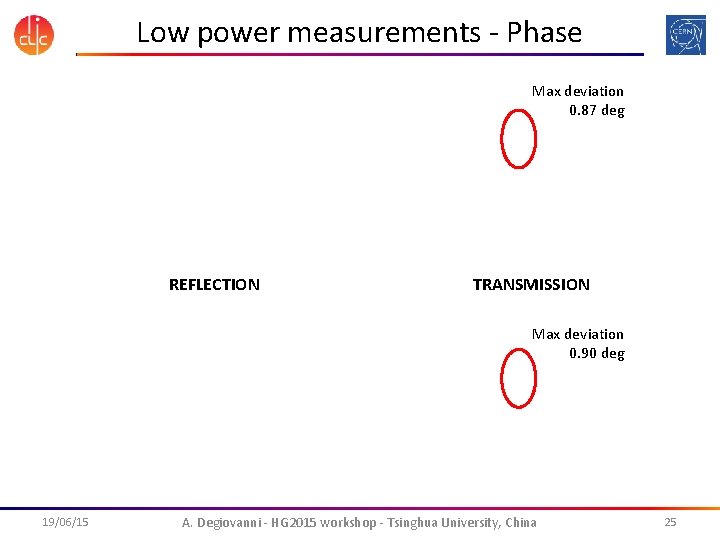
Low power measurements - Phase Max deviation 0. 87 deg REFLECTION TRANSMISSION Max deviation 0. 90 deg 19/06/15 A. Degiovanni - HG 2015 workshop - Tsinghua University, China 25
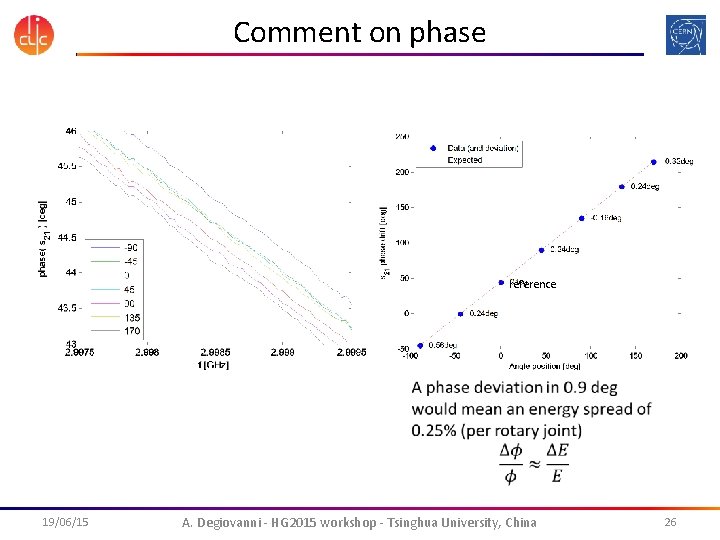
Comment on phase reference 19/06/15 A. Degiovanni - HG 2015 workshop - Tsinghua University, China 26
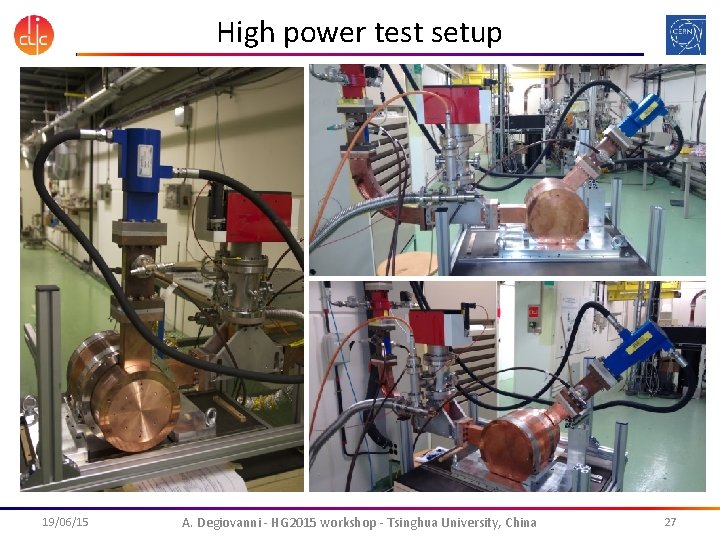
High power test setup 19/06/15 A. Degiovanni - HG 2015 workshop - Tsinghua University, China 27
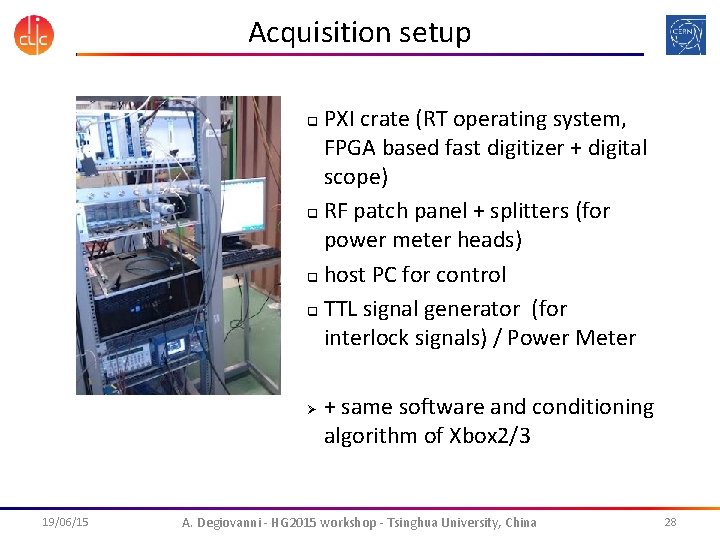
Acquisition setup PXI crate (RT operating system, FPGA based fast digitizer + digital scope) q RF patch panel + splitters (for power meter heads) q host PC for control q TTL signal generator (for interlock signals) / Power Meter q Ø 19/06/15 + same software and conditioning algorithm of Xbox 2/3 A. Degiovanni - HG 2015 workshop - Tsinghua University, China 28
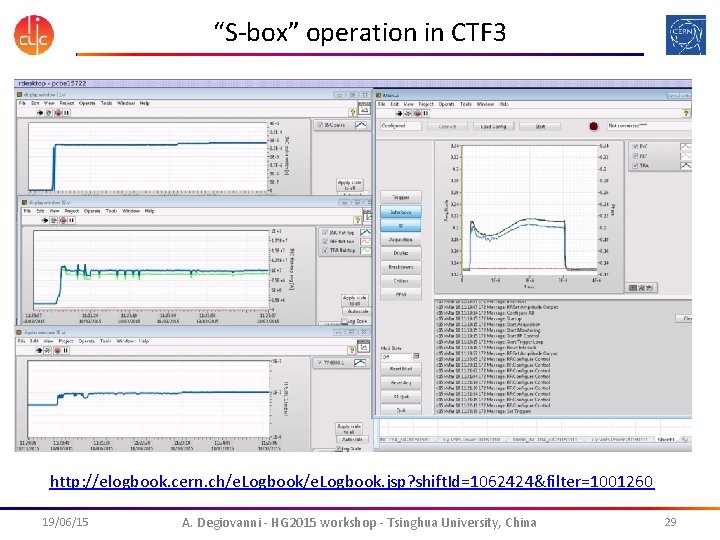
“S-box” operation in CTF 3 http: //elogbook. cern. ch/e. Logbook. jsp? shift. Id=1062424&filter=1001260 19/06/15 A. Degiovanni - HG 2015 workshop - Tsinghua University, China 29
full conditioning history q q 19/06/15 in 10 days we could condition the system up to 20 MW – 5 us – 50 Hz automatic conditioning also during nights and week-end A. Degiovanni - HG 2015 workshop - Tsinghua University, China 30
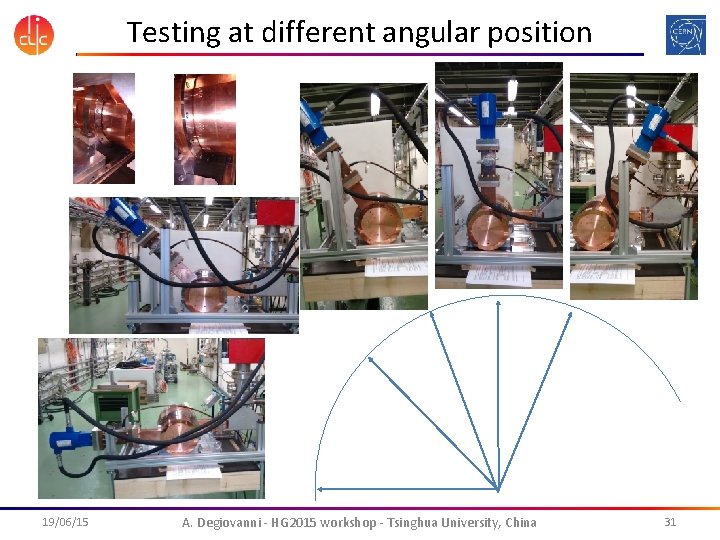
Testing at different angular position 19/06/15 A. Degiovanni - HG 2015 workshop - Tsinghua University, China 31
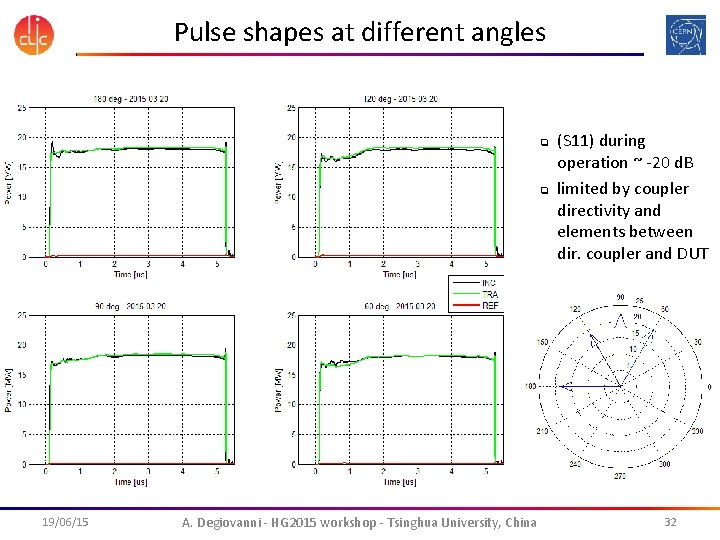
Pulse shapes at different angles q q 19/06/15 A. Degiovanni - HG 2015 workshop - Tsinghua University, China (S 11) during operation ~ -20 d. B limited by coupler directivity and elements between dir. coupler and DUT 32
NEW DEVELOPMENTS 19/06/15 A. Degiovanni - HG 2015 workshop - Tsinghua University, China 33
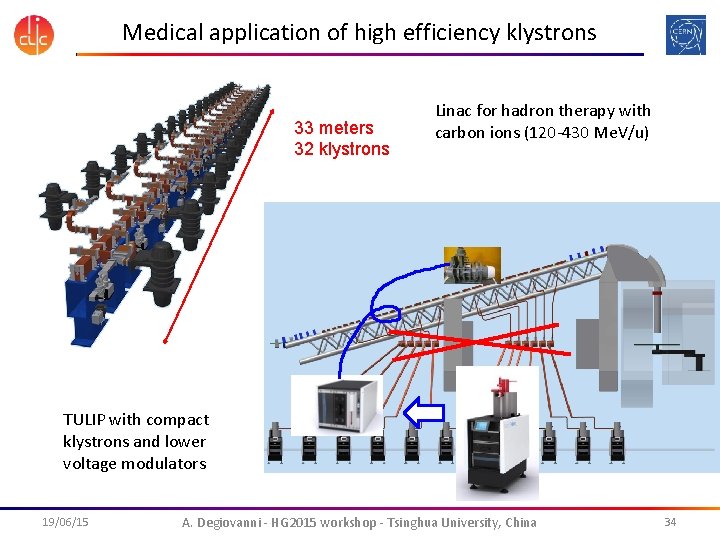
Medical application of high efficiency klystrons 33 meters 32 klystrons Linac for hadron therapy with carbon ions (120 -430 Me. V/u) TULIP with compact klystrons and lower voltage modulators 19/06/15 A. Degiovanni - HG 2015 workshop - Tsinghua University, China 34
Summary An S-band high-gradient travelling wave structure for proton has been built and will be tested by the end of 2015 q A 3 GHz high power rotating joint has been designed, manufactured and tested at CERN, showing good results q Application of high efficiency klystrons are foreseen both for proton single room facility design and for carbon ions hadrontherapy linacs q High gradient technology and high efficiency power sources have great potential application in linac for hadrontherapy application q 19/06/15 A. Degiovanni - HG 2015 workshop - Tsinghua University, China 35
THANK YOU FOR YOUR ATTENTION ! 19/06/15 A. Degiovanni - HG 2015 workshop - Tsinghua University, China 36
EXTRA SLIDES 19/06/15 A. Degiovanni - HG 2015 workshop - Tsinghua University, China 37
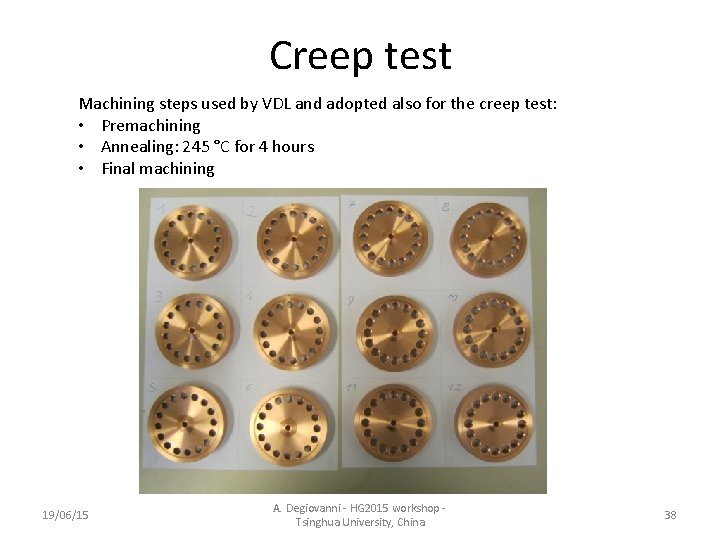
Creep test Machining steps used by VDL and adopted also for the creep test: • Premachining • Annealing: 245 °C for 4 hours • Final machining 19/06/15 A. Degiovanni - HG 2015 workshop - Tsinghua University, China 38
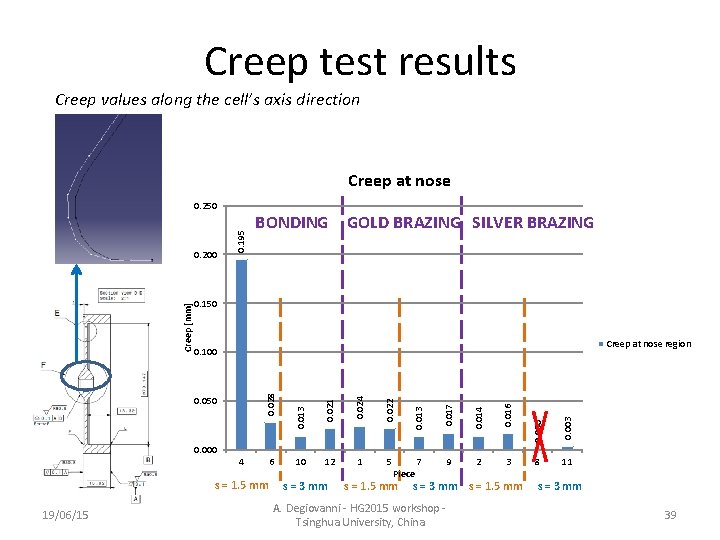
Creep test results Creep values along the cell’s axis direction Creep at nose 0. 200 0. 195 0. 250 BONDING GOLD BRAZING SILVER BRAZING Creep [mm] 0. 150 Creep at nose region 9 2 3 0. 003 7 0. 000 0. 016 5 0. 014 0. 022 1 0. 017 0. 024 12 0. 013 0. 021 0. 050 0. 013 0. 028 0. 100 8 11 0. 000 4 s = 1. 5 mm 19/06/15 6 10 s = 3 mm Piece s = 1. 5 mm s = 3 mm s = 1. 5 mm A. Degiovanni - HG 2015 workshop - Tsinghua University, China s = 3 mm 39
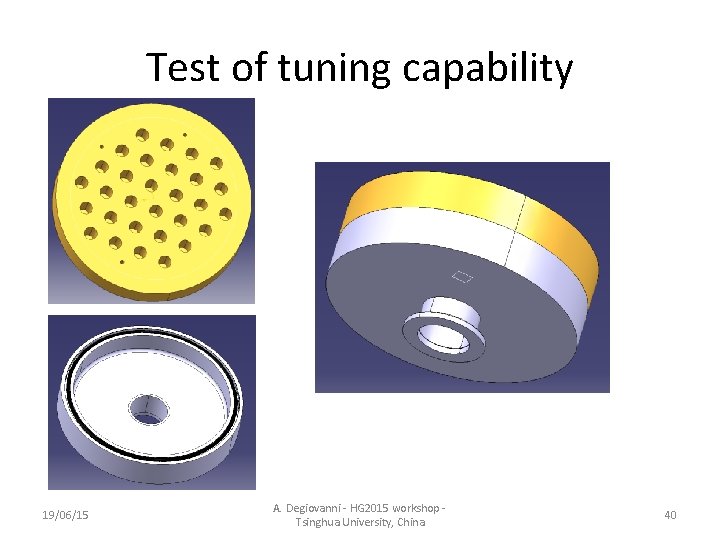
Test of tuning capability 19/06/15 A. Degiovanni - HG 2015 workshop - Tsinghua University, China 40