
3 GASTRIC SECRETION Prof Sherif W Mansour Physiology

- Slides: 12
3. GASTRIC SECRETION Prof. Sherif W. Mansour Physiology dpt. , Mutah School of medicine 2020 -2021
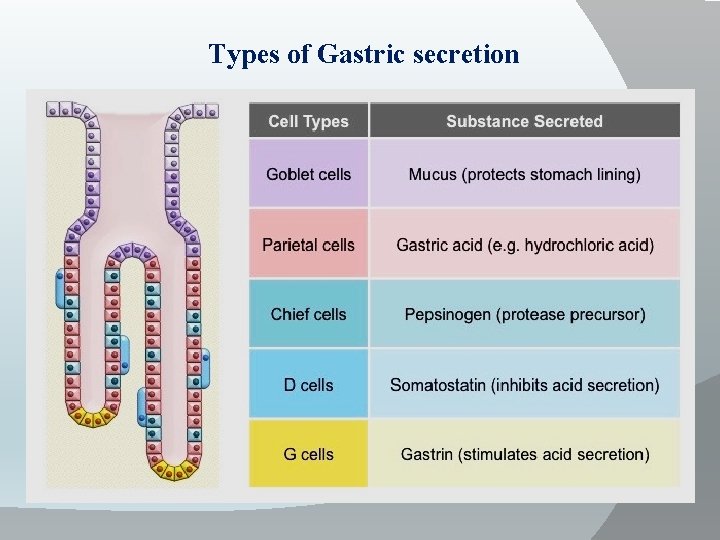
Types of Gastric secretion
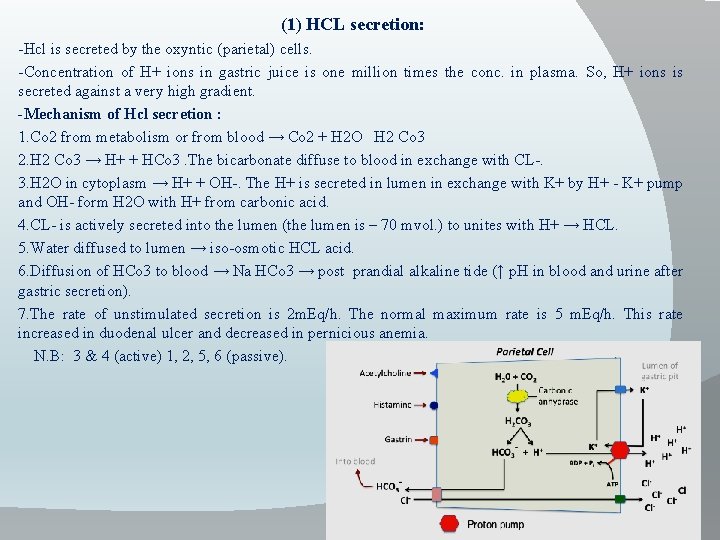
(1) HCL secretion: -Hcl is secreted by the oxyntic (parietal) cells. -Concentration of H+ ions in gastric juice is one million times the conc. in plasma. So, H+ ions is secreted against a very high gradient. -Mechanism of Hcl secretion : 1. Co 2 from metabolism or from blood → Co 2 + H 2 O H 2 Co 3 2. H 2 Co 3 → H+ + HCo 3. The bicarbonate diffuse to blood in exchange with CL-. 3. H 2 O in cytoplasm → H+ + OH-. The H+ is secreted in lumen in exchange with K+ by H+ - K+ pump and OH- form H 2 O with H+ from carbonic acid. 4. CL- is actively secreted into the lumen (the lumen is – 70 mvol. ) to unites with H+ → HCL. 5. Water diffused to lumen → iso-osmotic HCL acid. 6. Diffusion of HCo 3 to blood → Na HCo 3 → post prandial alkaline tide (↑ p. H in blood and urine after gastric secretion). 7. The rate of unstimulated secretion is 2 m. Eq/h. The normal maximum rate is 5 m. Eq/h. This rate increased in duodenal ulcer and decreased in pernicious anemia. N. B: 3 & 4 (active) 1, 2, 5, 6 (passive).
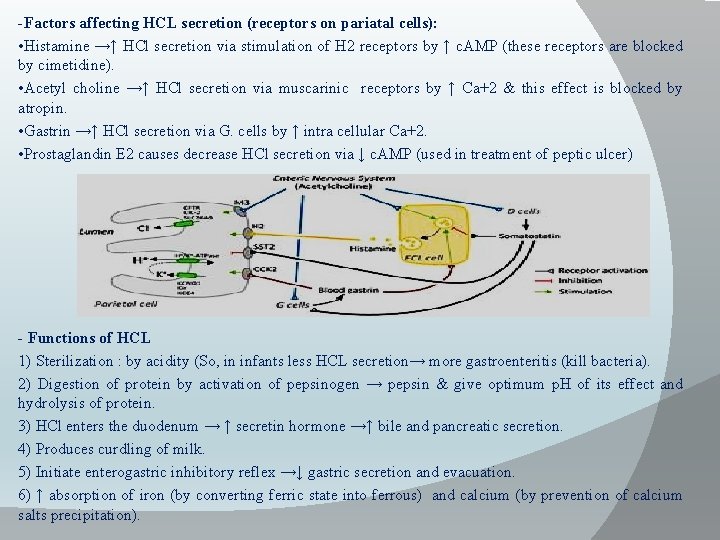
-Factors affecting HCL secretion (receptors on pariatal cells): • Histamine →↑ HCl secretion via stimulation of H 2 receptors by ↑ c. AMP (these receptors are blocked by cimetidine). • Acetyl choline →↑ HCl secretion via muscarinic receptors by ↑ Ca+2 & this effect is blocked by atropin. • Gastrin →↑ HCl secretion via G. cells by ↑ intra cellular Ca+2. • Prostaglandin E 2 causes decrease HCl secretion via ↓ c. AMP (used in treatment of peptic ulcer) - Functions of HCL 1) Sterilization : by acidity (So, in infants less HCL secretion→ more gastroenteritis (kill bacteria). 2) Digestion of protein by activation of pepsinogen → pepsin & give optimum p. H of its effect and hydrolysis of protein. 3) HCl enters the duodenum → ↑ secretin hormone →↑ bile and pancreatic secretion. 4) Produces curdling of milk. 5) Initiate enterogastric inhibitory reflex →↓ gastric secretion and evacuation. 6) ↑ absorption of iron (by converting ferric state into ferrous) and calcium (by prevention of calcium salts precipitation).
(2) Secretion of enzymes : A- pepsinogens : (I & II) : Secreted by chief (peptic) cells as Inactive pepsinogen → active pepsin. -Of optimum p. H 1. 6 – 3. 2. -Digest proteins → proteases & polypeptides. -Pepsinogen- I is large amount, secreted by chief cells and its secretion is linked with HCL secretion. -Pepsinogen- II is less amount, secreted by mucosal cells and not linked with HCL secretion. B-Gelatinase : which liquefies gelatin. C-Gastric lipase: act on short chain fat. Its optimum p. H = 3. D-Amylase (from saliva). E-Rennin: milk clotting enzymes (not present in humans). (3) Secretion of intrinsic factor : -It is a glycoprotein secreted from oxyntic cells with HCL. -It is essential for vit B 12 absorption in ileum. -In gastritis → pernicious anemia (↓ B 12 anemia). (4) Secretion of Mucus: There are two types of mucus: -Soluble thin mucus: secreted by mucus neck cells by vagal as muco-proteins to lubricate gastric chyme. -Insoluble thick mucus: Secreted by the surface epithelium. -Viscid alkaline mucus layer to protect gastric wall from digestion & acidity.
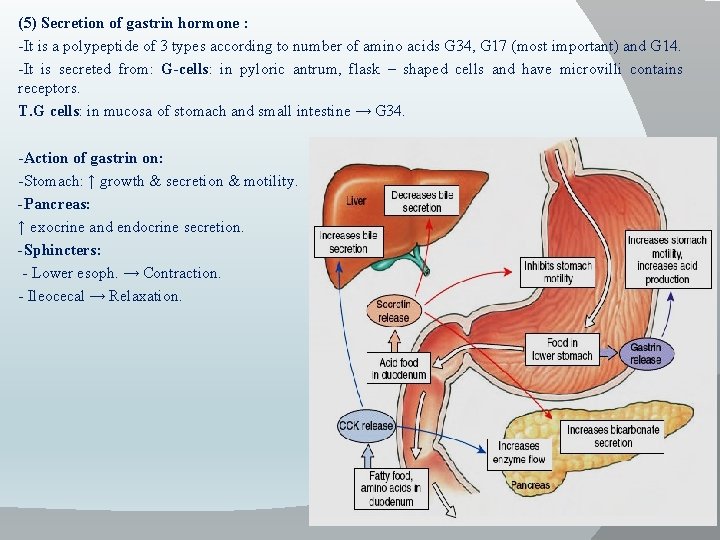
(5) Secretion of gastrin hormone : -It is a polypeptide of 3 types according to number of amino acids G 34, G 17 (most important) and G 14. -It is secreted from: G-cells: in pyloric antrum, flask – shaped cells and have microvilli contains receptors. T. G cells: in mucosa of stomach and small intestine → G 34. -Action of gastrin on: -Stomach: ↑ growth & secretion & motility. -Pancreas: ↑ exocrine and endocrine secretion. -Sphincters: - Lower esoph. → Contraction. - Ileocecal → Relaxation.
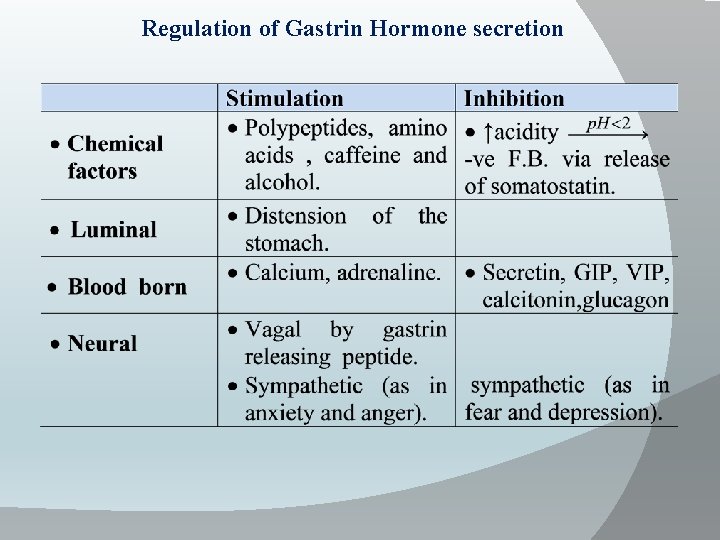
Regulation of Gastrin Hormone secretion
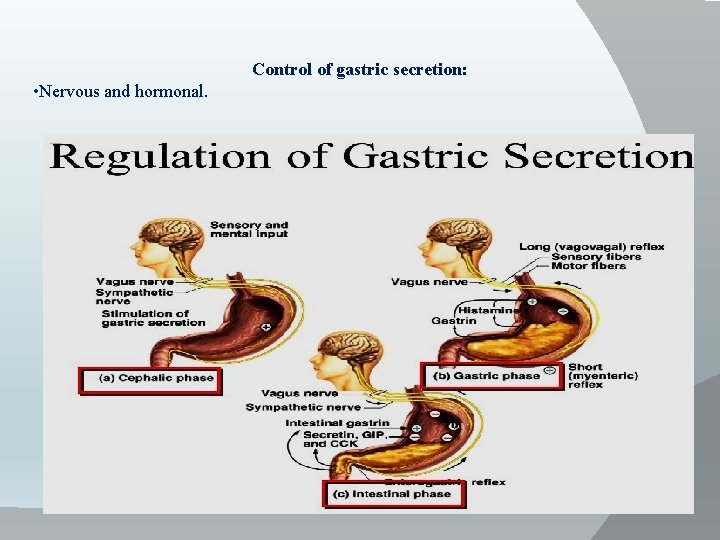
Control of gastric secretion: • Nervous and hormonal.
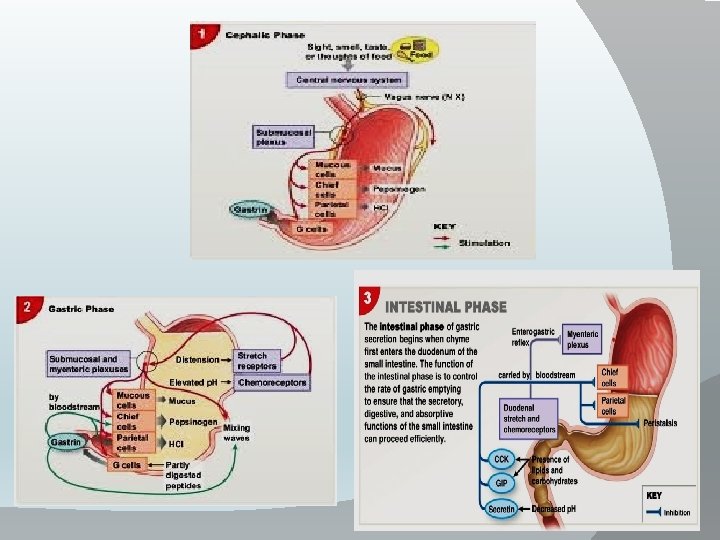
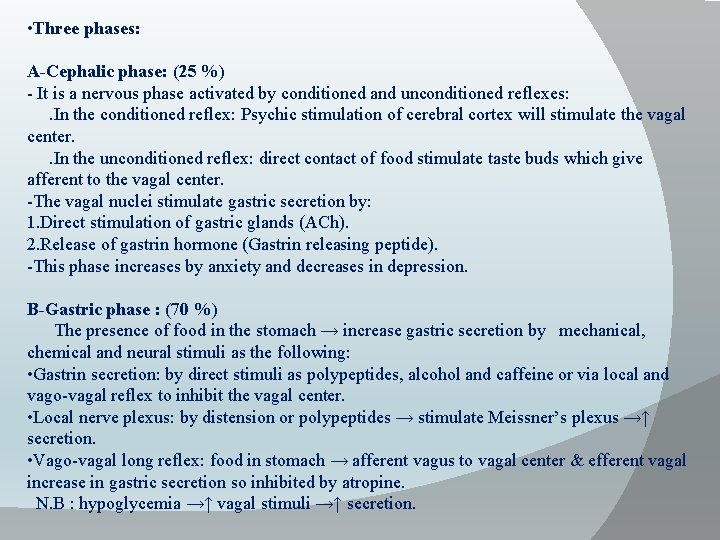
• Three phases: A-Cephalic phase: (25 %) - It is a nervous phase activated by conditioned and unconditioned reflexes: . In the conditioned reflex: Psychic stimulation of cerebral cortex will stimulate the vagal center. . In the unconditioned reflex: direct contact of food stimulate taste buds which give afferent to the vagal center. -The vagal nuclei stimulate gastric secretion by: 1. Direct stimulation of gastric glands (ACh). 2. Release of gastrin hormone (Gastrin releasing peptide). -This phase increases by anxiety and decreases in depression. B-Gastric phase : (70 %) The presence of food in the stomach → increase gastric secretion by mechanical, chemical and neural stimuli as the following: • Gastrin secretion: by direct stimuli as polypeptides, alcohol and caffeine or via local and vago-vagal reflex to inhibit the vagal center. • Local nerve plexus: by distension or polypeptides → stimulate Meissner’s plexus →↑ secretion. • Vago-vagal long reflex: food in stomach → afferent vagus to vagal center & efferent vagal increase in gastric secretion so inhibited by atropine. N. B : hypoglycemia →↑ vagal stimuli →↑ secretion.
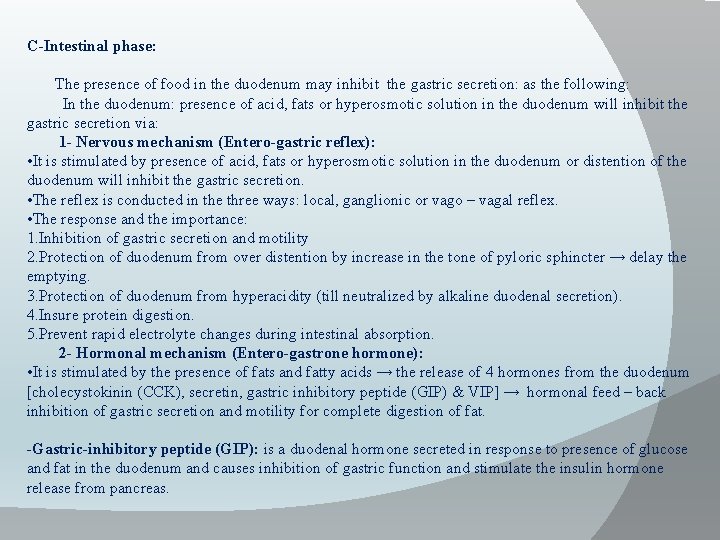
C-Intestinal phase: The presence of food in the duodenum may inhibit the gastric secretion: as the following: In the duodenum: presence of acid, fats or hyperosmotic solution in the duodenum will inhibit the gastric secretion via: 1 - Nervous mechanism (Entero-gastric reflex): • It is stimulated by presence of acid, fats or hyperosmotic solution in the duodenum or distention of the duodenum will inhibit the gastric secretion. • The reflex is conducted in the three ways: local, ganglionic or vago – vagal reflex. • The response and the importance: 1. Inhibition of gastric secretion and motility 2. Protection of duodenum from over distention by increase in the tone of pyloric sphincter → delay the emptying. 3. Protection of duodenum from hyperacidity (till neutralized by alkaline duodenal secretion). 4. Insure protein digestion. 5. Prevent rapid electrolyte changes during intestinal absorption. 2 - Hormonal mechanism (Entero-gastrone hormone): • It is stimulated by the presence of fats and fatty acids → the release of 4 hormones from the duodenum [cholecystokinin (CCK), secretin, gastric inhibitory peptide (GIP) & VIP] → hormonal feed – back inhibition of gastric secretion and motility for complete digestion of fat. -Gastric-inhibitory peptide (GIP): is a duodenal hormone secreted in response to presence of glucose and fat in the duodenum and causes inhibition of gastric function and stimulate the insulin hormone release from pancreas.
Thank You