
3 G Wireless Presentation Bryan Reamer Ma Yixing
3 G Wireless Presentation Bryan Reamer Ma Yixing Shu Yang IS 306 Telecommunication Networks
3 G wireless The next step in mobile communications – Define 3 G wireless – Where implementation is at – Constraints to Global implementation – Who benefits – What are the benefits
3 G’s ITU IMT-2000 definition Support circuit and packet data high bit rate – 144 kbps in high mobility(vehicular) traffic – 384 kbps for pedestrian traffic – 2 Mbps or higher for indoor traffic Interoperability and roaming common billing/ user profile – Sharing of usage/rate information between service provider – Standardized call detail recording – Standardized user profile Geographical position of mobiles and report it to both the network and the mobile terminal Support of multimedia services/ capabilities – – Fixed and variable bit rate traffic Bandwidth on demand Asymmetric data rates in forward and reverse links Multimedia store and forward – Broadband access up to 2 Mbps
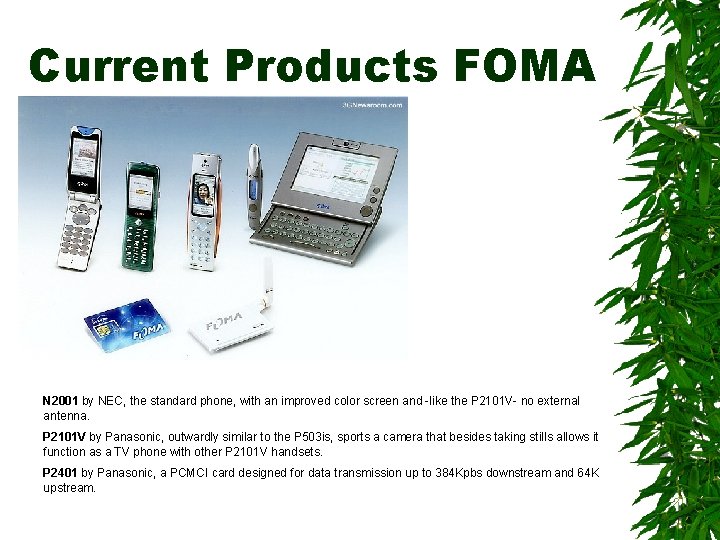
Current Products FOMA N 2001 by NEC, the standard phone, with an improved color screen and -like the P 2101 V- no external antenna. P 2101 V by Panasonic, outwardly similar to the P 503 is, sports a camera that besides taking stills allows it function as a TV phone with other P 2101 V handsets. P 2401 by Panasonic, a PCMCI card designed for data transmission up to 384 Kpbs downstream and 64 K upstream.
Wireless Services Available in US Verizon - cdma 2000 1 x technology up to 144 kbit/s but users should see speeds of 40 to 60 kbit/s on average. data speed 19. 2 kbps or less locally Sprint - Plans to upgrade by 2004 GPSR and EDGE Cingular - plans to start CDMA 2000 1 x AT&T - Deploying GSM/GPRS to 40% of its market, next to EDGE software to WCDMA T-Mobile - GSM/GPSR service Nextel Communications – unknown plans
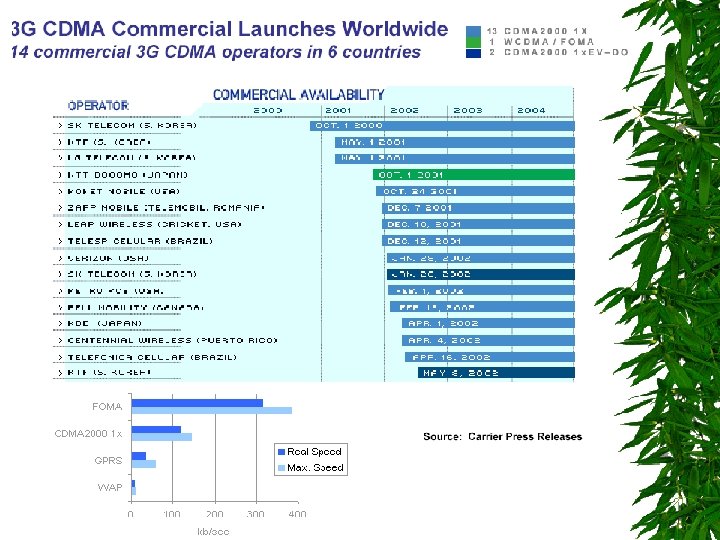
3 G wireless timeline ØSeptember 1998: Call in Do. Co. Mo's trial network ØOctober 1, 2001: NTT Do. Co. Mo launched commercial WCDMA 3 G mobile network. ØNovember 1, 2001: Live 3 G EDGE call. Ø December 1, 2001: Commercial UMTS network(Norway). No UMTS terminals Ø December 19, 2001: International UMTS 3 GPP roaming calls. Madrid - Tokyo. Ø January 28, 2002: Commercial CDMA 2000 1 x. EV-DO. ØFebruary 8, 2002: End-to-end 3 G WCDMA 3 GPP packet data calls Ø February 18, 2002: GSM/GPRS and 3 G/UMTS product. Ø February 20, 2002: Rich call in an end-to-end All-IP ØSeptember 24, 2002: Dual mode WCDMA/GSM calls with seamless handover between the two modes and high data rate in live networks ØSeptember 25, 2002: "Europe's First UMTS-Network" ØSeptember 26, 2002: Nokia [6650] for WCDMA [UMTS] and GSM networks". Ø October 1, 2002: Bluetooth WCDMA (UMTS) and GSM Voice Calls. ØOctober 3, 2002: Vo. IP call completed in a 3 GPP release 4 compliant network. ØOctober 10, 2002: UMTS voice and data calls demonstrating mobility across commercial cell sites using live 1900 MHz radio spectrum,
Reasons for delay Regulations Developing Technology Financial Considerations
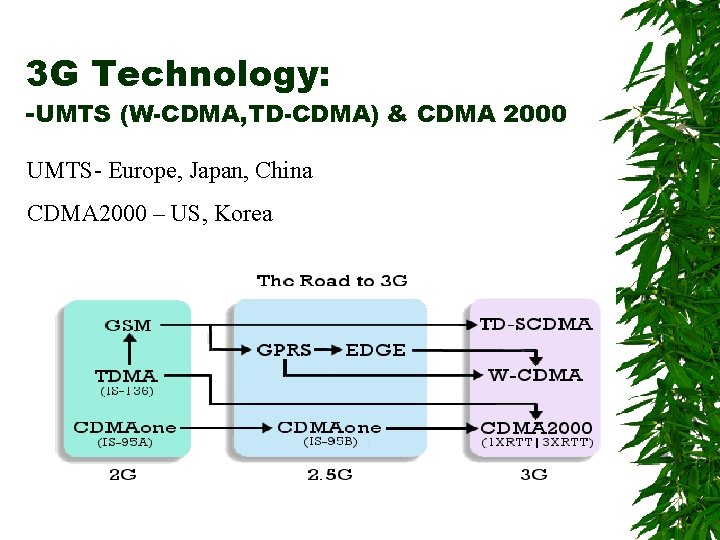
3 G Technology: -UMTS (W-CDMA, TD-CDMA) & CDMA 2000 UMTS- Europe, Japan, China CDMA 2000 – US, Korea
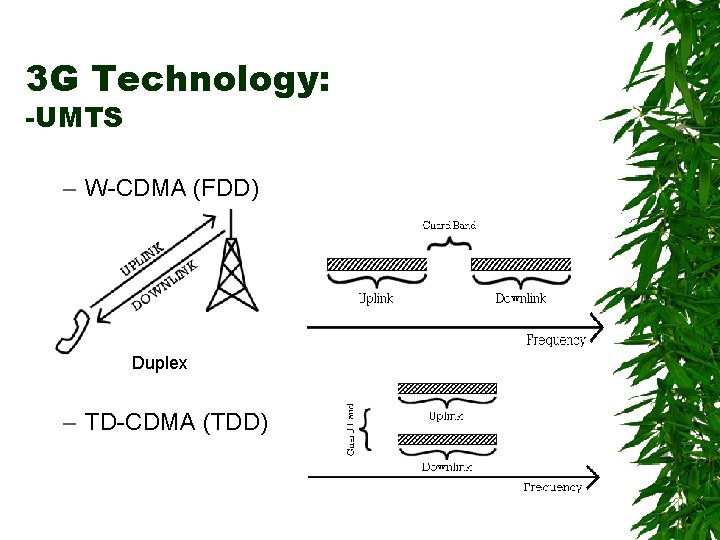
3 G Technology: -UMTS – W-CDMA (FDD) Duplex – TD-CDMA (TDD)
3 G Technology: -CDMA 2000 – 1 XRTT (144 Kbps) – 3 XRTT (2 Mbps) – 1 X EV (Evolution) 1 X EV-DO ("Data Only"): Separate frequencies for data and voice. 1 X EV-DV ("Data and Voice"): integrate voice and data on the same frequency band
W-CDMA vs. CDMA 2000 – W-CDMA: Brand new network, requires new spectrum. – CDMA 2000: Build on the old CDMA network, deploy fast, flexible in spectrum, more efficient for both voice and data, base station synchronization, existing in Korea.
Standardization: 3 GPP- UMTS 3 GPP 2 - CDMA 2000 Global Roaming
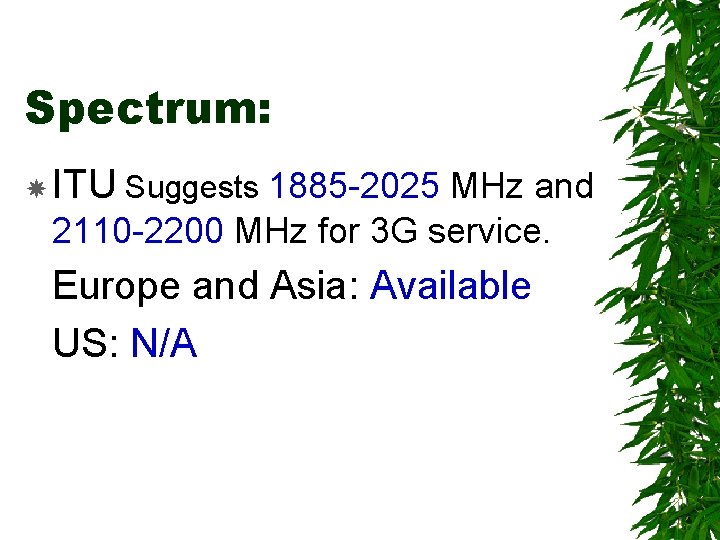
Spectrum: ITU Suggests 1885 -2025 MHz and 2110 -2200 MHz for 3 G service. Europe and Asia: Available US: N/A
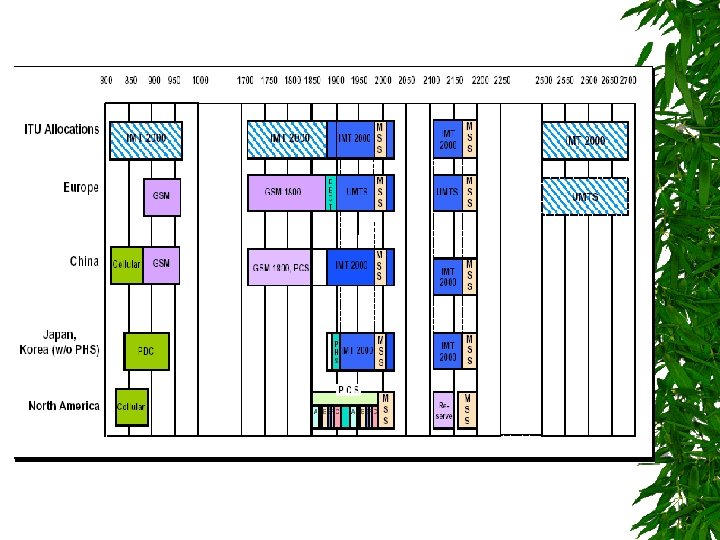
Spectrum: Regulators FCC (Federal Communication Commission) NTIA (National Communications and Information Administration) US, until September-2004 Demand is high, spectrums are limited Carriers need the license from government to run the business.
Is 3 G a wireless marvel or an investment disaster? The 3 G technology promises highspeed data, mobile streaming video and anytime-anywhere access. But implementation costs have significantly dampened enthusiasm.
Spectrum cost Limited spectrum Major carriers have to pay the $16 billion for getting the license from government auction of spectrum licenses. the prices some companies paid for licensing are affecting their ability to invest in 3 G infrastructure.
Technology cost WCDMA or CDMA 2000 Example of Korea and Japan The situation is similar in the U. S. Sprint PCS and other CDMA operators on the path to cheaper upgrade than those operators on the path to WCDMA. So the CDMA 2000 has time advantage, W-CDMA has scale. but this scale advantage need time.
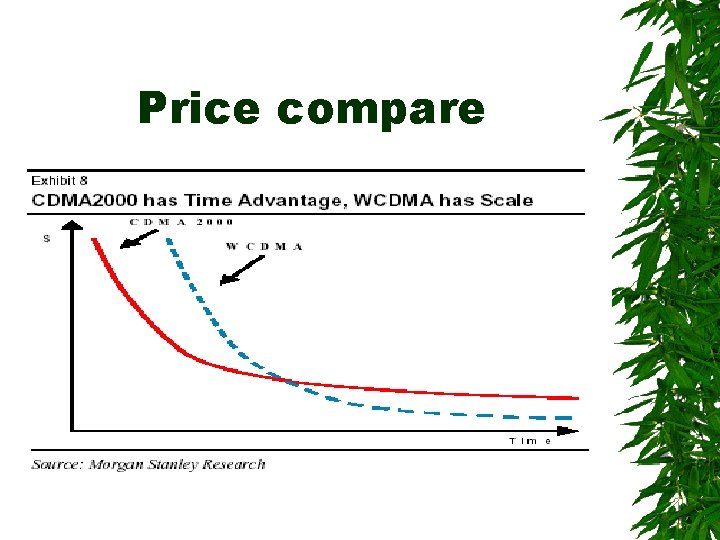
Price compare
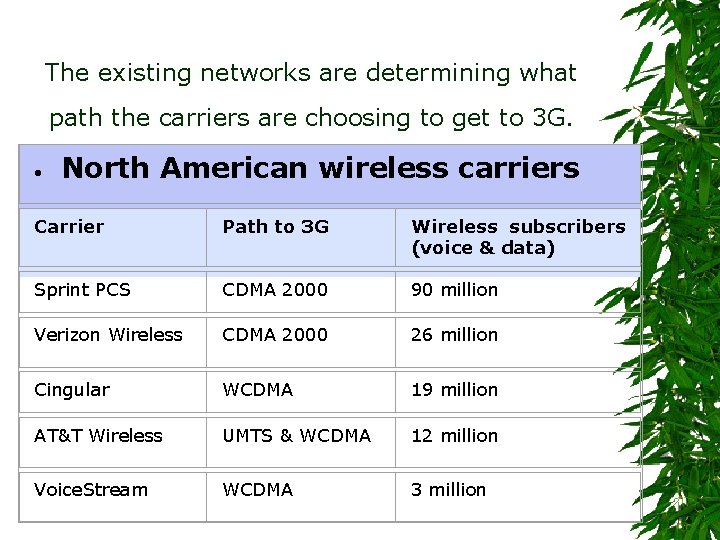
The existing networks are determining what path the carriers are choosing to get to 3 G. · North American wireless carriers Carrier Path to 3 G Wireless subscribers (voice & data) Sprint PCS CDMA 2000 90 million Verizon Wireless CDMA 2000 26 million Cingular WCDMA 19 million AT&T Wireless UMTS & WCDMA 12 million Voice. Stream WCDMA 3 million
Expensive devices and service to consumers In addition to 3 G's already expensive tag, the end user devices to be used in conjunction with the next generation of wireless infrastructure also expected to be expensive. It's estimated that 3 G-enabled handsets will cost $300, in addition to monthly service fees that could be as high as $90.
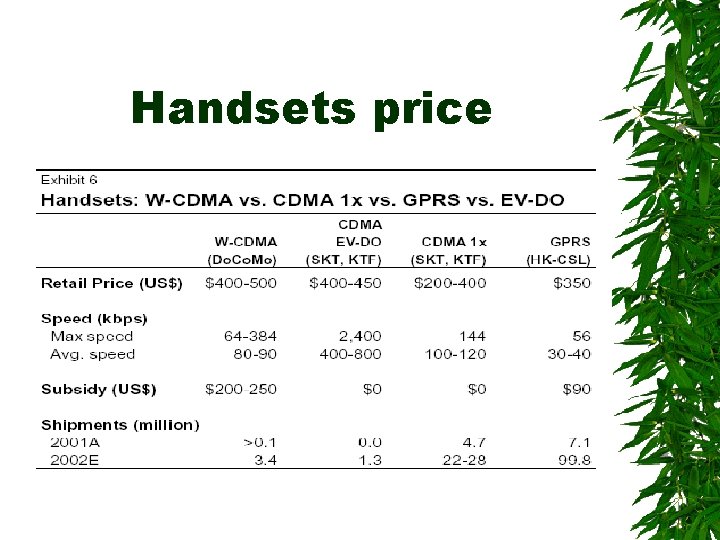
Handsets price
Huge market Despite these hurdles, major carries and equipment vendors have mostly laid out their blueprints for migrating toward 3 G technology. China already is the world's largest cell phone market, with 180 million subscribers and growing.
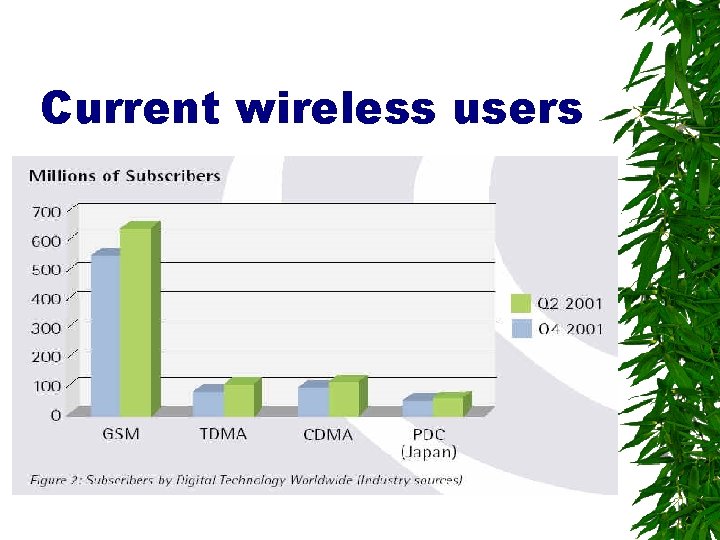
Current wireless users
Conclusion There are several factors that delay the deployment of 3 G systems worldwide, but it is such a large market issue companies will continue to use resources in developing 3 G technologies.

Q&A
- Slides: 27