
3 G Mobile Data Networks Overview of Architecture
3 G & Mobile Data Networks Overview of Architecture, Design & Case Studies Simon Newstead APAC Product Manager snewstead@juniper. net Copyright © 2003 Juniper Networks, Inc. Proprietary and Confidential www. juniper. net 1
Agenda § Mobile overview and the transition to 3 G § 2. 5 G data networks § 3 G - phases of deployment. Focus areas: • Layer 2/MPLS migration • IP RAN and transition techniques • IP Multimedia subsystem and Qo. S • ‘Push to Talk’ example • IPv 6 § WLAN integration options § Case studies Copyright © 2003 Juniper Networks, Inc. CONFIDENTIAL www. juniper. net 2
Agenda § Mobile overview and the transition to 3 G § 2. 5 G data networks § 3 G - phases of deployment. Focus areas: • Layer 2/MPLS migration • IP RAN and transition techniques • IP Multimedia subsystem and Qo. S • ‘Push to Talk’ example • IPv 6 § WLAN integration options § Case studies Copyright © 2003 Juniper Networks, Inc. CONFIDENTIAL www. juniper. net 3

Why 3 G? § Higher bandwidth enables a range of new applications!! § For the consumer • Video streaming, TV broadcast • Video calls, video clips – news, music, sports • Enhanced gaming, chat, location services… § For business • High speed teleworking / VPN access • Sales force automation • Video conferencing • Real-time financial information Copyright © 2003 Juniper Networks, Inc. CONFIDENTIAL www. juniper. net 4
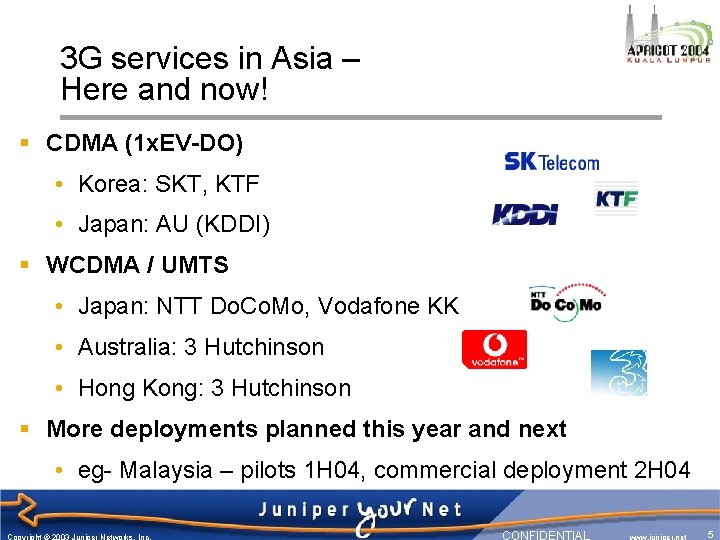
3 G services in Asia – Here and now! § CDMA (1 x. EV-DO) • Korea: SKT, KTF • Japan: AU (KDDI) § WCDMA / UMTS • Japan: NTT Do. Co. Mo, Vodafone KK • Australia: 3 Hutchinson • Hong Kong: 3 Hutchinson § More deployments planned this year and next • eg- Malaysia – pilots 1 H 04, commercial deployment 2 H 04 Copyright © 2003 Juniper Networks, Inc. CONFIDENTIAL www. juniper. net 5
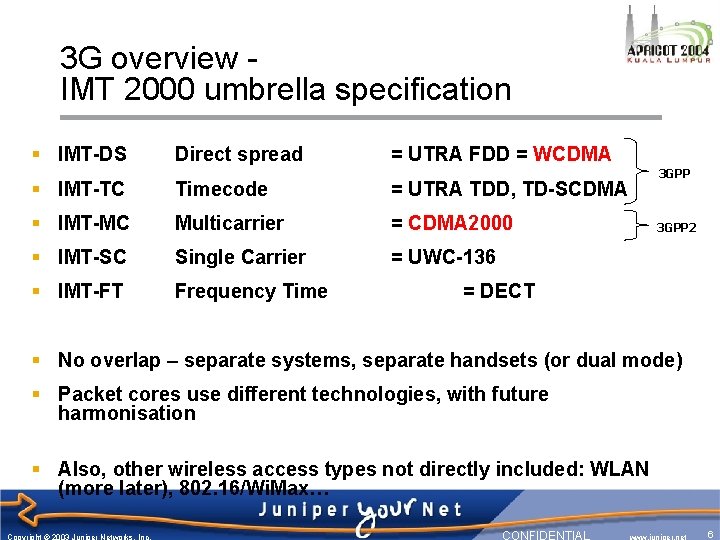
3 G overview IMT 2000 umbrella specification § IMT-DS Direct spread = UTRA FDD = WCDMA § IMT-TC Timecode = UTRA TDD, TD-SCDMA § IMT-MC Multicarrier = CDMA 2000 § IMT-SC Single Carrier = UWC-136 § IMT-FT Frequency Time 3 GPP 2 = DECT § No overlap – separate systems, separate handsets (or dual mode) § Packet cores use different technologies, with future harmonisation § Also, other wireless access types not directly included: WLAN (more later), 802. 16/Wi. Max… Copyright © 2003 Juniper Networks, Inc. CONFIDENTIAL www. juniper. net 6
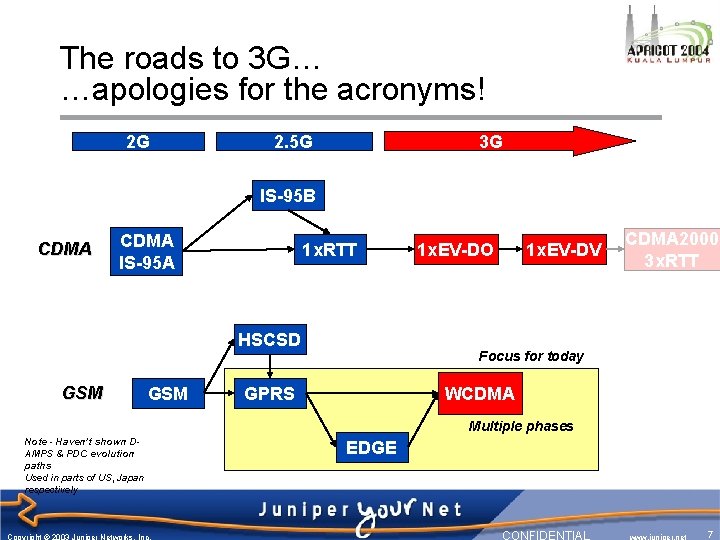
The roads to 3 G… …apologies for the acronyms! 2 G 3 G 2. 5 G IS-95 B CDMA IS-95 A 1 x. RTT HSCSD GSM 1 x. EV-DO 1 x. EV-DV CDMA 2000 3 x. RTT Focus for today GPRS WCDMA Multiple phases Note - Haven’t shown DAMPS & PDC evolution paths Used in parts of US, Japan respectively Copyright © 2003 Juniper Networks, Inc. EDGE CONFIDENTIAL www. juniper. net 7
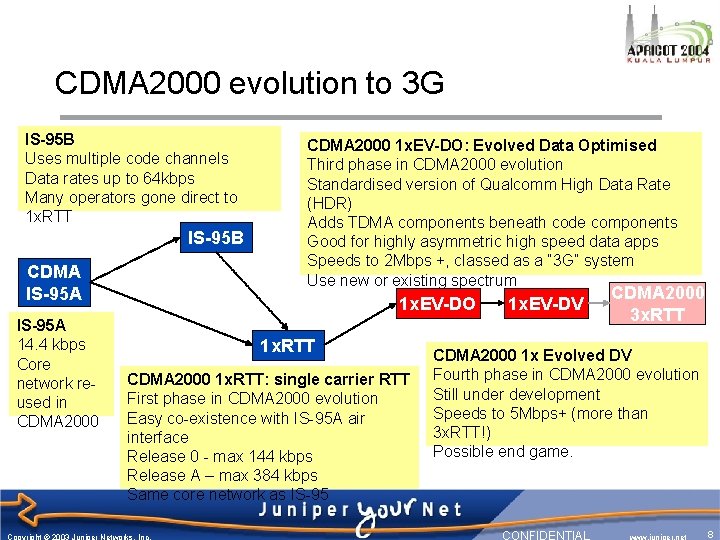
CDMA 2000 evolution to 3 G IS-95 B Uses multiple code channels Data rates up to 64 kbps Many operators gone direct to 1 x. RTT IS-95 B CDMA IS-95 A 14. 4 kbps Core network reused in CDMA 2000 1 x. EV-DO: Evolved Data Optimised Third phase in CDMA 2000 evolution Standardised version of Qualcomm High Data Rate (HDR) Adds TDMA components beneath code components Good for highly asymmetric high speed data apps Speeds to 2 Mbps +, classed as a “ 3 G” system Use new or existing spectrum 1 x. EV-DO 1 x. RTT CDMA 2000 1 x. RTT: single carrier RTT First phase in CDMA 2000 evolution Easy co-existence with IS-95 A air interface Release 0 - max 144 kbps Release A – max 384 kbps Same core network as IS-95 Copyright © 2003 Juniper Networks, Inc. 1 x. EV-DV CDMA 2000 3 x. RTT CDMA 2000 1 x Evolved DV Fourth phase in CDMA 2000 evolution Still under development Speeds to 5 Mbps+ (more than 3 x. RTT!) Possible end game. CONFIDENTIAL www. juniper. net 8
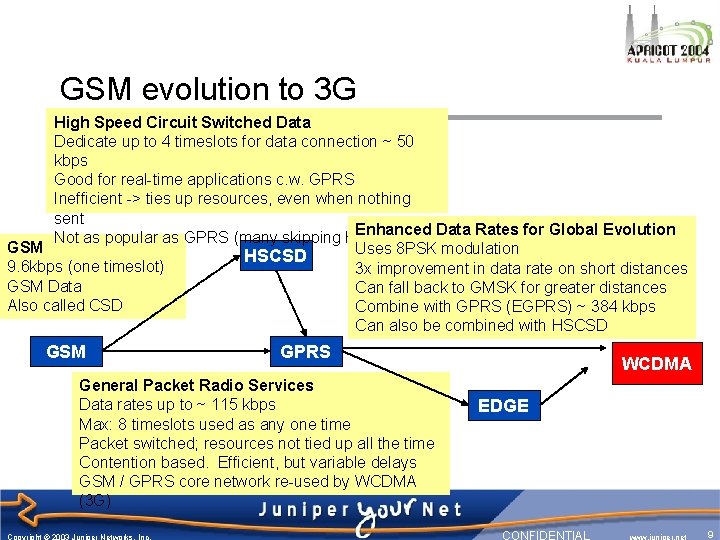
GSM evolution to 3 G High Speed Circuit Switched Data Dedicate up to 4 timeslots for data connection ~ 50 kbps Good for real-time applications c. w. GPRS Inefficient -> ties up resources, even when nothing sent Enhanced Data Rates for Global Evolution Not as popular as GPRS (many skipping HSCSD) GSM Uses 8 PSK modulation HSCSD 9. 6 kbps (one timeslot) 3 x improvement in data rate on short distances GSM Data Can fall back to GMSK for greater distances Also called CSD Combine with GPRS (EGPRS) ~ 384 kbps Can also be combined with HSCSD GSM GPRS General Packet Radio Services Data rates up to ~ 115 kbps Max: 8 timeslots used as any one time Packet switched; resources not tied up all the time Contention based. Efficient, but variable delays GSM / GPRS core network re-used by WCDMA (3 G) Copyright © 2003 Juniper Networks, Inc. WCDMA EDGE CONFIDENTIAL www. juniper. net 9
Mobile Basics: Quick Recap of 2 G systems Copyright © 2003 Juniper Networks, Inc. CONFIDENTIAL www. juniper. net 10
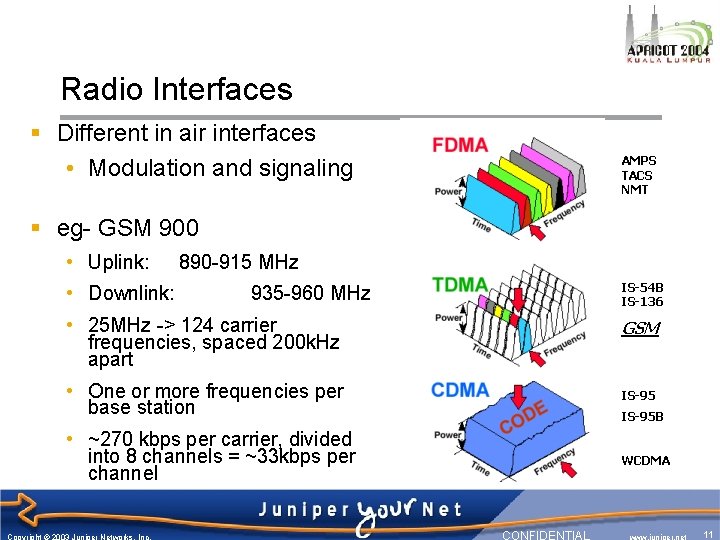
Radio Interfaces § Different in air interfaces • Modulation and signaling AMPS TACS NMT § eg- GSM 900 • Uplink: • Downlink: 890 -915 MHz IS-54 B IS-136 935 -960 MHz • 25 MHz -> 124 carrier frequencies, spaced 200 k. Hz apart GSM • One or more frequencies per base station IS-95 • ~270 kbps per carrier, divided into 8 channels = ~33 kbps per channel WCDMA Copyright © 2003 Juniper Networks, Inc. IS-95 B CONFIDENTIAL www. juniper. net 11
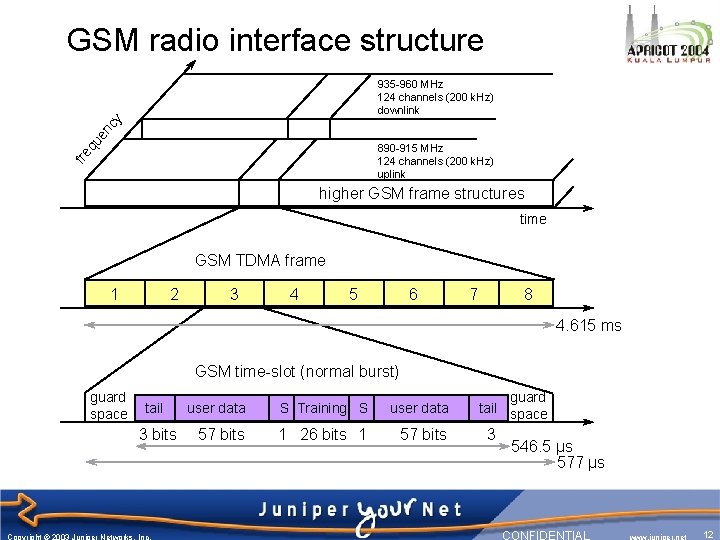
GSM radio interface structure qu en cy 935 -960 MHz 124 channels (200 k. Hz) downlink fre 890 -915 MHz 124 channels (200 k. Hz) uplink higher GSM frame structures time GSM TDMA frame 1 2 3 4 5 6 7 8 4. 615 ms GSM time-slot (normal burst) guard space tail 3 bits Copyright © 2003 Juniper Networks, Inc. user data S Training S user data 57 bits 1 26 bits 1 57 bits guard tail space 3 546. 5 µs 577 µs CONFIDENTIAL www. juniper. net 12
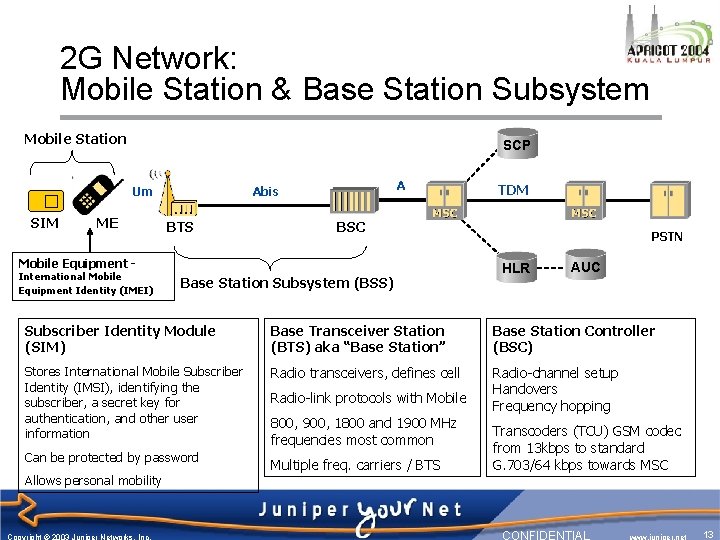
2 G Network: Mobile Station & Base Station Subsystem Mobile Station SCP Um SIM ME A Abis BTS BSC Mobile Equipment - International Mobile Equipment Identity (IMEI) TDM Base Station Subsystem (BSS) PSTN HLR AUC Subscriber Identity Module (SIM) Base Transceiver Station (BTS) aka “Base Station” Base Station Controller (BSC) Stores International Mobile Subscriber Identity (IMSI), identifying the subscriber, a secret key for authentication, and other user information Radio transceivers, defines cell Radio channel setup Handovers Frequency hopping Can be protected by password Allows personal mobility Copyright © 2003 Juniper Networks, Inc. Radio link protocols with Mobile 800, 900, 1800 and 1900 MHz frequencies most common Multiple freq. carriers / BTS Transcoders (TCU) GSM codec from 13 kbps to standard G. 703/64 kbps towards MSC CONFIDENTIAL www. juniper. net 13
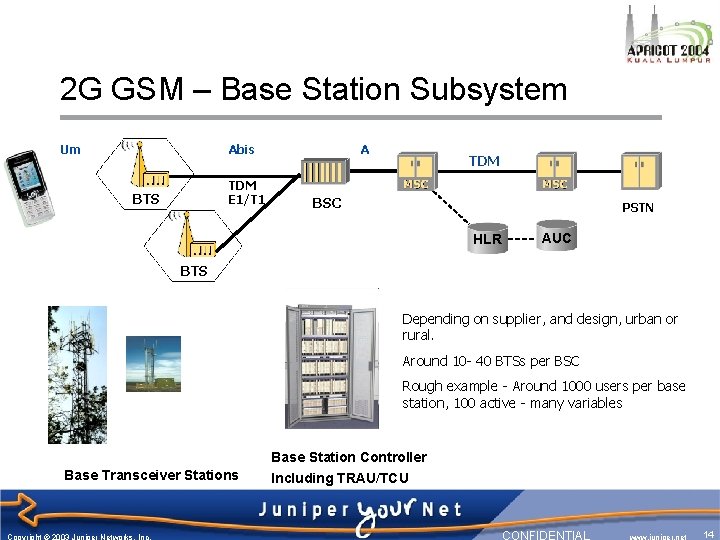
2 G GSM – Base Station Subsystem Um Abis TDM E 1/T 1 BTS A TDM BSC PSTN HLR AUC BTS Depending on supplier, and design, urban or rural. Around 10 40 BTSs per BSC Rough example Around 1000 users per base station, 100 active many variables Base Transceiver Stations Copyright © 2003 Juniper Networks, Inc. Base Station Controller Including TRAU/TCU CONFIDENTIAL www. juniper. net 14
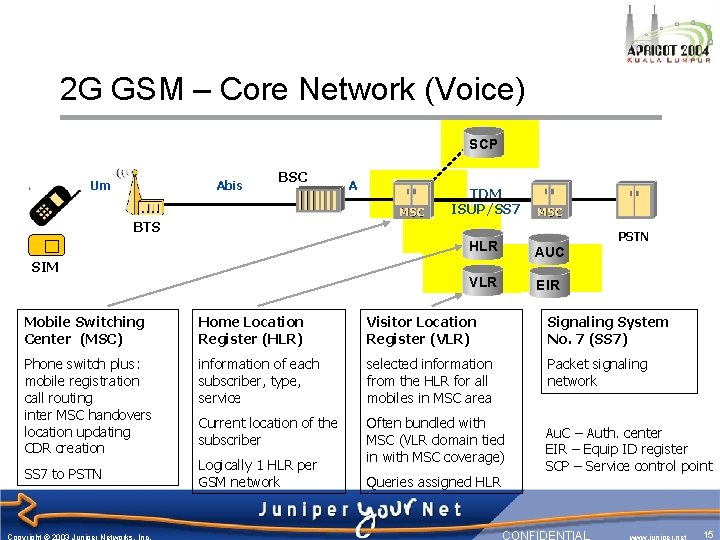
2 G GSM – Core Network (Voice) SCP Um Abis BSC A TDM ISUP/SS 7 BTS SIM PSTN HLR AUC VLR EIR Mobile Switching Center (MSC) Home Location Register (HLR) Visitor Location Register (VLR) Signaling System No. 7 (SS 7) Phone switch plus: mobile registration call routing inter MSC handovers location updating CDR creation information of each subscriber, type, service selected information from the HLR for all mobiles in MSC area Packet signaling network Current location of the subscriber Often bundled with MSC (VLR domain tied in with MSC coverage) SS 7 to PSTN Copyright © 2003 Juniper Networks, Inc. Logically 1 HLR per GSM network Queries assigned HLR Au. C – Auth. center EIR – Equip ID register SCP – Service control point CONFIDENTIAL www. juniper. net 15
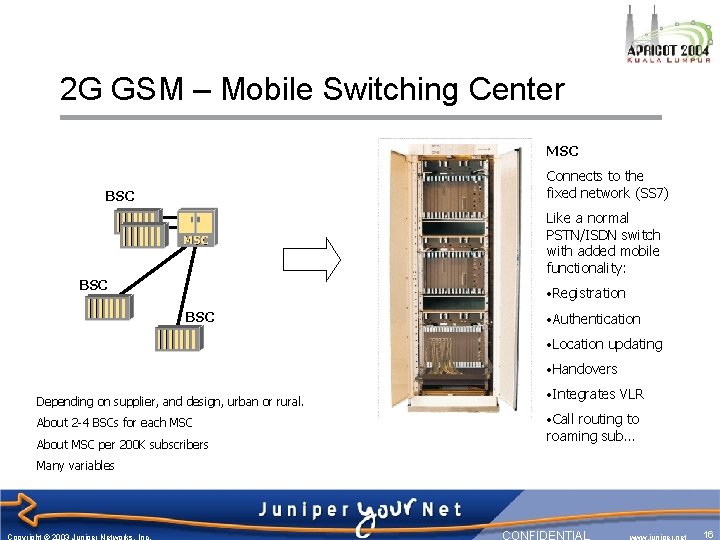
2 G GSM – Mobile Switching Center MSC Connects to the fixed network (SS 7) BSC Like a normal PSTN/ISDN switch with added mobile functionality: BSC • Registration BSC • Authentication • Location updating • Handovers Depending on supplier, and design, urban or rural. About 2 4 BSCs for each MSC About MSC per 200 K subscribers • Integrates VLR • Call routing to roaming sub… Many variables Copyright © 2003 Juniper Networks, Inc. CONFIDENTIAL www. juniper. net 16
Agenda § Mobile overview and the transition to 3 G § 2. 5 G data networks § 3 G - phases of deployment. Focus areas: • Layer 2/MPLS migration • IP RAN and transition techniques • IP Multimedia subsystem and Qo. S • ‘Push to Talk’ example • IPv 6 § WLAN integration options § Case studies Copyright © 2003 Juniper Networks, Inc. CONFIDENTIAL www. juniper. net 17
GPRS…. What is it? § General Packet Radio Service • 2. 5 G data service overlaid on an existing GSM network • Mobile station uses up to 8 timeslots (channels) for GPRS data connection from Mobile Station • Timeslots are shared amongst users (and voice) § Variable performance… • Packet Random Access, Packet Switched • Slotted Aloha Reservation / Contention handling • Throughput depends on coding scheme, # timeslots etc • From ~ 9 kbps min to max. of 171. 8 kbps (in theory!) Copyright © 2003 Juniper Networks, Inc. CONFIDENTIAL www. juniper. net 18
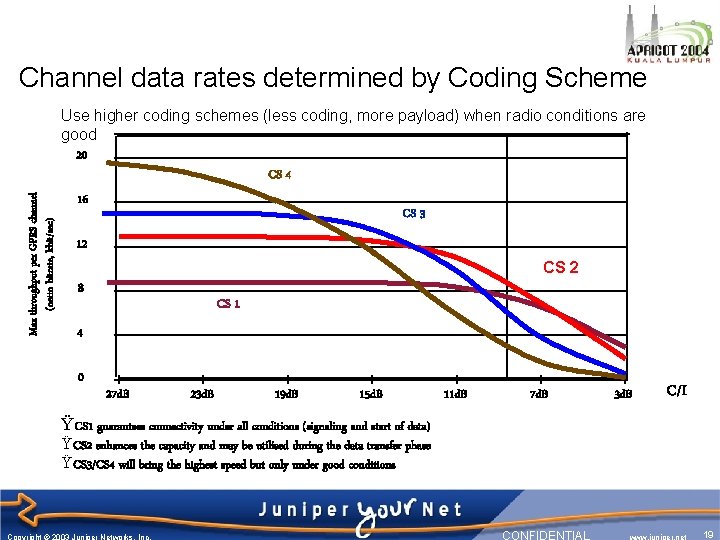
Channel data rates determined by Coding Scheme Max throughput per GPRS channel (netto bitrate, kbit/sec) Use higher coding schemes (less coding, more payload) when radio conditions are good 20 CS 4 16 CS 3 12 CS 2 8 CS 1 4 0 27 d. B 23 d. B 19 d. B 15 d. B 11 d. B 7 d. B 3 d. B C/I ŸCS 1 guarantees connectivity under all conditions (signaling and start of data) ŸCS 2 enhances the capacity and may be utilised during the data transfer phase ŸCS 3/CS 4 will bring the highest speed but only under good conditions Copyright © 2003 Juniper Networks, Inc. CONFIDENTIAL www. juniper. net 19
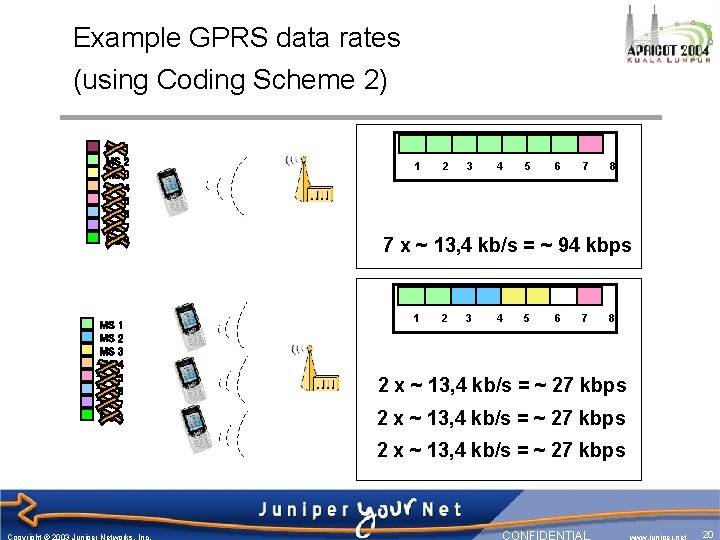
Example GPRS data rates (using Coding Scheme 2) MS MS MS MS 1 2 3 4 5 6 7 8 7 x ~ 13, 4 kb/s = ~ 94 kbps 1 2 3 4 5 6 7 8 2 x ~ 13, 4 kb/s = ~ 27 kbps Copyright © 2003 Juniper Networks, Inc. CONFIDENTIAL www. juniper. net 20
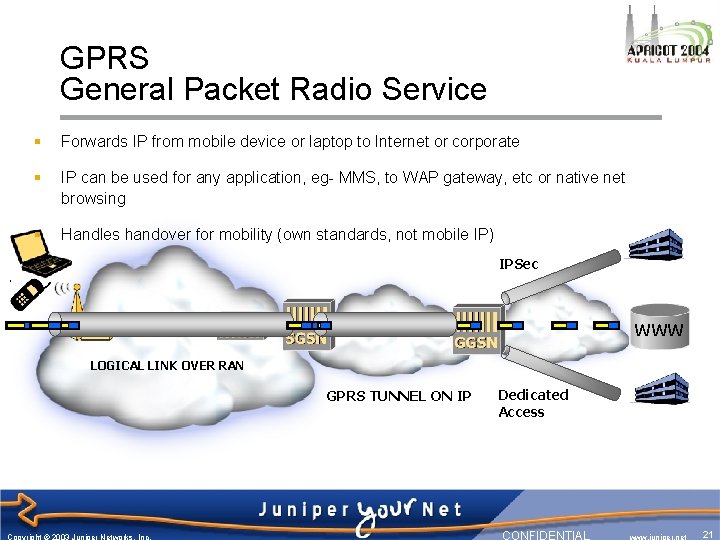
GPRS General Packet Radio Service § Forwards IP from mobile device or laptop to Internet or corporate § IP can be used for any application, eg- MMS, to WAP gateway, etc or native net browsing § Handles handover for mobility (own standards, not mobile IP) IPSec WWW LOGICAL LINK OVER RAN GPRS TUNNEL ON IP Copyright © 2003 Juniper Networks, Inc. Dedicated Access CONFIDENTIAL www. juniper. net 21
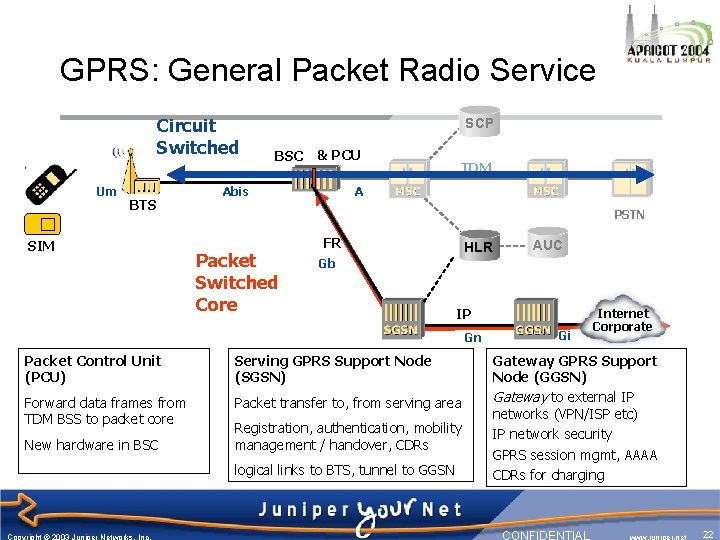
GPRS: General Packet Radio Service Circuit Switched Um BTS SIM SCP BSC & PCU Abis TDM A PSTN Packet Switched Core FR HLR Gb IP Gn Packet Control Unit (PCU) Serving GPRS Support Node (SGSN) Forward data frames from TDM BSS to packet core Packet transfer to, from serving area New hardware in BSC Registration, authentication, mobility management / handover, CDRs logical links to BTS, tunnel to GGSN Copyright © 2003 Juniper Networks, Inc. AUC Gi Internet Corporate Gateway GPRS Support Node (GGSN) Gateway to external IP networks (VPN/ISP etc) IP network security GPRS session mgmt, AAAA CDRs for charging CONFIDENTIAL www. juniper. net 22
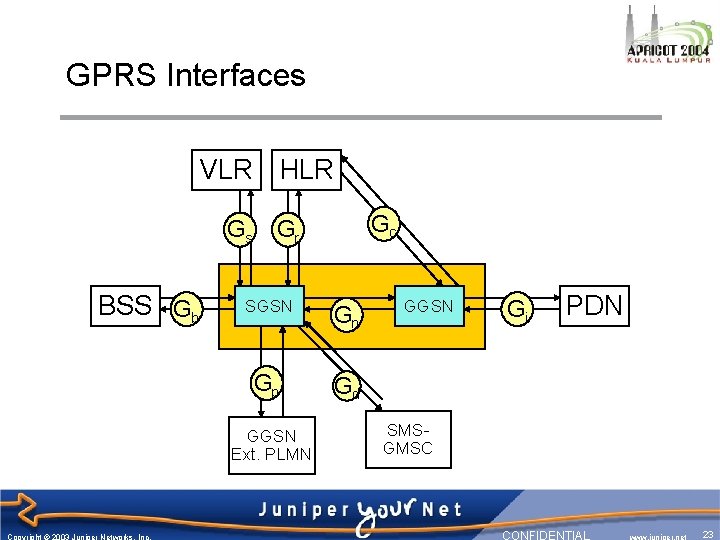
GPRS Interfaces VLR HLR Gs BSS Gb SGSN Gn Gp Gd GGSN Ext. PLMN Copyright © 2003 Juniper Networks, Inc. Gc Gr GGSN Gi PDN SMSGMSC CONFIDENTIAL www. juniper. net 23
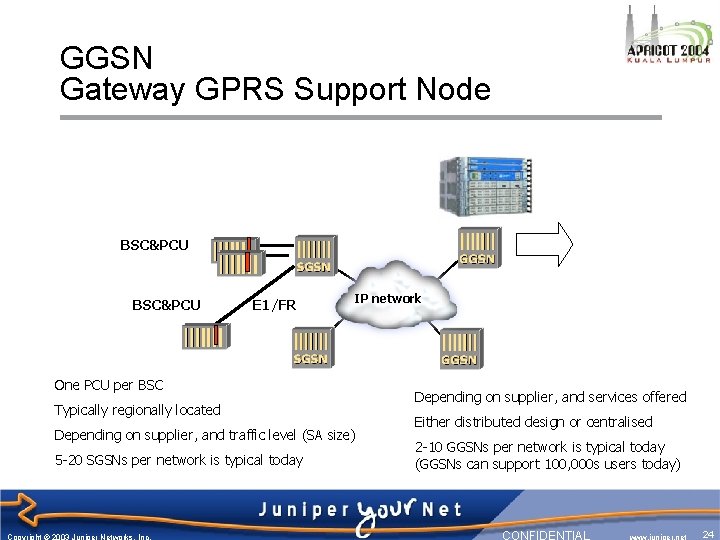
GGSN Gateway GPRS Support Node BSC&PCU E 1/FR IP network One PCU per BSC Typically regionally located Depending on supplier, and traffic level (SA size) 5 20 SGSNs per network is typical today Copyright © 2003 Juniper Networks, Inc. Depending on supplier, and services offered Either distributed design or centralised 2 10 GGSNs per network is typical today (GGSNs can support 100, 000 s users today) CONFIDENTIAL www. juniper. net 24
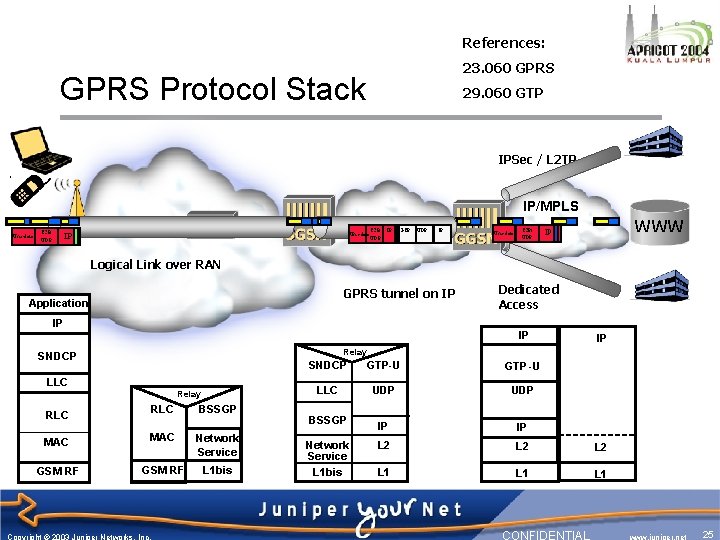
References: 23. 060 GPRS Protocol Stack 29. 060 GTP IPSec / L 2 TP IP/MPLS User-data TCP/ UDP IP User-data TCP/ IP GTP UDP IP UDP User-data TCP/ UDP WWW IP Logical Link over RAN GPRS tunnel on IP Application IP Dedicated Access IP IP Relay SNDCP LLC Relay RLC BSSGP MAC Network Service GSM RF L 1 bis RLC Copyright © 2003 Juniper Networks, Inc. SNDCP GTP-U GTP -U LLC UDP IP IP L 2 L 2 L 1 BSSGP Network Service L 1 bis L 1 CONFIDENTIAL Gi www. juniper. net 25
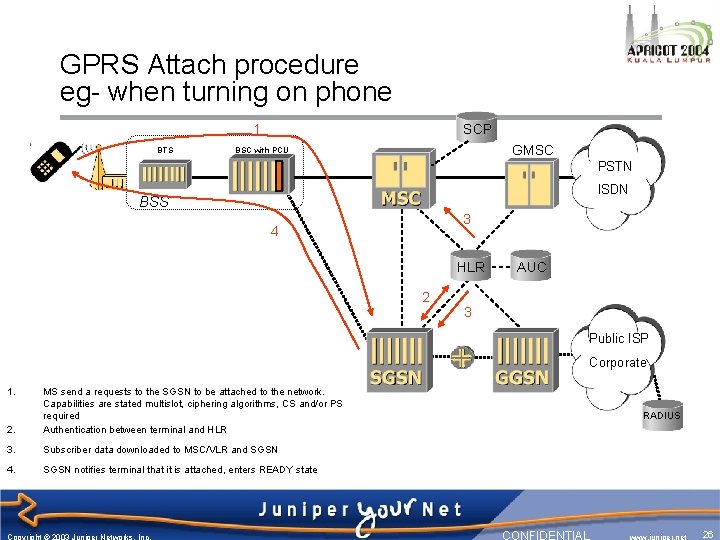
GPRS Attach procedure eg- when turning on phone 1 BTS SCP GMSC BSC with PCU PSTN ISDN BSS 3 4 HLR 2 AUC 3 Public ISP Corporate 1. 2. MS send a requests to the SGSN to be attached to the network. Capabilities are stated multislot, ciphering algorithms, CS and/or PS required Authentication between terminal and HLR 3. Subscriber data downloaded to MSC/VLR and SGSN 4. SGSN notifies terminal that it is attached, enters READY state Copyright © 2003 Juniper Networks, Inc. RADIUS CONFIDENTIAL www. juniper. net 26
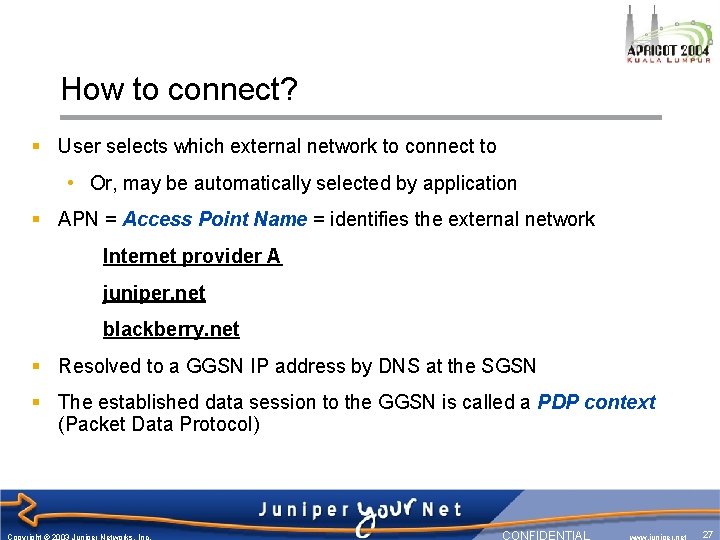
How to connect? § User selects which external network to connect to • Or, may be automatically selected by application § APN = Access Point Name = identifies the external network Internet provider A juniper. net blackberry. net § Resolved to a GGSN IP address by DNS at the SGSN § The established data session to the GGSN is called a PDP context (Packet Data Protocol) Copyright © 2003 Juniper Networks, Inc. CONFIDENTIAL www. juniper. net 27
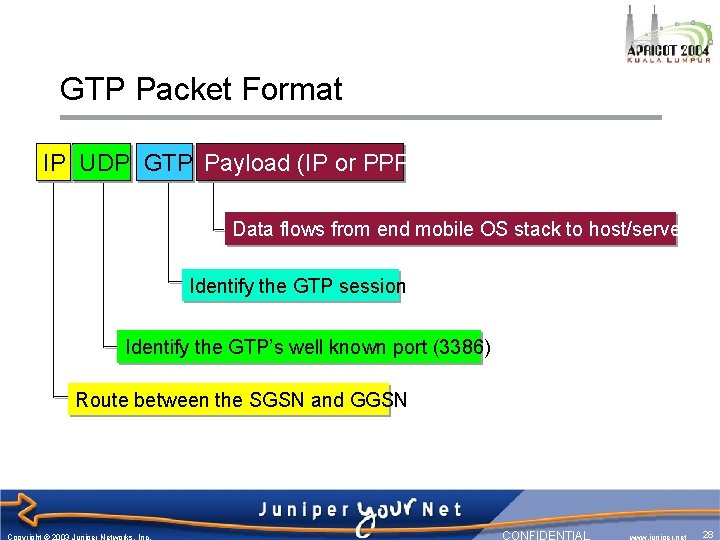
GPRS Tunneling Protocol (GTP) GTP Packet Format IP UDP GTP Payload (IP or PPP) Data flows from end mobile OS stack to host/server Identify the GTP session Identify the GTP’s well known port (3386) Route between the SGSN and GGSN Copyright © 2003 Juniper Networks, Inc. CONFIDENTIAL www. juniper. net 28
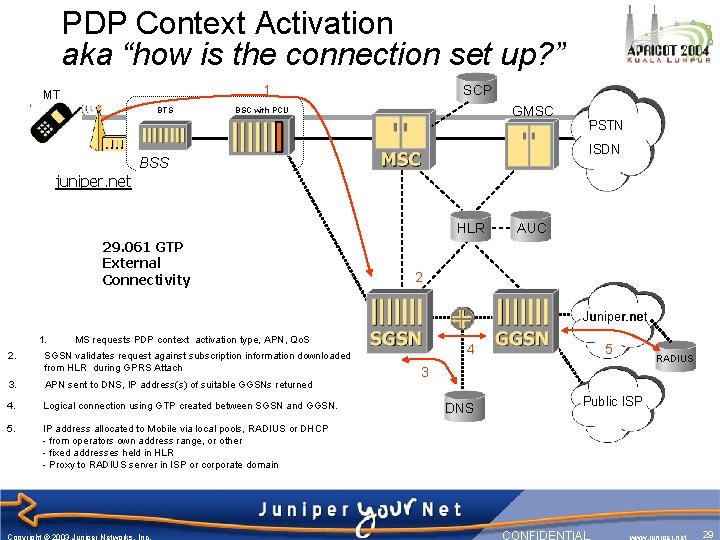
PDP Context Activation aka “how is the connection set up? ” 1 MT BTS juniper. net SCP GMSC BSC with PCU ISDN BSS HLR 29. 061 GTP External Connectivity PSTN AUC 2 Juniper. net 1. MS requests PDP context activation type, APN, Qo. S 2. SGSN validates request against subscription information downloaded from HLR during GPRS Attach 3. APN sent to DNS, IP address(s) of suitable GGSNs returned 4. Logical connection using GTP created between SGSN and GGSN. 5. IP address allocated to Mobile via local pools, RADIUS or DHCP - from operators own address range, or other - fixed addresses held in HLR - Proxy to RADIUS server in ISP or corporate domain Copyright © 2003 Juniper Networks, Inc. 5 4 RADIUS 3 DNS Public ISP CONFIDENTIAL www. juniper. net 29
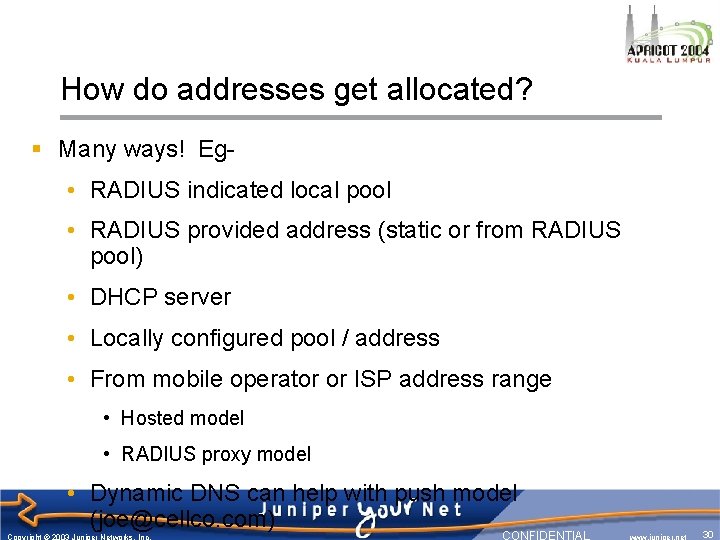
How do addresses get allocated? § Many ways! Eg • RADIUS indicated local pool • RADIUS provided address (static or from RADIUS pool) • DHCP server • Locally configured pool / address • From mobile operator or ISP address range • Hosted model • RADIUS proxy model • Dynamic DNS can help with push model (joe@cellco. com) Copyright © 2003 Juniper Networks, Inc. CONFIDENTIAL www. juniper. net 30
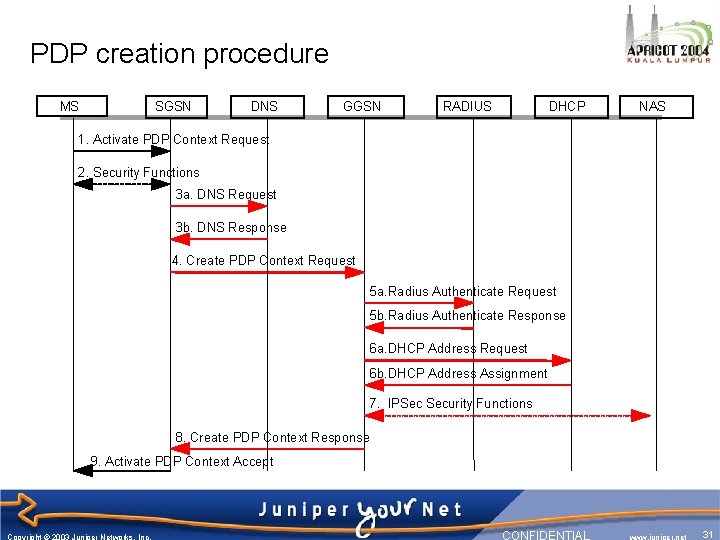
PDP creation procedure PDP Context Activation Procedure SGSN DNS GGSN MS RADIUS DHCP NAS 1. Activate PDP Context Request 2. Security Functions 3 a. DNS Request 3 b. DNS Response 4. Create PDP Context Request 5 a. Radius Authenticate Request 5 b. Radius Authenticate Response 6 a. DHCP Address Request 6 b. DHCP Address Assignment 7. IPSec Security Functions 8. Create PDP Context Response 9. Activate PDP Context Accept Copyright © 2003 Juniper Networks, Inc. CONFIDENTIAL www. juniper. net 31
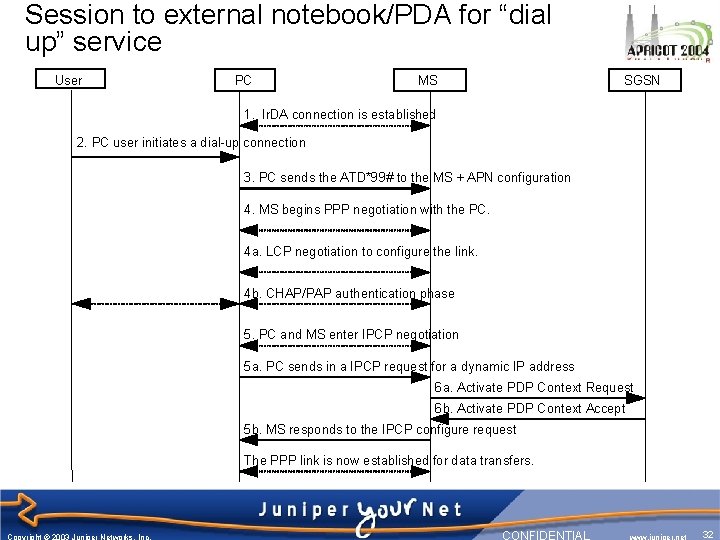
Session to external notebook/PDA for “dial up” service PDP User Context Activation to MS PC Procedure -- PC MS SGSN 1. Ir. DA connection is established 2. PC user initiates a dial-up connection 3. PC sends the ATD*99# to the MS + APN configuration 4. MS begins PPP negotiation with the PC. 4 a. LCP negotiation to configure the link. 4 b. CHAP/PAP authentication phase 5. PC and MS enter IPCP negotiation 5 a. PC sends in a IPCP request for a dynamic IP address 6 a. Activate PDP Context Request 6 b. Activate PDP Context Accept 5 b. MS responds to the IPCP configure request The PPP link is now established for data transfers. Copyright © 2003 Juniper Networks, Inc. CONFIDENTIAL www. juniper. net 32
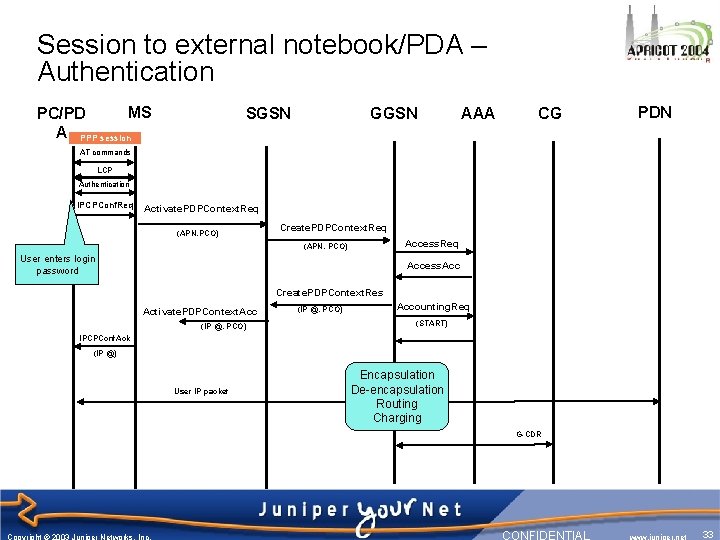
Session to external notebook/PDA – Authentication MS PC/PD A PPP session SGSN GGSN AAA CG PDN AT commands LCP Authentication IPCPConf. Req Activate. PDPContext. Req (APN, PCO) Create. PDPContext. Req Access. Req (APN, PCO) User enters login password Access. Acc Create. PDPContext. Res Activate. PDPContext. Acc (IP @, PCO) Accounting. Req (START) IPCPConf. Ack (IP @) User IP packet Encapsulation De-encapsulation Routing Charging G-CDR Copyright © 2003 Juniper Networks, Inc. CONFIDENTIAL www. juniper. net 33
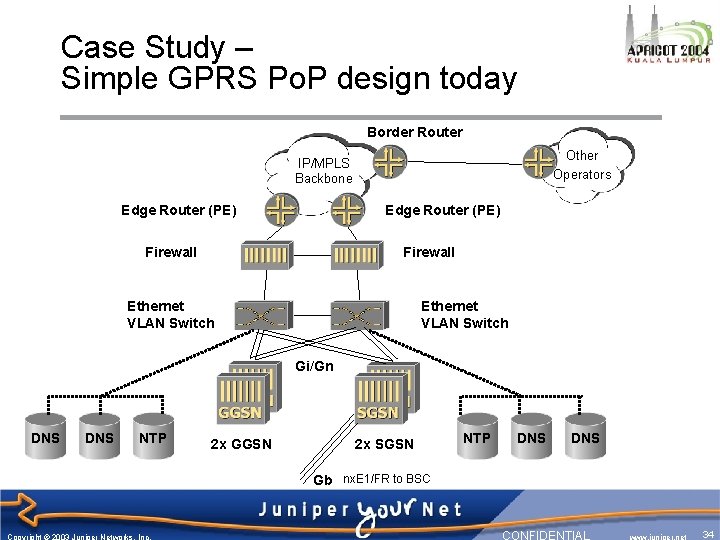
Case Study – Simple GPRS Po. P design today Border Router Other Operators IP/MPLS Backbone Edge Router (PE) Firewall Ethernet VLAN Switch Gi/Gn DNS NTP 2 x GGSN 2 x SGSN NTP DNS Gb nx. E 1/FR to BSC Copyright © 2003 Juniper Networks, Inc. CONFIDENTIAL www. juniper. net 34
Design issues – how to interconnect the GGSN into the IP/MPLS core? § Different approaches § Use flat IP network and tunnelling to end customer site (IPSEC, L 2 TP, GRE etc) § Static VR/VRFs meshed to local PE: • Pros: simple model, allows external inline devices (eg FW) • Cons: hard to manage/scale with redundancy (routing instances), local connections must be configured § GGSN becomes a native PE • Pros: excellent scalability with m. BGP, reduced operations (dynamic route propagation, VPN LSP setup etc) • Cons: MPLS VPN required on GGSN Copyright © 2003 Juniper Networks, Inc. CONFIDENTIAL www. juniper. net 35
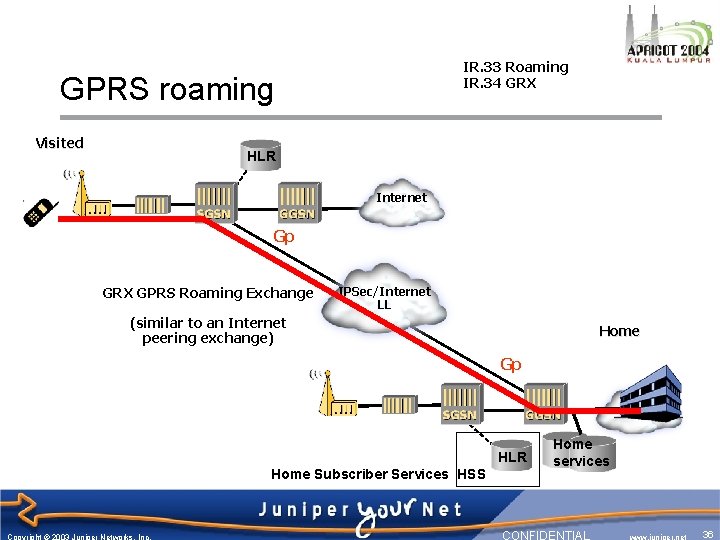
IR. 33 Roaming IR. 34 GRX GPRS roaming Visited HLR Internet Gp GRX GPRS Roaming Exchange IPSec/Internet LL (similar to an Internet peering exchange) Home Gp HLR Home Subscriber Services HSS Copyright © 2003 Juniper Networks, Inc. Home services CONFIDENTIAL www. juniper. net 36
What about EDGE? (and what is it? !) Copyright © 2003 Juniper Networks, Inc. CONFIDENTIAL www. juniper. net 37
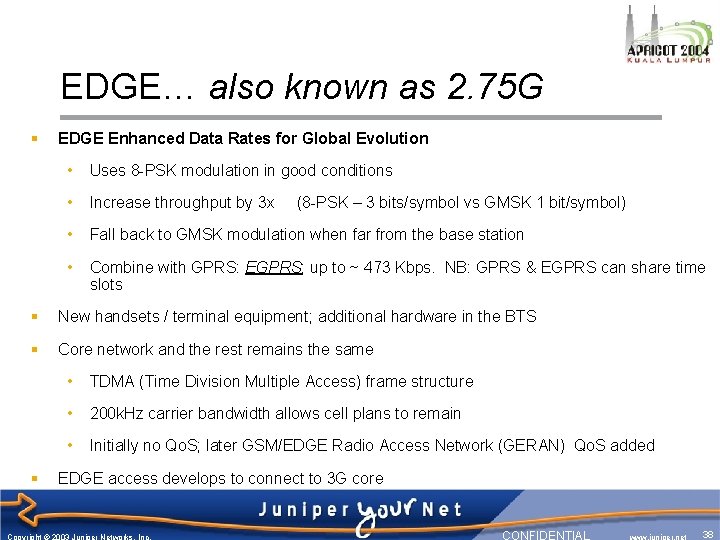
EDGE… also known as 2. 75 G § EDGE Enhanced Data Rates for Global Evolution • Uses 8 -PSK modulation in good conditions • Increase throughput by 3 x • Fall back to GMSK modulation when far from the base station • Combine with GPRS: EGPRS; up to ~ 473 Kbps. NB: GPRS & EGPRS can share time slots (8 -PSK – 3 bits/symbol vs GMSK 1 bit/symbol) § New handsets / terminal equipment; additional hardware in the BTS § Core network and the rest remains the same § • TDMA (Time Division Multiple Access) frame structure • 200 k. Hz carrier bandwidth allows cell plans to remain • Initially no Qo. S; later GSM/EDGE Radio Access Network (GERAN) Qo. S added EDGE access develops to connect to 3 G core Copyright © 2003 Juniper Networks, Inc. CONFIDENTIAL www. juniper. net 38
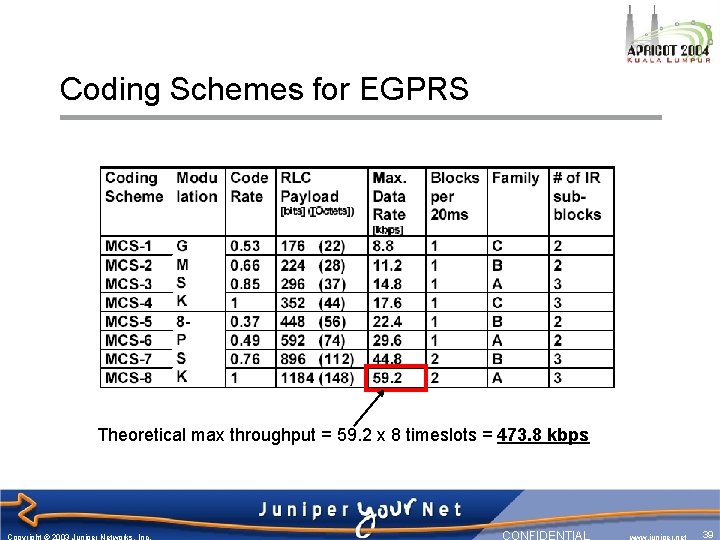
Coding Schemes for EGPRS Theoretical max throughput = 59. 2 x 8 timeslots = 473. 8 kbps Copyright © 2003 Juniper Networks, Inc. CONFIDENTIAL www. juniper. net 39
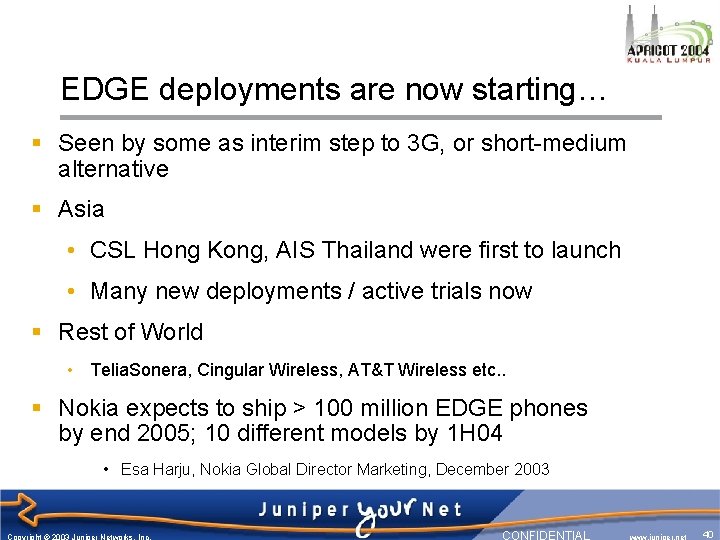
EDGE deployments are now starting… § Seen by some as interim step to 3 G, or short-medium alternative § Asia • CSL Hong Kong, AIS Thailand were first to launch • Many new deployments / active trials now § Rest of World • Telia. Sonera, Cingular Wireless, AT&T Wireless etc. . § Nokia expects to ship > 100 million EDGE phones by end 2005; 10 different models by 1 H 04 • Esa Harju, Nokia Global Director Marketing, December 2003 Copyright © 2003 Juniper Networks, Inc. CONFIDENTIAL www. juniper. net 40
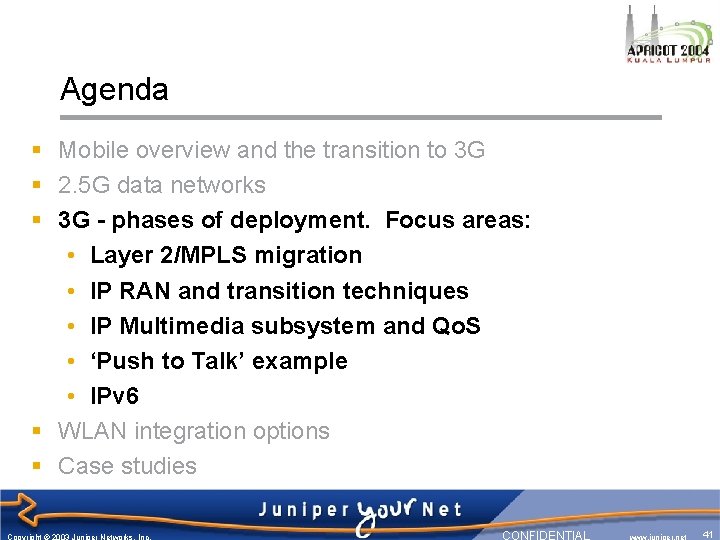
Agenda § Mobile overview and the transition to 3 G § 2. 5 G data networks § 3 G - phases of deployment. Focus areas: • Layer 2/MPLS migration • IP RAN and transition techniques • IP Multimedia subsystem and Qo. S • ‘Push to Talk’ example • IPv 6 § WLAN integration options § Case studies Copyright © 2003 Juniper Networks, Inc. CONFIDENTIAL www. juniper. net 41
Standards groups for UMTS/WCDMA § 3 G development work has been driven by ETSI, UMTS Forum § WCDMA is the main 3 G radio interface (driven initially by Do. Co. Mo) § 3 GPP = 3 G Partnership Program • Produces specs for 3 G system based on ETSI UTRA (Universal Terrestrial Radio Access Interface) • Also develops further enhancements for GSM/GPRS/EDGE • Several org partners including ETSI, CWTS – China Wireless Telecommunications Standards • www. 3 gpp. org – eg- Juniper is an active member and contributor Copyright © 2003 Juniper Networks, Inc. CONFIDENTIAL www. juniper. net 42
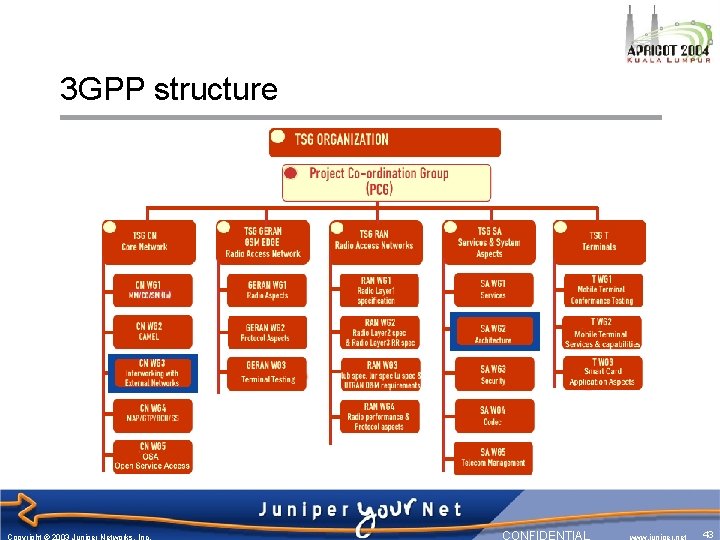
3 GPP structure Copyright © 2003 Juniper Networks, Inc. CONFIDENTIAL www. juniper. net 43
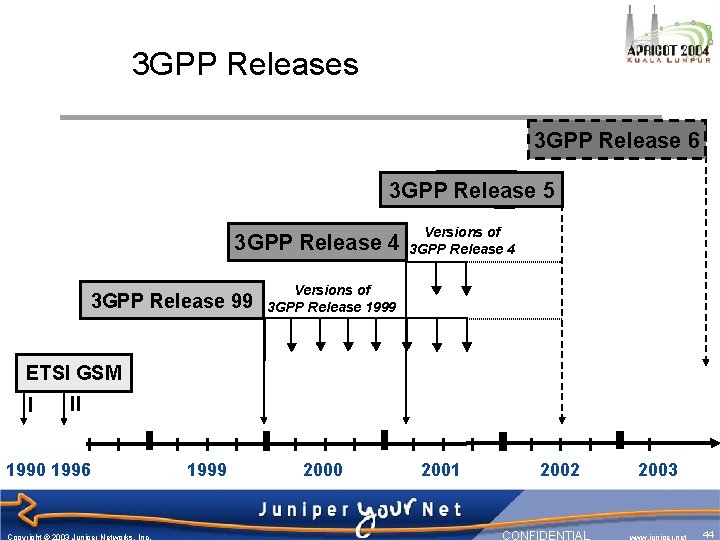
3 GPP Releases 3 GPP Release 6 3 GPP Release 5 3 GPP Release 4 3 GPP Release 99 Versions of 3 GPP Release 4 Versions of 3 GPP Release 1999 ETSI GSM I II 1990 1996 Copyright © 2003 Juniper Networks, Inc. 1999 2000 2001 2002 CONFIDENTIAL 2003 www. juniper. net 44
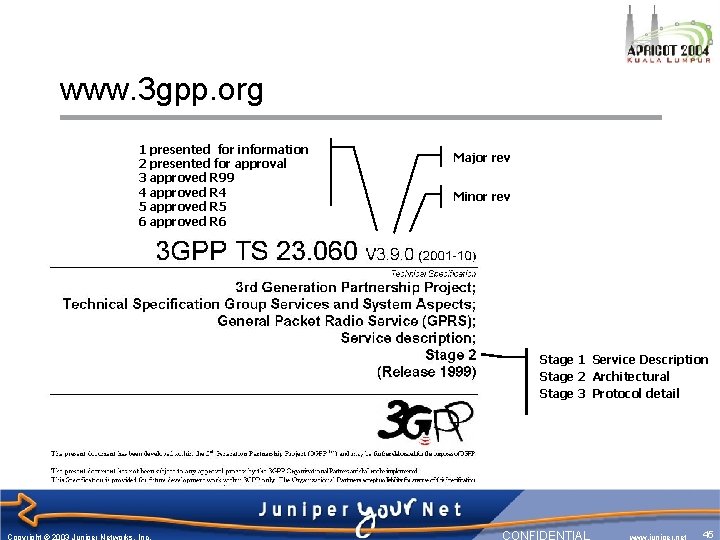
www. 3 gpp. org 1 presented for information 2 presented for approval 3 approved R 99 4 approved R 4 5 approved R 5 6 approved R 6 Major rev Minor rev Stage 1 Service Description Stage 2 Architectural Stage 3 Protocol detail Copyright © 2003 Juniper Networks, Inc. CONFIDENTIAL www. juniper. net 45
Involvement at 3 GPP Areas of focus: § Standards that impact Mobile backbone and GGSN infrastructure • Inter-working of Core network with external networks • 3 G Service policy management • IPv 6 and inter-working with IPv 4 • IP Multimedia Subsystem • IP Security § Transition of interfaces to IP • Iu-CS, Nb, Signalling • IP RAN § 3 GPP and WLAN Integration • WLAN working group at SA 2 Copyright © 2003 Juniper Networks, Inc. CONFIDENTIAL www. juniper. net 46
Recent activity to date § TR 23. 825 – IP Flow-based Charging (In conjunction with Ericsson) • Definition of Rx interface between PDF and AF § TS 23. 234 – 3 GPP system to WLAN inter-working • Supported discussions on: • Network and Service selection, Visited to Home network tunneling § TS 29. 061 – Inter-working between GPRS/UMTS networks with external PDN (in conjunction with Ericsson) • Description on use of IPv 6 in the user plane based on dynamic IPv 6 Address Allocation (stateless address auto-configuration), RADIUS Copyright © 2003 Juniper Networks, Inc. CONFIDENTIAL www. juniper. net 47
Recent activity to date § TS 23. 060 – GPRS Stage 2 (in conjunction with Ericsson) • Allocation of unique prefixes to IPv 6 terminals § TS 29. 207 - Policy control procedures (in conjunction with Nortel) • Supported creation of new WI for Stage 3 work on “Policy-based control of Diff. Serv Edge functions” § TS 29. 207 (in conjunction with Nortel and Ericsson) • Alignment of Go PIB with IETF Diff. Serv and Framework PIB Copyright © 2003 Juniper Networks, Inc. CONFIDENTIAL www. juniper. net 48
- Slides: 48