
3 Forms of Quadratic Equations Vertex y axh2

- Slides: 2
3 Forms of Quadratic Equations Vertex: y = a(x-h)2 + k Up or Down: Factored: y = a(x-x 1)(x-x 2) Up or Down: Standard: y = ax 2 + bx + c Up or Down: If a> 0 then up. If a<0 then down Axis of Symmetry: x=h Vertex: Axis of Symmetry: x = h (see vertex to find x) Vertex: (h, k) from equation Remember h is opp sign x-intercepts: Put 0 in for y and solve (don’t forget ±) y-intercept: Put 0 in for x and calculate How to graph: Plot vertex, x-int, y-int, and use axis of symmetry to find 5 th point. k = put h back into original equation x-intercepts: Put 0 in for y and set each factor = to 0 and solve OR x 1 & x 2 (opp signs of eq) y-intercept: Put 0 in for x and calculate How to graph: Plot vertex, x-int, y-int, and use axis of symmetry to find 5 th point. k = put h back into original equation x-intercepts: (Solutions, or zeros) Quadratics have to be set = 0 to solve in standard form Put 0 in for y and solve using a) Factor and set each = 0 OR b) Quadratic Formula y-intercept: (0, c) How to graph: Plot vertex, x-int, y-int, and use axis of symmetry to find 5 th point.
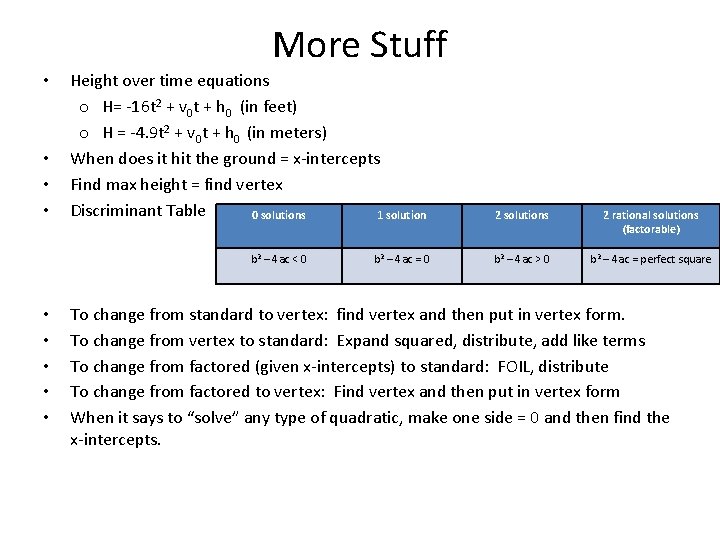
More Stuff • • Height over time equations o H= -16 t 2 + v 0 t + h 0 (in feet) o H = -4. 9 t 2 + v 0 t + h 0 (in meters) When does it hit the ground = x-intercepts Find max height = find vertex Discriminant Table 0 solutions 1 solution b 2 – 4 ac < 0 • • • b 2 – 4 ac = 0 2 solutions 2 rational solutions (factorable) b 2 – 4 ac > 0 b 2 – 4 ac = perfect square To change from standard to vertex: find vertex and then put in vertex form. To change from vertex to standard: Expand squared, distribute, add like terms To change from factored (given x-intercepts) to standard: FOIL, distribute To change from factored to vertex: Find vertex and then put in vertex form When it says to “solve” any type of quadratic, make one side = 0 and then find the x-intercepts.