
3 e 7 Understanding an Expression as an
- Slides: 8
3 e = 7: Understanding an Expression as an Object www. ncetm. org. uk/secondarymasterypd #Mastery. Materials
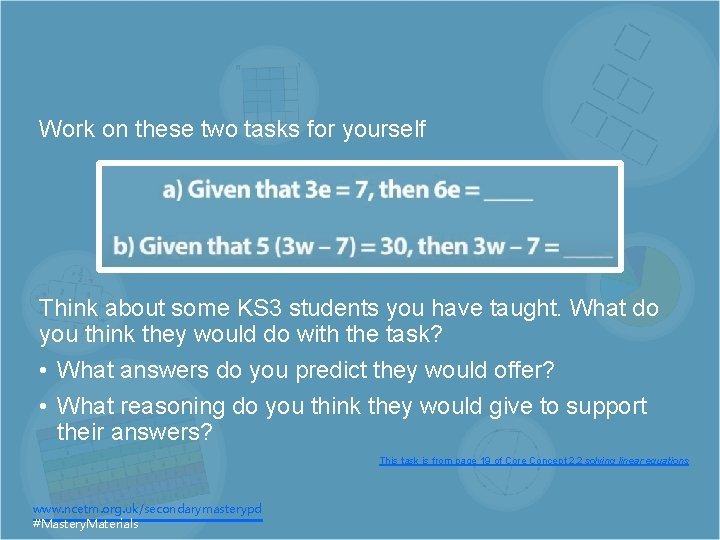
Work on these two tasks for yourself Think about some KS 3 students you have taught. What do you think they would do with the task? • What answers do you predict they would offer? • What reasoning do you think they would give to support their answers? This task is from page 19 of Core Concept 2. 2 solving linear equations www. ncetm. org. uk/secondarymasterypd #Mastery. Materials
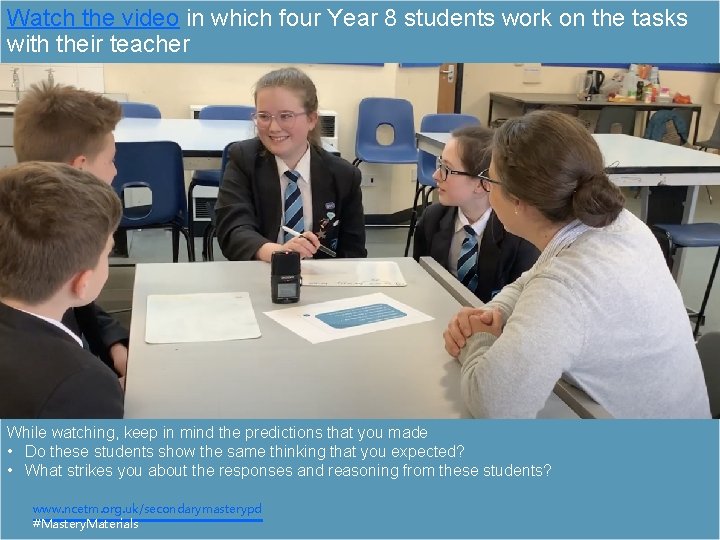
Watch the video in which four Year 8 students work on the tasks with their teacher While watching, keep in mind the predictions that you made • Do these students show the same thinking that you expected? • What strikes you about the responses and reasoning from these students? www. ncetm. org. uk/secondarymasterypd #Mastery. Materials
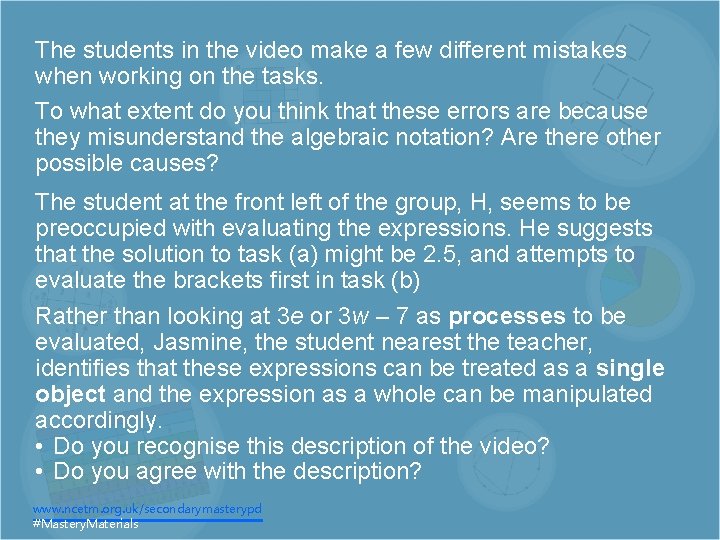
The students in the video make a few different mistakes when working on the tasks. To what extent do you think that these errors are because they misunderstand the algebraic notation? Are there other possible causes? The student at the front left of the group, H, seems to be preoccupied with evaluating the expressions. He suggests that the solution to task (a) might be 2. 5, and attempts to evaluate the brackets first in task (b) Rather than looking at 3 e or 3 w – 7 as processes to be evaluated, Jasmine, the student nearest the teacher, identifies that these expressions can be treated as a single object and the expression as a whole can be manipulated accordingly. • Do you recognise this description of the video? • Do you agree with the description? www. ncetm. org. uk/secondarymasterypd #Mastery. Materials
Seeing a mathematical entity as an object means being capable of referring to it as if it was a real thing – a static structure, existing somewhere in space and time. It also means being able to recognize the idea "at a glance" and to manipulate it as a whole, without going into details… In contrast, interpreting a notion as a process implies regarding it as a potential rather than actual entity, which comes into existence upon request in a sequence of actions. Sfard (1991) Link to article www. ncetm. org. uk/secondarymasterypd #Mastery. Materials
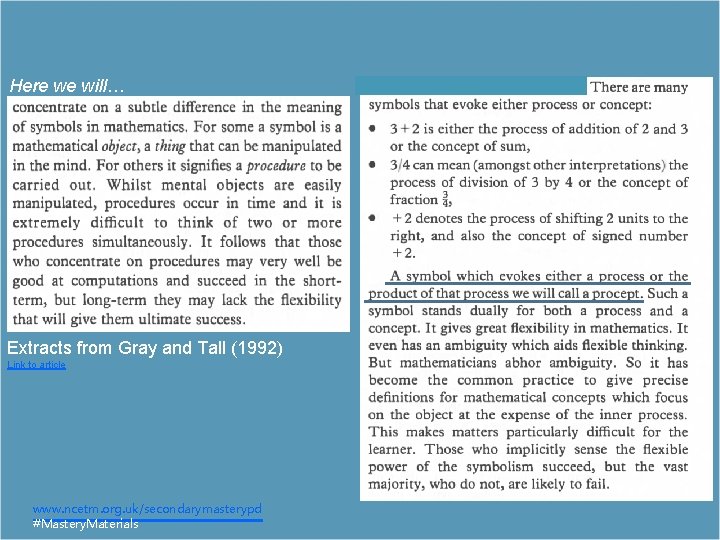
Here we will… Extracts from Gray and Tall (1992) Link to article www. ncetm. org. uk/secondarymasterypd #Mastery. Materials
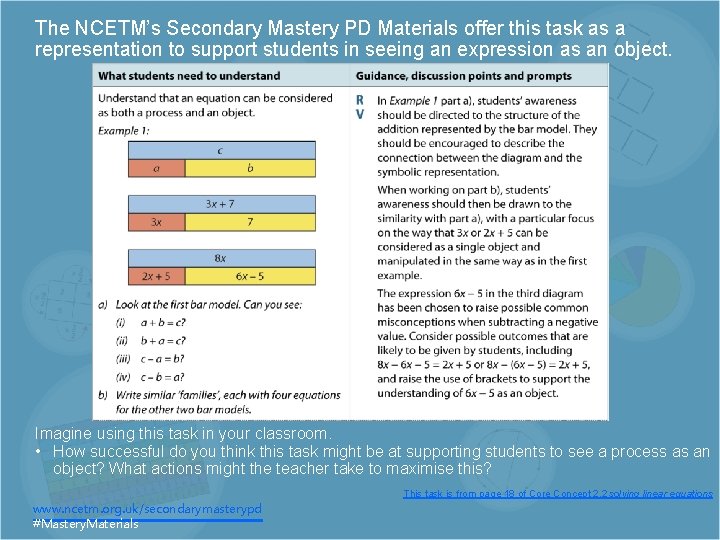
The NCETM’s Secondary Mastery PD Materials offer this task as a representation to support students in seeing an expression as an object. Imagine using this task in your classroom. • How successful do you think this task might be at supporting students to see a process as an object? What actions might the teacher take to maximise this? This task is from page 18 of Core Concept 2. 2 solving linear equations www. ncetm. org. uk/secondarymasterypd #Mastery. Materials
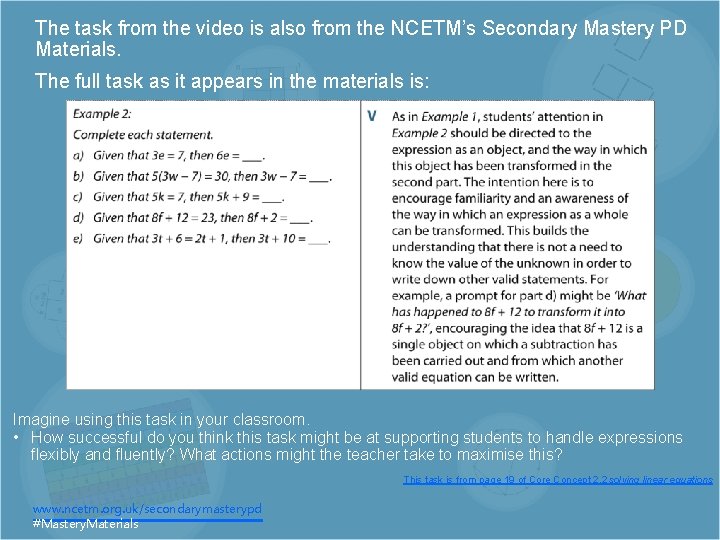
The task from the video is also from the NCETM’s Secondary Mastery PD Materials. The full task as it appears in the materials is: Imagine using this task in your classroom. • How successful do you think this task might be at supporting students to handle expressions flexibly and fluently? What actions might the teacher take to maximise this? This task is from page 19 of Core Concept 2. 2 solving linear equations www. ncetm. org. uk/secondarymasterypd #Mastery. Materials