
3 Dsurfaces parametric and other equations area of
- Slides: 25
3 D-surfaces • parametric and other equations • area of a 3 D surface • orientable surfaces
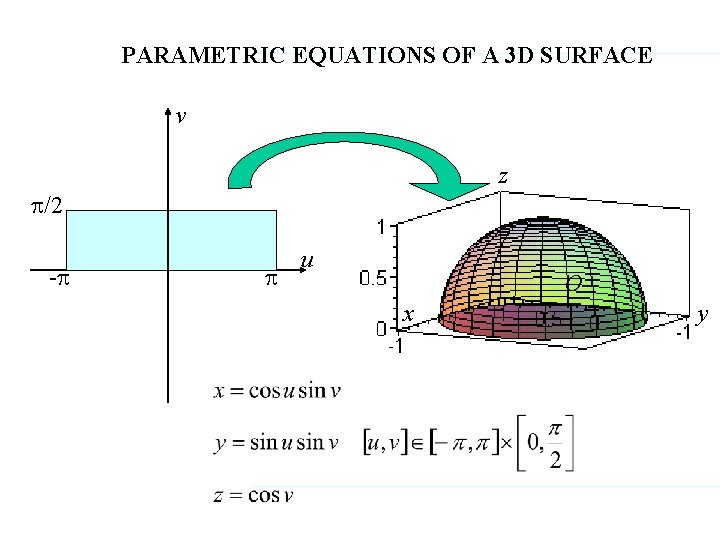
PARAMETRIC EQUATIONS OF A 3 D SURFACE v z /2 - u O x y
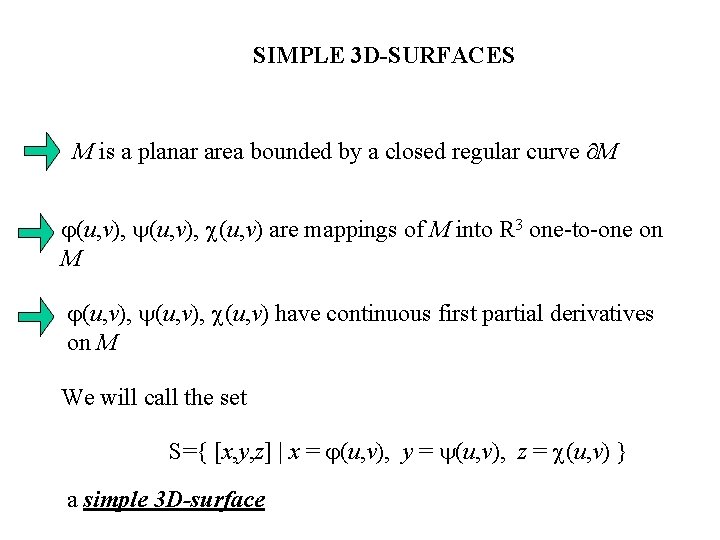
SIMPLE 3 D-SURFACES M is a planar area bounded by a closed regular curve M (u, v), (u, v) are mappings of M into R 3 one-to-one on M (u, v), (u, v) have continuous first partial derivatives on M We will call the set S={ [x, y, z] | x = (u, v), y = (u, v), z = (u, v) } a simple 3 D-surface
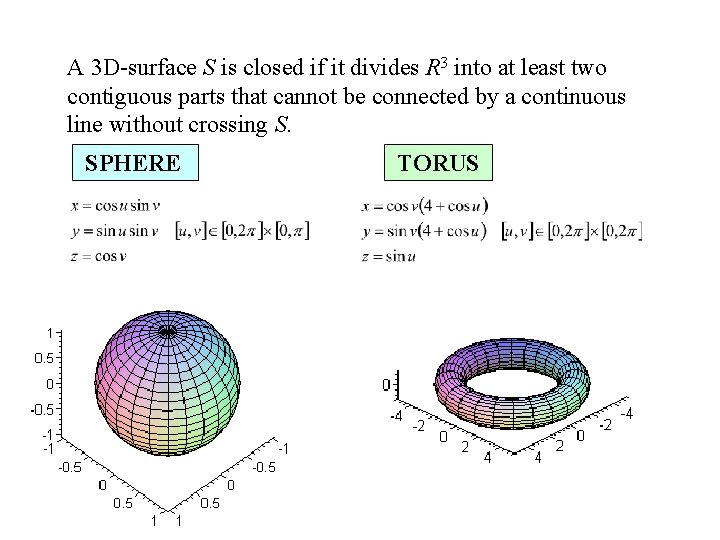
A 3 D-surface S is closed if it divides R 3 into at least two contiguous parts that cannot be connected by a continuous line without crossing S. SPHERE TORUS
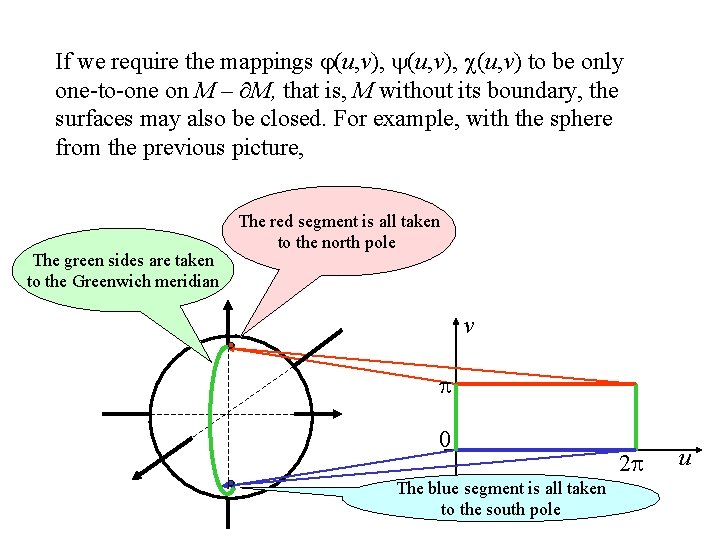
If we require the mappings (u, v), (u, v) to be only one-to-one on M – M, that is, M without its boundary, the surfaces may also be closed. For example, with the sphere from the previous picture, The green sides are taken to the Greenwich meridian The red segment is all taken to the north pole v 0 The blue segment is all taken to the south pole 2 u
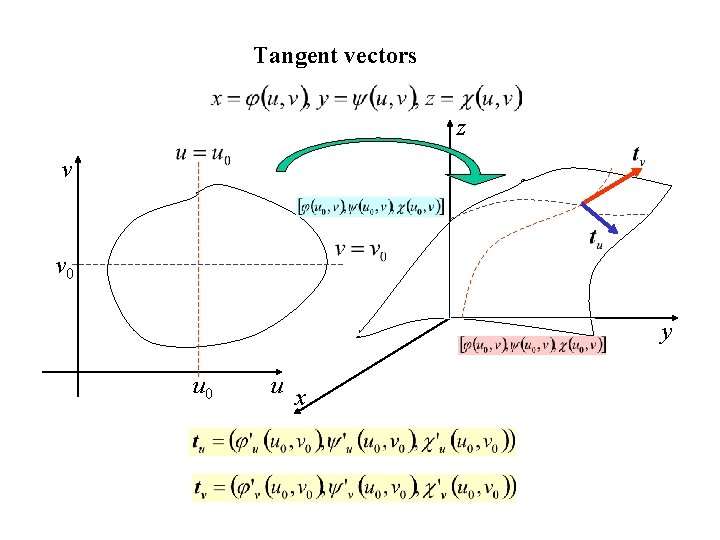
Tangent vectors z v v 0 y u 0 u x
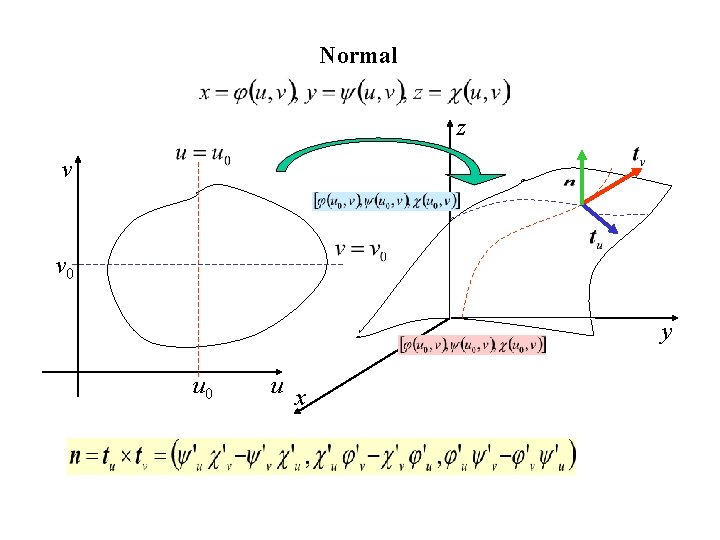
Normal z v v 0 y u 0 u x
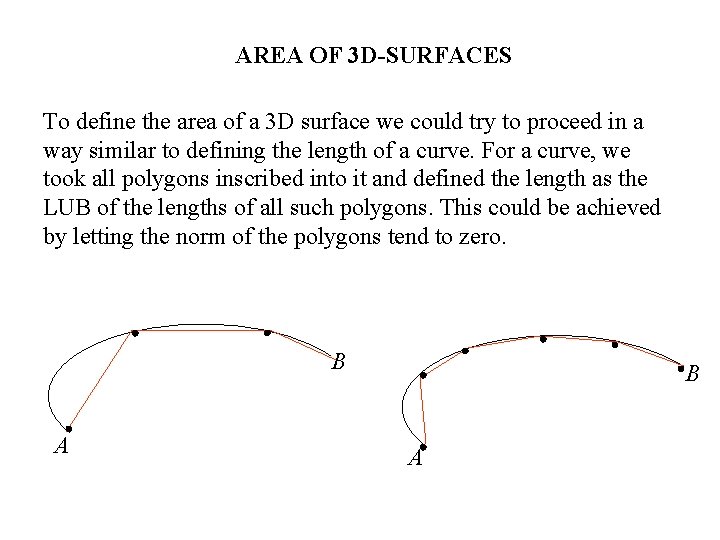
AREA OF 3 D-SURFACES To define the area of a 3 D surface we could try to proceed in a way similar to defining the length of a curve. For a curve, we took all polygons inscribed into it and defined the length as the LUB of the lengths of all such polygons. This could be achieved by letting the norm of the polygons tend to zero. B A
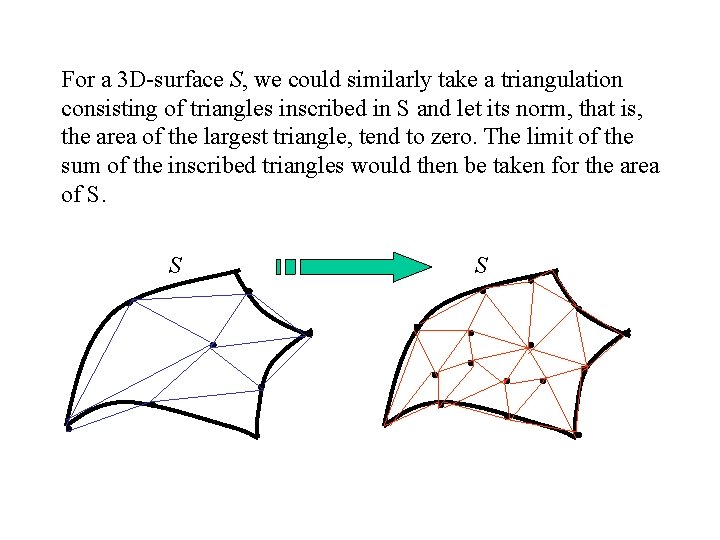
For a 3 D-surface S, we could similarly take a triangulation consisting of triangles inscribed in S and let its norm, that is, the area of the largest triangle, tend to zero. The limit of the sum of the inscribed triangles would then be taken for the area of S. S S
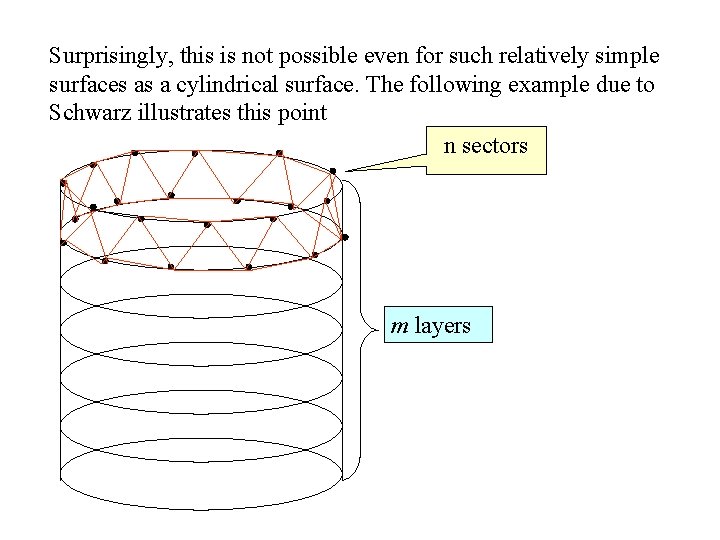
Surprisingly, this is not possible even for such relatively simple surfaces as a cylindrical surface. The following example due to Schwarz illustrates this point n sectors m layers
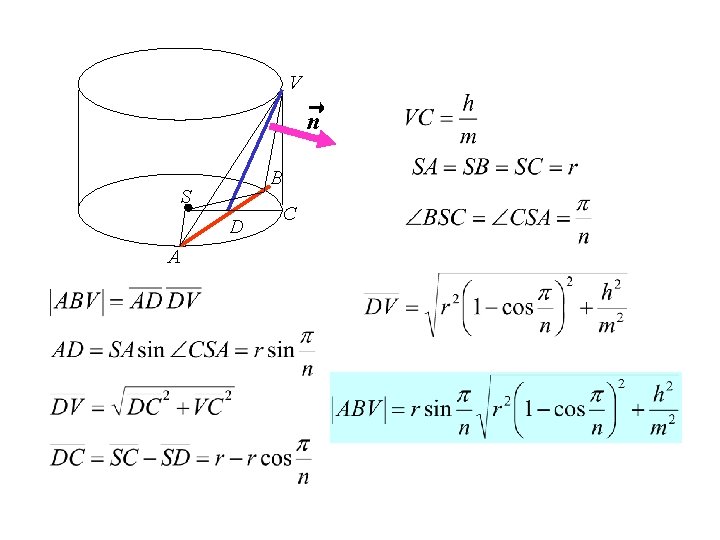
V n B S D A C
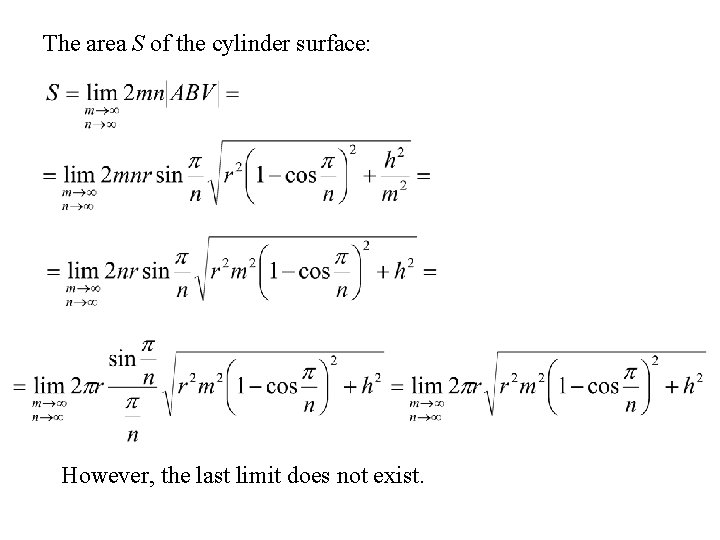
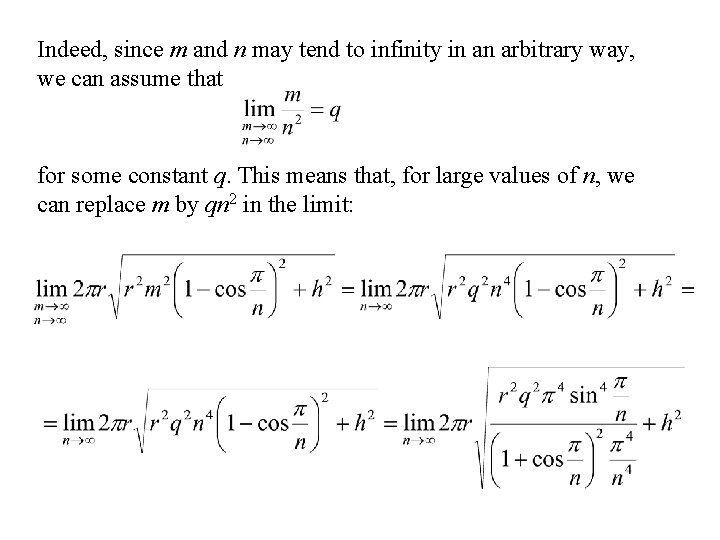
The area S of the cylinder surface: However, the last limit does not exist.
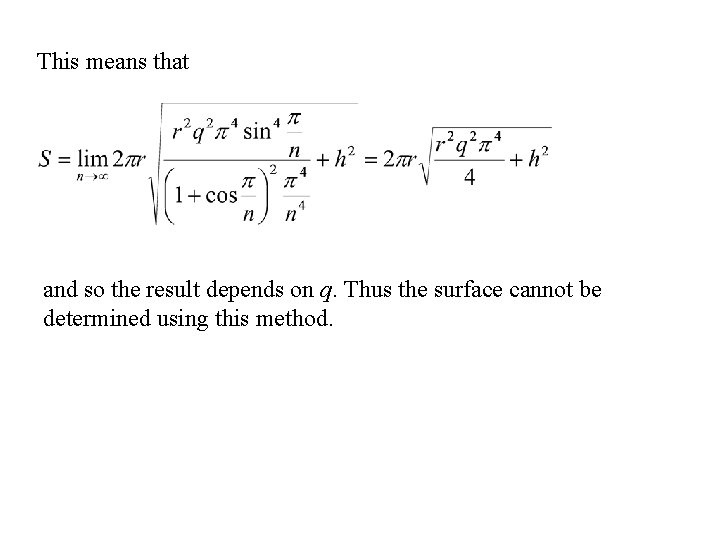
Indeed, since m and n may tend to infinity in an arbitrary way, we can assume that for some constant q. This means that, for large values of n, we can replace m by qn 2 in the limit:
This means that and so the result depends on q. Thus the surface cannot be determined using this method.
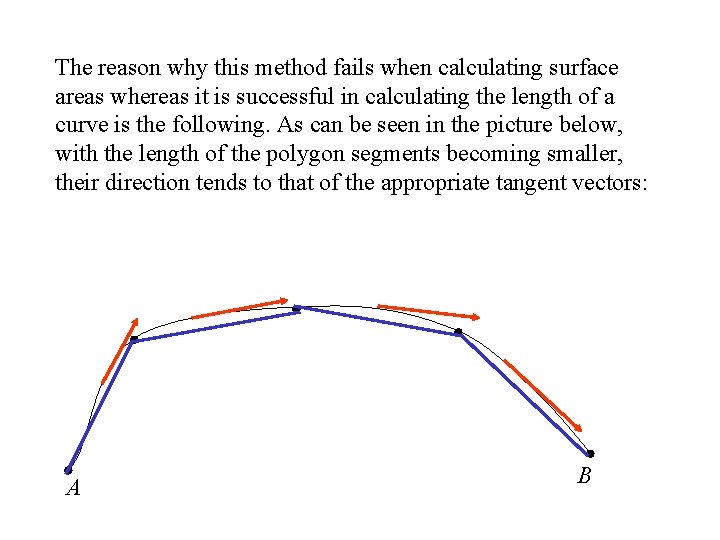
The reason why this method fails when calculating surface areas whereas it is successful in calculating the length of a curve is the following. As can be seen in the picture below, with the length of the polygon segments becoming smaller, their direction tends to that of the appropriate tangent vectors: A B
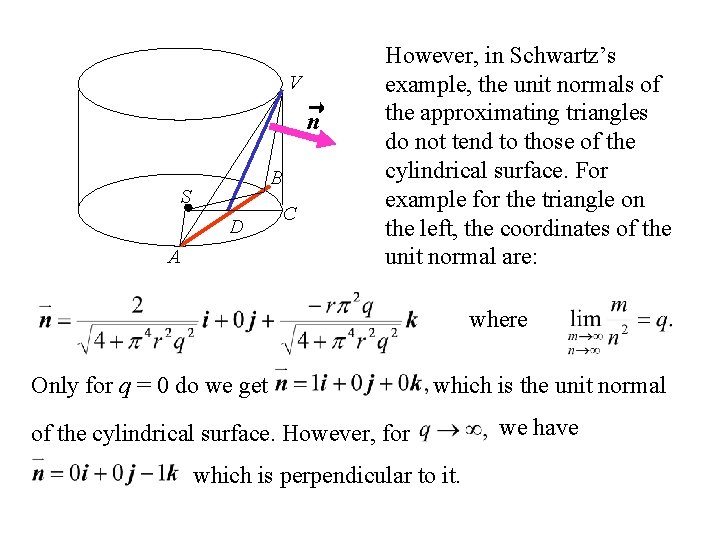
V n B S D A C However, in Schwartz’s example, the unit normals of the approximating triangles do not tend to those of the cylindrical surface. For example for the triangle on the left, the coordinates of the unit normal are: where Only for q = 0 do we get which is the unit normal of the cylindrical surface. However, for which is perpendicular to it. we have
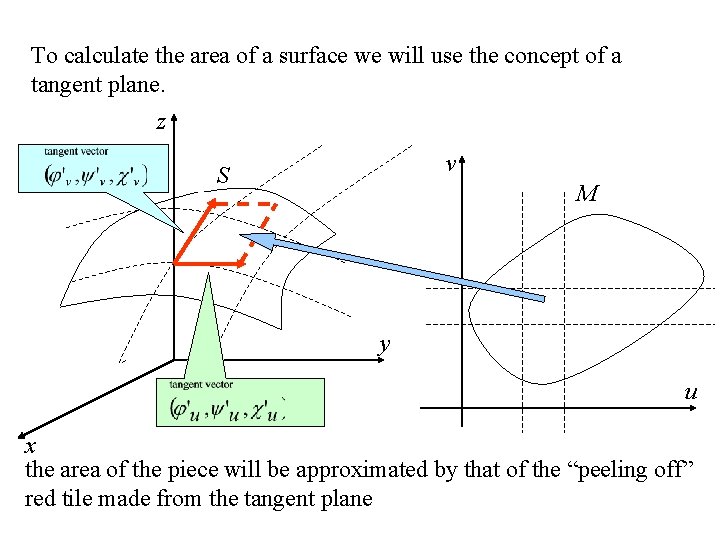
To calculate the area of a surface we will use the concept of a tangent plane. z v S M y u x the area of the piece will be approximated by that of the “peeling off” red tile made from the tangent plane
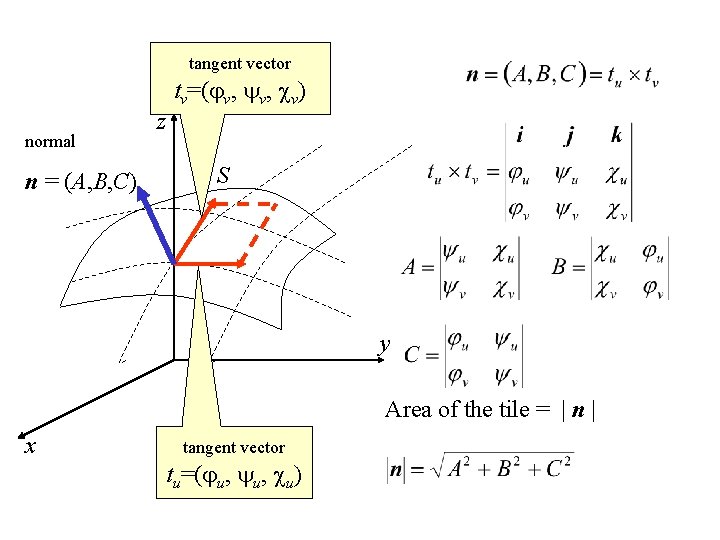
tangent vector tv=( v, v) normal n = (A, B, C) z S y Area of the tile = | n | x tangent vector tu=( u, u)
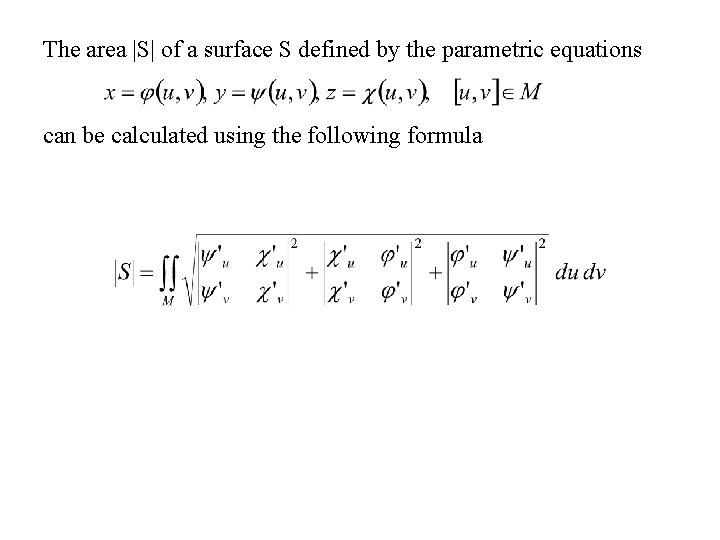
The area |S| of a surface S defined by the parametric equations can be calculated using the following formula
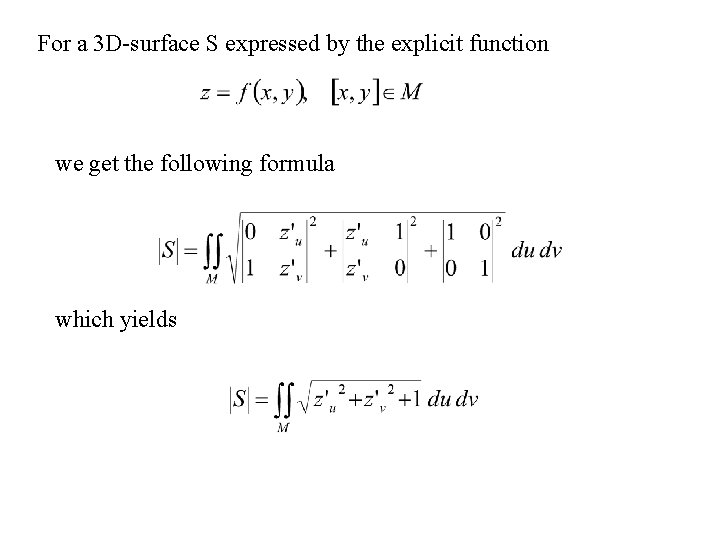
For a 3 D-surface S expressed by the explicit function we get the following formula which yields
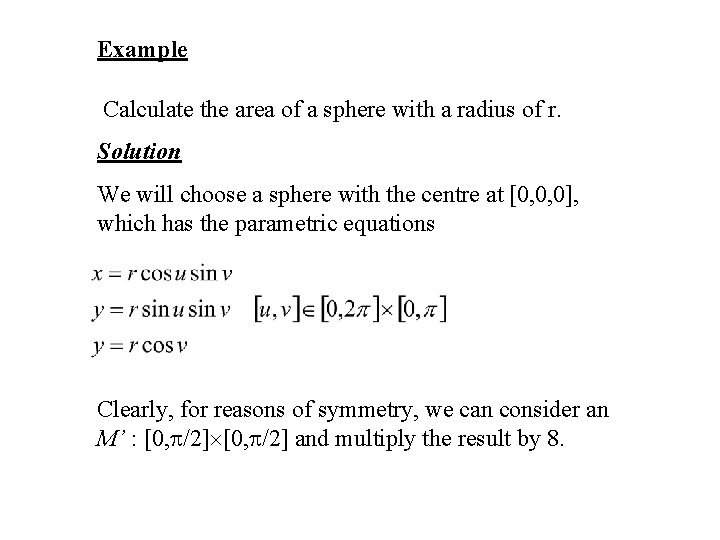
Example Calculate the area of a sphere with a radius of r. Solution We will choose a sphere with the centre at [0, 0, 0], which has the parametric equations Clearly, for reasons of symmetry, we can consider an M’ : [0, /2] and multiply the result by 8.
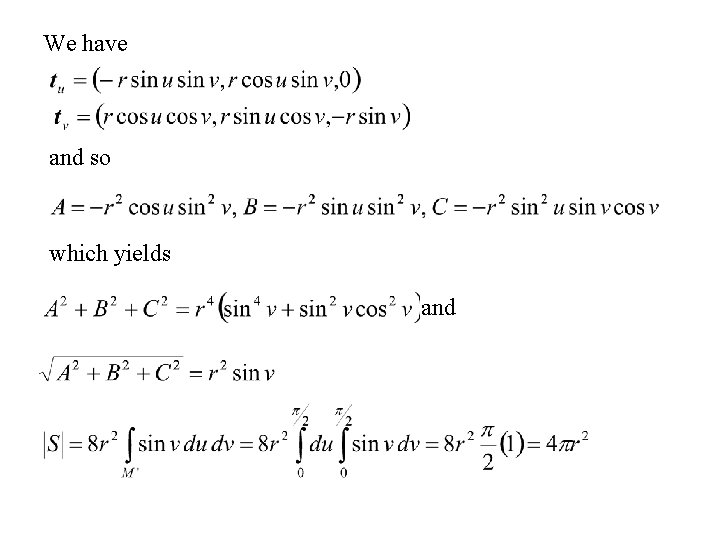
We have and so which yields and
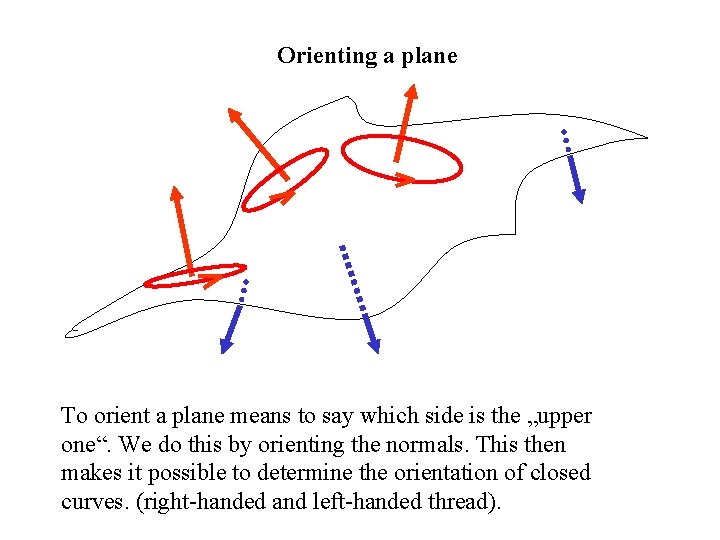
Orienting a plane To orient a plane means to say which side is the „upper one“. We do this by orienting the normals. This then makes it possible to determine the orientation of closed curves. (right-handed and left-handed thread).
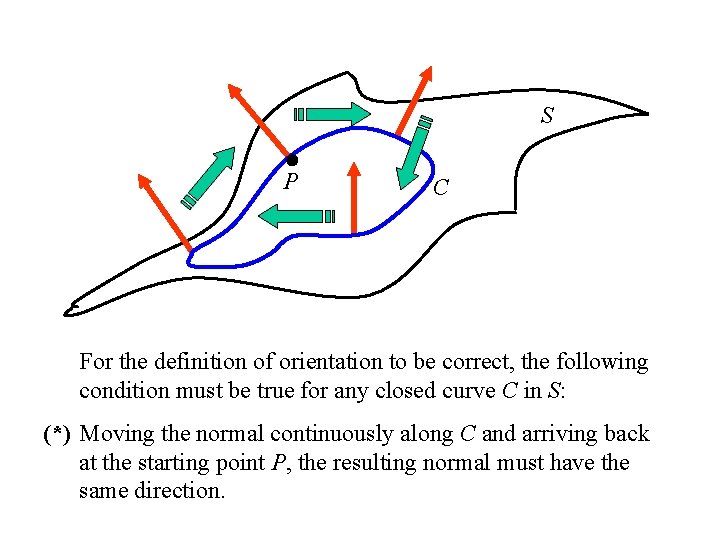
S P C For the definition of orientation to be correct, the following condition must be true for any closed curve C in S: (*) Moving the normal continuously along C and arriving back at the starting point P, the resulting normal must have the same direction.
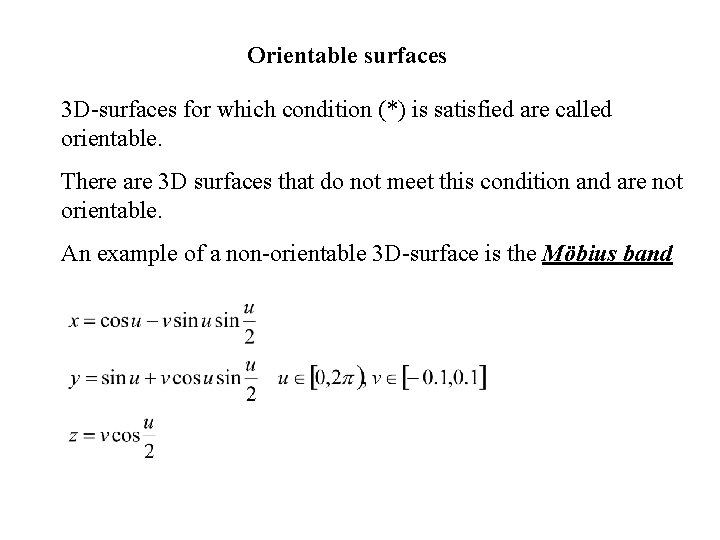
Orientable surfaces 3 D-surfaces for which condition (*) is satisfied are called orientable. There are 3 D surfaces that do not meet this condition and are not orientable. An example of a non-orientable 3 D-surface is the Möbius band