
3 DECISION M A K I N GT
- Slides: 14
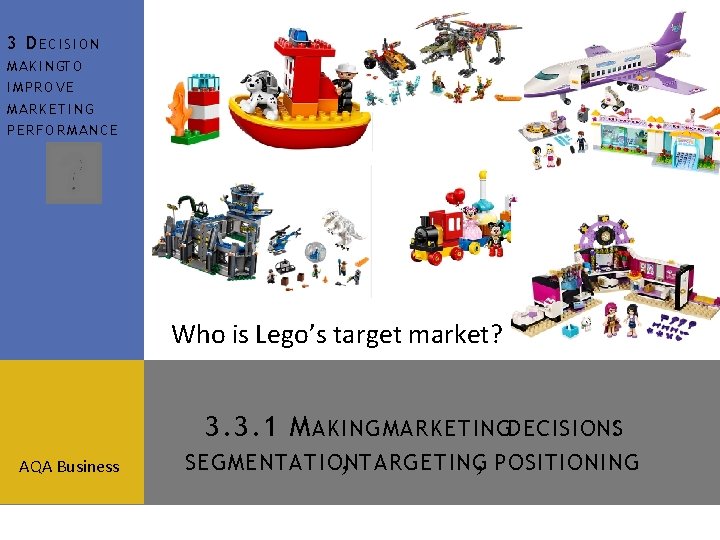
3 DECISION M A K I N GT O IMPROVE MARKETING PERFORMANCE Who is Lego’s target market? AQA Business 3. 3. 1 M AKING MARKETINGDECISIONS: SEGMENTATION , TARGETING, POSITIONING
3. 3. 1 M AKING MARKETING DECISIONS: SEGMENTATION , TARGETING, POSITIONING In this topic you will learn about The process and value of segmentation, targeting and positioning Influences on choosing a target market and positioning
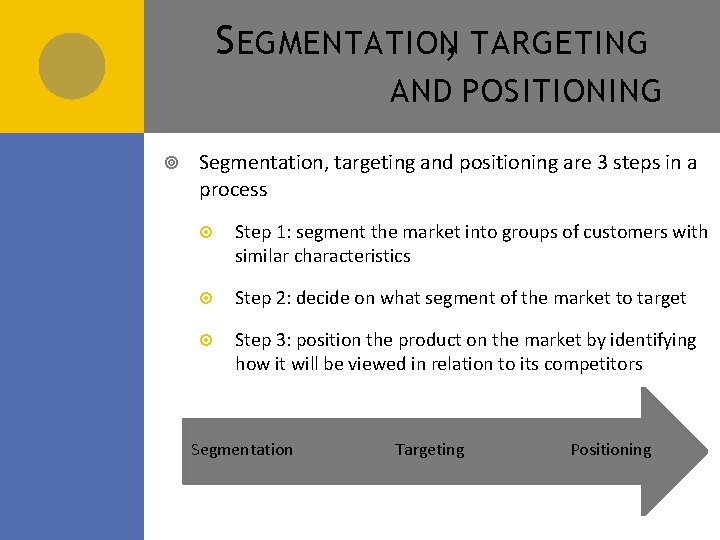
S EGMENTATION, TARGETING AND POSITIONING Segmentation, targeting and positioning are 3 steps in a process Step 1: segment the market into groups of customers with similar characteristics Step 2: decide on what segment of the market to target Step 3: position the product on the market by identifying how it will be viewed in relation to its competitors Segmentation Targeting Positioning
MARKET SEGMENTATION v Market segmentation occurs when the market is split into subgroups of consumers with similar characteristics v This helps to identify different types of consumer and different wants and needs v Segmentation methods include: v Demographic v Geographic v Income v Behavioural
D EMOGRAPHIC SEGMENTATION v Identifies subgroups of the population based on their demographic profile or characteristics v v Was Lego correct to segment the market by gender? v v Age Gender Level of education Race Religion Family size Stage in life e. g. empty nesters Demographics looks at the social and economic characteristics of individuals and households
G EOGRAPHIC SEGMENTATION v Geographic segmentation defines market categories based on where people live e. g. regions, cities or neighbourhoods v People in different geographical areas display different characteristics and needs e. g. v The South East of England is generally warmer than Scotland v Tastes and traditions vary between countries v Infrastructure in rural areas will differ from that of cities How has Mc. Donald’s had to reposition its products to meet the needs of the Indian market?
I NCOME SEGMENTATION v v Visit the Ford website – select 3 models of cars explain which socio economic group each car would suit. Identifying subgroups of the market based on their levels of income and profession A common method uses socio-economic groupings v A – Higher managerial such as chief executives and directors v B – Intermediate managerial such as solicitors, accountants and doctors v C 1 – Supervisory, clerical or junior professional such as teachers and junior managers v C 2 – Skilled manual such as plumbers, electricians and carpenters v D – Semi and unskilled workers such as refuse collectors and window cleaners v E - Pensioners, casual workers, students and unemployed To what extent are income and profession a strong positive correlation? Is this always true?
B EHAVIOURAL SEGMENTATION Are loyalty cards for the benefit of the consumer or the business? Characterises subgroups based on the behavioural patterns of the consumer rather than their characteristics Reasons for making purchases e. g. needs, emotional, rewards Frequency of purchase e. g. heavy user or light user Time of purchase e. g. seasonal, weekly, late at night Brand loyalty Method of purchase e. g. online Triggers e. g. response to digital marketing
B ENEFITS OF MARKET SEGMENTATION v There a number of benefits for a firm that uses market segmentation as part of its market research: Advertising can be targeted at specific market segments so that advertising spend is more effective The most profitable and least profitable customers can be identified Least profitable markets can be avoided It becomes easier to identify new products It helps the firm improve existing products and customer service
T ARGETING Targeting is the process of deciding which segment of the market to focus on This will be influenced by: Mission and objectives Perceived level of demand Degree of competition Nature of the product Understanding of the needs and wants of a specific segment
T ARGETING Targeting may include niche and mass marketing Should chocolate makers be targeting a niche or a mass market? Niche marketing is when a firm targets a small subsection or previously unexploited gap in a larger market Niche marketing may give a business first mover advantage and allow them to charge a premium price Mass marketing is when a firm targets the whole of a market rather than a particular segment Mass marketing can give a business a high volume of sales but often at a low price
P OSITIONING How can market mapping be used to help position a business or product in the market? Where a product is placed in the market relative to its competitors Positioning can be achieved by changing elements of the marketing mix to meet the needs of the target market Influences on positioning include: Internal constraints e. g. budgets Internal strengths e. g. creativity and innovation Market conditions e. g. degree of competition External environment e. g. state of the economy
I N PAIRS Select one industry e. g. watches, jewellery, mobile phones, hotels Identify how the S, T, P process applies to that industry Produce a poster to illustrate the S, T, P process in relation to your chosen industry
3. 3. 1 M AKING MARKETING DECISIONS: SEGMENTATION , TARGETING, POSITIONING In this topic you have learnt about The process and value of segmentation, targeting and positioning Influences on choosing a target market and positioning