
3 D WholeCell Mapping of Insulin Secretion Scientific
- Slides: 1
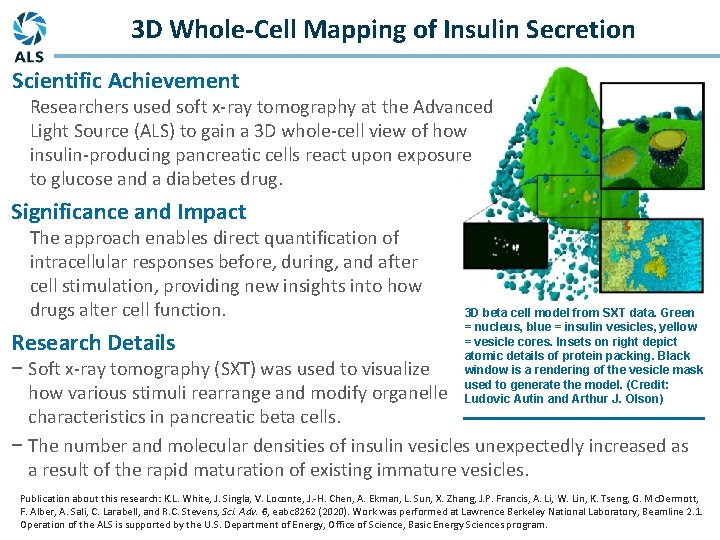
3 D Whole-Cell Mapping of Insulin Secretion Scientific Achievement Researchers used soft x-ray tomography at the Advanced Light Source (ALS) to gain a 3 D whole-cell view of how insulin-producing pancreatic cells react upon exposure to glucose and a diabetes drug. Significance and Impact The approach enables direct quantification of intracellular responses before, during, and after cell stimulation, providing new insights into how drugs alter cell function. Research Details 3 D beta cell model from SXT data. Green = nucleus, blue = insulin vesicles, yellow = vesicle cores. Insets on right depict atomic details of protein packing. Black window is a rendering of the vesicle mask used to generate the model. (Credit: Ludovic Autin and Arthur J. Olson) − Soft x-ray tomography (SXT) was used to visualize how various stimuli rearrange and modify organelle characteristics in pancreatic beta cells. − The number and molecular densities of insulin vesicles unexpectedly increased as a result of the rapid maturation of existing immature vesicles. Publication about this research: K. L. White, J. Singla, V. Loconte, J. -H. Chen, A. Ekman, L. Sun, X. Zhang, J. P. Francis, A. Li, W. Lin, K. Tseng, G. Mc. Dermott, F. Alber, A. Sali, C. Larabell, and R. C. Stevens, Sci. Adv. 6, eabc 8262 (2020). Work was performed at Lawrence Berkeley National Laboratory, Beamline 2. 1. Operation of the ALS is supported by the U. S. Department of Energy, Office of Science, Basic Energy Sciences program.