
3 D Visualization of Websites using VRML Introduction
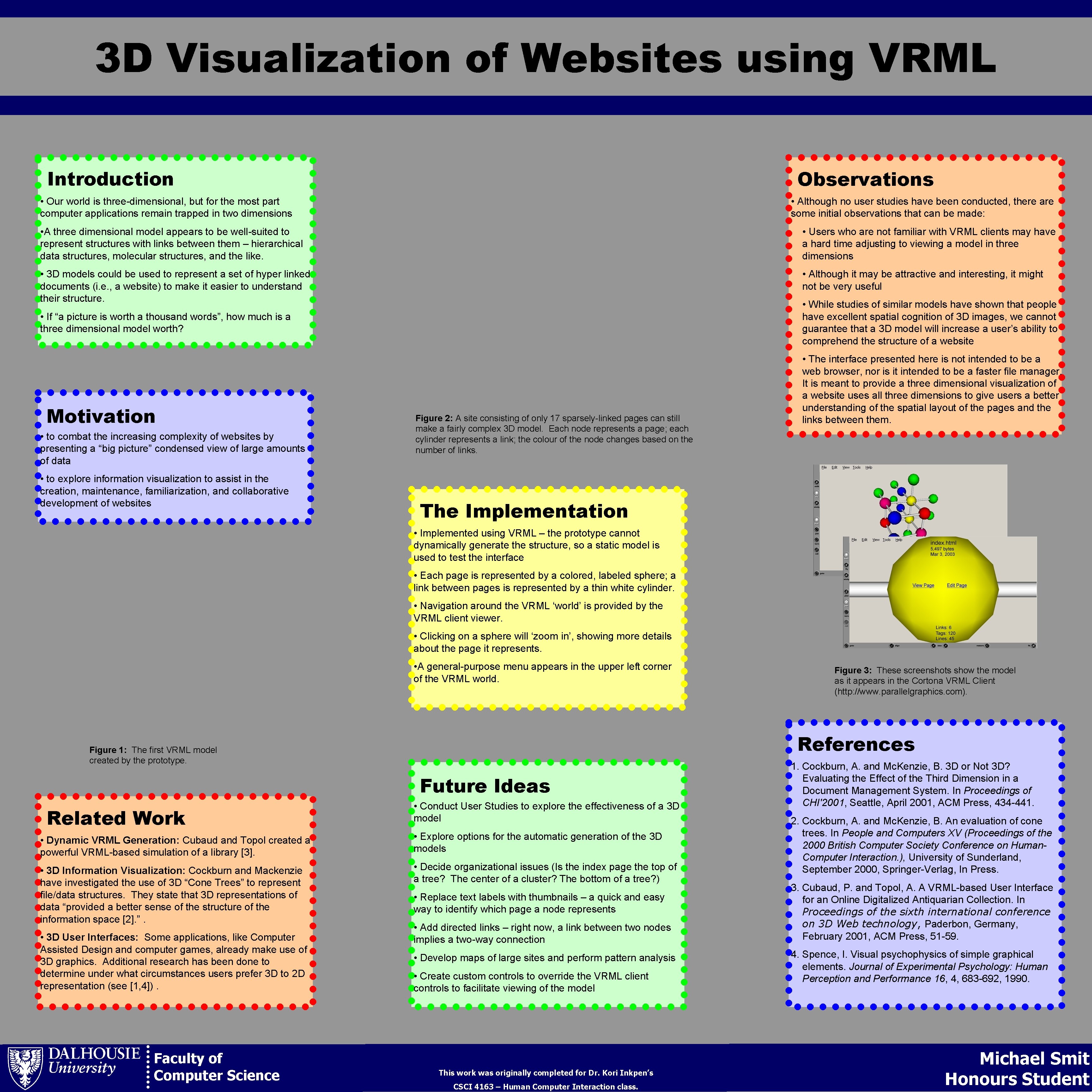
3 D Visualization of Websites using VRML Introduction Observations • Our world is three-dimensional, but for the most part computer applications remain trapped in two dimensions • Although no user studies have been conducted, there are some initial observations that can be made: • A three dimensional model appears to be well-suited to represent structures with links between them – hierarchical data structures, molecular structures, and the like. • Users who are not familiar with VRML clients may have a hard time adjusting to viewing a model in three dimensions • 3 D models could be used to represent a set of hyper linked documents (i. e. , a website) to make it easier to understand their structure. • Although it may be attractive and interesting, it might not be very useful • While studies of similar models have shown that people have excellent spatial cognition of 3 D images, we cannot guarantee that a 3 D model will increase a user’s ability to comprehend the structure of a website • If “a picture is worth a thousand words”, how much is a three dimensional model worth? Motivation • to combat the increasing complexity of websites by presenting a “big picture” condensed view of large amounts of data • to explore information visualization to assist in the creation, maintenance, familiarization, and collaborative development of websites Figure 2: A site consisting of only 17 sparsely-linked pages can still make a fairly complex 3 D model. Each node represents a page; each cylinder represents a link; the colour of the node changes based on the number of links. • The interface presented here is not intended to be a web browser, nor is it intended to be a faster file manager. It is meant to provide a three dimensional visualization of a website uses all three dimensions to give users a better understanding of the spatial layout of the pages and the links between them. The Implementation • Implemented using VRML – the prototype cannot dynamically generate the structure, so a static model is used to test the interface • Each page is represented by a colored, labeled sphere; a link between pages is represented by a thin white cylinder. • Navigation around the VRML ‘world’ is provided by the VRML client viewer. • Clicking on a sphere will ‘zoom in’, showing more details about the page it represents. • A general-purpose menu appears in the upper left corner of the VRML world. References Figure 1: The first VRML model created by the prototype. Future Ideas Related Work • Conduct User Studies to explore the effectiveness of a 3 D model • Dynamic VRML Generation: Cubaud and Topol created a powerful VRML-based simulation of a library [3]. • Explore options for the automatic generation of the 3 D models • 3 D Information Visualization: Cockburn and Mackenzie have investigated the use of 3 D “Cone Trees” to represent file/data structures. They state that 3 D representations of data “provided a better sense of the structure of the information space [2]. ”. • Decide organizational issues (Is the index page the top of a tree? The center of a cluster? The bottom of a tree? ) • 3 D User Interfaces: Some applications, like Computer Assisted Design and computer games, already make use of 3 D graphics. Additional research has been done to determine under what circumstances users prefer 3 D to 2 D representation (see [1, 4]). Faculty of Computer Science Figure 3: These screenshots show the model as it appears in the Cortona VRML Client (http: //www. parallelgraphics. com). • Replace text labels with thumbnails – a quick and easy way to identify which page a node represents • Add directed links – right now, a link between two nodes implies a two-way connection • Develop maps of large sites and perform pattern analysis • Create custom controls to override the VRML client controls to facilitate viewing of the model This work was originally completed for Dr. Kori Inkpen’s CSCI 4163 – Human Computer Interaction class. 1. Cockburn, A. and Mc. Kenzie, B. 3 D or Not 3 D? Evaluating the Effect of the Third Dimension in a Document Management System. In Proceedings of CHI'2001, Seattle, April 2001, ACM Press, 434 -441. 2. Cockburn, A. and Mc. Kenzie, B. An evaluation of cone trees. In People and Computers XV (Proceedings of the 2000 British Computer Society Conference on Human. Computer Interaction. ), University of Sunderland, September 2000, Springer-Verlag, In Press. 3. Cubaud, P. and Topol, A. A VRML-based User Interface for an Online Digitalized Antiquarian Collection. In Proceedings of the sixth international conference on 3 D Web technology, Paderbon, Germany, February 2001, ACM Press, 51 -59. 4. Spence, I. Visual psychophysics of simple graphical elements. Journal of Experimental Psychology: Human Perception and Performance 16, 4, 683 -692, 1990. Michael Smit Honours Student
- Slides: 1