
3 D Vision 3 D Perception Illusions Block
3 D Vision
3 D Perception: Illusions Block & Yuker
3 D Perception: Illusions Block & Yuker
3 D Perception: Illusions Block & Yuker
3 D Perception: Illusions Block & Yuker
3 D Perception: Illusions Block & Yuker
3 D Perception: Illusions Block & Yuker
3 D Perception: Illusions Block & Yuker
3 D Perception: Illusions Block & Yuker
3 D Perception: Illusions Block & Yuker
3 D Perception: Illusions Block & Yuker
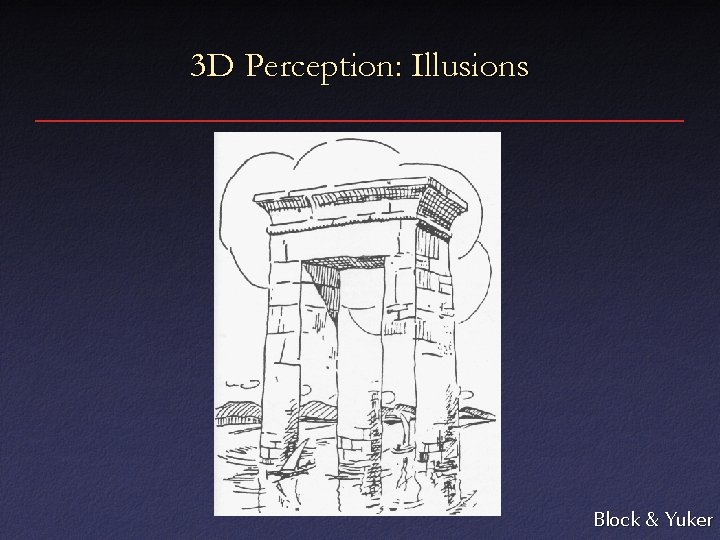
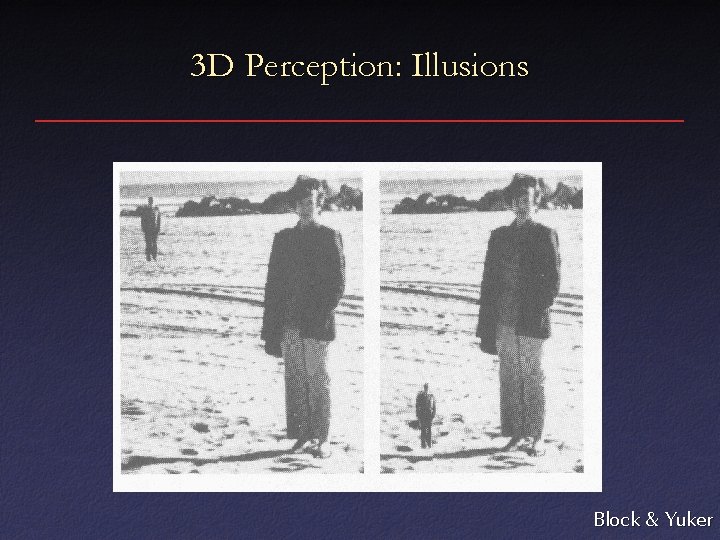
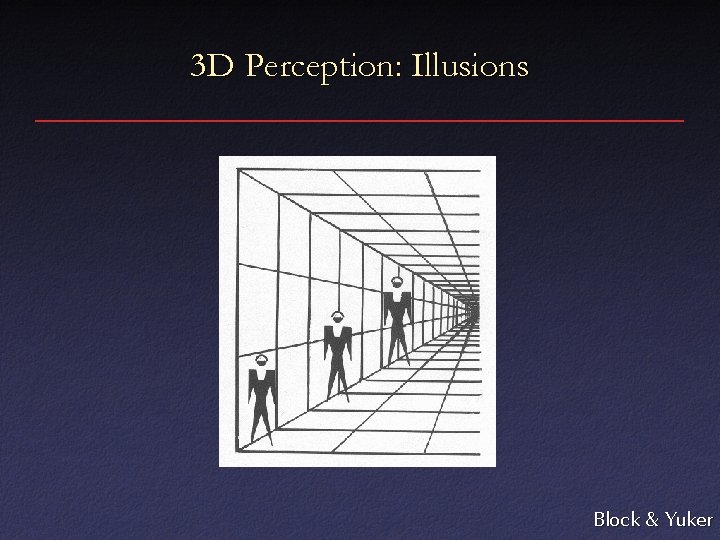
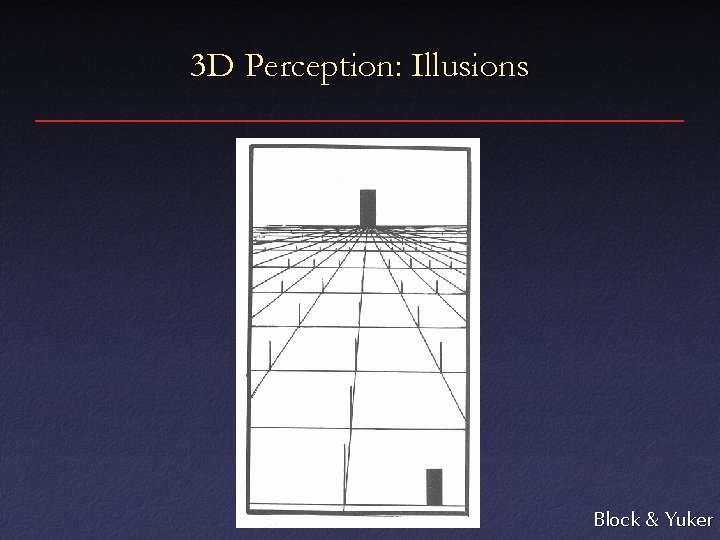
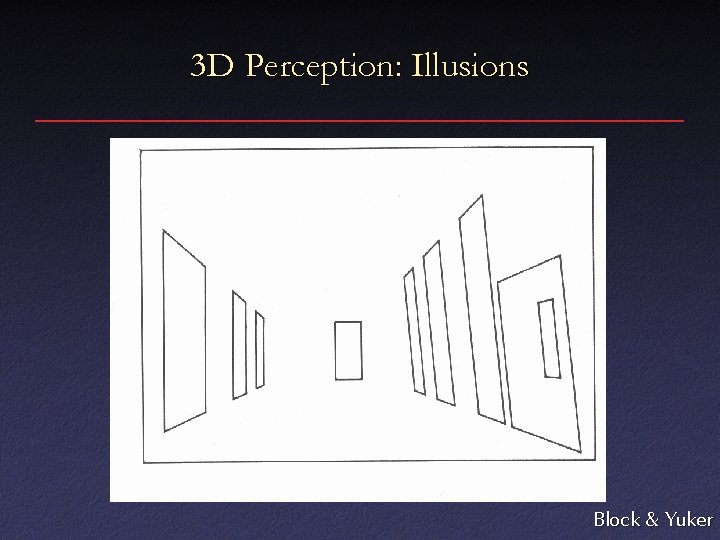
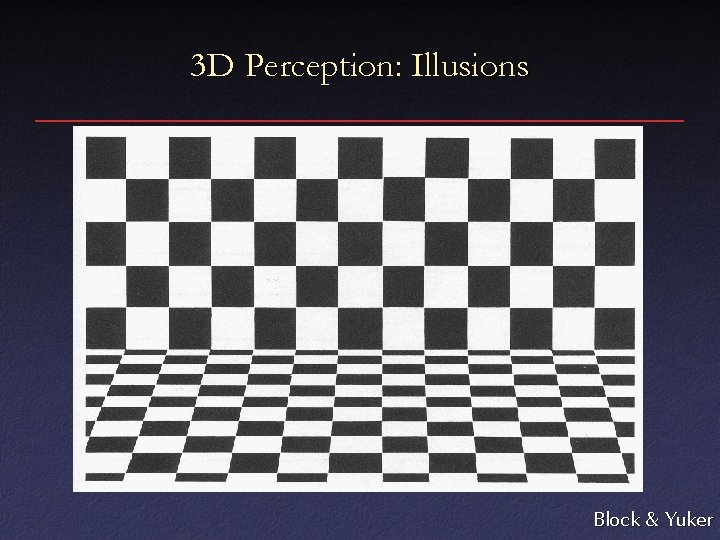
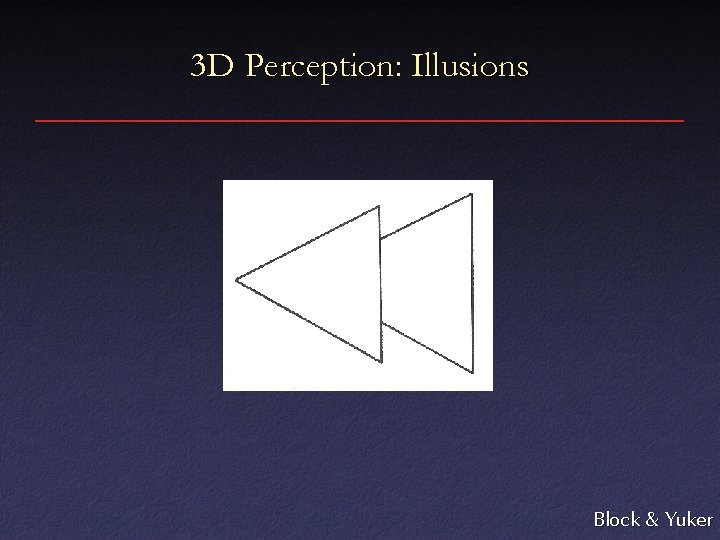
3 D Perception: Conclusions • Perspective is assumed • Relative depth ordering • Occlusion is important • Local consistency
3 D Perception: Stereo • Experiments show that absolute depth estimation not very accurate – Low “relief” judged to be deeper than it is • Relative depth estimation very accurate – Can judge which object is closer for stereo disparities of a few seconds of arc
3 D Computer Vision • Accurate (or not) shape reconstruction • Segmentation • Easier (? ) to match in 3 D than in 2 D – Occlusion – Shading – Smaller database of examples
3 D Data Types • Point Data • Volumetric Data • Surface Data
3 D Data Types: Point Data • “Point clouds” • Advantage: simplest data type • Disadvantage: no information on adjacency / connectivity
3 D Data Types: Volumetric Data • Regularly-spaced grid in (x, y, z): “voxels” • For each grid cell, store – Occupancy (binary: occupied / empty) – Density – Other properties • Popular in medical imaging – CAT scans – MRI
3 D Data Types: Volumetric Data • Advantages: – Can “see inside” an object – Uniform sampling: simpler algorithms • Disadvantages: – Lots of data – Wastes space if only storing a surface – Most “vision” sensors / algorithms return point or surface data
3 D Data Types: Surface Data • Polyhedral – Piecewise planar – Polygons connected together – Most popular: “triangle meshes” • Smooth – Higher-order (quadratic, cubic, etc. ) curves – Bézier patches, splines, NURBS, subdivision surfaces, etc.
3 D Data Types: Surface Data • Advantages: – Usually corresponds to what we see – Usually returned by vision sensors / algorithms • Disadvantages: – How to find “surface” for translucent objects? – Parameterization often non-uniform – Non-topology-preserving algorithms difficult
3 D Data Types: Surface Data • Implicit surfaces (cf. parametric) – Zero set of a 3 D function – Usually regularly sampled (voxel grid) • Advantage: easy to write algorithms that change topology • Disadvantage: wasted space, time
2½-D Data • Image: stores an intensity / color along each of a set of regularly-spaced rays in space • Range image: stores a depth along each of a set of regularly-spaced rays in space • Not a complete 3 D description: does not store objects occluded (from some viewpoint) • View-dependent scene description
2½-D Data • This is what most sensors / algorithms really return • Advantages – Uniform parameterization – Adjacency / connectivity information • Disadvantages – Does not represent entire object – View dependent
2½-D Data • Range images • Range surfaces • Depth images • Depth maps • Height fields • 2½-D images • Surface profiles • xyz maps • …
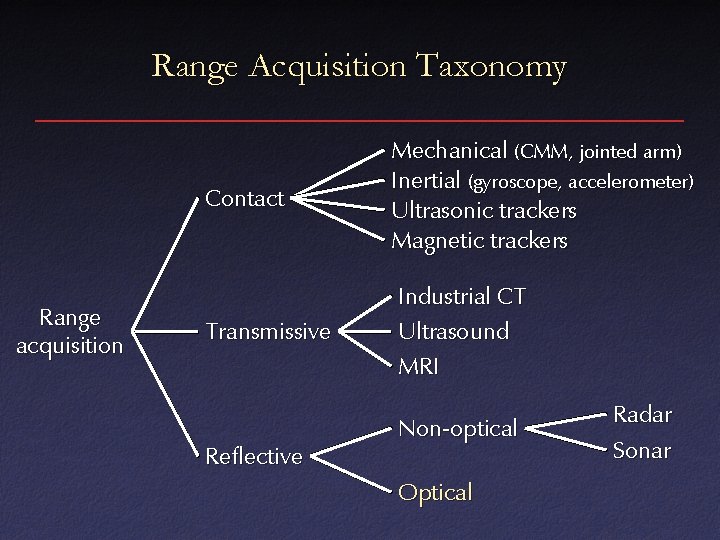
Range Acquisition Taxonomy Range acquisition Contact Mechanical (CMM, jointed arm) Inertial (gyroscope, accelerometer) Ultrasonic trackers Magnetic trackers Transmissive Industrial CT Ultrasound MRI Reflective Non-optical Optical Radar Sonar
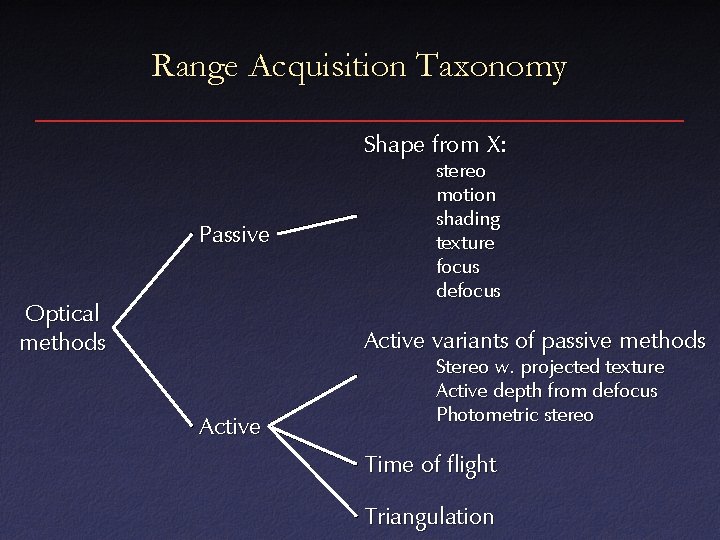
Range Acquisition Taxonomy Shape from X: Passive Optical methods stereo motion shading texture focus defocus Active variants of passive methods Active Stereo w. projected texture Active depth from defocus Photometric stereo Time of flight Triangulation
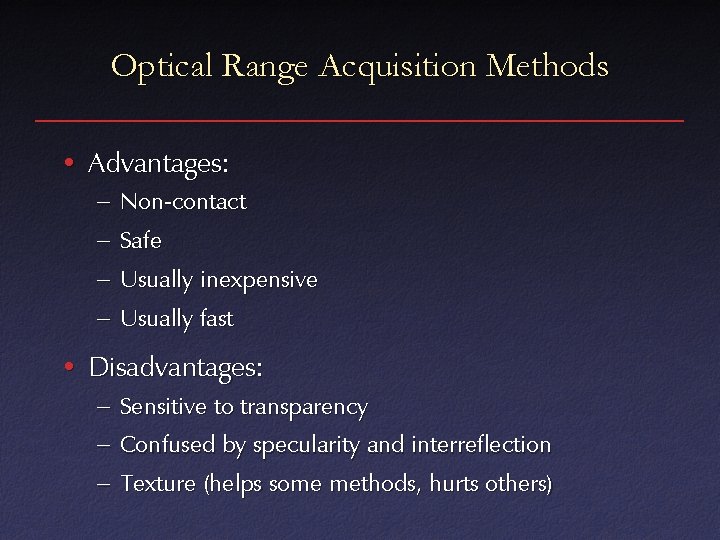
Optical Range Acquisition Methods • Advantages: – Non-contact – Safe – Usually inexpensive – Usually fast • Disadvantages: – Sensitive to transparency – Confused by specularity and interreflection – Texture (helps some methods, hurts others)
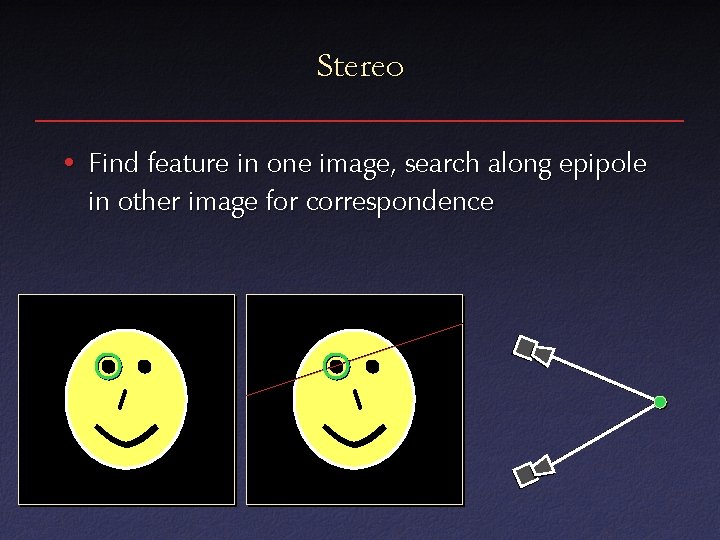
Stereo • Find feature in one image, search along epipole in other image for correspondence
Stereo • Advantages: – – Passive Cheap hardware (2 cameras) Easy to accommodate motion Intuitive analogue to human vision • Disadvantages: – – Only acquire good data at “features” Sparse, relatively noisy data (correspondence is hard) Bad around silhouettes Confused by non-diffuse surfaces • Variant: multibaseline stereo to reduce ambiguity
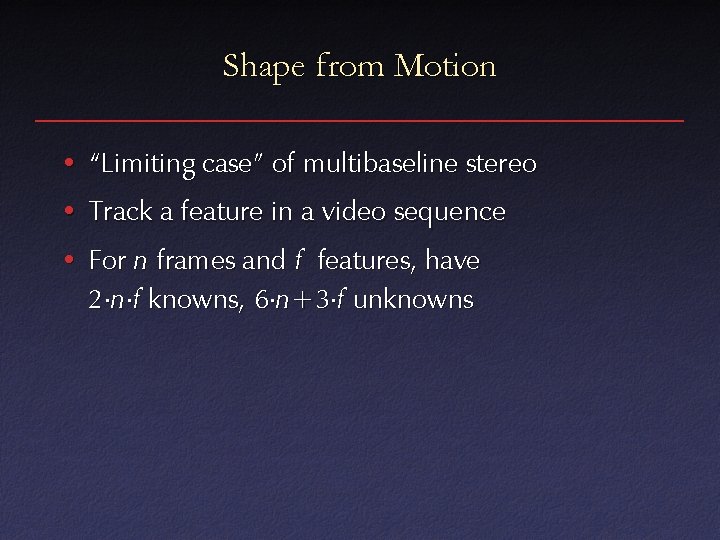
Shape from Motion • “Limiting case” of multibaseline stereo • Track a feature in a video sequence • For n frames and f features, have 2 n f knowns, 6 n+3 f unknowns
Shape from Motion • Advantages: – Feature tracking easier than correspondence in faraway views – Mathematically more stable (large baseline) • Disadvantages: – Does not accommodate object motion – Still problems in areas of low texture, in non-diffuse regions, and around silhouettes
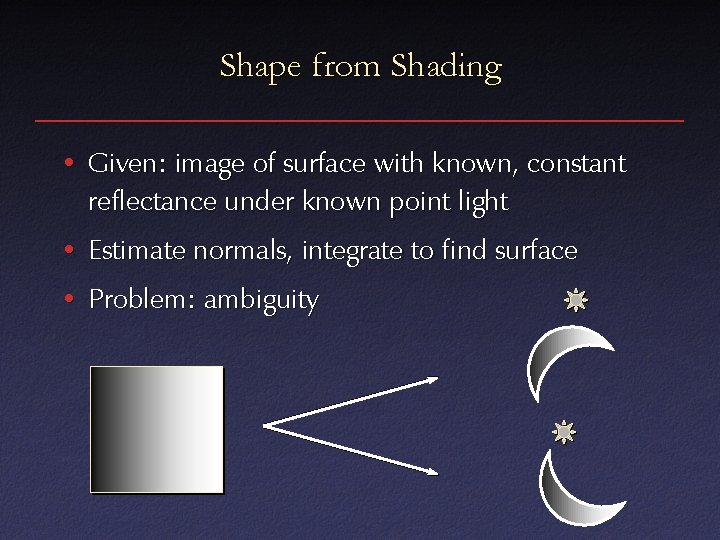
Shape from Shading • Given: image of surface with known, constant reflectance under known point light • Estimate normals, integrate to find surface • Problem: ambiguity
Shape from Shading • Advantages: – Single image – No correspondences – Analogue in human vision • Disadvantages: – Mathematically unstable – Can’t have texture • “Photometric stereo” (active method) more practical than passive version
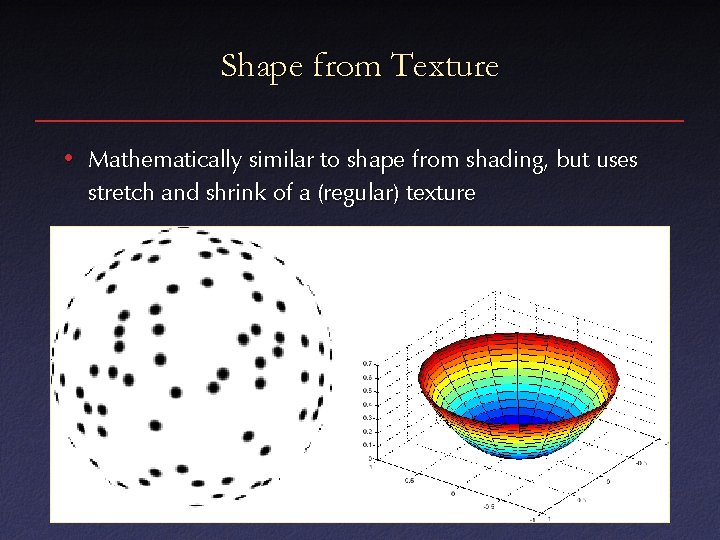
Shape from Texture • Mathematically similar to shape from shading, but uses stretch and shrink of a (regular) texture
Shape from Texture • Analogue to human vision • Same disadvantages as shape from shading
Shape from Focus and Defocus • Shape from focus: at which focus setting is a given image region sharpest? • Shape from defocus: how out-of-focus is each image region? • Passive versions rarely used • Active depth from defocus can be made practical
Active Optical Methods • Advantages: – Usually can get dense data – Usually much more robust and accurate than passive techniques • Disadvantages: – Introduces light into scene (distracting, etc. ) – Not motivated by human vision
Terminology • Range acquisition, shape acquisition, rangefinding, range scanning, 3 D scanning • Alignment, registration • Surface reconstruction, 3 D scan merging, scan integration, surface extraction • 3 D model acquisition
Related Fields • Computer Vision – Passive range sensing – Rarely construct complete, accurate models – Application: recognition • Metrology – Main goal: absolute accuracy – High precision, provable errors more important than scanning speed, complete coverage – Applications: industrial inspection, quality control, asbuilt models
Related Fields • Computer Graphics – Often want complete model – Low noise, geometrically consistent model more important than absolute accuracy – Application: animated CG characters
- Slides: 40