
3 D Vertebral Morphological Measurements Using Low Dose
3 D Vertebral Morphological Measurements Using Low Dose Stereoradiography Imaging: A Comparison with CT Scans Saba Pasha 1, Tom Schlösser 2, John Flynn 1, René Castelein 2 The Children’s Hospital of Philadelphia, The United States University Medical Center, Utrecht, Holland
Overview • Purpose: to compare the 3 D vertebral morphology measurements using low dose stereoradiography with CT scans • Methods: • Evaluate 9 patients with spinal deformities (ages 7. 8 -12. 5 years) • 2 observers performed EOS 3 D reconstruction versus one observer for CT reconstructions • Generate 3 D reconstruction of CT and stereoradiography X-rays • Total of 86 vertebrae included in analysis • Compare 8 morphological parameters

Gold Standard • Vertebral morphology analyzed on CT scan reconstructions using semiautomatic image processing technique (Scoliosis Analysis[1]) • Manual identification of the vertebral endplates and spinal contour on the CT scans [1] Lam TP, Vincken KL, Castelein RM, JC. C. Three-dimensional characterization of torsion and asymmetry of the intervertebral discs versus vertebral bodies in adolescent idiopathic scoliosis. Spine (Phila Pa 1976). 2014; 39(19): E 1159 -1166.

The Local Coordinate System of Each Vertebrae 8 anatomical landmarks identified: 1. ) Anterior Height (A) 2. ) Posterior Height (P) 3. ) Left Height (L) 4. ) Right Height (R) 5. ) Superior vertebral depth (S-D) 6. ) Inferior vertebral depth (I-D) 7. ) Superior vertebral width (S-W) 8. ) Inferior vertebral width (I-W)
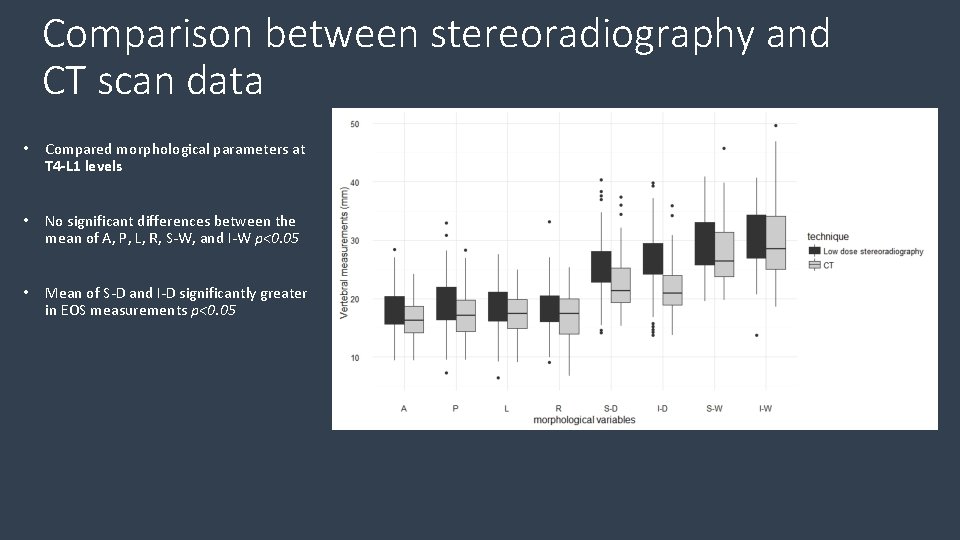
Comparison between stereoradiography and CT scan data • Compared morphological parameters at T 4 -L 1 levels • No significant differences between the mean of A, P, L, R, S-W, and I-W p<0. 05 • Mean of S-D and I-D significantly greater in EOS measurements p<0. 05
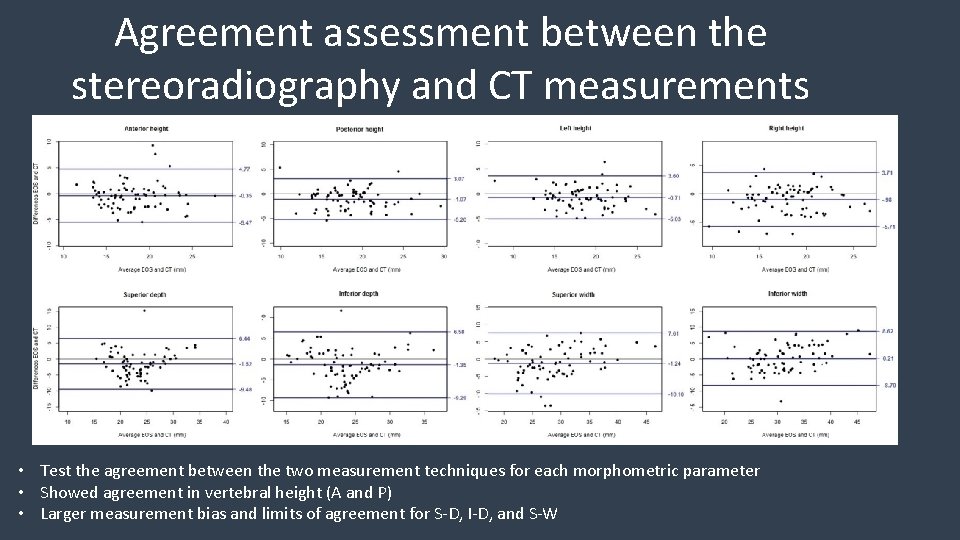
Agreement assessment between the stereoradiography and CT measurements • Test the agreement between the two measurement techniques for each morphometric parameter • Showed agreement in vertebral height (A and P) • Larger measurement bias and limits of agreement for S-D, I-D, and S-W
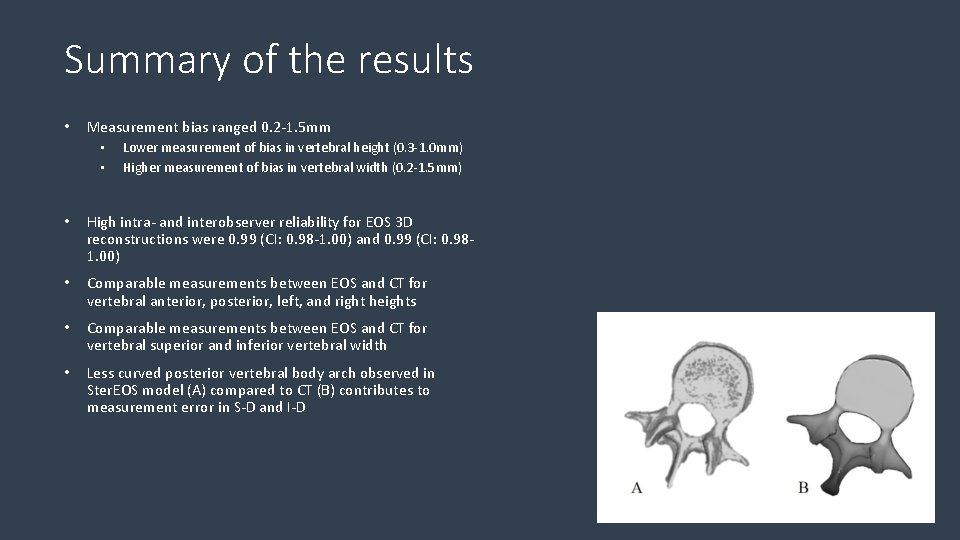
Summary of the results • Measurement bias ranged 0. 2 -1. 5 mm • • Lower measurement of bias in vertebral height (0. 3 -1. 0 mm) Higher measurement of bias in vertebral width (0. 2 -1. 5 mm) • High intra- and interobserver reliability for EOS 3 D reconstructions were 0. 99 (CI: 0. 98 -1. 00) and 0. 99 (CI: 0. 981. 00) • Comparable measurements between EOS and CT for vertebral anterior, posterior, left, and right heights • Comparable measurements between EOS and CT for vertebral superior and inferior vertebral width • Less curved posterior vertebral body arch observed in Ster. EOS model (A) compared to CT (B) contributes to measurement error in S-D and I-D
Limitations and Future Analysis Limitations • Only include spinal vertebrae at T 4 -L 1 levels • Excluded patients under the age of 7 years Future direction • Evaluation of the lumbar vertebrae morphological parameters using EOS system
Conclusion • 3 D reconstruction of stereoradiography images provides accurate and reliable measurements of the vertebral dimensions for: • Anterior/Posterior Height • Left/Right Height • Superior/Inferior Vertebral Width • Incorporating these measurements into clinical assessments of patients undergoing growth-friendly treatment for spinal deformity can enhance the patient care.
- Slides: 9