
3 D Time of Flight Sensors for Robot
3 D Time of Flight Sensors for Robot Navigation Mohammed Rizwan Adil, Chidambaram Alagappan. , and Swathi Dumpala Basaveswara
Robots �Gaining immense importance �Presence of robots being felt in all walks of life. �Image detection has become a prerequisite for effective navigation. �The robot should be able to ‘extract’ all the necessary information from its sensors.
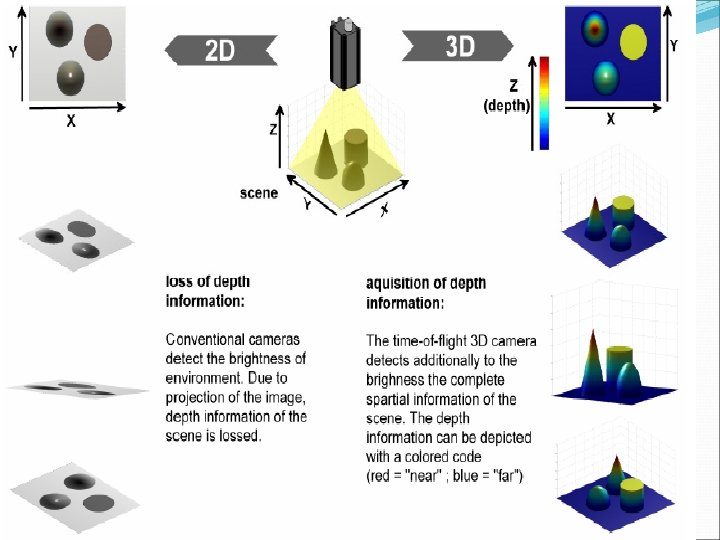
Image detection �Conventional 2 D images detect brightness but don’t detect depth. �Therefore 3 D Time of Flight Cameras are being used. �The depth information is depicted using color codes. � 3 D To. F cameras combine the accurate distance measurements and camera based system. �A final discussion about PMD and the psuedo four phase shift algorithm
Introduction �Four building blocks of navigation � 1. perception-robot must be able to interpret meaningful data using the sensors � 2. localization- the robot must be able to determine its position with regard to the environment � 3. cognition- the robot must be able to determine its path � 4. motion control- the mechanical traversal along the planned path
![Simultaneous Localization and Mapping (SLAM) [3]. �In most cases, the processes of exploring an](http://slidetodoc.com/presentation_image/5f94937854fdd5d75510415c8173d49d/image-5.jpg "Simultaneous Localization and Mapping (SLAM) [3]. �In most cases, the processes of exploring an")
Simultaneous Localization and Mapping (SLAM) [3]. �In most cases, the processes of exploring an unknown environment through maps and determining the relative position are performed simultaneously through a process known as Simultaneous Localization and Mapping
Several methods to obtainb 3 D images �An image from stereo vision camera which provides 3 D details of an object can be fused with the measurements of a 2 D laser range finder. � Stereo vision requires complicated algorithms and powerful sensors to construct its occupancy grid and despite all these, it is prone to error
Sf. M= Structure from Motion �Works assuming that the object is going to move. �Trajectories of points are used to estimate dimensions. �Technique will not work if object is dynamic(like flowing water)
Stereo Vision v/s Kinetic depth technique �In Stereo Vision, the image and the data from the laser range finders corresponding to the same time has to be overlapped to obtain a 3 D vision. �In Kinetic depth technique, the image of the same object has to be taken at two different time intervalseither ways, both techniques require data fusion which requires computing power.
Laser Range Scanners �Laser Range Scanner which works on the principle of calculating the distance from the observer to a particular point. � Laser Range Scanners provide sparse data sets, use mechanical components and do not provide a 3 D image with one image capture

To. F cameras �The time of flight cameras combine the features of active range sensors and camera based approaches and provide a complex image which contains both the intensities and also the distances of each and every point. �There is no fusion of data from two separate sources and the data is being gathered continuously

Principle behind the time of flight cameras �Points that are distant from the camera will take greater time to reach it. �The distance to the object us calculated using properties of light and phase shift of modulation envelope of the light source. �The phase and amplitude of the reflected light can be detected using various signal processing techniques. Usually, to get a high resolution CCD based sensors are employed
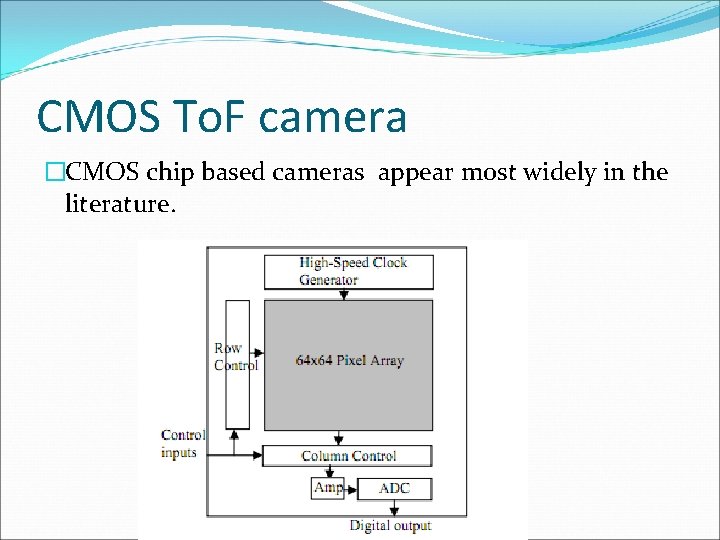
CMOS To. F camera �CMOS chip based cameras appear most widely in the literature.
�CMOS sensors usually have 64 x 64 pixel array and are implemented on a single chip using ordinary, low cost CMOS process. � It also needs to have ADC and also a mechanism to generate high speed modulation signals �The main part of the sensor design is the unique pixel structure
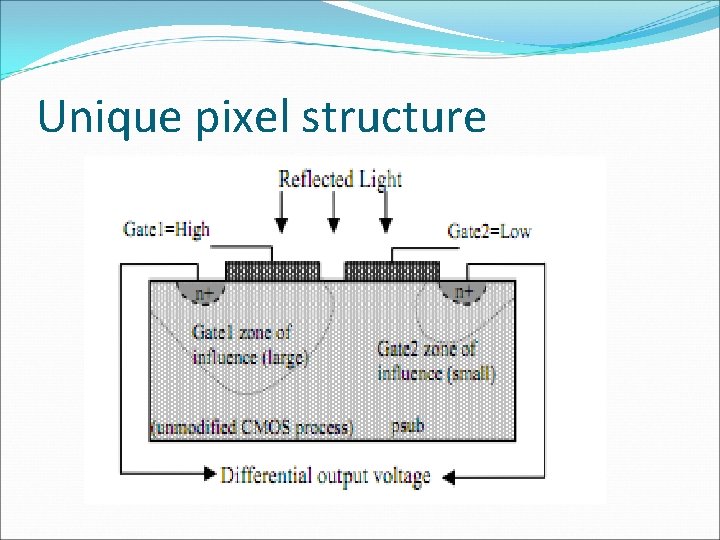
Unique pixel structure
�The differential structure accumulates photogenerated charges in two collection nodes using two modulated gates. �The gate modulation signals are synchronized with the light source, and hence depending on the phase of incoming light, one node collects more charges than the other.
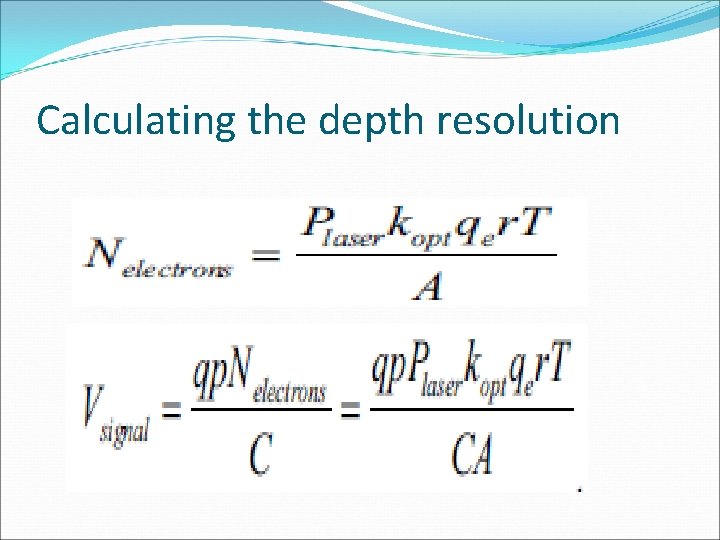
Calculating the depth resolution
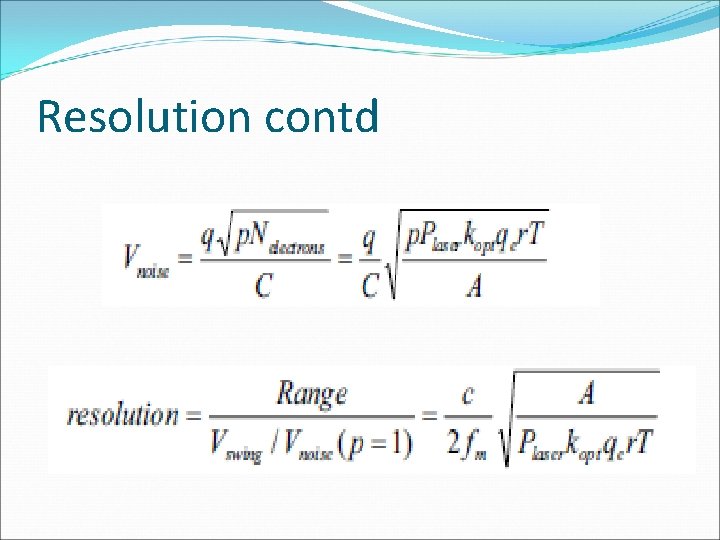
Resolution contd
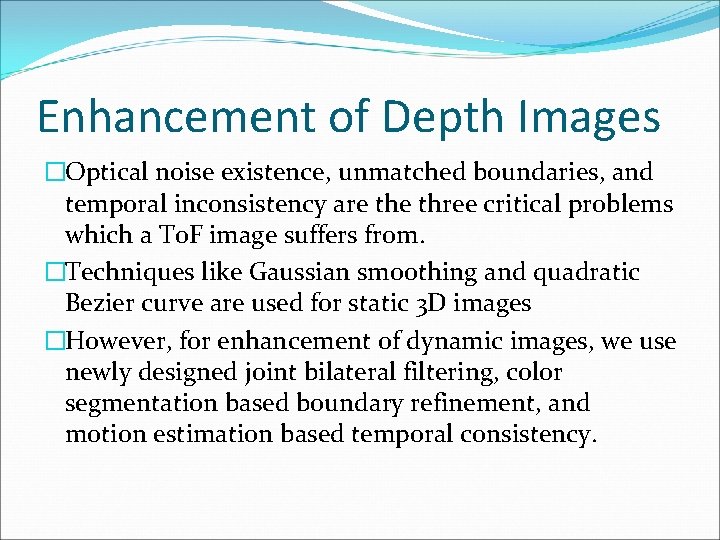
Enhancement of Depth Images �Optical noise existence, unmatched boundaries, and temporal inconsistency are three critical problems which a To. F image suffers from. �Techniques like Gaussian smoothing and quadratic Bezier curve are used for static 3 D images �However, for enhancement of dynamic images, we use newly designed joint bilateral filtering, color segmentation based boundary refinement, and motion estimation based temporal consistency.
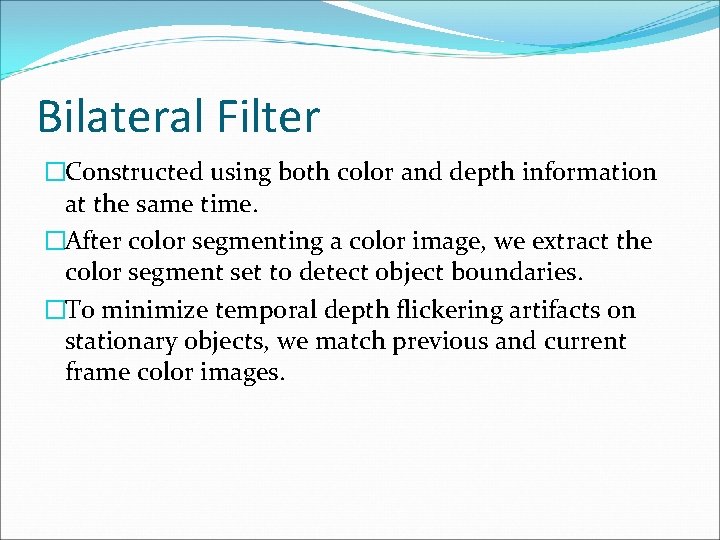
Bilateral Filter �Constructed using both color and depth information at the same time. �After color segmenting a color image, we extract the color segment set to detect object boundaries. �To minimize temporal depth flickering artifacts on stationary objects, we match previous and current frame color images.
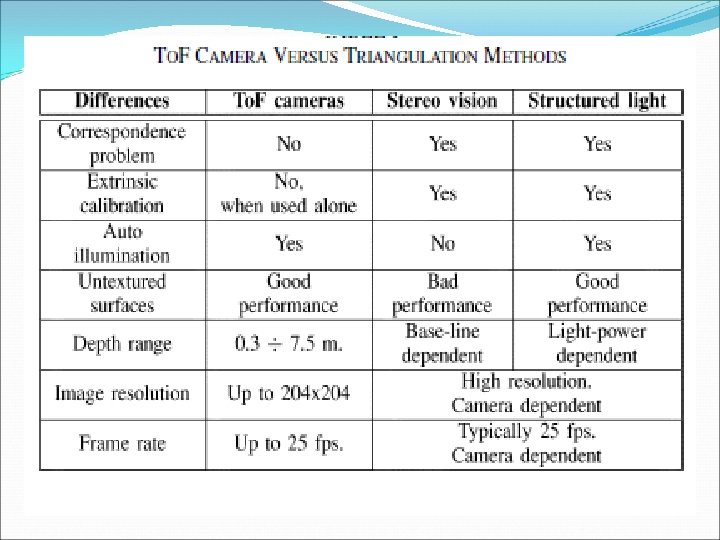
Review of latest developments �These cameras are able to provide registered dense depth and intense images, complete image acquisition and high frame rate, small and compact design. �They don’t need any mobile parts and have autoillumination
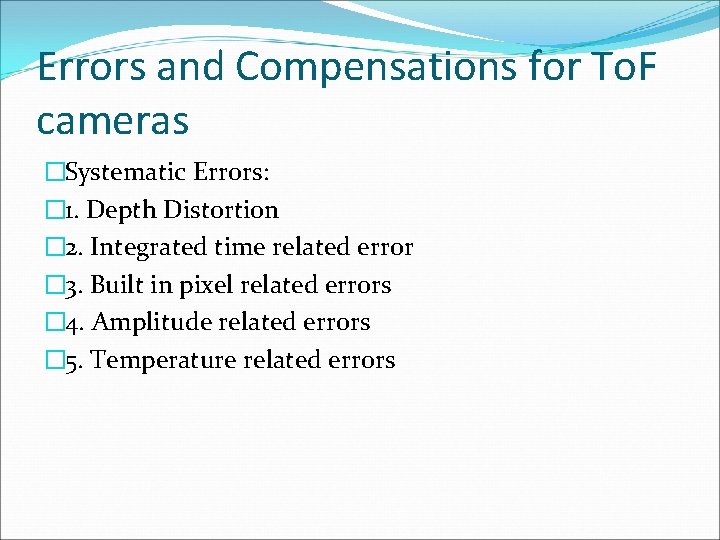
Errors and Compensations for To. F cameras �Systematic Errors: � 1. Depth Distortion � 2. Integrated time related error � 3. Built in pixel related errors � 4. Amplitude related errors � 5. Temperature related errors
�Non Systematic Errors � 1. SNR � 2. Multiple light reception � 3. Light scattering � 4. Motion blurring
Photonic Mixer Devices
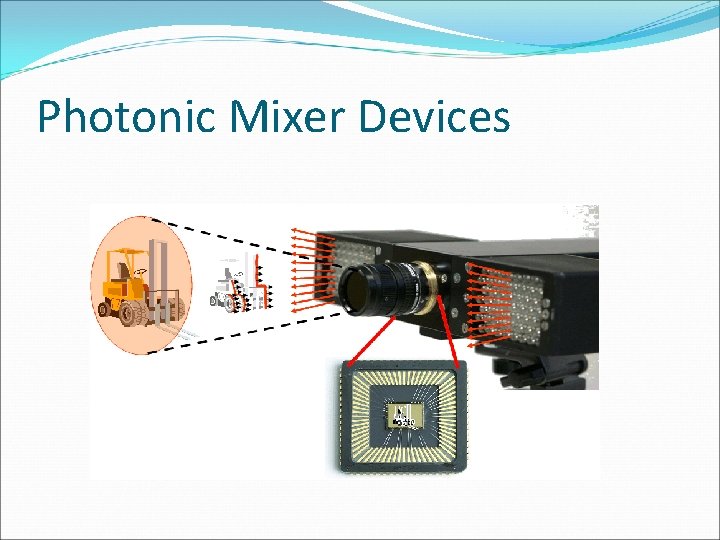
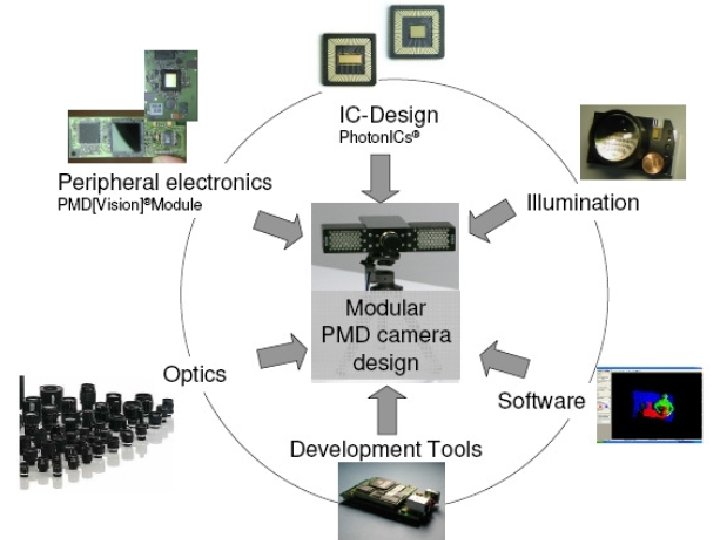
PMD cont’d �Photonic Mixer Devices are also based on To. F principle and can realize a 3 D image without complex electronics similar to a CMOS device �In a PMD, instead of a single laser beam (which would have to be scanned over the scene to obtain 3 D) the entire scene is illuminated with modulated light.
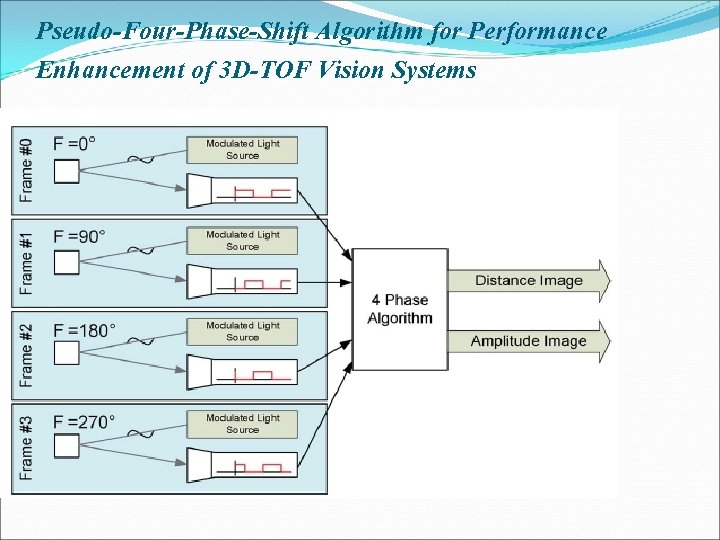
Pseudo-Four-Phase-Shift Algorithm for Performance Enhancement of 3 D-TOF Vision Systems
�Only two image captures instead of four are required to calculate the phase difference φ. �The frame rate of PMD TOF sensors is doubled without changing the integration time Tint.

Thanks
- Slides: 30