
3 D Surface Reconstruction using RFunctions and Supershapes
- Slides: 1
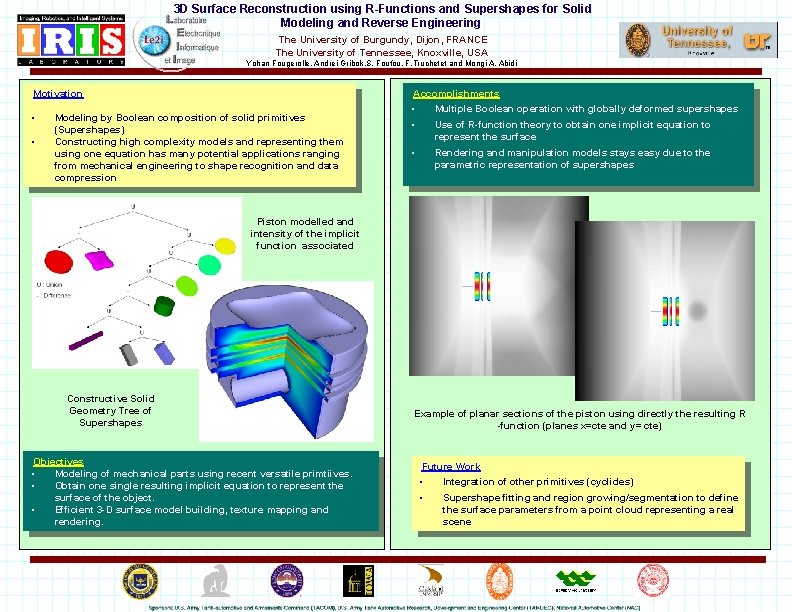
3 D Surface Reconstruction using R-Functions and Supershapes for Solid Modeling and Reverse Engineering The University of Burgundy, Dijon, FRANCE The University of Tennessee, Knoxville, USA Yohan Fougerolle, Andrei Gribok, S. Foufou, F. Truchetet and Mongi A. Abidi Motivation Accomplishments • • • Multiple Boolean operation with globally deformed supershapes • Rendering and manipulation models stays easy due to the parametric representation of supershapes • Modeling by Boolean composition of solid primitives (Supershapes) Constructing high complexity models and representing them using one equation has many potential applications ranging from mechanical engineering to shape recognition and data compression Use of R-function theory to obtain one implicit equation to represent the surface Piston modelled and intensity of the implicit function associated Constructive Solid Geometry Tree of Supershapes Objectives • Modeling of mechanical parts using recent versatile primtiives. • Obtain one single resulting implicit equation to represent the surface of the object. • Efficient 3 -D surface model building, texture mapping and rendering. Example of planar sections of the piston using directly the resulting R -function (planes x=cte and y= cte) Future Work • • Integration of other primitives (cyclides) Supershape fitting and region growing/segmentation to define the surface parameters from a point cloud representing a real scene