
3 D Printing in Education Building New Pathways
3 -D Printing in Education: Building New Pathways for Learning Dr. Lisa Wadors Verne Benetech Global Literacy June 14, 2016 www. CTDInstitute. org

Benetech Global Literacy Solutions BORN ACCESSIBLE These projects are supported by the U. S. Department of Education, Office of Special Education Programs (Award Number H 327 D 120002). Opinions expressed herein are those of the speaker and do not necessarily represent the position of the U. S. Department of Education. www. CTDInstitute. org
www. CTDInstitute. org
www. CTDInstitute. org
A Critical Strategy All materials Born Digital Must be Born Accessible www. CTDInstitute. org
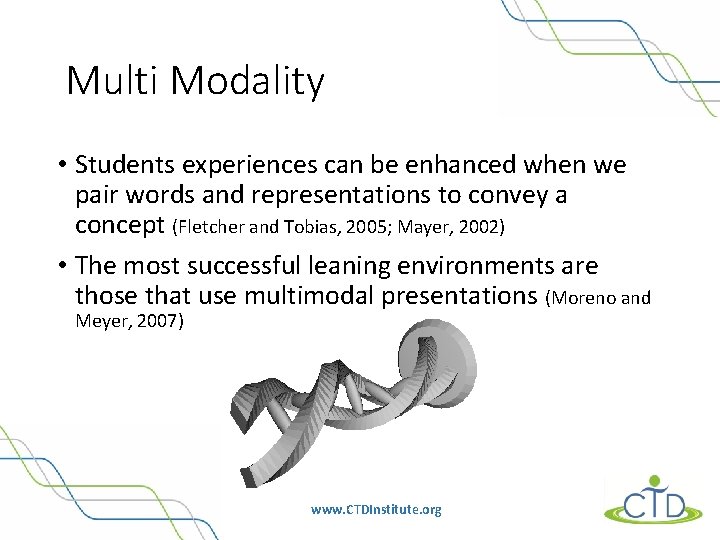
Multi Modality • Students experiences can be enhanced when we pair words and representations to convey a concept (Fletcher and Tobias, 2005; Mayer, 2002) • The most successful leaning environments are those that use multimodal presentations (Moreno and Meyer, 2007) www. CTDInstitute. org
How does 3 D Printing Work? • Objects are constructed using a layering process • Objects are printed using various materials such as: rubber, metal, plastics, even hot cacao powder Video (1: 35 min): Will 3 D Printing Change the World? www. CTDInstitute. org
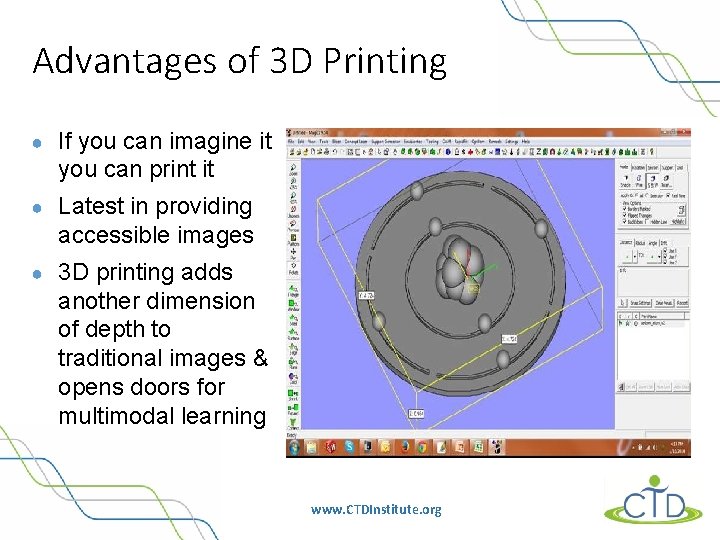
Advantages of 3 D Printing ● If you can imagine it you can print it ● Latest in providing accessible images ● 3 D printing adds another dimension of depth to traditional images & opens doors for multimodal learning www. CTDInstitute. org
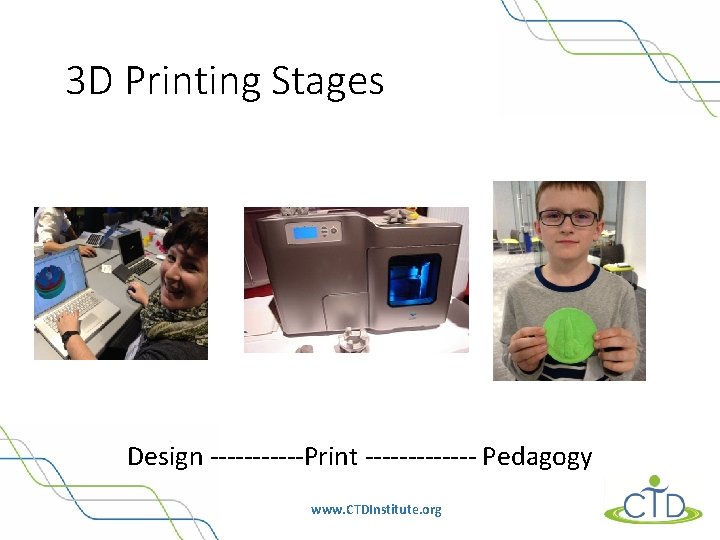
3 D Printing Stages Design ------Print ------- Pedagogy www. CTDInstitute. org
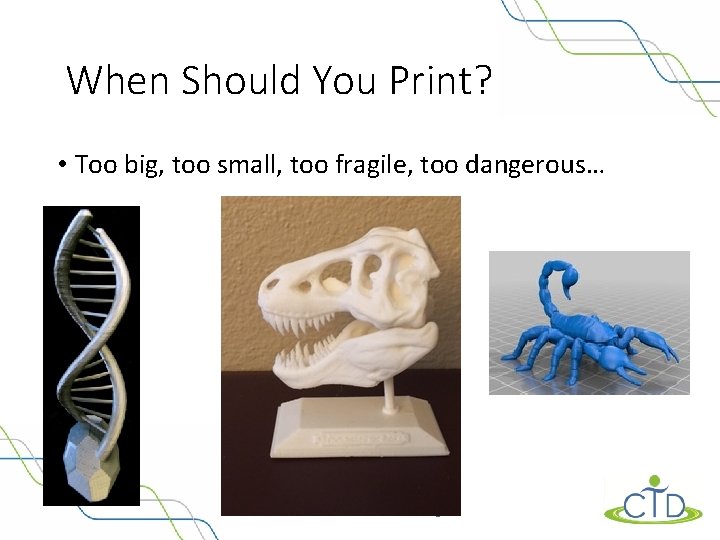
When Should You Print? • Too big, too small, too fragile, too dangerous… www. CTDInstitute. org
Should I Print? “… just because you have a 3 D printer, it doesn’t mean that everything needs to be 3 D printed. ” CP, FAAOP www. CTDInstitute. org -Gary Berke, MS,
Who Benefits From a 3 D Printed Model? • All learners can benefit from a model to explore. • Learners need different approaches to learn new concepts. • Learners with different abilities also need these learning tools, and use them in various ways. Video – Chelsea Cook www. CTDInstitute. org

Learners Who Are Blind or Who Have Low Vision 3 D printed model helps when: • Actual object is not available to explore through touch (too small, large, fragile, dangerous, not in proximity) • Process, stages, or progression are involved • Moveable and/or removable parts are incorporated (e. g. model of the eye, electricity through a circuit) www. CTDInstitute. org
Learners Who Are Blind or Who Have Low Vision 3 D printed model does not help when … • it is a stand-alone source of information (learner is expected to explore independently and understand concept) • the 3 D object attempts to duplicate a 2 D image (a raised outline map) • the results are 2. 5 D – not fully 3 D (showing only one face of the object) www. CTDInstitute. org
Learners who are deaf or hard of hearing 3 D printed model helps when: • learner also has a reading deficit that results in difficulty understanding a caption or other written material in relation to actual object • learner has difficulty understanding sign language interpreter's explanation • learner's first language is not English/ASL www. CTDInstitute. org
Learners who are deaf or hard of hearing 3 D printed model does not help when: • learner has same access to object as other students and that meets their needs for comprehension www. CTDInstitute. org
Learners with learning disabilities 3 D printed model helps when: learner with visual functioning difficulties has a hands-on opportunity to examine and manipulate object being taught more thoroughly • learner with auditory processing difficulties will be able to examine up close, ask questions, listen to directions/instructions while having the opportunity to manipulate object www. CTDInstitute. org
Learners with learning disabilities 3 D printed model does not help when: • object is not available for close-up examination and manipulation, but just for viewing at a distance www. CTDInstitute. org
Learners with physical disabilities Actual object or parts of it are not accessible for viewing • Using technology (e. g. microscope) is difficult for motor abilities www. CTDInstitute. org
All Learners Each learner has different skills. Encourage learner to use the 3 D object as needed for a better understanding. • The opportunity to ask questions and have discussion is very important in gaining understanding. www. CTDInstitute. org
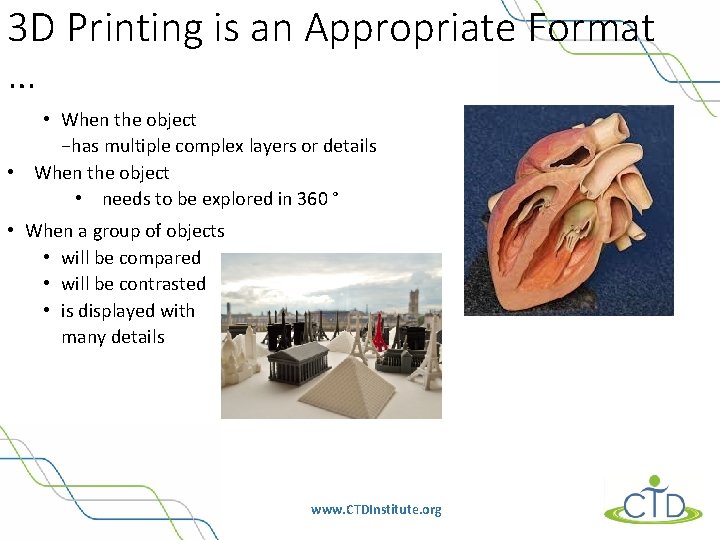
3 D Printing is an Appropriate Format … • When the object −has multiple complex layers or details • When the object • needs to be explored in 360 ° • When a group of objects • will be compared • will be contrasted • is displayed with many details www. CTDInstitute. org
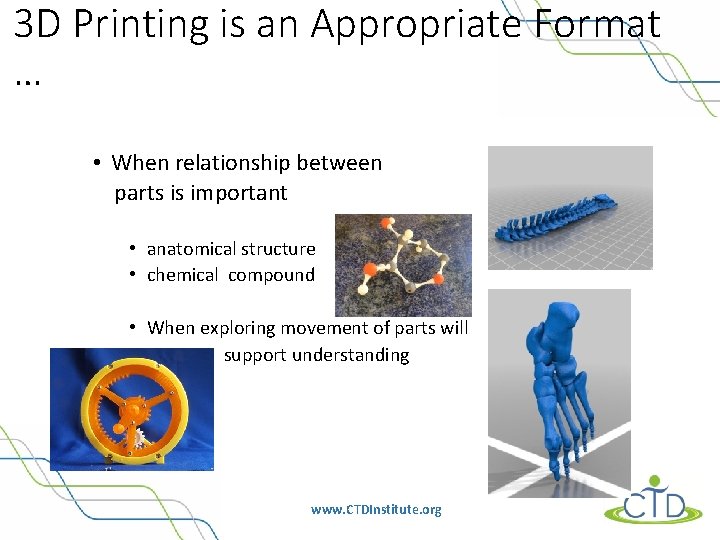
3 D Printing is an Appropriate Format … • When relationship between parts is important • anatomical structure • chemical compound • When exploring movement of parts will • support understanding www. CTDInstitute. org
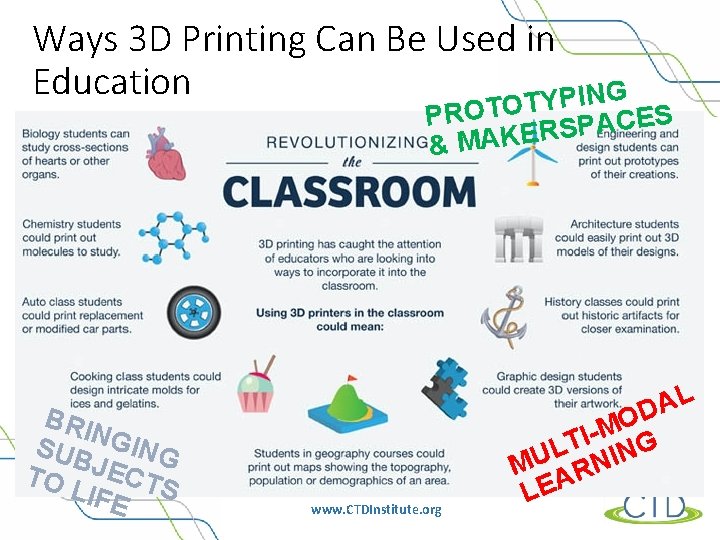
Ways 3 D Printing Can Be Used in Education TYPING PROTO SPACES R E K A M & BRI SUBNGING TO JECTS LIFE www. CTDInstitute. org L A D O M I LT ING U M RN LEA
3 D File Repositories Many 3 D file repositories already available today (not all files are open-source): • 3 DAGOGO • Advanced Distributed Learning (ADL) • Google Earth/Sketch. Up • Grabcad • Shapeways • Smithsonian X 3 D • Thingiverse • NIH www. CTDInstitute. org
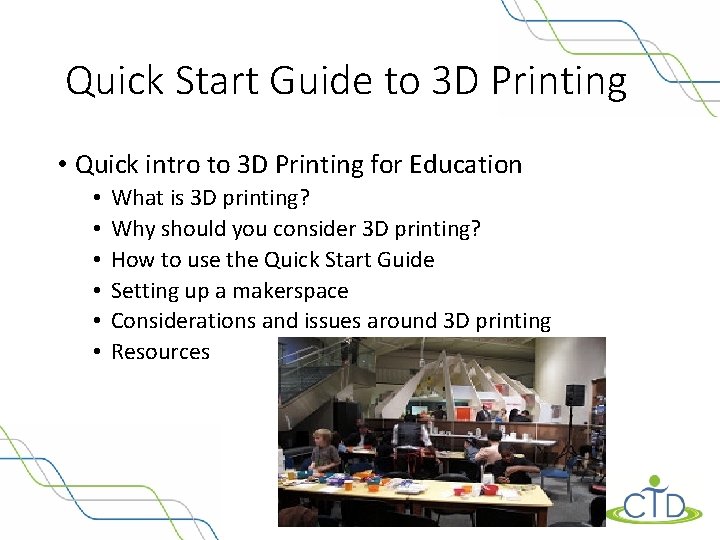
Quick Start Guide to 3 D Printing • Quick intro to 3 D Printing for Education • • • What is 3 D printing? Why should you consider 3 D printing? How to use the Quick Start Guide Setting up a makerspace Considerations and issues around 3 D printing Resources www. CTDInstitute. org
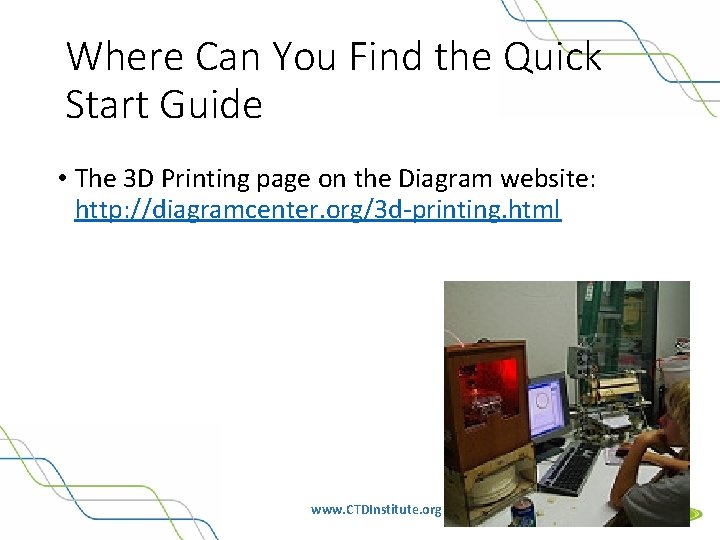
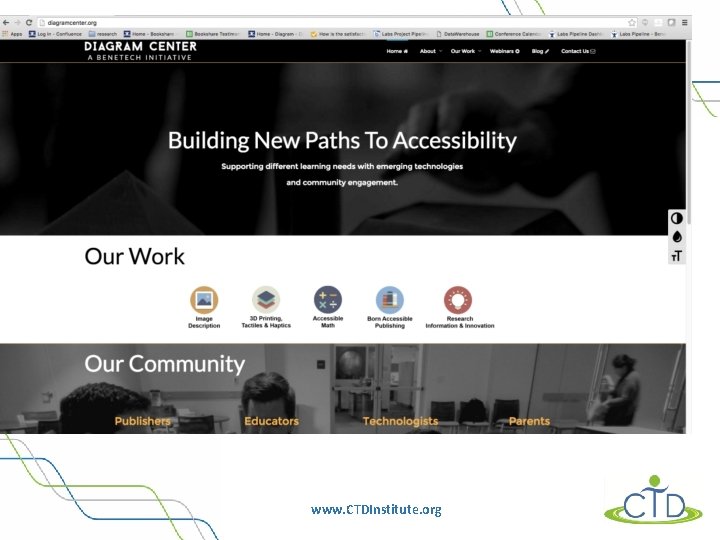
Where Can You Find the Quick Start Guide • The 3 D Printing page on the Diagram website: http: //diagramcenter. org/3 d-printing. html www. CTDInstitute. org
Future of Technology in Education DIAGRAM Center Research http: //diagramcenter. org/research. html Twitter @DIAGRAMC https: //twitter. com/DIAGRAMC Email us info@diagramcenter. org 3 d@benetech. org www. CTDInstitute. org
“Assistive and Instructional Technology Supporting Learners with Disabilities” www. CTDInstitute. org
- Slides: 28