
3 D Modeling Basics Three basic types of
3 D Modeling Basics Three basic types of 3 D CAD models: 1. Wireframe models 2. Surface models 3. Solid models
Wireframe Model n n n n “wires” represent edges of the actual object. surfaces of the object are not defined, only the boundaries of surfaces are represented by edges. See-through; not useful for visualization Has complete dimensional information but contains no volume. Easy to construct Created by constructing 2 D objects (lines, circles, arcs, etc. ) in 3 D space. Useful for planar or single-curved surfaces, but not compound curved surfaces. Example: wireframe model of a cube is like a model constructed of 12 coat-hanger wires.
Surface Model n n n Defines both surfaces and edges Provides better visualization of the actual 3 D object. Requires relatively tedious construction process; each surface must be constructed and oriented with respect to other surfaces. Auto. CAD is not a complete surface modeler; only allows planar and single-curved surfaces. Wireframe models are usually used as framework to build surfaces
Solid Model n n n Most complete and descriptive type of 3 D modeling. A computerized replica of the actual object. Contains definition of edges, surfaces, as well as the interior features of the object. Has mass and volume; can calculate mass and volumetric properties Construction techniques are usually simpler than those of surface modelers.
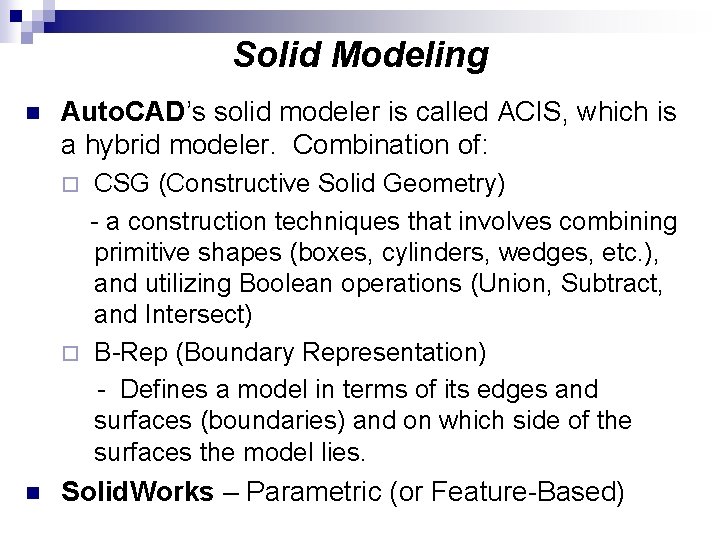
Solid Modeling n Auto. CAD’s solid modeler is called ACIS, which is a hybrid modeler. Combination of: CSG (Constructive Solid Geometry) - a construction techniques that involves combining primitive shapes (boxes, cylinders, wedges, etc. ), and utilizing Boolean operations (Union, Subtract, and Intersect) ¨ B-Rep (Boundary Representation) - Defines a model in terms of its edges and surfaces (boundaries) and on which side of the surfaces the model lies. ¨ n Solid. Works – Parametric (or Feature-Based)
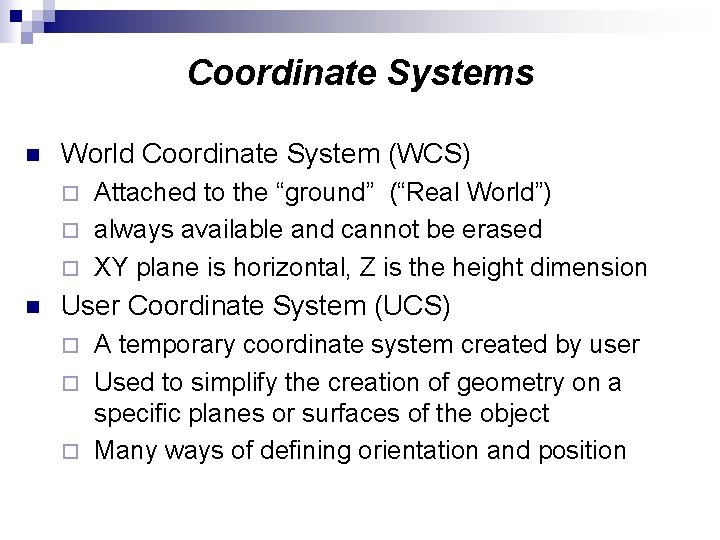
Coordinate Systems n World Coordinate System (WCS) Attached to the “ground” (“Real World”) ¨ always available and cannot be erased ¨ XY plane is horizontal, Z is the height dimension ¨ n User Coordinate System (UCS) A temporary coordinate system created by user ¨ Used to simplify the creation of geometry on a specific planes or surfaces of the object ¨ Many ways of defining orientation and position ¨
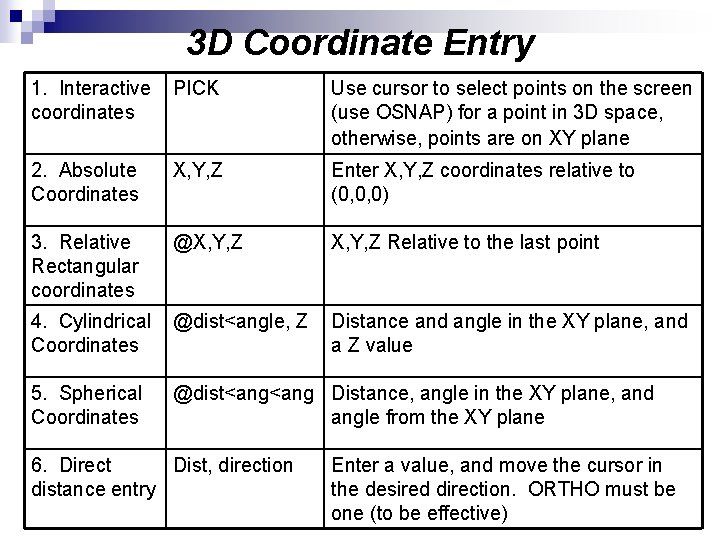
3 D Coordinate Entry 1. Interactive coordinates PICK Use cursor to select points on the screen (use OSNAP) for a point in 3 D space, otherwise, points are on XY plane 2. Absolute Coordinates X, Y, Z Enter X, Y, Z coordinates relative to (0, 0, 0) 3. Relative Rectangular coordinates @X, Y, Z Relative to the last point 4. Cylindrical Coordinates @dist<angle, Z Distance and angle in the XY plane, and a Z value 5. Spherical Coordinates @dist<ang Distance, angle in the XY plane, and angle from the XY plane 6. Direct Dist, direction distance entry Enter a value, and move the cursor in the desired direction. ORTHO must be one (to be effective)
- Slides: 7