
3 D Larynx Model with Moving Parts Karen
- Slides: 1
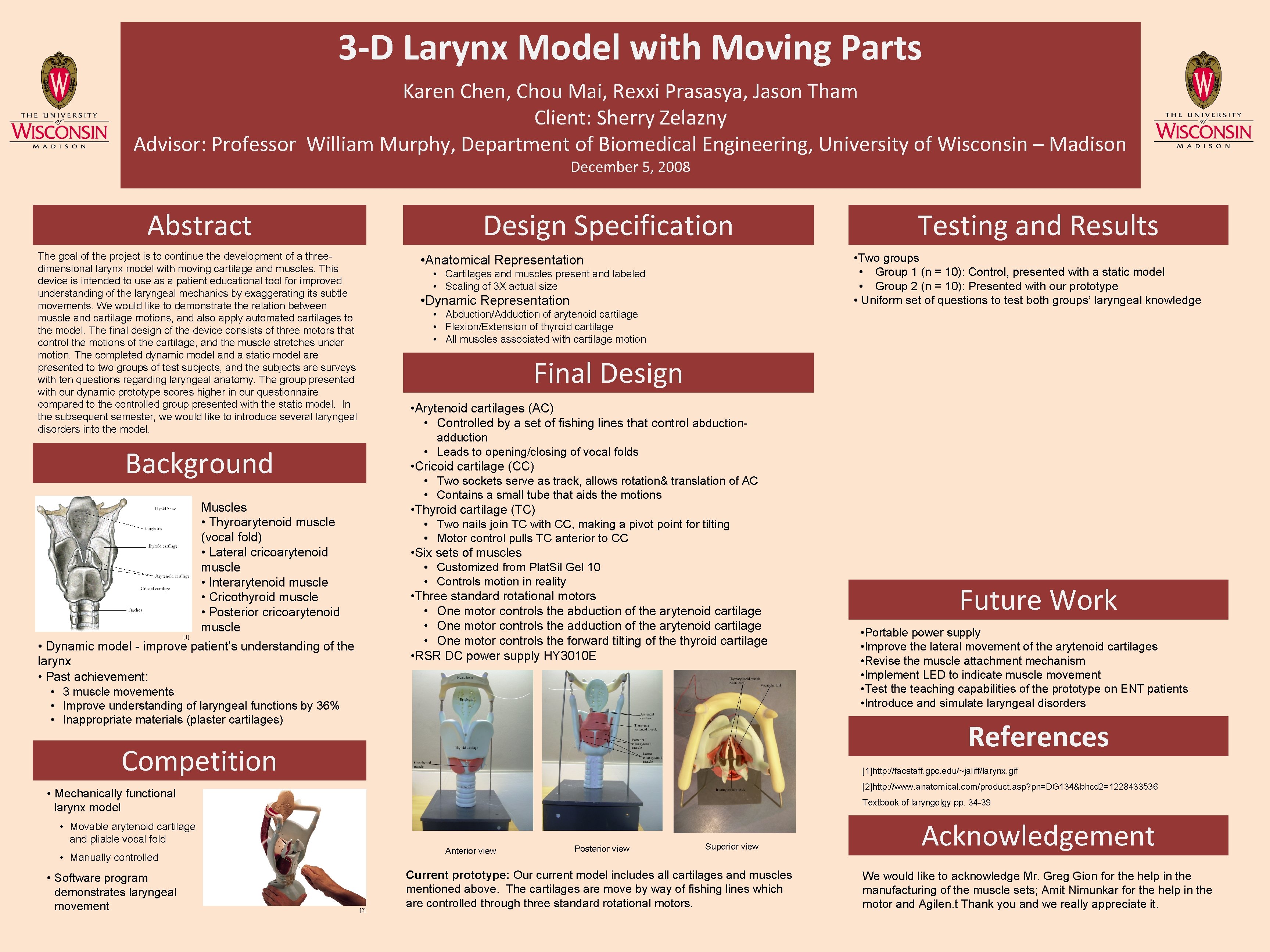
3 -D Larynx Model with Moving Parts Karen Chen, Chou Mai, Rexxi Prasasya, Jason Tham Client: Sherry Zelazny Advisor: Professor William Murphy, Department of Biomedical Engineering, University of Wisconsin – Madison December 5, 2008 Abstract Design Specification The goal of the project is to continue the development of a threedimensional larynx model with moving cartilage and muscles. This device is intended to use as a patient educational tool for improved understanding of the laryngeal mechanics by exaggerating its subtle movements. We would like to demonstrate the relation between muscle and cartilage motions, and also apply automated cartilages to the model. The final design of the device consists of three motors that control the motions of the cartilage, and the muscle stretches under motion. The completed dynamic model and a static model are presented to two groups of test subjects, and the subjects are surveys with ten questions regarding laryngeal anatomy. The group presented with our dynamic prototype scores higher in our questionnaire compared to the controlled group presented with the static model. In the subsequent semester, we would like to introduce several laryngeal disorders into the model. • Two groups • Group 1 (n = 10): Control, presented with a static model • Group 2 (n = 10): Presented with our prototype • Uniform set of questions to test both groups’ laryngeal knowledge • Anatomical Representation • Cartilages and muscles present and labeled • Scaling of 3 X actual size • Dynamic Representation • Abduction/Adduction of arytenoid cartilage • Flexion/Extension of thyroid cartilage • All muscles associated with cartilage motion Final Design • Arytenoid cartilages (AC) • Controlled by a set of fishing lines that control abductionadduction • Leads to opening/closing of vocal folds Background • Cricoid cartilage (CC) • Two sockets serve as track, allows rotation& translation of AC • Contains a small tube that aids the motions • Thyroid cartilage (TC) • Two nails join TC with CC, making a pivot point for tilting • Motor control pulls TC anterior to CC • Six sets of muscles • Customized from Plat. Sil Gel 10 • Controls motion in reality • Three standard rotational motors • One motor controls the abduction of the arytenoid cartilage • One motor controls the adduction of the arytenoid cartilage • One motor controls the forward tilting of the thyroid cartilage • RSR DC power supply HY 3010 E Muscles • Thyroarytenoid muscle (vocal fold) • Lateral cricoarytenoid muscle • Interarytenoid muscle • Cricothyroid muscle • Posterior cricoarytenoid muscle [1] • Dynamic model - improve patient’s understanding of the larynx • Past achievement: • 3 muscle movements • Improve understanding of laryngeal functions by 36% • Inappropriate materials (plaster cartilages) Future Work • Portable power supply • Improve the lateral movement of the arytenoid cartilages • Revise the muscle attachment mechanism • Implement LED to indicate muscle movement • Test the teaching capabilities of the prototype on ENT patients • Introduce and simulate laryngeal disorders References Competition [1]http: //facstaff. gpc. edu/~jaliff/larynx. gif [2]http: //www. anatomical. com/product. asp? pn=DG 134&bhcd 2=1228433536 • Mechanically functional larynx model Textbook of laryngolgy pp. 34 -39 • Movable arytenoid cartilage and pliable vocal fold Anterior view • Manually controlled • Software program demonstrates laryngeal movement Testing and Results [2] Posterior view Superior view Current prototype: Our current model includes all cartilages and muscles mentioned above. The cartilages are move by way of fishing lines which are controlled through three standard rotational motors. Acknowledgement We would like to acknowledge Mr. Greg Gion for the help in the manufacturing of the muscle sets; Amit Nimunkar for the help in the motor and Agilen. t Thank you and we really appreciate it.