
3 D KMC Simulation in the Annealed Binary
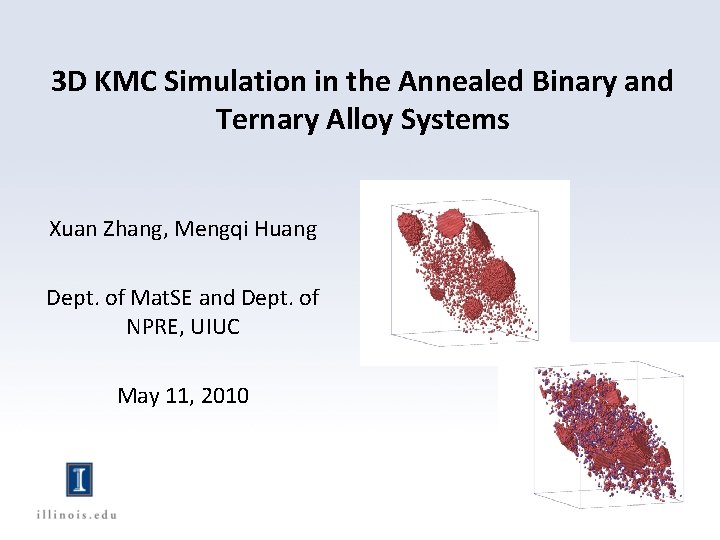
3 D KMC Simulation in the Annealed Binary and Ternary Alloy Systems Xuan Zhang, Mengqi Huang Dept. of Mat. SE and Dept. of NPRE, UIUC May 11, 2010
![Motivation [1] • Binary thin film alloy (Cu-Nb): large Nb precipitates ( > 40](http://slidetodoc.com/presentation_image_h2/2b0cdc22ccbcbe1cb7c1af9396a4efbb/image-2.jpg "Motivation [1] • Binary thin film alloy (Cu-Nb): large Nb precipitates ( > 40")
Motivation [1] • Binary thin film alloy (Cu-Nb): large Nb precipitates ( > 40 nm) at 600 C • Ternary thin film alloy (Cu 88. 5 W 1. 5 Nb 10): thermal annealing at two different temperature, different structures are observed in XRD: Knowledge we know: ü Below 600 C, W is immobile in bulk Cu ü At 600 C, W starts to be mobile ü Nb is mobile at both of the temperatures Mobility of W is the key point! • Solution: a simplified model, using KMC simulation to study the evolution of precipitates. [1] E. Botcharova etc. Journal of Alloys and Compounds 356 (2004) 157 -163

KMC flowchart: start Parameter input Initial configuration done. • N = 643 atoms • Only one vacancy: Calculate jumping probabilities. Choose a jump. Update configuration. Configuration output; analysis output. End. nstep : thermal transition rate of the vacancy jumping to the nn sites.
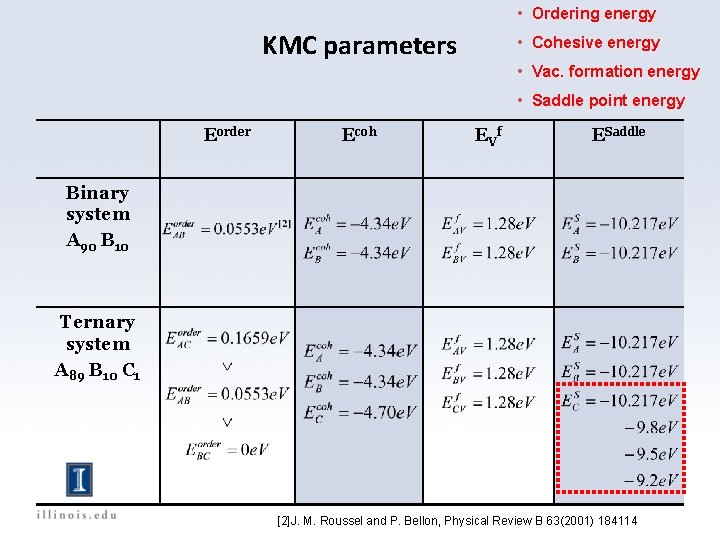
• Ordering energy KMC parameters • Cohesive energy • Vac. formation energy • Saddle point energy Eorder Ecoh EVf ESaddle Binary system A 90 B 10 Ternary system A 89 B 10 C 1 [2]J. M. Roussel and P. Bellon, Physical Review B 63(2001) 184114
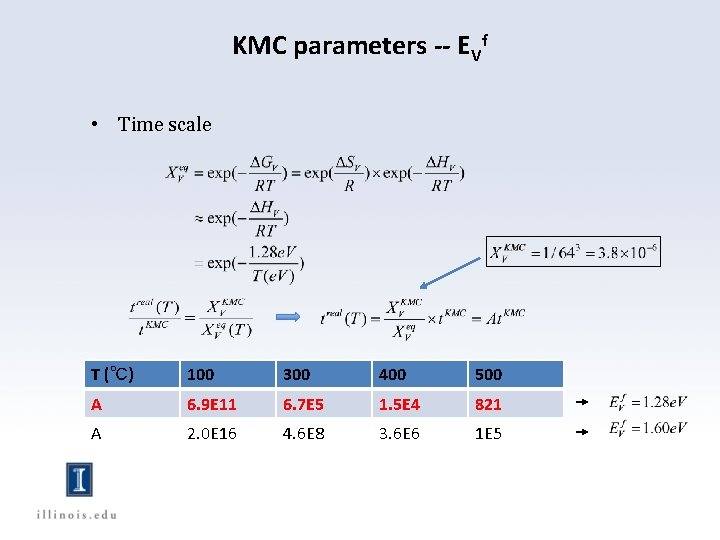
KMC parameters -- EVf • Time scale T (℃) 100 300 400 500 A 6. 9 E 11 6. 7 E 5 1. 5 E 4 821 A 2. 0 E 16 4. 6 E 8 3. 6 E 6 1 E 5
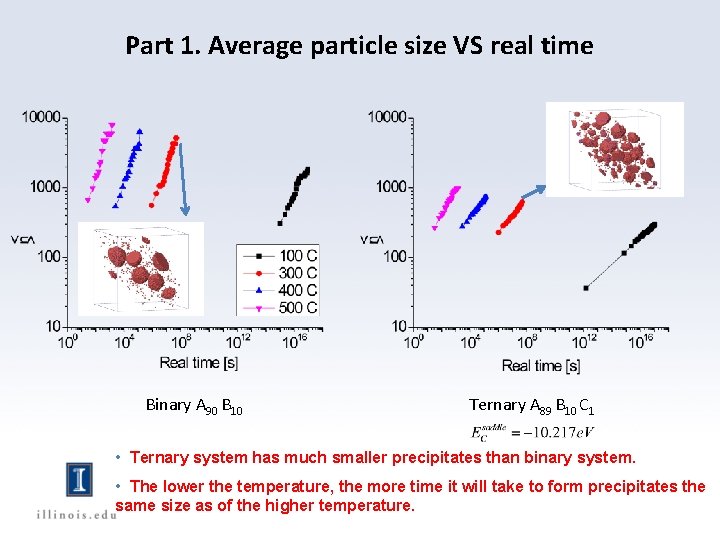
Part 1. Average particle size VS real time Binary A 90 B 10 Ternary A 89 B 10 C 1 • Ternary system has much smaller precipitates than binary system. • The lower the temperature, the more time it will take to form precipitates the same size as of the higher temperature.
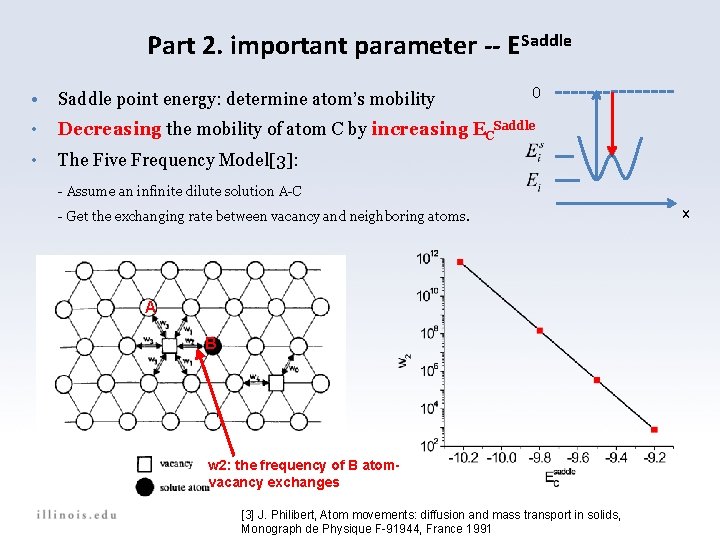
Part 2. important parameter -- ESaddle 0 • Saddle point energy: determine atom’s mobility • Decreasing the mobility of atom C by increasing ECSaddle • The Five Frequency Model[3]: - Assume an infinite dilute solution A-C - Get the exchanging rate between vacancy and neighboring atoms. A B w 2: the frequency of B atomvacancy exchanges [3] J. Philibert, Atom movements: diffusion and mass transport in solids, Monograph de Physique F-91944, France 1991 x
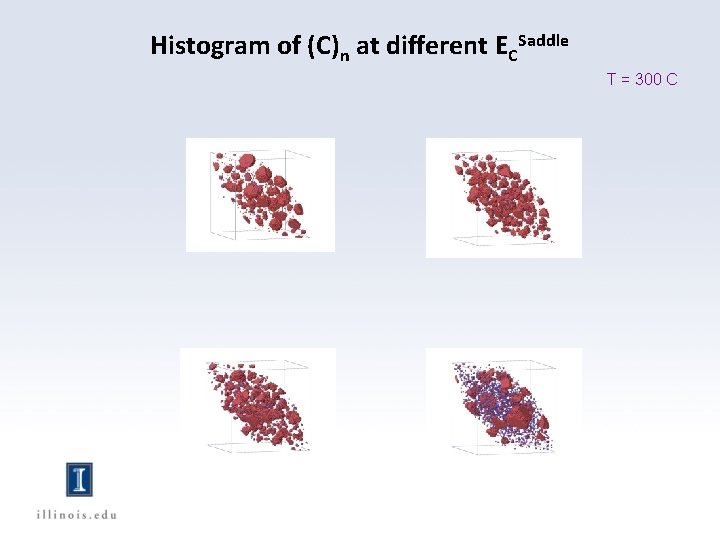
Histogram of (C)n at different ECSaddle T = 300 C
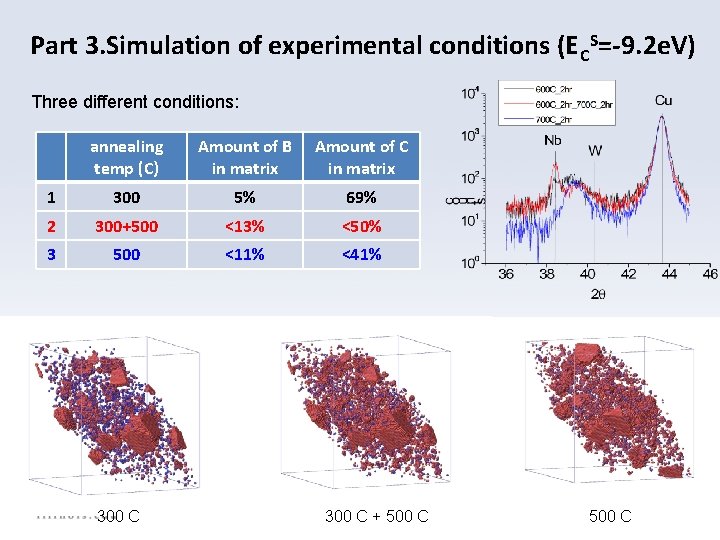
Part 3. Simulation of experimental conditions (ECS=-9. 2 e. V) Three different conditions: annealing temp (C) Amount of B in matrix Amount of C in matrix 1 300 5% 69% 2 300+500 <13% <50% 3 500 <11% <41% 300 C + 500 C
Conclusions • Ternary alloy will have much smaller precipitates than binary alloy for all the temperatures. • The saddle point energy of C atom plays a key role in simulation. • By simulating the experimental conditions, main features are obtained, and a qualitative explanation is given; however, more data is needed to make it convincing enough.
- Slides: 10