
3 D Game Programming Programmable Pipelines MingTe Chi

3 D Game Programming Programmable Pipelines Ming-Te Chi Department of Computer Science, National Chengchi University
Outline Programmable Pipelines – Vertex shaders – Fragment shaders Introduction to shading languages
Introduction Recent major advance in real time graphics is programmable pipeline – First introduced by NVIDIA GForce 3 – Software Support • • 3 Direct X 8, 9, 10 Open. GL Extensions Open. GL Shading Language (GLSL) Cg
Background Two main components – Vertex programs (shaders) – Fragment programs (shaders) Requires detailed understanding of two seemingly contradictory approaches – Open. GL pipeline • Real time – Render. Man ideas • offline 4
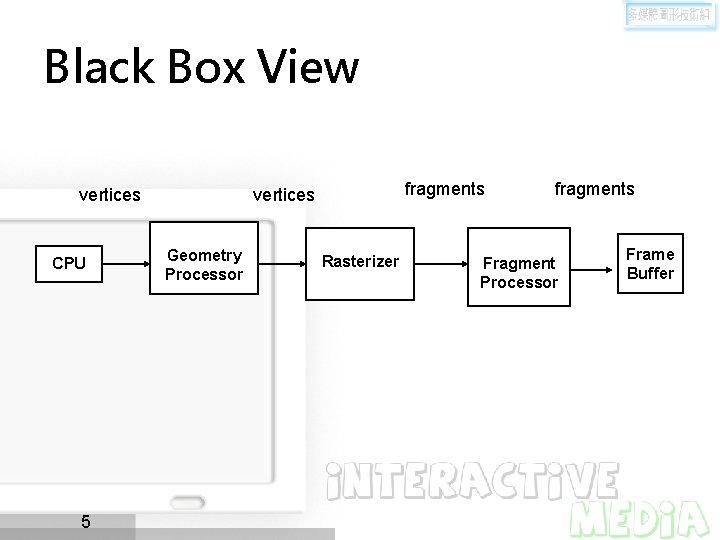
Black Box View vertices CPU 5 fragments vertices Geometry Processor Rasterizer fragments Fragment Processor Frame Buffer
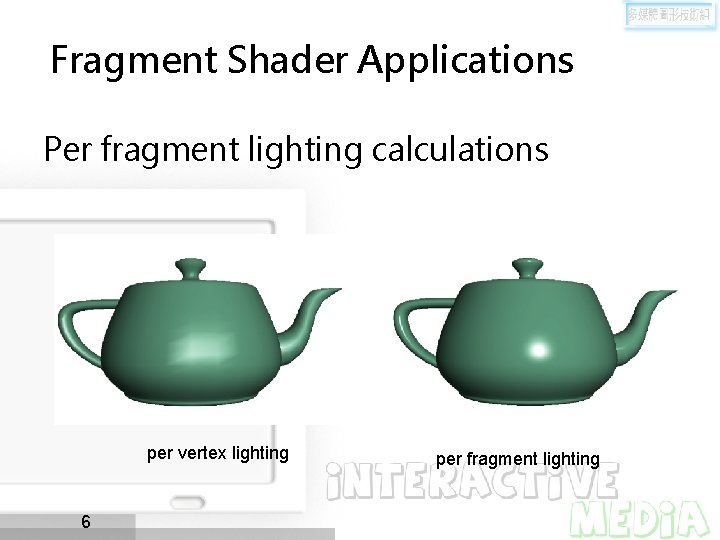
Fragment Shader Applications Per fragment lighting calculations per vertex lighting 6 per fragment lighting
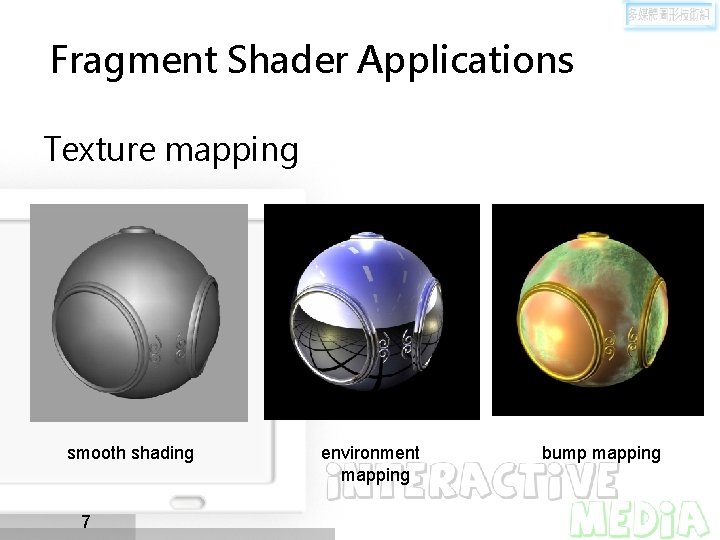
Fragment Shader Applications Texture mapping smooth shading 7 environment mapping bump mapping

GLSL 1 Simple shader
Objectives Shader applications – Vertex shaders – Fragment shaders Programming shaders – GLSL 9
Vertex Shader Applications Moving vertices – Morphing – Wave motion – Fractals Lighting – More realistic models – Cartoon shaders 10
Writing Shaders First programmable shaders were programmed in an assembly-like manner Open. GL extensions added for vertex and fragment shaders Cg (C for graphics) C-like language for programming shaders – Works with both Open. GL and Direct. X – Interface to Open. GL complex Open. GL Shading Language (GLSL) 11
GLSL Open. GL Shading Language Part of Open. GL 2. 0 High level C-like language New data types – Matrices – Vectors – Samplers Open. GL state available through built-in variables 12
Simple Vertex Shader const vec 4 red = vec 4(1. 0, 0. 0, 1. 0); void main(void) { gl_Position = gl_Projection. Matrix *gl_Model. View. Matrix*gl_Vertex; gl_Front. Color = red; } 13
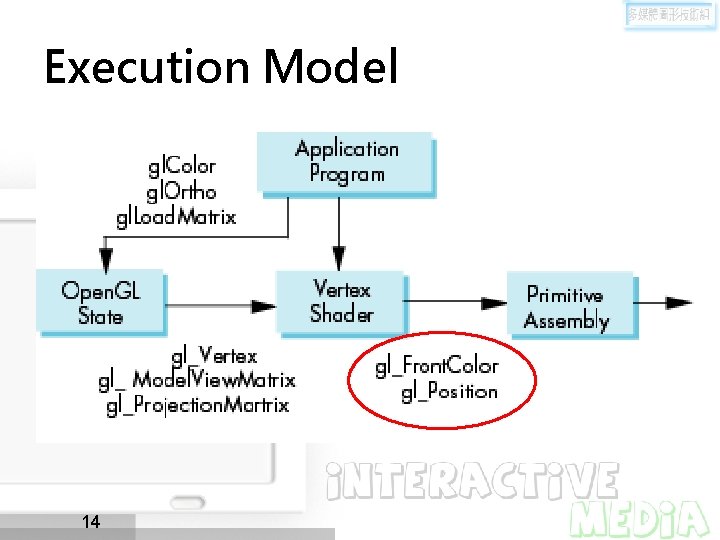
Execution Model 14
Simple Fragment Program void main(void) { gl_Frag. Color = gl_Color; } 15
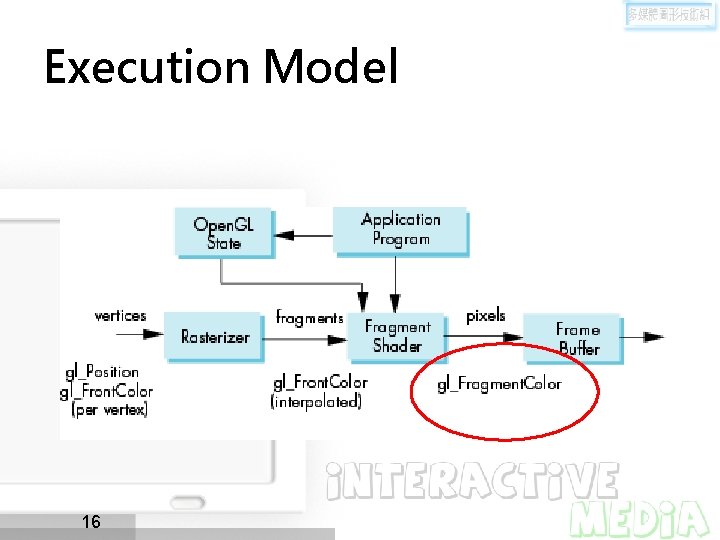
Execution Model 16
Data Types • C types: int, float, bool • Vectors: – float, vec 2, vec 3, vec 4 – Also int (ivec) and boolean (bvec) • Matrices: mat 2, mat 3, mat 4 – Stored by columns – Standard referencing m[row][column] • C++ style constructors – vec 3 a =vec 3(1. 0, 2. 0, 3. 0) – vec 2 b = vec 2(a) 17
Example: Vertex Shader const vec 4 red = vec 4(1. 0, 0. 0, 1. 0); varying vec 3 color_out; void main(void) { gl_Position = gl_Model. View. Projection. Matrix*gl_Vertex; color_out = red; } 23
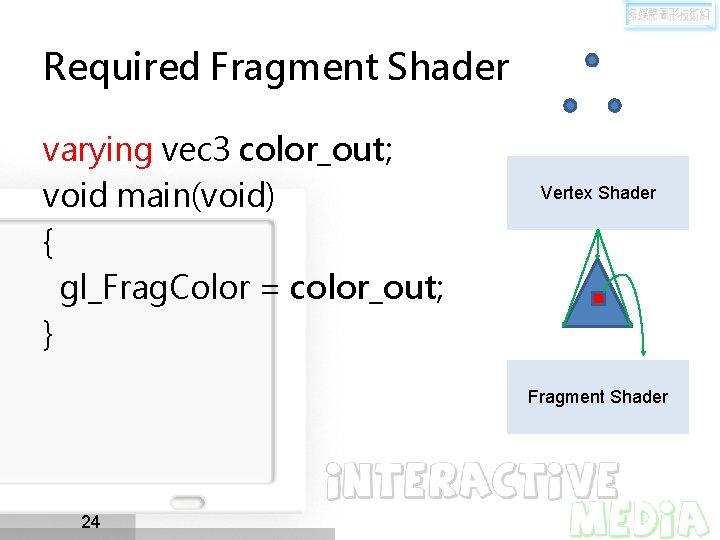
Required Fragment Shader varying vec 3 color_out; void main(void) { gl_Frag. Color = color_out; } Vertex Shader Fragment Shader 24
Passing values call by value-return Variables are copied in Returned values are copied back Three possibilities – in – out – inout 25
Operators and Functions Standard C functions – Trigonometric – Arithmetic – Normalize, reflect, length Overloading of vector and matrix types mat 4 a; vec 4 b, c, d; c = b*a; // a column vector stored as a 1 d array d = a*b; // a row vector stored as a 1 d array 26
![Swizzling and Selection Can refer to array elements by element using [] or selection](http://slidetodoc.com/presentation_image_h2/052c31e03fc438a23ef36d486c4fb639/image-22.jpg "Swizzling and Selection Can refer to array elements by element using [] or selection")
Swizzling and Selection Can refer to array elements by element using [] or selection (. ) operator with – x, y, z, w – r, g, b, a – s, t, p, q – a[2], a. b, a. z, a. p are the same Swizzling operator lets us manipulate components vec 4 a; a. yz = vec 2(1. 0, 2. 0); 27
Uniform // Find out where the flicker constant lives flicker. Location = gl. Get. Uniform. Location(prog. Obj, "flicker. Factor"); // Pick a random flicker factor flicker. Factor += ((((GLfloat)rand())/((GLfloat)RAND_MAX)) 0. 5 f) * 0. 1 f; if (flicker. Factor > 1. 0 f) flicker. Factor = 1. 0 f; if (flicker. Factor < 0. 0 f) flicker. Factor = 0. 0 f; gl. Uniform 1 f(flicker. Location, flicker. Factor);

GLSL 2 Phong shading model

Objectives Coupling GLSL to Applications Example applications 30
Linking Shaders to Open. GL Extensions – ARB_shader_objects – ARB_vertex_shader – ARB_fragment_shader Open. GL 2. 0 – Almost identical to using extensions – Avoids extension suffixes on function names 31
Reading a Shader are added to the program object and compiled Usual method of passing a shader is as a null-terminated string using the function gl. Shader. Source If the shader is in a file, we can write a reader to convert the file to a string 32
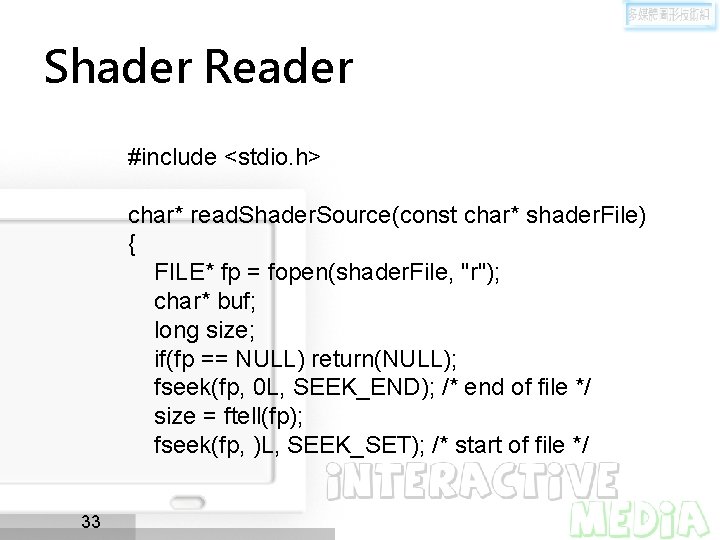
Shader Reader #include <stdio. h> char* read. Shader. Source(const char* shader. File) { FILE* fp = fopen(shader. File, "r"); char* buf; long size; if(fp == NULL) return(NULL); fseek(fp, 0 L, SEEK_END); /* end of file */ size = ftell(fp); fseek(fp, )L, SEEK_SET); /* start of file */ 33
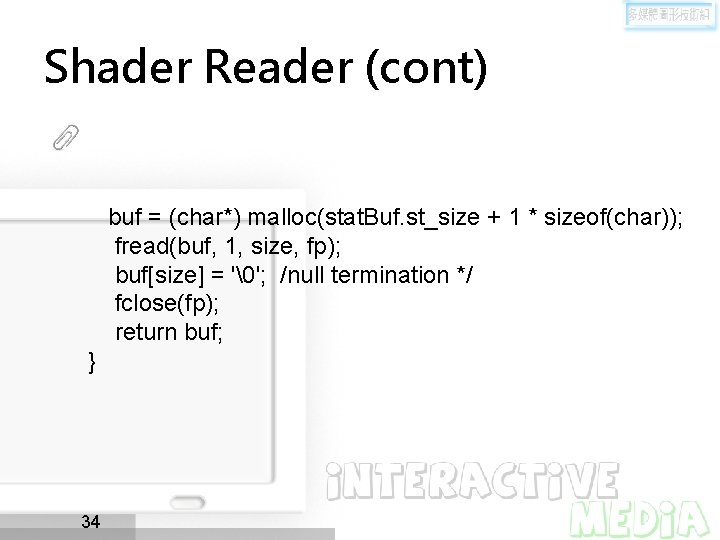
Shader Reader (cont) buf = (char*) malloc(stat. Buf. st_size + 1 * sizeof(char)); fread(buf, 1, size, fp); buf[size] = ''; /null termination */ fclose(fp); return buf; } 34
![Adding a Vertex Shader GLint v. Shader; GLunit my. Vertex. Obj; GLchar v. Shaderfile[]](http://slidetodoc.com/presentation_image_h2/052c31e03fc438a23ef36d486c4fb639/image-30.jpg "Adding a Vertex Shader GLint v. Shader; GLunit my. Vertex. Obj; GLchar v. Shaderfile[]")
Adding a Vertex Shader GLint v. Shader; GLunit my. Vertex. Obj; GLchar v. Shaderfile[] = “my_vertex_shader”; GLchar* v. Source = read. Shader. Source(v. Shader. File); my. Vertex. Obj = gl. Create. Shader(GL_VERTEX_SHADER); gl. Shader. Source(my. Vertex. Obj, 1, & v. Source, NULL); gl. Compile. Shader(my. Vertex. Obj); 35
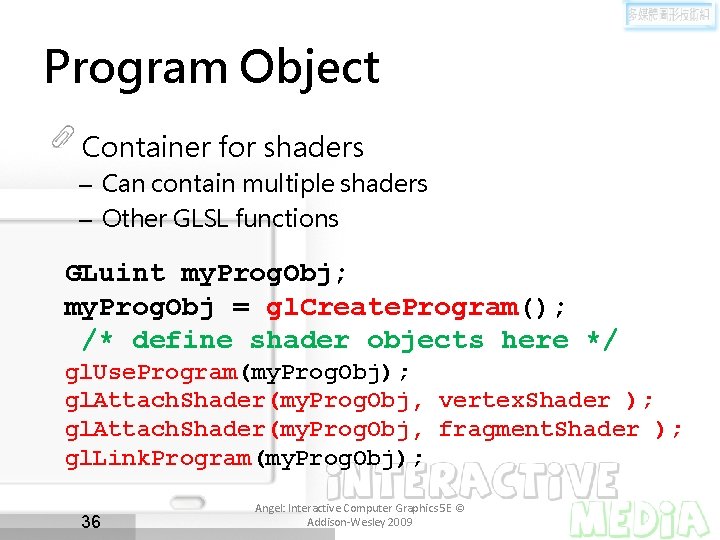
Program Object Container for shaders – Can contain multiple shaders – Other GLSL functions GLuint my. Prog. Obj; my. Prog. Obj = gl. Create. Program(); /* define shader objects here */ gl. Use. Program(my. Prog. Obj); gl. Attach. Shader(my. Prog. Obj, vertex. Shader ); gl. Attach. Shader(my. Prog. Obj, fragment. Shader ); gl. Link. Program(my. Prog. Obj); 36 Angel: Interactive Computer Graphics 5 E © Addison-Wesley 2009
Vertex Attributes Vertex attributes are named in the shaders Linker forms a table Application can get index from table and tie it to an application variable Similar process for uniform variables 37
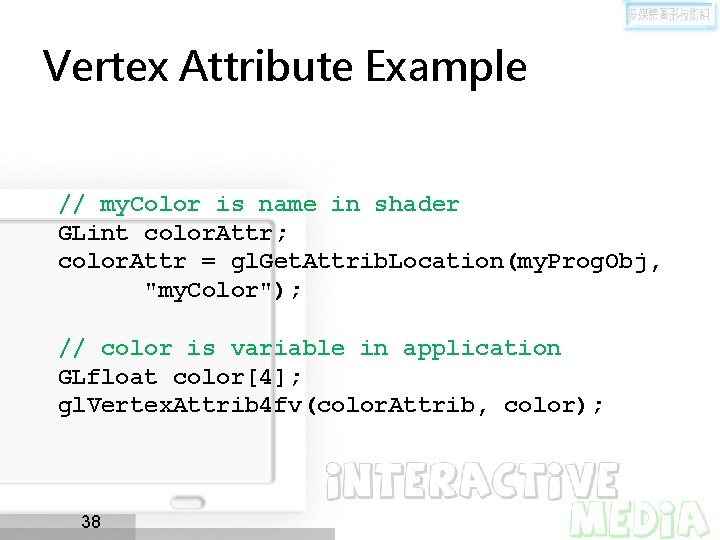
Vertex Attribute Example // my. Color is name in shader GLint color. Attr; color. Attr = gl. Get. Attrib. Location(my. Prog. Obj, "my. Color"); // color is variable in application GLfloat color[4]; gl. Vertex. Attrib 4 fv(color. Attrib, color); 38
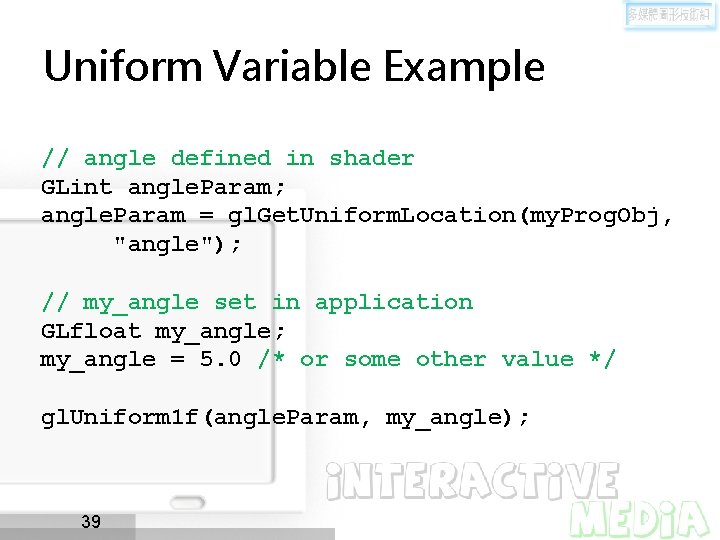
Uniform Variable Example // angle defined in shader GLint angle. Param; angle. Param = gl. Get. Uniform. Location(my. Prog. Obj, "angle"); // my_angle set in application GLfloat my_angle; my_angle = 5. 0 /* or some other value */ gl. Uniform 1 f(angle. Param, my_angle); 39
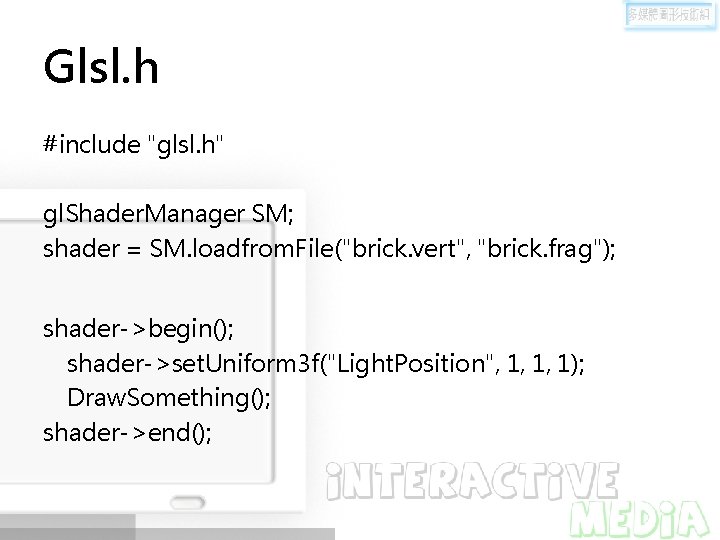
Glsl. h #include "glsl. h" gl. Shader. Manager SM; shader = SM. loadfrom. File("brick. vert", "brick. frag"); shader->begin(); shader->set. Uniform 3 f("Light. Position", 1, 1, 1); Draw. Something(); shader->end();
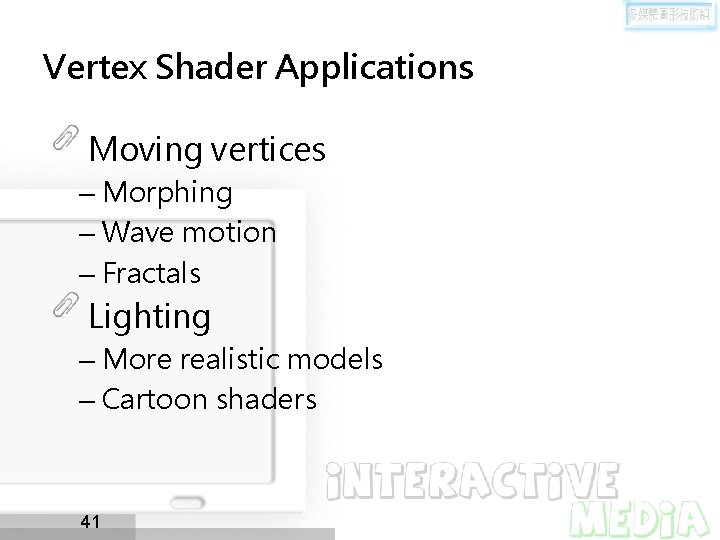
Vertex Shader Applications Moving vertices – Morphing – Wave motion – Fractals Lighting – More realistic models – Cartoon shaders 41
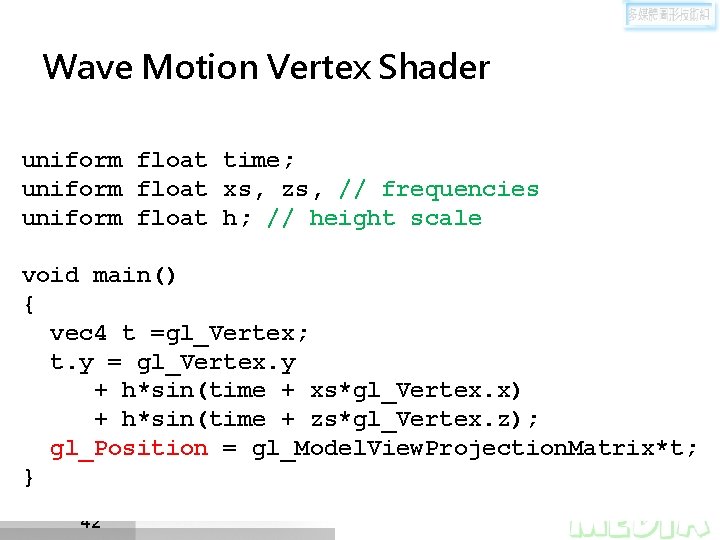
Wave Motion Vertex Shader uniform float time; uniform float xs, zs, // frequencies uniform float h; // height scale void main() { vec 4 t =gl_Vertex; t. y = gl_Vertex. y + h*sin(time + xs*gl_Vertex. x) + h*sin(time + zs*gl_Vertex. z); gl_Position = gl_Model. View. Projection. Matrix*t; } 42
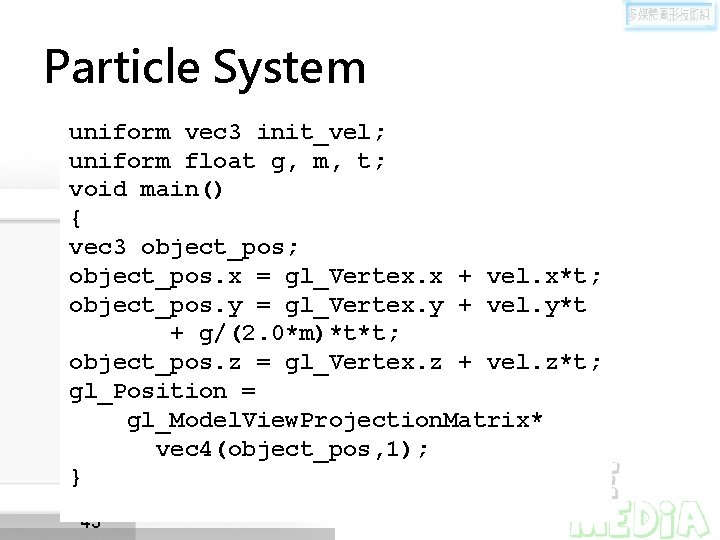
Particle System uniform vec 3 init_vel; uniform float g, m, t; void main() { vec 3 object_pos; object_pos. x = gl_Vertex. x + vel. x*t; object_pos. y = gl_Vertex. y + vel. y*t + g/(2. 0*m)*t*t; object_pos. z = gl_Vertex. z + vel. z*t; gl_Position = gl_Model. View. Projection. Matrix* vec 4(object_pos, 1); } 43
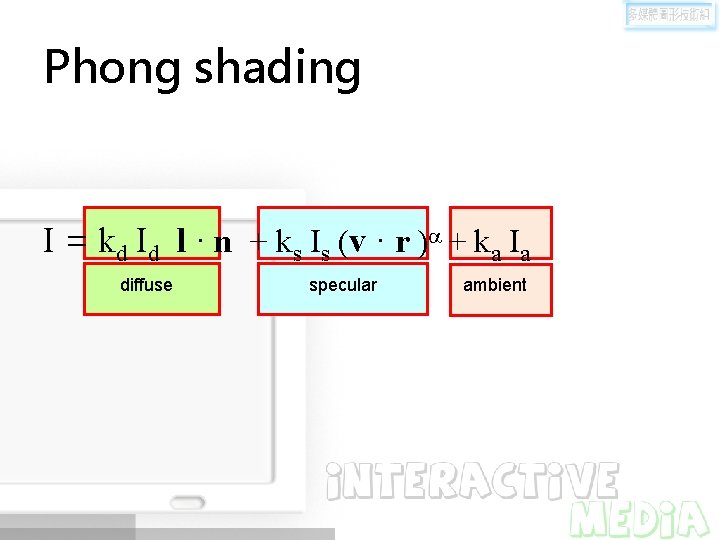
Phong shading I = kd Id l · n + ks Is (v · r )a + ka Ia diffuse specular ambient
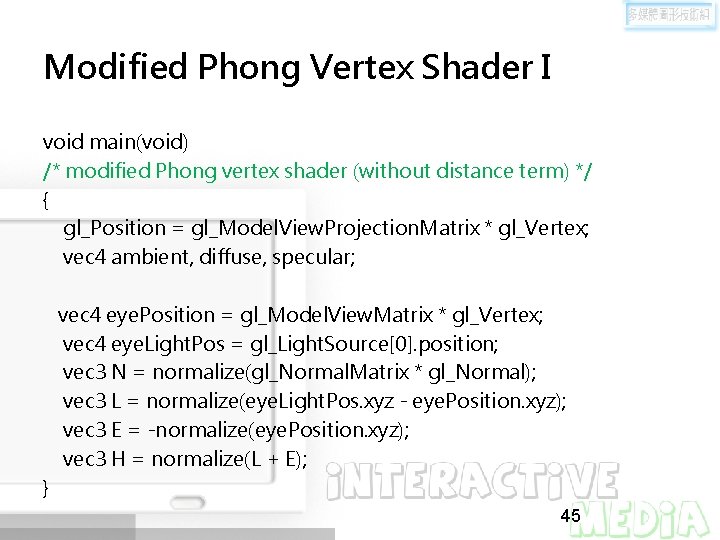
Modified Phong Vertex Shader I void main(void) /* modified Phong vertex shader (without distance term) */ { gl_Position = gl_Model. View. Projection. Matrix * gl_Vertex; vec 4 ambient, diffuse, specular; vec 4 eye. Position = gl_Model. View. Matrix * gl_Vertex; vec 4 eye. Light. Pos = gl_Light. Source[0]. position; vec 3 N = normalize(gl_Normal. Matrix * gl_Normal); vec 3 L = normalize(eye. Light. Pos. xyz - eye. Position. xyz); vec 3 E = -normalize(eye. Position. xyz); vec 3 H = normalize(L + E); } 45
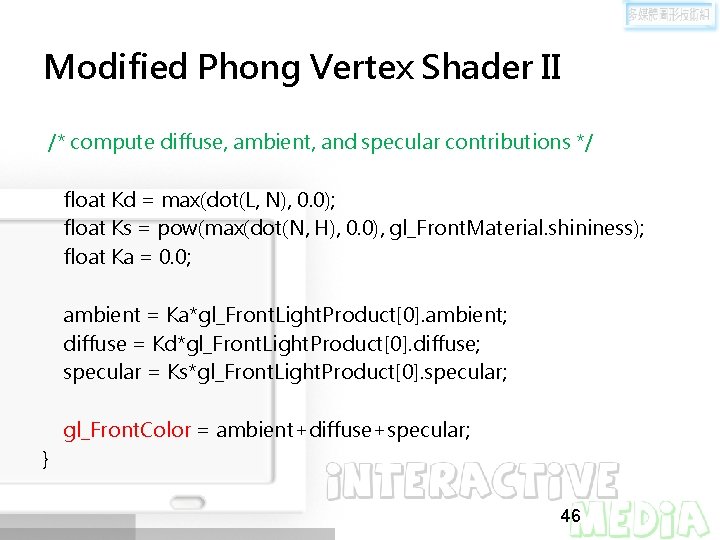
Modified Phong Vertex Shader II /* compute diffuse, ambient, and specular contributions */ float Kd = max(dot(L, N), 0. 0); float Ks = pow(max(dot(N, H), 0. 0), gl_Front. Material. shininess); float Ka = 0. 0; ambient = Ka*gl_Front. Light. Product[0]. ambient; diffuse = Kd*gl_Front. Light. Product[0]. diffuse; specular = Ks*gl_Front. Light. Product[0]. specular; gl_Front. Color = ambient+diffuse+specular; } 46
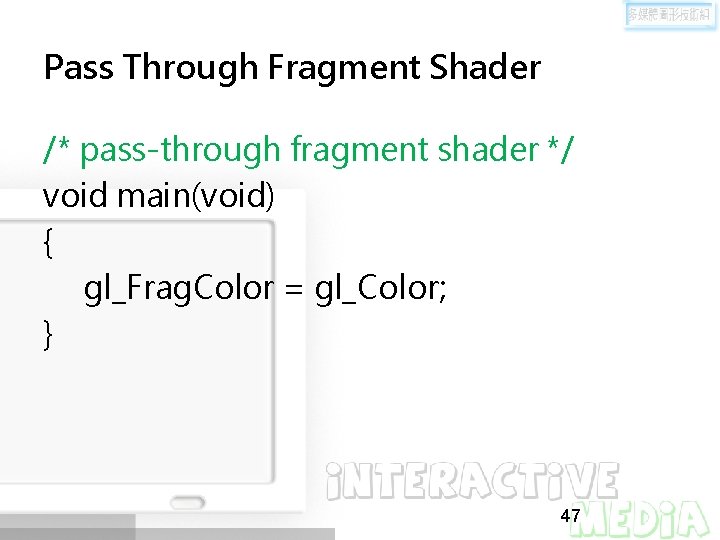
Pass Through Fragment Shader /* pass-through fragment shader */ void main(void) { gl_Frag. Color = gl_Color; } 47
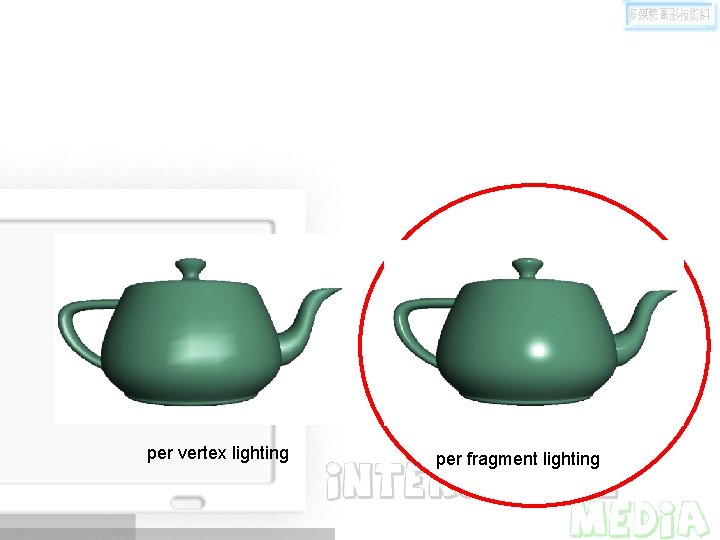
per vertex lighting per fragment lighting
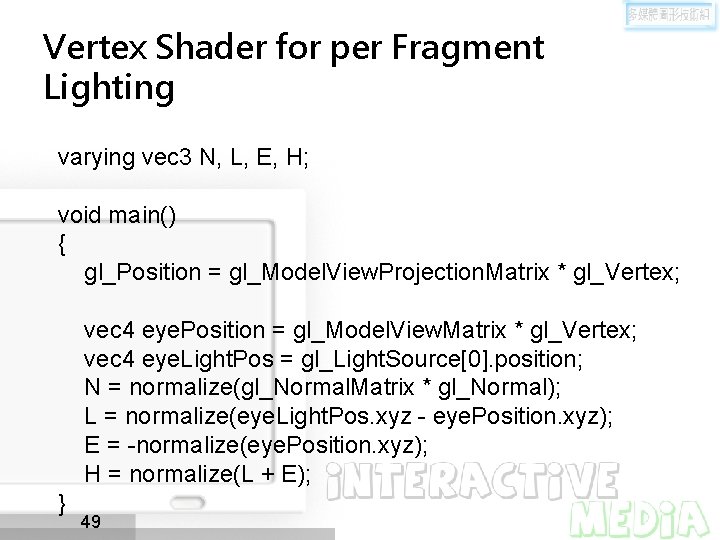
Vertex Shader for per Fragment Lighting varying vec 3 N, L, E, H; void main() { gl_Position = gl_Model. View. Projection. Matrix * gl_Vertex; vec 4 eye. Position = gl_Model. View. Matrix * gl_Vertex; vec 4 eye. Light. Pos = gl_Light. Source[0]. position; N = normalize(gl_Normal. Matrix * gl_Normal); L = normalize(eye. Light. Pos. xyz - eye. Position. xyz); E = -normalize(eye. Position. xyz); H = normalize(L + E); } 49
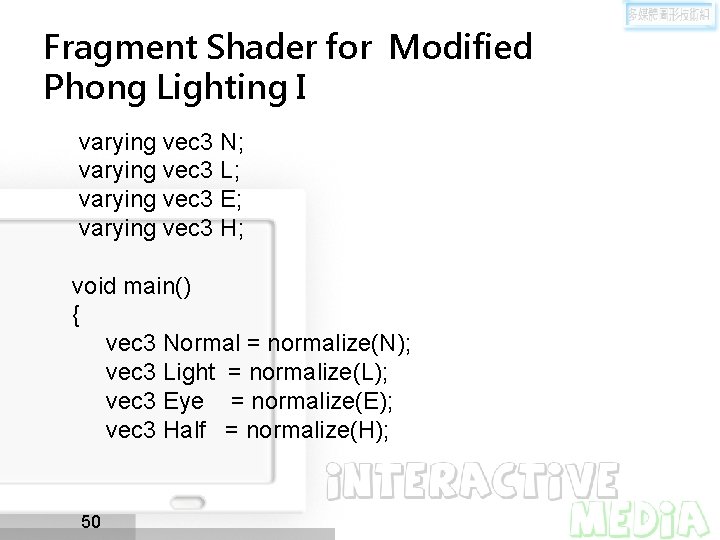
Fragment Shader for Modified Phong Lighting I varying vec 3 N; varying vec 3 L; varying vec 3 E; varying vec 3 H; void main() { vec 3 Normal = normalize(N); vec 3 Light = normalize(L); vec 3 Eye = normalize(E); vec 3 Half = normalize(H); 50
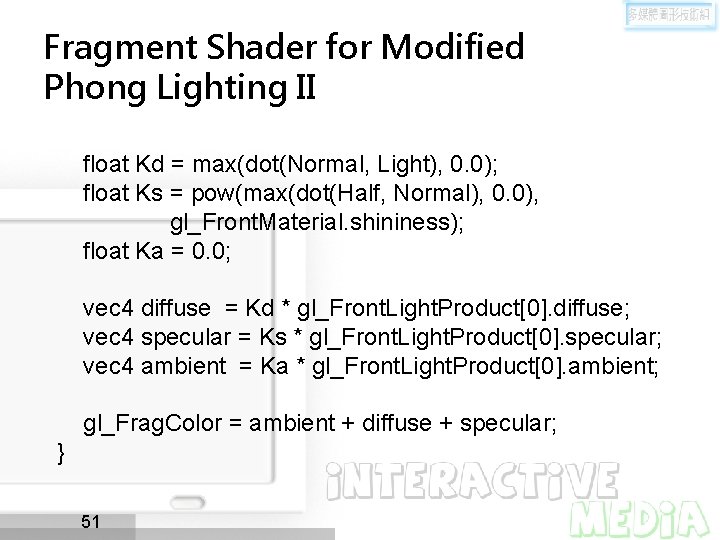
Fragment Shader for Modified Phong Lighting II float Kd = max(dot(Normal, Light), 0. 0); float Ks = pow(max(dot(Half, Normal), 0. 0), gl_Front. Material. shininess); float Ka = 0. 0; vec 4 diffuse = Kd * gl_Front. Light. Product[0]. diffuse; vec 4 specular = Ks * gl_Front. Light. Product[0]. specular; vec 4 ambient = Ka * gl_Front. Light. Product[0]. ambient; gl_Frag. Color = ambient + diffuse + specular; } 51
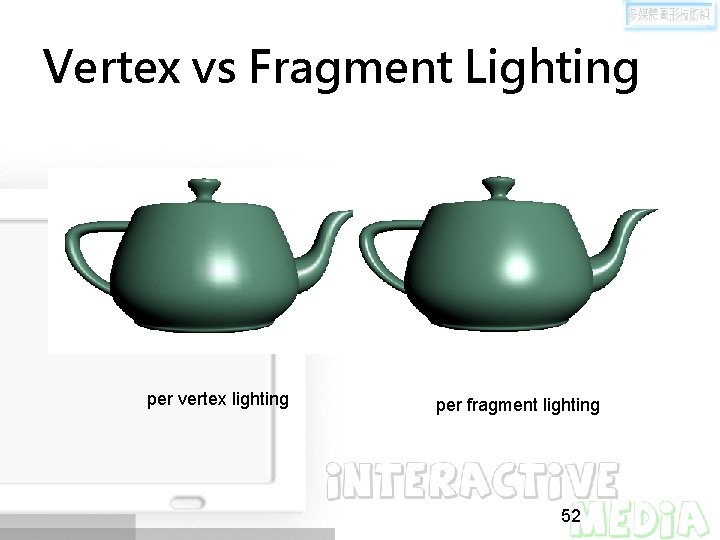
Vertex vs Fragment Lighting per vertex lighting per fragment lighting 52
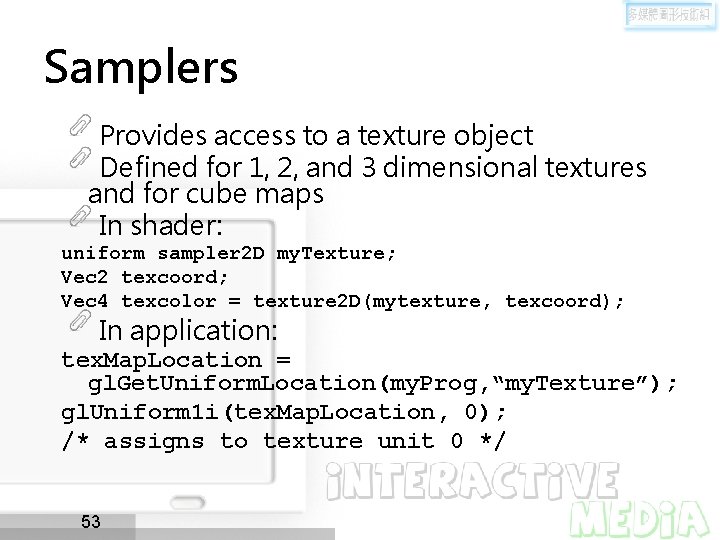
Samplers Provides access to a texture object Defined for 1, 2, and 3 dimensional textures and for cube maps In shader: uniform sampler 2 D my. Texture; Vec 2 texcoord; Vec 4 texcolor = texture 2 D(mytexture, texcoord); In application: tex. Map. Location = gl. Get. Uniform. Location(my. Prog, “my. Texture”); gl. Uniform 1 i(tex. Map. Location, 0); /* assigns to texture unit 0 */ 53
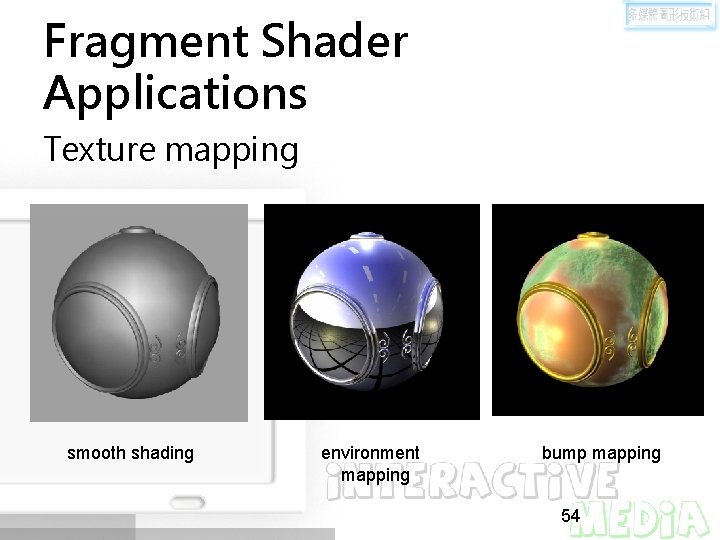
Fragment Shader Applications Texture mapping smooth shading environment mapping bump mapping 54
Cube Maps We can form a cube map texture by defining six 2 D texture maps that correspond to the sides of a box Supported by Open. GL Also supported in GLSL through cubemap sampler vec 4 tex. Color = texture. Cube(mycube, texcoord); Texture coordinates must be 3 D 55
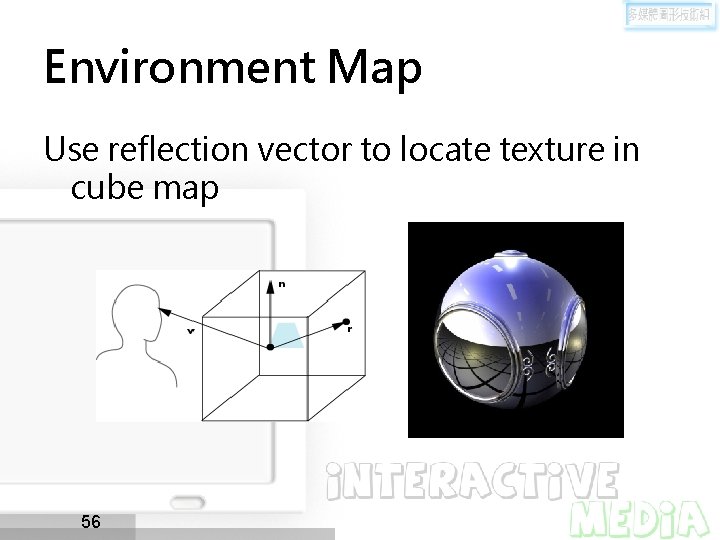
Environment Map Use reflection vector to locate texture in cube map 56
Environment Maps with Shaders Environment map usually computed in world coordinates which can differ from object coordinates because of modeling matrix – May have to keep track of modeling matrix and pass it shader as a uniform variable Can also use reflection map or refraction map (for example to simulate water) 57
Reflection Map Vertex Shader varying vec 3 R; void main(void) { gl_Position = gl_Model. View. Projection. Matrix*gl_Vertex; vec 3 N = normalize(gl_Normal. Matrix*gl_Normal); vec 4 eye. Pos = gl_Model. View. Matrix*gl_Vertex; R = reflect(-eye. Pos. xyz, N); } 58
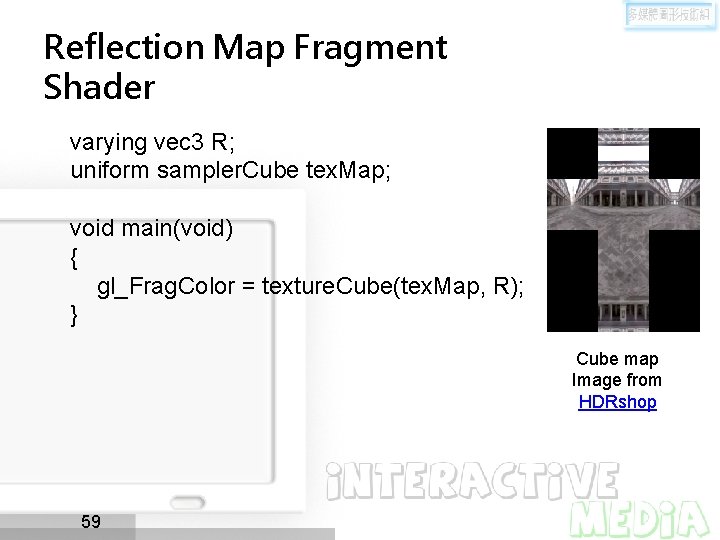
Reflection Map Fragment Shader varying vec 3 R; uniform sampler. Cube tex. Map; void main(void) { gl_Frag. Color = texture. Cube(tex. Map, R); } Cube map Image from HDRshop 59
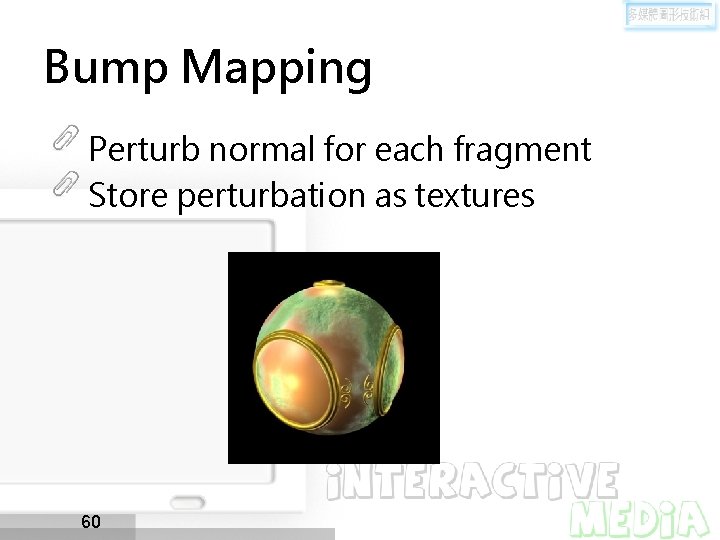
Bump Mapping Perturb normal for each fragment Store perturbation as textures 60
- Slides: 55