
3 D Computer Vision and Applications by Prof
3 D Computer Vision and Applications by Prof. K. H. Wong, Computer Science and Engineering Dept. CUHK http: //www. cse. cuhk. edu. hk/~khwong/papers. html khwong@cse. cuhk. edu. hk 3 D Comp. Vision and Applications v 9 b 1
Abstract • In this seminar, I will talk about various 3 -D pose estimation and structure from motion techniques in engineering applications. First, I will discuss the general approaches of feature based pose estimation and structure from motion. Then I will introduce the techniques of Kalman filtering and trifocal tensor for real time pose tracking. Issues of 3 -D vision approaches for virtual reality, projector-camera systems and automatically driving will be elaborated. During the talk, I will also give video demonstrations of some interesting vision based systems we developed in recently years. Finally the opportunities and challenges of 3 -D computer vison in the modern mobile era will be discussed. 3 D Comp. Vision and Applications v 9 b 2
Overview • Motivation • What is 3 -D vision? • How it is used? • Some previous approaches • Recent projects 3 D Comp. Vision and Applications v 9 b 3
Motivation • 3 D vision problems • Obtain 3 D information from 2 D images • Various applications • • Virtual reality Augmented reality Automatic driving Education and entertainment 3 D Comp. Vision and Applications v 9 b 4
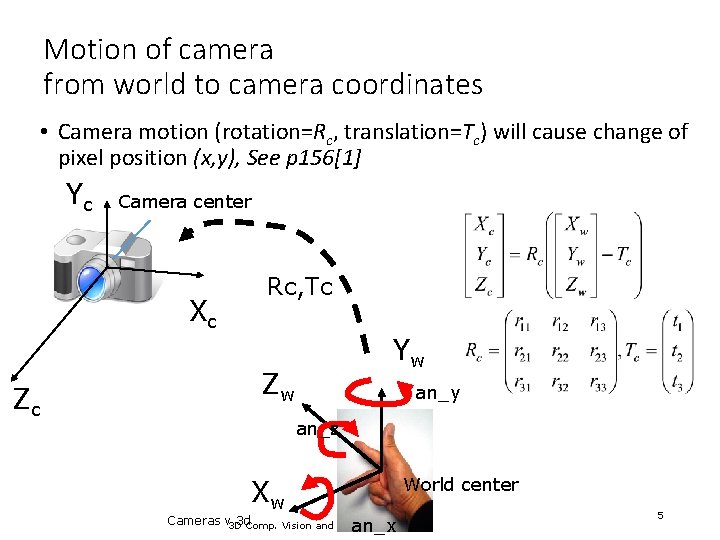
Motion of camera from world to camera coordinates • Camera motion (rotation=Rc, translation=Tc) will cause change of pixel position (x, y), See p 156[1] Yc Camera center Xc Zc Rc, Tc Yw Zw an_y an_z World center Xw Cameras v. 3 d 3 D Comp. Vision and Applications v 9 b an_x 5
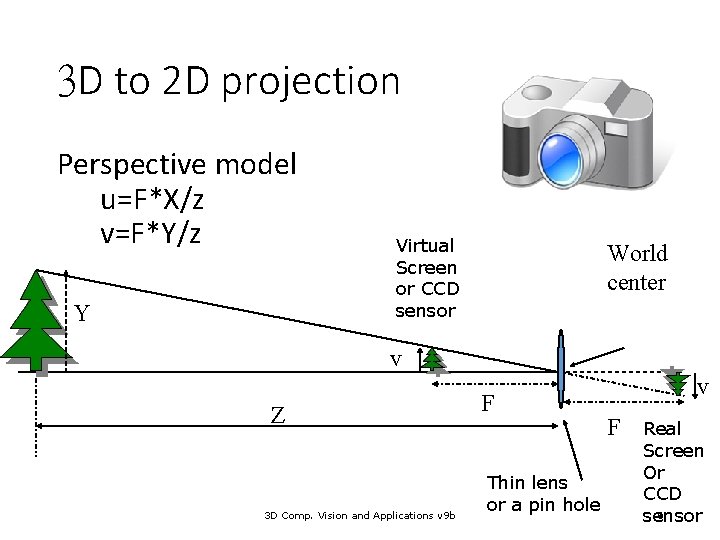
3 D to 2 D projection Perspective model u=F*X/z v=F*Y/z Y Virtual Screen or CCD sensor World center v Z 3 D Comp. Vision and Applications v 9 b F Thin lens or a pin hole v F Real Screen Or CCD 6 sensor
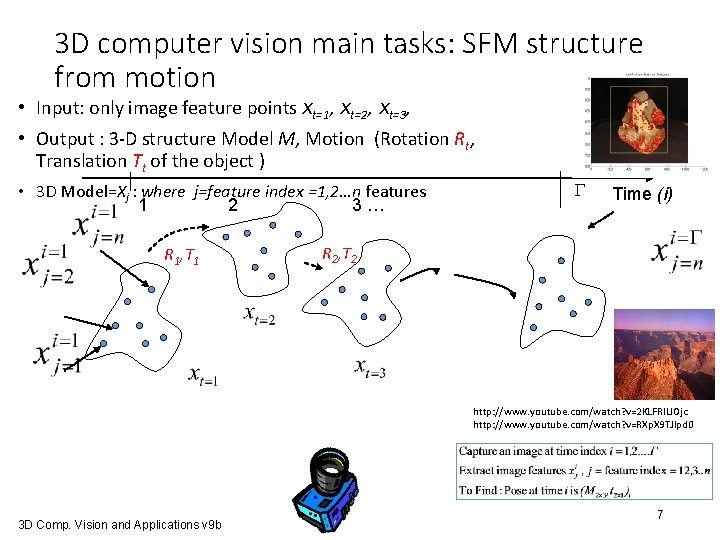
3 D computer vision main tasks: SFM structure from motion • Input: only image feature points xt=1, xt=2, xt=3, • Output : 3 -D structure Model M, Motion (Rotation Rt, Translation Tt of the object ) • 3 D Model=Xj : where j=feature index =1, 2…n features 1 2 3… R 1, T 1 Time (i) R 2, T 2 http: //www. youtube. com/watch? v=2 KLFRILl. Ojc http: //www. youtube. com/watch? v=RXp. X 9 TJlpd 0 3 D Comp. Vision and Applications v 9 b 7
Applications • 3 D models from images • Camera projection systems • Some recent work • Wearable devices • Virtual tourism 3 D Comp. Vision and Applications v 9 b 8
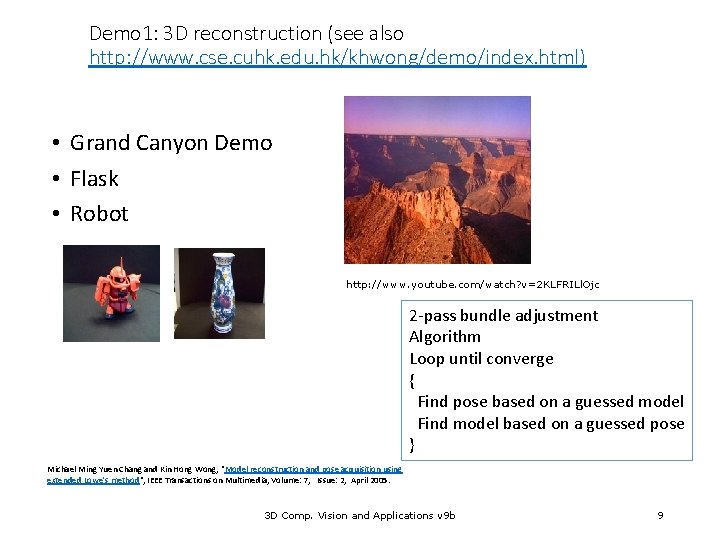
Demo 1: 3 D reconstruction (see also http: //www. cse. cuhk. edu. hk/khwong/demo/index. html) • Grand Canyon Demo • Flask • Robot http: //www. youtube. com/watch? v=2 KLFRILl. Ojc 2 -pass bundle adjustment Algorithm Loop until converge { Find pose based on a guessed model Find model based on a guessed pose } Michael Ming Yuen Chang and Kin Hong Wong, "Model reconstruction and pose acquisition using extended Lowe's method", IEEE Transactions on Multimedia, Volume: 7, Issue: 2, April 2005. 3 D Comp. Vision and Applications v 9 b 9
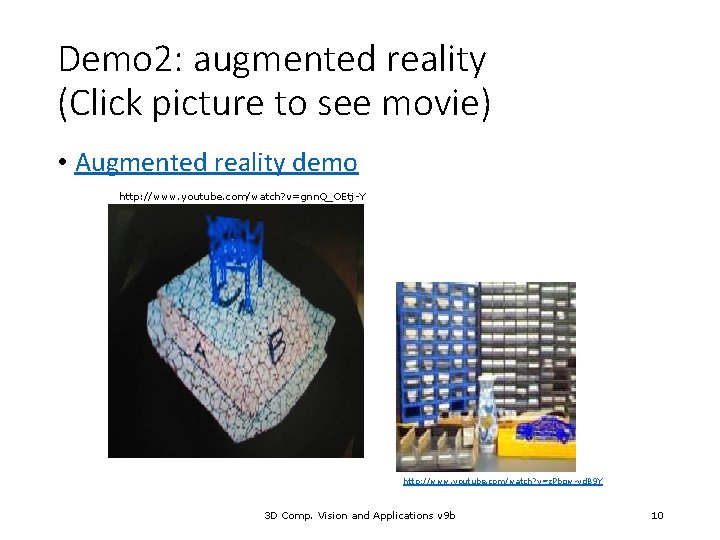
Demo 2: augmented reality (Click picture to see movie) • Augmented reality demo http: //www. youtube. com/watch? v=gnn. Q_OEtj-Y http: //www. youtube. com/watch? v=z. Pbgw-yd. B 9 Y 3 D Comp. Vision and Applications v 9 b 10
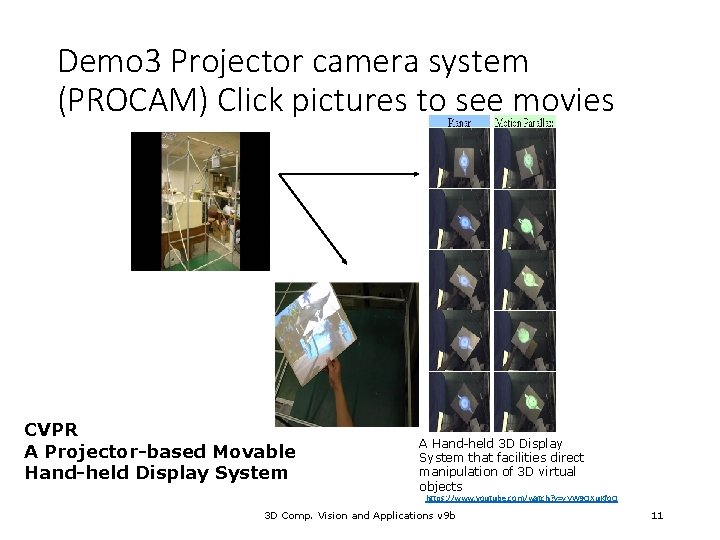
Demo 3 Projector camera system (PROCAM) Click pictures to see movies CVPR A Projector-based Movable Hand-held Display System A Hand-held 3 D Display System that facilities direct manipulation of 3 D virtual objects https: //www. youtube. com/watch? v=v. VW 9 QXu. Kfo. Q 3 D Comp. Vision and Applications v 9 b 11
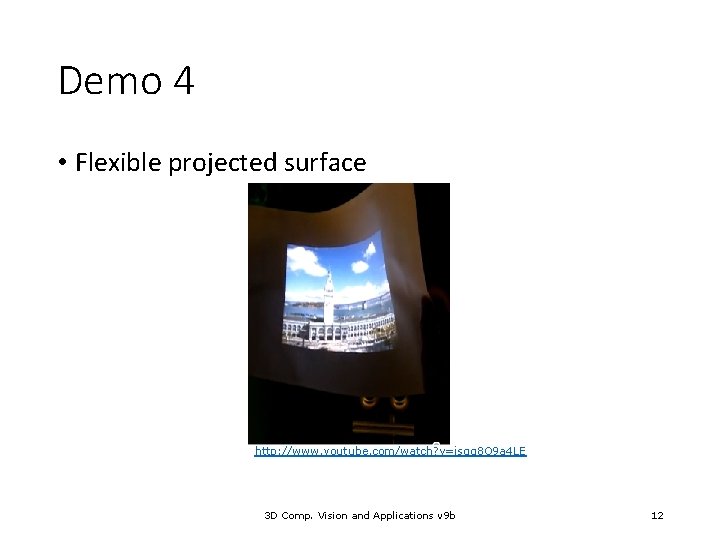
Demo 4 • Flexible projected surface http: //www. youtube. com/watch? v=isqg 8 O 9 a 4 LE 3 D Comp. Vision and Applications v 9 b 12
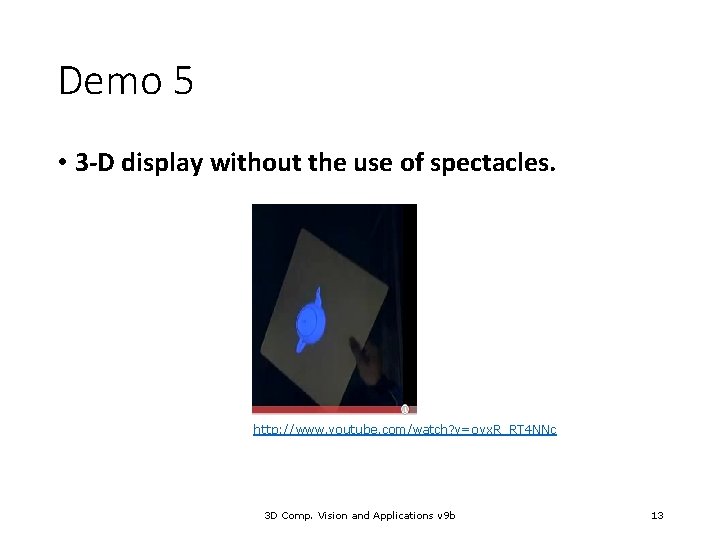
Demo 5 • 3 -D display without the use of spectacles. http: //www. youtube. com/watch? v=oyx. R_RT 4 NNc 3 D Comp. Vision and Applications v 9 b 13
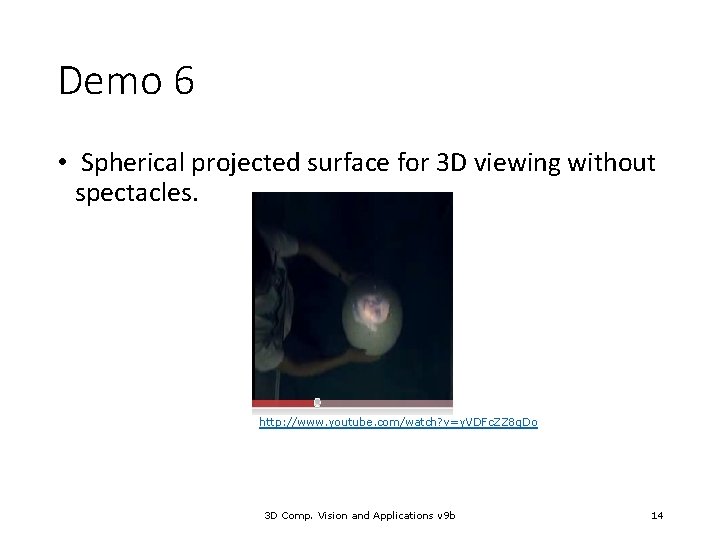
Demo 6 • Spherical projected surface for 3 D viewing without spectacles. http: //www. youtube. com/watch? v=y. VDFc. ZZ 8 g. Do 3 D Comp. Vision and Applications v 9 b 14
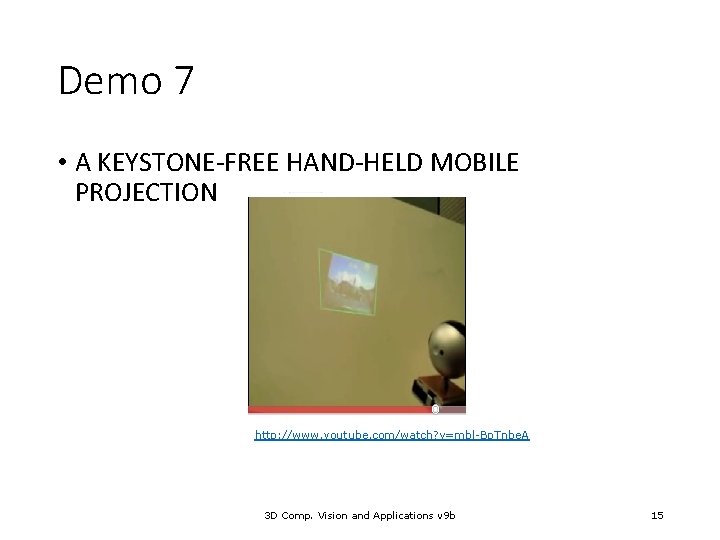
Demo 7 • A KEYSTONE-FREE HAND-HELD MOBILE PROJECTION http: //www. youtube. com/watch? v=mbl-Bp. Tnbe. A 3 D Comp. Vision and Applications v 9 b 15
Some theoretic work • Kalman filter based SFM structure from motion • Single camera • Ying Kin YU, Kin Hong Wong and Michael Ming Yuen Chang, "Recursive 3 D Model Reconstruction Based on Kalman Filtering", IEEE Transactions on Systems, Man and Cybernetics B, Vol. 35, No. 3, June 2005 • Stereo camera • Mohammad Ehab Ragab, Kin Hong Wong, Jun Zhou Chen, Michael Ming-Yuen Chang, "EKF Pose estimation: how many filters and cameras to use? ", IEEE International Conference on Image Processing (ICIP 08), San Diego, California, U. S. A, October 12– 15, 2008 • Ying Kin Yu, Kin Hong Wong, Michael Ming Yuen Chang and Siu Hang Or, "Recursive Camera Motion Estimation with Trifocal Tensor", IEEE Transactions on Systems, Man and Cybernetics B, Volume 36, Issue 5, Oct. 2006 Page(s): 1081 - 1090. • Trifocal tensor based, used in SLAM/Tracking tool box • For feature points • Ying Kin Yu, Kin Hong Wong, Siu Hang Or and Junzhou Chen, "Controlling Virtual Cameras Based on a Robust Model-free Pose Acquisition Technique", IEEE Transactions on Multimedia, No. 1, January 2009, pp. 184190. • For feature lines • LEE, Kai Ki; YU Ying Kin; WONG Kin Hong and CHANG Ming Yuen Michael "Tracking 3 -D motion from straight lines with trifocal tensors. " Multimedia Systems 22. 2 (2016): 181 -195. • For feature and point combined • Kai Ki LEE, Ying Kin YU, Kin Hong WONG, “ Recovering camera motion from points and lines in stereo images: • A recursive model-less approach using trifocal tensors", 17 th IEEE/ACIS (SNPD 2017), Japan, 26 -26 June 2017 3 D Comp. Vision and Applications v 9 b 16
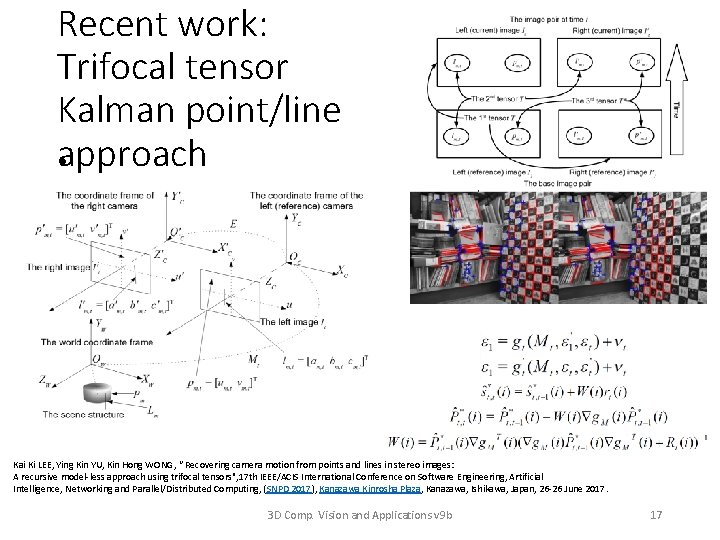
Recent work: Trifocal tensor Kalman point/line approach • Kai Ki LEE, Ying Kin YU, Kin Hong WONG, “ Recovering camera motion from points and lines in stereo images: A recursive model-less approach using trifocal tensors", 17 th IEEE/ACIS International Conference on Software Engineering, Artificial Intelligence, Networking and Parallel/Distributed Computing, (SNPD 2017), Kanazawa Kinrosha Plaza, Kanazawa, Ishikawa, Japan, 26 -26 June 2017. 3 D Comp. Vision and Applications v 9 b 17
Trifocal tensor vision is used in Automatic driving • Y. K. Yu, K. H. Wong, M. M. Y. Chang, and S. H. Or, "Recursive camera-motion estimation with the trifocal tensor. " IEEE Transactions on Systems, Man, and Cybernetics, Part B (Cybernetics) 36. 5 (2006): 10811090. • Cited by the author of the Kitti dataset and used in the toolbox http: //www. cvlibs. net/datasets/kitti/ • Kitt, Bernd, Andreas Geiger, and Henning Lategahn. "Visual odometry based on stereo image sequences with ransac-based outlier rejection scheme. " Intelligent Vehicles Symposium (IV), 2010 IEEE, 2010. 3 D Comp. Vision and Applications v 9 b 18
Recent work • Wearable glasses and beyond • Fro optical character recognition OCR • Virtual tourism • Calibration of Multiple Kinect Depth Sensors for Full Surface Model Reconstruction • Robot Avatar: a virtual tourism robot for people with disabilities • An efficient 3 -D environment scanning method 3 D Comp. Vision and Applications v 9 b 19
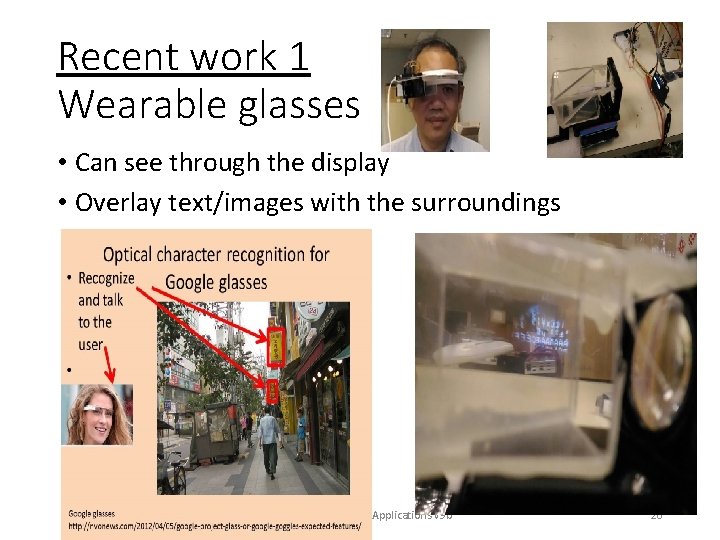
Recent work 1 Wearable glasses • Can see through the display • Overlay text/images with the surroundings 3 D Comp. Vision and Applications v 9 b 20
The design of smart glasses for VR applications The CU-GLASSES KH Wong 3 D Comp. Vision and Applications v 9 b 21
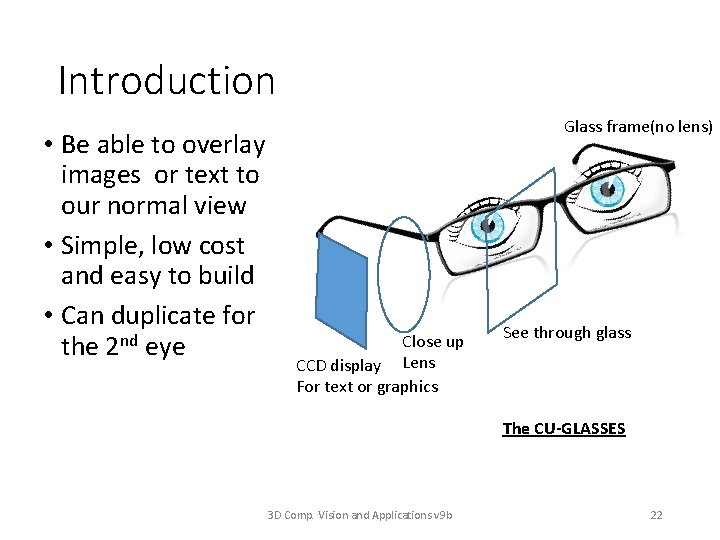
Introduction • Be able to overlay images or text to our normal view • Simple, low cost and easy to build • Can duplicate for the 2 nd eye Glass frame(no lens) Close up CCD display Lens For text or graphics See through glass The CU-GLASSES 3 D Comp. Vision and Applications v 9 b 22
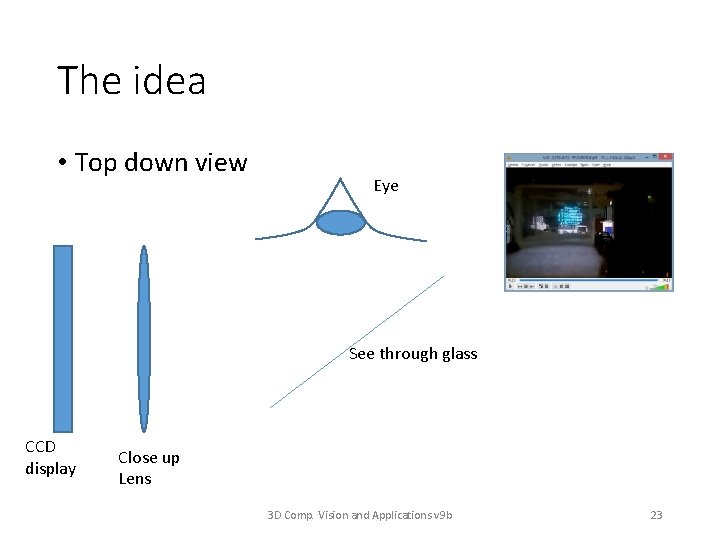
The idea • Top down view Eye See through glass CCD display Close up Lens 3 D Comp. Vision and Applications v 9 b 23
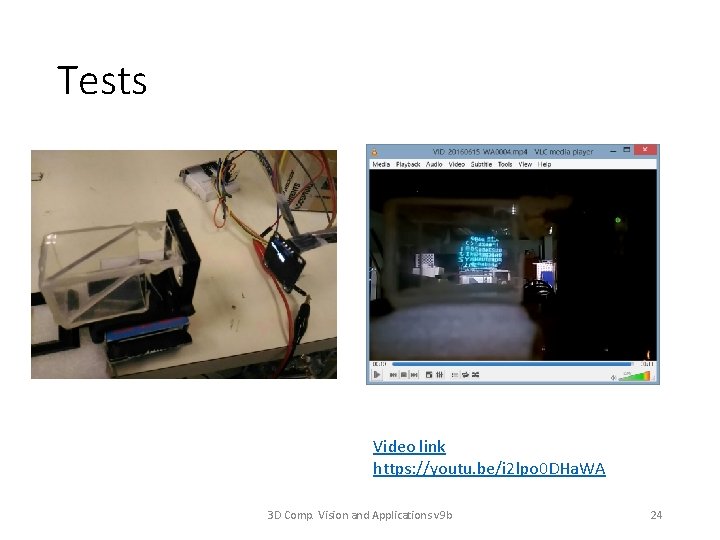
Tests • Video link https: //youtu. be/i 2 lpo 0 DHa. WA 3 D Comp. Vision and Applications v 9 b 24
Applications • Translation • Real time translate what you see into other languages • Education • Overlay more information to students when reading books 3 D Comp. Vision and Applications v 9 b 25
Virtual tourism idea • If you are wearing a head mount device such as the OCULUS (https: //www. oculus. com/en-us/), you can feel you are in anywhere you like in the virtual world. To extend it to the real world, we propose to build a robot that carries a set of cameras to capture the images in 3 -D at a remote place (e. g. at Tokyo). The 3 -D data will be sent back to the user and displayed through the OCULUS (e. g. at Hong Kong). There may be extended features, for example, the system can provide tourist or shopping information to users. This system enables users to visit other countries with little cost. Even disabled people can travel far away without leaving their homes. 3 D Comp. Vision and Applications v 9 b 26
Recent work 2 Calibration of Multiple Kinect Depth Sensors for Full Surface Model Reconstruction 2016 the first International Workshop on Pattern Recognition (IWPR 2016) Tokyo, Japan during May 11 -13, 2016 Kwan Pang Tsuia, Kin Hong Wongb*, Changling Wanga, Ho Chuen Kamb, Hing Tuen Yaub, and Ying Kin Yu a. Department of Mechanical Engineering, The Chinese University of Hong Kong, Hong Kong b. Department of Computer Science and Engineering, The Chinese University of Hong Kong, Hong Kong 3 D Comp. Vision and Applications v 9 b 27
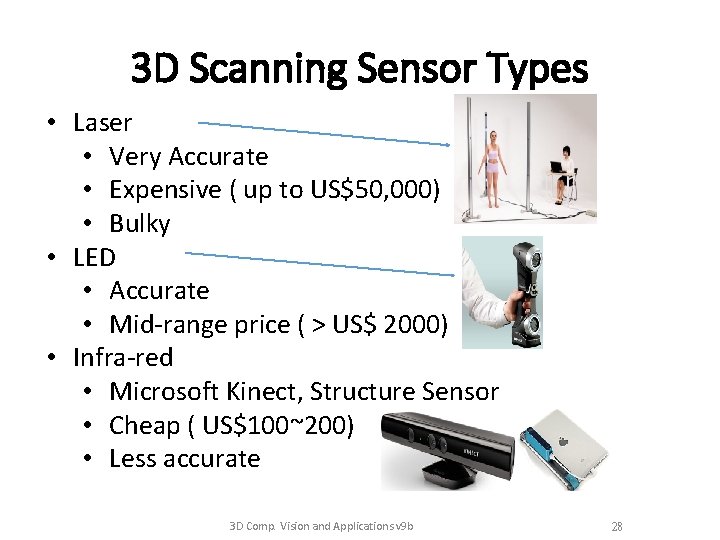
3 D Scanning Sensor Types • Laser • Very Accurate • Expensive ( up to US$50, 000) • Bulky • LED • Accurate • Mid-range price ( > US$ 2000) • Infra-red • Microsoft Kinect, Structure Sensor • Cheap ( US$100~200) • Less accurate 3 D Comp. Vision and Applications v 9 b 28
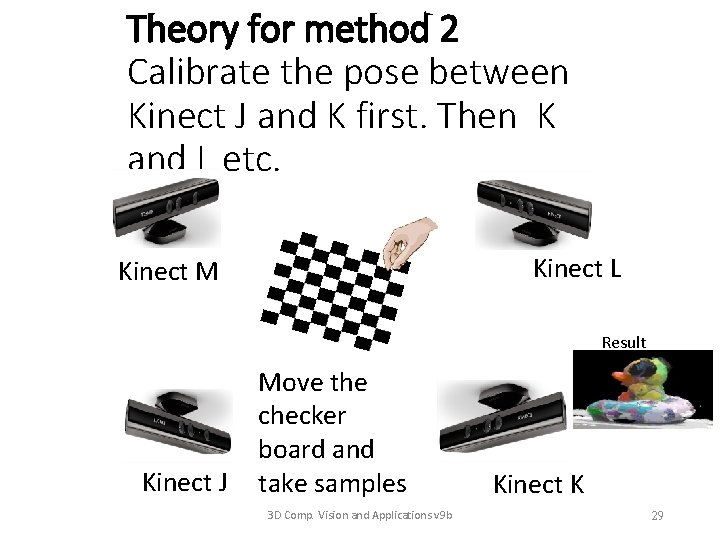
Theory for method 2 Calibrate the pose between Kinect J and K first. Then K and L etc. Kinect L Kinect M Result Kinect J Move the checker board and take samples 3 D Comp. Vision and Applications v 9 b Kinect K 29
Recent work 3 Robot Avatar: a virtual tourism robot for people with disabilities Chong Wing Cheung, Tai Ip Tsang, Kin Hong Wong* The 2 nd International Conference on Virtual Reality ICVR 16, May 20 -22, 2016, Chengdu, China. Department of Computer Science and Engineering, The Chinese University of Hong Kong, Hong Kong *corresponding author (khwong@cse. cuhk. edu. hk) Download link https: //appsrv. cse. cuhk. edu. hk/~khwong/www 2/conference/2016/ICVR 20 16. html 3 D Comp. Vision and Applications v 9 b 30
Introduction • To create a robot agent aimed to help the disabled person experiencing the physical environment • Generic Robot that used in Virtual Tourism or Bomb detonation, etc. • Using Cutting Edge Virtual Reality (VR) Technology • Chose Oculus Rift owing to the features, cost and programmability 3 D Comp. Vision and Applications v 9 b 31
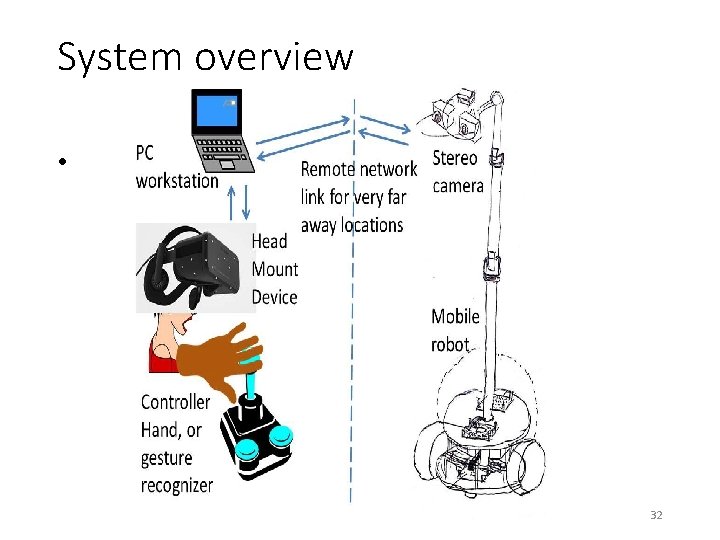
System overview • 3 D Comp. Vision and Applications v 9 b 32
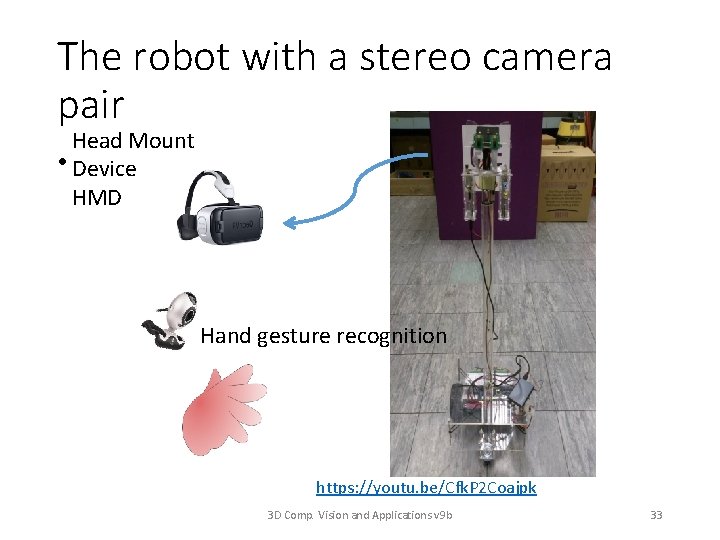
The robot with a stereo camera pair Head Mount • Device HMD Hand gesture recognition https: //youtu. be/Cfk. P 2 Coajpk 3 D Comp. Vision and Applications v 9 b 33
Demos • Utube : https: //youtu. be/Cfk. P 2 Coajpk • icvr 16_avatar_video. MP 4 3 D Comp. Vision and Applications v 9 b 34
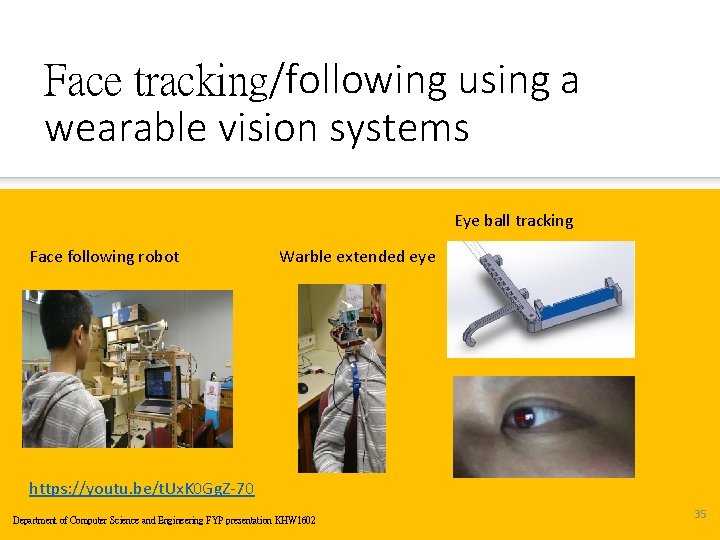
Face tracking/following using a wearable vision systems Eye ball tracking Face following robot Warble extended eye https: //youtu. be/t. Ux. K 0 Gg. Z-70 Department of Computer Science and Engineering FYP presentation KHW 1602 35

Recent work 4 An efficient 3 -D environment scanning method 24 th International Conference in Central Europe on Computer Graphics, Visualization and Computer Vision 2016 (WSCG 2016) Venue : May 30 - June 3, 2016 Kin Hong Wonga, Ho Chuen Kamaa, Ying Kin Yua, Sheung Lai Loa, Kwan Pang Tsuib, and Hing Tuen Yaua a. Department of Computer Science and Engineering, The Chinese University of Hong Kong, Hong Kong b. Department of Mechanical Engineering, The Chinese University of Hong Kong, Hong Kong 3 D Comp. Vision and Applications v 9 b 36
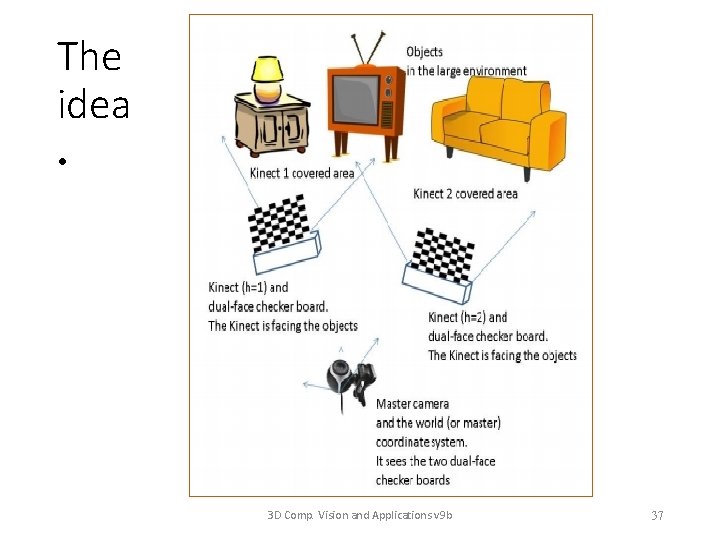
The idea • 3 D Comp. Vision and Applications v 9 b 37
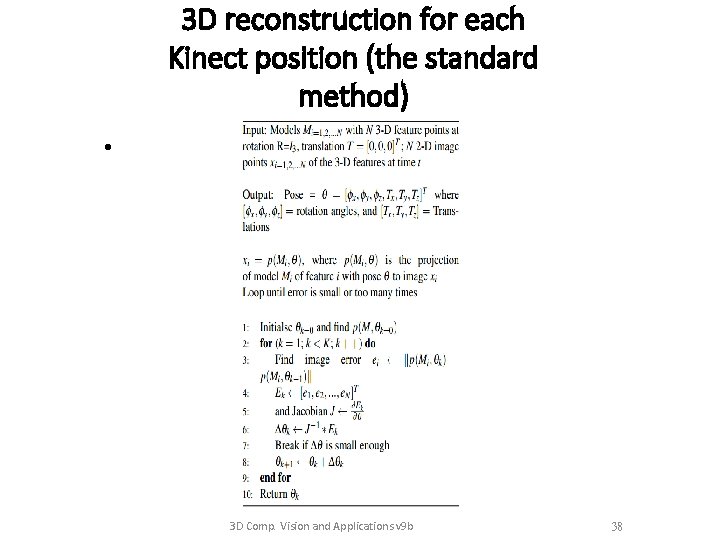
3 D reconstruction for each Kinect position (the standard method) • 3 D Comp. Vision and Applications v 9 b 38
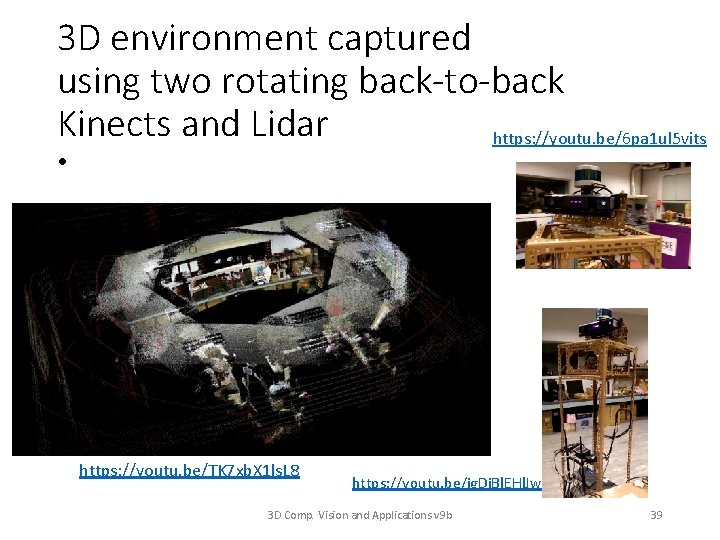
3 D environment captured using two rotating back-to-back Kinects and Lidar https: //youtu. be/6 pa 1 ul 5 vits • https: //youtu. be/TK 7 xb. X 1 ls. L 8 https: //youtu. be/ig. Di. Bl. EHl. Jw 3 D Comp. Vision and Applications v 9 b 39
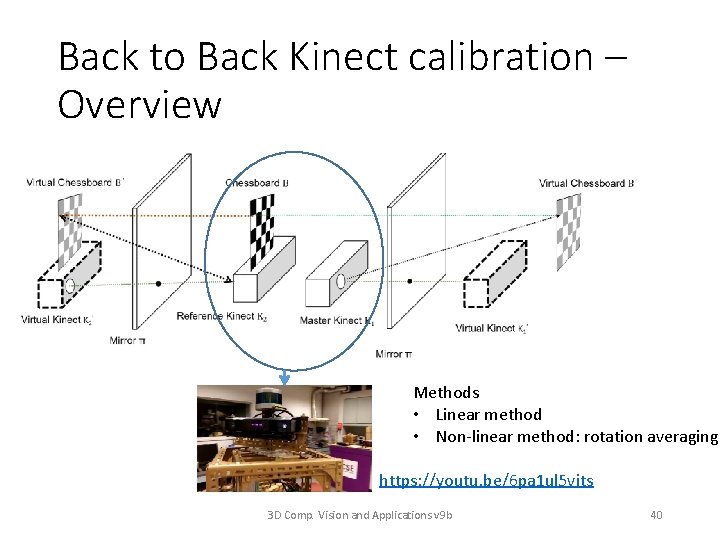
Back to Back Kinect calibration – Overview Methods • Linear method • Non-linear method: rotation averaging https: //youtu. be/6 pa 1 ul 5 vits 3 D Comp. Vision and Applications v 9 b 40
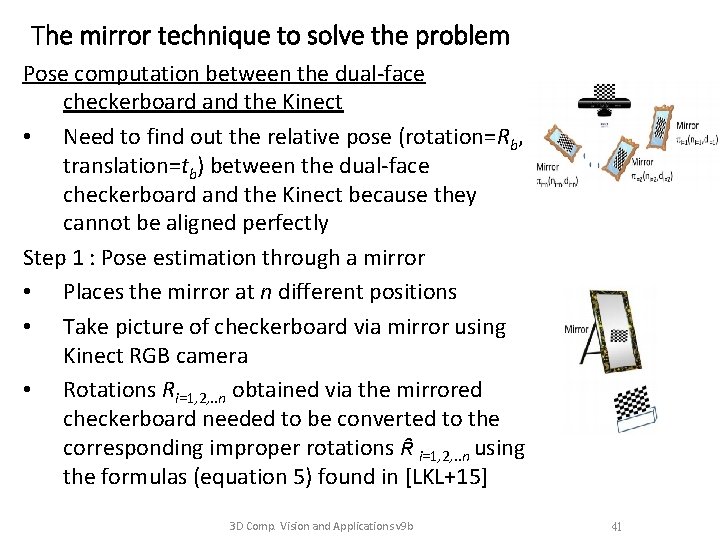
The mirror technique to solve the problem Pose computation between the dual-face checkerboard and the Kinect • Need to find out the relative pose (rotation=Rb, translation=tb) between the dual-face checkerboard and the Kinect because they cannot be aligned perfectly Step 1 : Pose estimation through a mirror • Places the mirror at n different positions • Take picture of checkerboard via mirror using Kinect RGB camera • Rotations Ri=1, 2, . . n obtained via the mirrored checkerboard needed to be converted to the corresponding improper rotations Ȓ i=1, 2, . . n using the formulas (equation 5) found in [LKL+15] 3 D Comp. Vision and Applications v 9 b 41
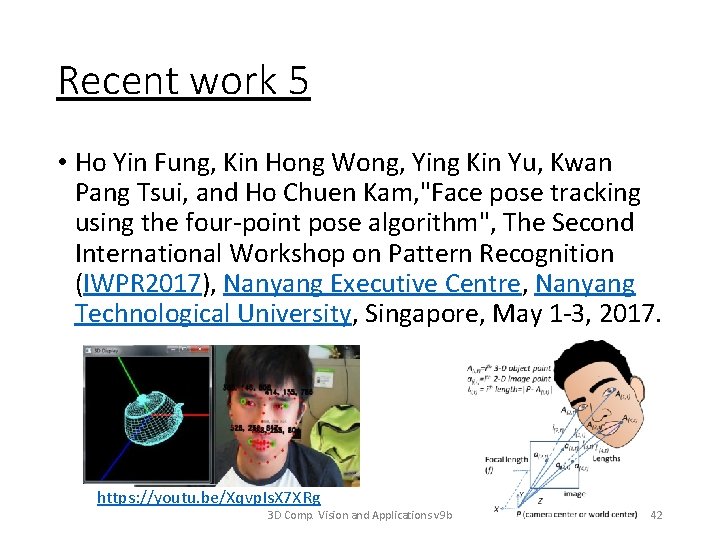
Recent work 5 • Ho Yin Fung, Kin Hong Wong, Ying Kin Yu, Kwan Pang Tsui, and Ho Chuen Kam, "Face pose tracking using the four-point pose algorithm", The Second International Workshop on Pattern Recognition (IWPR 2017), Nanyang Executive Centre, Nanyang Technological University, Singapore, May 1 -3, 2017. https: //youtu. be/Xqvp. Is. X 7 XRg 3 D Comp. Vision and Applications v 9 b 42
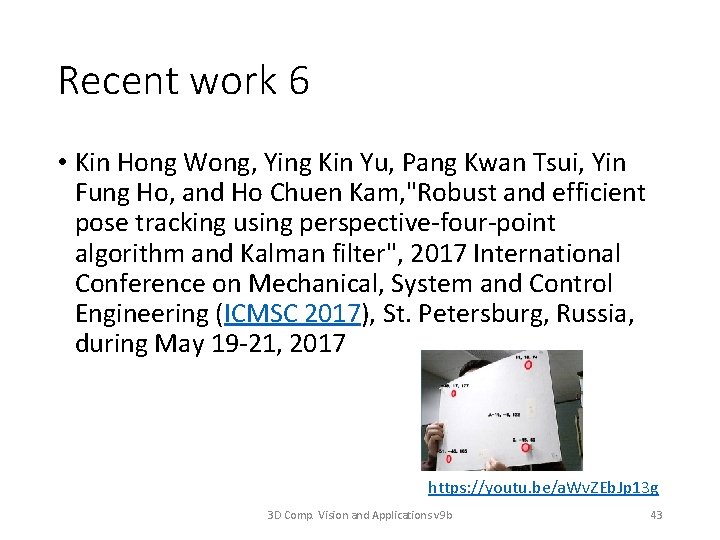
Recent work 6 • Kin Hong Wong, Ying Kin Yu, Pang Kwan Tsui, Yin Fung Ho, and Ho Chuen Kam, "Robust and efficient pose tracking using perspective-four-point algorithm and Kalman filter", 2017 International Conference on Mechanical, System and Control Engineering (ICMSC 2017), St. Petersburg, Russia, during May 19 -21, 2017 https: //youtu. be/a. Wv. ZEb. Jp 13 g 3 D Comp. Vision and Applications v 9 b 43
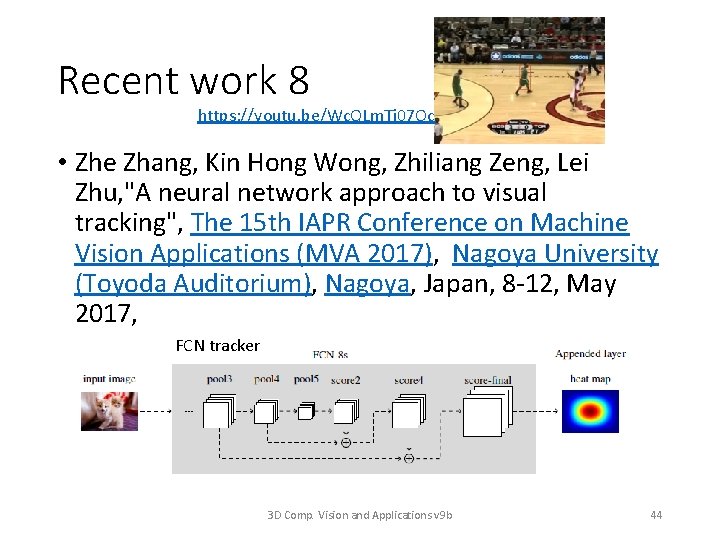
Recent work 8 https: //youtu. be/Wc. QLm. Ti 07 Oc • Zhe Zhang, Kin Hong Wong, Zhiliang Zeng, Lei Zhu, "A neural network approach to visual tracking", The 15 th IAPR Conference on Machine Vision Applications (MVA 2017), Nagoya University (Toyoda Auditorium), Nagoya, Japan, 8 -12, May 2017, FCN tracker 3 D Comp. Vision and Applications v 9 b 44

End Q&A 3 D Comp. Vision and Applications v 9 b 45
- Slides: 45