
3 D computer graphic Basis for realtime rendering
3 D computer graphic Basis for real-time rendering and GPU architecture 劉哲宇, Liou Jhe-Yu

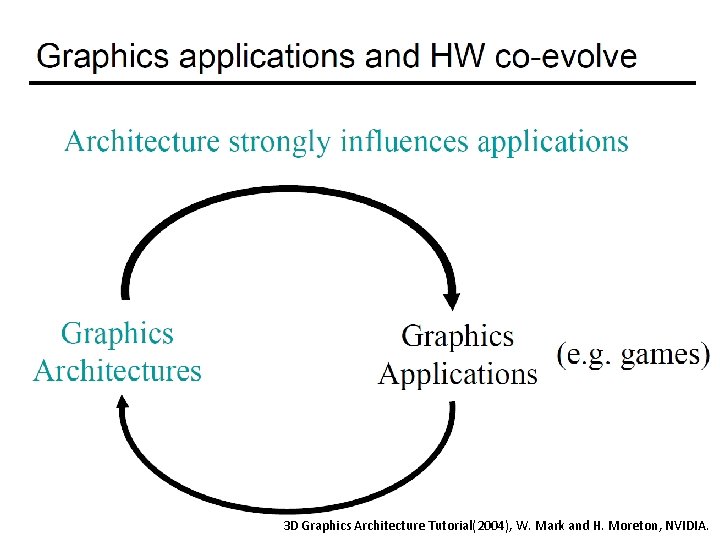
Motivation for learning graphics fundamentals • Q: I’m an architect. I do hardware, not algorithms. Can’t we just skip ahead to the case study? • A: Not really. You can’t understand 3 D graphics architectures without understanding 3 D graphics algorithms. • Q: Could I design my new Acme Flexi. GPU architecture by optimizing for current graphics applications/ traces/benchmarks? • A: No, not if you want your architecture to be relevant when it’s done. 3 D Graphics Architecture Tutoral(2004), W. Mark and H. Moreton, NVIDIA.
3 D Graphics Architecture Tutorial(2004), W. Mark and H. Moreton, NVIDIA.
Outline • 3 D computer graphic • Real-time rendering – using Open. GL fixed function pipeline(1. 5). – Geometry Stage – Rasterization stage • From fixed to Programmable – Open. GL shading pipeline
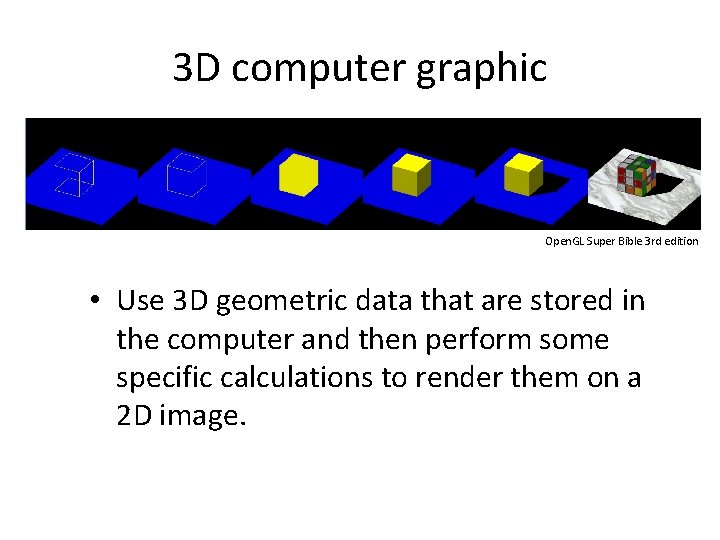
3 D computer graphic Open. GL Super Bible 3 rd edition • Use 3 D geometric data that are stored in the computer and then perform some specific calculations to render them on a 2 D image.
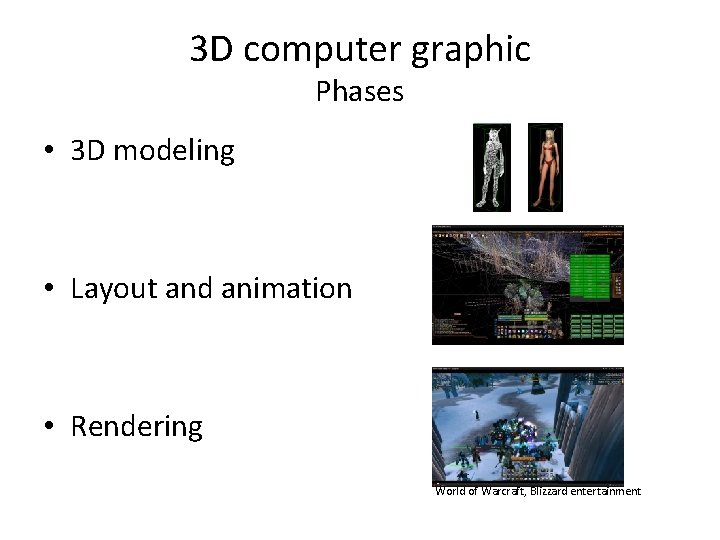
3 D computer graphic Phases • 3 D modeling • Layout and animation • Rendering World of Warcraft, Blizzard entertainment
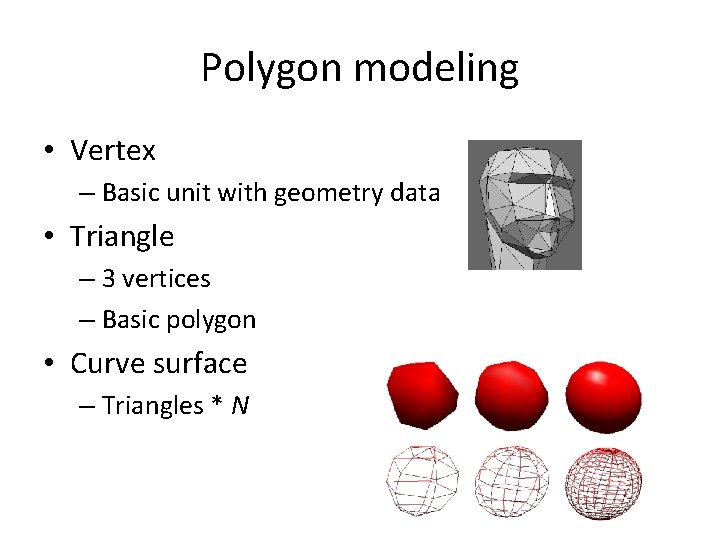
Polygon modeling • Vertex – Basic unit with geometry data • Triangle – 3 vertices – Basic polygon • Curve surface – Triangles * N
Layout and animation • Place 3 D object or vertex group. • Give them the relationship between time domain and movement vector. – May involve with physic simulation or motion capture on the human or animal movement.
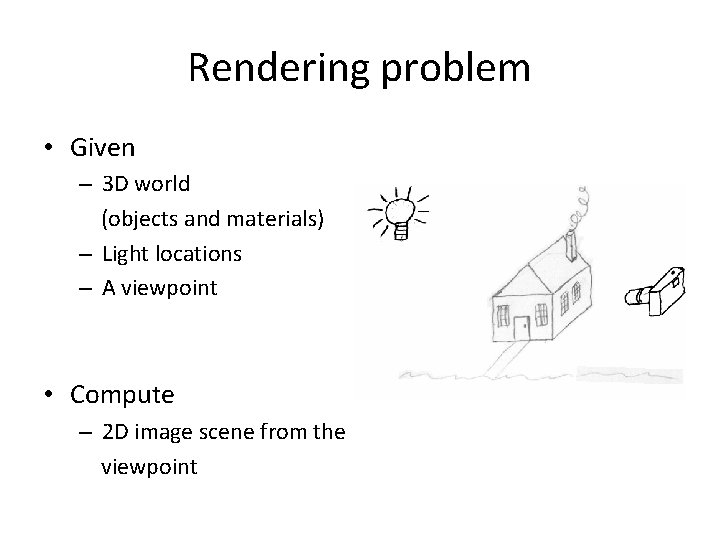
Rendering problem • Given – 3 D world (objects and materials) – Light locations – A viewpoint • Compute – 2 D image scene from the viewpoint
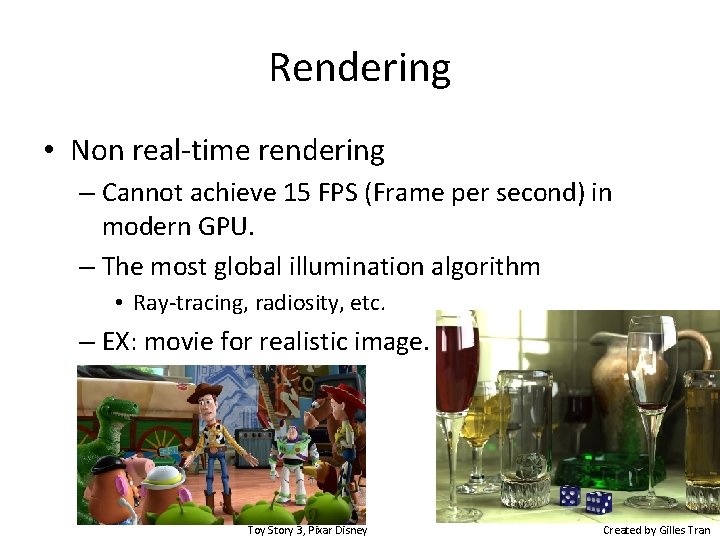
Rendering • Non real-time rendering – Cannot achieve 15 FPS (Frame per second) in modern GPU. – The most global illumination algorithm • Ray-tracing, radiosity, etc. – EX: movie for realistic image. Toy Story 3, Pixar Disney Created by Gilles Tran

Rendering • Real-time rendering – Can display over 15 FPS. – For those interactive applications. – EX. Video game. • Simplified lighting model and use texture image. • EX: Open. GL, Direct. X Crysis, Electronic Arts
What is Open. GL • Specify a series of abstract API. • Define its own virtual graphic pipeline. • Use APIs to control this pipeline and draw 3 D image – Programmer doesn’t need to communicate directly with real hardware. • Cross-platform, cross-language, royalty-free, … • The Open. GL fixed-function pipeline (before Open. GL 2. 0) is a really good entry point to know how the real-time rendering works.
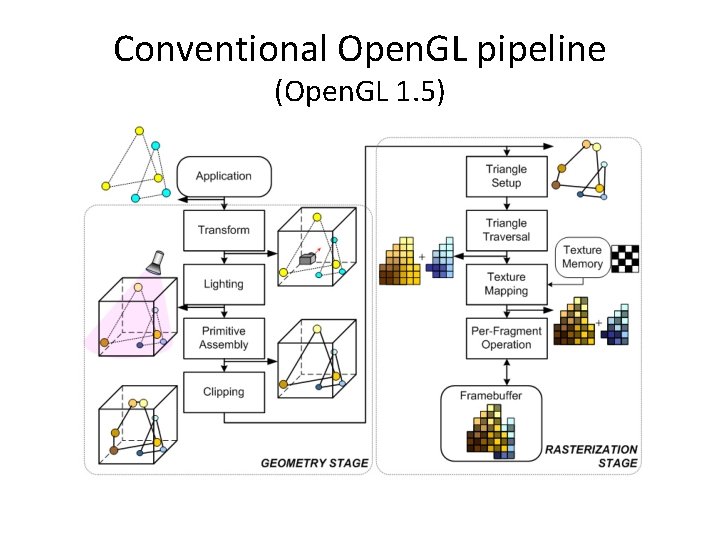
Conventional Open. GL pipeline (Open. GL 1. 5)
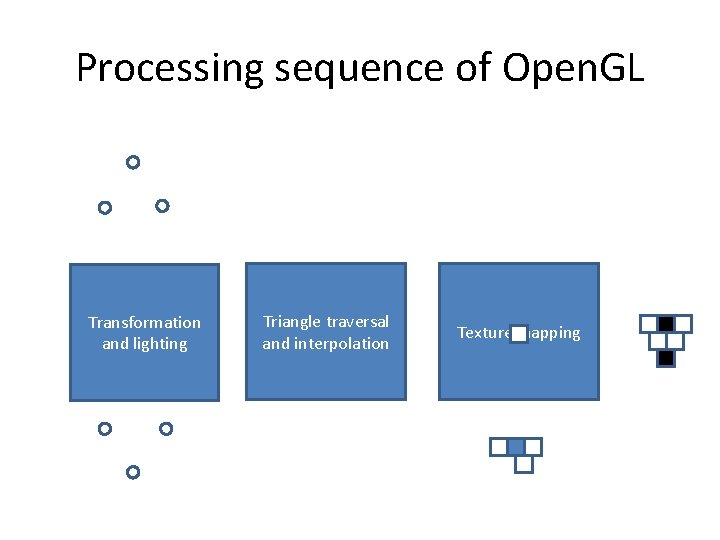
Processing sequence of Open. GL Transformation and lighting Triangle traversal and interpolation Texture mapping
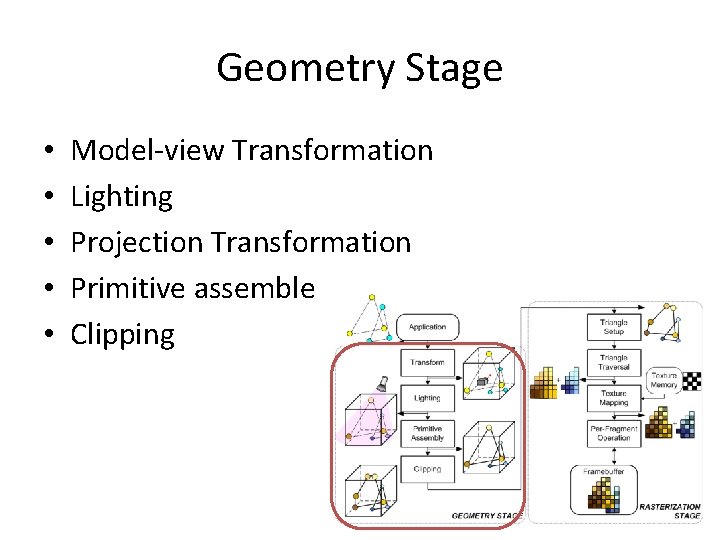
Geometry Stage • • • Model-view Transformation Lighting Projection Transformation Primitive assemble Clipping
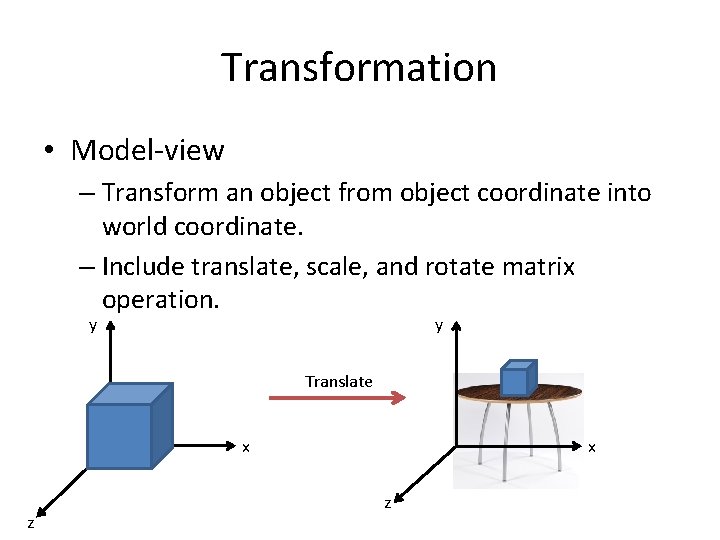
Transformation • Model-view – Transform an object from object coordinate into world coordinate. – Include translate, scale, and rotate matrix operation. y y Translate x z
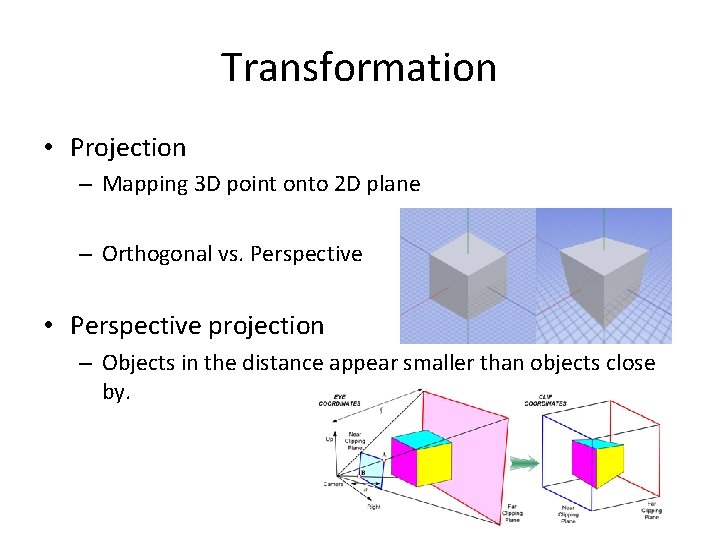
Transformation • Projection – Mapping 3 D point onto 2 D plane – Orthogonal vs. Perspective • Perspective projection – Objects in the distance appear smaller than objects close by.
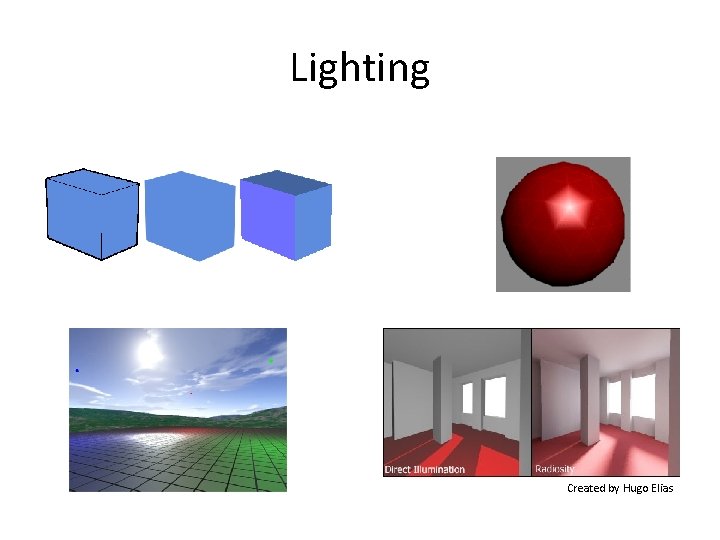
Lighting Created by Hugo Elias
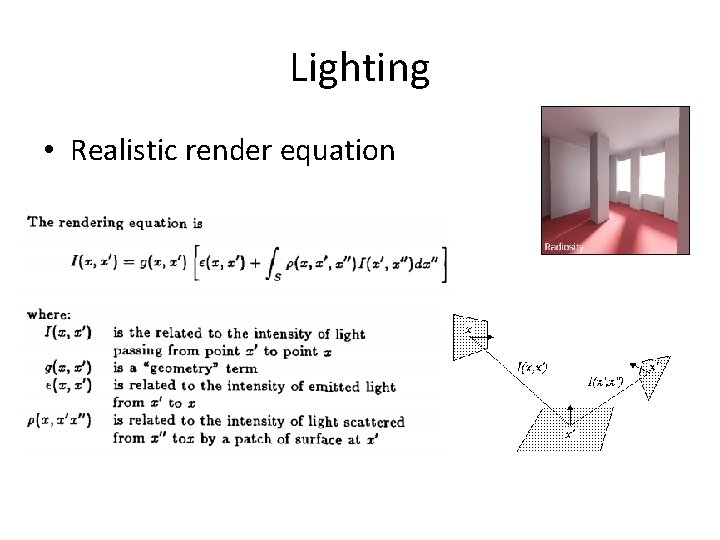
Lighting • Realistic render equation
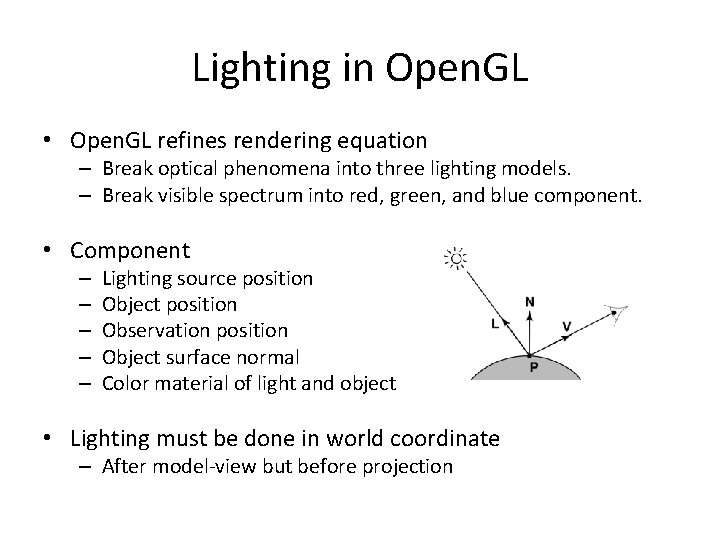
Lighting in Open. GL • Open. GL refines rendering equation – Break optical phenomena into three lighting models. – Break visible spectrum into red, green, and blue component. • Component – – – Lighting source position Object position Observation position Object surface normal Color material of light and object • Lighting must be done in world coordinate – After model-view but before projection
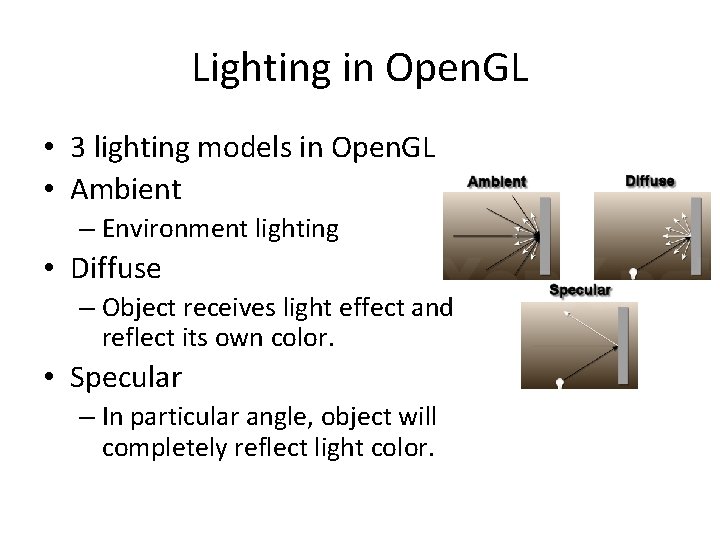
Lighting in Open. GL • 3 lighting models in Open. GL • Ambient – Environment lighting • Diffuse – Object receives light effect and reflect its own color. • Specular – In particular angle, object will completely reflect light color.
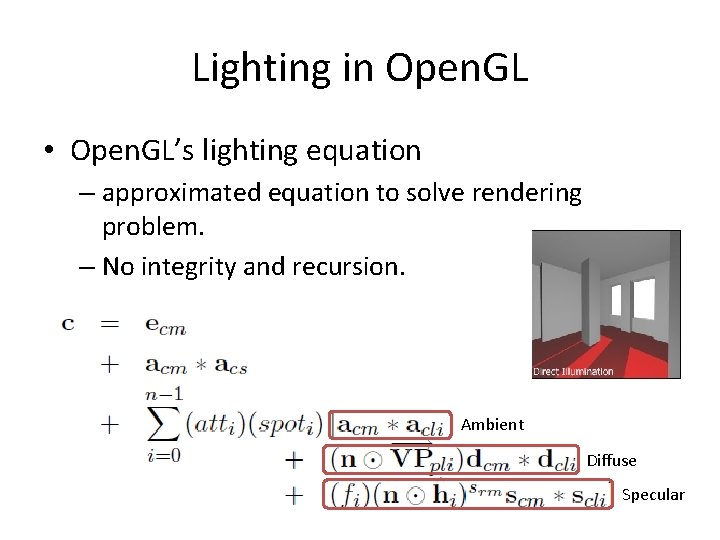
Lighting in Open. GL • Open. GL’s lighting equation – approximated equation to solve rendering problem. – No integrity and recursion. Ambient Diffuse Specular
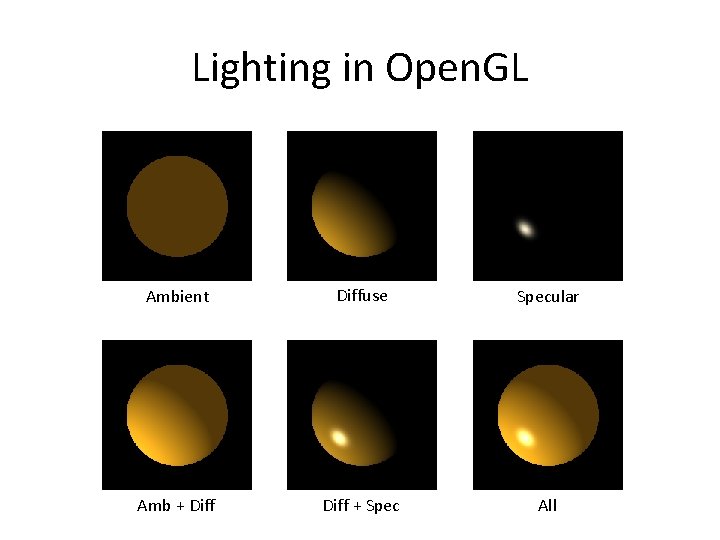
Lighting in Open. GL Ambient Diffuse Specular Amb + Diff + Spec All
Surface shading model • Per-Vertex lighting – Flat shading • One polygon, one surface normal. – Gouraud shading • One polygon, three normals on three vertices. • Per-Pixel lighting – Phong shading • One polygon has lots of normal value for every pixel.
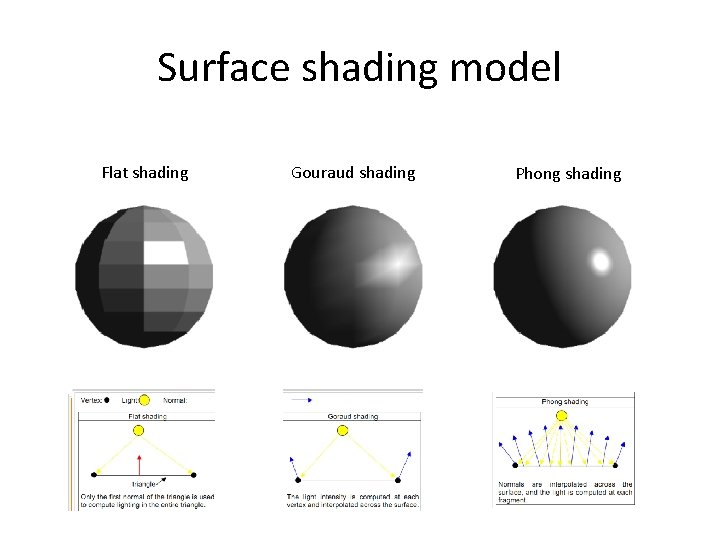
Surface shading model Flat shading Gouraud shading Phong shading
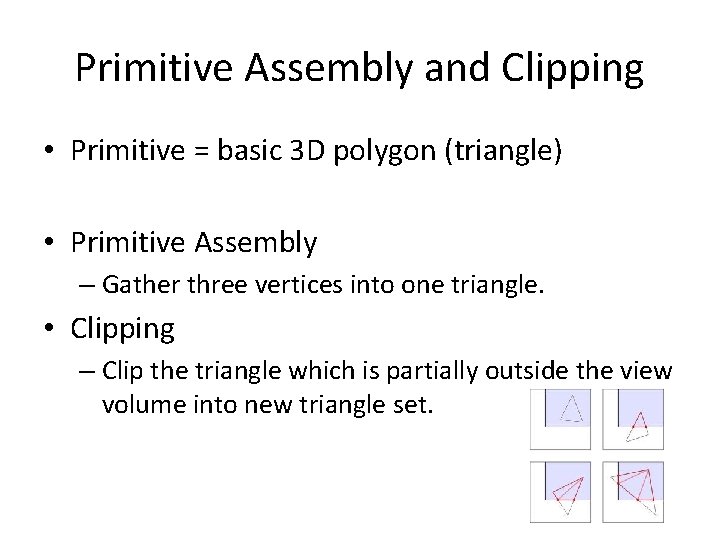
Primitive Assembly and Clipping • Primitive = basic 3 D polygon (triangle) • Primitive Assembly – Gather three vertices into one triangle. • Clipping – Clip the triangle which is partially outside the view volume into new triangle set.
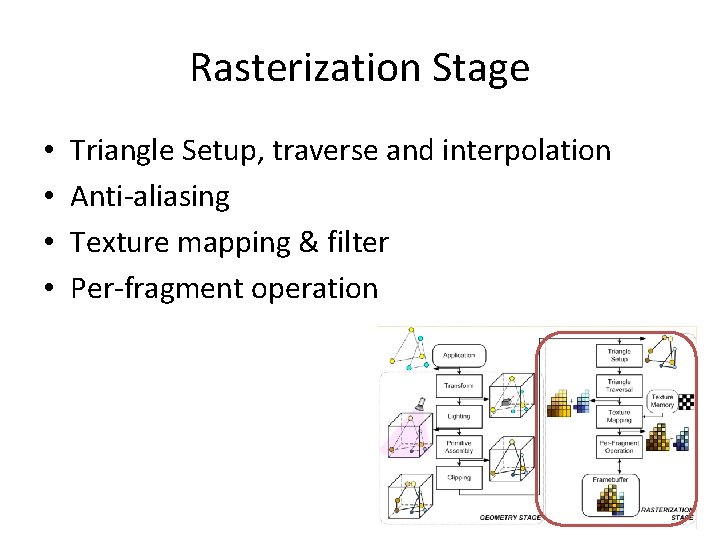
Rasterization Stage • • Triangle Setup, traverse and interpolation Anti-aliasing Texture mapping & filter Per-fragment operation
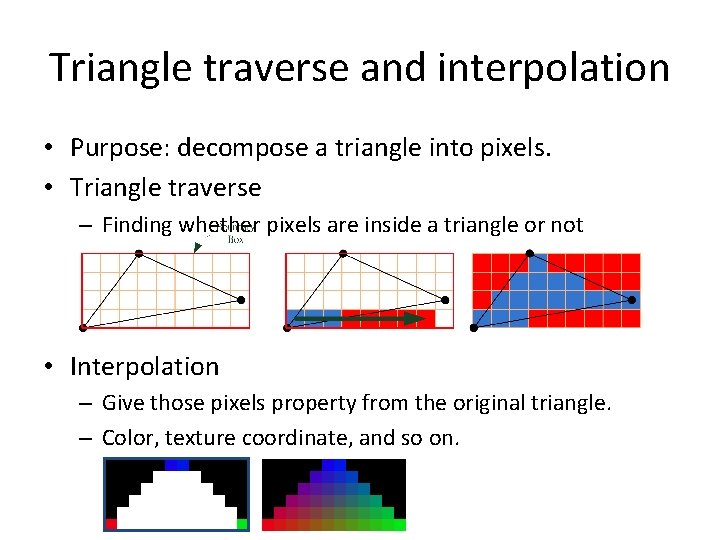
Triangle traverse and interpolation • Purpose: decompose a triangle into pixels. • Triangle traverse – Finding whether pixels are inside a triangle or not • Interpolation – Give those pixels property from the original triangle. – Color, texture coordinate, and so on.
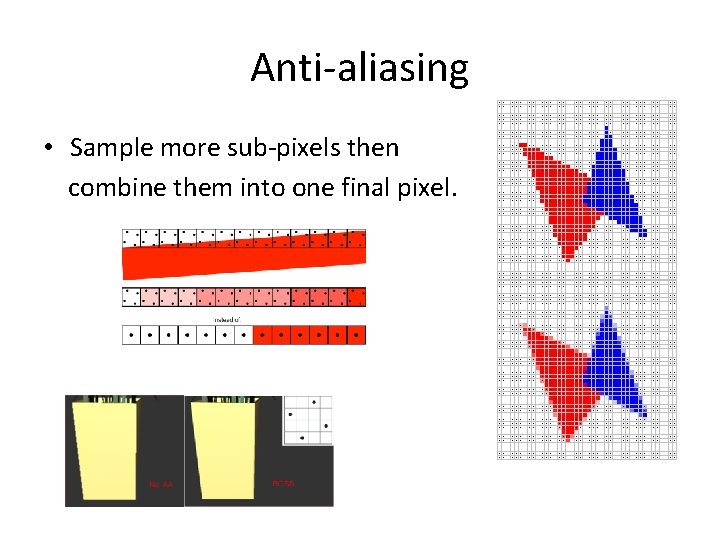
Anti-aliasing • Sample more sub-pixels then combine them into one final pixel.
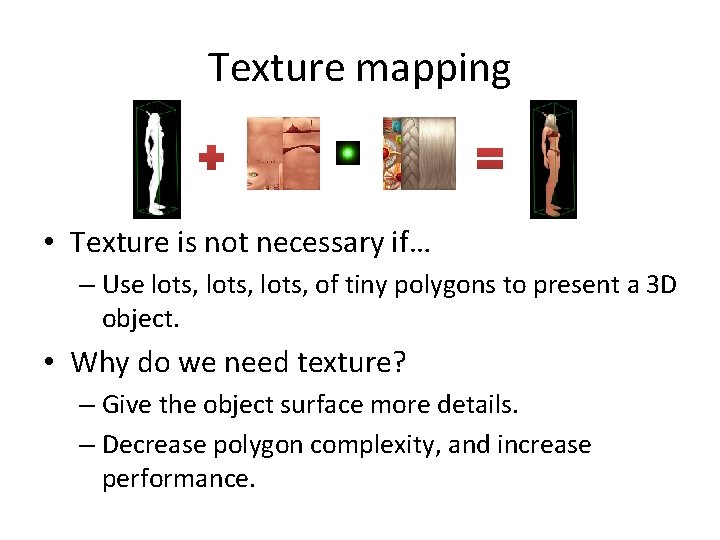
Texture mapping • Texture is not necessary if… – Use lots, of tiny polygons to present a 3 D object. • Why do we need texture? – Give the object surface more details. – Decrease polygon complexity, and increase performance.
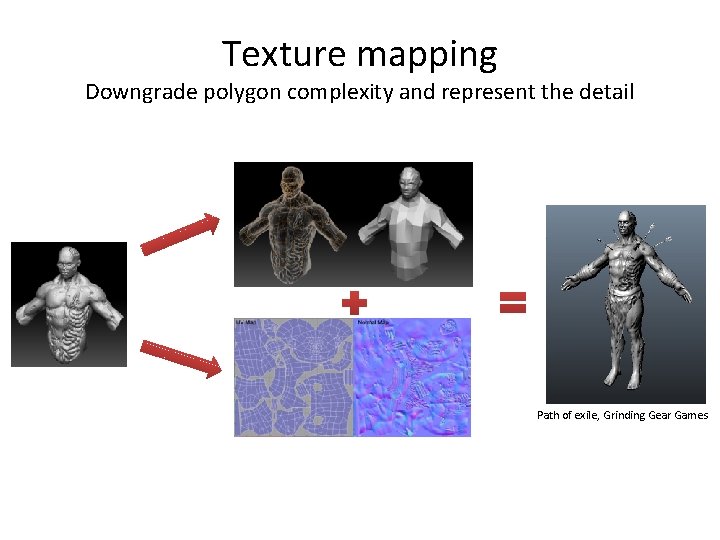
Texture mapping Downgrade polygon complexity and represent the detail Path of exile, Grinding Gear Games
Texture mapping • Basic texture mapping – Give the fragment color • Procedure texture mapping – Give the fragment physic property and adjust the color. – Ex. Normal mapping
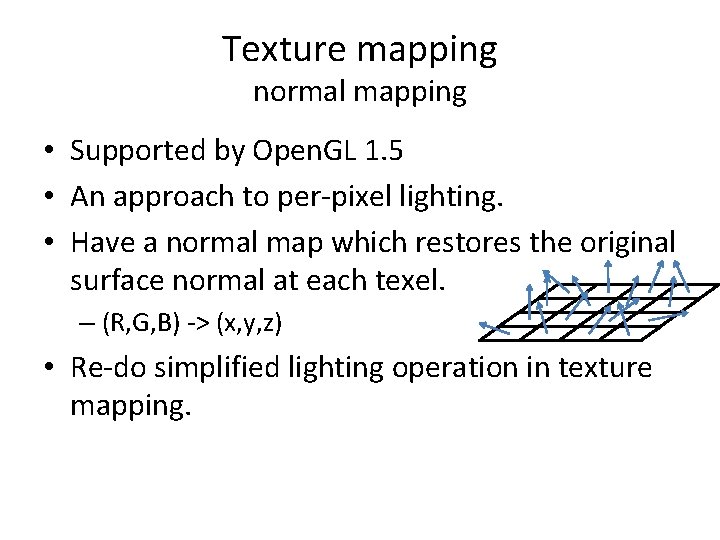
Texture mapping normal mapping • Supported by Open. GL 1. 5 • An approach to per-pixel lighting. • Have a normal map which restores the original surface normal at each texel. – (R, G, B) -> (x, y, z) • Re-do simplified lighting operation in texture mapping.
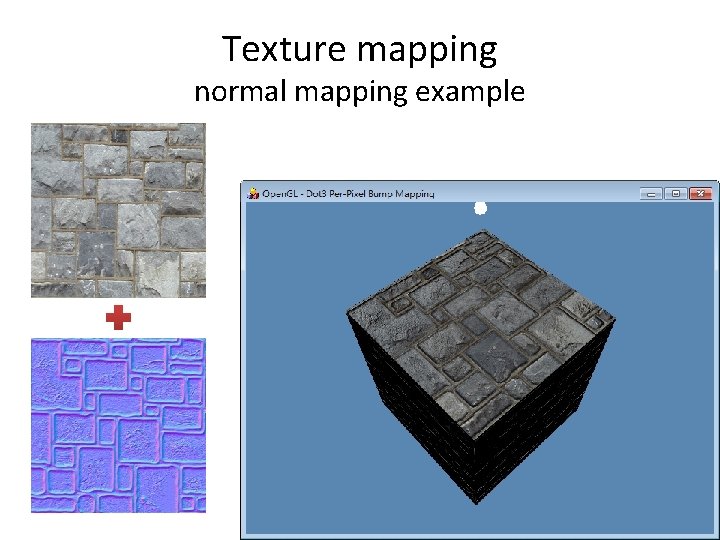
Texture mapping normal mapping example
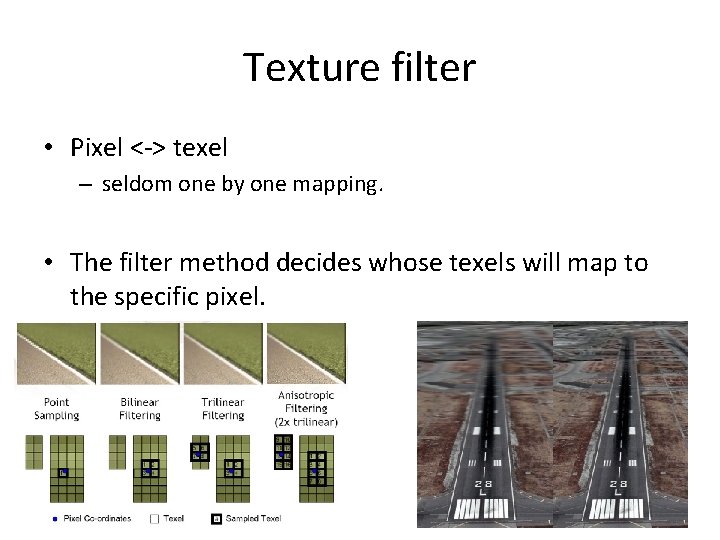
Texture filter • Pixel <-> texel – seldom one by one mapping. • The filter method decides whose texels will map to the specific pixel.
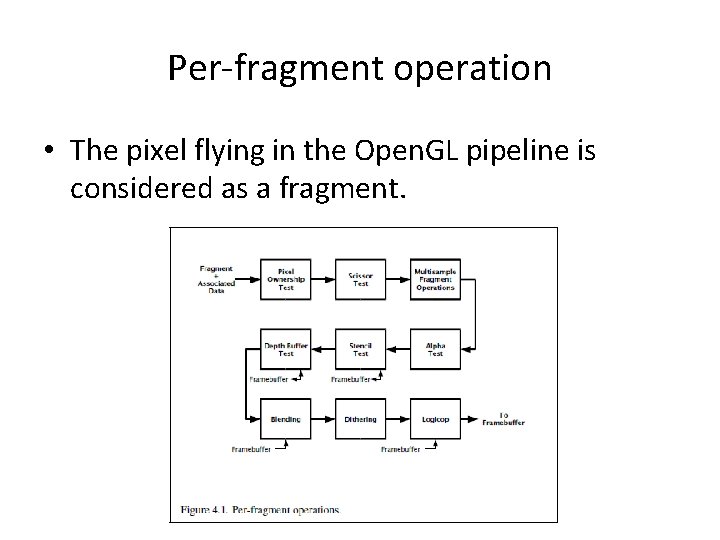
Per-fragment operation • The pixel flying in the Open. GL pipeline is considered as a fragment.
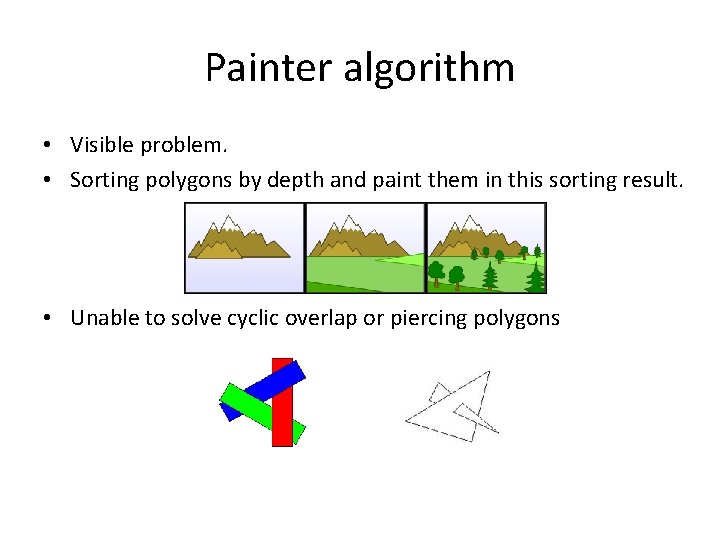
Painter algorithm • Visible problem. • Sorting polygons by depth and paint them in this sorting result. • Unable to solve cyclic overlap or piercing polygons
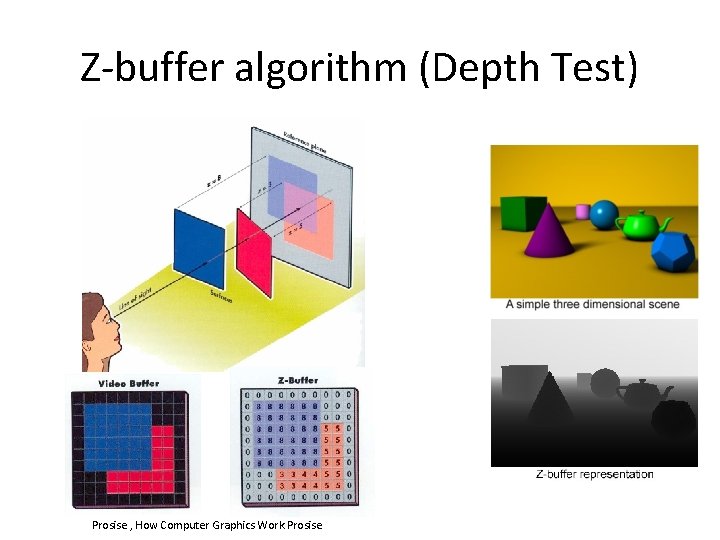
Z-buffer algorithm (Depth Test) Prosise , How Computer Graphics Work Prosise
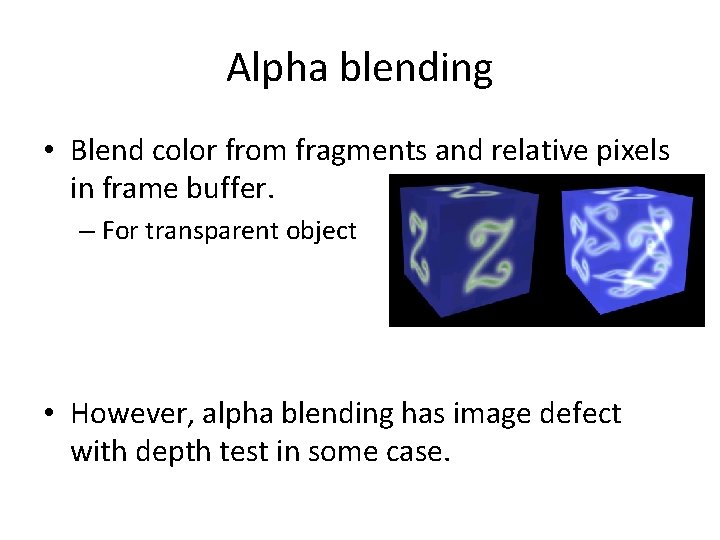
Alpha blending • Blend color from fragments and relative pixels in frame buffer. – For transparent object • However, alpha blending has image defect with depth test in some case.
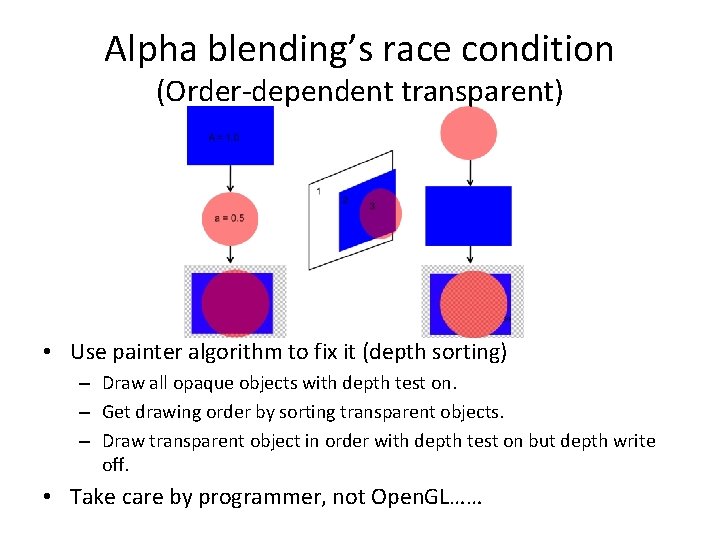
Alpha blending’s race condition (Order-dependent transparent) • Use painter algorithm to fix it (depth sorting) – Draw all opaque objects with depth test on. – Get drawing order by sorting transparent objects. – Draw transparent object in order with depth test on but depth write off. • Take care by programmer, not Open. GL……
Open. GL Conclusion • Programmer: – Prepare raw data. – Place Object and lighting source. – Optional operation. • Sort object if alpha blending is needed. • Open. GL (Hardware) – Calculating the effect between light and object. – Transforming 3 D object into 2 D image. – Executing texture operation
Outline • 3 D computer graphic • Real-time rendering – using Open. GL fixed function pipeline(1. 5). – Geometry Stage – Rasterization stage • From fixed to Programmable – programmable shading pipeline
Texture operation wants more flexibility • In Open. GL 1. 5, normal mapping can be “partially” achieved by calling and setting parameter in gl. Tex. Env API. – API does know what is dot operation. • If I want to execute vec. A Ω vec. B in texture operation. – Open. GL : Ω ? ?
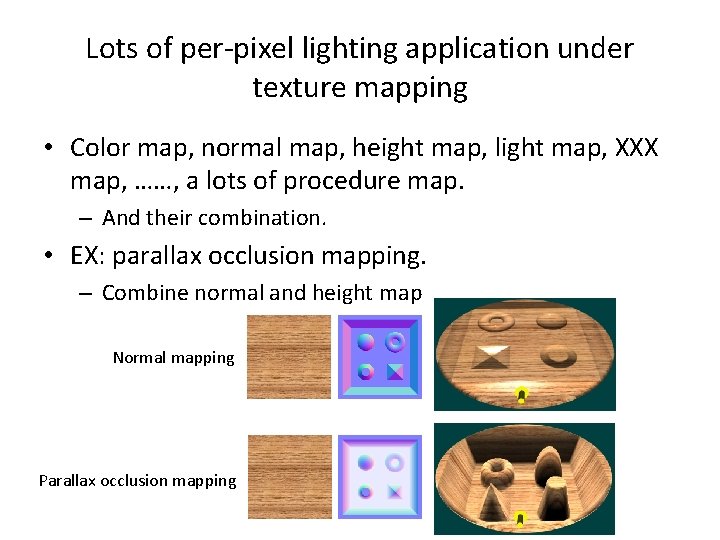
Lots of per-pixel lighting application under texture mapping • Color map, normal map, height map, light map, XXX map, ……, a lots of procedure map. – And their combination. • EX: parallax occlusion mapping. – Combine normal and height map Normal mapping Parallax occlusion mapping
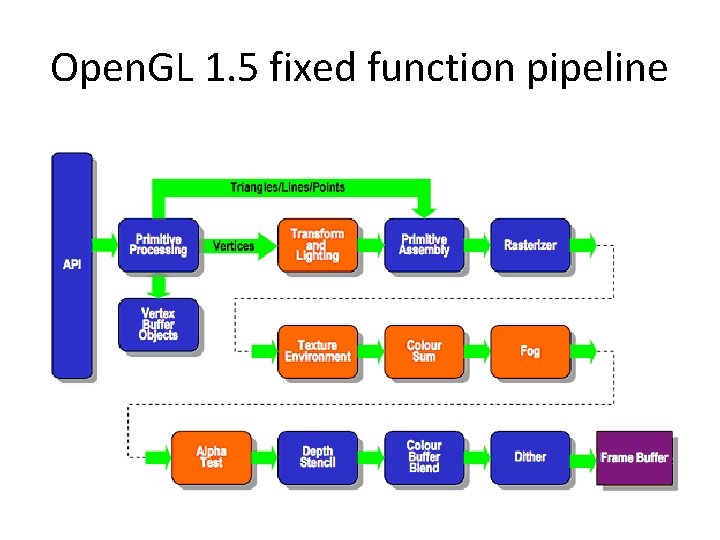
Open. GL 1. 5 fixed function pipeline
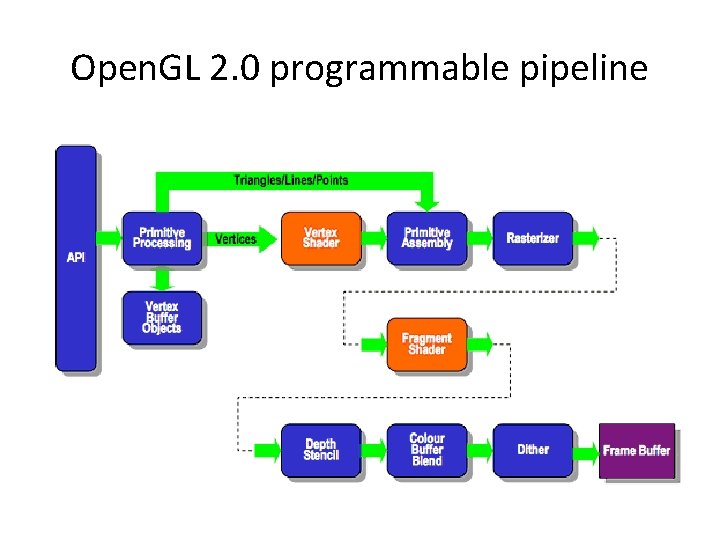
Open. GL 2. 0 programmable pipeline
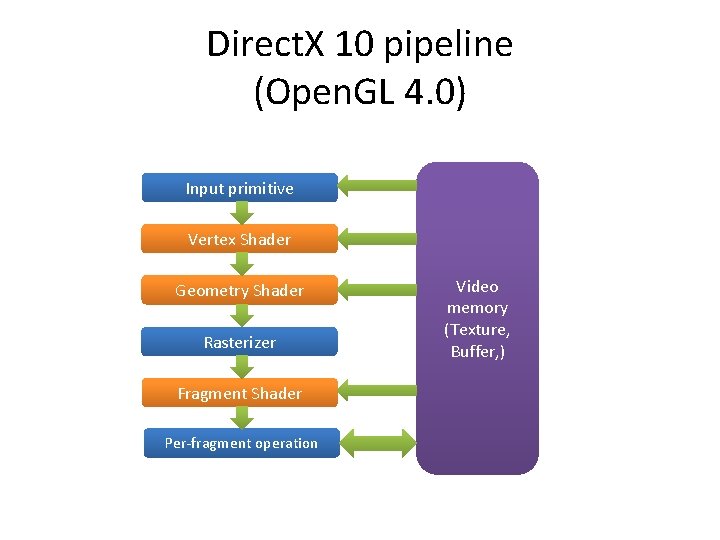
Direct. X 10 pipeline (Open. GL 4. 0) Input primitive Vertex Shader Geometry Shader Rasterizer Fragment Shader Per-fragment operation Video memory (Texture, Buffer, )
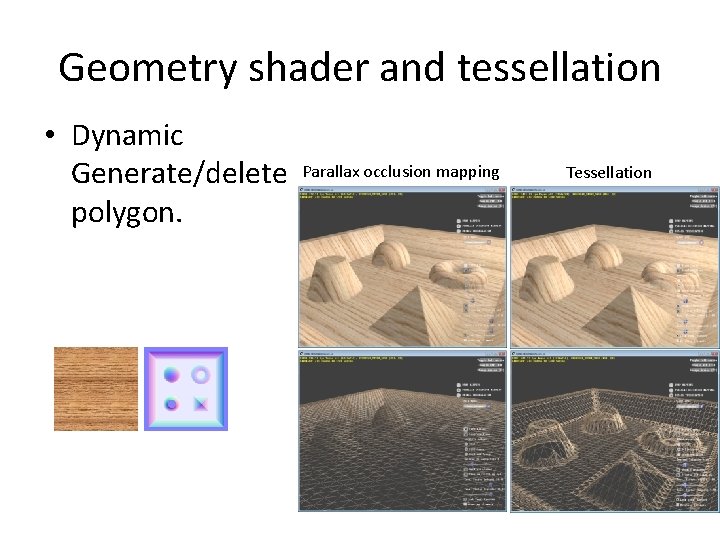
Geometry shader and tessellation • Dynamic Generate/delete polygon. Parallax occlusion mapping Tessellation
Programming pipeline with programmer • Advantage: – Freedom • More procedure texture applications, better image quality. • Special post production effect. • A solution for blending’s ordering problem can be made in advanced shader architecture without CPU pre-sorting. • Step forward to ray-tracing. • Disadvantage – No built-in light model and transformation function.
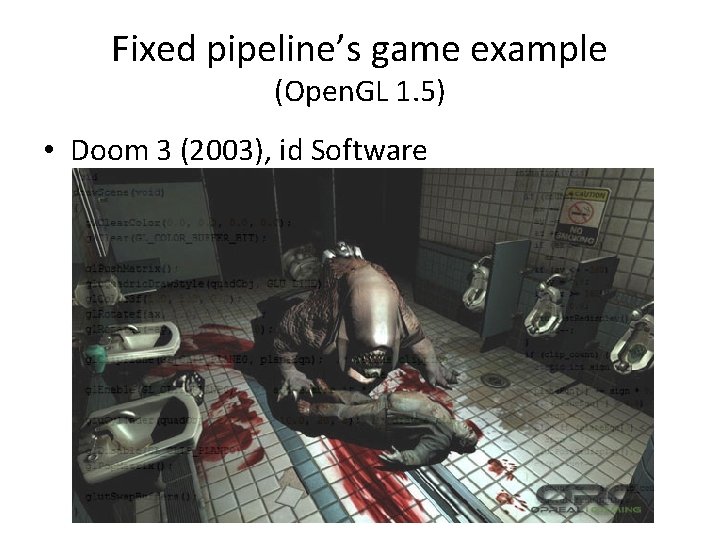
Fixed pipeline’s game example (Open. GL 1. 5) • Doom 3 (2003), id Software
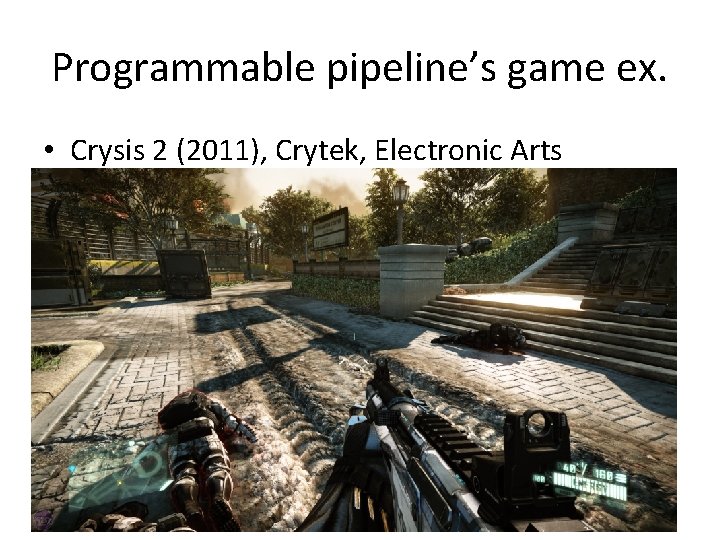
Programmable pipeline’s game ex. • Crysis 2 (2011), Crytek, Electronic Arts
Trend of application • Maintain the final image quality but decrease polygon complexity. • Simplify per-vertex lighting algorithm. • Use multi layer texture to reconstruct perpixel lighting and shadow effect. – Make lighting equation closer to the rendering equation.
Not everything is programmable • Primitive assembly, clipping, and culling. • Triangle traverse and interpolation. • Texture filter • Some per-fragment operation
GPU Architecture? See you next week Thank you
- Slides: 54