
3 D CITY CARTOGRAPHIC MODELS Temenoujka Bandrova Department
3 D CITY CARTOGRAPHIC MODELS Temenoujka Bandrova Department of Photogrammetry and Cartography University of ACEG – Sofia 2/6/2022
IN BRIEF Users of 3 D maps 3 D map – definition and content (main, secondary and additional cont. ) “From Paper to Virtual Map” – а cheap technology for easy creation of 3 D maps 3 D cartographic symbol system Animation of 3 D maps
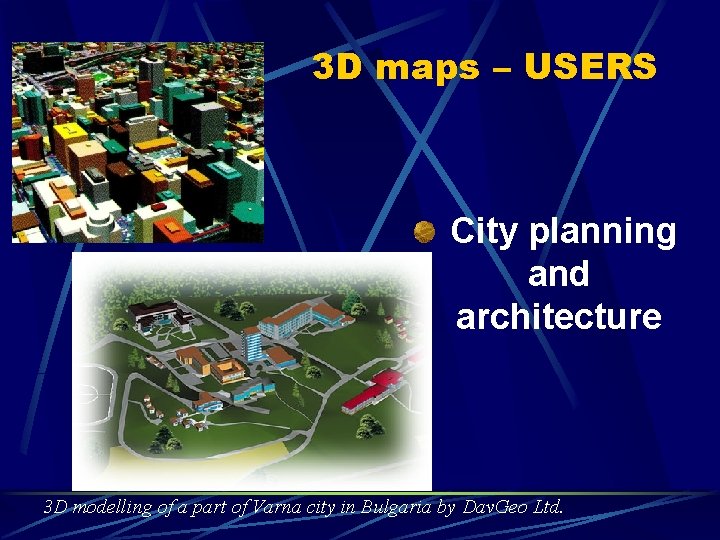
3 D maps – USERS City planning and architecture 3 D modelling of а part of Varna city in Bulgaria by Dav. Geo Ltd.
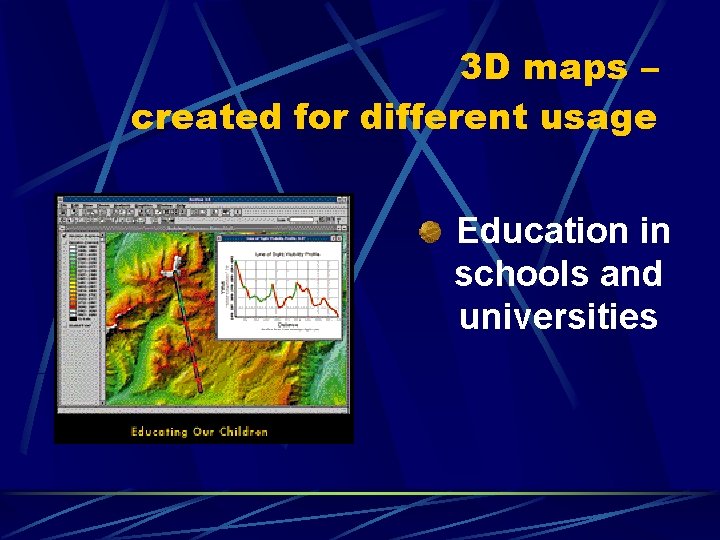
3 D maps – created for different usage Education in schools and universities
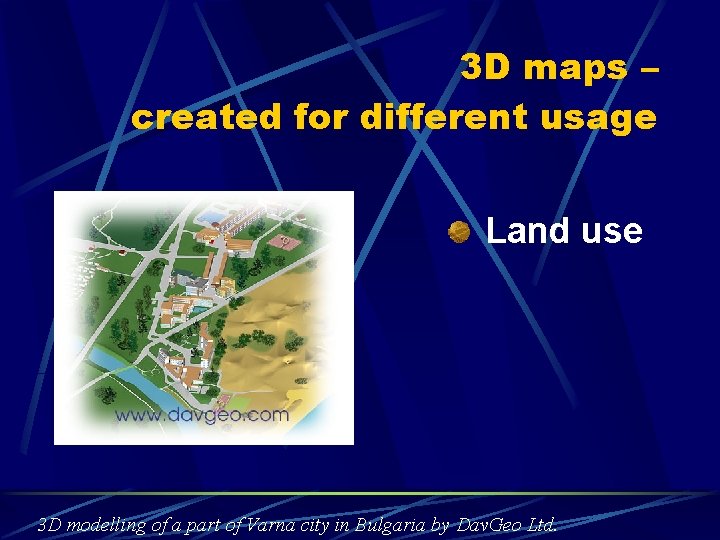
3 D maps – created for different usage Land use 3 D modelling of а part of Varna city in Bulgaria by Dav. Geo Ltd.
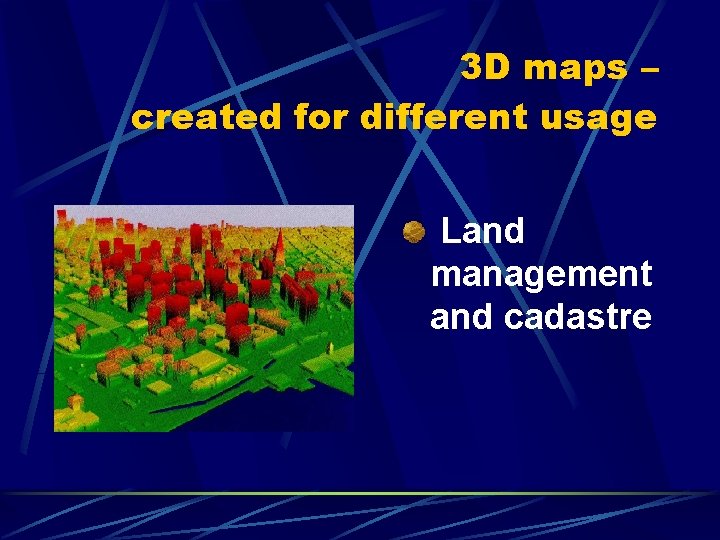
3 D maps – created for different usage Land management and cadastre
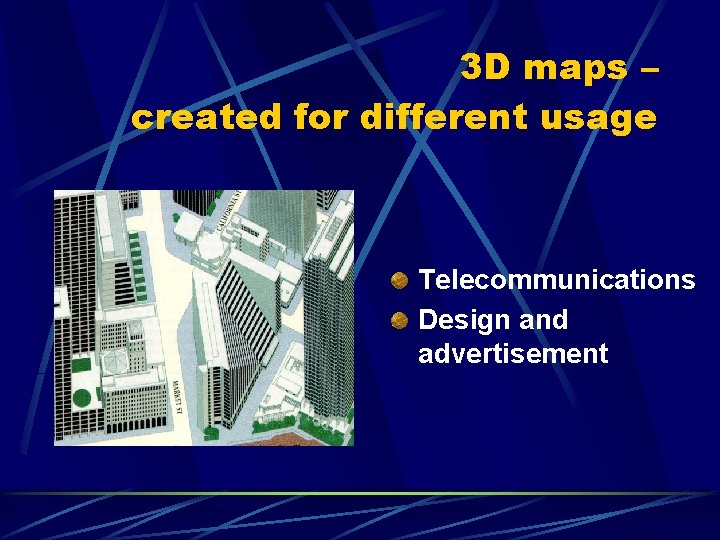
3 D maps – created for different usage Telecommunications Design and advertisement
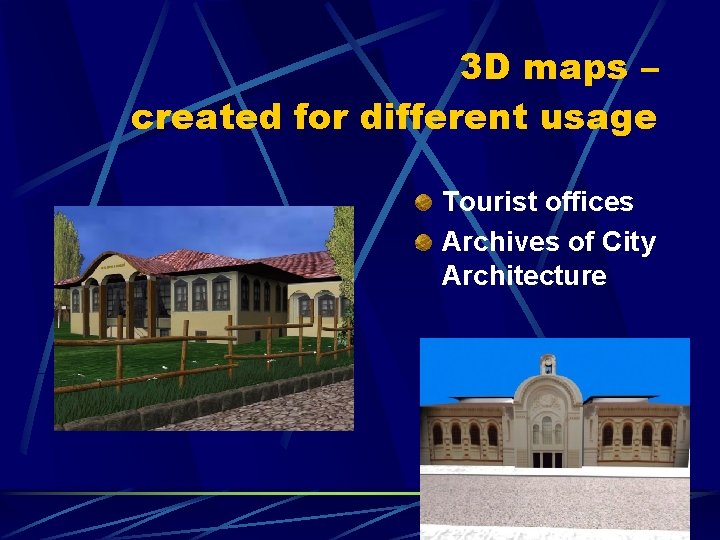
3 D maps – created for different usage Tourist offices Archives of City Architecture
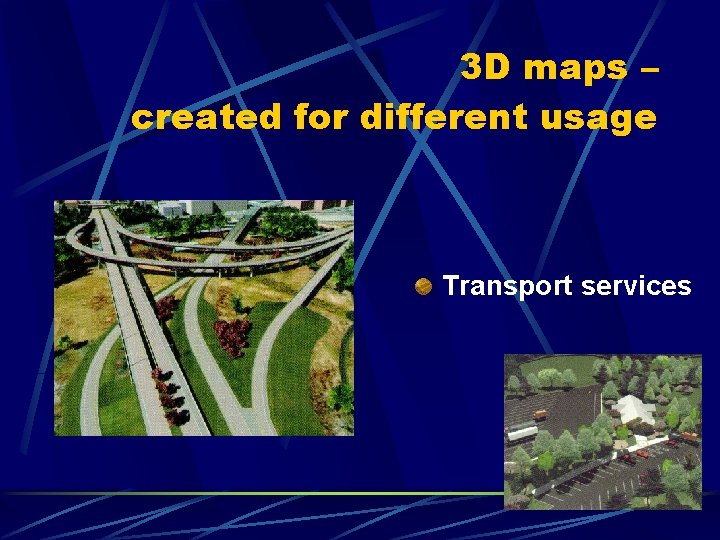
3 D maps – created for different usage Transport services
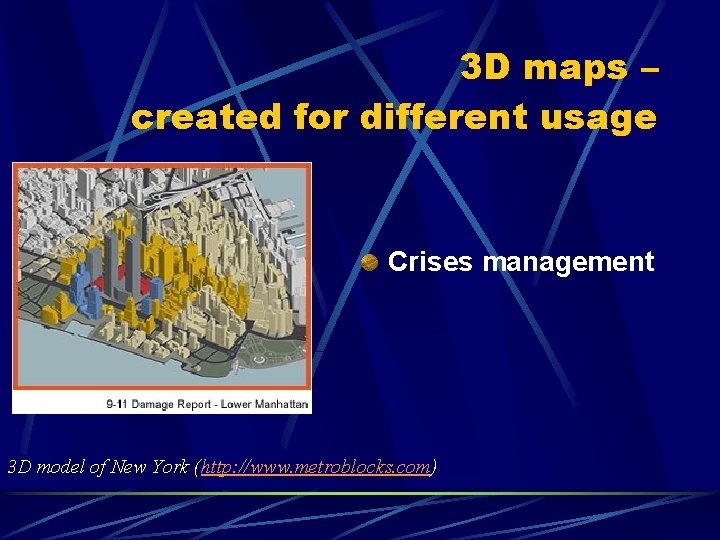
3 D maps – created for different usage Crises management 3 D model of New York (http: //www. metroblocks. com)
3 D maps – created for different usage Police Military fire management
3 D maps – created for different usage Meteorology
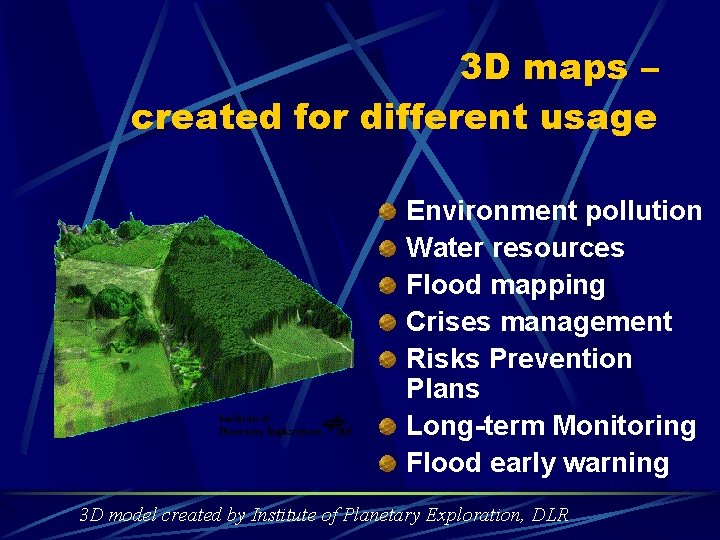
3 D maps – created for different usage Environment pollution Water resources Flood mapping Crises management Risks Prevention Plans Long-term Monitoring Flood early warning 3 D model created by Institute of Planetary Exploration, DLR

map - definition Maps – cartographic products represent the spatial variety of the natural and socioeconomic phenomena. 2 aspects: - mathematical – scale, map projections, coordinate system - geographical – visualize geo-information
3 D map - definition Digital, mathematical defined, threedimensional virtual representation of the Earth surface, objects and phenomena in nature and society. Represented objects and phenomena are classified, designed and visualised according to a particular purpose.
Disadvantages of 3 D maps Higher hardware and software requirements Difficulties in 3 rd coordinate collection Large amounts of data and complex visualization Lack of standardized symbol system High 3 D production price
Advantages of 3 D maps Multiple geometric representation High realistic representation of the real world Photo-realistic buildings and objects representation User friendly and easy for understanding models Attractive and more informatively products More applications and users
Contents of 3 D maps Main content Secondary content Additional content
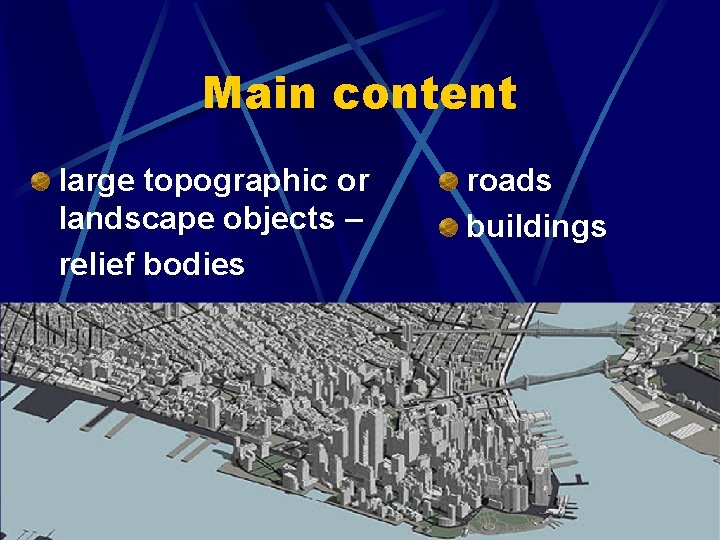
Main content large topographic or landscape objects – relief bodies roads buildings
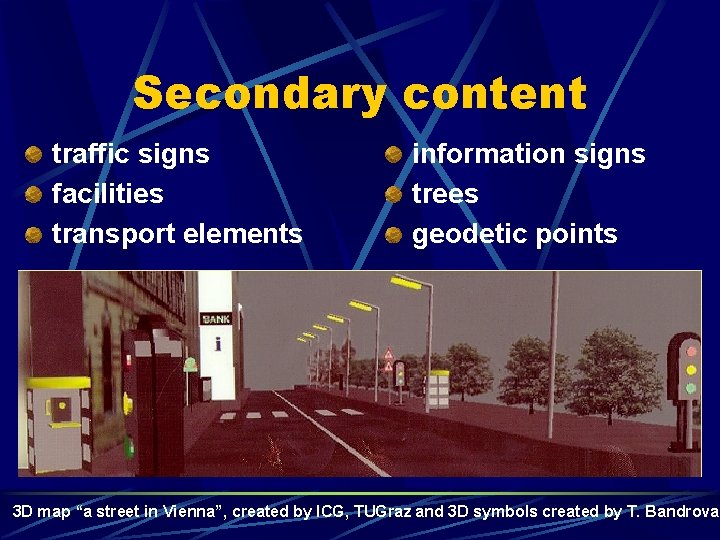
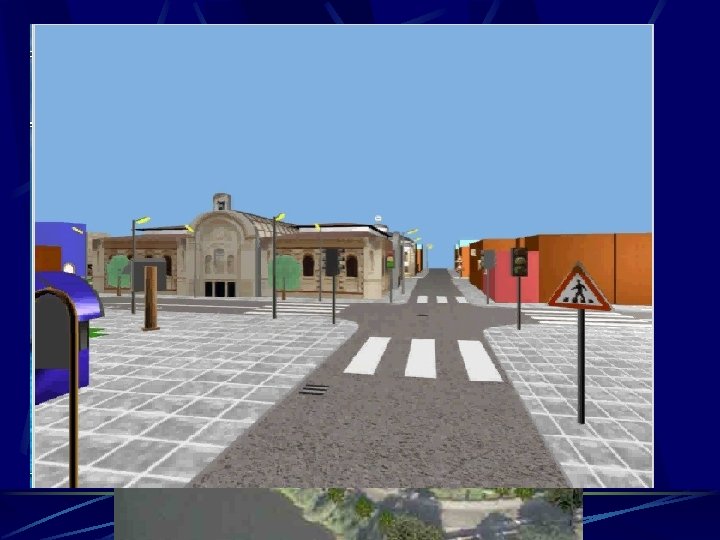
Secondary content traffic signs facilities transport elements information signs trees geodetic points 3 D map “a street in Vienna”, created by ICG, TUGraz and 3 D symbols created by T. Bandrova
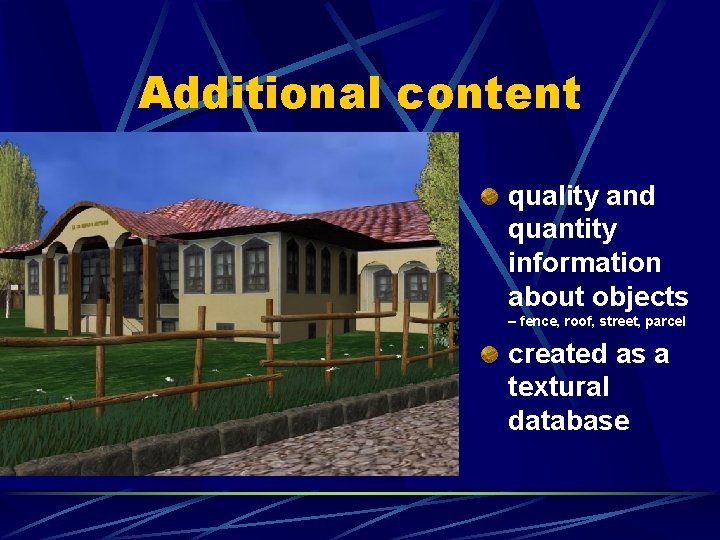
Additional content quality and quantity information about objects – fence, roof, street, parcel created as a textural database
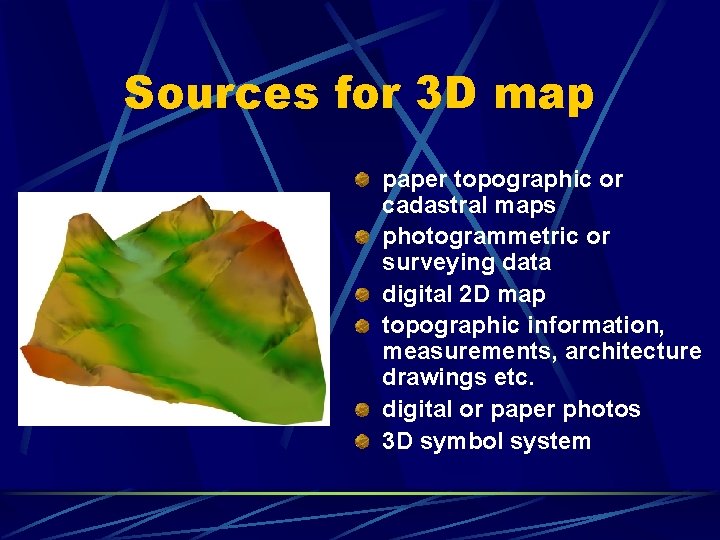
Sources for 3 D map paper topographic or cadastral maps photogrammetric or surveying data digital 2 D map topographic information, measurements, architecture drawings etc. digital or paper photos 3 D symbol system
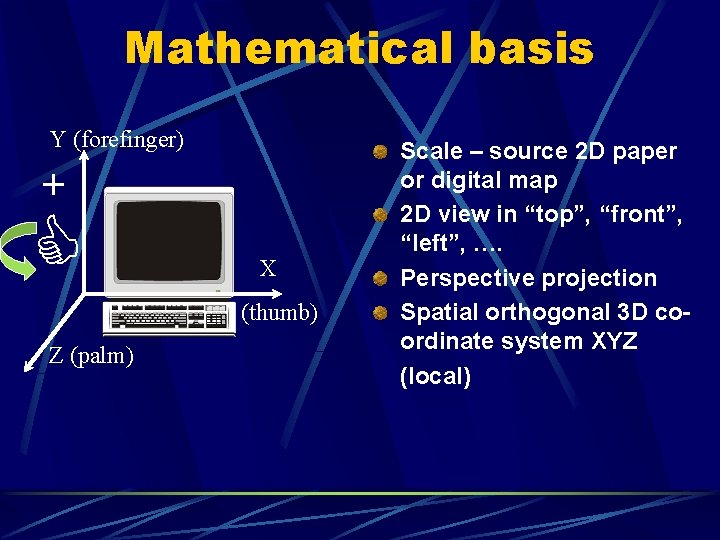
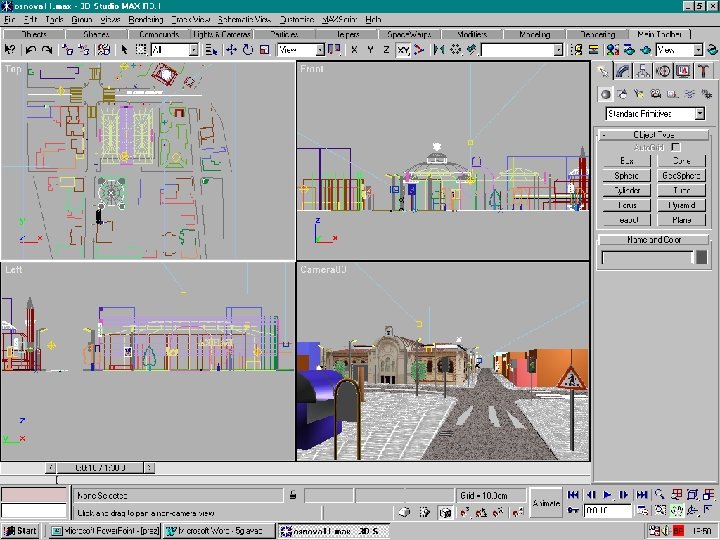
Mathematical basis Y (forefinger) + X (thumb) Z (palm) Scale – source 2 D paper or digital map 2 D view in “top”, “front”, “left”, …. Perspective projection Spatial orthogonal 3 D coordinate system ХYZ (local)
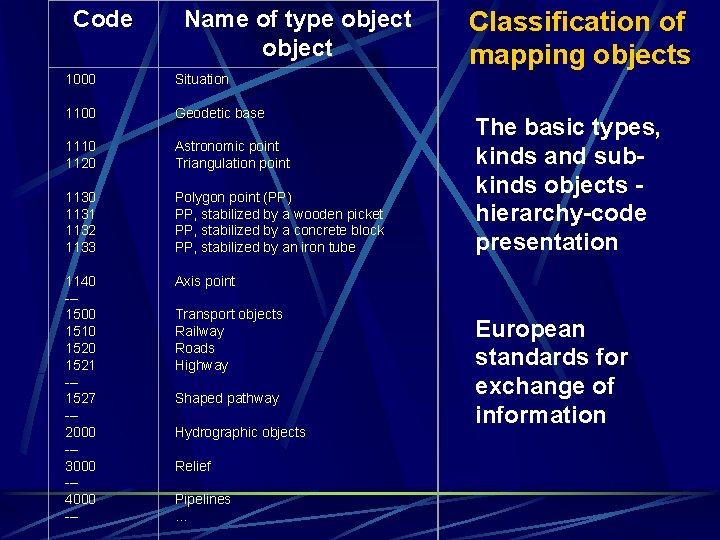
Code Name of type object 1000 Situation 1100 Geodetic base 1110 1120 Astronomic point Triangulation point 1130 1131 1132 1133 Polygon point (PP) PP, stabilized by a wooden picket PP, stabilized by a concrete block PP, stabilized by an iron tube 1140 --1500 1510 1521 --1527 --2000 --3000 --4000 --- Axis point Transport objects Railway Roads Highway Shaped pathway Hydrographic objects Relief Pipelines … Classification of mapping objects The basic types, kinds and subkinds objects hierarchy-code presentation European standards for exchange of information
Generalization Automatic – formal selection, smooth and filtration, according formal criteria Dynamic – for animation presentation and track out the development of the phenomena in the space and time Interactive – complex of the traditional, automatic and time generalization
Accuracy in objects representation Accuracy in reference (location) Thematic accuracy Semantic accuracy
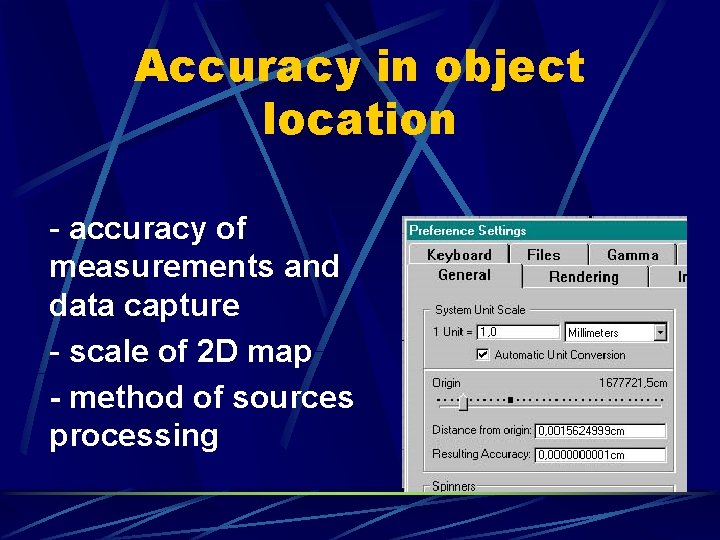
Accuracy in object location - accuracy of measurements and data capture - scale of 2 D map - method of sources processing
Thematic accuracy - data base – quality of statistical data, methods of capture and processing - data transformation – selection, classification and data references
Semantic accuracy - symbols define the objects - realistic and informatively representations
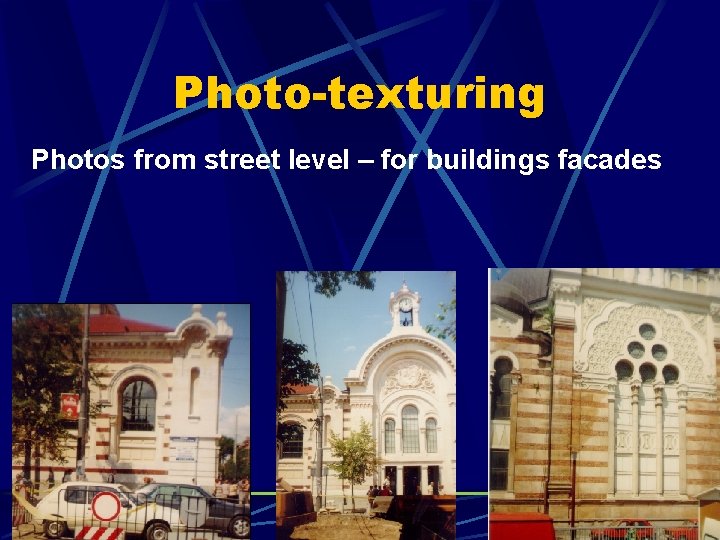
Photo-texturing Photos from street level – for buildings facades
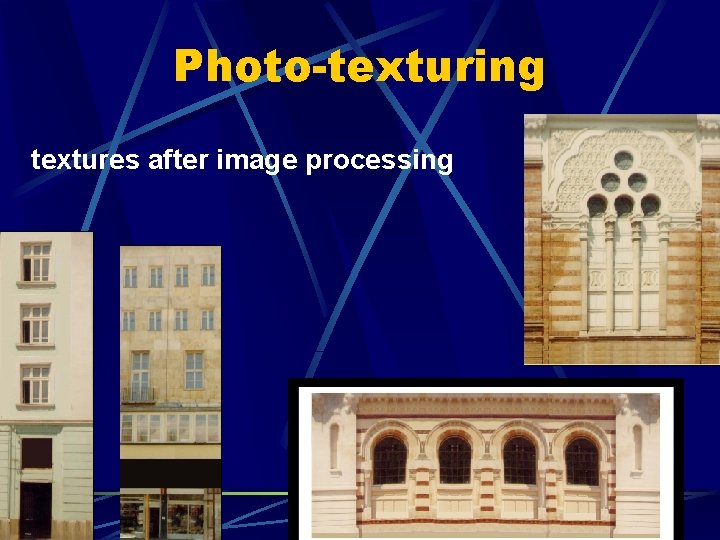
Photo-texturing textures after image processing
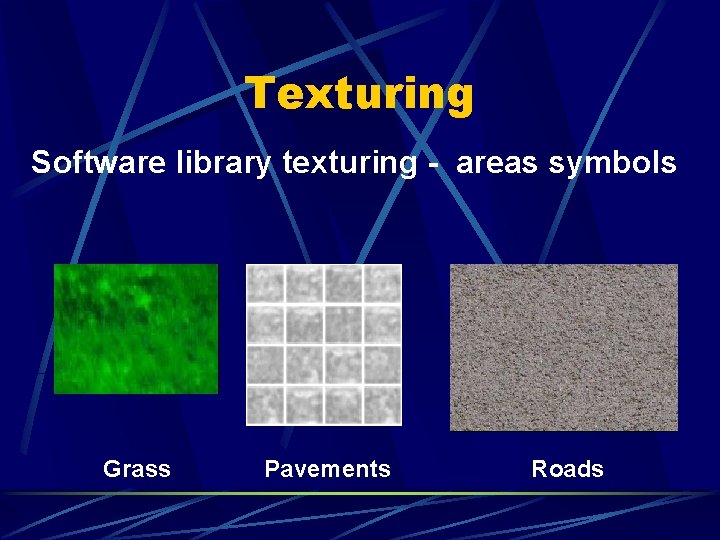
Texturing Software library texturing - areas symbols Grass Pavements Roads
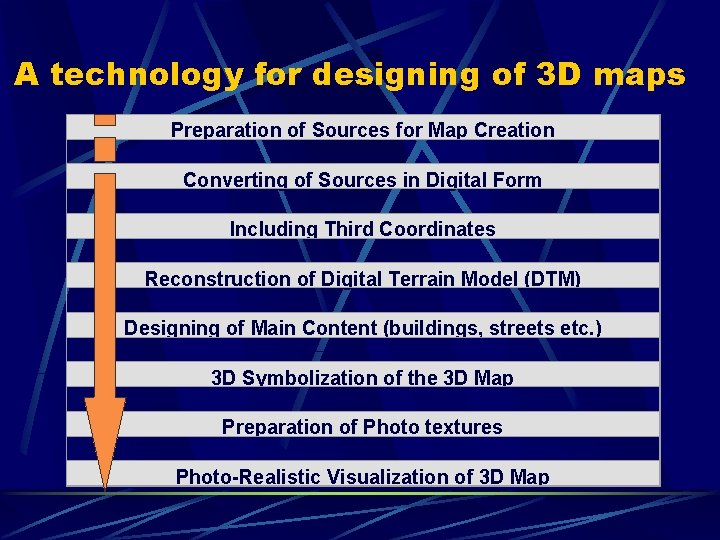
A technology for designing of 3 D maps Preparation of Sources for Map Creation Converting of Sources in Digital Form Including Third Coordinates Reconstruction of Digital Terrain Model (DTM) Designing of Main Content (buildings, streets etc. ) 3 D Symbolization of the 3 D Map Preparation of Photo textures Photo-Realistic Visualization of 3 D Map
3 D maps on 2 D monitor? This disadvantage is overtaken by applying of various “tricks” just in order to leave the user with no doubt that it is rally a 3 D model. This can be enriched by assigning to the objects of properties of the real objects and materials, such as luminosity, roughness, transparency, lighting, shadow. 3 D maps become more realistic like in the real world.
Quality of visualizing of 3 D maps 1. Real color tone of screen points 2. Good contrast and focus 3. Maximum possibility for brightness usage and keeping of good contrast 4. Grey linear scale (proportional brightness levels) 5. Quality of the white color 6. Monitor’s flicker and twinkle
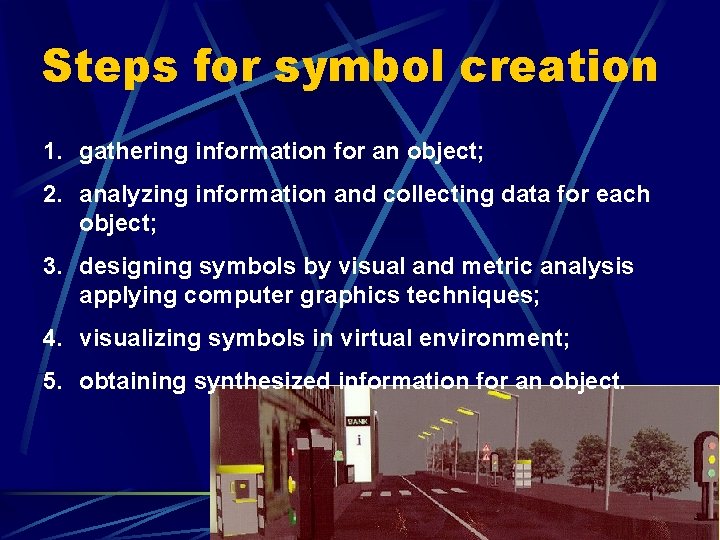
Steps for symbol creation 1. gathering information for an object; 2. analyzing information and collecting data for each object; 3. designing symbols by visual and metric analysis applying computer graphics techniques; 4. visualizing symbols in virtual environment; 5. obtaining synthesized information for an object.
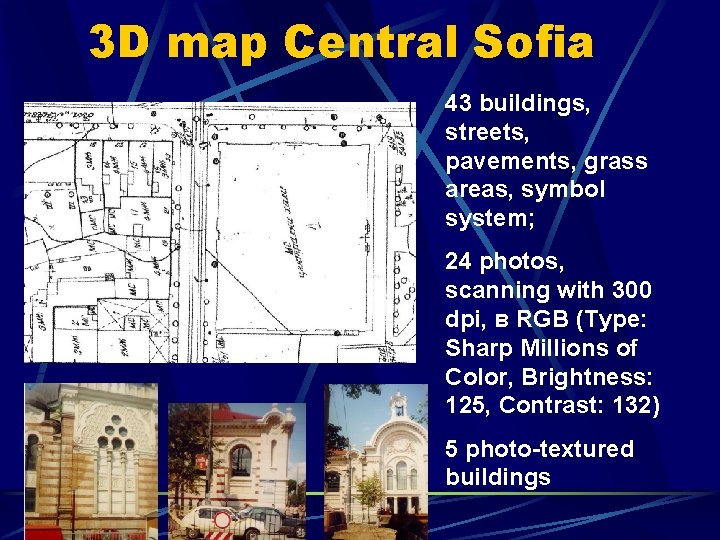
3 D map Central Sofia 43 buildings, streets, pavements, grass areas, symbol system; 24 photos, scanning with 300 dpi, в RGB (Type: Sharp Millions of Color, Brightness: 125, Contrast: 132) 5 photo-textured buildings
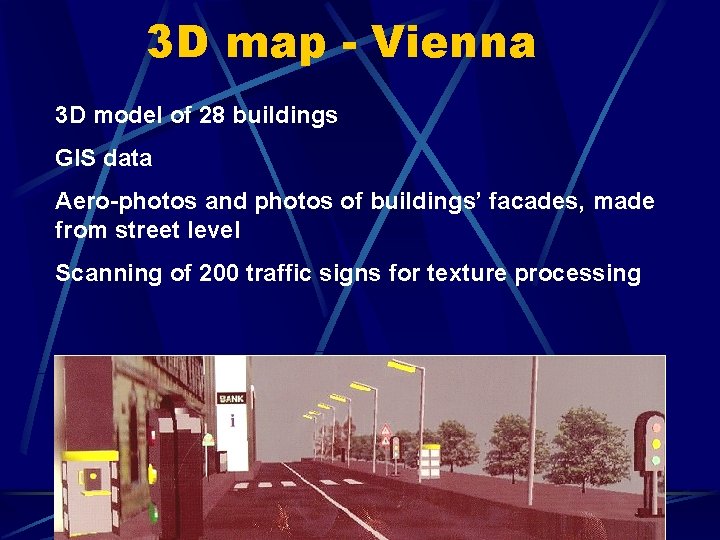
3 D map - Vienna 3 D model of 28 buildings GIS data Aero-photos and photos of buildings’ facades, made from street level Scanning of 200 traffic signs for texture processing
Conclusions Creation of a symbol system will facilitate the compilers as well as users of 3 D maps. Their existing will legalize the 3 D maps and this is the task of cartography in nowadays. The next step - researches of the qualitative and quantitative features of the map by 3 D GIS, extraction of the data for it and solving of different kind of tasks.
Thank you very much for your attention! Temenoujka Bandrova bandrova_fgs@uacg. bg University of Architecture, Civil Engineering and Geodesy Sofia - Bulgaria
- Slides: 42