
3 D CHARACTERIZATION OF THE CRITICAL ZONE WITHIN
![MAGNETIC MAPPING Click buttons for more information [Lénat et al. , 2001] Overview -](https://slidetodoc.com/presentation_image_h2/befd86b40539c539d723108821bd97c6/image-9.jpg "MAGNETIC MAPPING Click buttons for more information [Lénat et al. , 2001] Overview -")
- Slides: 21
3 D CHARACTERIZATION OF THE CRITICAL ZONE WITHIN A BASALTIC CATCHMENT USING AN AIRBORNE ELECTROMAGNETIC SURVEY DUMONT, M. 1, 2 JOIN, J. L. 1, WENDLING, V. 1, AUNAY, B. 2 1 University of Reunion Island (marc. dumont@univ-reunion. fr) , 2 BRGM Reunion Island Issue Results Buried valleys Overlapping Click buttons for more information
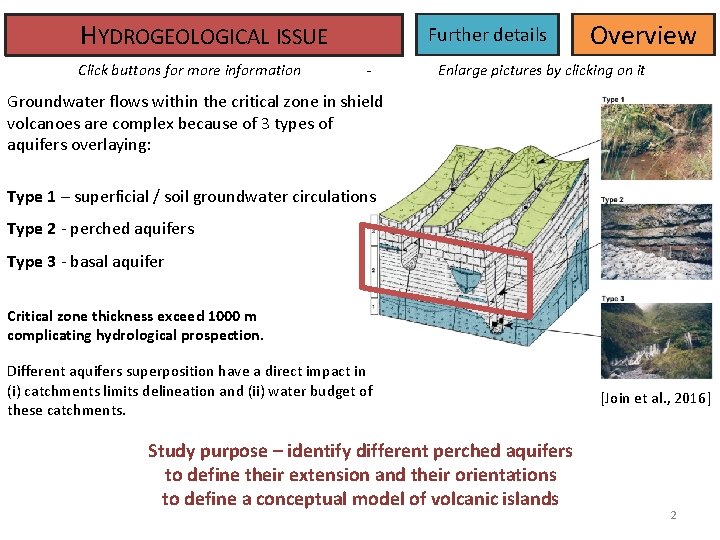
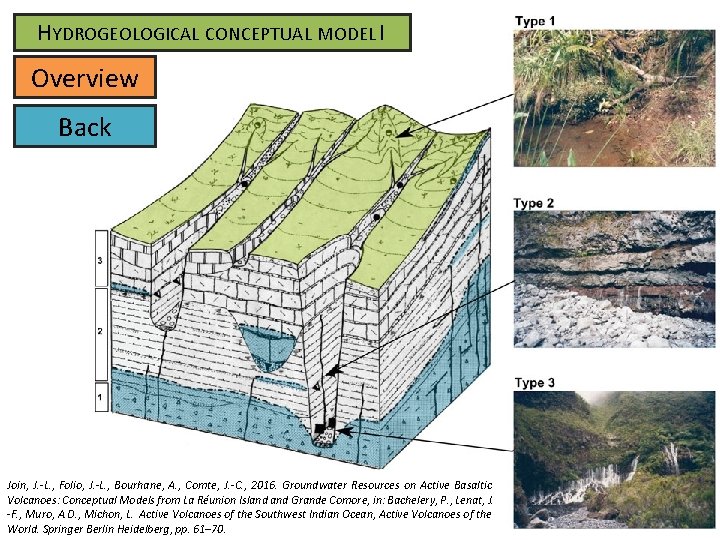
HYDROGEOLOGICAL ISSUE Click buttons for more information Further details - Overview Enlarge pictures by clicking on it Groundwater flows within the critical zone in shield volcanoes are complex because of 3 types of aquifers overlaying: Type 1 – superficial / soil groundwater circulations Type 2 - perched aquifers Type 3 - basal aquifer Critical zone thickness exceed 1000 m complicating hydrological prospection. Different aquifers superposition have a direct impact in (i) catchments limits delineation and (ii) water budget of these catchments. Study purpose – identify different perched aquifers to define their extension and their orientations to define a conceptual model of volcanic islands [Join et al. , 2016] 2
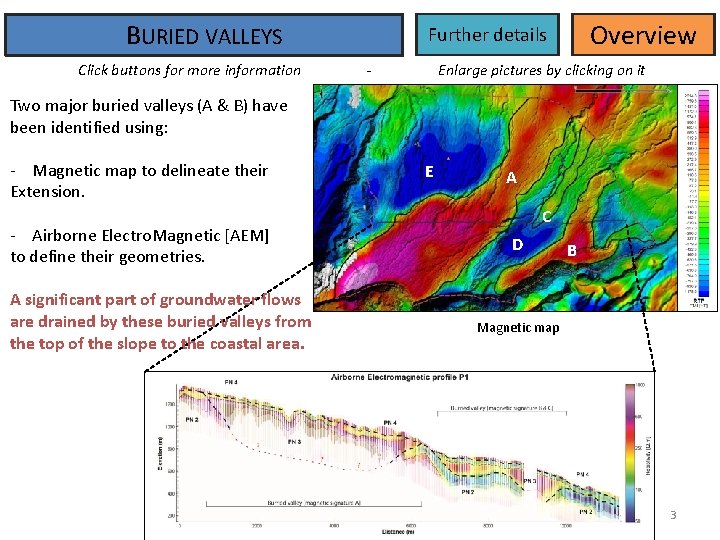
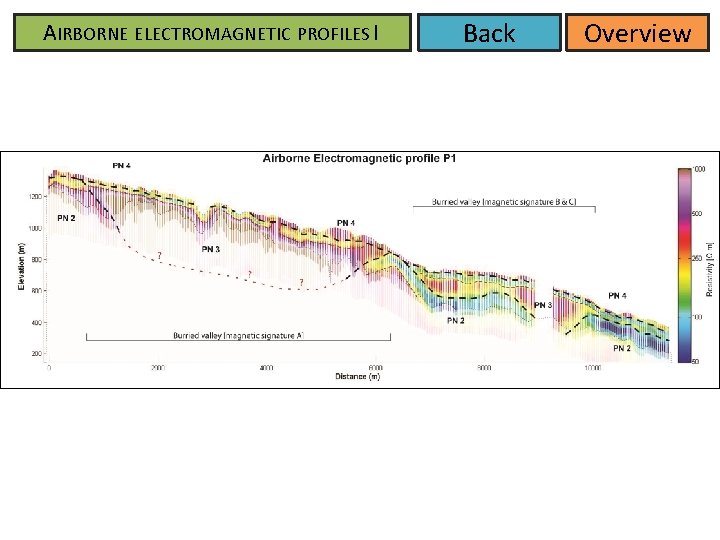
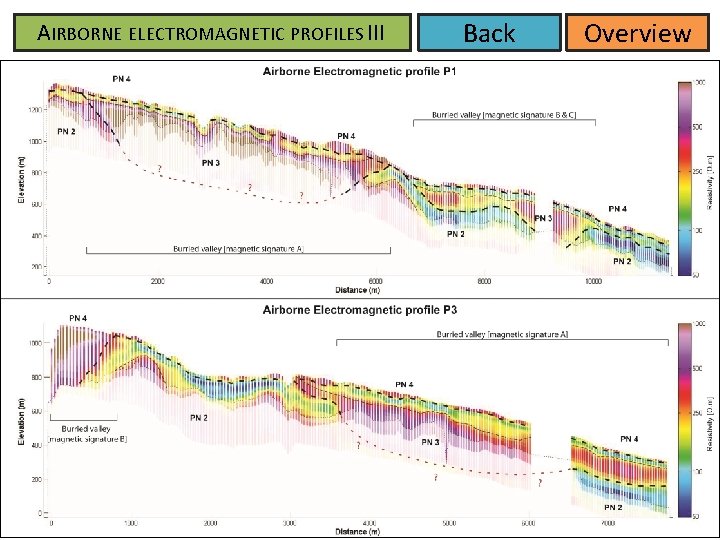
BURIED VALLEYS Click buttons for more information Overview Further details - Enlarge pictures by clicking on it Two major buried valleys (A & B) have been identified using: - Magnetic map to delineate their Extension. - Airborne Electro. Magnetic [AEM] to define their geometries. A significant part of groundwater flows are drained by these buried valleys from the top of the slope to the coastal area. E A C D B Magnetic map 3
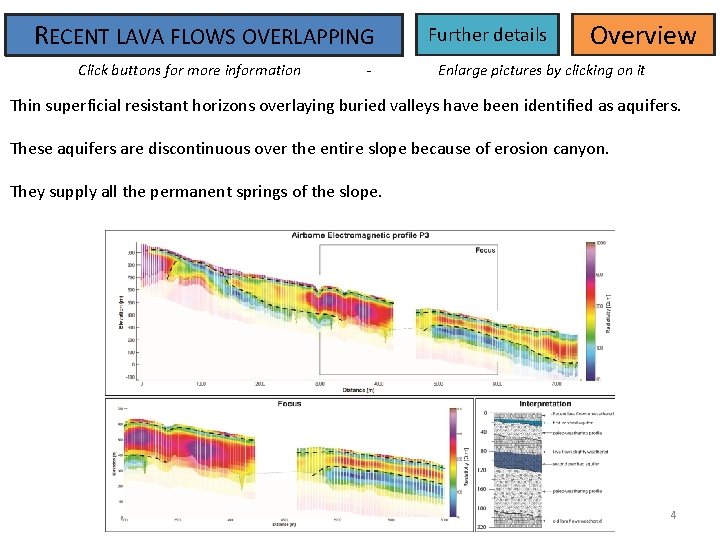
RECENT LAVA FLOWS OVERLAPPING Click buttons for more information - Further details Overview Enlarge pictures by clicking on it Thin superficial resistant horizons overlaying buried valleys have been identified as aquifers. These aquifers are discontinuous over the entire slope because of erosion canyon. They supply all the permanent springs of the slope. 4
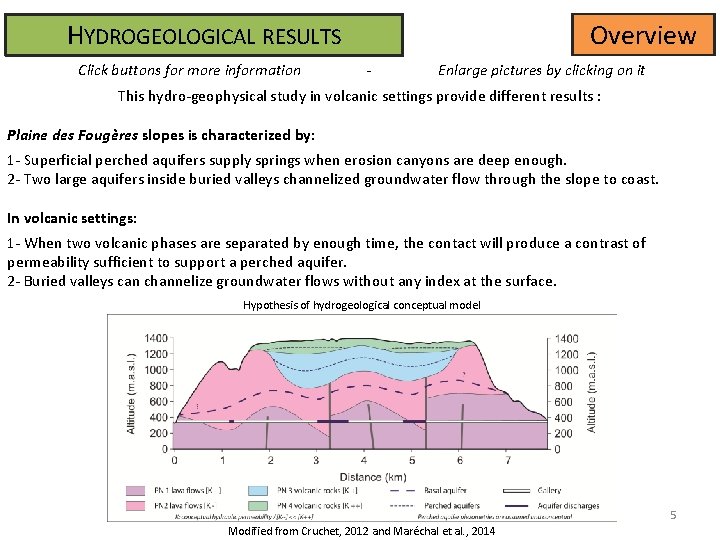
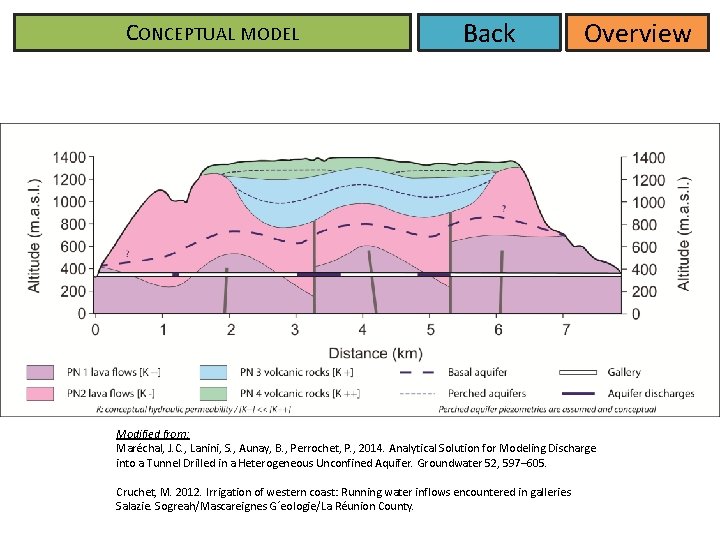
HYDROGEOLOGICAL RESULTS Click buttons for more information Overview - Enlarge pictures by clicking on it This hydro-geophysical study in volcanic settings provide different results : Plaine des Fougères slopes is characterized by: 1 - Superficial perched aquifers supply springs when erosion canyons are deep enough. 2 - Two large aquifers inside buried valleys channelized groundwater flow through the slope to coast. In volcanic settings: 1 - When two volcanic phases are separated by enough time, the contact will produce a contrast of permeability sufficient to support a perched aquifer. 2 - Buried valleys can channelize groundwater flows without any index at the surface. Hypothesis of hydrogeological conceptual model 5 Modified from Cruchet, 2012 and Maréchal et al. , 2014
Overview Supplementary
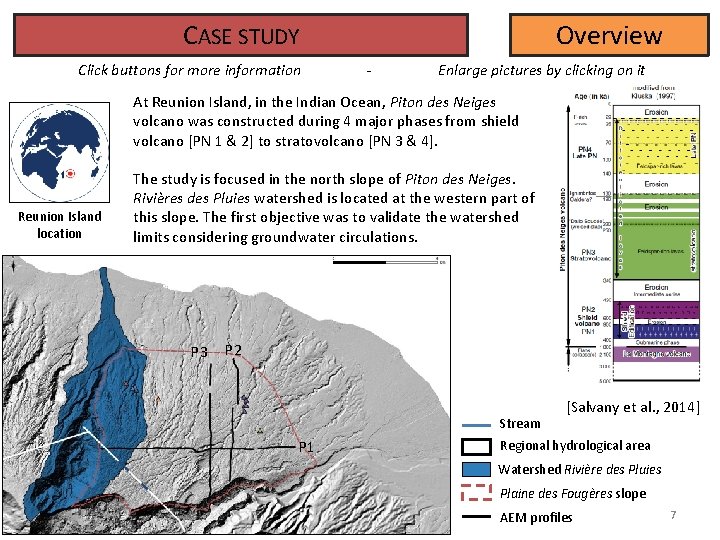
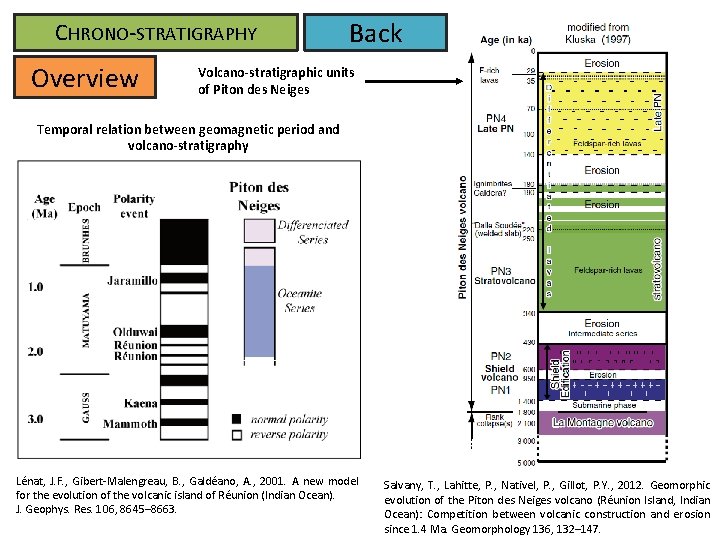
CASE STUDY Click buttons for more information Overview - Enlarge pictures by clicking on it At Reunion Island, in the Indian Ocean, Piton des Neiges volcano was constructed during 4 major phases from shield volcano [PN 1 & 2] to stratovolcano [PN 3 & 4]. Reunion Island location The study is focused in the north slope of Piton des Neiges. Rivières des Pluies watershed is located at the western part of this slope. The first objective was to validate the watershed limits considering groundwater circulations. P 3 P 2 Stream P 1 [Salvany et al. , 2014] Regional hydrological area Watershed Rivière des Pluies Plaine des Fougères slope AEM profiles 7
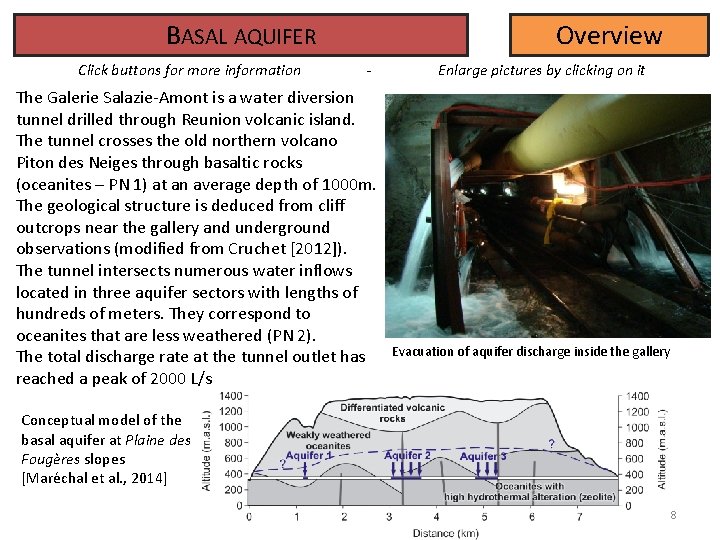
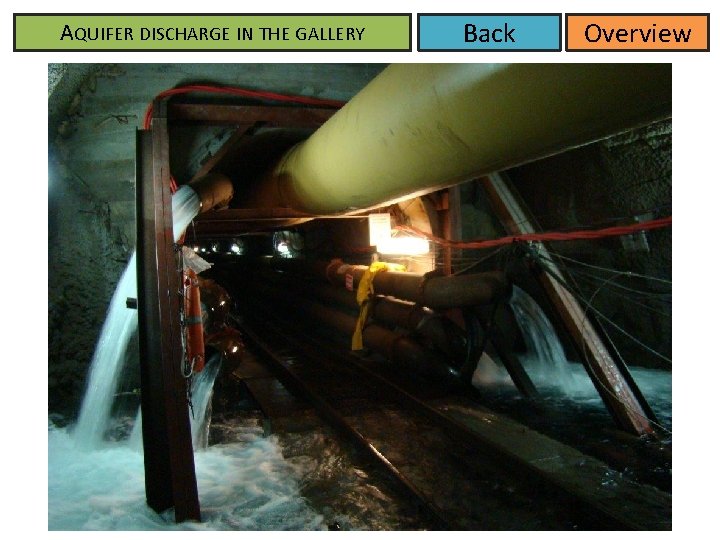
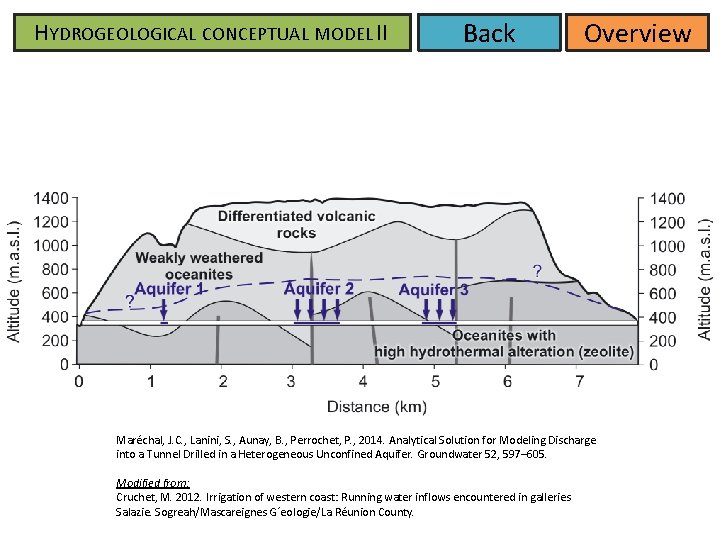
BASAL AQUIFER Click buttons for more information Overview - The Galerie Salazie-Amont is a water diversion tunnel drilled through Reunion volcanic island. The tunnel crosses the old northern volcano Piton des Neiges through basaltic rocks (oceanites – PN 1) at an average depth of 1000 m. The geological structure is deduced from cliff outcrops near the gallery and underground observations (modified from Cruchet [2012]). The tunnel intersects numerous water inflows located in three aquifer sectors with lengths of hundreds of meters. They correspond to oceanites that are less weathered (PN 2). The total discharge rate at the tunnel outlet has reached a peak of 2000 L/s Enlarge pictures by clicking on it Evacuation of aquifer discharge inside the gallery Conceptual model of the basal aquifer at Plaine des Fougères slopes [Maréchal et al. , 2014] 8
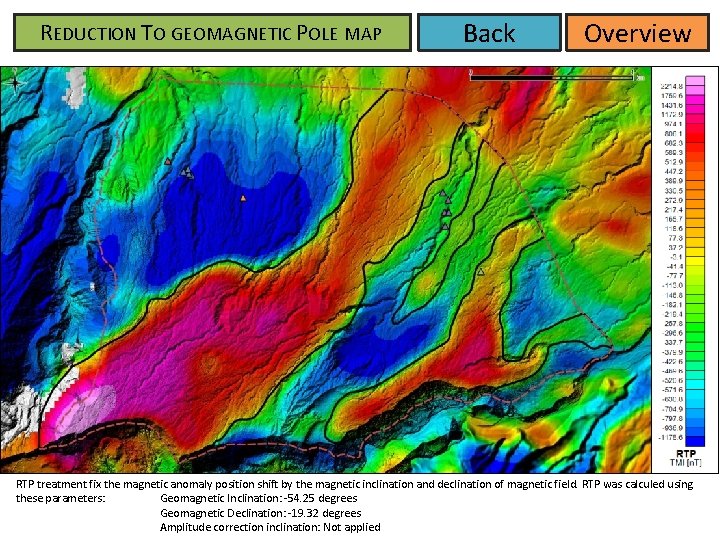
MAGNETIC MAPPING Click buttons for more information [Lénat et al. , 2001] Overview - Enlarge pictures by clicking on it E A C D B Mapping of magnetic anomaly using : - 1] Reduction To the magnetic Pole [RTP] map to analyse magnetic anomaly ; - 2] Tilt De. Rivative [TDR] map to specify anomalies delineation. PN 1 & 2 lava flows have negative polarity – PN 3 & 4 formations have normal polarity - Positive structures A, B & C might be burried valley [PN 3 or 4] Hypothesis - Negative structures C & D might be paleo-massif [PN 2] 9
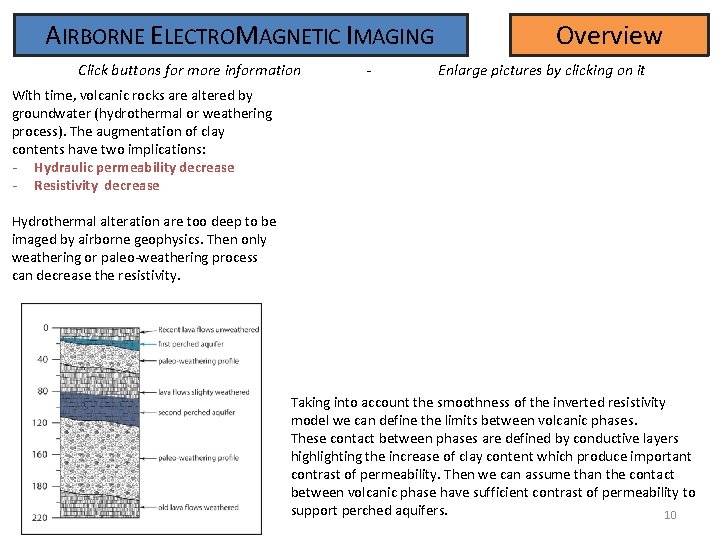
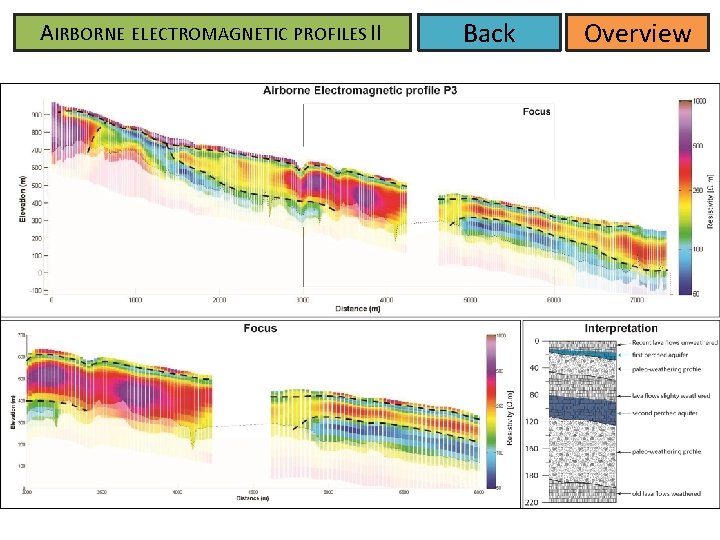
AIRBORNE ELECTROMAGNETIC IMAGING Click buttons for more information - Overview Enlarge pictures by clicking on it With time, volcanic rocks are altered by groundwater (hydrothermal or weathering process). The augmentation of clay contents have two implications: - Hydraulic permeability decrease - Resistivity decrease Hydrothermal alteration are too deep to be imaged by airborne geophysics. Then only weathering or paleo-weathering process can decrease the resistivity. Taking into account the smoothness of the inverted resistivity model we can define the limits between volcanic phases. These contact between phases are defined by conductive layers highlighting the increase of clay content which produce important contrast of permeability. Then we can assume than the contact between volcanic phase have sufficient contrast of permeability to support perched aquifers. 10
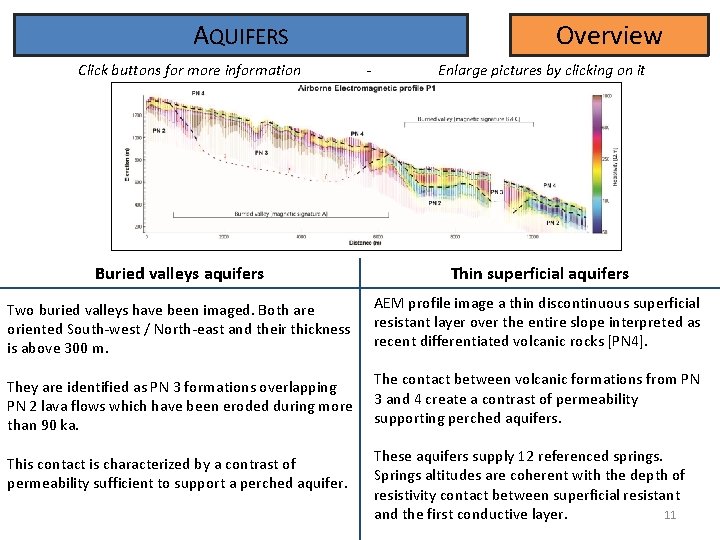
AQUIFERS Click buttons for more information Overview - Enlarge pictures by clicking on it Buried valleys aquifers Thin superficial aquifers Two buried valleys have been imaged. Both are oriented South-west / North-east and their thickness is above 300 m. AEM profile image a thin discontinuous superficial resistant layer over the entire slope interpreted as recent differentiated volcanic rocks [PN 4]. They are identified as PN 3 formations overlapping PN 2 lava flows which have been eroded during more than 90 ka. The contact between volcanic formations from PN 3 and 4 create a contrast of permeability supporting perched aquifers. This contact is characterized by a contrast of permeability sufficient to support a perched aquifer. These aquifers supply 12 referenced springs. Springs altitudes are coherent with the depth of resistivity contact between superficial resistant and the first conductive layer. 11
Overview Figures
HYDROGEOLOGICAL CONCEPTUAL MODEL I Overview Back Join, J. -L. , Folio, J. -L. , Bourhane, A. , Comte, J. -C. , 2016. Groundwater Resources on Active Basaltic Volcanoes: Conceptual Models from La Réunion Island Grande Comore, in: Bachelery, P. , Lenat, J. -F. , Muro, A. D. , Michon, L. Active Volcanoes of the Southwest Indian Ocean, Active Volcanoes of the World. Springer Berlin Heidelberg, pp. 61– 70.
CHRONO-STRATIGRAPHY Overview Back Volcano-stratigraphic units of Piton des Neiges Temporal relation between geomagnetic period and volcano-stratigraphy Lénat, J. F. , Gibert-Malengreau, B. , Galdéano, A. , 2001. A new model for the evolution of the volcanic island of Réunion (Indian Ocean). J. Geophys. Res. 106, 8645– 8663. Salvany, T. , Lahitte, P. , Nativel, P. , Gillot, P. Y. , 2012. Geomorphic evolution of the Piton des Neiges volcano (Réunion Island, Indian Ocean): Competition between volcanic construction and erosion since 1. 4 Ma. Geomorphology 136, 132– 147.
AQUIFER DISCHARGE IN THE GALLERY Back Overview
HYDROGEOLOGICAL CONCEPTUAL MODEL II Back Overview Maréchal, J. C. , Lanini, S. , Aunay, B. , Perrochet, P. , 2014. Analytical Solution for Modeling Discharge into a Tunnel Drilled in a Heterogeneous Unconfined Aquifer. Groundwater 52, 597– 605. Modified from: Cruchet, M. 2012. Irrigation of western coast: Running water inflows encountered in galleries Salazie. Sogreah/Mascareignes G´eologie/La Réunion County.
REDUCTION TO GEOMAGNETIC POLE MAP Back Overview RTP treatment fix the magnetic anomaly position shift by the magnetic inclination and declination of magnetic field. RTP was calculed using these parameters: Geomagnetic Inclination: -54. 25 degrees Geomagnetic Declination: -19. 32 degrees Amplitude correction inclination: Not applied
AIRBORNE ELECTROMAGNETIC PROFILES I Back Overview
AIRBORNE ELECTROMAGNETIC PROFILES II Back Overview
AIRBORNE ELECTROMAGNETIC PROFILES III Back Overview
CONCEPTUAL MODEL Back Overview Modified from: Maréchal, J. C. , Lanini, S. , Aunay, B. , Perrochet, P. , 2014. Analytical Solution for Modeling Discharge into a Tunnel Drilled in a Heterogeneous Unconfined Aquifer. Groundwater 52, 597– 605. Cruchet, M. 2012. Irrigation of western coast: Running water inflows encountered in galleries Salazie. Sogreah/Mascareignes G´eologie/La Réunion County.