
3 Climate Control Systems Service Automotive Heating Air
- Slides: 23
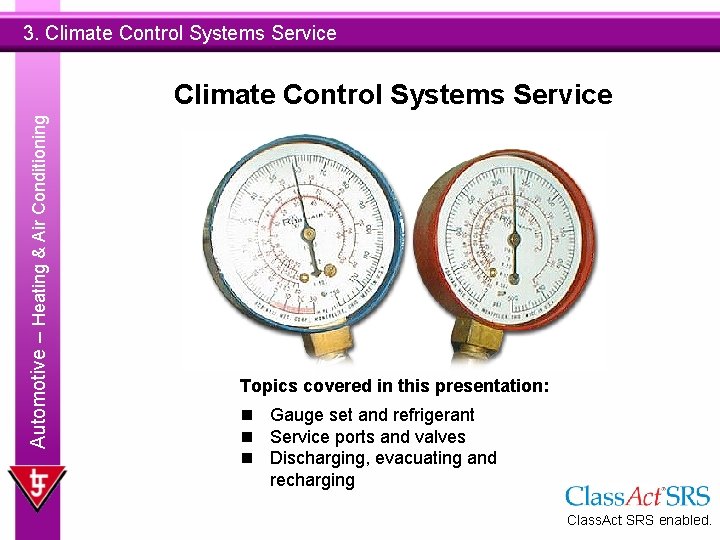
3. Climate Control Systems Service Automotive – Heating & Air Conditioning Climate Control Systems Service Topics covered in this presentation: n Gauge set and refrigerant n Service ports and valves n Discharging, evacuating and recharging Class. Act SRS enabled.
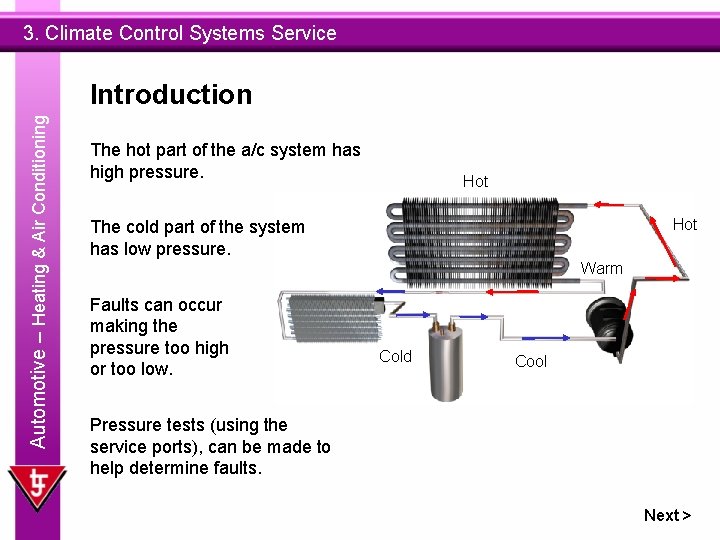
3. Climate Control Systems Service Automotive – Heating & Air Conditioning Introduction The hot part of the a/c system has high pressure. Hot The cold part of the system has low pressure. Warm Faults can occur making the pressure too high or too low. Cold Cool Pressure tests (using the service ports), can be made to help determine faults. Next >
3. Climate Control Systems Service Automotive – Heating & Air Conditioning Question 1 The cold side of an a/c system has low pressure. Is this true or false? Answer True or False.
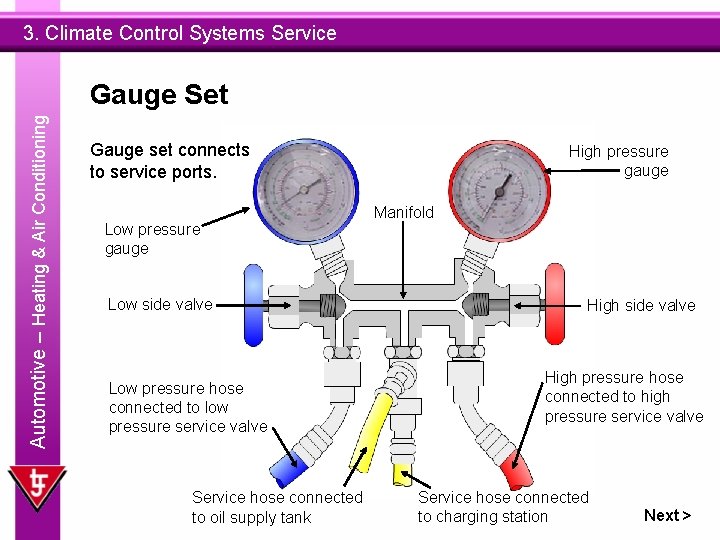
3. Climate Control Systems Service Automotive – Heating & Air Conditioning Gauge Set Gauge set connects to service ports. Low pressure gauge Low side valve Low pressure hose connected to low pressure service valve Service hose connected to oil supply tank High pressure gauge Manifold High side valve High pressure hose connected to high pressure service valve Service hose connected to charging station Next >
3. Climate Control Systems Service Automotive – Heating & Air Conditioning Question 2 Which colour is associated with low pressure on a gauge set? A) Black B) White C) Red D) Blue
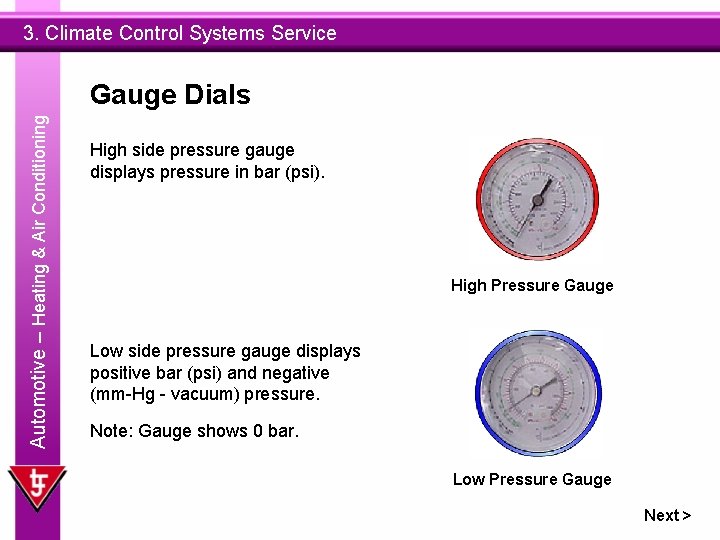
3. Climate Control Systems Service Automotive – Heating & Air Conditioning Gauge Dials High side pressure gauge displays pressure in bar (psi). High Pressure Gauge Low side pressure gauge displays positive bar (psi) and negative (mm-Hg - vacuum) pressure. Note: Gauge shows 0 bar. Low Pressure Gauge Next >
3. Climate Control Systems Service Automotive – Heating & Air Conditioning Question 3 Which of the following is NOT a unit for the measurement of pressure? A) psi B) vacuum C) bar D) mm Hg
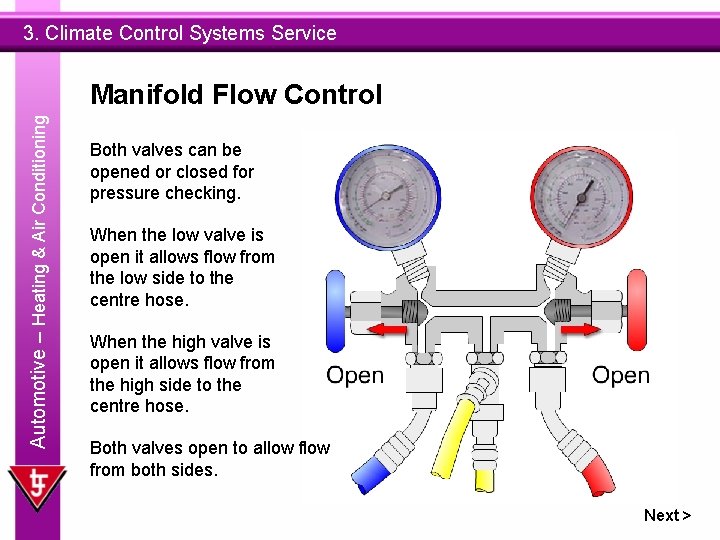
3. Climate Control Systems Service Automotive – Heating & Air Conditioning Manifold Flow Control Both valves can be opened or closed for pressure checking. When the low valve is open it allows flow from the low side to the centre hose. When the high valve is open it allows flow from the high side to the centre hose. Both valves open to allow from both sides. Next >
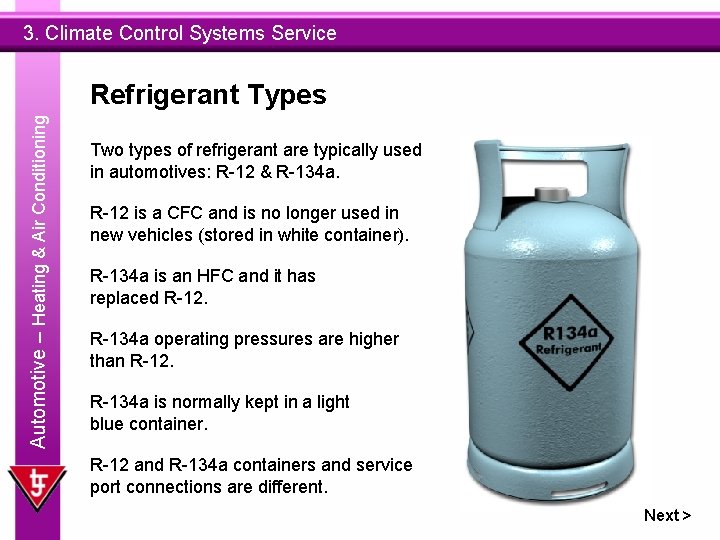
3. Climate Control Systems Service Automotive – Heating & Air Conditioning Refrigerant Types Two types of refrigerant are typically used in automotives: R-12 & R-134 a. R-12 is a CFC and is no longer used in new vehicles (stored in white container). R-134 a is an HFC and it has replaced R-12. R-134 a operating pressures are higher than R-12. R-134 a is normally kept in a light blue container. R-12 and R-134 a containers and service port connections are different. Next >
3. Climate Control Systems Service Automotive – Heating & Air Conditioning Question 4 Which refrigerant is normally kept in a light blue container? A) R-12 B) R-134 a
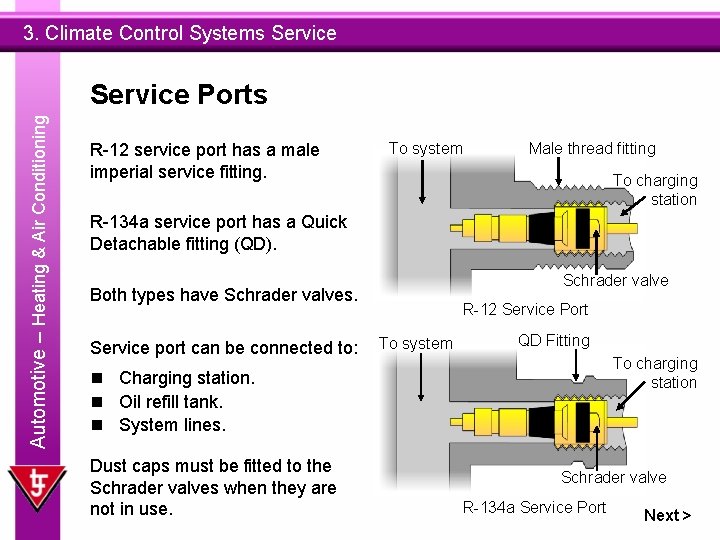
3. Climate Control Systems Service Automotive – Heating & Air Conditioning Service Ports R-12 service port has a male imperial service fitting. To system Male thread fitting To charging station R-134 a service port has a Quick Detachable fitting (QD). Schrader valve Both types have Schrader valves. Service port can be connected to: R-12 Service Port To system QD Fitting To charging station n Charging station. n Oil refill tank. n System lines. Dust caps must be fitted to the Schrader valves when they are not in use. Schrader valve R-134 a Service Port Next >
3. Climate Control Systems Service Automotive – Heating & Air Conditioning Question 5 If you were looking at a new vehicle, which connection system would you expect to see at the a/c service port? A) Male Imperial B) Quick Detachable
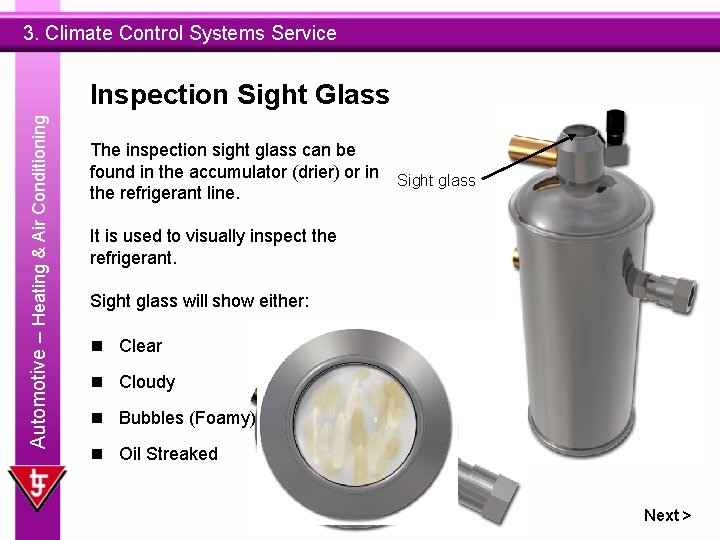
3. Climate Control Systems Service Automotive – Heating & Air Conditioning Inspection Sight Glass The inspection sight glass can be found in the accumulator (drier) or in Sight glass the refrigerant line. It is used to visually inspect the refrigerant. Sight glass will show either: n Clear n Cloudy n Bubbles (Foamy) n Oil Streaked Next >
3. Climate Control Systems Service Automotive – Heating & Air Conditioning Question 6 Which of the following would you not expect to see in an inspection sight glass? A) Liquid level B) Bubbles C) Streaks of oil D) Cloudy
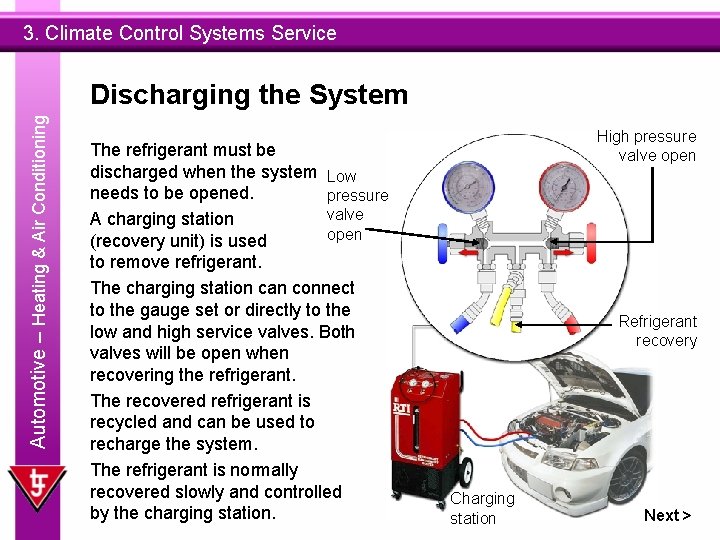
3. Climate Control Systems Service Automotive – Heating & Air Conditioning Discharging the System The refrigerant must be discharged when the system Low needs to be opened. pressure valve A charging station open (recovery unit) is used to remove refrigerant. The charging station can connect to the gauge set or directly to the low and high service valves. Both valves will be open when recovering the refrigerant. The recovered refrigerant is recycled and can be used to recharge the system. The refrigerant is normally recovered slowly and controlled by the charging station. High pressure valve open Refrigerant recovery Charging station Next >
3. Climate Control Systems Service Automotive – Heating & Air Conditioning Question 7 What is meant by 'discharging' the a/c system A) Removing extra pressure from the system B) Removing excess refrigerant from the system C) Removing all the refrigerant from the system D) Removing the gauge set from the system
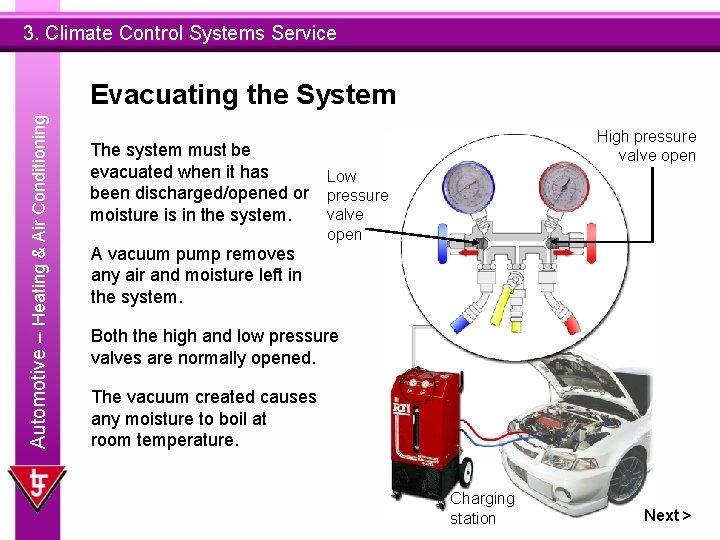
3. Climate Control Systems Service Automotive – Heating & Air Conditioning Evacuating the System The system must be evacuated when it has been discharged/opened or moisture is in the system. High pressure valve open Low pressure valve open A vacuum pump removes any air and moisture left in the system. Both the high and low pressure valves are normally opened. The vacuum created causes any moisture to boil at room temperature. Charging station Next >
3. Climate Control Systems Service Automotive – Heating & Air Conditioning Question 8 What is used to evacuate an a/c system? A) A vacuum pump B) A compressor C) A supply of compressed air D) A source of distilled water
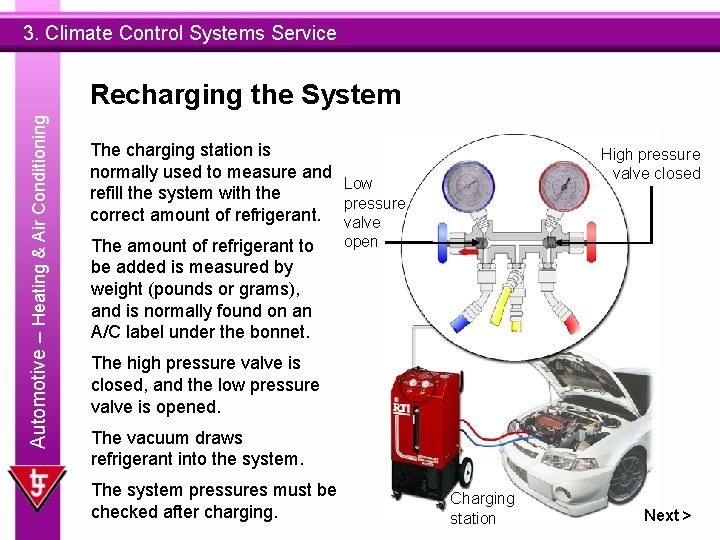
3. Climate Control Systems Service Automotive – Heating & Air Conditioning Recharging the System The charging station is normally used to measure and Low refill the system with the pressure correct amount of refrigerant. valve The amount of refrigerant to be added is measured by weight (pounds or grams), and is normally found on an A/C label under the bonnet. High pressure valve closed open The high pressure valve is closed, and the low pressure valve is opened. The vacuum draws refrigerant into the system. The system pressures must be checked after charging. Charging station Next >
3. Climate Control Systems Service Automotive – Heating & Air Conditioning Question 9 When recharging an A/C system, both valves on the gauge set must be open fully. Is this true or false Answer True or False.
3. Climate Control Systems Service Automotive – Heating & Air Conditioning Possible Recharging Errors Undercharge This occurs when there is not enough refrigerant in the system. It can cause inadequate cooling, faster refrigeration cycle and low system pressures. Overcharge This occurs when too much refrigerant is in the system. It produces inadequate cooling and liquid will not turn into vapour. This causes high system pressures and a constant running compressor. Water Moisture in the system can cause corrosion. The moisture can freeze causing erratic operation and unexpected system pressures. Next >
3. Climate Control Systems Service Automotive – Heating & Air Conditioning Question 10 What causes the liquid not to turn into a vapour? A) Undercharging B) Overcharging
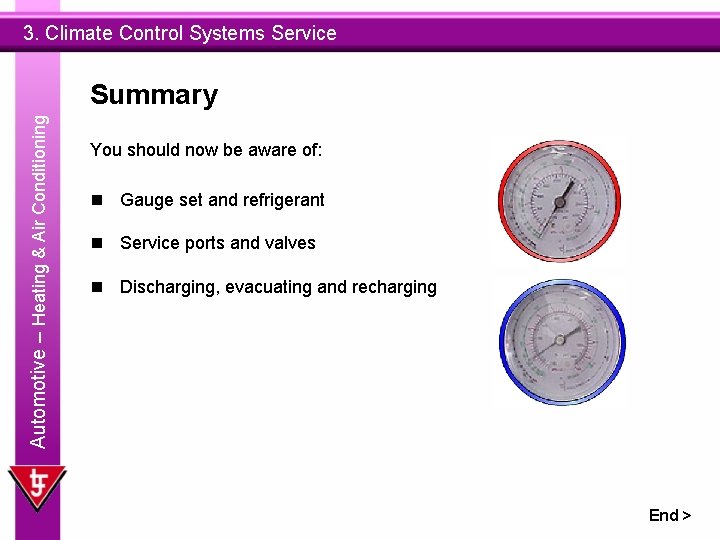
3. Climate Control Systems Service Automotive – Heating & Air Conditioning Summary You should now be aware of: n Gauge set and refrigerant n Service ports and valves n Discharging, evacuating and recharging End >