
3 CHAPTER 3 Lecturer LONG BUNTENG Organization Behavior
3 CHAPTER 3 Lecturer: LONG BUNTENG Organization Behavior MN 201 Perception and Learning in Organizations Mc. Graw-Hill/Irwin © 2008 The Mc. Graw-Hill Companies, Inc. All rights reserved.
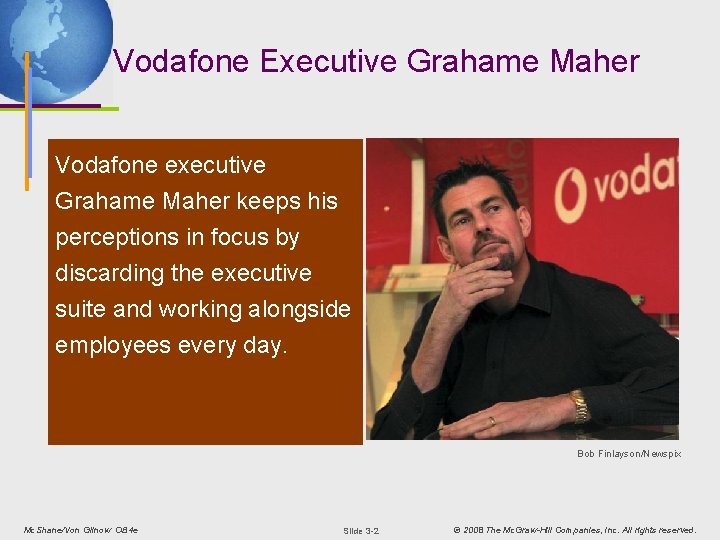
Vodafone Executive Grahame Maher Vodafone executive Grahame Maher keeps his perceptions in focus by discarding the executive suite and working alongside employees every day. Bob Finlayson/Newspix Mc. Shane/Von Glinow OB 4 e Slide 3 -2 © 2008 The Mc. Graw-Hill Companies, Inc. All rights reserved.
Perception Defined The process of selecting, organizing, and interpreting information in order to make sense of the world around us. Bob Finlayson/Newspix Mc. Shane/Von Glinow OB 4 e Slide 3 -3 © 2008 The Mc. Graw-Hill Companies, Inc. All rights reserved.
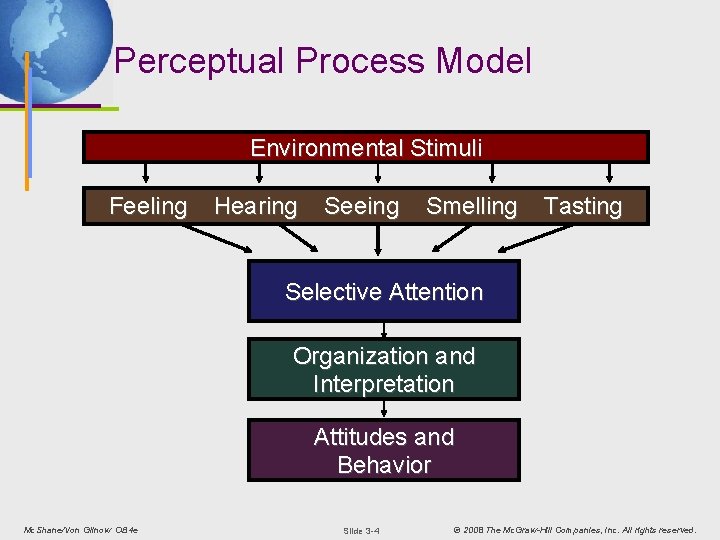
Perceptual Process Model Environmental Stimuli Feeling Hearing Seeing Smelling Tasting Selective Attention Organization and Interpretation Attitudes and Behavior Mc. Shane/Von Glinow OB 4 e Slide 3 -4 © 2008 The Mc. Graw-Hill Companies, Inc. All rights reserved.
Selective Attention • Characteristics of the object – size, intensity, motion, repetition, novelty • Perceptual context • Characteristics of the perceiver – attitudes – perceptual defense – expectations -- condition us to expect events Mc. Shane/Von Glinow OB 4 e Slide 3 -5 © 2008 The Mc. Graw-Hill Companies, Inc. All rights reserved.
Perceptual Organization/Interpretation • Categorical thinking – Mostly unconscious process of organizing people/things – Perceptual grouping principles • Closure -- filling in missing pieces • Identifying trends • Similarity or proximity • Mental models – Broad world-views or ‘theories-in-use’ – Help us to quickly make sense of situations – May block recognition of new opportunities/perspectives Mc. Shane/Von Glinow OB 4 e Slide 3 -6 © 2008 The Mc. Graw-Hill Companies, Inc. All rights reserved.
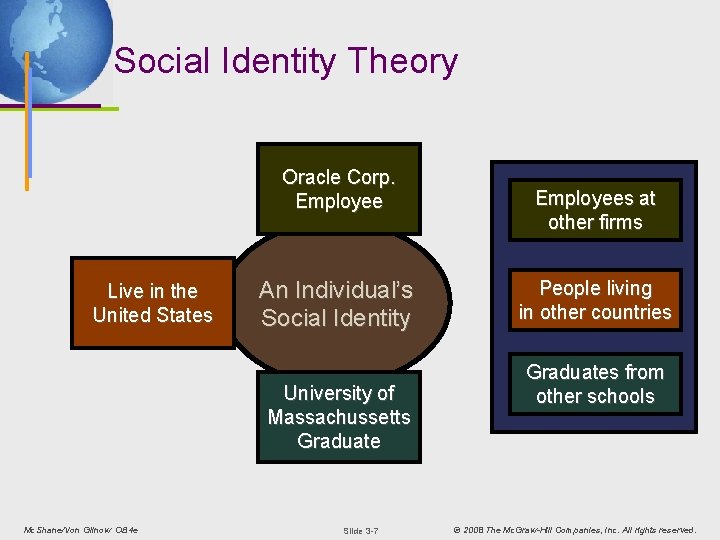
Social Identity Theory Oracle Corp. Employee Live in the United States An Individual’s Social Identity University of Massachussetts Graduate Mc. Shane/Von Glinow OB 4 e Slide 3 -7 Employees at other firms People living in other countries Graduates from other schools © 2008 The Mc. Graw-Hill Companies, Inc. All rights reserved.
Social Identity Theory Features • Categorization process – compare characteristics of our groups with other groups • Homogenization process – similar traits within a group; different traits across groups • Differentiation process – develop less favorable images of people in groups other than our own Mc. Shane/Von Glinow OB 4 e Slide 3 -8 © 2008 The Mc. Graw-Hill Companies, Inc. All rights reserved.
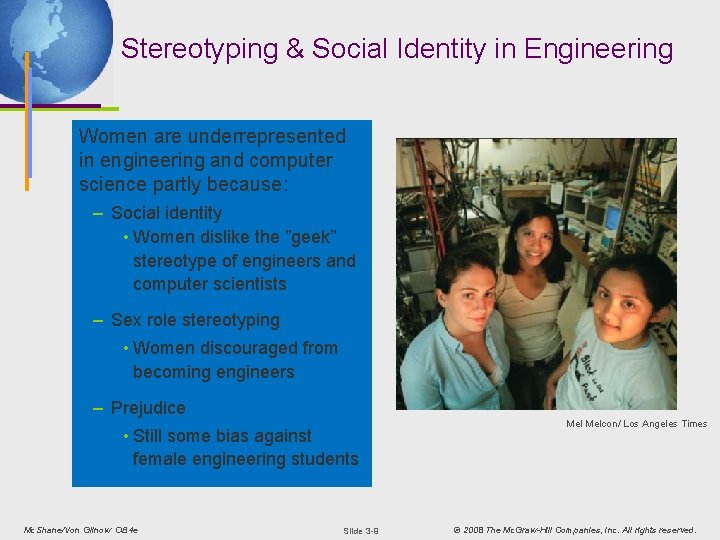
Stereotyping & Social Identity in Engineering Women are underrepresented in engineering and computer science partly because: – Social identity • Women dislike the ”geek” stereotype of engineers and computer scientists – Sex role stereotyping • Women discouraged from becoming engineers – Prejudice • Still some bias against female engineering students Mc. Shane/Von Glinow OB 4 e Slide 3 -9 Melcon/ Los Angeles Times © 2008 The Mc. Graw-Hill Companies, Inc. All rights reserved.
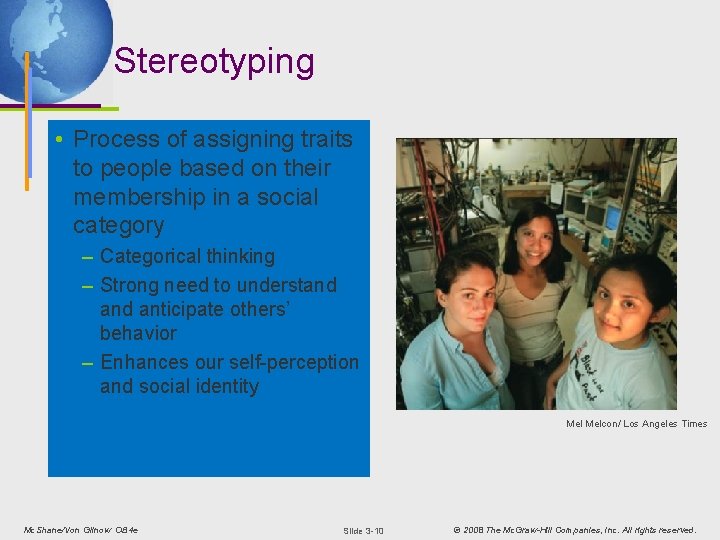
Stereotyping • Process of assigning traits to people based on their membership in a social category – Categorical thinking – Strong need to understand anticipate others’ behavior – Enhances our self-perception and social identity Melcon/ Los Angeles Times Mc. Shane/Von Glinow OB 4 e Slide 3 -10 © 2008 The Mc. Graw-Hill Companies, Inc. All rights reserved.
Minimizing Stereotyping Biases • Diversity awareness training – Educate employees about the benefits of diversity and dispel myths • Meaningful interaction – Contact hypothesis • Decision-making accountability – Making people accountable for their decisions motivates them to consider objective info rather than stereotypes Mc. Shane/Von Glinow OB 4 e Slide 3 -11 © 2008 The Mc. Graw-Hill Companies, Inc. All rights reserved.
Attribution Process • Internal Attribution – Perception that person’s behavior is due to motivation/ability rather than situation or fate • External Attribution – Perception that behavior is due to situation or fate rather than the person Mc. Shane/Von Glinow OB 4 e Slide 3 -12 © 2008 The Mc. Graw-Hill Companies, Inc. All rights reserved.
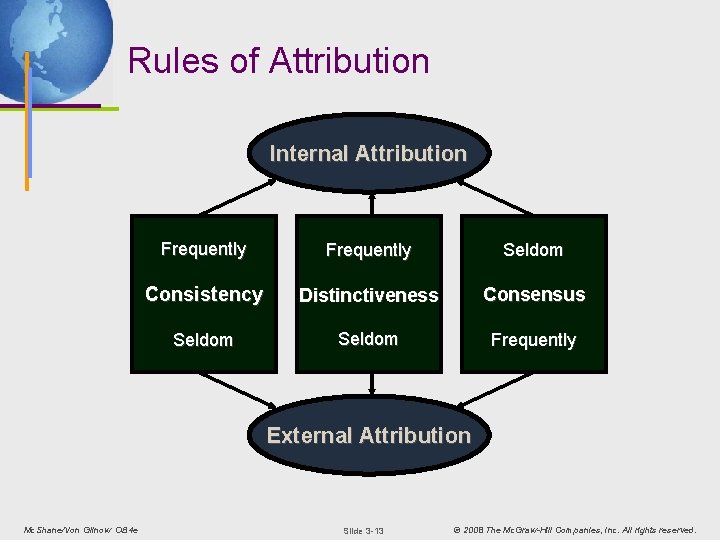
Rules of Attribution Internal Attribution Frequently Seldom Consistency Distinctiveness Consensus Seldom Frequently External Attribution Mc. Shane/Von Glinow OB 4 e Slide 3 -13 © 2008 The Mc. Graw-Hill Companies, Inc. All rights reserved.
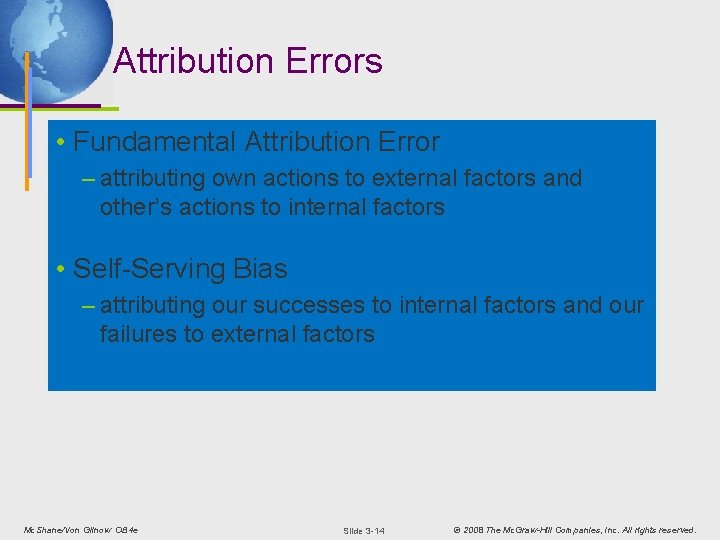
Attribution Errors • Fundamental Attribution Error – attributing own actions to external factors and other’s actions to internal factors • Self-Serving Bias – attributing our successes to internal factors and our failures to external factors Mc. Shane/Von Glinow OB 4 e Slide 3 -14 © 2008 The Mc. Graw-Hill Companies, Inc. All rights reserved.
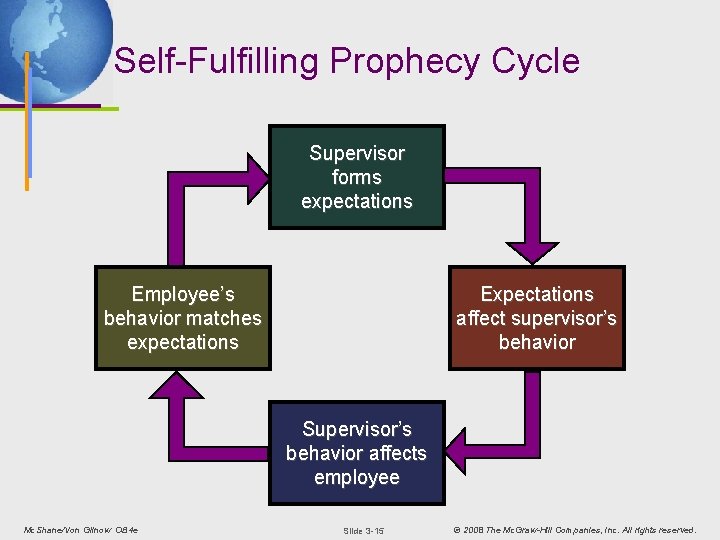
Self-Fulfilling Prophecy Cycle Supervisor forms expectations Employee’s behavior matches expectations Expectations affect supervisor’s behavior Supervisor’s behavior affects employee Mc. Shane/Von Glinow OB 4 e Slide 3 -15 © 2008 The Mc. Graw-Hill Companies, Inc. All rights reserved.
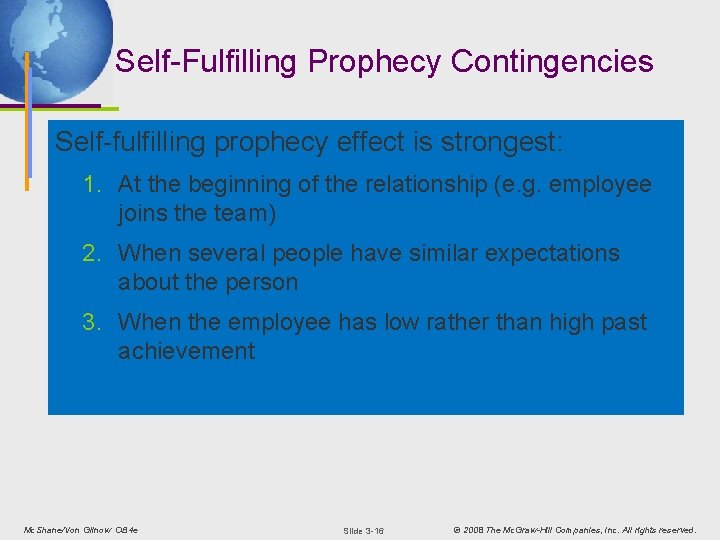
Self-Fulfilling Prophecy Contingencies Self-fulfilling prophecy effect is strongest: 1. At the beginning of the relationship (e. g. employee joins the team) 2. When several people have similar expectations about the person 3. When the employee has low rather than high past achievement Mc. Shane/Von Glinow OB 4 e Slide 3 -16 © 2008 The Mc. Graw-Hill Companies, Inc. All rights reserved.
Other Perceptual Errors • Primacy – first impressions • Recency – most recent information dominates perceptions • Halo – one trait forms a general impression • Projection – believe other people do the same things or have the same attitudes as you Mc. Shane/Von Glinow OB 4 e Slide 3 -17 © 2008 The Mc. Graw-Hill Companies, Inc. All rights reserved.
Improving Perceptions • Empathy – Sensitivity to the feelings, thoughts, and situation of others – Cognitive and emotional component • Self-awareness – Awareness of your values, beliefs and prejudices – Applying Johari Window Mc. Shane/Von Glinow OB 4 e Slide 3 -18 © 2008 The Mc. Graw-Hill Companies, Inc. All rights reserved.
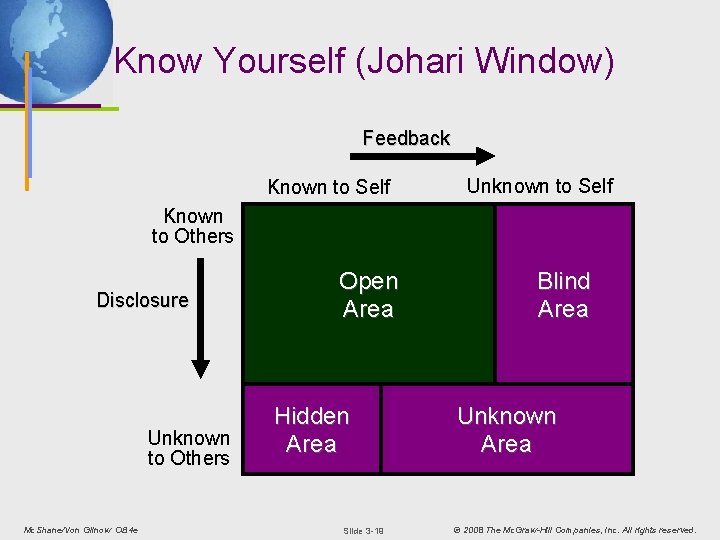
Know Yourself (Johari Window) Feedback Known to Self Known to Others Disclosure Unknown to Others Mc. Shane/Von Glinow OB 4 e Open Area Hidden Area Slide 3 -19 Unknown to Self Blind Area Unknown Area © 2008 The Mc. Graw-Hill Companies, Inc. All rights reserved.
Definition of Learning A relatively permanent change in behavior (or behavior tendency) that occurs as a result of a person’s interaction with the environment Mc. Shane/Von Glinow OB 4 e Slide 3 -20 © 2008 The Mc. Graw-Hill Companies, Inc. All rights reserved.
Learning and Behavior • Learning affected behavior through three MARS model elements: – Ability -- learning increases skills and knowledge – Role perceptions -- learning clarifies roles and priorities – Motivation -- learning is necessary for some need fulfillment Mc. Shane/Von Glinow OB 4 e Slide 3 -21 © 2008 The Mc. Graw-Hill Companies, Inc. All rights reserved.

Behavior Modification • We “operate” on the environment – alter behavior to maximize positive and minimize adverse consequences • Learning is viewed as completely dependent on the environment • Human thoughts are viewed as unimportant Mc. Shane/Von Glinow OB 4 e Slide 3 -22 © 2008 The Mc. Graw-Hill Companies, Inc. All rights reserved.
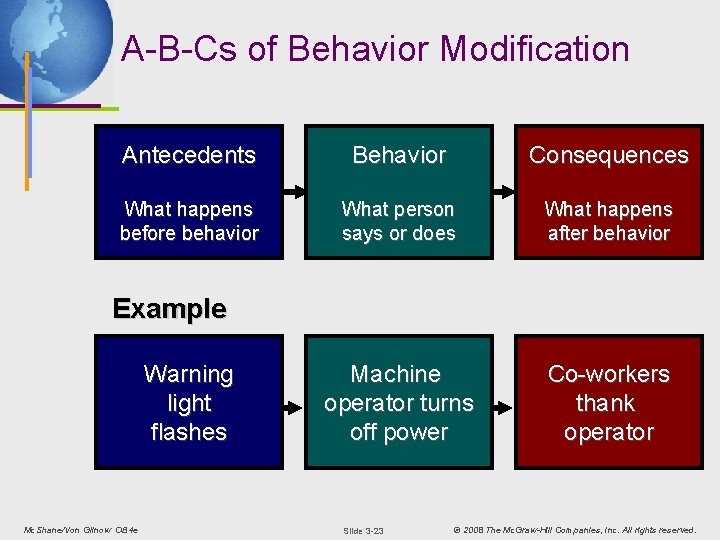
A-B-Cs of Behavior Modification Antecedents Behavior Consequences What happens before behavior What person says or does What happens after behavior Machine operator turns off power Co-workers thank operator Example Warning light flashes Mc. Shane/Von Glinow OB 4 e Slide 3 -23 © 2008 The Mc. Graw-Hill Companies, Inc. All rights reserved.
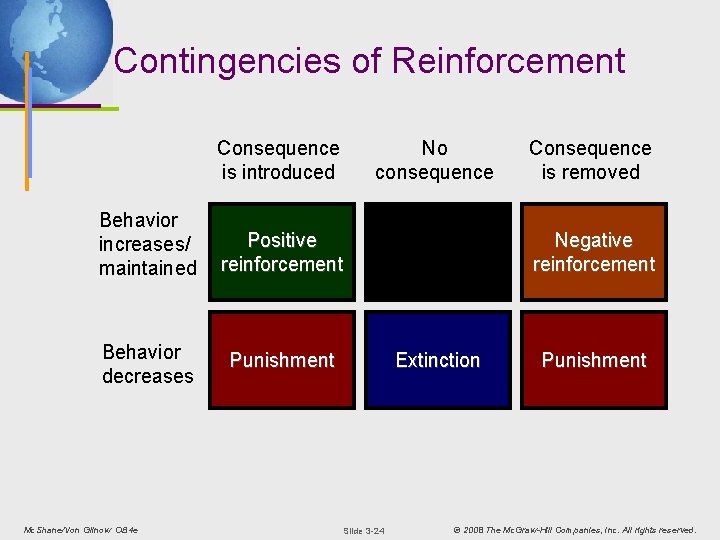
Contingencies of Reinforcement Consequence is introduced No consequence Behavior increases/ maintained Positive reinforcement Behavior decreases Punishment Mc. Shane/Von Glinow OB 4 e Negative reinforcement Extinction Slide 3 -24 Consequence is removed Punishment © 2008 The Mc. Graw-Hill Companies, Inc. All rights reserved.
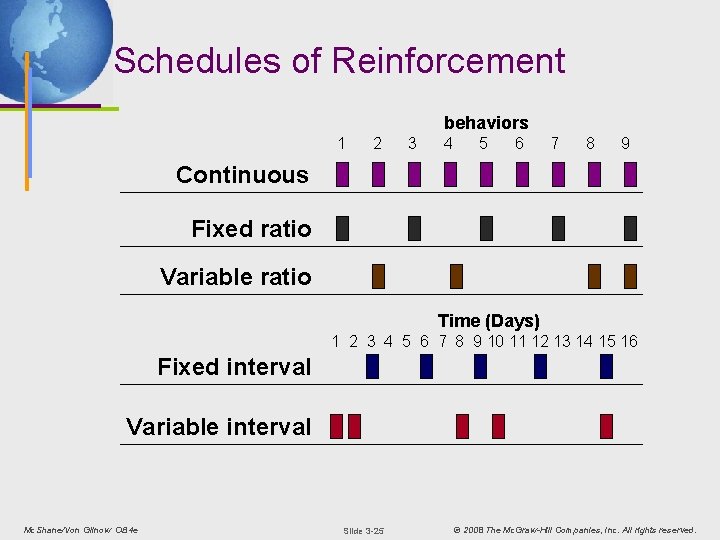
Schedules of Reinforcement behaviors 1 2 3 4 5 6 7 8 9 Continuous Fixed ratio Variable ratio Time (Days) 1 2 3 4 5 6 7 8 9 10 11 12 13 14 15 16 Fixed interval Variable interval Mc. Shane/Von Glinow OB 4 e Slide 3 -25 © 2008 The Mc. Graw-Hill Companies, Inc. All rights reserved.

Behavior Modification in Practice • Behavior modification is used in: – every day life to influence behavior of others – company programs to reduce absenteeism, improve safety, etc. • Behavior modification problems include: – Reward inflation – Ethical concern that variable ratio schedule is a lottery – Behaviorist philosophy vs. learning through mental processes Mc. Shane/Von Glinow OB 4 e Slide 3 -26 © 2008 The Mc. Graw-Hill Companies, Inc. All rights reserved.
Social Learning Theory • Behavioral modeling – Observing and modeling behavior of others • Learning behavior consequences – Observing consequences that others experience • Self-reinforcement – Reinforcing our own behavior with consequences within our control Mc. Shane/Von Glinow OB 4 e Slide 3 -27 © 2008 The Mc. Graw-Hill Companies, Inc. All rights reserved.
Kolb’s Experiential Learning Model Concrete experience Active experimentation Reflective observation Abstract conceptualization Mc. Shane/Von Glinow OB 4 e Slide 3 -28 © 2008 The Mc. Graw-Hill Companies, Inc. All rights reserved.
Developing a Learning Orientation • • Value the generation of new knowledge Reward experimentation Recognize mistakes as part of learning Encourage employees to take reasonable risks Mc. Shane/Von Glinow OB 4 e Slide 3 -29 © 2008 The Mc. Graw-Hill Companies, Inc. All rights reserved.
Action Learning • Experiential learning in which employees, usually in teams, investigate and apply solutions to a situation that is both real and complex, with immediate relevance to the company – Concrete experience – Learning meetings – Team conceptualizes and applies a solution to a problem Mc. Shane/Von Glinow OB 4 e Slide 3 -30 © 2008 The Mc. Graw-Hill Companies, Inc. All rights reserved.
3 Perception and Learning in Organizations Mc. Graw-Hill/Irwin © 2008 The Mc. Graw-Hill Companies, Inc. All rights reserved.
- Slides: 31