
3 Chapter 3 chapter Leveraging Resources and Capabilities
3 Chapter 3 chapter Leveraging Resources and Capabilities Global Strategy Global Mike W. Peng Copyright © 2014 Cengage Learning. All Rights Reserved. May not be scanned, copied or duplicated, or posted to a publicly accessible website, in whole or in part.
Outline • Understanding resources and capabilities • Resources, capabilities, and the value chain • The VRIO framework • Debates and extensions • The savvy strategist Copyright © 2014 Cengage Learning. All Rights Reserved. May not be scanned, copied or duplicated, or posted to a publicly accessible website, in whole or in part.
Understanding Resources and Capabilities • Tangible • Intangible Resources and capabilities that are observable and easily quantified Broadly organized in three categories: v Financial v Physical v© Technological Copyright 2014 Cengage Learning. All Rights Reserved. May not be scanned, copied or duplicated, or posted to a publicly accessible website, in whole or in part. Resources and capabilities not easily observed or difficult (or impossible) to quantify Examples include: v Human v Innovation v Reputation
Competing on Resources • Focus of the industry-based view: How “average” firms within an industry compete. • Focus of the resource-based view: How individual firms differ from each other within an industry and can outperform the industry average consistently and significantly. 3– 4
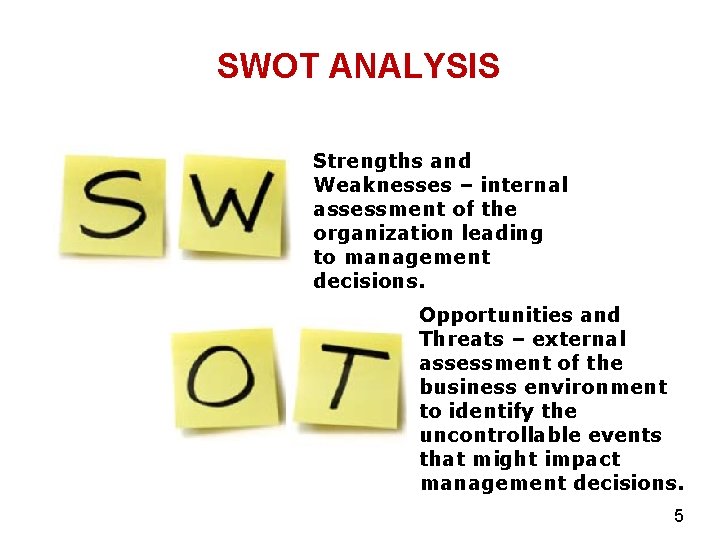
SWOT ANALYSIS Strengths and Weaknesses – internal assessment of the organization leading to management decisions. Opportunities and Threats – external assessment of the business environment to identify the uncontrollable events that might impact management decisions. 5
Resources, Capabilities, and the Value Chain • Value Chain The functional activities within the firm that create value in the goods and services produced • Components of the Value Chain Primary activities v Are directly associated with the development, production, and distribution of goods and services Support Copyright © 2014 activities Cengage Learning. All Rights Reserved. May not be v Assist in the accomplishment scanned, copied or duplicated, or posted to a publicly accessible website, in whole or in part. of primary activities
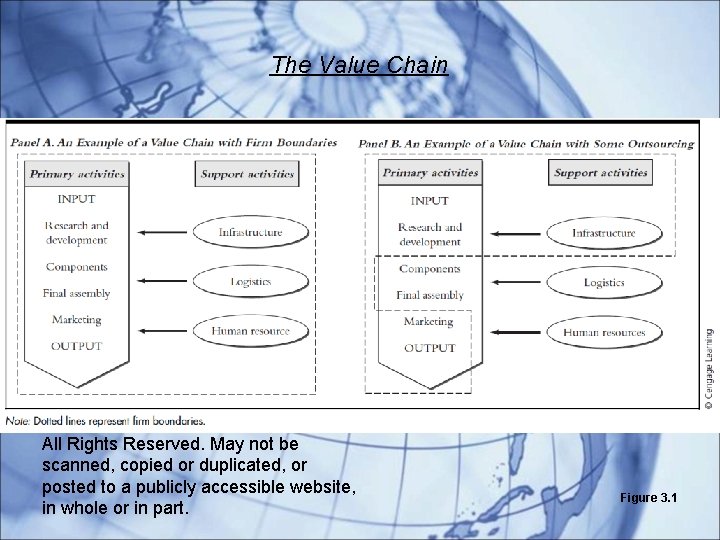
The Value Chain Copyright © 2014 Cengage Learning. All Rights Reserved. May not be scanned, copied or duplicated, or posted to a publicly accessible website, in whole or in part. Figure 3. 1

8
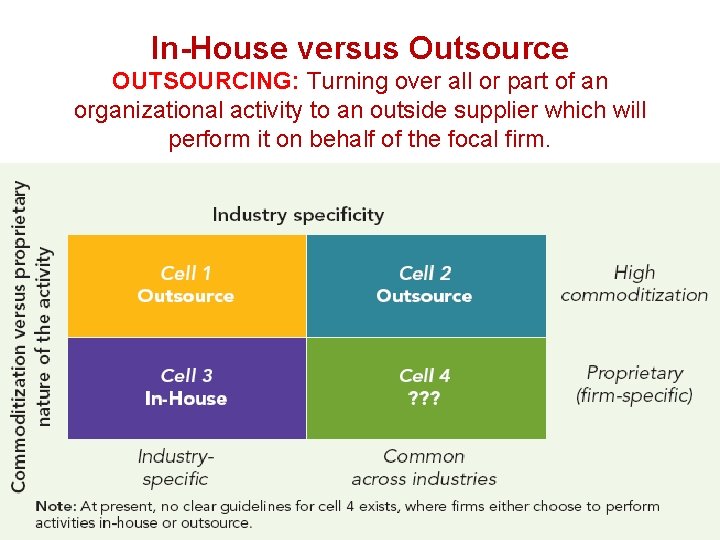
In-House versus Outsource OUTSOURCING: Turning over all or part of an organizational activity to an outside supplier which will perform it on behalf of the focal firm. 9
The VRIO Framework • VRIO An analysis of the “sticky” nature of resources and capabilities of a firm and the difficulty of their replication elsewhere. • Two Key Assumptions: Resource heterogeneity v Each firm has a unique combination of resources and capabilities such that no two firms are “twins. ” Resource immobility v Resources and capabilities unique to one firm cannot easily migrate to competing firms. 3– 10
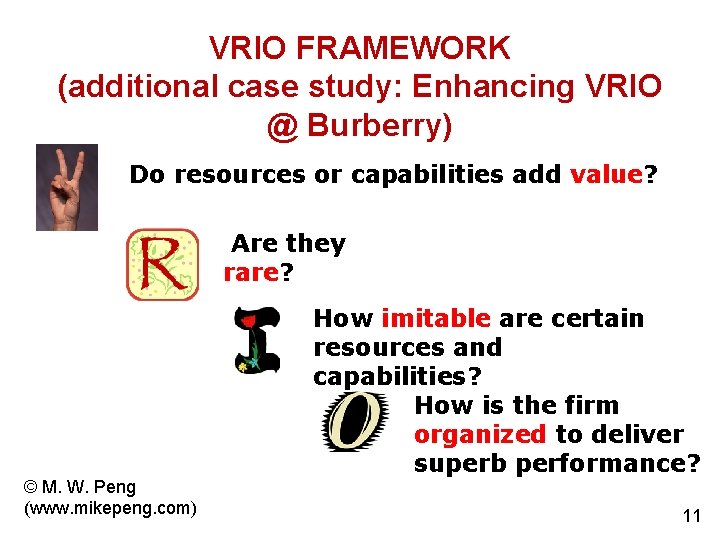
VRIO FRAMEWORK (additional case study: Enhancing VRIO @ Burberry) Do resources or capabilities add value? Are they rare? © M. W. Peng (www. mikepeng. com) How imitable are certain resources and capabilities? How is the firm organized to deliver superb performance? 11
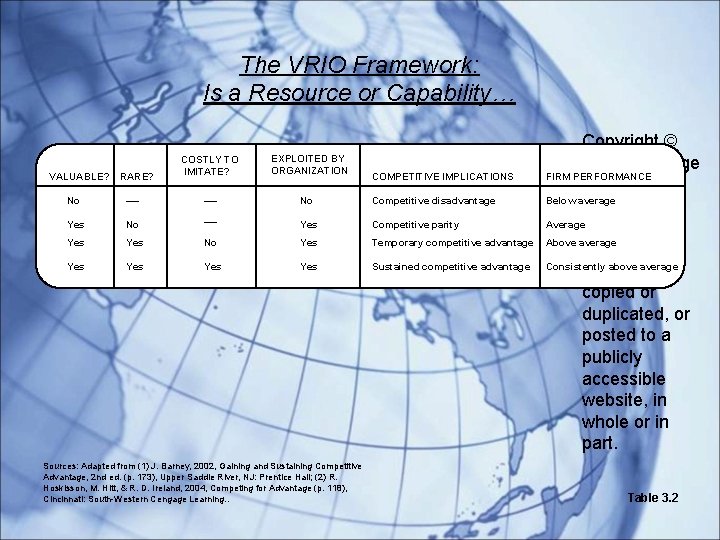
The VRIO Framework: Is a Resource or Capability… VALUABLE? RARE? COSTLY TO IMITATE? No EXPLOITED BY ORGANIZATION COMPETITIVE IMPLICATIONS No Competitive disadvantage Yes Competitive parity Yes No Yes Temporary competitive advantage Yes Yes Sustained competitive advantage Sources: Adapted from (1) J. Barney, 2002, Gaining and Sustaining Competitive Advantage, 2 nd ed. (p. 173), Upper Saddle River, NJ: Prentice Hall; (2) R. Hoskisson, M. Hitt, & R. D. Ireland, 2004, Competing for Advantage (p. 118), Cincinnati: South-Western Cengage Learning. . Copyright © 2014 Cengage FIRM PERFORMANCE Learning. All Below average Rights Average Reserved. Above average May not be Consistently above average scanned, copied or duplicated, or posted to a publicly accessible website, in whole or in part. Table 3. 2
The VRIO Framework: Value and Rarity • Four fundamental questions of VRIO Value: do the resources and capabilities add value? v Necessary for a competitive advantage Rarity: how rare the valuable resources and capabilities? v Valuable, but common parity, not advantage v Valuable and rare can lead to temporary advantage Copyright Cengage Learning. v© If 2014 everyone has it, you All Rights Reserved. May not be scanned, copied or duplicated, or posted to a publicly accessible website, in whole or in part. can’t make money from it
The VRIO Framework: Imitability • Easier to imitate tangible resources/capabilities than tangible ones • Why is imitation so difficult? Hard to acquire in a short time what competitors have developed over a long time Events earlier in time affect future events Difficult to identify causal determinants of performance Copyright © 2014 Cengage Learning. All Rights Reserved. May not be scanned, copied or duplicated, or posted to a publicly accessible website, in whole or in part.
The VRIO Framework: Imitability (cont’d) • Valuable, rare, but imitable resources/capabilities = temporary advantage • Only valuable, rare and hard-to-imitate resources/capabilities = sustained competitive advantage Copyright © 2014 Cengage Learning. All Rights Reserved. May not be scanned, copied or duplicated, or posted to a publicly accessible website, in whole or in part.
The VRIO Framework: Organization • The Question of Organization How is a firm organized to develop and leverage the full potential of its resources and capabilities? • Using complementary assets effectively • Managing social complexity effectively Invisible relationships can add value - make imitation more difficult Copyright © 2014 Cengage Learning. All Rights Reserved. May not be scanned, copied or duplicated, or posted to a publicly accessible website, in whole or in part.
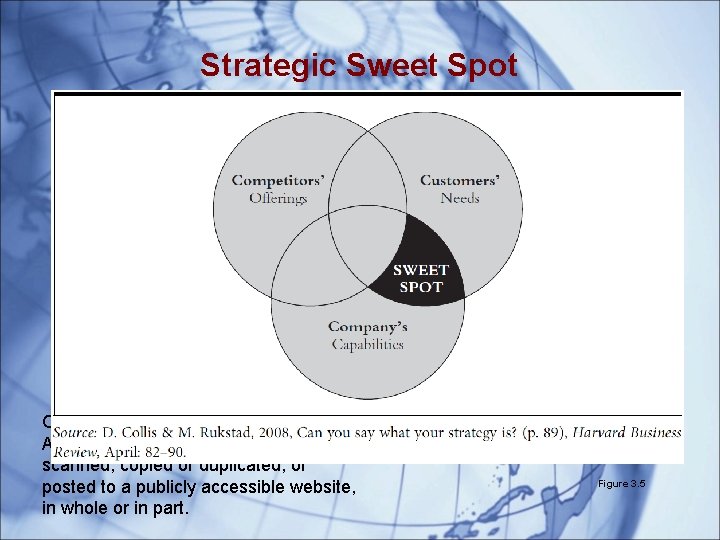
Strategic Sweet Spot Copyright © 2014 Cengage Learning. All Rights Reserved. May not be scanned, copied or duplicated, or posted to a publicly accessible website, in whole or in part. Figure 3. 5
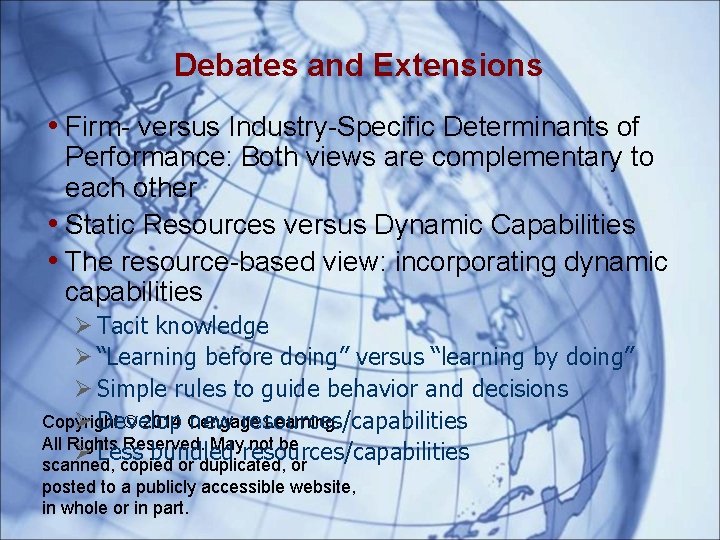
Debates and Extensions • Firm- versus Industry-Specific Determinants of Performance: Both views are complementary to each other • Static Resources versus Dynamic Capabilities • The resource-based view: incorporating dynamic capabilities Tacit knowledge “Learning before doing” versus “learning by doing” Simple rules to guide behavior and decisions Copyright © 2014 Cengage Learning. Develop new resources/capabilities All Rights Reserved. May not be Less bundled resources/capabilities scanned, copied or duplicated, or posted to a publicly accessible website, in whole or in part.
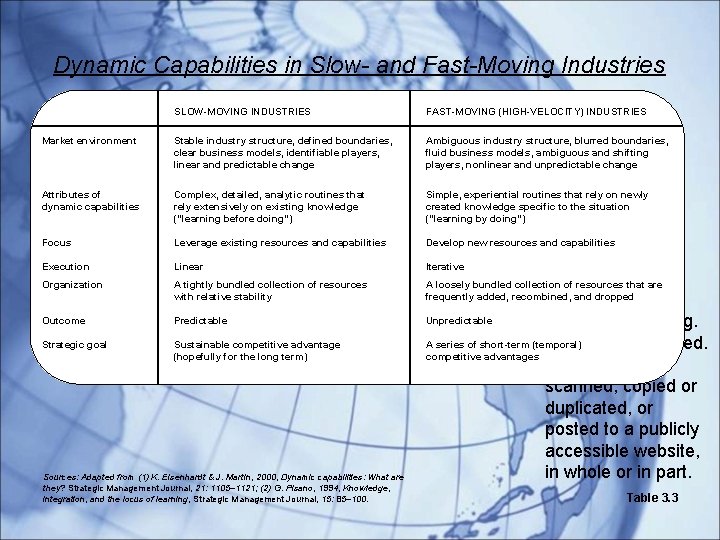
Dynamic Capabilities in Slow- and Fast-Moving Industries SLOW-MOVING INDUSTRIES FAST-MOVING (HIGH-VELOCITY) INDUSTRIES Market environment Stable industry structure, defined boundaries, clear business models, identifiable players, linear and predictable change Ambiguous industry structure, blurred boundaries, fluid business models, ambiguous and shifting players, nonlinear and unpredictable change Attributes of dynamic capabilities Complex, detailed, analytic routines that rely extensively on existing knowledge (“learning before doing”) Simple, experiential routines that rely on newly created knowledge specific to the situation (“learning by doing”) Focus Leverage existing resources and capabilities Develop new resources and capabilities Execution Linear Iterative Organization A tightly bundled collection of resources with relative stability A loosely bundled collection of resources that are frequently added, recombined, and dropped Outcome Predictable Strategic goal Sustainable competitive advantage (hopefully for the long term) Sources: Adapted from (1) K. Eisenhardt & J. Martin, 2000, Dynamic capabilities: What are they? Strategic Management Journal, 21: 1105– 1121; (2) G. Pisano, 1994, Knowledge, integration, and the locus of learning, Strategic Management Journal, 15: 85– 100. Copyright © 2014 Unpredictable Cengage Learning. A series of short-term (temporal) All Rights Reserved. competitive advantages May not be scanned, copied or duplicated, or posted to a publicly accessible website, in whole or in part. Table 3. 3
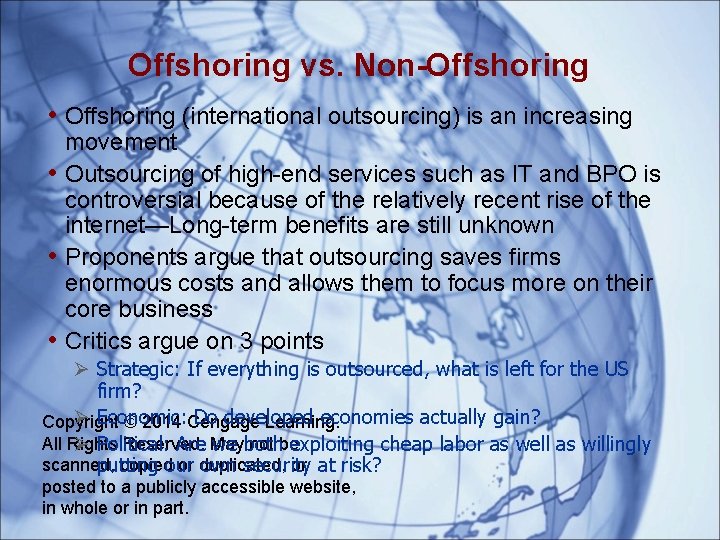
Offshoring vs. Non-Offshoring • Offshoring (international outsourcing) is an increasing movement • Outsourcing of high-end services such as IT and BPO is controversial because of the relatively recent rise of the internet—Long-term benefits are still unknown • Proponents argue that outsourcing saves firms enormous costs and allows them to focus more on their core business • Critics argue on 3 points Strategic: If everything is outsourced, what is left for the US firm? Economic: Do developed economies actually gain? Copyright © 2014 Cengage Learning. All Rights Reserved. not beexploiting cheap labor as well as willingly Political: Are May we both scanned, copiedour or duplicated, or at risk? putting own security posted to a publicly accessible website, in whole or in part.
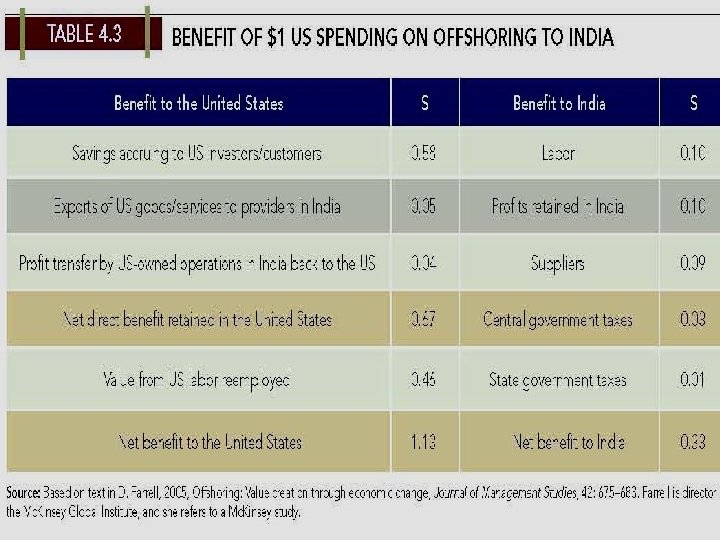
21
The Savvy Strategist • Developing resources/capabilities that are valuable, rare, hard-to-imitate, and embedded in organizational structures and systems can help firms achieve successful performance • Lessons from the VRIO framework Task for strategists - build firm strengths by identifying, developing, and leveraging resources/capabilities Imitation is not likely to be a successful strategy Sustained competitive advantage will not last forever Copyright © 2014 Cengage Firms should try to Learning. develop “strategic foresight” All Rights Reserved. May not be scanned, copied or duplicated, or posted to a publicly accessible website, in whole or in part.
The Savvy Strategist (cont’d) • Four fundamental questions: Resource Based Views Why do firms differ? Resource heterogeneity How do firms behave? Take advantage of strengths and overcome weaknesses What determines the scope of the firm? How a firm performs relative to rivals What determines the international success and failure of firms? Firm-specific resources/capabilities and a bit of luck Copyright © 2014 Cengage Learning. All Rights Reserved. May not be scanned, copied or duplicated, or posted to a publicly accessible website, in whole or in part.
- Slides: 23