
3 Cbased methods to detect longrange chromatin interactions
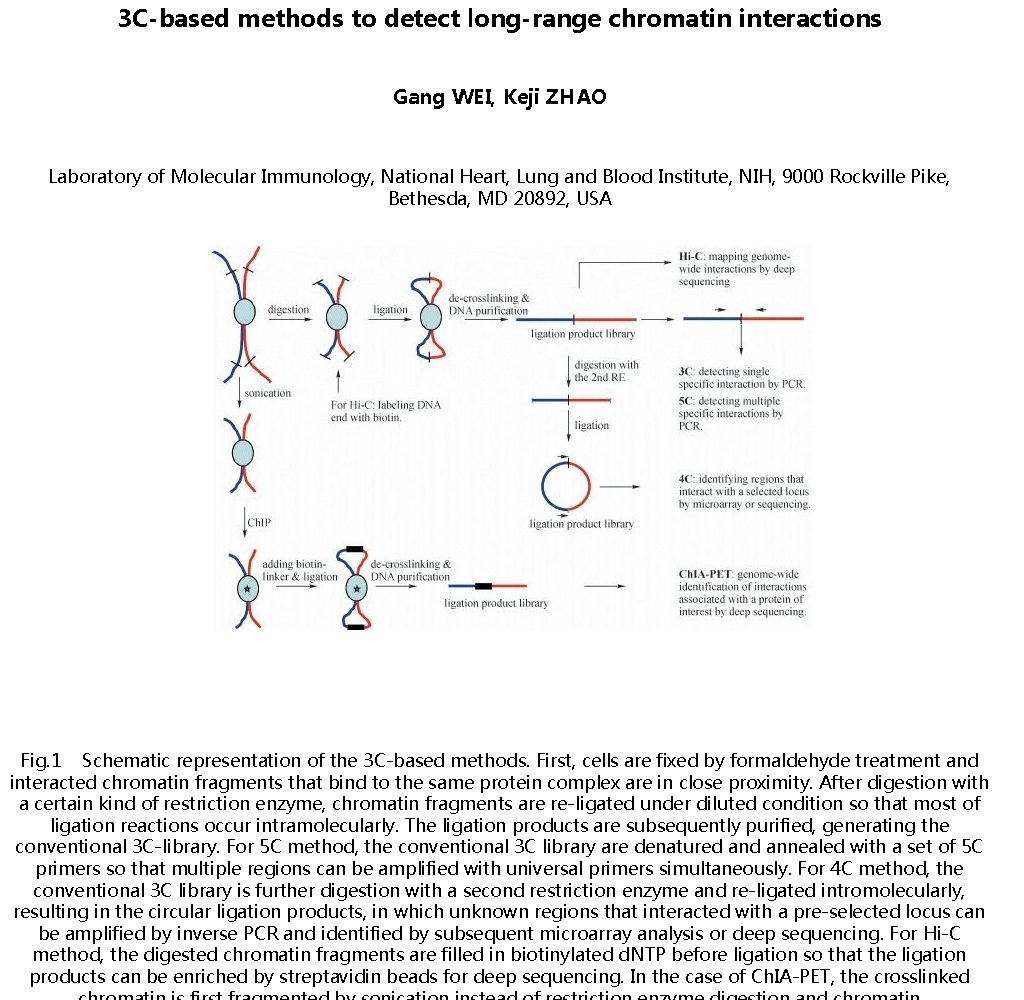
3 C-based methods to detect long-range chromatin interactions Gang WEI, Keji ZHAO Laboratory of Molecular Immunology, National Heart, Lung and Blood Institute, NIH, 9000 Rockville Pike, Bethesda, MD 20892, USA Fig. 1 Schematic representation of the 3 C-based methods. First, cells are fixed by formaldehyde treatment and interacted chromatin fragments that bind to the same protein complex are in close proximity. After digestion with a certain kind of restriction enzyme, chromatin fragments are re-ligated under diluted condition so that most of ligation reactions occur intramolecularly. The ligation products are subsequently purified, generating the conventional 3 C-library. For 5 C method, the conventional 3 C library are denatured annealed with a set of 5 C primers so that multiple regions can be amplified with universal primers simultaneously. For 4 C method, the conventional 3 C library is further digestion with a second restriction enzyme and re-ligated intromolecularly, resulting in the circular ligation products, in which unknown regions that interacted with a pre-selected locus can be amplified by inverse PCR and identified by subsequent microarray analysis or deep sequencing. For Hi-C method, the digested chromatin fragments are filled in biotinylated d. NTP before ligation so that the ligation products can be enriched by streptavidin beads for deep sequencing. In the case of Ch. IA-PET, the crosslinked
- Slides: 1