
3 Branches of Government THREE BRANCHES OF GOVERNMENT

3 Branches of Government
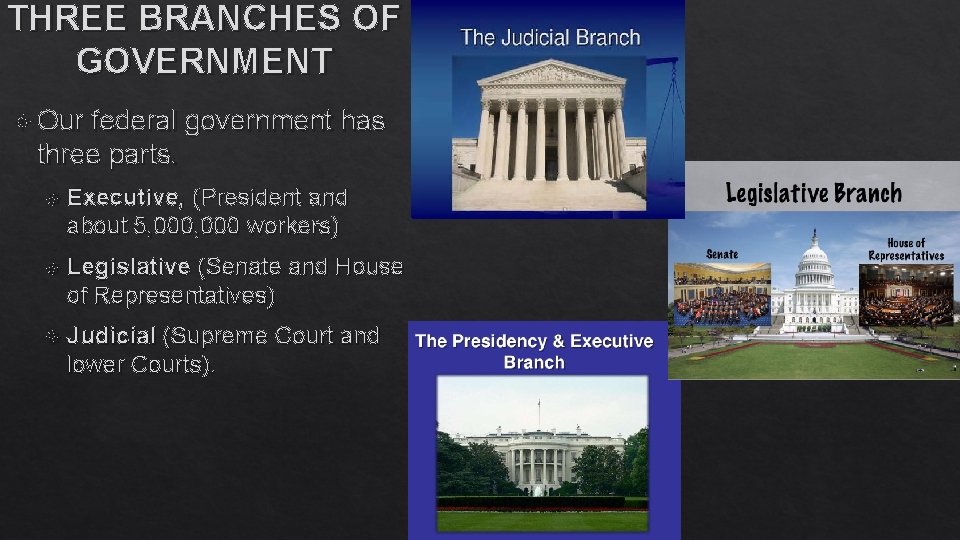
THREE BRANCHES OF GOVERNMENT Our federal government has three parts. Executive, (President and about 5, 000 workers) Legislative (Senate and House of Representatives) Judicial (Supreme Court and lower Courts).
Executive Branch The President of the United States The President enforces the laws. The President is elected by United States citizens, 18 years of age and older, who vote in the presidential elections in their states. These votes are tallied by states and form the Electoral College system. States have the number of electoral votes which equal the number of senators and representatives they have. It is possible to have the most popular votes throughout the nation and NOT win the electoral vote of the Electoral College.
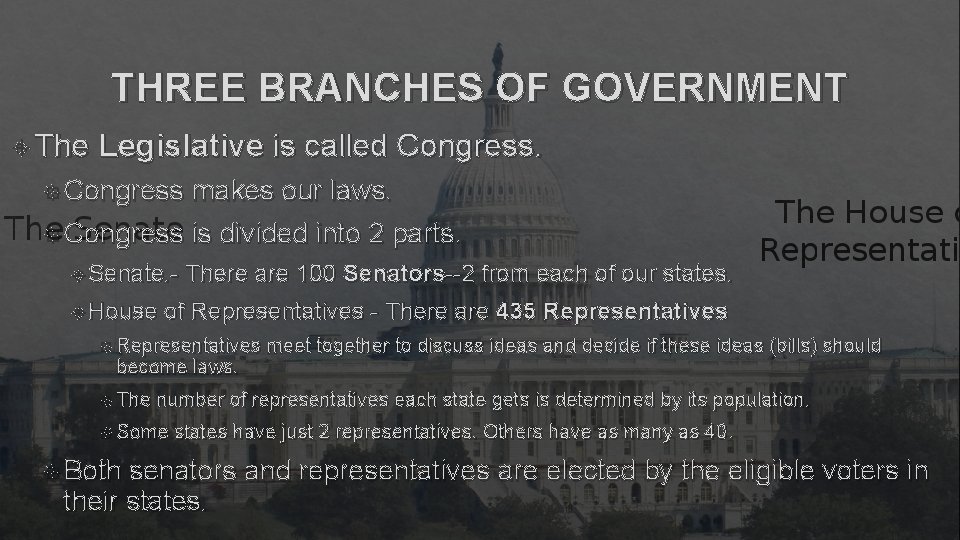
THREE BRANCHES OF GOVERNMENT The Legislative is called Congress makes our laws. Congress is divided into 2 parts. Senate. House There are 100 Senators--2 from each of our states. of Representatives - There are 435 Representatives become laws. The number of representatives each state gets is determined by its population. Some Both meet together to discuss ideas and decide if these ideas (bills) should states have just 2 representatives. Others have as many as 40. senators and representatives are elected by the eligible voters in their states.
THREE BRANCHES OF GOVERNMENT Judicial - includes the Supreme Court and 9 Justices. They are special judges who interpret laws according to the Constitution. These justices only hear cases that pertain to issues related to the Constitution. They are the highest court in our country. The federal judicial system also has lower courts located in each state to hear cases involving federal issues. All three parts of our federal government have their main headquarters in the city of Washington D. C. This Photo by Unknown Author is licensed under CC BY-SA
1. What are the 3 branches of our government? 2. What Branch of our government makes the laws? 3. What Branch of our government enforces our laws? 4. What are the two parts of our Congress? 5. There are _____ senators.
6. The ______ is elected by eligible United States citizens who vote and by the Electoral College system. 7. _____ and _____ are elected by voters in their states. 8. _______ study laws to see if they are correct according to the Constitution. 9. Where do the major branches of our federal government meet and work? 10. The____ is the leader of the Executive Branch of our government.
Congress & Courts: Keeping the Balance Congress makes laws, but the Courts interpret them. The Supreme Court decides if a law fits the meaning of the Constitution. baseball game These umpires did not make the rules for playing the game of baseball, but they are given the duty to decide what the rules mean in a special case. They are like judges. They interpret the rules as they see their original meaning. They are the last word. Judges in our court system are like these umpires. They interpret the rules. The court applies the rules of the Constitution to the nation's business
Congress & Courts: Keeping the Balance Congress what What The can pass "necessary and proper laws. " is necessary? is proper? Supreme Court may need to decide in special situations. This Photo by Unknown Author is licensed under CC BY-SA
Congress & Courts: Keeping the Balance Congress cannot interfere with the freedoms spelled out in the Bill of Rights. It can't punish a person for something that was not a crime when he did it. Any citizen can go to a court to protect his civil liberties. The citizen may even go to the Supreme Court to get a final verdict. Sometimes, the Constitution does not cover a law that the people want. The people can then vote directly by states to add a special section to the Constitution. This is called an amendment. Back in 1895, the Supreme Court would not let Congress put a tax of two cents a dollar on everyone's wages, (money people earned). So later, an income tax amendment was added to the Constitution.
Congress & President: Keeping the Balance The President has special ways to check Congress and Congress has special ways to check the President. The President checks Congress when he vetoes a bill. Congress can check him if a 2/3 majority votes to override his veto. The President decides what money is needed for each government department. prepares a budget and shows it to Congress can vote "yes" or "no" on the money spent. The President is checked in foreign policy (dealing with other countries) too. When a President makes a treaty (bargain) with another country, it doesn't really start until 2/3 of the Senate (67 members) approve it. These Presidents call in legislative leaders from Capitol Hill to talk about problems and new programs.
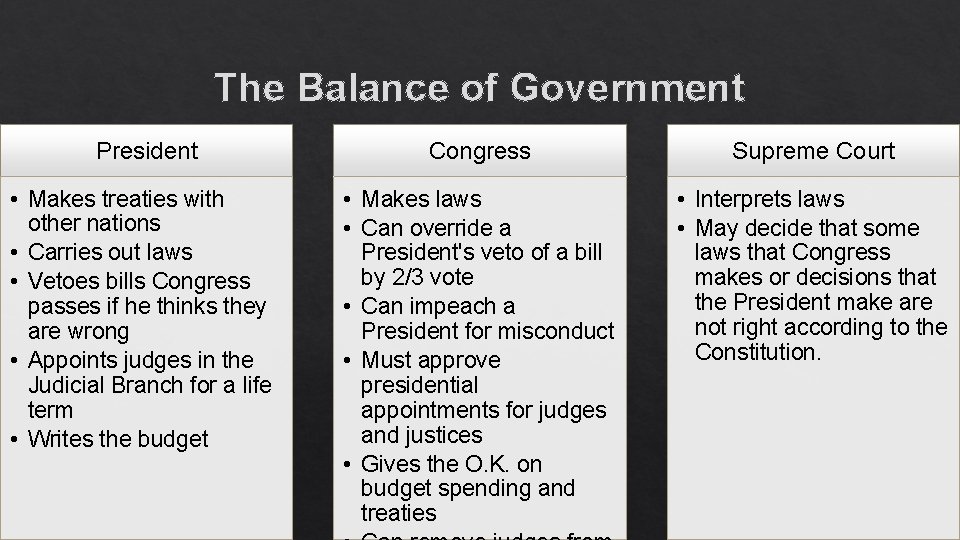
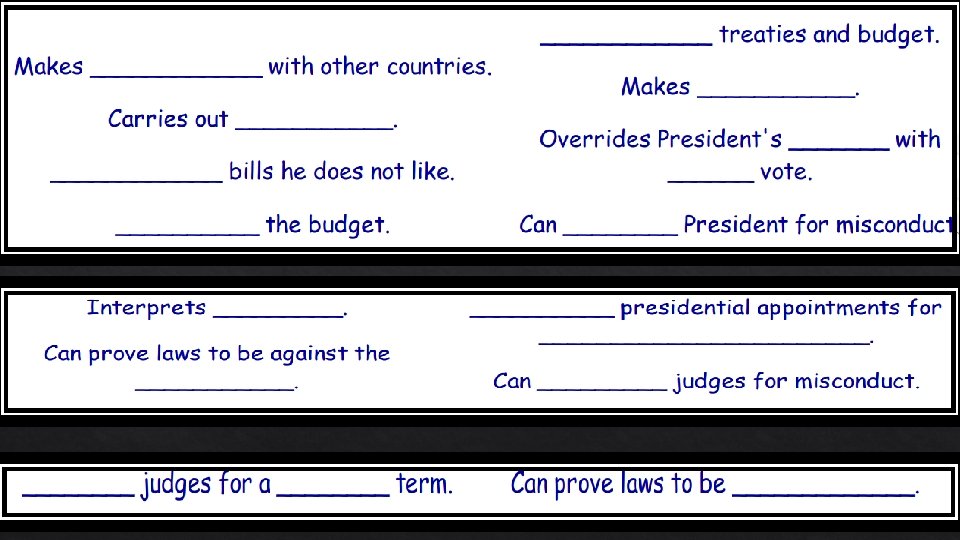
The Balance of Government President Congress Supreme Court • Makes treaties with other nations • Carries out laws • Vetoes bills Congress passes if he thinks they are wrong • Appoints judges in the Judicial Branch for a life term • Writes the budget • Makes laws • Can override a President's veto of a bill by 2/3 vote • Can impeach a President for misconduct • Must approve presidential appointments for judges and justices • Gives the O. K. on budget spending and treaties • Interprets laws • May decide that some laws that Congress makes or decisions that the President make are not right according to the Constitution.

- Slides: 14