
3 Act Problem Template Adapted from Dan Meyer
3 -Act Problem Template Adapted from Dan Meyer (http: //blog. mrmeyer. com/2011/the-threeacts-of-a-mathematical-story/) Many math teachers take act two as their job description. Hit the board, offer students three worked examples and twenty practice problems. The second act isn’t our job anymore. Not the biggest part of it, anyway. You are only one of many people your students can access as they look for resources and tools. Going forward, the value you bring to your math classroom increasingly will be tied up in the first and third acts of mathematical storytelling, your ability to motivate the second act and then pay off on that hard work. “If maths is the aspirin, how do I create a headache” Use this template to give substance to textbook maths examples; building the first and final acts. Or, use this template to create your own authentic 3 -Act problem. Template created: Mark Hansen (mhans 78@eq. edu. au) Sandy Strait State School, 2016
Teacher Essential Information When creating 3 -Act Problems 1. Get to the hook quickly 2. Make the first act visual and intuitive 3. Separate all acts 4. Ask for student help to create the second act- what do they want to know? 5. Make third act visual Questions to ask upon completion of creating 3 -Act 1. “If I were a Year **** child, how will I solve this/what will I get out of this? ” 2. Australian Curriculum: Is it accessible/engaging? Will children investigate/pose? Be creative communicators? 3. Is this problem complex and unfamiliar? 4. Does it have a “low floor / high ceiling”? 5. Do we have sequels? “What if. . ” Rules when enacting 3 -Acts in Classrooms 1. No wrong thinking 2. You must have a go 3. You can copy/change your mind but must tell us why 4. You can work with who you like (or on your own) 5. You may use anything to assist you (just ask a teacher) 6. Don’t rub anything out- let us see your thinking Descriptor Numbers Target Areas 83 Equivalent Number sentences to solve missing parts
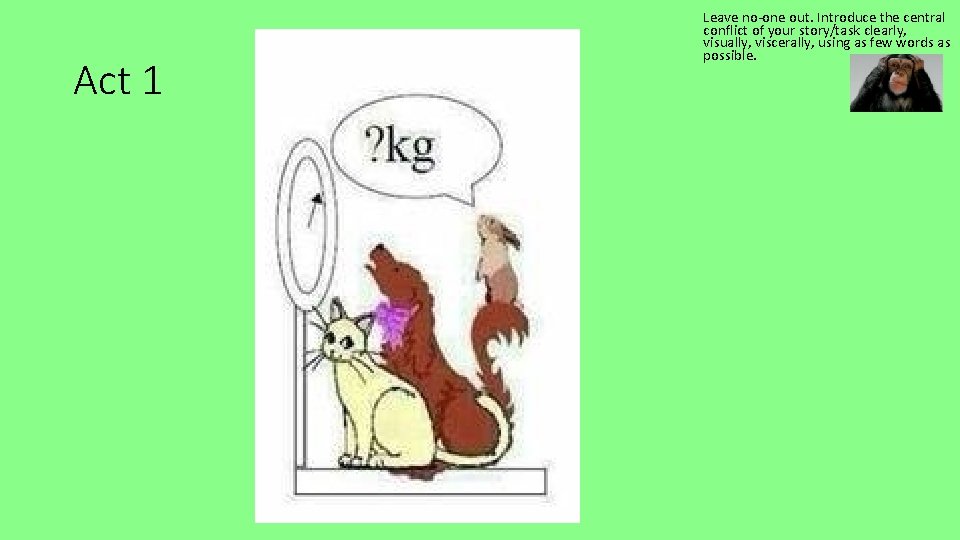
Act 1 Leave no-one out. Introduce the central conflict of your story/task clearly, visually, viscerally, using as few words as possible.
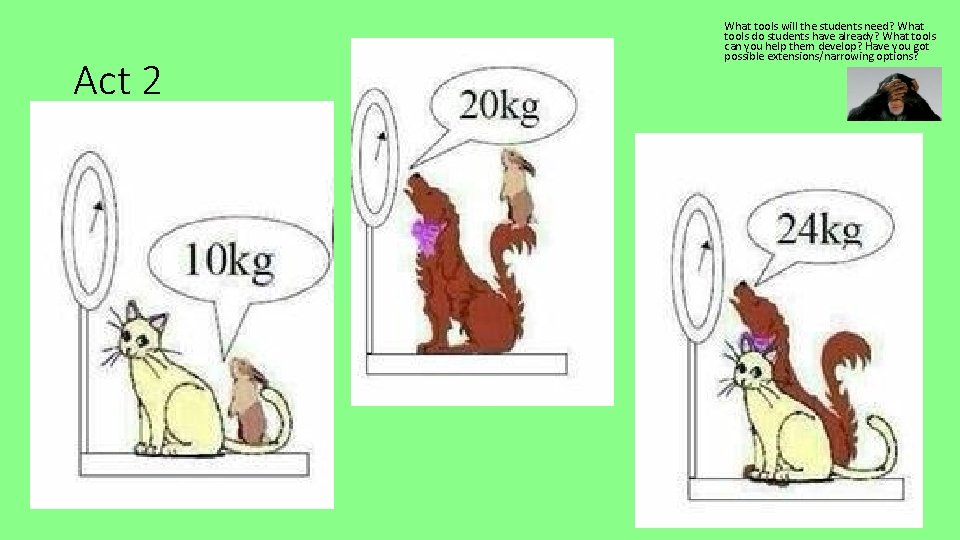
Act 2 What tools will the students need? What tools do students have already? What tools can you help them develop? Have you got possible extensions/narrowing options?
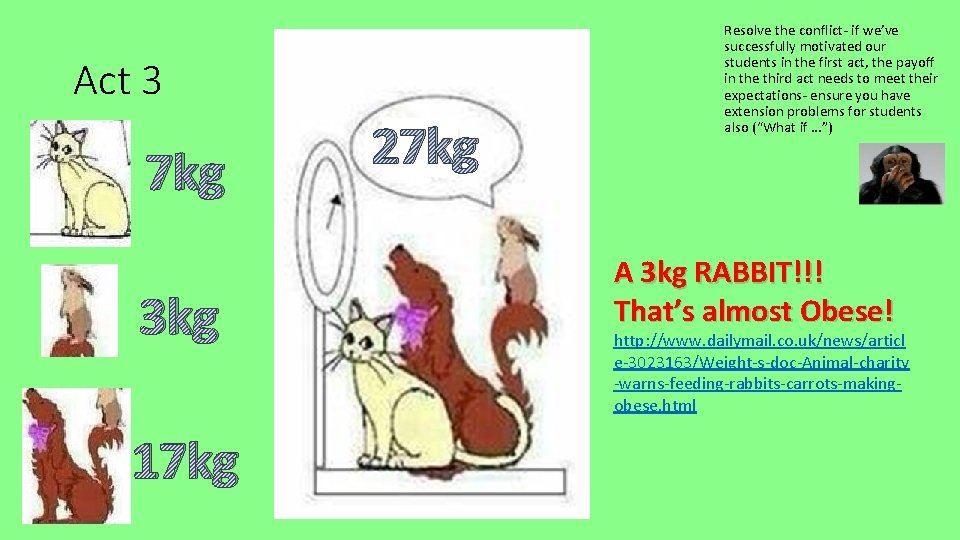
Act 3 7 kg 3 kg 17 kg 27 kg Resolve the conflict- if we’ve successfully motivated our students in the first act, the payoff in the third act needs to meet their expectations- ensure you have extension problems for students also (“What if …”) A 3 kg RABBIT!!! That’s almost Obese! http: //www. dailymail. co. uk/news/articl e-3023163/Weight-s-doc-Animal-charity -warns-feeding-rabbits-carrots-makingobese. html
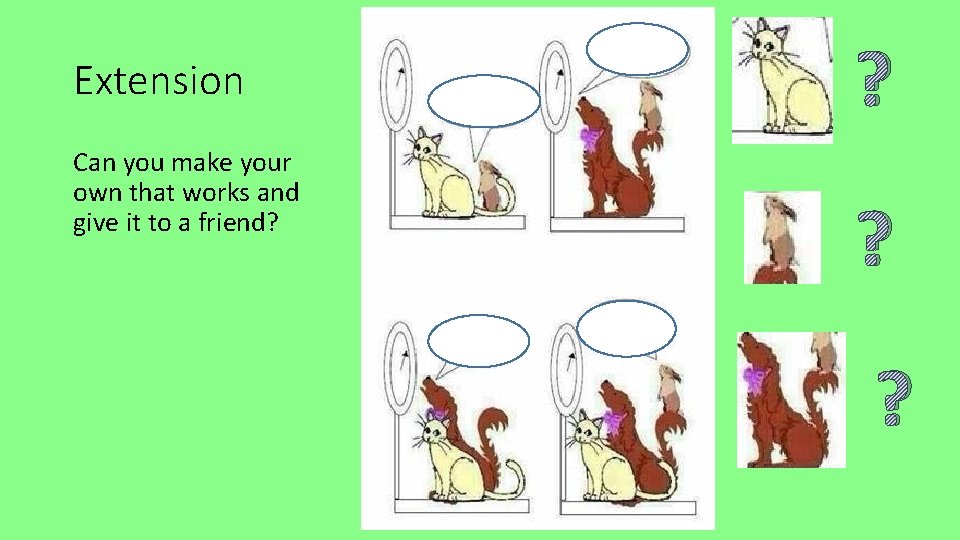
Extension Can you make your own that works and give it to a friend? ? ? ?

Reflection Please log your class reflection here: SSSS Mathematics Ed Studio • Were you happy with the solution? Why/why not? • What could you do next time to be more efficient/accurate? • What would we call this lesson to capture how we used maths?
Resources • www. bedtimemath. org • http: //www. 101 qs. com/ • http: //blog. mrmeyer. com/ • http: //www. estimation 180. com/ • http: //robertkaplinsky. com/lessons/ • http: //gfletchy. com/3 -act-lessons/ • http: //wmh 3 acts. weebly. com/3 -act-math. html • http: //mikewiernicki. com/3 -act-tasks/
- Slides: 8